

AI-assisted software development engagements succeed when five terms are agreed before kickoff, namely a business outcome with baseline metrics, a scope setting how much autonomy AI coding agents get per task type, deliverables that include specs, tests, evals and agent configuration, outcome-based success criteria, and client ownership of code and IP. Skipping these terms turns fast output into unverifiable releases.
In traditional software development, a fixed-scope statement of work (SOW) made the outcome of an engagement fairly predictable, because people wrote every line of source code. Once artificial intelligence (AI) agents take on part of that work by automating code generation, the same template leaves gaps. DORA’s 2025 State of AI-assisted Software Development report shows why those gaps matter, since it associates generative AI adoption with higher delivery throughput and higher delivery instability at the same time.
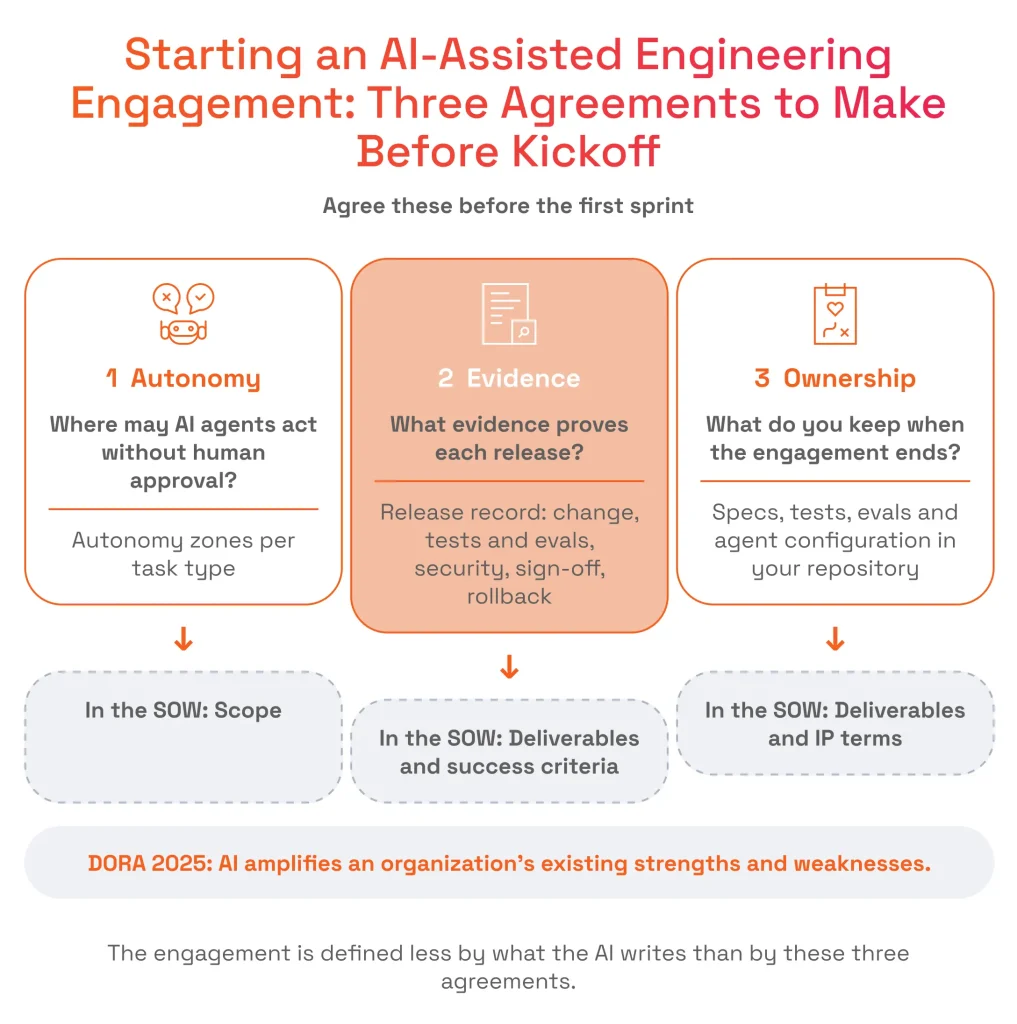
To know what an AI engineering engagement will deliver, the client and partner need three agreements before kickoff. They cover where AI agents may act without human approval (autonomy), what evidence proves each release (evidence) and what the client keeps when the work ends (ownership). Teams that still need to choose an AI-assisted engineering partner can settle that first and return to these terms afterward.
What Is an AI-Assisted Engineering Engagement?
An AI-assisted engagement is a delivery arrangement in which a partner’s engineers use AI coding agents across the software development lifecycle (SDLC) inside agreed specifications, tests, evals and approval rules. This way, every release can be verified before it ships. In this setting, coding agents are AI coding assistants that plan, edit code, run tests and iterate inside a repository.
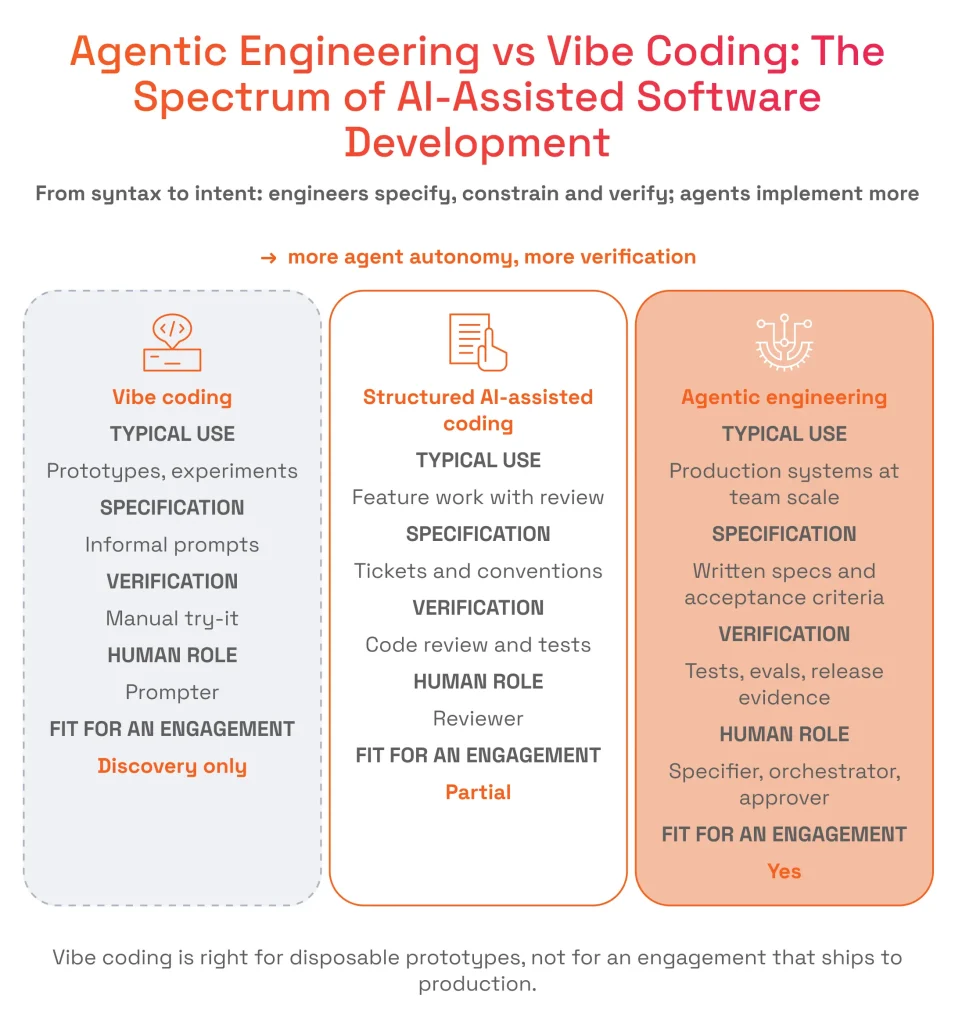
This way of working is called agentic engineering, meaning software development in which coding agents operate inside human-defined specifications, tests, evals and feedback loops. Within an agentic development workflow, the engineer’s work shifts from syntax toward intent. Engineers draw on computer science fundamentals to specify, constrain and verify while agents take on repetitive tasks and implement a larger share of the code.
Agentic engineering sits at one end of a wider spectrum of AI-assisted development. Vibe coding sits at the other end, as informal development driven by natural language prompts and checked mostly by trying the result. Structured AI-assisted coding, from auto-completing code to reviewed feature work, falls between the two. The three approaches differ in how much structure, verification and human judgment surrounds the AI output.
Agentic Engineering vs Vibe Coding: Where Structured AI-Assisted Coding Fits
Vibe coding | Structured AI-assisted coding | Agentic engineering | |
|---|---|---|---|
| Typical use | Prototypes, experiments | Feature work with review | Production systems at team scale |
| Structure | Informal prompts | Tickets and team conventions | Written specs and acceptance criteria |
| Verification | Manual try-it | Code review and tests | Tests, evals, release evidence |
| Human judgment | Prompter | Reviewer | Specifier, orchestrator, approverFit for an engagement |
| Fit for an engagement | Discovery only | Work that code review alone can verify | Anything that ships to production |
Vibe coding
- Typical use
Prototypes, experiments
- Structure
Informal prompts
- Verification
Manual try-it
- Human judgment
Prompter
- Fit for an engagement
Discovery only
Structured AI-assisted coding
- Typical use
Feature work with review
- Structure
Tickets and team conventions
- Verification
Code review and tests
- Human judgment
Reviewer
- Fit for an engagement
Work that code review alone can verify
Agentic engineering
- Typical use
Production systems at team scale
- Structure
Written specs and acceptance criteria
- Verification
Tests, evals, release evidence
- Human judgment
Specifier, orchestrator, approverFit for an engagement
- Fit for an engagement
Anything that ships to production
In practice, an engagement often uses more than one approach, depending on the stage of the work. Vibe coding fits one-off prototypes and early discovery, where fast learning matters most. AI-generated code headed for production needs verification before real users depend on it, so anything that will ship moves into agentic engineering, where specs, tests and evals decide what gets released.
What Should You Settle Before an AI Engineering Engagement Kicks Off?
Before kickoff, settle five items that decide whether agents can produce useful code from the first sprint.
They are a named decision owner, the business outcome with its baseline, access to code and environments, written rules for data and AI use, and confirmed ownership of code and IP.
- Name one decision owner on the client side, often the AI leader or head of engineering, because specs and approvals stall when nobody has the authority to sign them off.
- The business outcome, its baseline metric and the user behavior it targets should be agreed in writing, which gives both sides one measure to judge the engagement by at month three.
- Repository, CI and development environment access granted before day one lets the partner configure agents and pipelines from the first sprint.
- Written rules for data and AI use tell engineers and agents which coding tools, models and data classes are permitted, setting guardrails without slowing delivery before agents generate code.
- IP and code ownership confirmed in the contract means everything produced, including agent configuration, belongs to the client from the start.
An item still open on kickoff day tends to turn into idle weeks or a quiet workaround. A missing baseline leaves ROI unprovable later, while missing access or AI-use rules push agents into guesswork that reviewers then have to catch. With two or more items open, moving the start date is usually cheaper than starting on time.
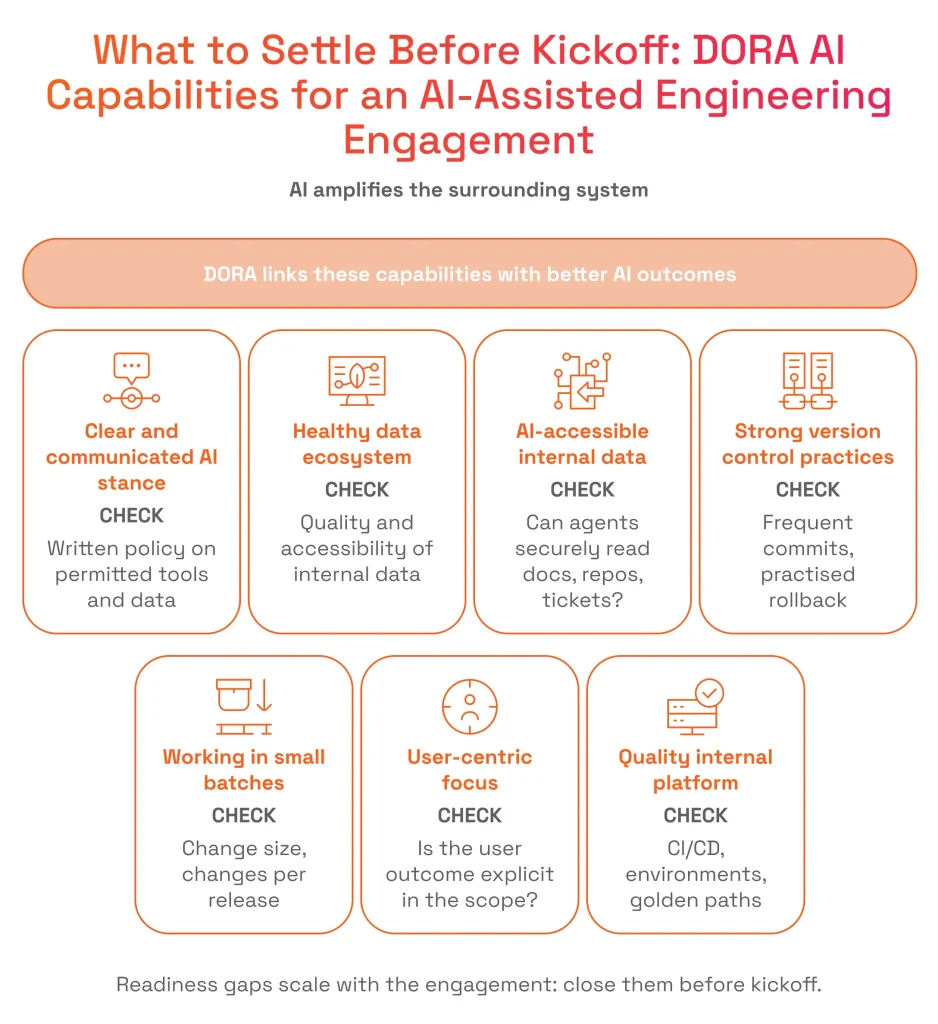
Once these items are closed, the next check covers the conditions DORA links to better AI outcomes. The DORA research describes AI’s primary role as an amplifier that magnifies an organization’s existing strengths and dysfunctions. To make the idea usable, the report introduces the DORA AI Capabilities Model of seven capabilities, and each one translates into a concrete check a client can run before the partner writes any code.
DORA capability | What to check before kickoff | Why it matters for the engagement |
|---|---|---|
Clear and communicated AI stance | Written policy on permitted tools and data | Avoids both over-cautious and over-permissive AI use |
Healthy data ecosystem | Quality and accessibility of internal data | Amplifies AI’s effect on organizational performance |
AI-accessible internal data | Can agents securely read docs, repos, tickets? | Context engineering depends on it |
Strong version control practices | Frequent commits, practiced rollback | The safety net when agents produce more change |
Working in small batches | Change size, changes per release | Associated with better product performance under AI |
User-centric focus | Is the user outcome explicit in the scope? | Without it, AI adoption is associated with weaker team performance |
Quality internal platform | CI/CD, environments, golden paths | Carries individual gains to the organization |
DORA capability
Clear and communicated AI stance
Healthy data ecosystem
AI-accessible internal data
Strong version control practices
Working in small batches
User-centric focus
Quality internal platform
What to check before kickoff
Written policy on permitted tools and data
Quality and accessibility of internal data
Can agents securely read docs, repos, tickets?
Frequent commits, practiced rollback
Change size, changes per release
Is the user outcome explicit in the scope?
CI/CD, environments, golden paths
Why it matters for the engagement
Avoids both over-cautious and over-permissive AI use
Amplifies AI’s effect on organizational performance
Context engineering depends on it
The safety net when agents produce more change
Associated with better product performance under AI
Without it, AI adoption is associated with weaker team performance
Carries individual gains to the organization
Of the seven capabilities, the data and platform ones shape an engagement most directly. Healthy and AI-accessible internal data determine the quality of context engineering, meaning the design of what an agent sees, from instructions and knowledge to examples, tools and guardrails. A quality internal platform shapes developer experience and is where the baseline gets tracked, and platform health metrics show whether individual speed-ups are reaching the organization.
Each of these readiness gaps is exactly what a review before an AI engineering engagement is designed to surface while it is still cheap to close.
How Do You Define the AI-Assisted Engineering Scope?
AI-assisted engineering scope defines which systems are in and out, which types of work are included, and how much autonomy coding agents have for each type of work. Scope written this way gives agents and reviewers the same limits, so a fast sprint cannot widen what the agents were allowed to touch.
Start From What Is Already Decided
Where scope begins depends on how much the client has already decided, and two entry paths cover most engagements. When the outcome is known and the approach is still open, scope begins with project planning, use-case prioritization and discovery, which is the usual route to an AI-driven MVP.
With a spec or prototype already in hand, scope becomes execution to an agreed production standard. Discovery then covers only the gaps that scaling an AI-built prototype tends to expose, such as missing tests or undocumented integrations.
Which Work Can AI Agents Do Alone, and Which Needs a Human?
AI agents can act alone on routine tasks that tests and evals can check. Test case generation is a clear example: DX’s research on developer time savings ranks it among the ten AI use cases that deliver the most value. Complex tasks touching architecture, payments, personal data or compliance stay with a senior engineer. The market terms for these limits are guardrails, the technical limits on what an agent may do, and human-in-the-loop, the points where a person approves before work continues. SPD Technology combines both in a framework we call calibrated autonomy, which assigns each task type to one of three zones that can move as evidence accumulates.
How to Assign AI Autonomy by Task Risk
Setting explicit boundaries ensures AI agents operate only within predefined risk thresholds while critical system logic remains under human control.
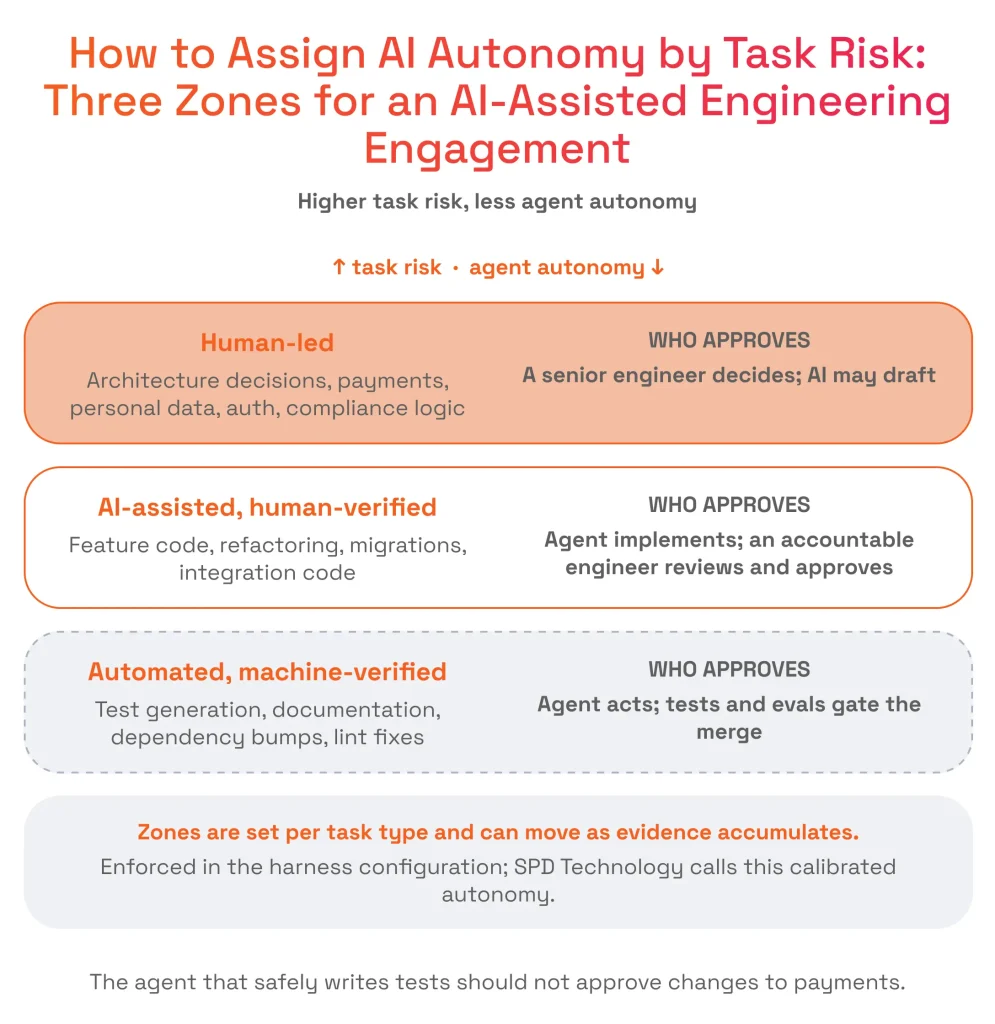
Calibrating autonomy by task type prevents over-reliance on automation and establishes clear approval checkpoints across the delivery lifecycle.
Zone | Typical work | Who approves |
|---|---|---|
Human-led | Architecture decisions, payments, personal data, auth, compliance logic | A senior engineer decides; AI may draft |
AI-assisted, human-verified | Feature code, refactoring, migrations, integration code | Agent implements; an accountable engineer reviews and approves |
Automated, machine-verified | Test generation, documentation, dependency bumps, lint fixes | Agent acts; tests and evals gate the merge |
Zone
Human-led
AI-assisted, human-verified
Automated, machine-verified
Typical work
Architecture decisions, payments, personal data, auth, compliance logic
Feature code, refactoring, migrations, integration code
Test generation, documentation, dependency bumps, lint fixes
Who approves
A senior engineer decides; AI may draft
Agent implements; an accountable engineer reviews and approves
Agent acts; tests and evals gate the merge
Zone rules hold only when the agent configuration enforces them. That is the work of agent harness engineering, with tool permissions, hooks and file rules set per zone to keep code generation inside its limits.
The middle zone shows how this works in production. SPD Technology built an incident pilot, an AI incident-management system, for a US fintech and SaaS platform. Incident Pilot takes an incident through to a pull request ready for review, cutting time to a PR-ready fix from 60+ minutes to under 30 minutes and reaching up to a 70% successful autonomous resolution rate. That result removed the need for round-the-clock on-call coverage. Every fix still arrives as a reviewable PR, which is the AI-assisted, human-verified zone working as designed.

Oleksandr Boiko
Delivery Director at SPD Technology
“Autonomy zones are a starting position. When a task type passes review cleanly for several releases in a row, we propose moving it one zone toward automation, and any production incident moves it back. The client signs off on both directions.”
What Boundaries Belong in the Statement of Work?
Autonomy zones decide who approves each type of work, and the SOW sets the outer limits that apply across all three zones. It should name six boundaries in plain language, so both sides can check any agent action against them during the engagement.
- The repositories and systems in scope are listed by name, together with those that stay out of scope, so agents never receive access to the entire codebase by default.
- Agents may work in development and staging environments, and the SOW rules out any direct writes to production environments.
- Tool access, including any MCP servers, is granted with permissions scoped to the tasks each agent performs.
- The data classes agents may read are named, so personal and payment data reach agent context only through human-led tasks.
- Permitted AI models and providers are listed, which keeps any change of model under contract control.
- A change-request process covers new systems, data classes or autonomy changes, each signed off by the client’s decision owner.
What AI Development Deliverables Should an AI-Assisted Engineering Partner Hand Over?
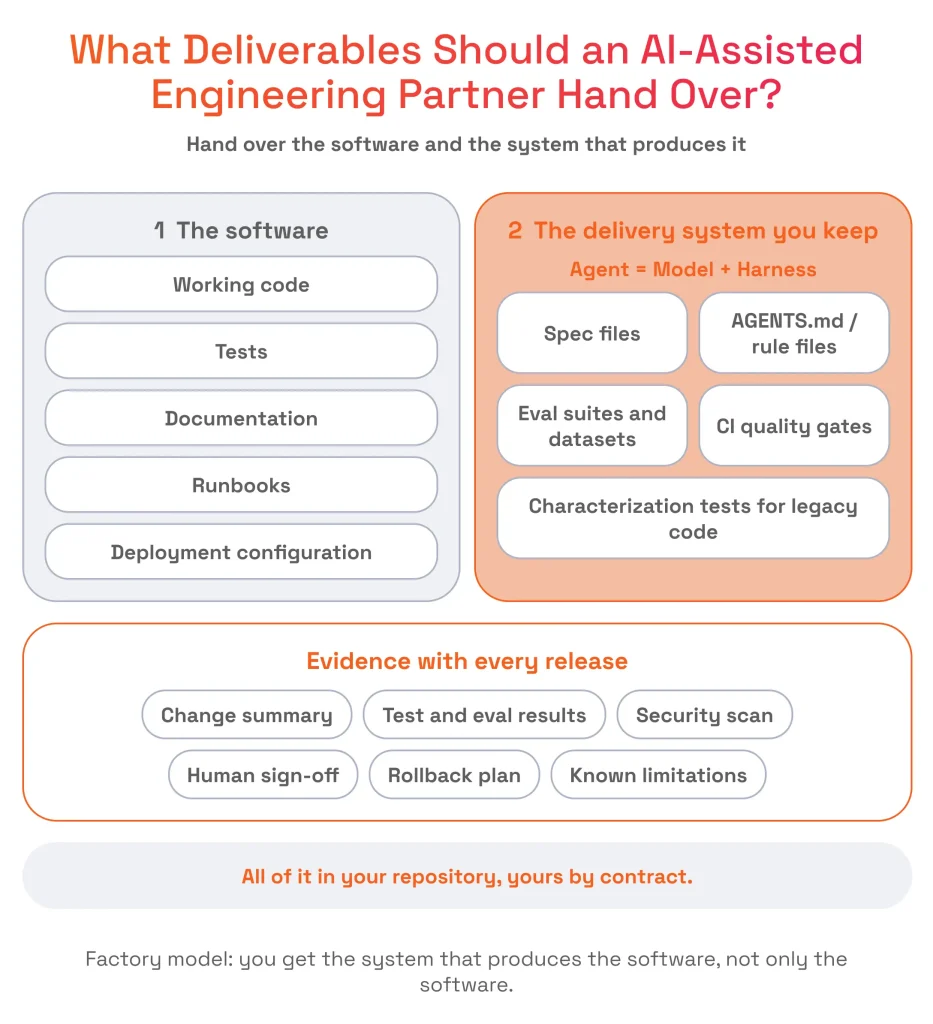
AI development deliverables come in two sets, the software and the system that produced it, and both are stored in the client’s repository and owned by the client. In AI-assisted software engineering, the second set carries as much value as the first, because it lets the client’s team reproduce and extend how each feature was built.
The Software
The first set is familiar to any engineering leader and covers working code, tests, code documentation, runbooks and deployment configuration. Acceptance follows the usual rules with one addition, namely that tests must cover code changed by an AI assistant or agent as fully as the code people wrote.
The Delivery System You Keep
The second set is the harness, meaning everything around the model, from instructions and rule files to tools, sandboxes, hooks and evals. In short, Agent = Model + Harness. At the core of the harness sit the spec files produced through spec-first development, natural language descriptions that record what each feature must do before an agent touches it.
Around the specs sit AGENTS.md and other rule files, eval suites with their datasets, CI quality gates and characterization tests that pin down how legacy code behaves today. The context files in that set are where context engineering lives in the repository, so a new engineer or a new agent starts from the same knowledge the original team used.
The eval suites play a different role from the tests next to them. Tests check deterministic behavior, such as whether a function returns the expected value for a given input. Evals score non-deterministic AI and machine learning behavior against a rubric or reference dataset, and eval engineering turns those scores into an acceptance gate the client’s team can rerun after the partner leaves.
Taken together, these files follow the factory model, so a handover gives the client’s team a working software development process as well as a codebase.

Serhii Leleko
AI & ML Engineer at SPD Technology
“The code is the easiest part of an engagement to hand over. The rule files, eval datasets and specs are what let a client’s own team keep shipping at the same quality, so they go into the client’s repository from the first sprint and get reviewed like any other code.”
What Evidence Should Come With Every Release?
Both sets of deliverables grow with every development cycle, so each release should arrive with a short evidence record that the client approver signs before anything ships.
- A change summary explains what changed, why, and which spec or ticket it traces back to.
- Test and eval results show which suites ran and whether each one met its agreed threshold.
- A scan for security vulnerabilities in the changed code and its dependencies is attached to the record.
- The human sign-off names the engineer who reviewed and approved the release.
- A rollback plan with mitigation strategies states how the release can be reversed and who would trigger it.
- Known limitations list the edge cases left open, so they stay visible as tracked work.
Release records cover one release at a time, and the deliverables as a whole need acceptance rules of their own, each with a named person to confirm it.
Deliverable | What you accept | Who confirms |
|---|---|---|
Specifications and acceptance criteria | Reviewed before implementation starts | Product owner and tech lead |
Code and tests | CI green; tests cover changed code | Named senior engineer |
Eval suite (for AI features or agent workflows) | Scores meet agreed thresholds | Tech lead |
Agent configuration (rule files, tool permissions) | Versioned in your repository | Client engineering lead |
Release evidence record | One per release | Client approver |
Handover and enablement | Your team can run the system without the partner | Client engineering lead |
Deliverable
Specifications and acceptance criteria
Code and tests
Eval suite (for AI features or agent workflows)
Agent configuration (rule files, tool permissions)
Release evidence record
Handover and enablement
What you accept
Reviewed before implementation starts
CI green; tests cover changed code
Scores meet agreed thresholds
Versioned in your repository
One per release
Your team can run the system without the partner
Who confirms
Product owner and tech lead
Named senior engineer
Tech lead
Client engineering lead
Client approver
Client engineering lead
Most of these items can be accepted during the engagement, so the final handover confirms work the client has already reviewed release by release.
Before you sign off the deliverables list, check it against our AI production-ready checklist.
How Do You Set AI Engineering Success Criteria?
AI engineering success criteria compare outcomes against a pre-engagement baseline across business results, delivery speed, delivery stability, software quality and cost, with evals as the acceptance gate for AI behavior. Criteria built this way account for the 80% problem, a recurring pattern in which AI produces most of a feature quickly while edge cases, integration and correctness decide when it can ship. Demos show the fast part of that pattern, so the criteria have to measure the rest.
Why Measure a Baseline Before Day One?
A baseline records 4 to 8 weeks of historical data on delivery and quality metrics before the partner starts, and the most useful comparison is the same service measured over time. Without that record, no ROI of AI-assisted software engineering can be verified, because every later figure lacks a starting point to compare against. Predictive analytics on future savings has nothing to build on either.
The same baseline anchors the financial case for the budget owner. Cost of change per feature and total cost of ownership are measured against the client’s own pre-engagement figures, with AI tooling and token cost per release counted on the cost side. That way, engineering time saved by automating routine tasks is weighed against what the agents consume.
Which Metrics Show Real Delivery Outcomes?
Each category in the AI engineering success criteria maps to metrics that track a result the client actually pays for. Development speed and stability sit next to each other on purpose, since the DORA findings make it risky to watch one while ignoring the other.
Category | Metric | Why it belongs |
|---|---|---|
Business | Time to a user-facing outcome; manual work removed | What the engagement was bought for |
Delivery speed | Lead time for changes, deployment frequency | Shows whether changes reach users faster |
Delivery stability | Change fail rate, rework rate, failed deployment recovery time | Catches the instability DORA links to AI adoption |
Quality | Escaped defects, first-pass review acceptance | Catches the 80% problem |
AI behavior | Eval pass rate on an agreed rubric | Non-deterministic features need evals |
Economics | Cost of change per feature; AI tooling and token cost per release | Weighs engineering savings against AI costs |
Category
Business
Delivery speed
Delivery stability
Quality
AI behavior
Economics
Metric
Time to a user-facing outcome; manual work removed
Lead time for changes, deployment frequency
Change fail rate, rework rate, failed deployment recovery time
Escaped defects, first-pass review acceptance
Eval pass rate on an agreed rubric
Cost of change per feature; AI tooling and token cost per release
Why it belongs
What the engagement was bought for
Shows whether changes reach users faster
Catches the instability DORA links to AI adoption
Catches the 80% problem
Non-deterministic features need evals
Weighs engineering savings against AI costs
Two popular measures stay out of the success criteria on purpose. The percentage of AI-generated code and the count of lines written both measure activity and say nothing about whether delivery or code quality improved. That is why the link between rework and development velocity matters more for acceptance.
Self-reported developer productivity is an equally weak signal. In METR’s randomized controlled trial of 16 experienced open-source developers working on their own repositories in early 2025, tasks where AI tools were allowed took 19% longer. Even so, the same developers estimated afterward that AI had made them about 20% faster. That gap comes from one specific setting, and it still shows why success criteria should rest on measured lead time and rework.
Why Should Evals Set the Acceptance Bar?
A demo proves that one path through a feature works on one occasion. An eval suite scores behavior across many cases and natural language inputs, including the edge cases where the 80% problem usually surfaces, so it gives the acceptance decision a repeatable basis for improving software quality over time.
For engagements that ship agents or AI features built on natural language processing and machine learning models, two kinds of evaluation apply. Output evaluation judges the final result against the agreed rubric, and trajectory evaluation judges the sequence of actions and tool calls behind it. That second check becomes essential once you plan how to evaluate AI agents before production.
What Governance, Security and IP Terms Matter in AI-Assisted Development?
Governance, security and IP terms settle who owns the code and the delivery system, where data and prompts are processed, how AI-generated code and its dependencies are checked, what gets recorded for audit and how the client can exit. Written into the SOW, these terms let a CIO show procurement that AI-assisted delivery is auditable from the first release.
Most of these terms fit into short clauses, and each clause closes a gap that agents could otherwise widen gradually over many releases.
- The contract assigns IP in AI-generated code to the client and states how the licensing terms of the chosen models apply to that code.
- Data residency and model-provider terms specify where prompts and outputs are processed, a question that comes up early when building production AI with Claude.
- Secrets, keys and credentials stay out of prompts and context files, and CI scans enforce that rule on every commit.
- Every new dependency is verified against its registry to catch hallucinated packages, an attack pattern called slopsquatting that sits among the main security risks of AI-generated code.
- Changes touching payments or personal data receive a dedicated security review by a human engineer.
- Audit trails of AI interactions, including prompts, agent actions and approvals, are retained for the period the client’s compliance team sets.
- An exit and portability clause guarantees the client can run, extend and move the full delivery system without the partner.
The principle behind these clauses is zero trust, in which AI outputs are treated as untrusted until tests, evals and a reviewer have verified them. Output that skips that step becomes AI technical debt, meaning unreviewed and unowned code that raises the cost of every later change. Teams that can trust AI-generated code get there by writing verification into the contract from day one.
What Should the First 90 Days Look Like?
The first 90 days run in three phases, and each phase closes with a gate the client approves before the next one starts.
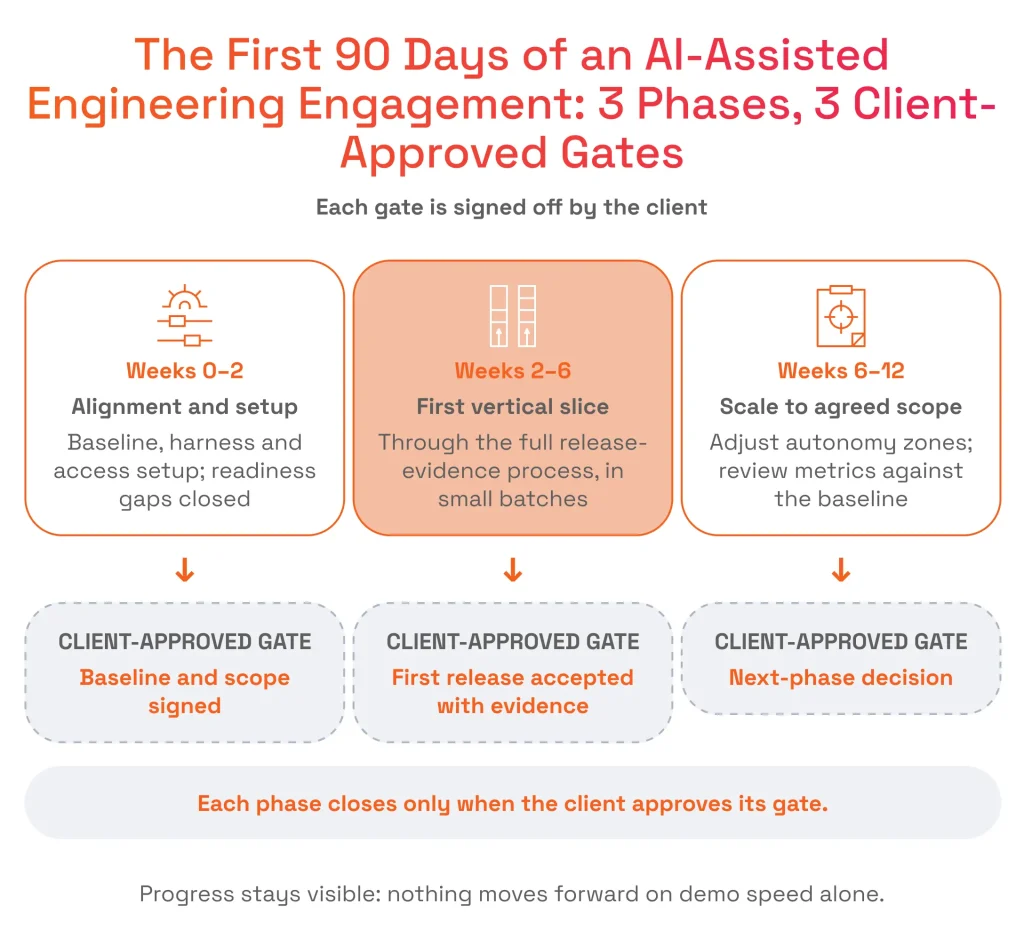
Gates keep the start of the engagement under the client’s control, because the partner can widen scope or autonomy only after the evidence from the previous phase has been accepted.
Phase | Weeks | What happens | Gate the client approves |
|---|---|---|---|
1. Align and baseline | 0-2 | Alignment, baseline agreed from existing metrics, harness and access setup, readiness gaps closed | Baseline and scope signed |
2. First vertical slice | 2-6 | First slice through the full release-evidence process, in small batches | First release accepted with evidence |
3. Scale and review | 6-12 | Scale to agreed scope, adjust autonomy zones, review metrics against the baseline | Scope and autonomy for the next phase agreed |
Phase
1. Align and baseline
2. First vertical slice
3. Scale and review
Weeks
0-2
2-6
6-12
What happens
Alignment, baseline agreed from existing metrics, harness and access setup, readiness gaps closed
First slice through the full release-evidence process, in small batches
Scale to agreed scope, adjust autonomy zones, review metrics against the baseline
Gate the client approves
Baseline and scope signed
First release accepted with evidence
Scope and autonomy for the next phase agreed
Phase two runs in small batches, which keeps each release easy to review, and DORA associates that working style with better product performance under AI. Phase three builds on the evidence records from those releases, so autonomy zones can move in either direction depending on how the first releases actually performed.
For how this plan plays out when a prototype must reach real users, see AI MVP to production in 90 days.
What Are the Most Common Mistakes When Starting an AI-Assisted Engagement?
The most common mistakes when starting an AI-assisted engagement come from carrying a traditional SOW into an application development process where agents write much of the code.
Each one looks minor on signing day and grows expensive by month three, when the client needs to accept, measure or extend what was built.
Mistake | What it causes | Fix |
|---|---|---|
No named decision owner on the client side | Specs and approvals stall; agents wait or guess | Name one accountable owner in the SOW |
No baseline captured before kickoff | No way to prove ROI at month three | Record 4-8 weeks of delivery and quality metrics first |
Scope written as a feature list only | Agents act with no agreed autonomy limits | Add autonomy zones per task type |
Delivery system left with the partner | Lock-in; the client’s team cannot extend the software | Specs, tests, evals and agent configuration in the client’s repository by contract |
Success measured by % of AI-generated code | Activity grows while stability and quality slip unseen | Track DORA delivery metrics and eval pass rates |
Governance added after the first incident | AI technical debt and security gaps already shipped | Agree security, IP and data terms before kickoff |
Mistake
No named decision owner on the client side
No baseline captured before kickoff
Scope written as a feature list only
Delivery system left with the partner
Success measured by % of AI-generated code
Governance added after the first incident
What it causes
Specs and approvals stall; agents wait or guess
No way to prove ROI at month three
Agents act with no agreed autonomy limits
Lock-in; the client’s team cannot extend the software
Activity grows while stability and quality slip unseen
AI technical debt and security gaps already shipped
Fix
Name one accountable owner in the SOW
Record 4-8 weeks of delivery and quality metrics first
Add autonomy zones per task type
Specs, tests, evals and agent configuration in the client’s repository by contract
Track DORA delivery metrics and eval pass rates
Agree security, IP and data terms before kickoff
The missing baseline usually surfaces first, often when a board or investors ask for proof, and the questions investors ask about an AI PoC show how quickly an unmeasured result loses credibility.
If two or more of these mistakes describe your draft SOW, the engagement is likely to produce fast output that is hard to accept, measure or own. Founders heading into due diligence face the same test, since an investor-ready MVP rests on the same evidence and ownership terms.
Why Choose SPD Technology for AI-Assisted Engineering Engagement?
SPD Technology’s agentic engineering practice agrees the same terms with every client before kickoff through its AI engineering services, so AI can accelerate delivery in a way that survives production. That practice rests on 20 years of delivery, 650+ engineers and 460+ delivered projects, with one team owning both architecture and execution.
- Autonomy is matched to risk through three zones, so payments, personal data and system design stay human-led in every agentic AI development engagement.
- Every release ships with an evidence record covering the change, tests, security, sign-off and rollback, and a named senior engineer approves it before the client approver signs off.
- High-stakes domains are covered through an Anthropic partnership with Claude-certified architects, an Adyen payments partnership and compliance-by-design architecture for HIPAA, SOC 2 and PCI DSS.
- SPD Technology enabled Claude Code for an iconic US landmark and delivered +89% engineering delivery output, 2× code-review throughput and −81% human-reported bugs against a flat 2025 baseline at constant headcount. The client owns the 47 custom skills, 6 subagents and 19 slash commands built during the engagement. That transfer of the delivery system is what lets AI-native development teams keep their pace after the engagement ends.
- Within a 10+ year partnership with PitchBook, SPD Technology built AI market-trend detection that processes about 50,000 articles daily across 3,000+ data sources. SPD Technology’s AI work has also been delivered for Morningstar and Pie Insurance.
Still comparing vendors?
See how to choose an AI-assisted engineering partner, with evaluation criteria and questions to ask.
Key Takeaways
- An AI-assisted engineering engagement succeeds or fails on three agreements made before kickoff, covering where AI agents may act without approval, what evidence proves each release, and what the client keeps at the end.
- AI-assisted engineering scope must define autonomy per task type, because the agent that safely writes tests should never approve changes to payments, personal data or architecture.
- AI development deliverables that include specifications, tests, evals and agent configuration in the client’s repository let the client’s team reproduce and extend how the software was built.
- A baseline captured before day one is the only basis for verifying the ROI of AI-assisted software engineering.
- Lead time, change fail rate, rework rate and eval pass rate show whether delivery improved, while the share of AI-generated code only counts activity.
- DORA’s 2025 research describes AI as an amplifier of existing practices, so readiness gaps in data access, version control and batch size scale with the engagement unless they are closed early.
In short: agree autonomy, evidence and ownership before kickoff, and the speed of AI-assisted delivery becomes something a CTO can verify and a CFO can price.
FAQ
What is an AI-assisted software development engagement?
An AI-assisted engagement is a delivery arrangement in which a partner’s engineers use AI coding agents across the SDLC within agreed specifications, tests, evals and approval rules.
Before kickoff, client and partner settle where agents may act without human approval, what evidence each release must carry and what the client keeps at the end.
What should the scope of an AI-assisted engineering project include?
The scope of an AI-assisted engineering project should name the systems in and out, the types of work included and the autonomy coding agents have for each type of work.
Most teams use three zones, keeping architecture, payments, personal data and compliance logic human-led under a senior developer, letting agents implement feature code under engineer review, and automating repetitive coding tasks such as tests, documentation and dependency bumps behind machine checks.
The SOW also lists the environments agents may touch, with no direct production writes, along with permitted tools, data classes and models.
What deliverables should I expect from an AI-assisted engineering partner?
Expect two sets of deliverables, the software itself and the delivery system that produced it, both stored in your repository.
- The software covers code, tests, documentation, runbooks and deployment configuration.
- The delivery system covers specs, rule files such as AGENTS.md, CI quality gates, agent configuration and eval suites.
How do you measure the ROI of AI-assisted software engineering?
The ROI of AI-assisted software engineering is measured by comparing outcomes against a baseline of 4 to 8 weeks of metrics captured before the engagement starts.
On the benefit side, track lead time for changes, deployment frequency, change fail rate, rework rate, escaped defects and the manual work removed. The cost side includes engineering time, cost of change per feature, and AI tooling and token cost per release. Share of AI-generated code and lines of code are best kept out of the calculation, because they count activity and can rise while stability falls.
What is the difference between vibe coding and agentic engineering?
Vibe coding is informal, prompt-driven development that produces code snippets checked mostly by trying the result. Agentic engineering runs coding agents inside human-defined specifications, tests, evals and feedback loops so every release can be verified.
Vibe coding fits disposable prototypes and early discovery. The verified approach suits production systems at team scale.
How much does an AI-assisted engineering engagement cost?
The main cost drivers are the systems and tech stack in scope, the amount of discovery needed before execution, the team composition, the autonomy zones and the review load they create, and gen AI tooling and token spend.
How long does it take to start an AI-assisted engineering engagement?
Starting usually takes about two weeks of alignment, baseline capture and setup before the first vertical slice begins, and that slice lands within the following four weeks. The pace depends mainly on how quickly the partner gets repository and environment access, how ready internal data is for agents, and how much discovery the scope needs.
Who owns the code and AI configuration in an AI-assisted engagement?
The client should own the code and AI configuration. Ownership covers code, specs, tests, eval suites and agent configuration, all versioned in the client’s repository from the first sprint. The contract also addresses licensing of AI-generated code under the chosen models’ terms and the model provider’s data terms, including where prompts are processed. An exit and portability clause rounds out these terms, so the client can run and extend the system without the partner.