

AI tools and no-code platforms can reduce MVP development time by 30–50%, but they do not enforce architecture, testing, or scalability. As a result, many AI MVPs accumulate technical debt that leads to performance issues and costly rewrites. Building an AI MVP without technical debt requires combining AI speed with structured engineering practices from day one, especially for early-stage startups operating in competitive markets.
Developing an MVP has become faster than ever before due to the evolution of Artificial Intelligence-powered coding tools, no-code platforms, and agent-based development workflows. Early-stage startup founders may be caught up in the illusion of efficiency: products that once took months to build can now be crafted in days. However, such solutions usually come live with performance issues, security gaps, and zero test coverage. Every new release frequently breaks something because of no CI/CD, staging, and DevOps.
This gap is critical for startups building AI-driven MVPs. While speed-to-market has improved, the majority of guidance still focuses on launching quickly, not on what happens after launch — when system complexity, data dependencies, and architectural decisions begin to surface.
As a result, many AI-driven MVPs succeed in validation but fail in evolution. The real question is no longer how fast you can build, but whether what you build can scale without being rebuilt from scratch.
Why AI MVP Development Feels Easier Than It Actually Is
According to McKinsey & Company, organizations adopting AI/ML are seeing significant gains in engineering productivity and speed, as AI reduces the manual effort traditionally required for tasks such as coding and testing. The truth is, real success depends on DevOps expertise, system design, and disciplined execution inside modern AI based MVP development workflows.
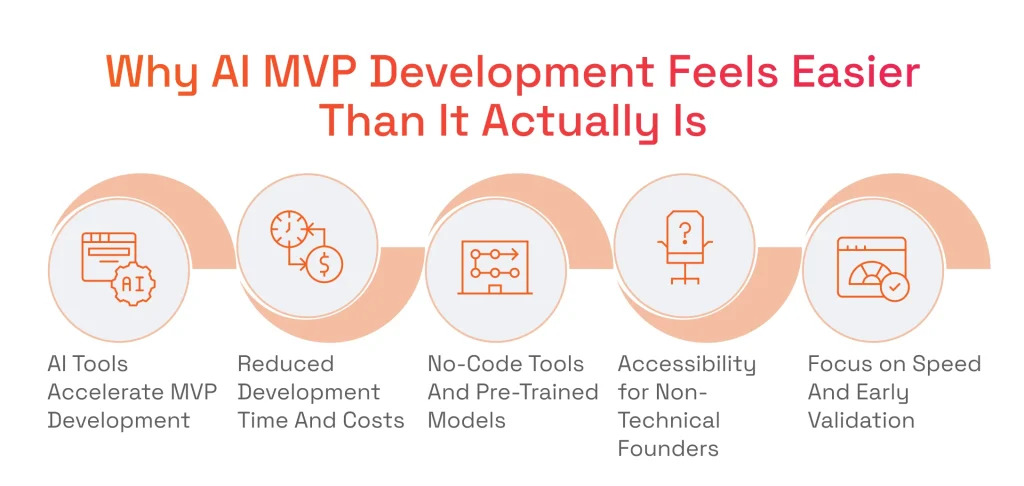
AI Tools Have Redefined MVP Development Speed
AI and machine learning have fundamentally changed the game. What previously required coordinated engineering effort can now be initiated by a very small team, sometimes even a single founder.
- AI-powered MVP development: Modern AI/ML development tools now generate not only boilerplate code, but also entire functional flows, authentication systems, CRUD logic, UI components, and API integrations. Leveraging AI technologies and AI automation, these tools streamline and accelerate the MVP development process, reducing manual effort and enabling faster iteration. AI features such as predictive analytics and automated testing help optimize performance and reliability, making the development process more efficient and the resulting product more robust. This shifts MVP creation from an engineering effort to an assembly of generated parts, significantly reducing upfront friction but also limiting intentional system design decisions.
- Reduced development time: AI-assisted coding and development can shorten the MVP build process considerably, enabling teams to deliver working software 30-50% faster than traditional development cycles. This acceleration is most visible when teams try to test ideas efficiently, especially during early validation.
- Lower development costs: AI-powered MVP development can reduce development costs by 50-60%, allowing startups to build an MVP in just 3-8 weeks instead of the traditional 20-24 weeks. AI also reduces dependency on senior engineers, which creates room for critical mistakes in design and architecture.
- No-code tools and pre-trained models: Startups leverage existing blocks to build products. Stripe is a popular choice for payments, OpenAPI works well for intelligence, Firebase takes over backend services, and Google Cloud is great for scalable infrastructure. This approach easily covers short-term goals but may not work as well for AI at scale.
Additionally, AI-powered tools can analyze large datasets from social media and market trend research to validate startup ideas quickly, allowing entrepreneurs to confirm demand before development begins.
Accessibility Has Lowered the Barrier to Building Products
AI helped more people build products and enabled a never-before-seen speed in doing so. A traditional software product development process will never be the same. Here is why:
- Non-technical founders: Founders can now launch AI-driven solutions using AI copilots and prebuilt infrastructure.
- Rapid prototyping: Structured development phases are being replaced by continuous iteration, with features added, changed, or replaced in real time. Startups can quickly define user personas, understand user preferences, and refine their target audience using early product signals. This enables faster experimentation and helps teams attract users much earlier in the lifecycle.
- AI wrappers: Many startups are effectively building interface layers atop foundation models.
Most MVP Advice Prioritizes Speed and Validation
There is a gap between AI hype vs. reality in how MVPs are built versus how they actually scale, as most modern startup frameworks still emphasize rapid execution as the primary success factor:
- Focusing on only the core features, reducing scope to the minimum viable hypothesis,
- Encouraging fast iteration loops based on user insights, where changes are driven by immediate user feedback,
- Promoting an early release culture, where imperfect systems are launched to validate demand.

Serhii Leleko
ML & AI Engineer at SPD Technology
“Common MVP advice rarely, if ever, addresses the evolution of the system after validation, assuming that what works in the early stages will scale naturally. Unfortunately, most MVPs accumulate shortcuts, the consequences of which become apparent under production load and require costly rework later.”
The Hidden Technical Debt in AI MVP Development
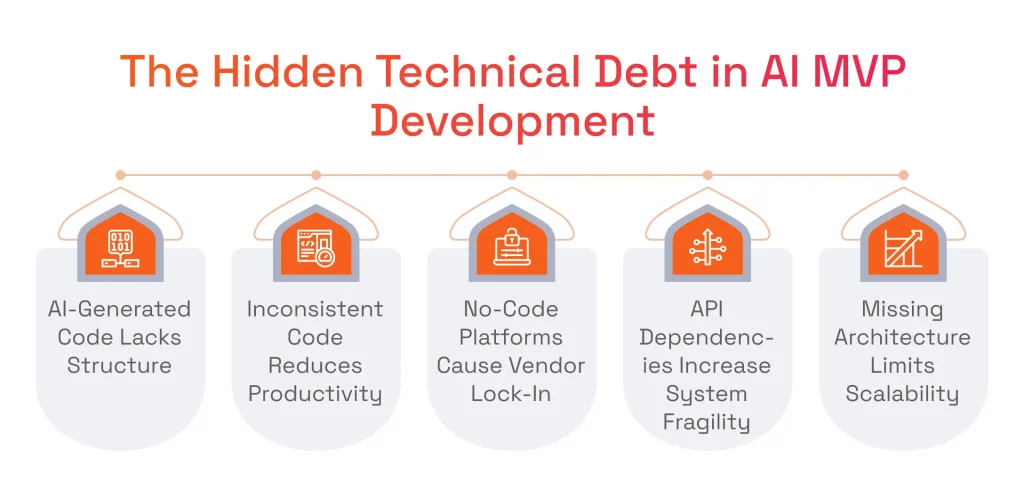
According to a Forrester report, businesses struggle with turning MVPs into successful production systems due to a lack of maintainability, integration complexity, and architectural gaps. This issue is particularly relevant for startups, as rapid progress comes at the cost of technical debt. As systems mature, poorly structured MVPs often degrade into fragmented legacy systems, making long-term evolution harder.
Serhii Leleko
ML & AI Engineer at SPD Technology
“The hidden cost of technical debt in AI MVP development is not just slower delivery, but compounding architectural constraints, reduced scalability, and significantly higher rebuild costs once real users and production scale expose system weaknesses.”
AI-Generated Code Lacks Consistency at Scale
Code created by AI produces working outputs quickly but lacks structure, consistent patterns, and clear architecture. As different parts evolve independently, the codebase becomes fragmented, which harms productivity. Over time, engineers spend more effort on understanding, fixing, and aligning inconsistent logic than on building new features, slowing overall development.
No-Code Platforms Introduce Vendor Lock-In
Predefined components help no-code platforms achieve this massive deployment speed; they are also the very reason customization is limited beyond a platform’s boundaries. There is a problem with vendor lock-in and evolving project requirements, which creates migration challenges. Moving away from a no-code solution requires rebuilding the entire functionality, making scaling an expensive endeavor.
API-First Development Creates System Fragility
Dependency risks are the biggest challenge API-first development faces. By relying on external services for core functionality, you lose control over the core parts of the system and risk failures in those services. Your system eventually becomes fragile due to external API outages, changes, or performance issues.
Missing Architecture Limits Future Growth
MVPs become hard to evolve when system boundaries are not clearly defined. With no planned separation between components, any change to the system becomes a risk, and adding features becomes difficult. This risk is common in production systems, even among top AI development companies building complex products.
MVP Shortcuts vs Long-Term Consequences
MVP Shortcut | Immediate Benefit | Long-Term Consequence |
|---|---|---|
Using no-code as the core system | Launch faster with minimal engineering | Vendor lock-in makes scaling or migration difficult |
Relying on AI-generated code without standards | Faster feature development | Inconsistent code slows maintenance and future development |
Skipping system architecture design | Reduces upfront planning time | System cannot scale or handle real users reliably |
Building directly on external AI APIs | Quick and simple integration | System breaks with API changes or outages |
Avoiding testing and CI/CD | Faster initial releases | More bugs and unstable deployments in production |
Using synthetic data instead of real users | Faster validation cycles | Product fails to match real user behavior |
Ignoring monitoring and observability | Simpler MVP setup | Failures go undetected and harder to fix |
MVP Shortcut
Using no-code as the core system
Relying on AI-generated code without standards
Skipping system architecture design
Building directly on external AI APIs
Avoiding testing and CI/CD
Using synthetic data instead of real users
Ignoring monitoring and observability
Immediate Benefit
Launch faster with minimal engineering
Faster feature development
Reduces upfront planning time
Quick and simple integration
Faster initial releases
Faster validation cycles
Simpler MVP setup
Long-Term Consequence
Vendor lock-in makes scaling or migration difficult
Inconsistent code slows maintenance and future development
System cannot scale or handle real users reliably
System breaks with API changes or outages
More bugs and unstable deployments in production
Product fails to match real user behavior
Failures go undetected and harder to fix
Why AI MVPs Fail After Launch
It is common for early-stage MVPs to be designed for speed, controlled inputs, and limited user behavior. When the real production conditions come into play, the system’s hidden weaknesses quickly become apparent.
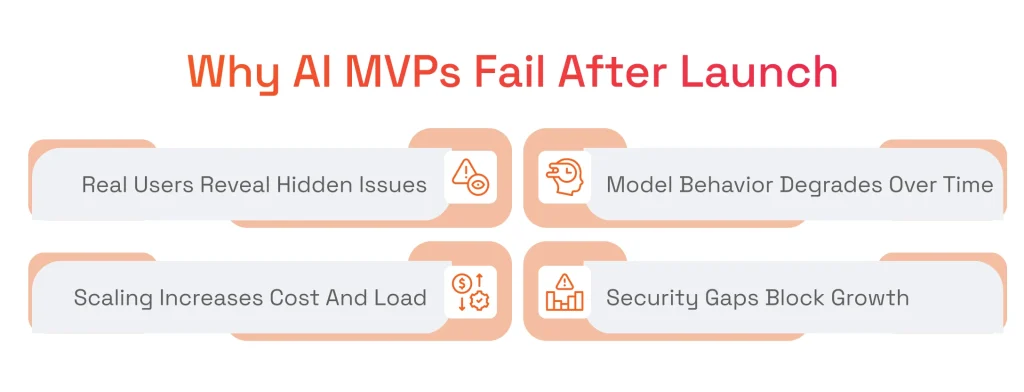
Real Users Expose What Prototypes Hide
The first contact with real users exposes the weaknesses of poorly built prototypes by breaking them with messy data, edge cases, and unpredictable user behavior. Chances are, the features that worked perfectly in demos will not function as well under pressure.
AI Model Behavior Degrades Without Continuous Oversight
Without continuous monitoring and human-in-the-loop approach, AI systems fail to provide reliable outputs as data inputs change. AI/ML models remain prone to hallucinations and drift, so even the most bleeding-edge technological solutions underdeliver without proper human oversight.
Scaling Introduces Cost and Performance Constraints
Rapid prototyping can’t account for performance and infrastructure demands that come with the launch. As a result, there is overall instability, unreasonable compute costs, and slow response times, which are all the price you have to pay for building for speed rather than efficiency.
Security and Compliance Gaps Block Growth
Another major reason AI MVPs fail to succeed after launch is that they often don’t include compliance and security requirements for enterprise-level operations. Missing data governance, regulatory safeguards, and authentication standards prevent operations with enterprise customers in highly regulated markets and industries.
Our dedicated article focuses on a 90-day path from vibe-coded MVP to production system, helping you to avoid common pitfalls.
The AI MVP Productivity Paradox: Speed vs Maintainability
When the primary focus is on development speed, long-term engineering efficiency ultimately suffers. Let’s break down how it occurs.
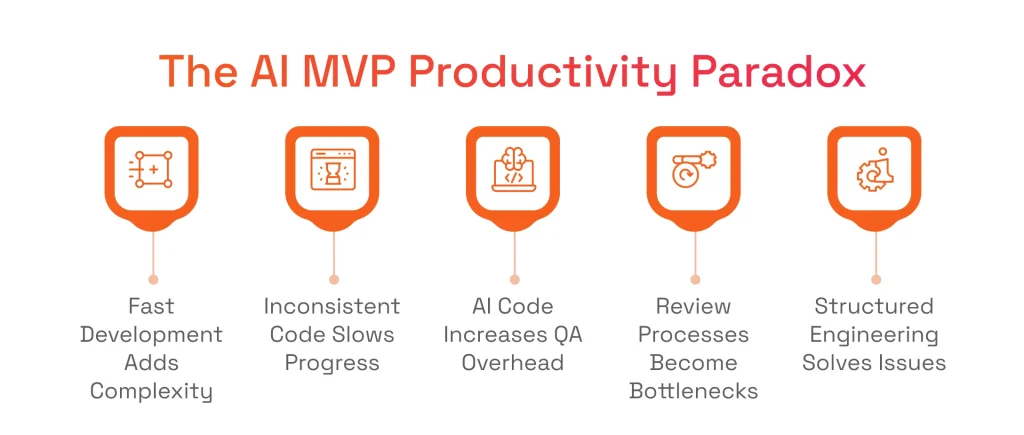
Faster Development Creates Hidden Engineering Friction
As AI speeds up output, the system may become unnecessarily complex. Generated features often result in inconsistent, larger code, with different components following different patterns. This is especially true when multiple tools and prompts are used across the same codebase.
Why AI-Generated Code Slows Down QA and Maintenance
The review and validation process also suffers from the use of generated code. Even senior QA teams waste an unreasonable amount of time trying to understand generated logic, ensure consistency, and identify edge cases. This time increases even further when the number of combinations, dependencies, and unintended interactions expands.
Solving the Productivity Paradox Requires Structured Engineering
It is possible to solve the productivity paradox by building a structure around AI:
- Formal review processes ensure that AI-generated outputs are validated against architectural and business requirements.
- Clear coding standards ensure consistency across generated and manual code.
- CI/CD pipelines help enforce quality checks automatically.
What “Building It Right” Actually Means
Aligning MVP development with your business goals and product idea is crucial to ensure the solution is tailored to your industry-specific needs and delivers real impact. Using AI for idea validation helps startups focus on the most critical features that address user pain points, ensuring that the MVP is aligned with market needs and user expectations. True success for AI MVP, however, is the system design that evolves without collapsing under its own complexity.
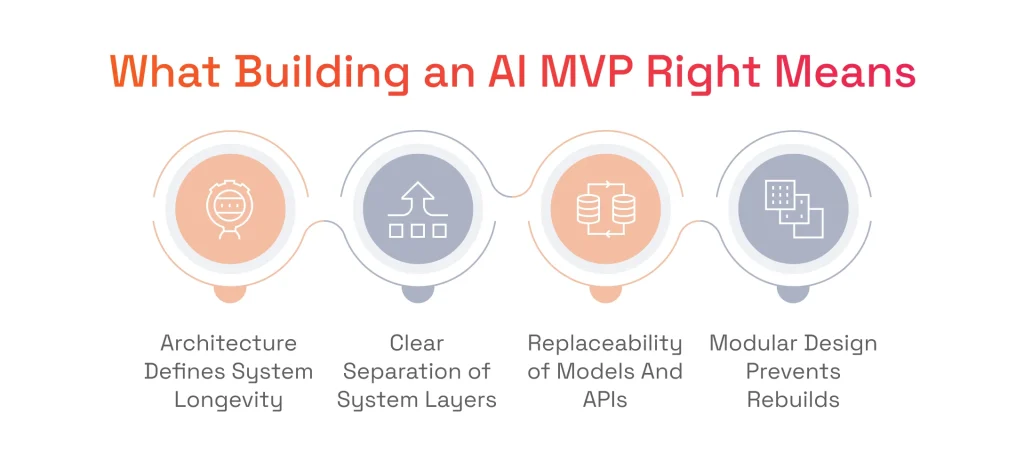
Architecture Defines Long-Term Viability
A holistic architecture approach is the deciding factor that helps the MVP evolve into a complete product without costly rework. System design should always be a priority because it defines how data flows and components interact.
AI Systems Require Clear Separation of Responsibilities
There are problems with scaling when all logic is mixed into a single, tightly coupled system. Separating the AI layer from backend and frontend ensures that each part evolves independently, reduces complexity, and makes the system easier to maintain and debug.
Replaceability Is Critical in AI-Driven Systems
Relying on a single provider can be a critical mistake with devastating consequences, as APIs and AI models evolve at lightning speed. The goal should always be to design with replaceable components in mind, keeping product logic untouched as external services and components are getting swapped over time.
A “Teardown-Ready” System Prevents Future Rebuilds
MVPs built without modularity will require a complete redesign on a bigger scale. A teardown-ready approach entails a modular system with flexible components. Each part of the system could be replaced or scaled independently at any time, without affecting the product.
How to Build an AI MVP Without Technical Debt
Truly sustainable products are built after a set of deliberate decisions around architecture, security, scalability, and validation from the very beginning.
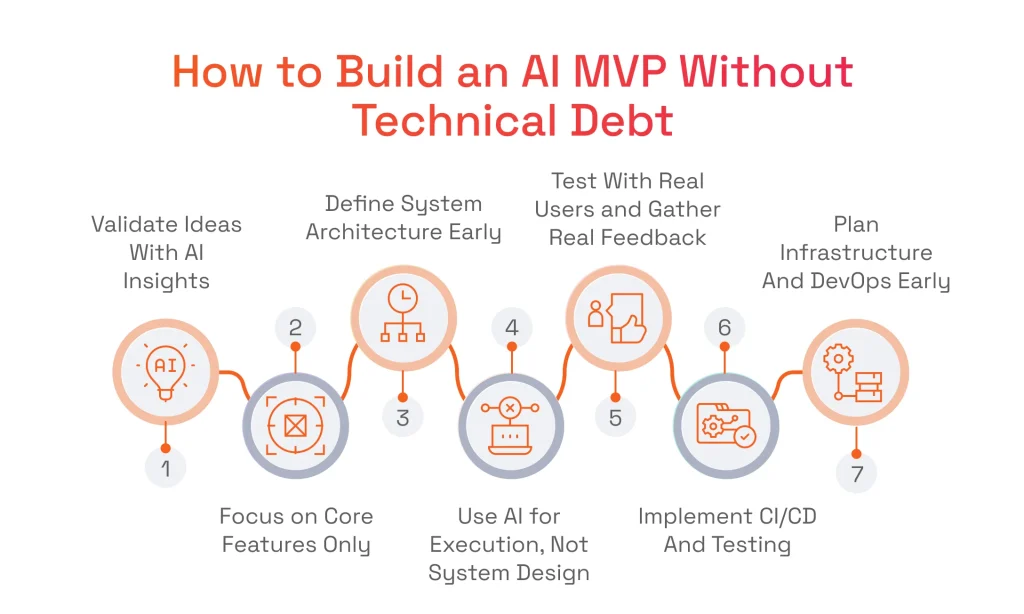
Step 1: Validate the Idea Using AI Insights
Validation is the starting point of any AI MVP development. Feel free to use the latest AI products for detailed analysis of user demand, market signals, and competitor gaps. Before writing the first line of code, ensure your product has measurable demand.
Step 2: Focus on Core Features Only
The initial goal of the MVP should be to solve a specific problem. It will be a bad decision to try to cover many cases from the start, as it will introduce additional complexity. The scope should focus on core functionality, addressing the main user pain points and nothing else.
Step 3: Define System Architecture Early
Building upon architectural clarity helps reduce, or in some cases eliminate, rework in the future, preventing chaos during scaling. To achieve this clarity, determine how data flows through the system, how components interact, and set specific boundaries between services.
A structured approach is described in our article on writing software requirements, where upfront clarity reduces downstream ambiguity and rework.
Step 4: Use AI for Execution, Not System Design
It makes sense to keep all strategic decisions in human hands, as AI currently shines only in implementation. Areas such as task automation, simple code generation, and data-driven analytics can be handled by AI. However, product logic, system boundaries, and all architectural decisions should be made by a competent team member.
Step 5: Test with Real Users and Gather Feedback
Real user behavior is the primary indicator of validation you should pay attention to, so make sure you have all the means to monitor user interactions with the product. Take notes on unexpected usage patterns and collect structured feedback to fine-tune assumptions and features. Use this feedback to refine the user flow, ensuring a smoother experience and optimizing the product to enhance user engagement.
Step 6: Implement CI/CD and Automated Testing Early
Deployment stability is another aspect that can’t be ignored. CI/CD pipelines and automated testing ensure that code changes do not break existing functionality and help maintain consistency as the product evolves and user interactions increase.
Step 7: Plan for Scaling from Day One
Infrastructure choices and DevOps practices should support future growth, ensuring that increased traffic, data volume, or feature expansion does not require a complete system rebuild. When designing scalable architecture for SaaS MVPs and web apps, it’s important to enable seamless scaling, support smart APIs, and lay the groundwork for enterprise-grade reliability as your product evolves.
AI MVP Technical Debt Prevention Checklist
This checklist will help you ensure that your AI-driven MVP is built on the right foundation and can remain scalable and fast as the user base grows.
- Architecture defined before development
- Core features prioritized
- AI components decoupled from core system
- CI/CD pipeline implemented
- Automated testing in place
- Monitoring and logging configured
- Feedback loops established
- Vendor lock-in risks assessed
Following these steps increases the likelihood of MVP success, delivers a market ready product, and provides key benefits such as reduced risk and faster time-to-market.
When AI and No-Code Tools Make Sense
No-code and AI tools can be a massive game-changer when used in the right context. The secret here is to determine where simplicity turns into advantage, and when it introduces risks. Leveraging AI driven MVP for startups and comprehensive MVP development services can help founders choose the right approach for their needs, ensuring a balance between rapid prototyping and scalable, industry-specific solutions.
Early-Stage Validation and Experimentation
AI and no-code tools are ideal when the goal is to test ideas quickly with minimal investment. They allow founders to validate assumptions by engaging directly with target users during early-stage validation, ensuring the problem is confirmed with the intended audience before development begins.
These tools also enable startups to gather early data analytics from a working product, which is crucial since investors are more likely to fund startups that can demonstrate real user engagement and data rather than just a concept. This approach helps explore different product directions and iterate rapidly without committing to full-scale development. This is especially useful when the problem, market fit, or user behavior is still uncertain.
Internal Tools and Low-Risk Use Cases
AI and no-code tools may serve as highly efficient solutions when there is a limited scope or low reliability requirements, for example, with internal systems or applications that have limited access to critical data and functionality. Specific use cases may include workflow optimization, automation tools, and dashboards.
SPD Technology’s Case Study: Boosting Gift Card Conversions by 12.5% with an AI Search Assistant
What we did
We built an MVP in 3 days using Replit, focusing on rapid validation rather than a perfect infrastructure for our client, BlackHawk Network Inc. (BHN). The total validation cost was just $25, which allowed us to test the idea with real users almost immediately. After confirming demand and usability, we transitioned to AWS Bedrock to support production-level performance and future growth.
What it solved
Vague intent was a key user problem we solved. Our system helped users move from uncertain ideas to confident decisions by providing context-aware recommendations and explaining why specific options were relevant.
Results
Our team achieved a remarkable +12.5% increase in the search-to-purchase conversion rate. Additionally, there was a +16% increase in items per order, indicating higher engagement and more confident buying behavior.
Key takeaway
This case proved that fast MVP development can be effective when combined with a clear path to scale. Starting with a lightweight prototype enabled quick validation, while the shift to AWS Bedrock ensured the system could evolve without a full rebuild.

When Engineering Discipline Becomes Critical
Engineering discipline becomes critical once an MVP moves beyond validation and starts operating in real production environments. In particular, AI-driven MVP development requires strong engineering discipline to ensure that the solution is scalable, maintainable, and positioned for long-term success as the startup grows.
Scaling to Real Users Changes System Requirements
The moment real users start interacting with the system, requirements may change fundamentally. We have extensive experience redesigning software built by other teams, knowing firsthand that early-stage software that performs well in controlled environments often fails under high load. Traffic spikes, edge cases, and data inconsistencies are the real-world tests for the performance design.
Investor Readiness Requires Technical Credibility
During investor evaluation, technical due diligence is often a key component. As our numerous interactions with investors show, they assess system architecture rather than focusing solely on product demos. Systems that lack clear structure planning introduce concerns about future engineering costs and integration complexity.
Growing Teams Need Structured Systems
SPD Technology has multiple long-term engineering engagements with cross-functional teams worldwide. When we improve existing unstructured systems, the main concerns we address are duplicated logic, slow delivery, and onboarding. For dedicated teams to be truly effective as they grow, defined coding standards and architecture are mandatory.
Production Systems Require Reliability and Governance
Production environments always have higher standards compared to MVPs. Based on our experience, scaling to production level requires built-in monitoring, security controls, compliance readiness, and operational governance. Without these elements, systems become fragile as they grow and are expensive to maintain.
Serhii Leleko
ML & AI Engineer at SPD Technology
“Scaling challenges come up repeatedly in real systems built under time pressure. We have seen these patterns constantly over 20+ years of software development, building products from early MVPs through to large-scale enterprise platforms.”
Key Takeaways
- AI-powered MVP development reduces development time by 30–50% and costs by 50–60%, while a lack of system architecture planning creates scalability limitations and expensive reengineering after launch.
- AI-generated code accelerates feature delivery. However, inconsistent structure increases long-term maintenance complexity and reduces engineering productivity as systems grow.
- No-code platforms enable rapid MVP validation in 3–8 weeks rather than 20–24 weeks, but they introduce vendor lock-in that limits flexibility and makes migration expensive.
- API-first development accelerates integration with external services, yet it creates system fragility where external failures, latency, or changes directly impact product stability.
- Skipping CI/CD and automated testing speeds up initial releases, resulting in higher production instability and increased cost of fixing bugs in real user environments.
- Technical debt introduced during MVP development increases future development effort by up to 5–10x when architectural decisions are postponed instead of addressed early.
FAQ
What is an AI-driven MVP for startups?
An AI-driven MVP for startups is a minimum viable product built using AI tools, no-code platforms, or LLM APIs to accelerate development and validate product ideas quickly.
Why do AI MVPs fail after launch?
AI MVPs fail after launch because they are often built without scalable architecture, which leads to technical debt, performance issues, and system fragility under real user load.
Is AI-generated code production-ready?
No, it often isn’t production-ready from the start. It typically lacks consistent structure, alignment with architectural standards, and fails to meet maintainability standards.
How does technical debt form in AI MVP development?
Technical debt arises when developers prioritize deployment speed over system design. This leads to fragmented code and creates dependencies that grow into additional problems during scaling.
Can no-code tools be used for scalable products?
While no-code tools can be a perfect fit for early validation, they are not ideal for scalable products. The main reasons are limited flexibility in meeting complex system requirements and vendor lock-in.
How can startups avoid technical debt in MVP development?
Startups can avoid technical debt by defining system architecture early, enforcing coding standards, and using AI for execution rather than system design decisions.
When should AI and no-code tools be used?
AI and no-code tools should be used for early-stage validation, experimentation, and internal tools where speed is more important than long-term scalability.