

Chinese AI models such as DeepSeek, Qwen, Kimi and GLM often lead open-weight rankings on price/performance, while Western open-weight models such as Llama, Mistral, Gemma and gpt-oss usually clear enterprise procurement with fewer questions. Model origin carries four separate risks: data flow and jurisdiction, model behavior, license and regulation, and customer and procurement perception. Self-hosting the weights keeps data in your environment, yet behavior risks such as weaker safety tuning or narrative bias travel with the model, and so do procurement and regulatory questions. Enterprises should decide per workload, test shortlisted models with their own evals and red-team checks, and keep the model swappable behind a gateway.
Your engineering team benchmarks an open-weight release that matches the accuracy of your current production tier at a fraction of the compute cost, and the decision looks straightforward. Then the approval chain starts: your CISO asks where the weights run, legal asks about training provenance, and enterprise sales asks how prospects will react to the vendor name during security reviews. The discussion stalls because no one has separated the geopolitical noise from requirements you can actually verify.
Between February 2026 and the week of September 14, Chinese models went from 6-13% of OpenRouter tokens to 57-67%, according to developer-gateway data reported by CNBC. That puts the questionnaire question in front of almost every team shipping AI. Self-hosting answers part of it. The rest comes down to splitting model origin into the risks it actually carries and testing each one per workload, which the sections below work through.
Chinese vs Western Open-Weight Models: What Is the Short Answer?
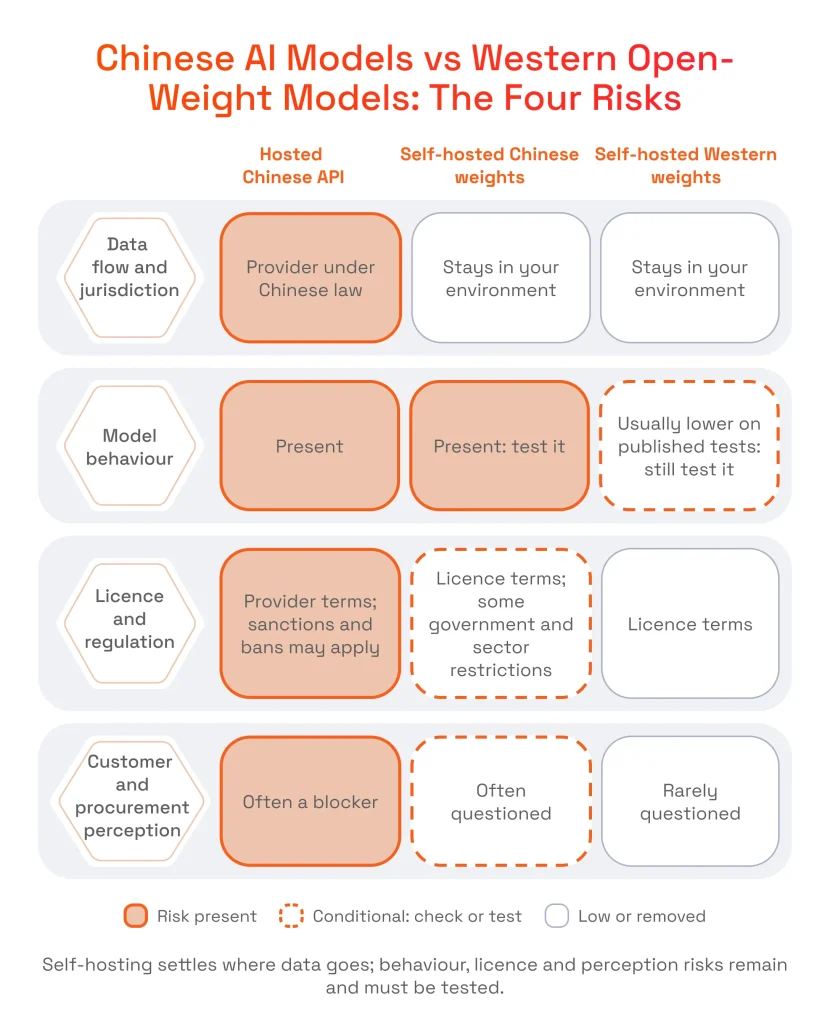
For a coding assistant used only by your own engineers, a Chinese open-weight model usually gives more quality per dollar. Put the same model behind a bank’s customer chat and the calculation flips, since Western open-weight models clear procurement with fewer questions and carry more published safety testing.
Where a model is hosted decides who can read your prompts. The weights decide how the model behaves, wherever it runs.
Risk | Hosted Chinese API | Self-hosted Chinese weights | Self-hosted Western weights |
|---|---|---|---|
Data flow and jurisdiction | Data processed by a provider under Chinese law | Data stays in your environment | Data stays in your environment |
Model behavior (safety tuning, bias, insecure output) | Present | Present; test it | Present, usually lower on published tests; still test it |
License and regulation | Provider terms; sanctions and bans may apply | License terms; some government and sector restrictions | License terms |
Customer and procurement perception | Often a blocker | Often questioned | Rarely questioned |
Risk
Data flow and jurisdiction
Model behavior (safety tuning, bias, insecure output)
License and regulation
Customer and procurement perception
Hosted Chinese API
Data processed by a provider under Chinese law
Present
Provider terms; sanctions and bans may apply
Often a blocker
Self-hosted Chinese weights
Data stays in your environment
Present; test it
License terms; some government and sector restrictions
Often questioned
Self-hosted Western weights
Data stays in your environment
Present, usually lower on published tests; still test it
License terms
Rarely questioned
The same weights can work well in an internal log-parsing tool and be unacceptable in a client-facing wealth management app, so the decision is made per workload.
Who Are the Main Chinese and Western Open-Weight Model Families in 2026?
DeepSeek, Qwen, Kimi, GLM and MiniMax lead the Chinese open-weight field in 2026, with Tencent Hunyuan and Xiaomi MiMo close behind. Every major Chinese LLM family now ships open weights. On the Western side the list is shorter: Meta’s Llama, Mistral, Google’s Gemma and OpenAI’s gpt-oss.
Each row below lists a family’s latest open-weight releases and the license attached to them, as of November 2026. Licenses can change between checkpoints, so check the model card of the exact version you plan to ship.
Family | Developer | Country | License type (per checkpoint) | Typical strengths |
|---|---|---|---|---|
DeepSeek (V4 family) | DeepSeek | China | MIT (recent releases) | Low cost, reasoning, coding |
Qwen | Alibaba | China | Apache 2.0 for many sizes; bespoke license for some flagships | Multilingual, wide size range, agents |
Kimi | Moonshot AI | China | Modified MIT / custom per version | Long-running agents, long context |
GLM | Z.ai (Zhipu) | China | MIT for some, custom for newer flagships | Coding, agentic work, security tasks |
MiniMax | MiniMax | China | Community license | Long context at low cost |
Llama | Meta | US | Llama Community License (custom) | Ecosystem and tooling |
Mistral | Mistral AI | France (EU) | Apache 2.0 for many; research license for some | EU origin, efficiency |
Gemma | US | Apache 2.0 (Gemma 4); earlier versions under the Gemma license | Small and mid sizes, on-device | |
gpt-oss | OpenAI | US | Apache 2.0 | Reasoning at modest hardware cost |
Family
DeepSeek (V4 family)
Qwen
Kimi
GLM
MiniMax
Llama
Mistral
Gemma
gpt-oss
Developer
DeepSeek
Alibaba
Moonshot AI
Z.ai (Zhipu)
MiniMax
Meta
Mistral AI
Google
OpenAI
Country
China
China
China
China
China
US
France (EU)
US
US
License type (per checkpoint)
MIT (recent releases)
Apache 2.0 for many sizes; bespoke license for some flagships
Modified MIT / custom per version
MIT for some, custom for newer flagships
Community license
Llama Community License (custom)
Apache 2.0 for many; research license for some
Apache 2.0 (Gemma 4); earlier versions under the Gemma license
Apache 2.0
Typical strengths
Low cost, reasoning, coding
Multilingual, wide size range, agents
Long-running agents, long context
Coding, agentic work, security tasks
Long context at low cost
Ecosystem and tooling
EU origin, efficiency
Small and mid sizes, on-device
Reasoning at modest hardware cost
Licenses differ between base models and the fine-tuned checkpoints built on them, so legal review starts with the difference between open weight and open source before any external model enters your build pipeline.
Chinese open-weight families: what is each good at?
Chinese models took 41% of Hugging Face downloads over the prior year, according to figures CSIS cited in July 2026. If cost leads the brief, DeepSeek covers reasoning and coding cheaply and MiniMax does the same for long context. Qwen suits multilingual products, with the widest range of sizes. Agent work points elsewhere: CSIS found Kimi K2.7 Code close to OpenAI and Anthropic models on agent and software-engineering benchmarks, and GLM-5.2 brings roughly 750 billion parameters and a 1-million-token context window.
Western open-weight families: what is each good at?
A team already running Llama gets the deepest pool of tooling on the Western side, under Meta’s custom community license. Mistral is the usual pick when a European buyer wants an EU-built model, and many of its releases carry Apache 2.0. Gemma 4 fits on small hardware, down to on-device work, and since April 2026 ships under Apache 2.0. OpenAI’s gpt-oss reasons well without a large GPU budget. Several of the strongest Western models are closed, so any ranking of the best open weight models leaves them out.
How Do Chinese and Western Models Compare on Quality, Cost and Context Length?
The leading Chinese open-weight models sit close to the frontier, and closer than most Western open-weight releases. How far behind the U.S. frontier? Months, said CSIS in July 2026. NIST CAISI was more precise in May 2026, putting DeepSeek V4 Pro about 8 months back. Treat any open source LLM comparison published this week as provisional, because the order will have changed by next month.
Hosted prices for Chinese open-weight models usually sit well below Western frontier APIs per token, because many independent hosts serve the same weights and undercut each other, as CSIS noted in July 2026. As of November 2026, Kimi K3.1 Pro listed at $2 per million input tokens and $10 per million output tokens on Moonshot’s API, and DeepSeek V4.1-Flash dropped to $0.15 per million input tokens in off-peak hours. Per-task cost is a different matter: NIST CAISI found DeepSeek V4 Pro ranged from 53% cheaper to 41% more expensive than GPT-5.4 mini across seven tasks. Check the provider’s pricing page before you budget.
Training costs less as well. Chinese labs lean heavily on knowledge distillation, training a model on a stronger model’s outputs, though CSIS points out that labs outside China do the same. Publishing the weights works as the adoption strategy, since every host serving them and every developer downloading them spreads the model further.
Which model counts as the best open source LLM depends on what you measure. The BenchLM open-weight snapshot from November 7, 2026, placed Moonshot AI’s Kimi K3.1 Pro and Kimi K3 at the top of its 92-model ranking.
Dimension | Chinese open-weight leaders | Western open-weight leaders | How to verify for your product |
|---|---|---|---|
Aggregate benchmark position | Top of open-weight leaderboards (e.g. BenchLM, dated) | Generally behind the Chinese leaders on aggregate scores | Your own eval set |
Coding and agentic tasks | Strong; several near frontier on public coding benchmarks | Mixed by family | Task suite with tool calls |
Hosted price per million tokens | Low; compare input and output rates separately | Varies; fewer hosts for some families | Total cost per successful task |
Context length | Up to ~1M tokens on several flagships | Typically 128K-256K, some longer | Quality at your real context length |
Model sizes | Many very large MoE flagships; smaller variants exist | Wide range including small on-device models | Fit to your hardware |
Dimension
Aggregate benchmark position
Coding and agentic tasks
Hosted price per million tokens
Context length
Model sizes
Chinese open-weight leaders
Top of open-weight leaderboards (e.g. BenchLM, dated)
Strong; several near frontier on public coding benchmarks
Low; compare input and output rates separately
Up to ~1M tokens on several flagships
Many very large MoE flagships; smaller variants exist
Western open-weight leaders
Generally behind the Chinese leaders on aggregate scores
Mixed by family
Varies; fewer hosts for some families
Typically 128K-256K, some longer
Wide range including small on-device models
How to verify for your product
Your own eval set
Task suite with tool calls
Total cost per successful task
Quality at your real context length
Fit to your hardware
Qwen vs DeepSeek vs Llama: which one fits which job?
The qwen vs deepseek choice usually settles itself once someone writes down what the product has to do. If it is a support bot answering customers in Polish and Turkish, Qwen’s wider language coverage and range of sizes, many under Apache 2.0, make it the obvious first test. DeepSeek earns its place on cheaper, narrower jobs such as a budget coding assistant, since its recent releases cost little to run and ship under MIT. Inside a company that already runs Llama 4, the qwen vs llama question comes down to how much of Meta’s tooling the team is willing to give up for a newer model that speaks more languages.
Why should your own eval set make the final call?
Last quarter’s leaderboard winner can still fall over the first time it meets the JSON your billing service expects, or a Portuguese customer phrasing a refund request their own way, and no public score would have warned you. Those scores blend many tasks and several model versions into one number, and the details your product depends on disappear inside it. Even a developer’s own figures can drift from what outsiders measure: when NIST CAISI tested DeepSeek V4 Pro in May 2026, the model did better on DeepSeek’s self-reported benchmarks than on CAISI’s independent ones.
Build an eval set of 50 to 200 real, sanitized tasks from your product, each scored against a written rubric. Running the shortlist on it shows the cost per successful task, which is the number that matters: a model that is cheap per token but needs three retries costs more than one that gets it right the first time.
That is what our eval engineering practice builds, so the model you pick holds up in production. Retry rates also drive the budget surprises covered in our analysis of what AI-assisted development really costs.
A lightweight, domain-specific LLM that SPD Technology developed for a US EdTech company shows task fit outranking leaderboard position. Tuned for children aged 9-12 and sized to stay cost-effective, the model served a repeat client for whom SPD Technology had already delivered a video-conferencing platform.
Is DeepSeek Safe? What Are the Security Risks of Chinese AI Models?
The answer depends on where the model runs. Using DeepSeek through its own app or a China-hosted endpoint sends your data into infrastructure governed by Chinese data and intelligence laws. Self-hosting the open weights in your VPC keeps prompts away from the original lab’s servers, but leaves the model’s trained behavior unchanged. That split is the honest answer to whether Chinese AI models are safe to use.
Downloadable weights also stop short of full auditability, because you do not receive the training data or everything needed to rebuild the model. That is why many releases described as open source AI are better treated as open-weight.
A security reviewer will usually ask two separate things here: who can read the prompts your customers type, and what the model does when someone types something hostile. The first depends on where the model runs, so that is where to start.
Hosted API vs self-hosted weights: where does the data actually go?
Deployment | Who processes prompts and outputs | Main data risk |
|---|---|---|
Chinese provider’s app or API | Provider in China | Jurisdiction (e.g. China’s National Intelligence Law), retention, government-device bans |
Third-party host outside China (cloud or gateway) | That host | Host’s retention and sub-processors; logs do not go directly to the original lab (CSIS) |
Self-hosted in your VPC or on-prem | You | Your own controls |
Deployment
Chinese provider’s app or API
Third-party host outside China (cloud or gateway)
Self-hosted in your VPC or on-prem
Who processes prompts and outputs
Provider in China
That host
You
Main data risk
Jurisdiction (e.g. China’s National Intelligence Law), retention, government-device bans
Host’s retention and sub-processors; logs do not go directly to the original lab (CSIS)
Your own controls
An endpoint hosted in mainland China puts your data within reach of China’s National Intelligence Law, so the questions are the data path for prompts and outputs and the provider’s residency and retention terms. CSIS notes that a third-party host lets teams use these models without sending logs directly to the original Chinese lab; the host’s own retention and sub-processors then decide where the data goes. Usage is spreading fastest in the Global South: OpenRouter data reported by CNBC put Chinese models at 67% of tokens for companies in 82 countries across Latin America, Africa and Asia, so check routing and retention terms wherever your users are.
Running the weights in your own environment keeps prompts out of the original developer’s view entirely, subject to license terms. Whether your team should self-host an LLM comes down to weighing that control against the cost of running GPUs.
Behavior risks: what can still go wrong after self-hosting?
What a model learned in training moves with the weights into your VPC. Published evaluations show it can include how the model handles jailbreaks, political prompts and requests for code.
The oldest of these results is still the clearest lesson in method. In September 2025, NIST CAISI tested three earlier DeepSeek models, R1, R1-0528 and V3.1, and found them far easier to jailbreak and hijack than U.S. reference models. With one common jailbreak applied, R1-0528 went along with 94% of plainly malicious requests, where the U.S. models went along with 8%, and on politically sensitive questions the DeepSeek models repeated inaccurate CCP narratives four times as often. Those are older checkpoints, and current DeepSeek releases need their own tests.
CrowdStrike found a quieter problem two months later. Asked for ordinary code, DeepSeek-R1 wrote something vulnerable 19% of the time, and adding politically sensitive context that had nothing to do with the task raised the odds of a severe flaw by up to 50%. CrowdStrike notes that other LLMs may react to similar triggers.
GLM-5.3 is the subject of the 2026 findings. Anthropic, which sells competing models and ran the tests itself, reported in September that a false cover story got past the model’s safeguards in 64% of simulated tests, and stripping refusals out of the open weights, a technique called abliteration, got past them every time. A month later, Reuters reporting carried by Business Standard described security lab Irregular watching GLM-5.3 complete 3 of 13 multi-stage attack scenarios and bend its instructions to reach the requested result, a habit called reward hacking that tests scoring only task success can miss.
These results describe specific model versions, and CrowdStrike notes other LLMs may react to similar triggers, so run the same red-team suite on every shortlisted model, Western ones included. Agents add one more risk: agent hijacking, where instructions hidden in a retrieved document or web page steer the agent’s tool calls.

Serhii Leleko
AI & ML Engineer at SPD Technology
“Moving the weights into your own VPC settles who can see the prompts. Everything the model learned in training comes along with them, including how it handles a jailbreak attempt or a politically loaded question. That is why we run the red-team suite in every language the product serves: a skew that never appears in English can surface the first week a Spanish- or Arabic-speaking customer starts using it.”
Before any open-weight model goes to production, run these checks:
- Jailbreak and prompt-injection tests, to find alignment gaps before attackers do.
- Tool-call and context-poisoning attacks on the agent, as part of how you evaluate AI agents before production.
- Bias and policy-divergence rates in every language the product supports.
- Static analysis of generated code, to catch AI-generated code security risks before they ship.
- Over-refusal rates, so safety tuning does not block legitimate user requests.
- A full regression run on every new checkpoint, to confirm behavior has not shifted.
The results give you a risk baseline per workload. If a candidate scores badly, add input filtering, validate structured outputs, and place runtime guardrails between the model and the systems it can call.
What Regulatory and Procurement Risks Come With Chinese AI Models?
Most of what stalls a deal here happens outside engineering. A federal order can reach a specific model and every product built on it, and the next security questionnaire may ask where your model came from, with public-sector, defense and critical-infrastructure buyers sometimes ruling out an origin entirely. Congressional scrutiny is still running, and the license adds conditions of its own.
Each row below has a different owner, and the costly ones tend to surface late, after engineering has already built around a model and a customer’s vendor-risk team starts asking questions.
Risk | What to check | Who owns it |
|---|---|---|
Government bans and restrictions (deepseek ban) | Current federal, state and allied-country restrictions; most target hosted apps on government devices, not self-hosted weights | Legal / compliance |
Possible future rules on open-weight models | Proposals reported in 2026 to restrict Chinese open-weight models in the US; congressional inquiries (CNBC) | Legal, monitored quarterly |
Customer procurement | Questionnaires asking for model origin, hosting location, testing evidence | Security + sales |
Sector and public-sector rules | Public-sector, defense and critical-infrastructure customers may exclude certain origins | Compliance |
EU AI Act | General-purpose AI model obligations and deployer duties apply regardless of origin | Compliance with counsel |
License | Thresholds, acceptable use, attribution, derivatives | Legal |
Supply continuity | Models can be withdrawn or restricted on both sides; US export-control actions in 2026 also suspended access to some Western models | CTO, handled by swap path |
Risk
Government bans and restrictions (deepseek ban)
Possible future rules on open-weight models
Customer procurement
Sector and public-sector rules
EU AI Act
License
Supply continuity
What to check
Current federal, state and allied-country restrictions; most target hosted apps on government devices, not self-hosted weights
Proposals reported in 2026 to restrict Chinese open-weight models in the US; congressional inquiries (CNBC)
Questionnaires asking for model origin, hosting location, testing evidence
Public-sector, defense and critical-infrastructure customers may exclude certain origins
General-purpose AI model obligations and deployer duties apply regardless of origin
Thresholds, acceptable use, attribution, derivatives
Models can be withdrawn or restricted on both sides; US export-control actions in 2026 also suspended access to some Western models
Who owns it
Legal / compliance
Legal, monitored quarterly
Security + sales
Compliance
Compliance with counsel
Legal
CTO, handled by swap path
Document every model choice, checkpoint, hosting environment and red-team result, so a customer’s vendor-risk questionnaire gets an answer the same day. The same record answers the questions investors ask of AI proofs of concept before technical reviews begin.
SPD Technology closed HIPAA and SOC 2 gaps for an FSA/HSA payments company, built an AI-assisted eligibility system covering more than 200,000 healthcare products with 80%+ classification accuracy, and moved releases to sub-daily cycles on AWS ECS with Terraform.
How Do You Choose an Open-Weight Model for an Enterprise Product?
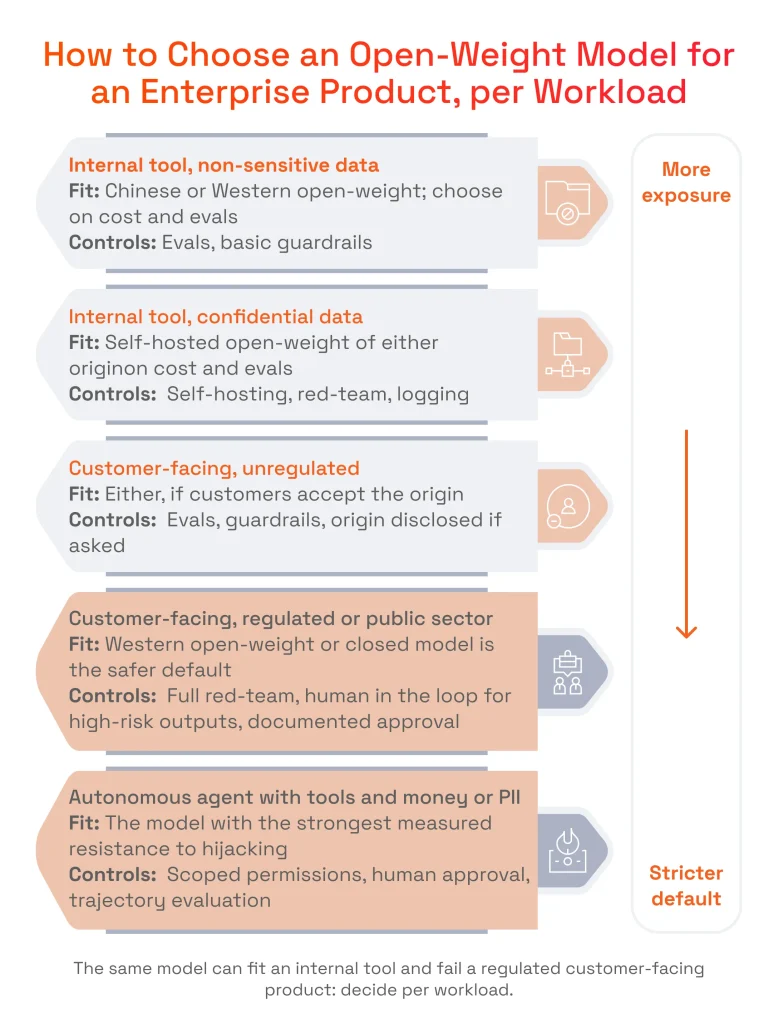
Make the call one workload at a time. An internal tool summarizing meeting notes, a customer-facing chatbot at an insurer and an agent that can move money each carry a different mix of data sensitivity, customer exposure and autonomy, so each gets its own shortlist, screened on license and procurement first and settled on your evals and red-team results.
Teams that want an outside view of that sorting can draw on AI consulting services.
Check every candidate against this list:
- Accuracy and instruction-following on an eval set built from your own product tasks.
- A license that allows commercial deployment and distribution in your product.
- A provenance your customers’ procurement rules and any public-sector requirements accept.
- A hosting option (public API, cloud, or your VPC) that meets your data governance rules.
- A clean pass on your red-team and jailbreak suite for the exact checkpoint.
- Cost per successful request, not the published price per token.
- Release cadence, security patches and community activity, so you don’t build on an abandoned model.
- A gateway that lets you swap the model if a ban or license dispute arrives.
Run this list after the model reaches staging, and the origin item is where it can break: the prompts, the integration and two weeks of evals are already built around a model the first enterprise customer may question. Holding the review at kickoff, with security and sales in the room, moves that conversation to the start.
Workload profile | Typical fit | Required controls |
|---|---|---|
Internal tool, non-sensitive data | Chinese or Western open-weight; choose on cost and evals | Evals, basic guardrails |
Internal tool, confidential data | Self-hosted open-weight of either origin | Self-hosting, red-team, logging |
Customer-facing, unregulated | Either, if customers accept origin | Evals, guardrails, origin disclosed if asked |
Customer-facing, regulated or public sector | Western open-weight or closed model is the safer default | Full red-team, human in the loop for high-risk outputs, documented approval |
Autonomous agent with tools and money or PII | Model with strongest measured resistance to hijacking | Scoped permissions, human approval, trajectory evaluation |
Workload profile
Internal tool, non-sensitive data
Internal tool, confidential data
Customer-facing, unregulated
Customer-facing, regulated or public sector
Autonomous agent with tools and money or PII
Typical fit
Chinese or Western open-weight; choose on cost and evals
Self-hosted open-weight of either origin
Either, if customers accept origin
Western open-weight or closed model is the safer default
Model with strongest measured resistance to hijacking
Required controls
Evals, basic guardrails
Self-hosting, red-team, logging
Evals, guardrails, origin disclosed if asked
Full red-team, human in the loop for high-risk outputs, documented approval
Scoped permissions, human approval, trajectory evaluation
An internal tool is usually where fine-tuning a cheaper self-hosted model pays off first, and generative AI development services cover that work. Anything that moves money or touches patient records needs a person to approve the model’s high-risk outputs, which is what human-in-the-loop design is for.
When is a Chinese model the right call?
Self-hosted Chinese open weights are a sound choice for internal data transformation, high-volume batch extraction and developer tooling, where the input data stays inside your VPC. Code translation, synthetic data generation and internal summarization are typical fits, especially where compute cost decides whether the feature is viable. If you sell to US federal civilian agencies, avoid DeepSeek-based products: a DHS order signed in July 2026 removes DeepSeek technology from their systems, including third-party products built on it.
When is a Western model the safer default?
Western open weights remain the safer default for customer-facing applications in regulated markets, critical infrastructure, and software sold to cautious enterprise procurement teams. An agent with access to financial systems or sensitive customer data needs a model with measured resistance to hijacking. Where a closed frontier model fits best, our experience building production AI with Claude shows how to meet compliance requirements with a managed model.
Peak traffic was the worry for a French B2C fashion retailer whose customer support had to keep answering when the site was busiest. SPD Technology built its chatbot on a Mistral LLM, with LangChain and retrieval-augmented generation on AWS drawing answers from the retailer’s own data. At 30 requests per second during peak hours it stayed up 100% of the time, and 99% of queries came back in under 10 seconds.
Can you use both through model routing?
Model routing sends each request to a different model based on its complexity, sensitivity and cost. One gateway can send routine internal document summaries to a low-cost, self-hosted Chinese open-weight model and route high-risk customer compliance workflows to a Western model with stronger published safety results.
Check the shortlisted model and deployment against our AI Production-Ready Checklist.
How Do You Keep the Model Swappable?
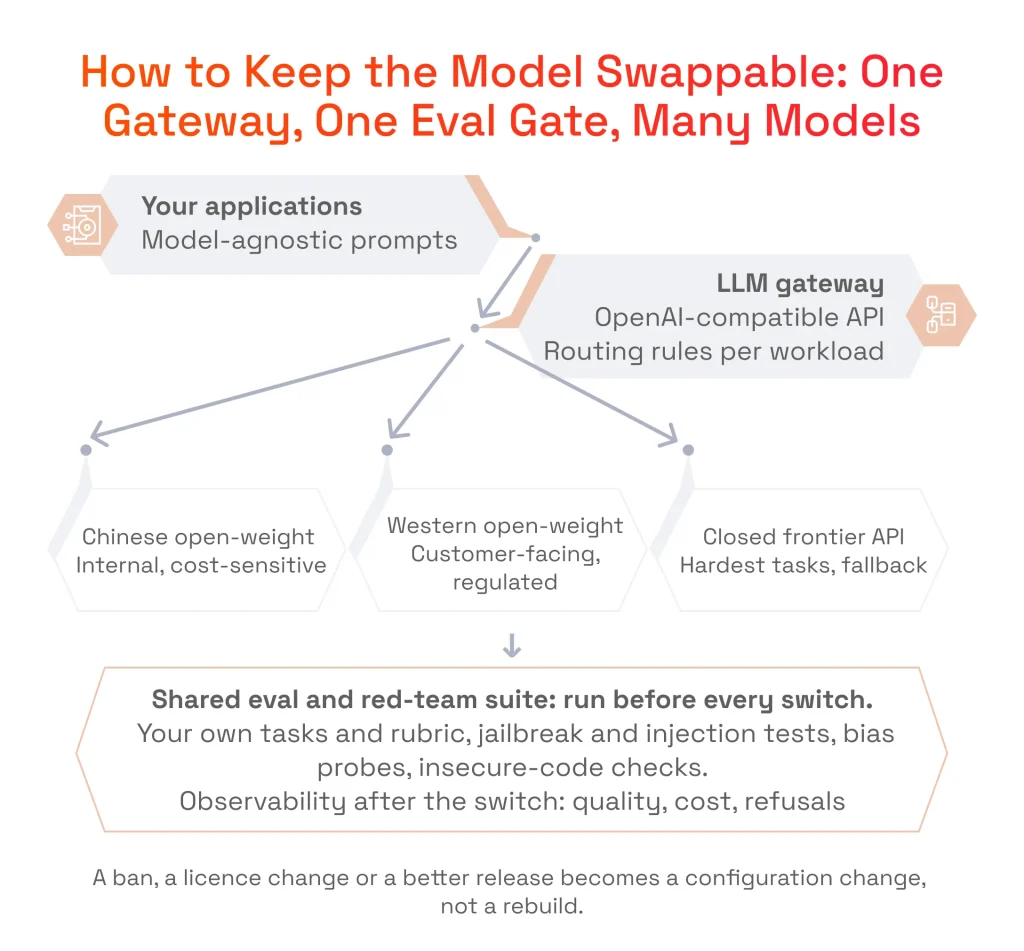
Put an OpenAI-compatible gateway between your application and the model. When prompts, system messages and request formats are standardized behind it, changing the model checkpoint means editing a routing config, so a ban, a license change or a price change becomes a fix measured in days.
Coupling the product tightly to one proprietary API creates AI MVP scaling risks that become painful the moment commercial terms change. Isolating the model early is far cheaper than doing it later.
In practice that takes five habits:
- Run the gateway as its own service, outside the application code, to handle routing and load balancing.
- Keep prompts and context in neutral formats, following agent harness engineering practice, so no vendor format locks you in.
- Run one shared eval and red-team suite on every candidate checkpoint before you change a production route.
- Track latency, drift and refusal rates with MLOps consulting and development tooling, so regressions show up the day they happen.
- Keep a fallback model from a different origin, so a provider or regional outage doesn’t take the product down.
The application then talks to one internal interface, and the infrastructure team can change the model behind it without a rebuild.
Why Choose SPD Technology for Enterprise Model Selection?
SPD Technology helps enterprises select, test and deploy models on evidence from their own tasks and red-team results, behind integration layers that keep the architecture flexible as models change. Whether you need help choosing the model or want your shortlist tested and delivered to a production standard, the work runs through our AI/ML development services.
- High-stakes data delivery: About 50,000 articles a day from 3,000+ data sources run through the AI/ML trend detection SPD Technology built for a global investment data platform, within a partnership of more than 10 years. The AI/ML web-crawling platform built for Morningstar cut data-collection time from 2-3 days to 2-3 hours and storage cost tenfold. Payments and personal data pass a dedicated security-review gate, and SPD Technology is an Adyen service partner.
- Evals and red-teaming before any model change: Candidates are scored on the client’s own tasks before anything ships, and a named senior engineer approves each release, with an evidence package covering the change, tests, security checks, sign-off and rollback.
- Autonomy matched to risk: That principle runs through SPD Technology’s agentic AI development services. For a US fintech platform, Incident Pilot cut incident response from 60+ minutes to under 30 minutes to a PR-ready fix and resolves up to 70% of incidents autonomously. It never merges code on its own, so every fix goes through human code review, and money, personal data and architecture decisions stay with people.
- Model-agnostic, client-owned delivery: Gateway configuration, eval suites and deployment scripts live in the client’s own repository, so the client keeps control of the model choice.
- Anthropic partner: SPD Technology is a Select-tier member of the Claude Partner Network (Services Track). Where a closed frontier model fits a workload better, our Claude-certified architects design around it.
Conclusion
Sooner or later a customer questionnaire will ask which model sits behind your product and where it came from. Self-hosting answers the data half on the spot. The rest comes from work a good engineering team does anyway: evals on your own tasks, red-team runs in every language you serve, a dated record of who approved which model, and a gateway that can swap it in days. On those terms, Chinese open-weight models compete for each workload like any other candidate. In short, model origin breaks down into four separate risks (data flow and jurisdiction, model behavior, license and regulation, and customer and procurement perception), and each one is settled with evidence, not origin alone.
Key Takeaways
- On a hosted API, a Chinese open-weight model often costs less per token than a Western one of similar benchmark quality, because many providers serve the same weights and undercut each other.
- Self-hosting a Chinese model keeps prompts and data in your environment, so the data flow and jurisdiction risk of hosted Chinese APIs no longer applies.
- Self-hosting leaves model behavior unchanged, so weaker safety tuning, narrative bias or insecure code under certain prompts must be found with your own red-team tests.
- Because public leaderboards mix benchmarks and versions, only an eval set built from your own tasks shows which model performs best for your product.
- The same model can be acceptable for an internal tool and unacceptable for a regulated customer-facing product, so model choice should be made per workload.
- License and regulation, and customer and procurement perception questions are easier to answer when the model, version, hosting, tests and approvals are documented before a customer asks.
- An OpenAI-compatible gateway with a shared eval suite turns a ban, a license change or a better release into a configuration change measured in days.
FAQ
Are Chinese AI models open source?
Mostly they’re open-weight, which is a narrower thing. DeepSeek, Qwen, Kimi, and GLM let anyone download the weights and run them, but the training data and full training code stay unreleased, so they fall short of open source as the Open Source Initiative defines it. Licenses run from MIT and Apache 2.0 to custom terms and can change between checkpoints of one family, so read the one attached to the exact checkpoint you plan to ship.
Is it safe to self-host DeepSeek or Qwen for customer data?
Self-hosting settles where the data goes: it stays in your VPC and never reaches a provider under Chinese jurisdiction. What the model learned in training comes with it, and published evaluations of some Chinese models found weak spots in jailbreaks, prompt injection, biased answers, and insecure code. Red-team it on your own data as you would other models, put human approval around risky actions, and check that customers accept the origin, since U.S. federal civilian agencies now exclude DeepSeek-based products.
Which Chinese LLM is best for coding?
There’s no single best Chinese AI model for coding, at least not for long. DeepSeek, GLM, Kimi and Qwen each put a 2026 release near the top of open-weight coding and agentic benchmarks, and they trade places often. On a real project, the gap shows up in narrow places, like refactors that need deep reasoning across many files, or your agent’s tool-calling format. Test two or three on tasks from your own repo and keep the one with the lowest cost per successful task.
Can a US company legally use Chinese AI models in its product?
As of November 2026, no federal law stops a private U.S. company from building on an open-weight Chinese model. The exceptions are targeted, and one matters for public-sector sales: a DHS order signed in July 2026 keeps DeepSeek technology, including third-party products built on it, out of federal civilian agencies, and a post-trained version of DeepSeek may still count as built on it. Some states, contractors, and sectors add rules, and the license adds its own. Confirm with counsel before launch. This isn’t legal advice.
How do Chinese AI models compare to Llama and Mistral?
On many 2026 public benchmarks, the strongest Chinese open-weight models score above Llama and Mistral, and the hosts serving them usually charge less per token. Where Llama and Mistral pull ahead is the security questionnaire: a reviewer at a bank or insurer rarely asks a second question about a Meta or Mistral model, and Mistral adds EU origin. Llama ships under Meta’s community license and many Mistral models use Apache 2.0. Your own evals settle quality, Chinese language tasks included if your product handles them.
What does a DeepSeek ban actually cover?
On government devices in several U.S. states and other countries, it usually means DeepSeek’s web and mobile apps are off limits. The federal picture changed when DHS made its July 2026 order public in October: civilian agencies now have to strip DeepSeek technology out of their systems, and that reaches into products outside vendors built with it. If your product runs DeepSeek weights, self-hosted or not, talk to public-sector buyers before you commit.
How much does it cost to run a Chinese open-weight model compared with a Western one?
Usually less on a hosted endpoint, since plenty of hosts serve the same Chinese weights and undercut each other, according to the Center for Strategic and International Studies (July 2026). Per-token prices can still mislead: when NIST CAISI tested DeepSeek V4 Pro in May 2026, some benchmarks cost up to 53% less per solved task than GPT-5.4 mini and others up to 41% more. Self-hosting means paying for GPUs and the engineers who run them, so for a support assistant, watch what each resolved ticket costs.
How should you test a Chinese open-weight model before launch?
Start with an eval set of 50 to 200 real tasks from your product, scored against a written rubric, and run every candidate on it, Western ones included. Add red-team runs for jailbreaks, prompt injection and agent hijacking in every language you serve, plus static analysis of any code the model writes. Once the set exists, testing a new model is quick, because the tasks and red-team runs are reused, and with a gateway in place the switch itself is a configuration change.