

Trusting AI-generated code without reading it means asking for evidence: what changed, what was tested, what was scanned for security issues, and who reviewed the work.
A 2025 Clutch survey found 59% of developers use AI-generated code they don’t fully understand, so unverified work often ships unchecked. Enforcing strict automated testing and clear review workflows helps your teams catch hidden bugs before they reach production.
There’s a decision on your desk with a date attached. You’re about to sign with an agency, or you’re deciding whether to keep building on the codebase you already own, or a partner wants a yes this quarter. The software in question was built with heavy AI assistance. The demo ran clean, and the builder told you it’s in good shape.
However, a demo is a claim about one moment, staged under conditions the builder chose. Whatever the demo skipped — the error paths, the security edges, the thousandth user — stays visible only to the people who did the work.
The gap between adoption and confidence has widened fast. Google Cloud’s 2025 DORA research surveyed nearly 5,000 technology professionals and found AI adoption among software development professionals at 90%, which means nearly every build you evaluate now has AI somewhere in it. At the same time, 30% of those professionals report little or no trust in AI-generated output.
Here, you will find a practical method for how to trust AI-generated code when you’re the non-technical buyer signing off on it: the risks in plain language, the proof to request, and the sound of a real answer.
“I Trust My Developer” Isn’t a Strategy: Here’s What Is
Clutch surveyed 800 software professionals in June 2025 and found that 59% of developers use AI-generated code they do not fully understand. These are people who read code for a living.
Follow that through to your side of the table. Where close verification is thin among the people equipped to perform it, a non-technical buyer accepting a verbal assurance may be trusting work that nobody examined carefully at any point. Call it the AI code trust gap: confidence in the software has outrun anyone’s knowledge of it.
Impressions drift from measurement too. As a randomized controlled trial carried out by METR in July 2025 revealed, developers perceived themselves to be about 20% more efficient as a result of using AI technologies, whereas the study data showed that the actual time taken by developers increased by 19%. METR has since labeled those figures as historical and published a February 2026 update that did find evidence of a speedup, though selection effects make that finding unreliable. What survives is the distance between how the work felt and what the clock recorded.
None of this is cynicism about developers. It points to a skill you can acquire without learning to program: ask for evidence, and learn what a specific answer sounds like.
Vibe Coding vs. Governed Delivery: Why the Same AI Tools Produce Different Results
Vibe coding is fast, informal, AI-assisted building. Someone describes what they want in ordinary language, accepts what comes back, and keeps moving. For finding out in an afternoon whether an idea has any life in it, that’s a genuinely good use of the tools.
The variable sits around the tooling, never inside it. How you consume the output, how you test things, what gets documented — that’s what determines whether the very same model and the very same prompt create either a disposable output or something controlled and evidence-backed.
Blackhawk Network provides gift cards worldwide. The company needed an assistant tool that could answer ambiguous and emotional queries like “something for my sister who has everything”. Before any development work, we proved the concept with a disposable prototype built in three days for $25 on Replit. The AI gift assistant, launched later, operated on semantic search for fuzzy queries and delivered a 12.5% improvement in conversion rate and a 16% increase in items per order. The prototype itself wasn’t the actual product. It just showed whether the concept would work.
Ask a builder what they did to verify what the AI produced. Whether AI was involved tells you almost nothing on its own.
What Can Go Wrong with AI-Generated Code (In Plain Language)
Four failure modes account for most of what goes wrong in AI-assisted work, and each can be described without any technical vocabulary at all. You won’t catch any of them yourself. Knowing their names lets you ask whether each was checked, which is the only leverage a buyer actually needs here.
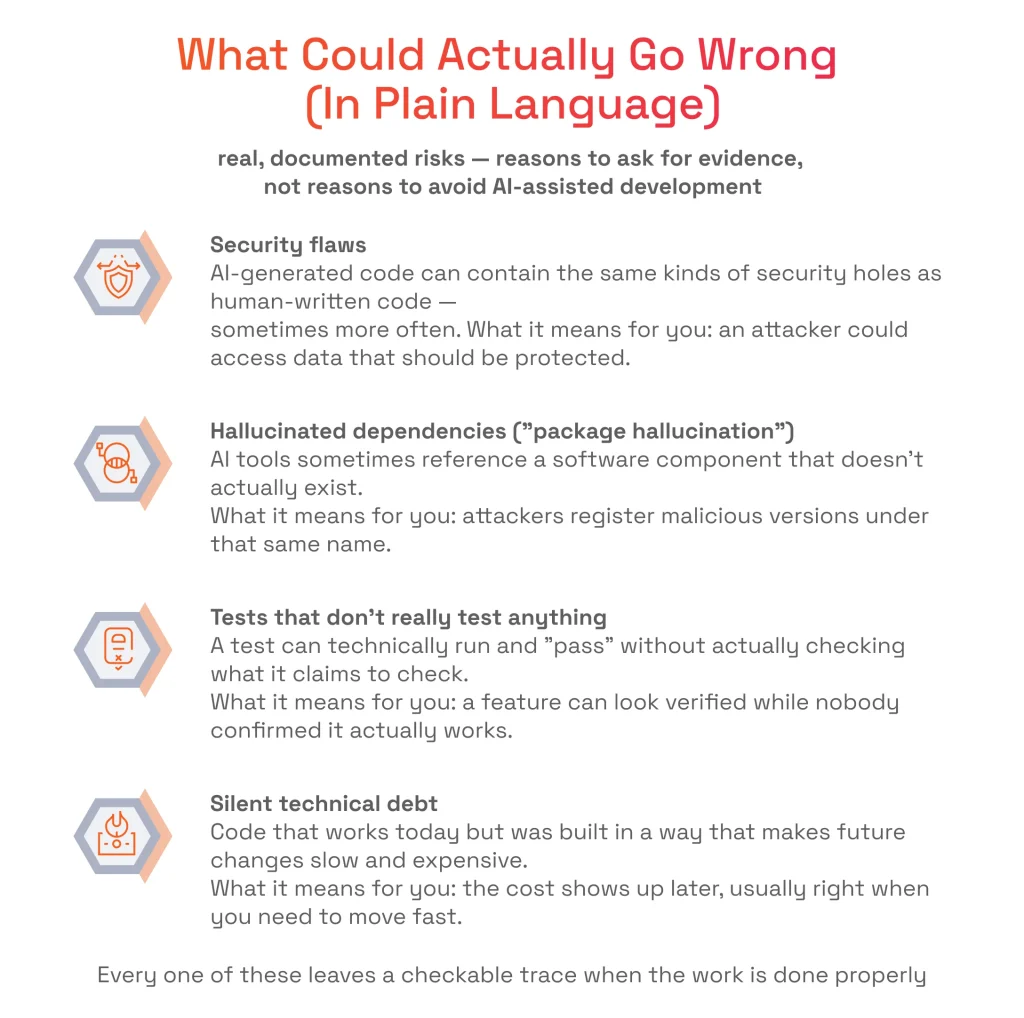
These are the AI code security risks and quality risks worth being able to name out loud in a meeting.
Risk in AI-Generated Code | In Plain Language | What It Means for You |
|---|---|---|
Security flaws | AI-generated code can contain the same kinds of security holes as human-written code, sometimes more often, because it learned from imperfect examples | An attacker could access data or functionality that should have been protected |
Hallucinated dependencies (“package hallucination”) | AI tools sometimes reference a software component that doesn’t actually exist | Attackers can create malicious versions of the invented component, which then get installed unknowingly, a pattern known as slopsquatting |
Tests that don’t really test anything | A test can technically run and “pass” while not actually checking the thing it claims to check | A feature can look verified on paper while nobody has confirmed it actually works |
Silent technical debt | Code that works today but was built in a way that makes future changes slow and expensive | The cost shows up later, usually right when you need to move fast |
Risk in AI-Generated Code
Security flaws
Hallucinated dependencies (“package hallucination”)
Tests that don’t really test anything
Silent technical debt
In Plain Language
AI-generated code can contain the same kinds of security holes as human-written code, sometimes more often, because it learned from imperfect examples
AI tools sometimes reference a software component that doesn’t actually exist
A test can technically run and “pass” while not actually checking the thing it claims to check
Code that works today but was built in a way that makes future changes slow and expensive
What It Means for You
An attacker could access data or functionality that should have been protected
Attackers can create malicious versions of the invented component, which then get installed unknowingly, a pattern known as slopsquatting
A feature can look verified on paper while nobody has confirmed it actually works
The cost shows up later, usually right when you need to move fast
Every item on that list is a reason to ask for evidence that somebody checked it. None of them is an argument against AI-assisted development, and the next section covers what that evidence looks like when you request it. For the mechanics underneath these failures, we’ve written at length on why AI-generated code breaks in production.

Serhii Leleko
AI & ML Engineer at SPD Technology
“A passing test tells you that something was checked. It does not tell you what. For AI-assisted work, we read the tests before the code because a generated test suite will often confirm that a function returned something but leave the expected value unchecked. That gap is invisible in a demo and expensive in production.”
That habit of reading the tests first came from work, where the stakes leave no room for anything else. We have built and tested software for DNA-sequencing machines since 2019, and an incorrect result on that hardware is a patient-safety issue. Automated test suites cut testing time three to four times over there, with every result landing on a dashboard that seven development teams read daily. The pharmaceutical company needs what was tested to stay legible to people who never wrote a line of it.
The Evidence Package: What to Ask For Instead of “Trust Me”
Most of how to trust AI-generated code boils down to a single request you can make in plain English. At SPD Technology, we call it the evidence package: a specific, requestable set of proof that a piece of work was done properly. Delivery produces it as a matter of course, so it exists before anyone asks.
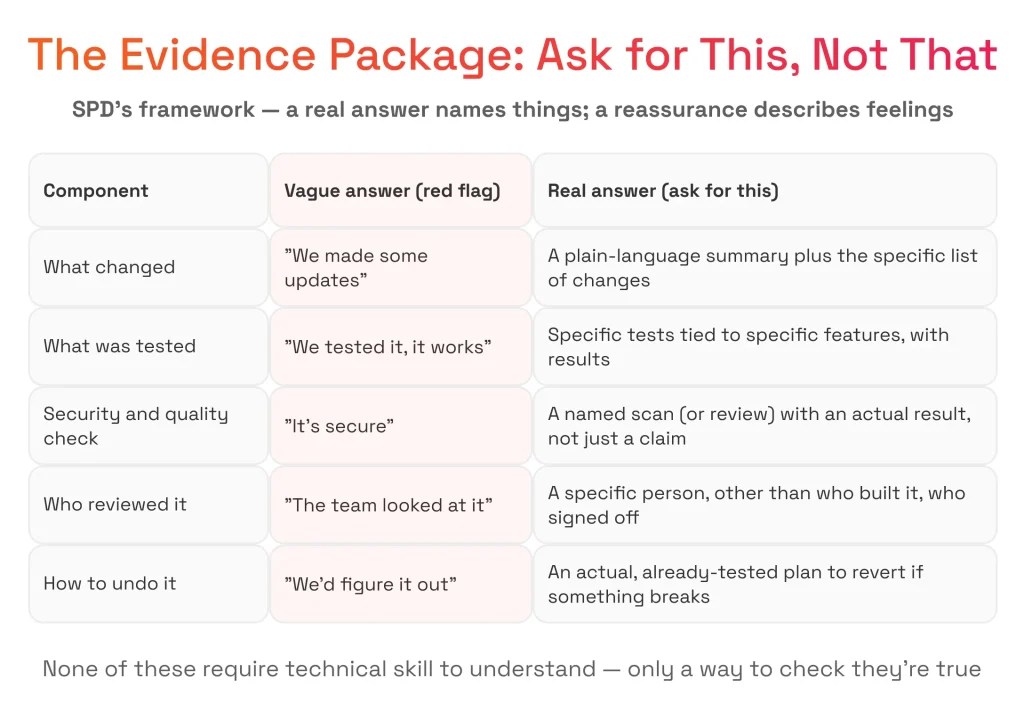
Five components make it up. What changed gives you a plain-language summary alongside the specific list of what moved. What was tested connects named tests to named features and shows the results of each. The security and quality check refers to a security scan or a code review with an actual result attached. Who reviewed it names a human being other than the person who built the thing. And how to undo it is a rollback plan somebody has already executed at least once.
Evidence Package Component | Vague Answer (Red Flag) | What to Ask For |
|---|---|---|
What changed | “We made some updates” | A plain-language summary plus the specific list of changes |
What was tested | “We tested it, it works” | Specific tests tied to specific features, with results |
Security and quality check | “It’s secure” | A named security scan or code review with the result attached and dated |
Who reviewed it | “The team looked at it” | A specific person, other than whoever built it, who signed off |
How to undo it (rollback plan) | “We’d figure it out” | An actual, already-tested plan to revert if something breaks |
Evidence Package Component
What changed
What was tested
Security and quality check
Who reviewed it
How to undo it (rollback plan)
Vague Answer (Red Flag)
“We made some updates”
“We tested it, it works”
“It’s secure”
“The team looked at it”
“We’d figure it out”
What to Ask For
A plain-language summary plus the specific list of changes
Specific tests tied to specific features, with results
A named security scan or code review with the result attached and dated
A specific person, other than whoever built it, who signed off
An actual, already-tested plan to revert if something breaks
Specificity is what separates a trustworthy answer from a reassurance. A real evidence package names things. A reassurance describes feelings.
Generating automated proof is critical when measuring speed without hiding rework during rapid delivery cycles.
Evidence like this costs the least when the delivery process produces it on its own. For a digital lender in the UAE, we rebuilt the release pipeline so that automated quality checks and security scans run on every change before a human reviews anything. That turns the audit trail into a by-product of shipping, available at any moment without someone assembling a document first. The platform it protects serves more than 35 million monthly users across 20-plus countries and has facilitated over $1.6 billion in loans.
Questions to Ask Before You Hire a Developer or Sign Off on a Build
The practical version of how to trust AI-generated code is to ask a few questions and listen closely to the answers. You’re listening for specificity, and specificity is audible whether or not you understand the technical content.
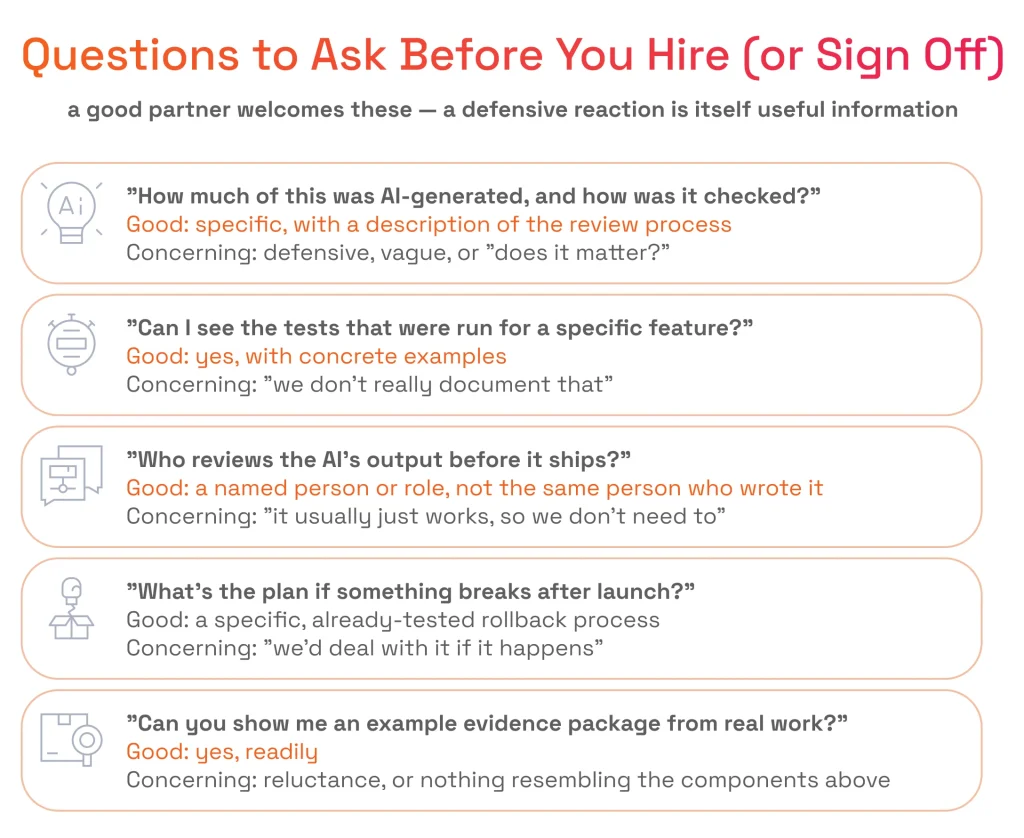
Each row below pairs a question with the answer that should reassure you and the answer that should slow you down.
Question to Ask Your Developer or Agency | Good Answer | Concerning Answer |
|---|---|---|
How much of this was AI-generated, and how was it checked? | Specific, with a description of the review process | Defensive, vague, or “does it matter?” |
Can I see the tests that were run for a specific feature? | Yes, with concrete examples | “We don’t really document that” |
Who reviews the AI’s output before it ships? | A named person or role, not the same person who wrote it | “It usually just works, so we don’t need to” |
What’s the plan if something breaks after launch? | A specific, already-tested rollback process | “We’d deal with it if it happens” |
Can you show me an example evidence package from real work? | Yes, readily | Reluctance, or nothing that resembles the components above |
Question to Ask Your Developer or Agency
How much of this was AI-generated, and how was it checked?
Can I see the tests that were run for a specific feature?
Who reviews the AI’s output before it ships?
What’s the plan if something breaks after launch?
Can you show me an example evidence package from real work?
Good Answer
Specific, with a description of the review process
Yes, with concrete examples
A named person or role, not the same person who wrote it
A specific, already-tested rollback process
Yes, readily
Concerning Answer
Defensive, vague, or “does it matter?”
“We don’t really document that”
“It usually just works, so we don’t need to”
“We’d deal with it if it happens”
Reluctance, or nothing that resembles the components above
None of this is about catching anyone out. A good partner welcomes all five of these questions, because answering them is a chance to show work they’re proud of. Defensiveness or evasion on any one of them has told you something useful.
When to Bring In an Independent Code Audit
An outside review earns its cost at specific moments: before a fundraise, before a major partnership, and any time being wrong would be expensive, embarrassing, or slow to undo. Fundraising raises the bar in particular, since the questions investors ask about AI development tend to arrive faster than a founder can assemble answers.
What you get is a reviewer with no stake in the original build, examining both the code and the evidence behind it. Technical due diligence of that kind produces an assessment written for the person paying for it, which means you can act on the findings without following the technical reasoning that produced them. An independent AI infrastructure audit is the form this usually takes when you need to evaluate AI-built software you didn’t commission yourself.
Our engineers audited a large library and cultural-center platform in the UAE against more than 15 criteria covering architecture, performance, documentation, and infrastructure cost. The owners received a written assessment with specific recommendations to improve performance and reduce the platform’s running costs. That software audit ended in a document they could act on without reading a single line of code.
Commissioning a review like that says nothing about your confidence in whoever built the thing. A home buyer hires an inspector while fully expecting the house to be fine, and does it because the purchase is large and the mistakes are slow to reverse. The same arithmetic applies to software you are about to fund, sell, or keep building on.
Ready to take the next step? If you’re preparing for a raise specifically, our guide on what to prove before you raise funds covers the evidence investors ask to see.
Buyer’s Trust Checklist for AI-Generated Code
Take the six checks below into your next call with the builder and mark them one at a time, honestly. Each one is answerable by a non-technical buyer in an afternoon, and none of them requires opening the code or understanding what’s in it. Wherever a box stays empty, you have found the exact question to raise before money or signatures move.
✓ | Question | What It Confirms |
|---|---|---|
⃣ | Has an evidence package (or something like it) ever been offered without you asking? | The builder treats evidence as a normal part of delivery, not a special request |
⃣ | When you asked specific questions, did you get specific answers? | Claims about the work can be checked, not just believed |
⃣ | Has anyone other than the original builder reviewed the work? | Verification doesn’t rest entirely on the person who has the most reason to say it’s fine |
⃣ | Does a tested rollback plan exist? | There’s an actual answer for “what if something breaks,” not an improvised one |
⃣ | Have you seen what was actually tested, not just been told “it works”? | “Working” and “verified” are being treated as different claims |
⃣ | Given what’s at stake, would an independent second opinion be worth it? | The scrutiny applied matches the actual cost of being wrong |
✓
⃣
⃣
⃣
⃣
⃣
⃣
Question
Has an evidence package (or something like it) ever been offered without you asking?
When you asked specific questions, did you get specific answers?
Has anyone other than the original builder reviewed the work?
Does a tested rollback plan exist?
Have you seen what was actually tested, not just been told “it works”?
Given what’s at stake, would an independent second opinion be worth it?
What It Confirms
The builder treats evidence as a normal part of delivery, not a special request
Claims about the work can be checked, not just believed
Verification doesn’t rest entirely on the person who has the most reason to say it’s fine
There’s an actual answer for “what if something breaks,” not an improvised one
“Working” and “verified” are being treated as different claims
The scrutiny applied matches the actual cost of being wrong
Two or fewer checks usually mean the decision rests on trust alone. For a low-stakes call, this can be a defensible place to land. Where funding, a major partnership, or continued investment is riding on it, our AI production-ready checklist is a faster way to close the gap than discovering it later.
Key Takeaways
- A 2025 Clutch survey found that 59% of developers use AI-generated code they don’t fully understand, which enlarges a buyer’s need for a different kind of proof.
- AI tools can invent software dependencies that don’t exist, a failure called package hallucination, and attackers who spot the pattern register malicious versions under the invented name.
- A test can run and pass while checking nothing meaningful, so “the tests pass” and “the feature is verified” remain two separate questions.
- Asking what was done to verify the AI’s output produces a checkable answer; asking whether AI was used at all produces almost no information.
- An evidence package covers what changed, what was tested, what was scanned, who reviewed it, and how to undo it. Any buyer can request one and judge it for specificity without being able to read code.
- A defensive or vague reaction to a direct question about verification is itself information, since a trustworthy partner welcomes that question.
- An independent second opinion earns its cost when being wrong is expensive — a fundraise, a major partnership, continued investment — which is the logic behind a home inspection.
In short: a builder who can show what changed, what was tested, what was scanned, and who approved it has earned trust in AI-generated code; one who offers only reassurance has answered a different question.
FAQ
Can I trust software if I can’t read the code myself?
Yes, when the trust rests on evidence. Knowing how to trust AI-generated code is a matter of asking whether the builders can produce specific proof: what changed, what was tested, what got scanned for security issues, and which independent person reviewed it. A trustworthy builder answers each of those with particulars. Someone offering only “trust me” has either skipped the verification work or has reasons for keeping it out of view.
Is AI-generated code less secure than code written by humans?
However, the evidence is not conclusive. There have been studies showing that there are security vulnerabilities in the code generated by AI at significant levels, and these mistakes are similar to the ones made in code written by humans. What matters less is who writes it than what kind of verification the code undergoes after generation. AI-generated code that passes testing and review can be much more reliable than unreviewed human code for the same reason: the process matters here, not authorship.
What is package hallucination, and should I be worried about it?
Package hallucination happens when an AI tool references a software component that doesn’t exist, having generated a plausible-sounding name based on learned patterns. The danger arises when attackers register real, malicious versions of the most commonly invented names, a practice called slopsquatting. Blindly installing what the AI suggested can then introduce malware into your product. Ask whether dependencies are checked against a known, verified list — that’s a reasonable and specific question.
What should I ask for if I don’t understand technical answers?
Ask for specificity, and let technical depth take care of itself. A good answer to “what was tested” names actual features and actual results in plain language. Anyone can hear the difference between “we tested the payment flow, and here’s what we checked” and “yeah, we tested it,” even if they have no idea what a testing framework is. The evidence-package components exist so a buyer can judge how specific an answer is without judging its technical content.
When should I pay for an independent code audit instead of trusting my developer’s word?
The cost of being wrong is the clearest signal. Before a fundraising round, before a major partnership, or any time a mistake would be expensive or hard to undo, an independent second opinion pays for itself even with no particular reason for doubt. There’s no accusation involved. A home buyer gets an inspection regardless of how much they like the seller, and technical due diligence works the same way.
What’s the difference between a demo working and code being trustworthy?
The demo shows that it works under controlled conditions, as it should. Knowing how to trust AI-generated code beyond that initial success comes down to verifying it against hidden bugs, security vulnerabilities, and real-world edge cases the demo overlooked. An evidence package is available to make the gap between “it worked when I saw it” and “this stands up” narrower. Most unpleasant surprises hide in this gap.
How much does an independent audit of AI-built software cost?
The cost of an audit depends on three factors familiar to you from your product: codebase size, number of external systems integrated into it, and presence of evidence of any kind. An audit of a startup-level product usually falls in the $5,000-$15,000 range. Products with many integrations are expensive, and adding a compliance review makes them even pricier. Auditing a product with no documentation costs more than auditing one with documentation.
How long does an independent review of an existing codebase take?
Duration depends on codebase size, the number of integrations, and how much documentation already exists. Two to four weeks from kickoff to written assessment covers most engagements. Reviews of a small product with clear records finish faster than reviews of a sprawling system where the reviewer first has to reconstruct how things fit together, which can push the work past six weeks. Timelines for building follow similar logic, which we cover in how long a custom AI/ML project takes.