

Agent harness engineering is the discipline of designing everything around an AI model that turns it into a working agent: instructions and rule files, tool and MCP access, the sandboxed execution environment, enforcement hooks, and orchestration logic. The concept is often summarized as Agent = Model + Harness — a framing popularized by LangChain’s Vivek Trivedy in early 2026 and extended by engineers at Anthropic, OpenAI, and elsewhere. The harness, not the model, is usually why two teams get different results from the same AI agent: one team demonstrated moving a coding agent from outside the top 30 into the top 5 on the Terminal Bench 2.0 leaderboard by changing only the harness, with the underlying model unchanged. A well-engineered harness constrains what an agent is allowed to do; it does not, by itself, confirm that what the agent produced is correct — that requires a separate verification discipline built on evals rather than tests.
An AI agent behaves predictably for three days, then suddenly ignores a repository convention or attempts a destructive file edit. The default reaction across most engineering teams is to blame the model and wait for the vendor’s next release.
That diagnosis is usually wrong. Harvard Business Review’s analysis of agentic AI project failures attributes most of them to organizational and architectural gaps that have nothing to do with the underlying model’s capability.
When an agent stumbles, the variable that actually failed is almost always the harness — the tool access and enforcement hooks built around it, not the model doing the reasoning. This article gets into what that harness actually consists of and why agent harness engineering explains inconsistent behavior better than model choice — including the one question most coverage of this topic skips: where a harness’s job ends and a separate verification discipline begins.
What Is an Agent Harness?
Agent harness engineering starts from a simple fact: an AI model on its own is purely a text-in, text-out engine. It possesses no state, no ability to execute shell commands, no awareness of a codebase’s history, and no built-in mechanisms to prevent unwanted operations. The harness is the system engineered around that model to give it persistence, tool access, runtime boundaries, and structured instructions. The relationship translates cleanly to a simple equation: Agent = Model + Harness.
The phrase was popularized by Vivek Trivedy at LangChain in a March 2026 technical write-up, picked up by Addy Osmani, and further formalized in engineering literature from Anthropic and OpenAI. Popular developer environments like Claude Code, Cursor, Aider, and Cline are fundamentally different harnesses. Several of these tools route prompts to the exact same underlying model, yet they yield vastly different code changes, error rates, and user experiences.
Every autonomous agent runs on an iterative reasoning-and-acting cycle often called the ReAct loop — perceive, plan, act, observe, adjust. The model alone generates the candidate plan and text output, but the harness executes the loop. It feeds observations back into the context window, invokes external APIs, enforces sandboxing, and determines when execution halts. When building an AI-driven MVP, designing this runtime loop deliberately matters far more than selecting between flagship LLMs.
Why “Blame the Model” Is Usually the Wrong Diagnosis
When an agent invents a dependency that doesn’t exist or breaks a test suite that was passing an hour ago, engineers routinely assume the underlying model isn’t good enough. Teams file the problem under “wait for the next frontier model update” and stall deployment.
Public benchmarks increasingly disprove this assumption. LangChain’s Vivek Trivedy documented a team moving a coding agent from outside the top 30 into the top 5 on the public Terminal Bench 2.0 leaderboard by changing only the harness configuration, with the base model held entirely fixed.
Corroborating experiments confirm the same pattern. A separate LangChain engineering team gained 13.7 points on the same benchmark (moving from 52.8 to 66.5 on Terminal Bench 2.0) solely by refining system prompts, tool definitions, and middleware while keeping the foundation model constant.
The harness is an internal engineering surface your team directly controls, whereas model weights belong to external vendors. Gartner forecasted that more than 40% of agentic AI projects will be canceled by the end of 2027, citing escalating costs, unclear returns, and poor risk management as the leading causes rather than model quality itself. Understanding why AI-generated code breaks in production requires looking directly at the configuration surrounding the model.
The Anatomy of a Harness: Core Components
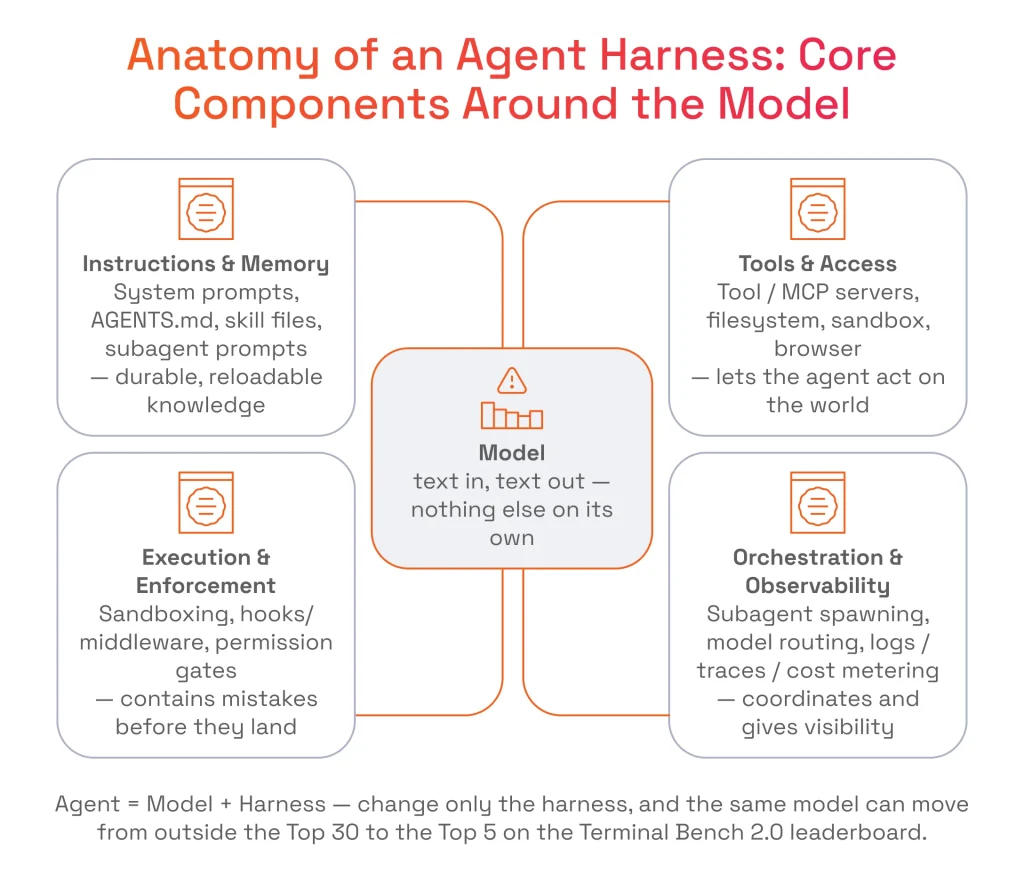
A production harness is not a single prompt file or a light wrapper around an API call. It is a structured, versioned delivery surface maintained directly inside a team’s code repository alongside application software.
Each layer of the harness addresses specific vulnerabilities in agent execution. Several core components exist explicitly to combat context rot — the progressive degradation of model reasoning that occurs as the context window fills up with historical logs, raw file dumps, and repetitive tool outputs. Techniques like compaction, tool-call offloading, and progressive disclosure exist specifically to manage that degradation, not because more context is inherently a problem.
Category | What's In It | What It Solves |
|---|---|---|
Instructions & memory | System prompts, AGENTS.md, skill files, subagent prompts | Gives the agent durable, reloadable knowledge across sessions — models can’t edit their own weights, so this is the only way to “teach” them something new |
Tools & access | Tool and MCP server access and descriptions, filesystem, browser | Lets the agent act on the world beyond generating text — read data, call APIs, verify its own work |
Execution & enforcement | Sandboxing, hooks/middleware, permission gates | Constrains where and how the agent runs, and intercepts specific actions (destructive commands, unreviewed pushes) before they happen |
Orchestration & observability | Subagent spawning, model routing, logs/traces, cost and latency metering | Coordinates multiple agents or models by role, and gives a team visibility into what actually happened |
Category
Instructions & memory
Tools & access
Execution & enforcement
Orchestration & observability
What's In It
System prompts, AGENTS.md, skill files, subagent prompts
Tool and MCP server access and descriptions, filesystem, browser
Sandboxing, hooks/middleware, permission gates
Subagent spawning, model routing, logs/traces, cost and latency metering
What It Solves
Gives the agent durable, reloadable knowledge across sessions — models can’t edit their own weights, so this is the only way to “teach” them something new
Lets the agent act on the world beyond generating text — read data, call APIs, verify its own work
Constrains where and how the agent runs, and intercepts specific actions (destructive commands, unreviewed pushes) before they happen
Coordinates multiple agents or models by role, and gives a team visibility into what actually happened
On SPD Technology’s Claude Code engineering and operations enablement for a US ticketing platform, these layers live in the client’s monorepo: 47 custom skills, 6 subagents, and 19 slash commands turn the team’s conventions into executable workflows, the /feature and /bugfix pipelines stop hard before PR creation, and a test-fidelity guardrail catches AI-written tests with phantom or weakened assertions.
Guardrails, Hooks, and Sandboxing: Precise Terms for a Vague Word
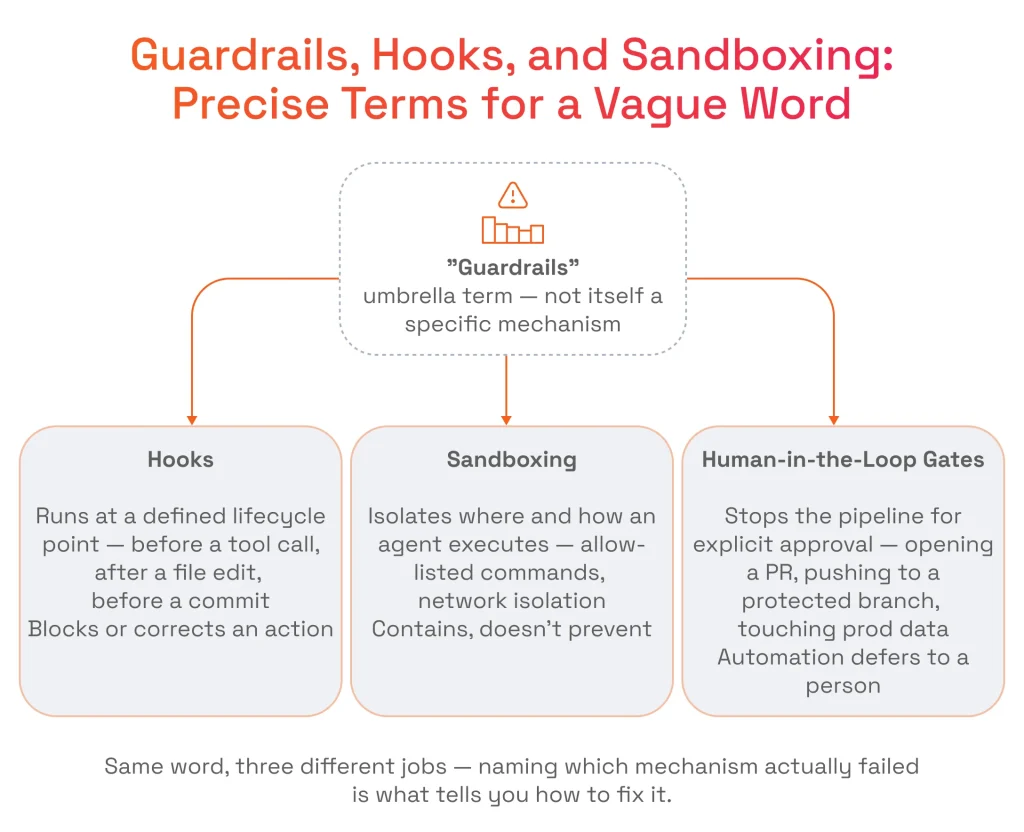
Industry conversations rely heavily on “guardrails” as a catch-all term for keeping agents under control. In software architecture, however, treating guardrails as a single mechanism masks how enforcement actually happens.
Engineers must distinguish between two primary technical mechanisms: hooks and sandboxing. Hooks are deterministic scripts executed at distinct lifecycle points — pre-tool-call, post-file-edit, pre-commit — that intercept an action and either block it or let it through, sometimes after modifying it first. Where a hook stops one action at a time, sandboxing works at a different level: it isolates the whole execution environment through containerization or restricted shell permissions, limiting what the agent can touch on the file system and reach over the network.
Human-in-the-loop gates are a third, distinct mechanism: a deliberate point where automation pauses for a person’s explicit approval on specific action types — opening a PR, pushing to a protected branch, touching production data. Combining deterministic hooks, containerized sandboxing, and calibrated approval gates creates an enforceable security boundary around autonomous agents.
Tool Orchestration: Coordinating Tools, Subagents, and Models
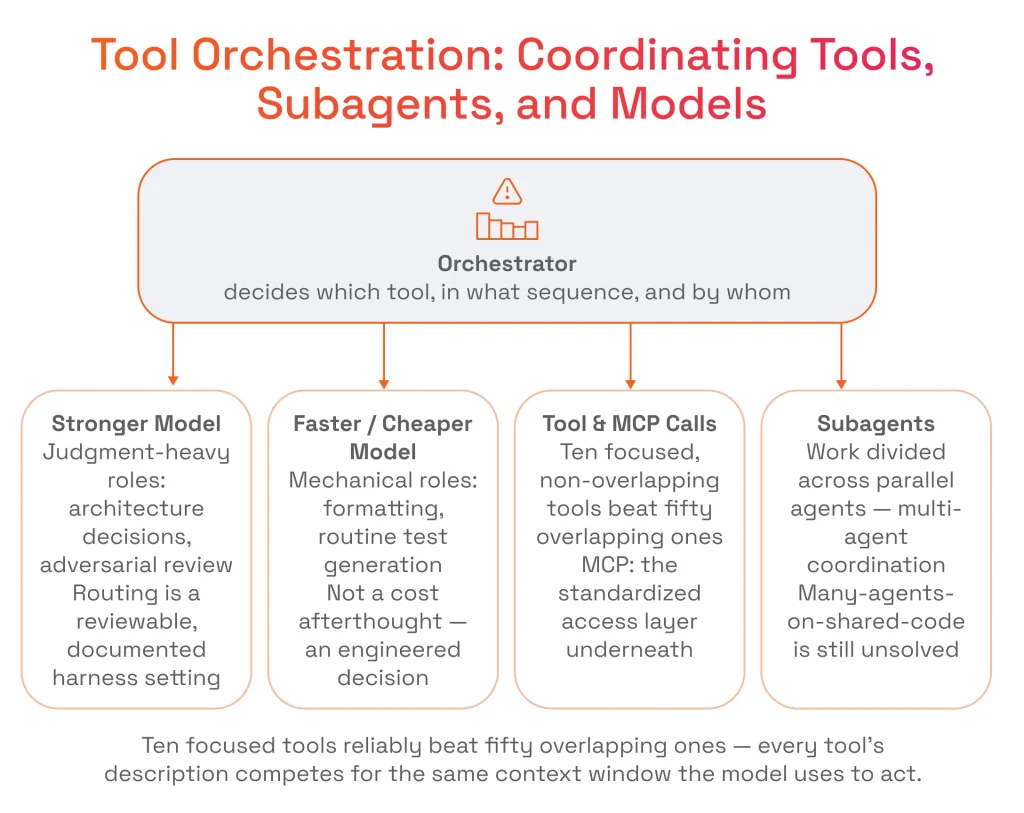
Tool orchestration refers to the harness logic that decides which tools an agent can invoke, the sequence of execution, and how subagents or distinct models divide responsibilities. Granting raw tool access without orchestration logic rapidly degrades agent performance.
Engineering teams frequently make the mistake of overloading an agent with dozens of utilities. Ten well-described, non-overlapping tools outperform fifty overlapping ones because every tool’s name and description eats into the same context-window space the model uses to decide what to call next — more options just means more chances to guess wrong.
Orchestration also governs strategic model routing rather than treating cost management as an afterthought. A well-engineered harness routes complex architectural planning tasks to larger, highly capable models while delegating routine file parsing or unit test execution to smaller, lower-latency models.
Modern harnesses increasingly build on standardized integration specifications like the Model Context Protocol (MCP), giving individual agents a consistent way to reach external tools and data. Coordinating many agents working in parallel across a shared, monolithic repository is a separate problem, and one the industry hasn’t solved yet.
What a Harness Can’t Fix: The Verification Gap
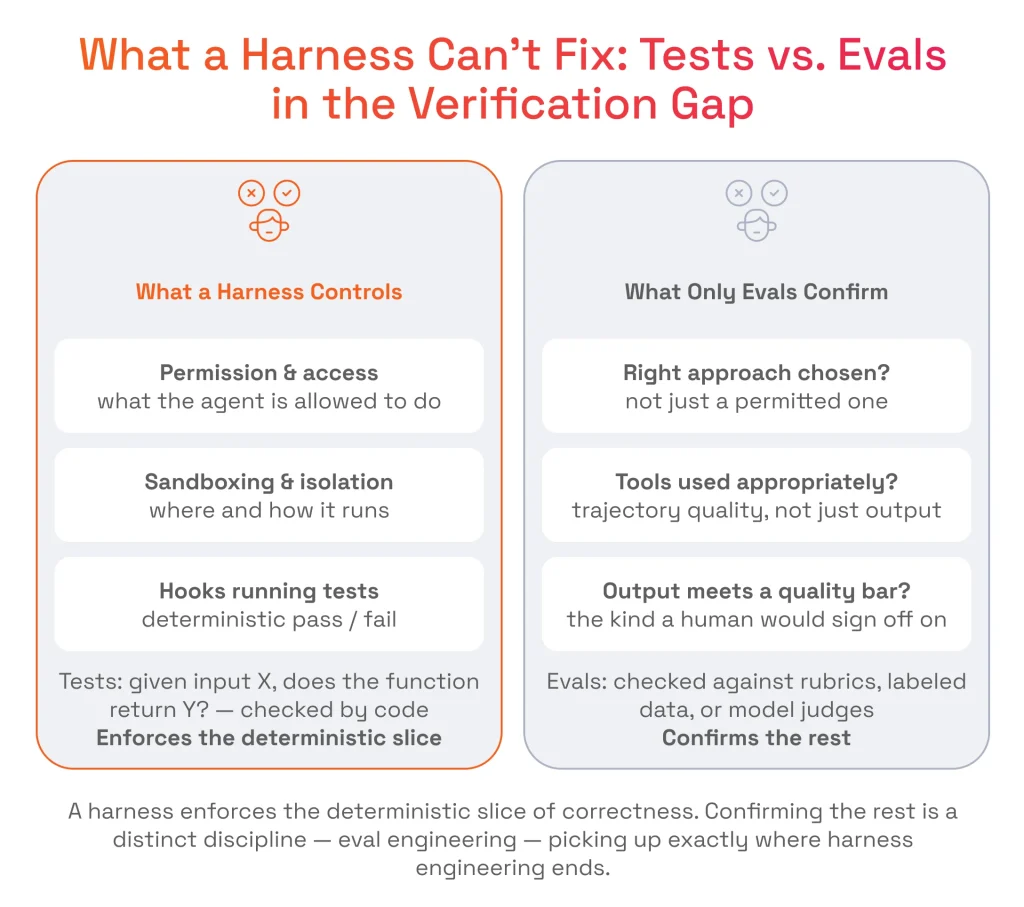
A well-engineered harness effectively restricts what an agent is allowed to do, where it executes, and which APIs it can access. However, no amount of harness engineering can independently verify whether the output the agent generated is logically correct or meets business requirements.
Software architect Birgitta Böckeler categorizes harness responsibilities into maintainability, architectural fitness, and application behavior — the hardest of the three, since it’s the one that asks whether the system actually does what it’s supposed to do. Her own read is cautious: a harness can force an agent to run its tests every time, yet a freshly generated green suite still falls short of proving the system correct.
This limitation marks the boundary between traditional software testing and AI evaluation. Tests check deterministic operations, where a known input has one correct, assertion-checked output. Whether an agent chose a sound approach or actually met a rubric-level quality bar is a different kind of question — and it’s evals that answer it, checked against judge models and curated benchmark datasets rather than a single correct answer.
A harness configured to execute unit tests after every file modification enforces the deterministic slice of correctness. Confirming the broader quality and intent of the solution requires a dedicated eval engineering discipline that begins where the harness hands off.
For how output and trajectory evaluation actually gets built and wired into a release gate, that’s the subject of a companion piece on eval engineering.
Signs Your Harness Needs Engineering, Not a Better Model
When agentic workflows fail, teams often struggle to isolate architectural configuration gaps from model intelligence limitations. Audit your current setup against these common engineering symptoms.
✓ | Symptom | What It Usually Means |
|---|---|---|
☐ | No shared rules file across the team | Each engineer’s agent behaves according to whatever they’ve individually prompted — there’s no team-level configuration at all |
☐ | Output quality visibly varies by who’s prompting | The harness isn’t standardized — it’s living in individual habits, not in versioned configuration |
☐ | The agent keeps “forgetting” the same instruction | The instruction likely isn’t in a file the harness reliably reloads every session — or it’s buried where it doesn’t compete well for attention |
☐ | AGENTS.md (or equivalent) hasn’t changed in months | The harness stopped being treated as a living system — new failures aren’t being converted into new rules |
☐ | Agents have unscoped or production-level access | Execution isolation was never engineered — the harness is relying on the agent simply not doing anything wrong |
☐ | No logs or traces of what an agent actually did on a run | There’s no observability layer — failures get diagnosed from memory instead of evidence |
✓
☐
☐
☐
☐
☐
☐
Symptom
No shared rules file across the team
Output quality visibly varies by who’s prompting
The agent keeps “forgetting” the same instruction
AGENTS.md (or equivalent) hasn’t changed in months
Agents have unscoped or production-level access
No logs or traces of what an agent actually did on a run
What It Usually Means
Each engineer’s agent behaves according to whatever they’ve individually prompted — there’s no team-level configuration at all
The harness isn’t standardized — it’s living in individual habits, not in versioned configuration
The instruction likely isn’t in a file the harness reliably reloads every session — or it’s buried where it doesn’t compete well for attention
The harness stopped being treated as a living system — new failures aren’t being converted into new rules
Execution isolation was never engineered — the harness is relying on the agent simply not doing anything wrong
There’s no observability layer — failures get diagnosed from memory instead of evidence
Checking two or three of these symptoms indicates that harness optimization will yield immediate performance gains without changing models. Reviewing our AI Production-Ready Checklist helps structure these configuration improvements systematically.
How Much Harness Engineering Do You Need? Three Depths
Engineering teams need different levels of harness sophistication depending on system maturity and existing architectural debt. We scope that work across three distinct depths, from a light diagnostic pass on an existing setup to a full build from scratch. Remediating an existing setup is often the fastest entry point: it targets an active operational failure directly, without requiring a complete overhaul.
Depth | What It Looks Like | Best Fit |
|---|---|---|
Embedded | Harness configuration happens as part of a broader build; inherited at project handover | Teams already committed to a full build engagement |
Installed | The harness is built for an existing stack and handed over as a defined, standalone piece of work | Teams that know what they need but lack the bandwidth or specialized experience to build it themselves |
Remediated | An existing harness is diagnosed and repaired — the fastest, lowest-commitment entry point | Teams with an active, already-felt reliability problem, not yet ready to commit to a broader engagement |
Depth
Embedded
Installed
Remediated
What It Looks Like
Harness configuration happens as part of a broader build; inherited at project handover
The harness is built for an existing stack and handed over as a defined, standalone piece of work
An existing harness is diagnosed and repaired — the fastest, lowest-commitment entry point
Best Fit
Teams already committed to a full build engagement
Teams that know what they need but lack the bandwidth or specialized experience to build it themselves
Teams with an active, already-felt reliability problem, not yet ready to commit to a broader engagement
Navigating the path from MVP to production in 90 days requires establishing these permission boundaries early. As systems expand, scaling from MVP to platform relies heavily on standardized, repo-level agent controls.

Serhii Leleko
AI & ML Engineer at SPD Technology
“The mistake teams make is treating autonomy as one global setting — either the agent asks before every action, or it doesn’t. What we call calibrated autonomy at SPD Technology scopes that decision per task: an agent earns the right to act without review only where the verification around that specific task is actually strong enough to catch it if it’s wrong. A task with weak verification gets a permission gate regardless of how well the agent has performed elsewhere.”
Getting Started: A Practical First Step
The practical starting point for agent harness engineering is a targeted audit of a single, active agent workflow your team already uses — not a hypothetical one. Identify every recurring failure or manual intervention that occurred over the past month.
The most effective initial harness improvement is often the simplest: take one correction you’ve made to an agent by hand and turn it into an explicit AGENTS.md rule or a pre-commit hook. The next time that same situation comes up, the agent gets it right without anyone stepping in.
MIT Sloan Management Review and Boston Consulting Group’s joint research on agentic AI adoption found that organizations moving from pilot to production consistently underinvest in the oversight and architecture work needed to trust what an agent produces, not in the model choice itself. Addressing the risks of scaling AI MVP development starts by replacing ad-hoc prompting with explicit harness design.
Our Expertise
SPD Technology treats harness engineering as a defined, deliverable capability — not a byproduct of building agents, but a specific piece of work with its own scope: a versioned configuration in the client’s own repository covering rules, tool and MCP access, sandbox boundaries, and model routing, plus the documentation a team needs to operate and extend it themselves.
- A harness is delivered as a versioned configuration in the client’s own repository — rules and instructions, tool and MCP access, sandbox boundaries, orchestration and model routing — not a one-off setup that lives in someone’s head.
- Autonomy is calibrated to task risk rather than granted uniformly: what an agent is allowed to do without review scales with how strong the verification around that task actually is.
- Model routing is engineered per role, not left to default: judgment-heavy work runs on stronger models, mechanical work runs on faster and cheaper ones, and the routing itself is a reviewable, documented setting.
- Harness work is available at the depth a team actually needs — folded into a larger build, delivered as a standalone install, or scoped narrowly to diagnose and repair a harness that’s already producing unreliable behavior.
- Harness engineering is treated as the first half of a two-part discipline — it constrains what an agent may do; a paired verification practice is what confirms whether what it did was right.
Answering key questions investors ask about AI development requires demonstrating this level of architectural discipline and operational predictability.
Conclusion
Inconsistent agent behavior is usually a harness problem wearing a model problem’s clothes. The model supplies raw reasoning; the harness decides what it’s allowed to touch and which tools it can call, with the guardrails set around both.
A well-engineered harness constrains what an agent can do, but it stops short of confirming that what it did was right. Closing that gap falls to a separate, still-maturing practice — eval engineering — that only starts once the harness’s job is done.
Key Takeaways
- “Agent = Model + Harness” means the model is one input into an agent’s behavior, not the whole explanation for it — which is why the same model can perform very differently across two teams’ setups.
- A team publicly moved a coding agent from outside the top 30 into the top 5 on the Terminal Bench 2.0 leaderboard by changing only the harness, with the underlying model held constant — direct evidence that configuration, not model capability, was the binding constraint.
- “Guardrails” is a useful conversational word and an imprecise engineering one — hooks, sandboxing, and permission gates are the actual mechanisms that do the enforcing, and naming which one is doing the work changes how you’d fix a failure.
- Ten focused, non-overlapping tools reliably outperform fifty overlapping ones, because every tool’s description competes for the same limited context-window space the model uses to decide what to do next.
- A harness that runs tests on every change has enforced the deterministic slice of correctness; confirming the agent’s approach, tool choices, or output quality requires evals, a distinct discipline.
- An AGENTS.md or rules file that hasn’t changed in months usually means the team stopped treating the harness as a living system — new failures aren’t being converted into new constraints, so the same mistakes recur.
- Harness engineering is a discipline you configure once and then have to keep configuring — every fixed failure should become a permanent rule, hook, or access change, not a one-time patch.
In short: Focus on engineering the surface you control — the harness — before assuming your agent’s limitations stem from the foundation model.
Frequently Asked Questions
What’s the difference between a harness and an agent framework?
An agent framework (like LangGraph, AutoGen, or CrewAI) supplies the abstractions and runtime primitives for building agentic software. The harness is the specific, versioned configuration of those primitives for a given repository or task: its exact system prompts, tool schemas, file access boundaries, hook scripts, and routing logic. Swap the framework under an unchanged harness and the configuration usually survives intact; swap the harness under an unchanged framework and agent behavior can look completely different.
Is harness engineering the same as prompt engineering?
Prompt engineering is one input into a harness among several — tool access, execution environment, enforcement hooks, memory, and orchestration all sit alongside it, and none of those are things a prompt alone can control. A well-written system prompt or AGENTS.md file is part of the instructions layer of a harness, but a team can have an excellent prompt and still get unreliable agent behavior if the surrounding harness isn’t engineered with the same care.
What is AGENTS.md and why does it matter for harness engineering?
AGENTS.md is a plain-text rules file checked into a repository’s root — the harness’s main way of giving an agent durable, reloadable instructions: coding conventions, things it should never touch, commands to run before it calls a task done. Skip it, and an agent falls back on generic model pretraining every session, which is exactly how it ends up violating conventions nobody ever told it about.
Can a better model fix a bad harness?
A more capable model can interpret ambiguous instructions more skillfully, or recover from a minor error on its own — but it can’t override a structural gap in the harness. Give it a tool it was never granted access to and it still can’t call it; put a rule in front of it that was never loaded into its context window and it still won’t follow it. Upgrading the model usually just masks a harness flaw for a while, without resolving the reliability problem underneath.
Do guardrails and hooks mean the same thing?
No. “Guardrails” is a broad umbrella term describing any constraint or boundary placed on an agent’s behavior. Underneath that umbrella, hooks work as one specific enforcement mechanism — event-driven scripts or middleware that run at precise points in the agent’s lifecycle, such as before a tool call or after a file edit, to inspect, approve, modify, or block an action deterministically.
Does a well-engineered harness guarantee an AI agent’s output is correct?
No. A well-engineered harness controls what an agent is permitted to do and structures how it executes tasks, drastically reducing unsafe or out-of-bounds behavior. However, confirming that the agent’s generated code, logic, or content is semantically correct requires a separate verification discipline — evaluation engineering — utilizing deterministic test execution, LLM-as-judge rubrics, and trajectory analysis.