An investor-ready MVP depends on whether specific qualities of the build can be proven. These qualities include graceful error handling, automated test coverage on core workflows, active monitoring, documented architecture, baseline security practices, and a reliable deployment pipeline. Using artificial intelligence to accelerate initial development is generally accepted by modern venture investors. Y Combinator has noted that a noticeable portion of startups in a recent cohort operated with codebases generated almost entirely through AI. The primary operational risk stems from an inability to verify what was actually shipped. Technical founders establish this verification by directly reading their source code. Non-technical founders require an alternative approach: a structured audit trail comprising records of build steps, automated tests, security scans, and peer reviews that an independent technical advisor can evaluate directly.
You have built a working prototype using AI generation tools, a freelance engineer, or an early technical co-founder. With a fundraising round on the horizon, you need to know what technical due diligence requires and how to confirm your product meets those expectations when you cannot personally audit the codebase.
Strong advice already exists regarding the core areas evaluated during technical due diligence. However, most existing guidelines assume that a founder can personally read, interpret, and explain every line of underlying code. That assumption fails for non-technical founders who cannot acquire deep engineering skills before meeting with investors. This guide outlines the standard technical due diligence checklist and explains how to demonstrate technical readiness through verifiable evidence.
Why “Built with AI” Isn’t the Red Flag Anymore
Using artificial intelligence to write software code fast no longer alarms institutional investors during initial fundraising conversations. Y Combinator’s own managing partner has said publicly that a quarter of its Winter 2025 batch had codebases where 95% of the code was AI-generated, and he framed it as evidence of highly technical founders moving faster, not as a shortcut to worry about. Investors view capital efficiency and rapid iteration as positive indicators when evaluating early-stage teams.
The actual concern for venture capitalists and their technical reviewers centers on poor construction practices and an inability to explain how the software operates under stress. Shipping software created through generative prompts is acceptable, but failing to verify its structural integrity exposes the business to operational risk. Proving that a product functions reliably, handles user data safely, and scales predictably matters far more than whether a human or an algorithm typed the lines of code. For a non-technical founder MVP, producing independent proof of quality replaces the need to personally read every line of the repository. Reviewing the standard questions investors ask about AI development helps clarify how evaluation criteria have shifted toward verifiable operational evidence.
The Technical Due Diligence Checklist: What Investors’ Advisors Actually Check
When investors conduct AI-built MVP due diligence, they typically retain an experienced engineering advisor to audit the product. This technical review evaluates specific operational and structural standards to confirm the software can support commercial growth.
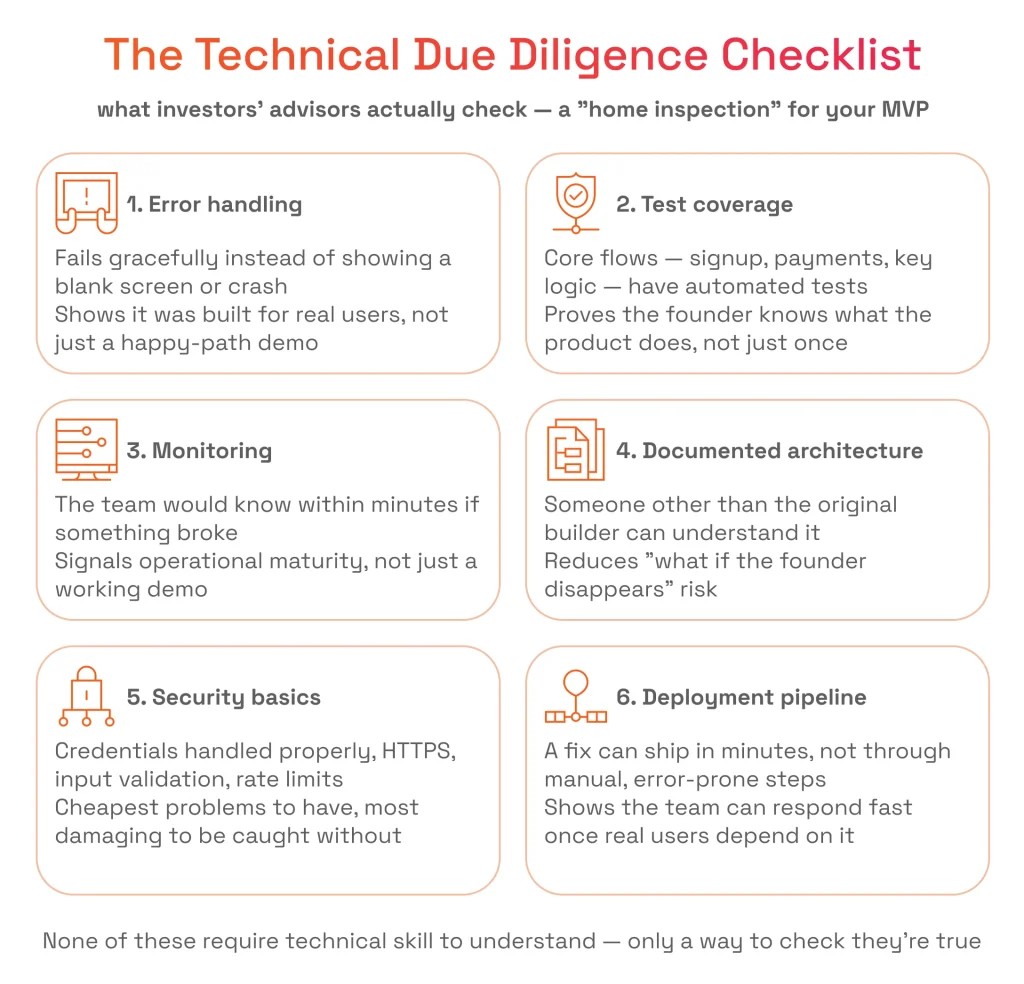
This evaluation framework reflects six core engineering areas identified in Vibe Coder Blog’s “How to Evaluate Whether Your AI-Built MVP Is Investor-Ready” as the standard focus of technical due diligence reviews. These six categories outline what an investor’s technical reviewer will inspect when evaluating your codebase.
Area | What It Actually Means | Why It Matters to Investors |
|---|---|---|
Error handling | The app fails gracefully instead of showing users a blank screen or crash | Shows the product was built for real users, not just a happy-path demo |
Test coverage | Core flows (signup, payments, key business logic) have automated tests | Proves the founder knows what the product actually does, not just that it appeared to work once |
Monitoring | The team would know within minutes if something broke, not from a user complaint | Signals operational maturity, not just a working demo |
Documented architecture | Someone other than the original builder could understand how it’s put together | Reduces the “what happens if the founder disappears” risk technical advisors specifically look for |
Security basics | Credentials handled properly, HTTPS, input validation, rate limiting in place | These are the cheapest problems to have and the most damaging to be caught without |
Deployment pipeline | A fix can ship in minutes, not through manual, error-prone steps | Shows the team can respond to problems quickly once real users depend on the product |
Area
Error handling
Test coverage
Monitoring
Documented architecture
Security basics
Deployment pipeline
What It Actually Means
The app fails gracefully instead of showing users a blank screen or crash
Core flows (signup, payments, key business logic) have automated tests
The team would know within minutes if something broke, not from a user complaint
Someone other than the original builder could understand how it’s put together
Credentials handled properly, HTTPS, input validation, rate limiting in place
A fix can ship in minutes, not through manual, error-prone steps
Why It Matters to Investors
Shows the product was built for real users, not just a happy-path demo
Proves the founder knows what the product actually does, not just that it appeared to work once
Signals operational maturity, not just a working demo
Reduces the “what happens if the founder disappears” risk technical advisors specifically look for
These are the cheapest problems to have and the most damaging to be caught without
Shows the team can respond to problems quickly once real users depend on the product
Understanding these categories conceptually is straightforward for most founders. The primary challenge for a non-technical founder is establishing a reliable method to confirm that their software actually meets these criteria without inspecting the code themselves. Referencing an AI Production-Ready Checklist helps structure these technical standards into clear, actionable requirements.
The Gap This Checklist Doesn’t Solve: What If You Can’t Check It Yourself?
Standard engineering checklists offer clear benchmarks for production readiness. However, they implicitly assume that the founder possesses the software engineering skills required to audit the repository, run test suites, and evaluate security configurations personally.
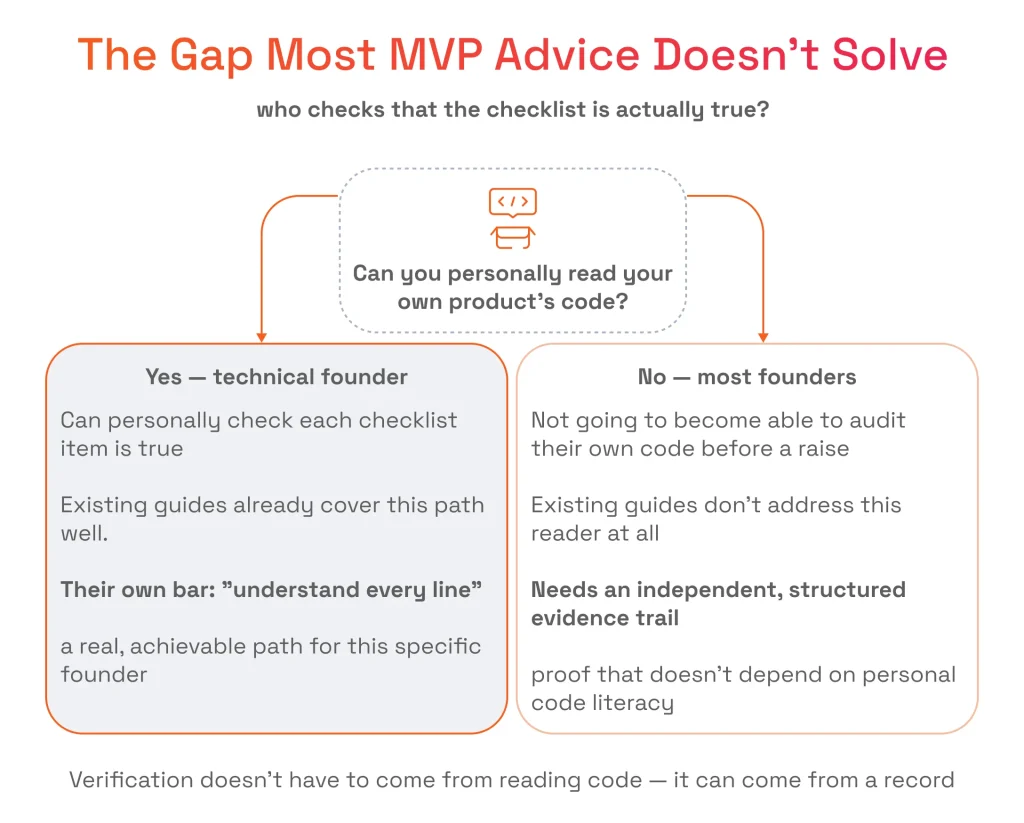
This assumption presents a practical barrier for non-technical founders. Learning full-stack software development, infrastructure management, and application security while managing operations and fundraising is unfeasible. Attempting a rapid crash course in code reading immediately prior to investor meetings rarely yields the depth needed to answer granular technical questions from an experienced advisor.
Verification can be achieved without the founder reading the source code directly. Our guide on how to trust software you can’t read walks through exactly this approach — an independent, structured record of build steps, automated test runs, and security audits that gives an investor’s technical reviewer the concrete evidence they need.
This distinction becomes critical when addressing the common structural gaps found in early software prototypes. Generative tools excel at rapidly assembling user interfaces and primary features. The remaining, less visible requirements—such as error boundaries, rate limiting, and automated regression tests—are frequently omitted during initial build phases. Addressing these hidden elements converts a fragile prototype into a resilient product.
From Prototype to Investor-Ready: What Actually Has to Change
Informal software construction, often called vibe coding, relies on rapid, prompt-driven iteration to build working visual prototypes quickly. At this stage, the prototype should function as a minimum viable product for market validation, not just concept demonstration. That means pairing user research with conversations with potential users, including user interviews to identify pain points before investing heavily.
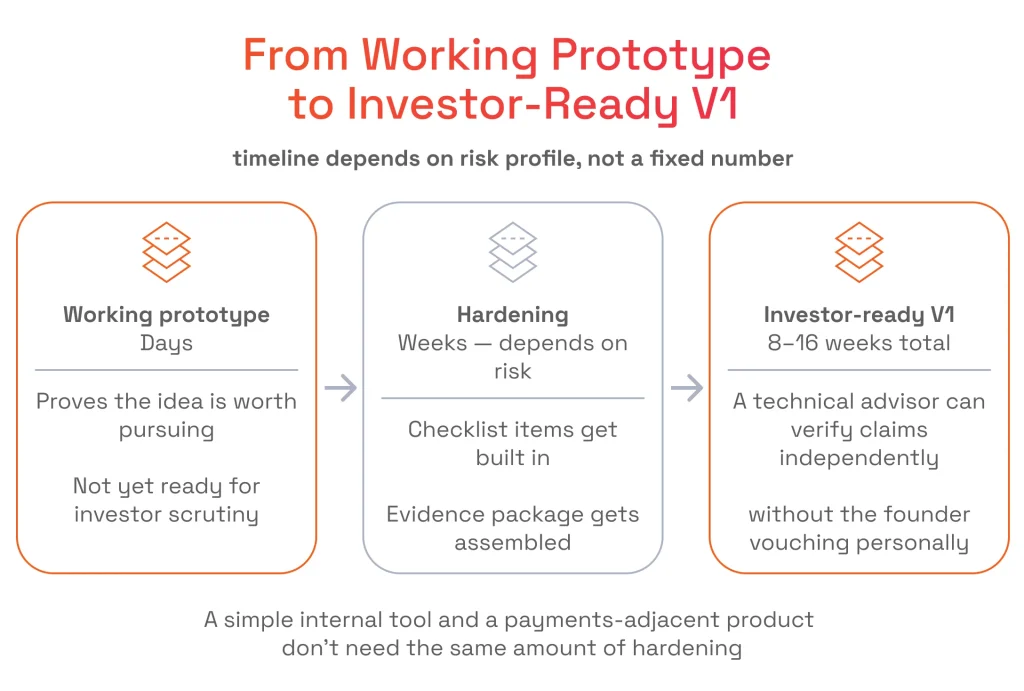
When transitioning from concept validation to institutional fundraising, the development approach must become more structured. Achieving an investor-ready MVP requires a clearer product strategy that prioritizes essential features and must-have features, for example through the MoSCoW method, while avoiding unnecessary features such as custom branding. This kind of minimum viable product can validate market demand in 8–12 weeks before full development begins, while a spec-first engineering process generates automated test logs, architecture documentation, and review records during delivery.
This transition does not require discarding early work or slowing down product delivery. Implementing structured specifications and automated checks allows engineering teams to maintain high output while generating the verification trail required by investors. Following established guidelines for building an AI-driven MVP ensures that speed and architectural stability are maintained simultaneously.
For the engineering discipline behind this distinction, see spec-first development for AI-assisted engineering.
The Evidence Package: What to Have Ready Before a Technical Reviewer Asks
Practitioner guides such as Vibe Coder Blog emphasize that founders should present concrete evidence—including operational dashboards, error logs, and test results—to support investor readiness and strengthen each investor conversation rather than relying solely on verbal assertions during technical reviews.
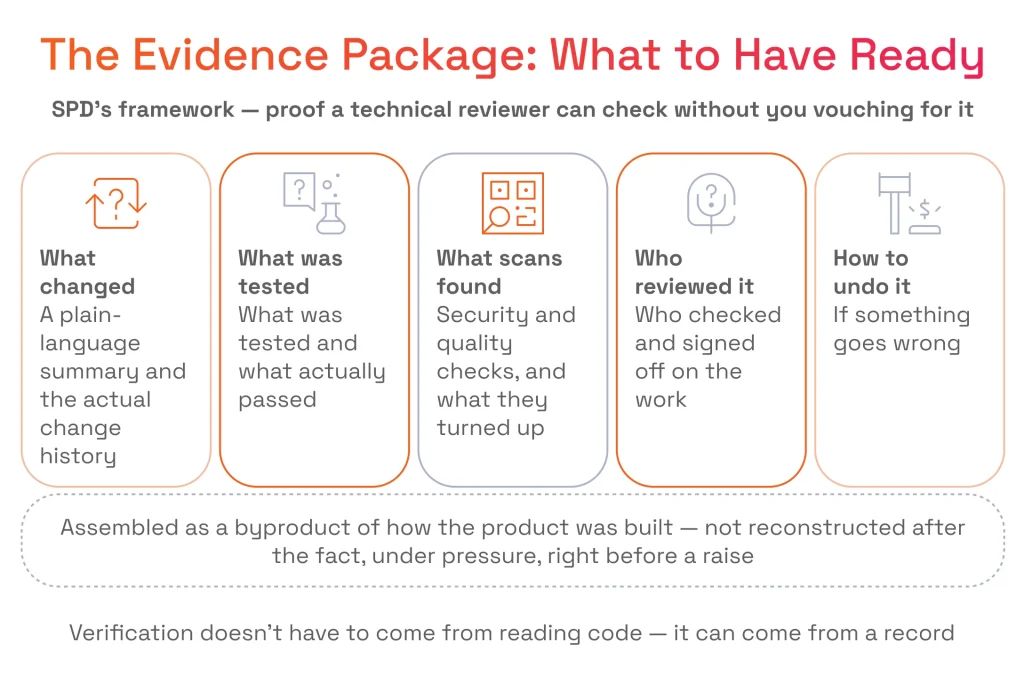
To meet this standard, SPD Technology uses an evidence package framework. This documentation bundle is produced continuously during development rather than compiled hastily before due diligence. It includes a plain-language summary of code changes, automated test results, security scan logs, peer review sign-offs, clear rollback procedures, a pitch deck, and a concise dashboard linked to raw data alongside test results and logs.
Providing this compiled record allows a non-technical founder to satisfy technical due diligence requirements through verified documentation rather than personal code inspections. It also helps present growth metrics clearly, while records of architecture decisions and a compact technical footprint reduce perceived risk for reviewers and can improve investor interest.

Serhii Leleko
AI & ML Engineer at SPD Technology
“The thing a technical reviewer actually asks for isn’t a walkthrough of the code — it’s a record. What changed, what was tested, what a security scan flagged, who signed off. If that record exists as a byproduct of how the product was built, a founder who’s never read a line of it can still hand over something a reviewer trusts.”
Red Flags a Technical Advisor Will Actually Look For
Technical reviewers evaluate software repositories for systemic architectural flaws and maintainability issues. Identifying these issues early prevents unexpected delays during investor due diligence.
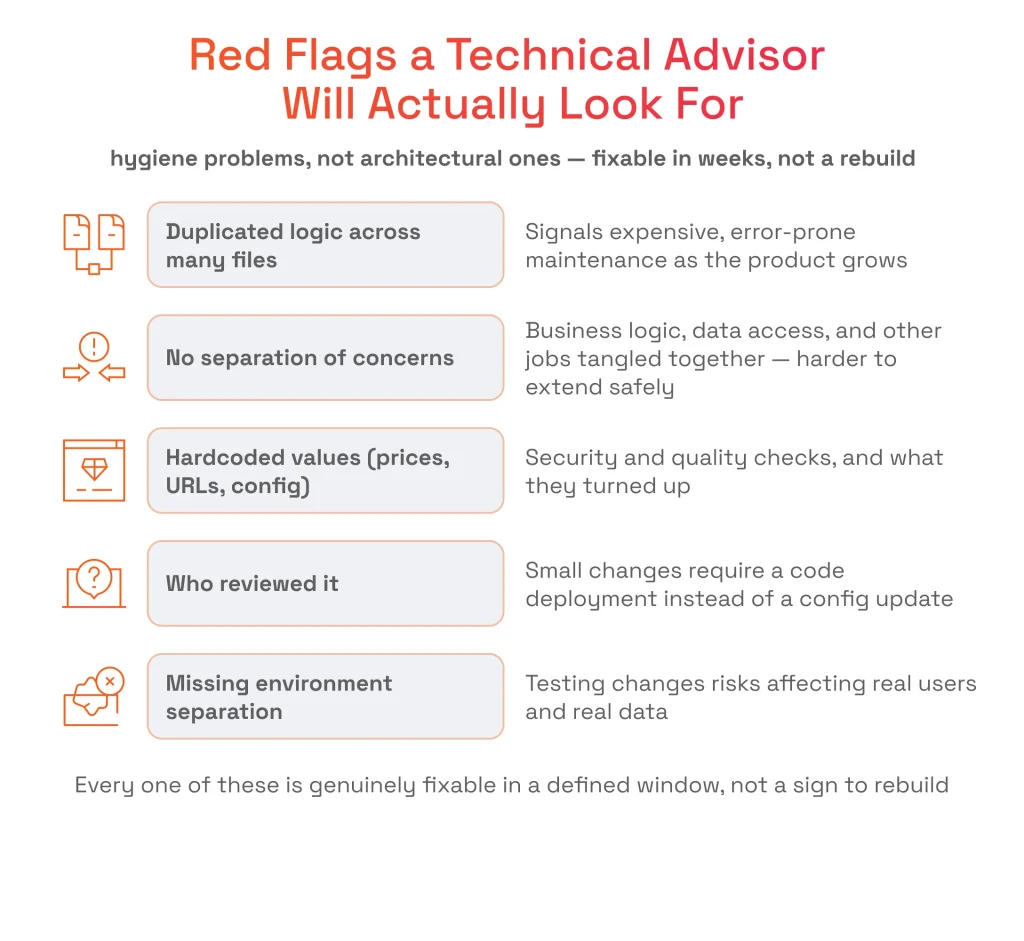
The red flags outlined below represent common structural deficiencies that technical advisors regularly flag when auditing early-stage software applications.
Red Flag | Why It Concerns a Reviewer |
|---|---|
Duplicated logic across many files | Signals expensive, error-prone maintenance as the product grows |
No separation of concerns | Business logic, data access, and other responsibilities tangled together makes the codebase harder to extend safely |
Hardcoded values (prices, URLs, config) | Small changes require a code deployment instead of a configuration update |
Missing environment separation | Testing changes risks affecting real users and real data |
No error boundaries | A single broken component can take down an entire page or feature |
Red Flag
Duplicated logic across many files
No separation of concerns
Hardcoded values (prices, URLs, config)
Missing environment separation
No error boundaries
Why It Concerns a Reviewer
Signals expensive, error-prone maintenance as the product grows
Business logic, data access, and other responsibilities tangled together makes the codebase harder to extend safely
Small changes require a code deployment instead of a configuration update
Testing changes risks affecting real users and real data
A single broken component can take down an entire page or feature
These engineering deficiencies reflect code hygiene issues rather than fundamental architectural failures. Experienced development teams can resolve these issues within defined remediation windows without rebuilding the application from scratch. Understanding why AI-generated code breaks in production helps founders identify and fix these hidden vulnerabilities before formal technical reviews begin.
What “Investor-Ready” Actually Takes: Timeline and Effort
Preparing a software product for technical due diligence requires a phased engineering approach. The initial build is MVP development: a functional version with core features that demonstrates viability before the hardening phase implements testing, security, and monitoring safeguards.
The total time required for this process varies based on the product’s underlying complexity and risk profile. An internal administrative dashboard requires significantly less hardening effort than a platform processing financial transactions or sensitive personal data. In many cases, an MVP can be built and launched in 6–12 weeks to gather user feedback before the longer investor-ready hardening path is complete.
Stage | Typical Timeframe | What It Proves |
|---|---|---|
Working prototype | Days | The idea is worth pursuing — not yet ready for investor technical scrutiny |
Hardening | Weeks, depending on the product’s risk profile | The checklist items in this article are actually true, not assumed |
Investor-ready V1 | 8–16 weeks total, idea to production-ready | A technical advisor can verify claims independently, without the founder vouching personally |
Stage
Working prototype
Hardening
Investor-ready V1
Typical Timeframe
Days
Weeks, depending on the product’s risk profile
8–16 weeks total, idea to production-ready
What It Proves
The idea is worth pursuing — not yet ready for investor technical scrutiny
The checklist items in this article are actually true, not assumed
A technical advisor can verify claims independently, without the founder vouching personally
Moving systematically from an initial idea to investor-ready V1 ensures that safety and quality controls are integrated cleanly into the codebase, often delivering cost savings and reducing initial development costs by 60–80% versus a full build. Managing the risks of scaling AI MVP development allows engineering teams to avoid costly technical debt while maintaining rapid delivery schedules at minimal cost. A well-executed investor-ready MVP can also help impress investors and, in some cases, support fundraising outcomes above $2 million.
Investor-Ready Minimum Viable Product Checklist
-
Error handling, test coverage, monitoring, documentation, security basics, and a deployment pipeline are all in place — confirming the product would survive the standard technical due diligence checklist, while its key features and core value are visible in the MVP, not just technically stable.
-
Each of the above can be evidenced, not just described from memory — confirming claims about the product don’t rest entirely on the founder’s recollection.
-
No major red flags (duplicated logic, mixed concerns, hardcoded values, missing environments, no error boundaries) are present — confirming the codebase won’t raise immediate concerns in a technical advisor’s first pass.
-
Someone other than the founder has reviewed and confirmed the above — confirming verification doesn’t depend entirely on the founder’s own technical judgment.
-
There’s a record of what changed, what was tested, and what was reviewed over time, with success criteria and success metrics defined in advance for engagement, time-to-value, and activation, including a 20% activation rate as one useful benchmark tied to investor interest — confirming a technical advisor has something concrete to check instead of a verbal summary.
-
The founder can explain the trade-offs made, even without having written the code — confirming investors can tell the difference between a founder who understands their product and one repeating what a tool told them.
-
A rollback or recovery plan exists if something breaks after launch — confirming operational thinking beyond just getting the product built.
Our Expertise
An asset and wealth-management client required functional matching technology on an accelerated timeline to support active investor fundraising discussions. To meet this objective, SPD Technology engineered an AI/ML smart-search matching engine utilizing vector embeddings, paired with a custom web-crawling mechanism built within one week using Apify. The resulting MVP was delivered on time and within budget, enabling the client to navigate their fundraising process with verified technology.
Rapid execution and rigorous quality standards remain fully compatible when supported by structured development practices. A separate AI-driven product—an AI shopping assistant—was validated in three days with approximately $25 in tooling expenses using Replit, showing how MVPs can reduce initial development costs by 60–80% when scope stays narrow.

This engagement demonstrated that low-cost initial validation worked because analytics were integrated to track user behavior, feedback mechanisms were built into the product to collect feedback and gather real user feedback after launch, and production-grade engineering followed the same underlying discipline.
- MVPs are built against formal specifications, with code reviews and technical evidence generated continuously throughout the development process.
- Analytics should be embedded early to monitor real user behavior, capture engagement rates, and review retention metrics as core proof points.
- Technical due diligence criteria are integrated directly into early engineering workflows as mandatory delivery requirements.
- Post-launch support should continue after release so the team can gather feedback, review real usage data, and iterate responsibly.
- Founders receive comprehensive architecture documentation and audit trails designed for direct submission to institutional technical reviewers.
Conclusion
Being investor-ready means that specific technical standards regarding application stability, test coverage, and security can be verified independently. Demonstrating this quality does not require non-technical founders to read or audit source code personally.
The most effective path to technical readiness involves evaluating the application against standard due diligence benchmarks with the assistance of experienced engineers. Establishing a clear evidence trail ensures that your software withstands investor scrutiny while you focus on driving business growth.
Key Takeaways
- Using AI tools to build fast is no longer a red flag to investors — Y Combinator’s own data shows a real share of a recent batch’s codebases were almost entirely AI-generated — but not being able to prove what was actually shipped still is.
- The technical due diligence checklist that matters doesn’t require technical skill to understand — it requires a way to verify it that doesn’t depend solely on the founder’s own judgment.
- A founder who cannot personally read their own codebase cannot meet the bar most AI-built-MVP advice sets (“understand every line”), which means verification has to come from an independent source, not a personal crash course before a raise.
- Duplicated logic, mixed responsibilities, hardcoded values, missing environment separation, and missing error boundaries are hygiene problems, not architectural ones — fixable in a defined window rather than requiring a rebuild.
- “Bring receipts” — dashboards, error rates, passing tests — is a good instinct but stops short of a structured evidence trail; the difference is between anecdotal proof and something a technical advisor can check independently.
- A fast initial prototype and a rigorous, evidence-backed final build aren’t in tension — one real engagement validated an MVP in three days for roughly $25, while a separate engagement delivered a fundraising-ready MVP on time and on budget using the same discipline.
- A fixed, one-size timeline for reaching “investor-ready” can’t account for how much hardening a specific product needs — a payments-adjacent product and a simple internal tool don’t clear the same bar at the same pace.
In short: Investor-ready means provable, not just working — and that proof has to be able to stand without the founder personally vouching for it.
FAQ
Do investors care if my MVP was built with AI tools?
Not on its own — Y Combinator has publicly noted that a real share of a recent batch’s startups had codebases that were almost entirely AI-generated, and investors increasingly view fast, capital-efficient building as a strength rather than a shortcut. What investors and their technical advisors actually care about is whether the founder understands what was built and can prove it holds up: proper error handling, test coverage on core flows, basic security, and a way to fix problems quickly. Being unable to answer those questions is the actual red flag, not the tool used to build the product.
What is technical due diligence, and what does it actually check?
Technical due diligence is a review, usually by a technical advisor working for an investor, that checks whether a product’s underlying code and architecture can support the business the founder is pitching. In practice, it checks a fairly consistent set of things: whether the app handles errors gracefully, whether core flows like signup and payments are tested, whether the team would know quickly if something broke in production, whether someone other than the original builder could understand the architecture, whether basic security practices are followed, whether a fix can be deployed quickly, what kind of technical foundation is in place, whether the tech stack is sensible, and whether scalable technologies were chosen with restraint. None of these require the founder to be a programmer to understand concepts, but they do require a way to verify each one is actually true, and investors value a compact technical footprint to reduce risk.
What if I can’t read code and can’t personally verify my MVP is technically sound?
This is a real and common situation, and the solution isn’t necessarily learning to code before a raise — it’s having someone else verify the product against the standard checklist and produce a record you can hand to a technical advisor. That record should cover what was built, what was tested, what security and quality checks were run, and who reviewed it, assembled as part of how the product was built rather than put together under pressure right before due diligence starts. The goal is proof that doesn’t depend on the founder’s own ability to read the codebase.
How is a vibe-coded prototype different from an investor-ready MVP?
A vibe-coded prototype is built fast and informally, usually through iterative AI prompting, with the specific goal of proving an idea is worth pursuing — a legitimate, valuable stage, not something to apologize for. An investor-ready MVP has cleared a higher, more specific bar: it is a functional version built around the core value proposition, with error handling, test coverage, security, monitoring, and documentation actually in place, usually because it was built against a defined specification with review and evidence built in along the way, rather than purely through prompting. The user journey should be mapped so people can reach the primary goal in minimal steps and with low acquisition friction. The two aren’t opposites; investor-ready is usually the next stage after a prototype has validated the idea. A value-driven dashboard can surface the product’s core benefit immediately in investor demos and early user testing.
What are the most common technical red flags that concern investors’ technical advisors?
The most common patterns are duplicated logic scattered across many files, expensive to maintain as the product grows; business logic and data access mixed together with no separation; hardcoded values like prices or URLs baked directly into the code; development and production environments that behave identically or share the same data; and missing error handling that lets one broken piece take down an entire page. Every one of these is a fixable hygiene issue rather than a sign the product needs to be rebuilt from scratch, typically addressable in a matter of weeks rather than months.
How long does it actually take to get an MVP to investor-ready?
There’s no single honest answer, despite what fixed-timeline agency offers suggest — it depends on how much hardening the specific product needs, which depends on its risk profile. A simple internal tool needs far less scrutiny than anything touching payments or personal data. As a general shape: an initial working prototype can take days, hardening it against the standard technical due diligence checklist typically takes several weeks, and a full idea-to-investor-ready-V1 timeline is commonly in the range of 8 to 16 weeks depending on scope.
How much does it cost to make an AI-built MVP investor-ready?
Cost follows the same logic as timeline: it depends on how much hardening the product’s risk profile actually needs, not on a flat per-project rate. A simple internal tool with no payment or personal data flowing through it costs far less to harden than anything payments-adjacent, where security scanning, audit logging, and compliance checks add real scope. The honest way to estimate it is the same checklist above — every gap between what exists and what’s provable is a line item, not a guess.