

Highlights
- AI-powered incident management solution — Incident Pilot — automates detection, analysis, and resolution of production incidents
- Cuts response time from 60+ minutes to under 30 minutes to pull request-ready fix
- Eliminates the need for 24/7 on-call engineering support, contributing resource optimization
- Handles incidents autonomously across time zones, ensuring continuous incident management
- Achieves up to 70% successful AI resolution rate with continuous improvement
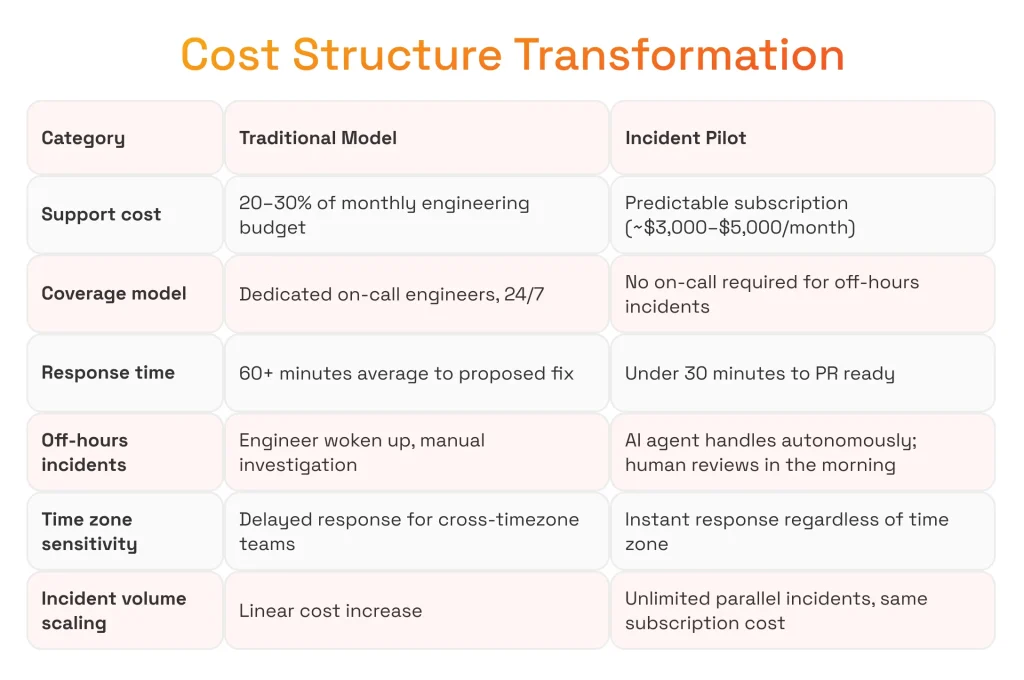
- Transforms support cost model from 20–30% of engineering budget to predictable subscription
- Built on Claude Code as the AI engineering layer — one agentic core powers automated code review, incident response, and feature development across the SDLC
- Automated code review in the CI/CD pipeline — every pull request is reviewed by the agent before human sign-off
- Deep toolchain integration via MCP — native Jira and Sentry connections let the agent read production context and act in the tools the team already uses
- Slack-triggered development workflows — engineers kick off agent tasks directly from chat
How it was built
Incidents do not follow business hours, and a manual response chain (alert, engineer wakes up, reads context, investigates, writes a fix) costs time and 20-30% of the engineering budget in support contracts. SPD Technology built Incident Pilot, an AI agent that plugs into the client’s existing toolchain and manages the incident lifecycle.
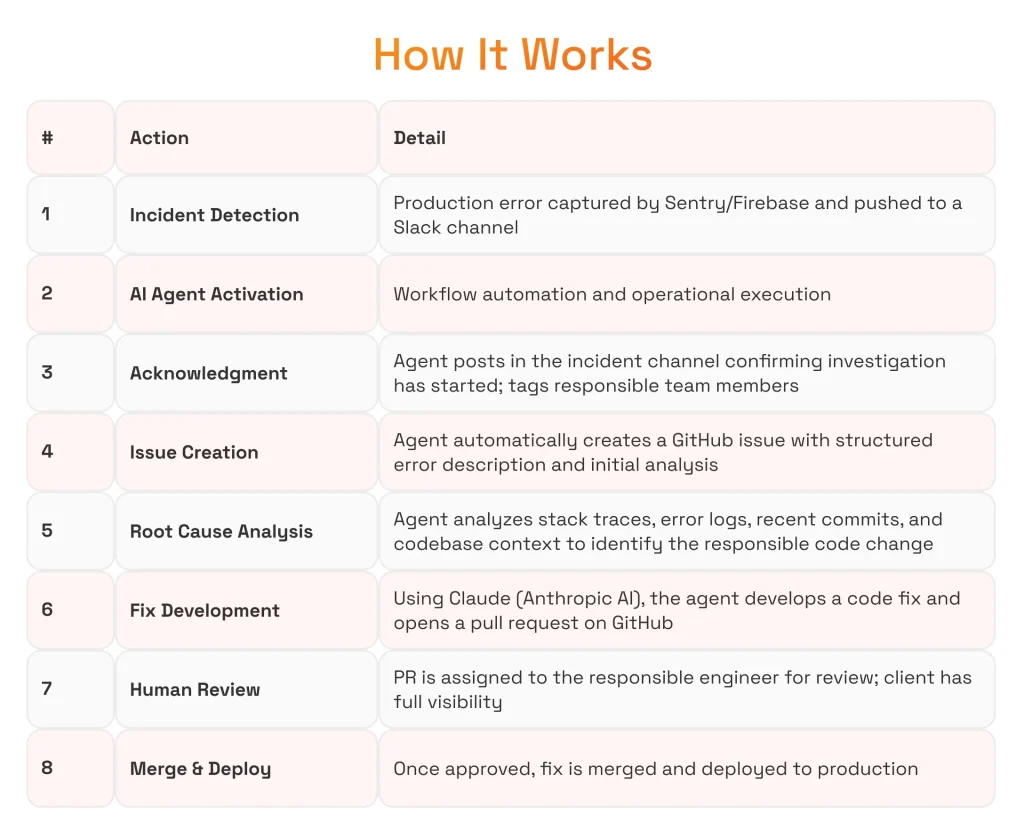
- Mirror the human workflow. The agent detects the error, acknowledges it, creates an issue, analyzes the root cause, develops a fix and opens a pull request.
- Keep humans in the loop. The agent never merges code on its own: every fix goes through standard human code review.
- Reduce noise. Deduplication and alert grouping show engineers only unique, actionable incidents; repeated errors are tracked silently and surfaced when frequency spikes.
- Claude Code as the AI engineering layer. Each repository gets a CLAUDE.md file with its architecture, conventions and runbooks, plus custom skills and commands. Jira and Sentry are connected through MCP, and a Slack integration lets engineers start development workflows from chat.
- Six-phase rollout. Repository setup and CLAUDE.md configuration, automated code review in CI/CD, Incident Pilot, Jira and Sentry MCP integrations, semi-automated SDLC (feature development and test writing), and Slack integration, followed by enablement: SSO and tenant setup, seat provisioning, champion training, go-live support and a hypercare period.
Incident Pilot was contracted as an autonomous incident-response prototype, a proof of concept for one use case: detect a production incident, run root-cause analysis, create an issue, develop a fix and open a pull request for human review. Result: response time from 60+ to under 30 minutes, up to 70% successful AI resolution and no need for 24/7 on-call engineers.
Built on Claude Code; integrations: Jira, Sentry, Slack, GitHub.
Client
The client is a US-based technology company operating a consumer cashback and rewards platform where uptime directly impacts customer trust and transaction volume. With its engineering team based in Europe, cross-timezone production support created challenges for both incident response and development velocity.
SPD Technology deployed Incident Pilot as both a proof of concept and a live operational tool. The agent instantly acknowledges incidents, creates issues, and starts working on fixes — often before the client’s US business day begins.
Incident Pilot became the flagship capability of a broader initiative to embed agentic engineering across the software development lifecycle, creating a unified AI layer for code review, feature delivery, and production incident resolution.
Product
Incident Pilot is an AI-powered incident management agent that integrates directly with existing development infrastructure.
Incident Pilot is built on Claude Code as its core reasoning model and adapts to each repository through a CLAUDE.md configuration that encodes the codebase’s conventions, architecture, and operational runbooks. Native Jira and Sentry integrations (via MCP) let the agent pull incident context and file issues directly in the tools the team already relies on.
It autonomously executes the full incident response lifecycle:
- Incident detection
- Investigation and root cause analysis
- Issue creation
- Fix development (via AI)
- Pull request creation for human review
The core principle: mirror the exact workflow of a human engineer but execute it automatically in minutes instead of hours.
Goals & objectives
- Eliminate off-hours on-call burden. Remove the need for engineers to be woken up at night for production incidents, enabling morning reviews instead of middle-of-the-night firefighting.
- Reduce incident response time. Cut the average time from error detection to a proposed fix from 60+ minutes down to under 30 minutes, regardless of time of day or engineer availability.
- Lower support costs. Transform the cost structure from a variable 20–30% of the monthly engineering budget to a predictable, flat subscription model.
- Protect feature delivery velocity. Free engineering teams from the constant interruption of incident response so sprint cycles stay on track and features ship on schedule.
- Build institutional knowledge. Automatically generate structured root cause analyses for every incident, creating an organizational knowledge base that survives engineer turnover.
- Scale without linear cost increases. Handle unlimited parallel incidents at the same subscription cost, eliminating the need to scale on-call teams alongside growing system complexity.
- Establish an agentic engineering platform. Stand up a reusable AI engineering layer — powering code review, incident response, and feature development — rather than a single-purpose tool, so the investment compounds across the SDLC.
Project challenge
Engineering teams maintaining production systems face a structural problem: incidents don’t follow business hours, but engineers do.
- On-call costs are disproportionate to incident frequency. In a traditional support model, 20–30% of the total monthly engineering budget is allocated to support contracts — most of which pays for human availability during quiet periods, not actual incident work.
- Time zone gaps cause dangerous delays. For US-based clients with European engineering teams, incidents happening at night trigger a slow, manual chain reaction: alert fires → engineer wakes up → logs in → reads context → investigates → begins writing a fix. By the time a fix is proposed, significant time has passed and business impact has accumulated.
- The manual response cycle is long by design. A typical incident flow: production error → alert in monitoring tool (e.g., Sentry) → Slack notification → engineer acknowledgment → GitHub issue creation → investigation → fix → pull request → deploy. Each handoff is manual, each step is sequential, and each requires a human to context-switch away from their primary work.
- Incidents interrupt feature delivery. Beyond the direct cost of incident response, the hidden cost is the work that doesn’t happen: sprint cycles disrupted, features delayed, engineers pulled out of flow.
- Adopting AI across the SDLC without disruption. Introducing an autonomous agent into a live engineering org raises real questions — access and tenancy, security, developer trust, and where humans must stay in control. The client needed a rollout engineers would actually adopt, not resist.
Solution
SPD Technology developed and deployed Incident Pilot – an AI-powered agent that plugs into the client’s existing toolchain and autonomously manages the full incident lifecycle. The solution was designed around three core principles:
- Mirror the human workflow. Incident Pilot follows the exact same steps a human engineer would: detect the error, acknowledge it, create an issue, analyze root cause, develop a fix, and open a pull request. The only difference is speed and availability.
- Keep humans in the loop. The agent never merges code autonomously. Every fix goes through standard human code review before reaching production, preserving engineering accountability and quality standards.
- Reduce noise, not visibility. Smart deduplication and alert grouping ensure engineers only see unique, actionable incidents. Repeated errors are tracked silently and surfaced only when frequency spikes — eliminating alert fatigue without hiding information.
Claude Code as the AI engineering layer. Rather than a stand-alone script, Incident Pilot was delivered on top of Claude Code — a single agentic core that also reviews code and helps ship features. Each repository is adapted with a CLAUDE.md file capturing its architecture, conventions, and runbooks, plus custom skills and commands for the team’s recurring tasks. Jira and Sentry are connected through MCP so the agent reads production context and acts in the team’s existing tools, and a Slack integration lets engineers trigger development workflows directly from chat.
A phased implementation. The platform was rolled out in six phases, each building on the last:
- Repository setup & CLAUDE.md configuration
- Automated code review in the CI/CD pipeline
- AI Incident Pilot: autonomous detection, root-cause analysis, and PR creation
- Jira & Sentry MCP integrations
- Semi-automated SDLC: feature development and test writing
- Slack integration for triggering development workflows
- Rollout & enablement. Getting the platform live in the client’s environment was a first-class part of the engagement:
- SSO and tenant setup for the client environment
- Seat provisioning for the engineering team
- Champion training and enablement sessions
- Go-live support and a hypercare period
Incident Pilot itself was contracted as an autonomous incident-response prototype – a proof of concept delivered against a defined use case: detect a production incident, run root-cause analysis, create an issue, develop a fix, and open a pull request for human review.
Our results
Operational Performance
- Incident acknowledgment: ~2 minutes
- Pull request ready: ~24 minutes after detection
- Deployment: next business day after human review
- 24/7 coverage with no on-call rotation required
Before Incident Pilot, average time to a proposed fix exceeded 60 minutes — and that assumed the on-call engineer was reachable. Off-hours incidents regularly took longer.
Quality Metrics
- 65–70% incidents resolved correctly without rework
- 30–35% false positives (used to tune the agent’s prompts and repository documentation, improving accuracy for similar future incidents).
- AI performance: comparable to human engineers in most cases
Cost Structure Transformation
Institutional Knowledge as a Byproduct
Every incident handled by Incident Pilot generates a structured root cause analysis stored automatically. Over time, this builds an institutional knowledge base of failure patterns — without any manual documentation effort. Teams gain organizational memory that survives engineer turnover.