| AI MVP development often hides scaling risks until the first growth event. Most post MVP startup problems stem from AI generated code debt, missing observability, and weak architecture uncovered during a startup codebase audit. The following 10 questions identify those risks before scaling makes them catastrophic:
|
Successfully built an impressive AI-powered Minimal Viable Product? Great, you’ve saved serious time, money, and effort. Now comes the hard part: scaling it. The real question is whether your AI MVP can actually handle real-world load. When usage spikes, latency explodes, costs skyrocket, and architectural decisions made in hours become major liabilities. Features that worked in managed environments fail dramatically in production creating a real risk that AI MVP development brings. Low-code tools accelerate speed, but integrating AI at scale requires planning for resilience from day one.
This article reframes AI MVP development as a risk management exercise. Instead of asking how to build fast, it asks what happens next. The 10 questions that follow are designed to stress-test your MVP before growth does—whether that means 10x users, investor due diligence, or your first production incident.
What AI MVP Scaling Actually Means — and Why It Catches Most Teams Off Guard
A working demo and early engagement feel like proof of concept. But they’re not proof of scale. Founders often miss this gap—the MVP validated your idea, not your infrastructure.
However, AI MVP scaling is not an extension of the same phase; it’s a transition into a completely different set of constraints. Many teams are caught off guard because they overlook the need to collect user feedback, match user expectations, and examine user journeys to identify friction points and points for refinement.
The Difference Between a Shipped AI MVP and a Scalable AI MVP
A shipped AI MVP proves that the idea works. The model produces useful outputs, target users engage with it, and the product demonstrates real value. With modern tools like Cursor or Replit, that proof can happen in days. Unlike a traditional software product development process, AI-driven MVP development dramatically compresses timelines, providing an advantage in the competitive landscape while bypassing many of the validation checkpoints required for long-term scalability.
Discover a real-world use case of how we built an AI MVP in 3 days and learn how quickly teams can move from idea to validation.
Scalable AI-powered MVPs are different from shipped products. They prove the system can handle real-world conditions—rising concurrency, unpredictable inputs, growing datasets, sustained usage over time. It holds under load. It degrades gracefully instead of failing abruptly.
Costs stay predictable. You can modify the system without triggering chain reactions across everything else. That’s the bar for scalability.
Scalable AI MVPs also incorporate predictive analytics and user insights. You start identifying patterns that strengthen decision-making, optimize features, and drive continuous improvement. It’s not only surviving scale—it’s about learning from it.
This is where the gap appears. AI-assisted coding is tailored for speed and iteration, not for sustained durability. They help you reach “it works”, but not “it survives.”

Serhii Leleko
ML & AI Engineer at SPD Technology
“That’s why many post MVP startup problems are misdiagnosed. What looks like a product issue is often an engineering one. When founders say “the AI is getting worse,” the real issue may be a lack of model versioning, silent data drift, or missing evaluation pipelines. The system didn’t suddenly break, as it was never designed to evolve safely in the first place.”
Shipped AI MVP vs Scalable AI MVP
Dimension | Shipped AI MVP | Scalable AI MVP |
|---|---|---|
Primary goal | Validate idea and user value | Sustain performance under real-world conditions |
System behavior | Works in controlled or low-load environments | Handles concurrency, spikes, and unpredictable usage |
Latency | Acceptable at low volume | Stable and optimized under high load |
Cost structure | Unpredictable, often ignored early | Modeled, monitored, and optimized per request/user |
Codebase quality | AI-generated, fast, loosely structured | Modular, testable, and maintainable |
Observability | Minimal or none | Full logging, monitoring, and alerting |
Model management | Static or implicit | Versioned, tracked, and evaluable |
Failure handling | Breaks under stress | Degrades gracefully with fallbacks |
Data pipelines | Assumed to work at small scale | Designed for scale, drift detection, and recovery |
Change management | High risk of breaking existing logic | Safe iteration with controlled releases |
Dimension
Primary goal
System behavior
Latency
Cost structure
Codebase quality
Observability
Model management
Failure handling
Data pipelines
Change management
Shipped AI MVP
Validate idea and user value
Works in controlled or low-load environments
Acceptable at low volume
Unpredictable, often ignored early
AI-generated, fast, loosely structured
Minimal or none
Static or implicit
Breaks under stress
Assumed to work at small scale
High risk of breaking existing logic
Scalable AI MVP
Sustain performance under real-world conditions
Handles concurrency, spikes, and unpredictable usage
Stable and optimized under high load
Modeled, monitored, and optimized per request/user
Modular, testable, and maintainable
Full logging, monitoring, and alerting
Versioned, tracked, and evaluable
Degrades gracefully with fallbacks
Designed for scale, drift detection, and recovery
Safe iteration with controlled releases
Find out what makes an AI MVP investor-ready: The Scaling Checklist based on our practical experience.
Why AI MVP Development Creates Unique Scaling Risks That Traditional MVPs Don’t
AI systems don’t scale like traditional software, and here is why:
- Costs are non-linear: A 10x increase in users doesn’t mean 10x cost; it can mean 50x if prompts, context size, or API calls weren’t built with efficiency in mind. When selecting your AI model, always choose the smallest one that meets your needs to cut latency and infrastructure costs. Deep learning approaches, although powerful, are computationally heavy and often not suitable for rapid MVP development; simpler machine learning models or pre-trained AI models may be more appropriate for early-stage products.
- AI-generated code debt accumulates invisibly: The system runs. The logic works. But everything’s tangled together. You can’t see what’s happening. You hesitate to change anything. Every new feature you add makes it more fragile. Adding reinforcement learning, for example, could build adaptive AI behaviors and learn from customer feedback. But it also makes your MVP way more complicated.
- Model behavior can change without any code changes: A provider update or a drifting fine-tune can alter outputs overnight. You need real data to validate your AI MVP. It’s the only way to secure reliability. Continuously collecting new data helps address data drift and increase overall accuracy. It keeps you competitive too.
- Data pipelines introduce failure modes unique to AI: Label drift, distribution shift, and feedback-loop corruption don’t crash your system. They slowly kill it. You need to look at your data assets, including proprietary data, and make sure you actually have what you need to train and maintain machine learning models that work.
10 Questions That Expose AI MVP Scaling Risks Before They Become Incidents
These ten questions aren’t solely technical checkpoints. They’re about figuring out if your product can actually survive growth or if it’ll fall apart the moment real pressure hits. Get clear answers now. Don’t wait until investors are asking or your system is on fire.
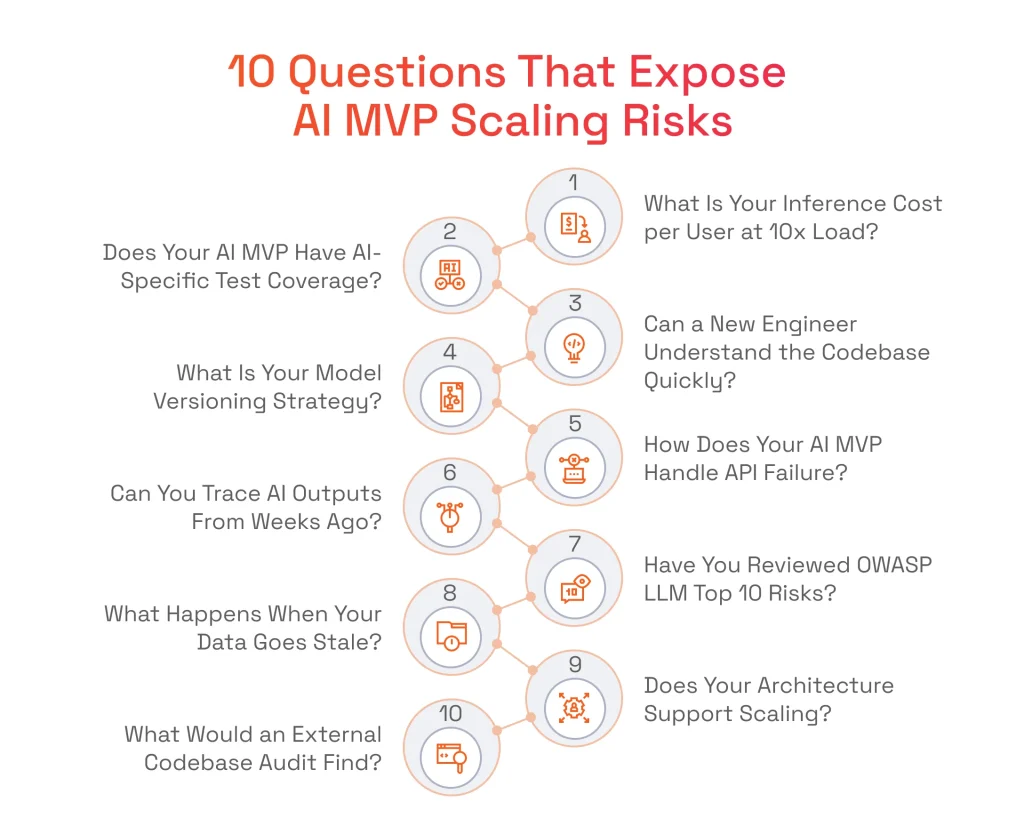
Q1 — What Is Your Inference Cost per User at 10x Your Current Load?
Why it matters at scale
At the moment, the product may look promising since usage is low and each request doesn’t cost much. However, Large Language Models scale differently than expected, with a request that costs a fraction of a cent at 100 users can cost significantly more at 10,000 users due to longer prompts, more concurrent requests, and unoptimized workflows. Your unit economics can shift unexpectedly, and profitability can turn into losses per customer. It’s easy to miss these changes until they compound, so understanding these dynamics early helps you build a sustainable model.
What a prepared answer looks like
A team that understands scale has modeled inference costs at current, 10x, and 100x usage. They’ve set a cost ceiling tied to revenue per user, implemented caching for repeated queries, and evaluated multiple models based on cost per token. Prompt optimization and batching are already baked into the architecture.
What a dangerous non-answer sounds like
“We haven’t modeled that yet,” or “AI APIs are cheap enough for now.”
Summary
Inference cost explosion is one of the most common post MVP startup problems, and it often appears only when growth begins. This is where the gap between AI hype vs. reality becomes visible—what looks cheap and scalable at the MVP stage can quickly become financially unsustainable under real usage.
Q2 — Does Your AI MVP Codebase Have Test Coverage for AI-Specific Outputs?
Why it matters at scale
Your AI outputs need proper testing, because models can hallucinate, prompts can break in unexpected ways, and behavior can shift without clear signals. Normal unit tests aren’t enough, as they test logic, not what the model actually produces. So, every update carries risk. Building monitoring and validation for AI outputs early helps you catch issues before they impact users, turning uncertainty into confidence as you scale.
What a prepared answer looks like
You’ve built an evaluation suite for output quality, so when prompts or models change, regression tests run automatically. You’ve got lightweight smoke tests too, as they make sure outputs stay within baseline expectations. The team doesn’t trust the AI layer; instead, it constantly verifies it.
What a dangerous non-answer sounds like
“The model is good enough that we don’t need to test it.”
Summary
Without proper monitoring, issues can surface unexpectedly in production, and silent failures might go unnoticed until users report problems. Building visibility into your system early helps you stay ahead of issues rather than reacting to them after they’ve impacted your users.
Q3 — Can You Onboard a New Senior Engineer Without a 2-Week Archaeology Project?
Why it matters at scale
As your team grows, clear documentation and consistent code patterns make onboarding easier. Without these foundations, new team members spend time figuring out how things work instead of adding value from day one; by contrast, establishing these practices early makes hiring and team growth smoother. When critical knowledge lives in one person’s head, it creates a bottleneck for scaling.
What a prepared answer looks like
Your README actually explains what the system does and how pieces connect. A senior engineer can read through it and understand the architecture in a few hours. By day one or two, newly hired experts are already contributing rather than still asking questions.
What a dangerous non-answer sounds like
“Only the founder understands how it works.”
Summary
This is a major red flag in any startup codebase audit. Key-person dependency is one of the fastest ways to stall growth.
Q4 — What Is Your Model Versioning Strategy When Your LLM Provider Releases an Update?
Why it matters at scale
When your LLM provider updates their model, outputs can shift in subtle or significant ways. Without locked model versions, it’s hard to understand what changed or trace issues back to their source. As you grow and customers come to depend on consistent behavior, version control becomes essential for maintaining predictability and explaining changes when they occur.
What a prepared answer looks like
Lock down your model version so you can test updates before deploying them. Benchmark new versions against your use cases to ensure they perform as expected, and establish a rollback process you’ve actually tested. This approach gives you confidence when updates happen and keeps your system predictable as you scale.
What a dangerous non-answer sounds like
“We just use the latest version.”
Summary
Relying on “latest” removes control. In scale startup architecture, reproducibility is foundational.
Q5 — How Does Your AI MVP Handle Failure When the Model or API Is Unavailable?
Why it matters at scale
Your product will face API rate limits, provider downtime, and latency spikes. Building resilience into the system means your product can handle these situations gracefully rather than failing completely. This keeps you in control of the user experience, even when external services have issues. That’s why serious teams build AI-at-scale services and treat reliability like an actual system requirement, not an afterthought.
What a prepared answer looks like
Fallback logic exists for all AI calls with graceful degradation (e.g., simplified responses, cached outputs, or alternative user flows). Retry strategies with exponential backoff are implemented, and users receive clear, informative real feedback instead of crashes.
What a dangerous non-answer sounds like
“The provider is reliable.”
Summary
Stop pretending the AI layer is stable. It’s not. Build your product assuming it will fail, because it most probably will.
Q6 — Can You Trace Why Your AI Produced a Specific Output Three Weeks Ago?
Why it matters at scale
When something goes wrong, teams must be able to reconstruct what happened. Without this, debugging becomes guesswork.
What a prepared answer looks like
You’re logging inputs, prompts, outputs—everything containing timestamps and who it came from. You can follow a request through your entire system, and you can pull up any interaction from weeks ago and see exactly what happened.
What a dangerous non-answer sounds like
“We log errors, but not outputs.”
Summary
Lack of traceability isn’t only a technical issue—it’s a blocker for enterprise adoption, especially in regulated industries.
Q7 — Have You Tested Your AI MVP Against OWASP LLM Top 10 Security Risks?
Why it matters at scale
Building with AI introduces additional security considerations. The OWASP LLM Top 10 outlines common vulnerabilities that occur on production, including prompt injection, data leakage, and model manipulation. Understanding these risks early and building safeguards helps you protect your system and users as you scale.
What a prepared answer looks like
Your team has gone through the OWASP LLM Top 10 and identified which ones apply to you. You’ve tested prompt injection scenarios, you’re cleaning up outputs before they leave the system, and locking down access to sensitive data. Security is built from the start, not treated as an afterthought.
What a dangerous non-answer sounds like
“Security is something we’ll handle later.”
Summary
In modern MVP software development, data security is a baseline requirement for any product striving to scale or sell to enterprises.
Q8 — What Happens to Your AI MVP When Your Training or Fine-Tuning Data Goes Stale?
Why it matters at scale
Data becomes outdated, user behavior shifts, and performance drops silently. This is one of the most overlooked post MVP startup problems because it shows up in production later.
What a prepared answer looks like
You know how fresh your data needs to be, you’ve set up a schedule to refresh it, and you have monitoring that catches when data starts drifting. Most importantly, you’re tracking model performance all the time—not waiting for something to break.
What a dangerous non-answer sounds like
“We’ll retrain when we notice issues.”
Summary
By the time real users notice, the problem has already impacted experience and trust. Scaling requires proactive monitoring, not reactive fixes.
Q9 — Does Your AI MVP Architecture Support the Pattern: Audit → Foundation → Scale?
Why it matters at scale
Most MVPs embed AI logic everywhere, making changes dangerous and expensive. The decisions you make now stick around for years. This gets even messier when you’re building toward autonomy—when you bring in agentic AI development services, you’re adding orchestration, state management, and multi-step workflows. Complexity piles on fast.
What a prepared answer looks like
Your AI layer is isolated, there’s a clear API between it and everything else, and you can audit each piece separately. When you need to improve something, you don’t have to rewrite your entire business logic to do it.
What a dangerous non-answer sounds like
“AI is everywhere in the codebase.”
Summary
Tightly coupled design kills iteration when you can’t touch one thing without breaking three others. It’s probably the most common problem we see in startups trying to scale.
Q10 — If You Had to Hand This Product to an External MVP Development Company for a Codebase Audit, What Would They Find?
Why it matters at scale
This question forces you to be honest. It’s what investors or partners are going to find when they dig in. You don’t need to be perfect, you just need to know what’s broken.
What a prepared answer looks like
The team can clearly articulate known technical debt, gaps in testing, and architectural risks. There is a prioritized approach to address them, with trade-offs already considered.
What a dangerous non-answer sounds like
“I think it’s fine”.
Summary
A strong answer signals readiness for growth, a weak one signals hidden risk. In reality, every issue found in a startup codebase audit is something that could have been anticipated.
AI MVP Scaling Risk Matrix: What Each Gap Costs
Scaling Risk (Q#) | Engineering Gap | Business Consequence | Severity |
|---|---|---|---|
Q1: Inference cost at scale | No cost modeling or caching strategy | Margin collapse at growth stage; product becomes unprofitable | ⚠️ Critical |
Q2: AI output test coverage | Zero AI-specific tests; only UI smoke tests | 43% of AI code changes require production debugging; release risk | ⚠️ Critical |
Q3: Codebase documentability | No ADRs; knowledge lives in one person | Key-person dependency; investor red flag; onboarding paralysis | ⚠️ Critical |
Q4: Model versioning strategy | Always-latest model; no evaluation process | Silent output degradation; unreproducible behavior; debug blindness | 🔶 High |
Q5: Failure handling & fallback | No fallback; crashes on API outage | Full downtime on provider incidents; poor user experience at scale | 🔶 High |
Q6: Output observability | No logging of prompts/outputs | Cannot audit, comply, or debug; blocks enterprise and regulated deals | 🔶 High |
Q7: AI security review | OWASP LLM Top 10 not evaluated | 45% of AI code has vulnerabilities; enterprise/investor blocker | 🔶 High |
Q8: Data freshness & drift | No data monitoring; re-train on complaint | Silent model degradation; user trust erosion over weeks | ℹ️ Medium |
Q9: Architecture isolation | AI tightly coupled across all layers | Every scaling initiative risks system-wide breakage | ℹ️ Medium |
Q10: Codebase audit readiness | Team cannot enumerate their own technical debt | Investor due diligence surfaces unknowns; funding risk | ⚠️ Critical |
Scaling Risk (Q#)
Q1: Inference cost at scale
Q2: AI output test coverage
Q3: Codebase documentability
Q4: Model versioning strategy
Q5: Failure handling & fallback
Q6: Output observability
Q7: AI security review
Q8: Data freshness & drift
Q9: Architecture isolation
Q10: Codebase audit readiness
Engineering Gap
No cost modeling or caching strategy
Zero AI-specific tests; only UI smoke tests
No ADRs; knowledge lives in one person
Always-latest model; no evaluation process
No fallback; crashes on API outage
No logging of prompts/outputs
OWASP LLM Top 10 not evaluated
No data monitoring; re-train on complaint
AI tightly coupled across all layers
Team cannot enumerate their own technical debt
Business Consequence
Margin collapse at growth stage; product becomes unprofitable
43% of AI code changes require production debugging; release risk
Key-person dependency; investor red flag; onboarding paralysis
Silent output degradation; unreproducible behavior; debug blindness
Full downtime on provider incidents; poor user experience at scale
Cannot audit, comply, or debug; blocks enterprise and regulated deals
45% of AI code has vulnerabilities; enterprise/investor blocker
Silent model degradation; user trust erosion over weeks
Every scaling initiative risks system-wide breakage
Investor due diligence surfaces unknowns; funding risk
Severity
⚠️ Critical
⚠️ Critical
⚠️ Critical
🔶 High
🔶 High
🔶 High
🔶 High
ℹ️ Medium
ℹ️ Medium
⚠️ Critical
AI MVP Scaling Readiness Checklist: What a Startup Codebase Audit Reviews
Our checklist is designed to help quickly identify whether the system is truly production-ready.
-
Inference cost modeled per user session at 1x, 10x, and 100x load
-
Caching strategy documented and implemented for repeated query patterns
-
Model selection was evaluated against cost-per-token at target volume — not just quality
-
Cost ceiling defined; alert fires before monthly bill exceeds threshold
-
AI-specific evaluation suite exists for core output quality
-
Regression tests run automatically on every model update or prompt change
-
Test coverage on AI integration layer — not just UI and database layers
-
Code is readable and modifiable by a senior engineer who didn’t write it
-
Prompt inputs and model outputs logged with timestamps and session context
-
Correlation IDs link AI outputs to specific user interactions
-
Alert fires on output quality degradation, latency spike, or error rate increase
-
Any specific AI interaction from the past 30 days can be retrieved and reviewed
-
AI component isolated behind a defined API contract — not woven throughout the app
-
Model versioning pinned in configuration; rollback path defined and tested
-
Fallback logic implemented for all external AI API dependencies
-
Foundation rebuild (tests, observability, error handling) can be added without rewriting business logic
-
OWASP LLM Top 10 reviewed and mapped to the product
-
Prompt injection scenarios tested and mitigated
-
Output sanitization prevents sensitive data leakage to end users
-
Team can enumerate top 5 technical debt items with a prioritized remediation plan
Post-MVP Startup Problems: The Three AI-Specific Failure Patterns Most Teams Don’t See Coming
Most post MVP problems hit when real usage starts, when investors start asking questions, or when the system actually has to handle production load. Sure, 61% of CEOs say their boards want AI adoption faster than the team can build, but that’s not really the issue. The real problem is a lack of scaling discipline.
Serhii Leleko
ML & AI Engineer at SPD Technology
“When you’re scaling an MVP, the failures look predictable at first—rising costs, model quality drops, debugging takes forever, system behavior becomes unpredictable. But dig into any of these, and you’ll find the same root cause: code debt piling up during those fast build cycles.”
AI Generated Code Debt: The Silent Rot That Builds After Launch
AI-generated code debt is different from the traditional kind. You can’t see it at first because everything looks fine—the code runs, the API responds, tests pass. But it’s building up anyway, across three layers you may probably miss:
- Architecture debt: AI components are tangled together, no clear boundaries between them
- Quality debt: tests are missing, documentation doesn’t exist, patterns are all over the place
- Operational debt: you can’t see what’s happening in production, no idea what it costs, no performance tracking
The real risk is the accumulation of dozens of small decisions made under pressure to move quickly. Together, they create systems that are expensive to operate, difficult to debug, and nearly impossible to safely extend. Industry data reinforces this: 43% of AI-generated code changes require production debugging, while 45% of AI-generated code contains security vulnerabilities.
How to Run a Startup Codebase Audit Before You Scale
A startup codebase audit is how you figure out if your AI-driven prototypes can actually scale without tearing everything down and rebuilding. It looks at five things that tend to break when you grow:
- whether your architecture has real isolation and modularity
- if you’re actually testing AI-specific outputs
- whether you can see what’s happening and trace where outputs come from
- how you’re handling model versions
- security gaps and what you’re exposed to
The real question: Can you safely scale this, or do you need to rebuild the foundation first?
A good audit gives you a prioritized list of what to fix, tied directly to your business goals. A bad audit doesn’t kill momentum—it just tells you which foundational pieces need work before you pour money into growth.
AI MVP Scaling vs. Traditional MVP Scaling: What Changes at Every Stage
Traditional MVP scaling is mostly an infrastructure problem. You throw better servers at it, optimize your database, add caching. DevOps teams know how to handle this.
AI MVP scaling is completely different. It’s not one problem—it’s five at once, and they’re tangled together:
- infrastructure scaling
- model behavior stability
- data quality and drift
- cost growth dynamics
- output reliability and consistency
Change one thing and something else breaks. That’s the trap.
Most teams just copy what works for regular scaling and apply it to AI. Then they get blindsided. Costs explode overnight. Models start degrading and nobody notices until it’s too late. Outputs become garbage under load. You’d think these problems would be obvious, but they’re not—they’re just part of how AI MVP development actually works when nobody’s thought it through.
The fix is building discipline from the start. An effective AI MVP development process isn’t just about shipping fast—it’s about gathering feedback and iterating in a way that accounts for these interconnections. You need testing from day one. You need logging. You need privacy baked in. You need continuous improvement built into the MVP process itself.
A minimum viable product for AI isn’t minimal on engineering rigor. Before you push for growth, audit your startup codebase. Check your architecture, your data, your model behavior, your costs. Validate everything. That’s how you scale AI products safely.
AI MVP Development Services: Scaling In-House vs. Bringing in an MVP Development Company
Once an AI MVP reaches early traction, the next challenge is about whether the system can actually scale. The choice is typically between scaling in-house or engaging with an external AI MVP development services company to stabilize and evolve the product.
Both approaches work but it depends on what you’re starting with. How messy is your codebase? How strong is your team? Those things matter.
Here’s the difference from traditional software scaling. Most teams just want to move fast. Ship features. Grow users. But GRP driven MVP development is different. It’s not about speed—it’s about building something that actually holds together as it grows. Something reliable under real load. Something that performs when millions of people are using it, not just hundreds.
What In-House Scaling Requires That Most Vibe-Coded Teams Don’t Have Yet
In-house AI MVP scaling is hard because you need senior people who actually know production AI. You need someone reviewing your architecture, you need tools to see what’s happening, and you need to fix the foundation before you can safely add more features. Many teams that launch quickly with vibe coding tools and AI services skip foundational practices, including proper testing, model governance, and clear architecture.
The technical debt compounds as you scale. What starts as quick wins can turn into months of refactoring and fixes, slowing your momentum when you should be growing. Building these practices early pays dividends as your product matures.
This is where a partner like SPD Technology actually makes sense. They’re not there to build features. They’re there to stabilize your architecture, reduce the scaling risk that’s killing you, and turn your AI prototypes into something investors will actually fund—without tearing everything down and rebuilding from scratch. It’s the difference between limping forward and actually moving.
The MVP phase got you to market fast. Now you need people who understand what it takes to scale that without breaking everything.
What to Look For in an AI MVP Development Company or MVP Development Services for Startups
When evaluating MVP development services for startups, three aspects matter:
- Every engagement should begin with a structured startup codebase audit. Any MVP software development partner that skips this step and goes directly into implementation risks compounding existing issues.
- The approach should be surgical, not additive. Effective scaling, such as our Vibe-to-Scale model, focuses on preserving 60–70% of what works while replacing only what creates risk or instability.
- Delivery must include both architecture and execution. An MVP development company that only provides recommendations without implementation ownership leaves the hardest part—execution—on the internal team.
Investor-Ready Software Is the Outcome, Not the Starting Point
Investor ready software is not defined by features, but by engineering evidence: test coverage, observability, security baseline, and documented architecture. Most AI MVP development services for startups optimize for speed-to-demo. But teams approaching fundraising or enterprise sales need systems that can withstand technical due diligence, not just user testing.
The path to investor-ready software for a vibe-coded AI MVP is: audit → foundation rebuild → scalable architecture. Not a single sprint.
Find out what the 90-day path from vibe-coded MVP to production system looks like and how it can work for your scenario.
Key Takeaways
- AI MVP building is not complete at shipping — it is complete when the system can answer 10 core scaling questions; most vibe-coded MVPs fail more than half of them at first review.
- Inference cost is a hidden scaling failure mode: a 10x increase in users can result in exponential cost growth if prompts, caching, and model selection were not designed for production load.
- AI generated code debt accumulates invisibly during development cycles and becomes critical under scale pressure due to missing architecture boundaries, weak test coverage, and lack of observability.
- Most post MVP startup problems in AI systems are misdiagnosed engineering issues: perceived model degradation is often data drift, prompt regression, or untracked version changes.
- Investor ready software is defined by engineering evidence, not features: traceability, testing, security validation, and architecture documentation are the baseline for technical due diligence.
- A startup codebase audit is the most revealing scaling diagnostic: it exposes whether system risks are known and managed or still hidden inside production dependencies.
FAQ
What are the biggest risks when scaling an AI MVP?
The biggest AI MVP scaling risks include inference cost explosion, AI generated code debt, model drift, missing observability, and unassessed security vulnerabilities. These issues typically do not appear during the build phase and only surface during the first real scaling event, such as a traffic spike or funding-driven growth. As a result, many post MVP startup problems are actually latent engineering issues that were never validated for production load.
How do I know if my AI MVP is ready to scale?
An AI MVP is ready to scale when it can reliably answer key engineering questions around cost, reliability, observability, and architecture under load. This includes inference cost modeling, AI-specific test coverage, model versioning strategy, fallback handling, and security testing against frameworks like OWASP LLM Top 10. If your team cannot answer at least 6 of these clearly, your AI MVP scaling risks are still unquantified.
What is AI generated code debt and how does it affect scaling?
Code debt builds up when you’re moving fast and cutting corners. You grab a low-code tool, ship something, and it works. But the architecture’s a mess. There’s no test coverage for what the model outputs. You can’t debug what’s actually happening when it fails. Then you hit growth. Suddenly maintenance is bleeding money. You’re terrified to change anything. And when production breaks, you’re flying blind trying to figure out why.
When should a startup use an MVP development company or external audit services?
New product founders should engage MVP development services for startups when approaching a funding round, facing unexplained performance issues, or when no one on the team can clearly describe the system architecture or technical debt. It is also critical when vibe-coded systems lack documentation, observability, or test coverage for AI components. An early startup codebase audit considerably reduces remediation costs and prevents scaling failures.
What does investor-ready software look like for an AI MVP?
Investors want proof you’ve built something solid with a real competitive advantage. Here’s what they’re looking for:
- Traceability: You can trace where all outputs come from
- Testing: You’ve tested it according to all current requirements
- Model versioning: Your model versions are locked down, not floating
- Security: All necessary aspects have been validated
- Documentation: Your architecture is documented so that someone else could understand it
Skip any of this, and you’ll hit problems during due diligence. Enterprise customers will spot it too, because a working MVP isn’t enough; they need to see that you’ve considered this carefully.