

To choose an AI development partner for AI-assisted engineering, judge it on how it proves AI-generated code is correct. Before signing, ask to see four things: the verification method including tests for code, evals for AI behavior, and independent review; a real release record showing tests, security checks, and a named human sign-off; the written rules for which tasks coding agents may complete without human approval; and proof that specifications, tests, evals, and agent configuration will live in your repository. Then run a short paid pilot against agreed success criteria. A partner practicing agentic engineering can show all four on request.
Shortlists for technical vendors look identical faster than they used to. Three or four options sit on a desk, each offering accelerated engineering, clean demos, and high productivity numbers. The choice appears to depend entirely on commercial terms, team culture match, or past industry logos.
That initial checklist belonged to a different era of vendor selection. Most criteria evaluate firms that build custom machine learning models, yet today’s buyer is selecting an organization that constructs core software using autonomous coding agents. DORA’s 2025 research confirms AI acts as an amplifier of existing engineering strengths and weaknesses, meaning unverified code generation simply accelerates architectural chaos. Selecting the right partner for AI-assisted software development requires evaluating verification systems, risk-calibrated autonomy rules, evidence-backed releases, and delivery system ownership.
What Is an AI-Assisted Engineering Partner, and How Is It Different from an AI Development Company?
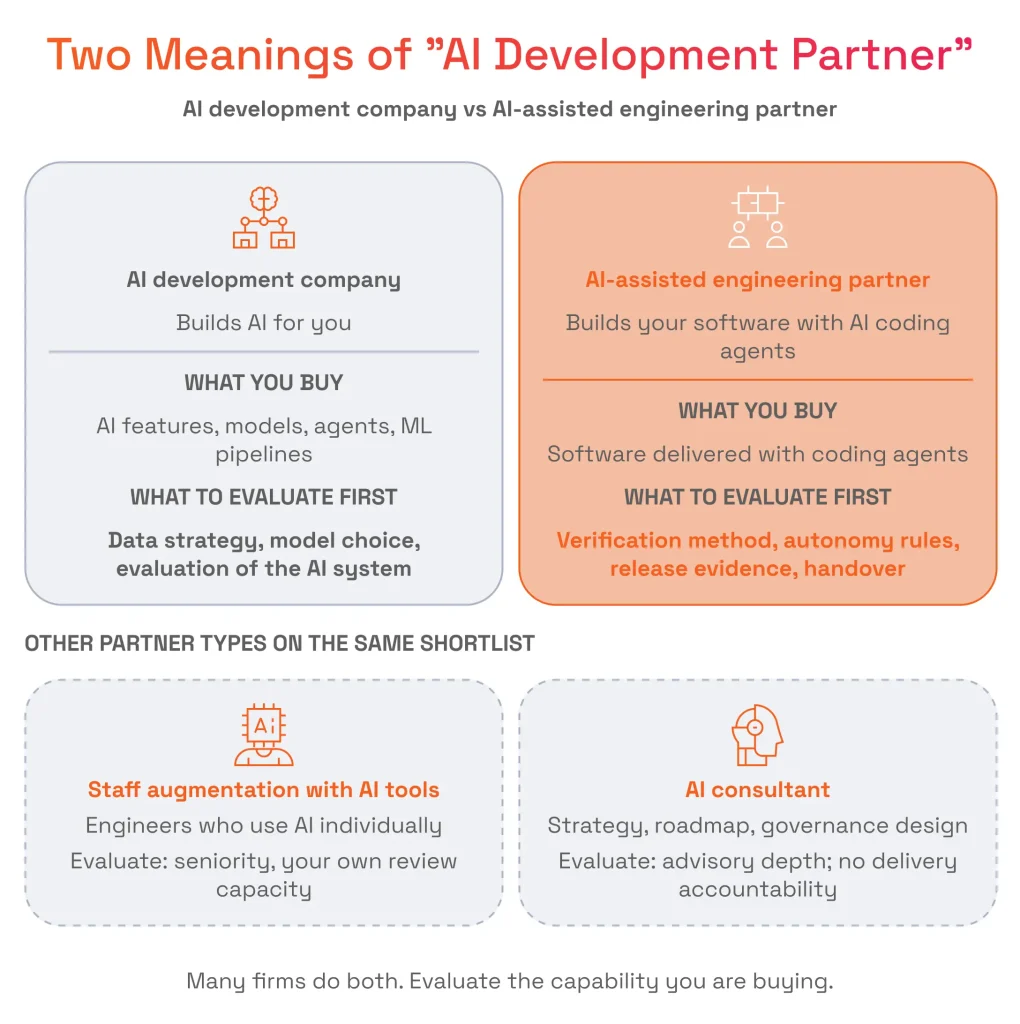
An AI-assisted engineering partner builds your software using AI coding agents under specifications, tests, evals and human approval. An AI development company builds AI systems like models, agents, and ML pipelines for you. Many firms do both, so evaluate the capability you are buying.
An AI-assisted engineering partner follows the agentic development workflow. Engineers write the specs, tests and evals first, and the coding agents work inside those limits. Results from each run feed back into the next task, so every release can be checked before it ships.
This is where agentic engineering vs vibe coding stops being a question of style. With vibe coding, a developer prompts until the code seems to work and tests it mostly by hand. That’s acceptable for a first-version prototype. A payment flow handling real money needs more than someone’s impression that it worked, so AI-generated code should pass the same continuous integration checks as any other code before it goes into main.
If part of the contract covers a custom ML model, ask about model drift and retraining too. For regular application work, those topics rarely come up.
Partner type | What you buy | What to evaluate first |
|---|---|---|
AI development company | AI features, models, agents, ML pipelines | Data strategy, model choice, evaluation of the AI system |
AI-assisted engineering partner | Software delivered with coding agents | Verification method, autonomy rules, release evidence, handover |
Staff augmentation with AI tools | Engineers who use AI individually | Seniority, your own review capacity |
AI consultant | Strategy, roadmap, governance design | Advisory depth; no delivery accountability |
Partner type
AI development company
AI-assisted engineering partner
Staff augmentation with AI tools
AI consultant
What you buy
AI features, models, agents, ML pipelines
Software delivered with coding agents
Engineers who use AI individually
Strategy, roadmap, governance design
What to evaluate first
Data strategy, model choice, evaluation of the AI system
Verification method, autonomy rules, release evidence, handover
Seniority, your own review capacity
Advisory depth; no delivery accountability
Why Does Partner Choice Matter More When AI Writes the Code?
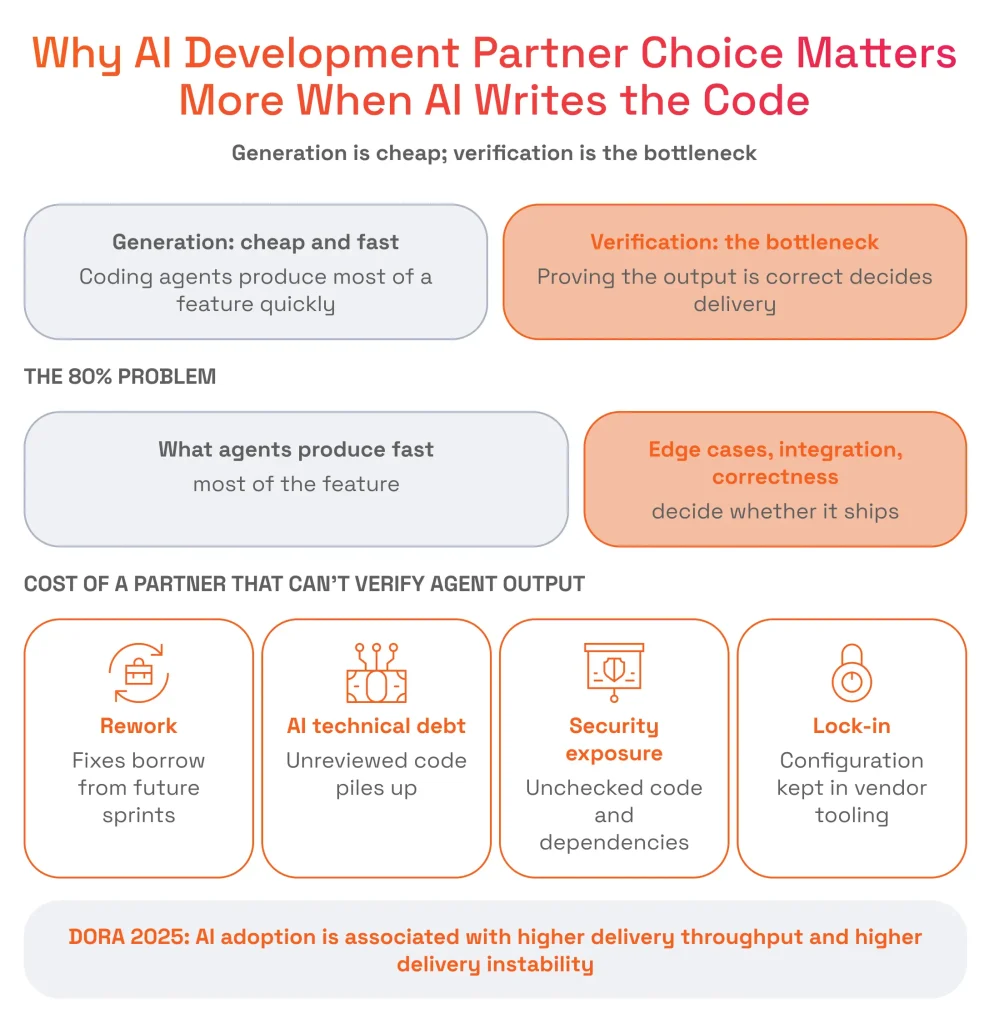
AI makes generation cheap and moves the hard work to verification, so the gap between a disciplined and an undisciplined partner widens every sprint. Speed of output creates a false sense of progress when underlying logical errors remain hidden beneath clean syntax.
Data from Google Cloud’s DORA 2025 State of AI-assisted Software Development demonstrates that AI adoption is associated with higher delivery throughput and keeps a negative relationship with delivery stability, while 30% of respondents report little or no trust in AI-generated code. This dynamic maps directly to what engineering leader Addy Osmani described as the 80% problem, where agents produce most of a feature fast, and edge cases, integration and correctness decide whether it ships.
Uncontrolled generation causes severe AI MVP scaling risks when early structural shortcuts compound across multiple releases. Choosing an undisciplined partner brings specific financial consequences: compounding rework and development velocity losses, unreviewed AI technical debt that inflates future modification costs, severe security exposure from hallucinated dependencies, and total vendor lock-in through proprietary generation harnesses.
Should You Build In-House, Buy a Tool or Choose a Partner?
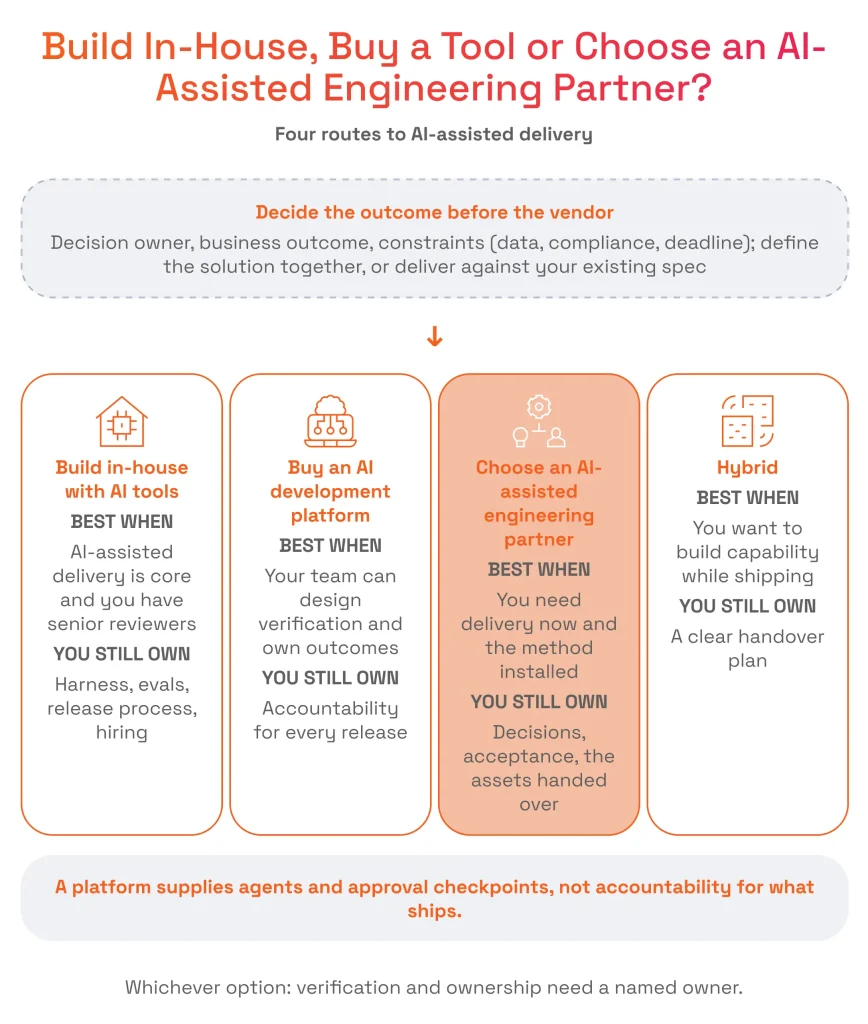
The build vs buy vs partner decision mostly comes down to who will review the code. If AI-assisted engineering is going to be a core capability for years and you can hire senior engineers to check what the agents produce, building in-house makes sense. Buying a platform works for teams that already have that review discipline and only need the tooling. A partner fits the middle case, where you need software delivered now and also want someone to set up a method your team will keep using after the engagement. Many companies combine the two, letting a partner ship the first releases while they hire and train their own reviewers.
If you plan to build the capacity in-house, set up AI engineering enablement guardrails early, so your senior engineers can hold every branch to the same review standard. Scaling AI-assisted software development also costs more than most teams budget for at the start, and much of that goes to training, which doesn’t really end because the tools keep changing.
Vendors are responding to the demand, and IBM’s announcement of Bob in April 2026 shows an enterprise platform presenting itself as an execution partner. A platform can supply the agents and the approval checkpoints, but whoever runs it is still accountable for what reaches production.
The structural trade-offs between these operational paths appear below:
Option | Best when | You still own |
|---|---|---|
Build in-house with AI tools | AI-assisted delivery is core and you have senior reviewers | Harness, evals, release process, hiring |
Buy an AI development platform | Your team can design verification and own outcomes | Accountability for every release |
Choose an AI-assisted engineering partner | You need delivery now and the method installed | Decisions, acceptance, the assets handed over |
Hybrid | You want to build capability while shipping | A clear handover plan |
Option
Build in-house with AI tools
Buy an AI development platform
Choose an AI-assisted engineering partner
Hybrid
Best when
AI-assisted delivery is core and you have senior reviewers
Your team can design verification and own outcomes
You need delivery now and the method installed
You want to build capability while shipping
You still own
Harness, evals, release process, hiring
Accountability for every release
Decisions, acceptance, the assets handed over
A clear handover plan
Decide the outcome before the vendor
The VP of Engineering or CTO owns this decision, defining the outcome in terms of business goals while balancing target business outcomes against compliance frameworks and strict delivery deadlines; implemented correctly, AI can unlock efficiency and competitive advantage. Clear alignment upfront prevents purchasing high-capacity generation tools when the primary technical bottleneck involves legacy system integration.
Organizations must determine whether their vendor should co-design technical specifications or execute against an established product backlog. Companies looking to build an AI-driven MVP require a partner capable of translating ambiguous commercial goals into rigorous system architecture before agent execution begins. If a prototype already exists, the plan for moving an AI MVP to production in 90 days gives that deadline a realistic shape.
Which Evaluation Criteria Separate Real AI-Assisted Engineering from Claims?
When you compare partners, use criteria you can verify as a systematic way to compare vendors, including their past performance and technical maturity. Ask to see how they verify code and what their release records look like. The rules for what agents may do without approval should be written down, and the contract should state who owns the specs, tests and configurations afterward.
A polished demo or a claim of 40% faster delivery tells you far less, so put those near the bottom of the scorecard. Used this way, the AI partner evaluation criteria quickly separate teams with a real review process from vendors who generate code and hope it holds up, and show that the best AI development companies are the ones that can prove these operational capabilities rather than the ones with the strongest branding or broadest service list.
How does the partner verify what agents produce?
Unit and integration tests work well for ordinary code, where the same input should always give the same output and a test either passes or fails. AI features don’t behave that way. A support assistant might answer the same billing question three slightly different ways, and all three could be fine, or one could quote the wrong fee. Evals handle that by scoring each response against a rubric the team agreed on in advance, checking accuracy, consistency and harmful content with either an automated scoring engine or an LLM-as-judge setup.
Review needs the same kind of separation. Whoever wrote a pull request, engineer or agent, shouldn’t be the only one checking it, so a different reviewer, ideally one actively trying to break the change, signs off before it merges.
Coding agents can only work with the context they’re given. A good partner treats context engineering as real work and puts effort into the system instructions, the architecture specs and the examples from your own codebase that an agent reads before it writes anything. Using spec-first development takes this further. The team writes down what a feature should do, including edge cases and limits, before an agent starts, so the agent has clear intent to work from and reviewers have something concrete to check the result against.
Projects built around a custom model add another layer. Top partners first check whether data exists in usable form and assess data readiness, including access and structure, before model development starts. Before training starts, the data has to be collected and cleaned properly, and data engineering usually structures the pipelines and datasets needed for reliable ai models alongside frameworks like TensorFlow or PyTorch. Data governance at this stage should comply with regulations such as GDPR or HIPAA.
One of the global pharmacy industry leaders with over 100,000 employees turned to SPD Technology to build and test software for its DNA-sequencing machines starting in 2019. Implementing robust automated testing reduced QA cycles by 3x–4x, while an SQA dashboard constructed by SPD now supports 7 concurrent engineering teams. Verification discipline in a regulated domain shows up as inspectable artifacts and shared quality tooling.
Is there evidence on every release?
Ask the partner for an anonymized release log from a client project that’s still running, and pick one release to go through together. Each commit should have its test results, eval scores against the agreed rubric and the output of an automated security scan. Someone has to have signed off on the release by name. Look for the rollback plan as well, and check that it was written down before the release went out.
If the project includes a deployed AI model, the log should also show how the model is monitored, when it was last retrained and which version is running in production, along with monitoring details, retraining history, version control, and the documentation needed for transparency and long-term maintainability of AI models. Missing pieces are worth asking about directly, since a partner that keeps good records will usually have the answer on hand.

Serhii Leleko
ML & AI Engineer at SPD Technology
“When a partner shows me a release record, I read it backwards. I start with the rollback plan and the name on the sign-off, because those two lines tell me whether anyone expected the change to fail and who answers for it if it does. Test counts come last; agents can turn those green on their own.”
Without proper maintenance, AI systems can degrade over time, so release discipline should extend into ongoing monitoring and updates that catch drift from sources like user behavior shifts.
How much autonomy do agents get, and who approves?
System guardrails and human approval thresholds scale based on task severity, an approach SPD Technology structures as calibrated autonomy. High-risk operations touching monetary transactions, personal data, or core framework architecture remain strictly human-led. A named senior engineer reviews all agent-generated pull requests before production deployment. Operational oversight scales dynamically across distinct system components based on strict domain impact assessments. These rules matter even more when vendors claim production experience with AI agents, because governance and approval thresholds are what separate real delivery from demo-only autonomy.
Will you own the delivery system?
A robust agent harness includes instruction files like AGENTS.md, sandboxed execution environments, execution hooks, and evaluation scripts built around underlying models to guarantee repeatable output; generative AI integration often sits inside the same delivery system and should follow the same repository ownership and repeatability rules.
Reviewing agent harness engineering reveals how structured setup files prevent agent drift across development cycles. Specifications, test suites, evaluation scripts, AGENTS.md files, and configuration files must reside within your core repository by contract, with the delivery model set up to support seamless connection to existing enterprise architecture. This factory model ensures your organization retains full control over the machinery used to construct the software.
How are security, IP and data handled in AI-generated code?
Security questions for an AI partner start with the contract. It should say who owns the code and IP the agents produce, how the vendor handles your data, and where secrets like API keys are stored, ideally somewhere agents can’t read them. If the system touches health or personal data, the partner also needs to show how it meets HIPAA or GDPR requirements, with encryption and access controls covering training data and model assets as well as production data.
Dependencies need their own check. Language models sometimes suggest packages that don’t exist, and an attacker can register those names and fill them with malicious code. When Spracklen et al. tested 16 LLMs on 576,000 code samples for their USENIX Security 2025 paper, hallucinated package names turned up often enough to count as a real attack route, so managing the security risks of AI-generated code means verifying every external import automatically before it’s merged. Where several teams share a data pipeline, the same applies to data quality checks.
One of our customers runs payment infrastructure for FSA and HSA spending in US healthcare, and they came to SPD Technology with HIPAA and SOC 2 security gaps that needed fixing quickly. The catch was that feature work couldn’t stop while that happened. SPD Technology resolved compliance deficiencies while accelerating release velocity, bringing release cycles under one day with Terraform and GitHub Actions on AWS ECS while more than 200,000 eligible healthcare products stayed in sync across company’s payment endpoints. That combination is possible when compliance checks are built into the pipeline itself, so every release passes through them automatically, however often releases go out.
Can they show results against a baseline in a domain like yours?
Valid vendor performance claims present measured before-and-after operational metrics linked to explicit historical baselines. A financial technology application evolved by SPD Technology alongside Mogami over a decade-long partnership completed three major architectural overhauls. Complex calculations that previously required 15 minutes now complete in under 2 minutes. That represents the concrete evidence buyers should require.
Who is on the team, and what do they actually do?
Engineering teams must feature senior architects who define specifications, govern context engineering, and evaluate agent outputs directly. Every statement of work should list these key technical leads by name.
Poynt’s Reseller Portal was tied into a legacy monolith, and SPD Technology put a dedicated team of eight engineers on separating it. Over a two-year engagement, the team decoupled Poynt’s Reseller Portal and took on full operational ownership of the result, so Poynt had fewer of its own people tied up in support and less of the product depending on the old system.
Is the commercial model transparent?
Contracts must delineate fixed development costs from variable AI model consumption, establishing a clear change management process. Total cost of ownership calculations need to itemize token usage and third-party tooling fees alongside engineering hours on every invoice. Scope boundaries and verifiable success criteria are locked before engineering execution begins. When you compare pricing models, distinguish time-and-materials billing from outcome-based engagement: stronger partners use pricing models that reflect project scope and align fees with measurable business value, long-term support, and clear ownership of outcomes, while outcome-based engagement ties fees to business value through agreed KPIs and measurement periods.
As a benchmark, hourly rates for AI implementation teams often range from $50 to $300, while fixed-price AI projects commonly run from $10K to $500K depending on complexity. That complexity also varies by the AI technologies involved, and deep learning work typically extends delivery timelines beyond simpler AI solutions. Any AI development project should also budget for ongoing monitoring and maintenance of AI models, not just the initial build cost.
The selection framework below maps core evaluation criteria directly to required buyer evidence:
Criterion | Evidence to request | Weak signal |
|---|---|---|
Verification method | Test and eval suites from a past engagement; review process | “Our engineers review everything” with no artefacts |
Release evidence | One anonymised release record | Only case-study metrics |
Autonomy and approval | Written rules: which tasks agents merge, which need a human | “Humans are always in the loop” with no specifics |
Delivery system ownership | Contract clause; repo layout with specs, evals, agent config | Prompts and configs kept in the vendor’s tooling |
Security, IP, data | Licensing position; data-flow and secrets policy | Generic “we are SOC 2” answer only |
Track record | Before/after metrics with baseline and timeframe | Percentages with no baseline |
Team | Named senior engineers and their role with agents | Sales team only on calls |
Criterion
Verification method
Release evidence
Autonomy and approval
Delivery system ownership
Security, IP, data
Track record
Team
Evidence to request
Test and eval suites from a past engagement; review process
One anonymised release record
Written rules: which tasks agents merge, which need a human
Contract clause; repo layout with specs, evals, agent config
Licensing position; data-flow and secrets policy
Before/after metrics with baseline and timeframe
Named senior engineers and their role with agents
Weak signal
“Our engineers review everything” with no artefacts
Only case-study metrics
“Humans are always in the loop” with no specifics
Prompts and configs kept in the vendor’s tooling
Generic “we are SOC 2” answer only
Percentages with no baseline
Sales team only on calls
Work through the “Evidence to Request” column during the call itself, while the vendor still has its screen shared. Start with the release evidence row, since a single record shows whether verification, approval and rollback come together in a real shipped change.
Use our AI Production-Ready Checklist to check a partner’s release evidence against what production actually requires.
How Do You Score and Compare AI Development Partners?
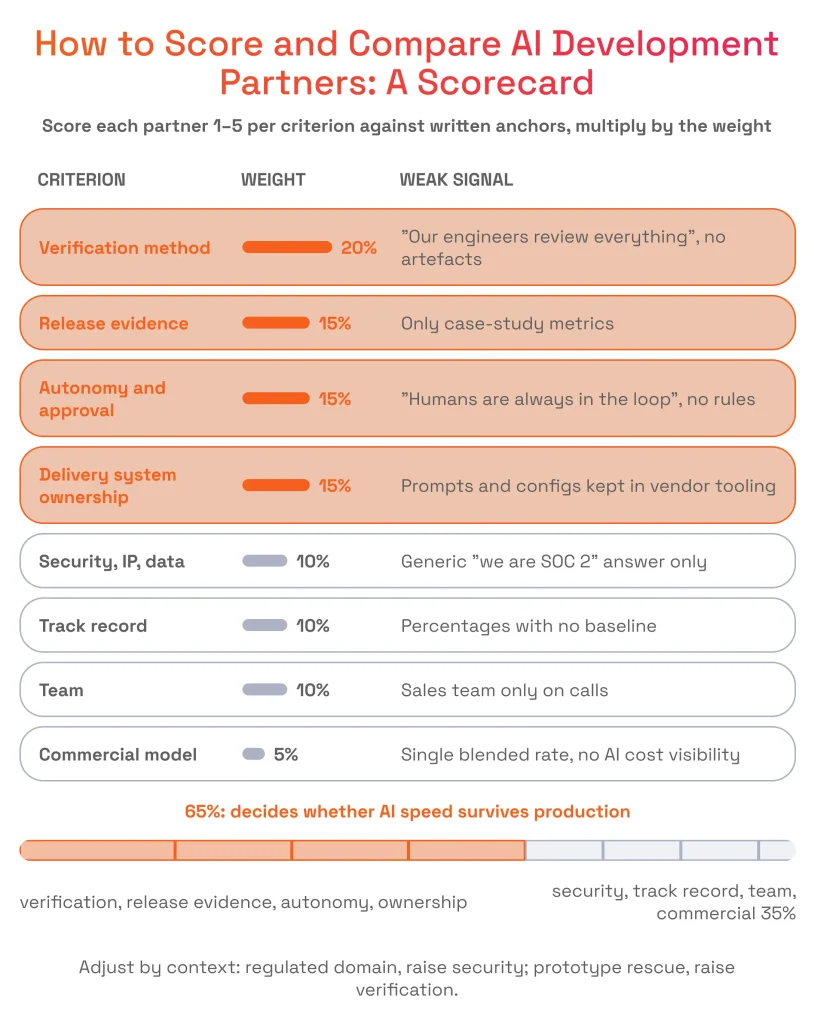
Weight verification, release evidence, autonomy rules, and ownership terms highest when comparing prospective vendors. These four categories account for 65% of the total score because they determine whether generated code survives real-world deployment. Scoring each candidate from 1 to 5 against strict written anchors prevents subjective biases from skewing the shortlist. Many teams still struggle to move beyond pilots, and 64% of organizations have not scaled AI across the enterprise.
Teams should adjust criteria weights based on their specific technical constraints. Highly regulated industries must increase the security and data governance allocation, whereas legacy codebase rescues require prioritizing verification capability. Scorecards should also reflect whether the ai project must scale beyond a pilot into enterprise operations. Establishing clear platform health metrics like change fail rate, rework rate, and lead time provides the baseline needed to measure vendor performance accurately over time.
Criterion | Weight | 1 = | 5 = |
|---|---|---|---|
Verification method | 20% | No artefacts | Tests + evals + independent review, shown |
Release evidence | 15% | None | Real record per release with sign-off |
Autonomy and approval | 15% | Undefined | Written rules per task risk, named approver |
Delivery system ownership | 15% | Vendor-held | In client repo by contract |
Security, IP, data | 10% | Generic answers | Documented policy for AI-generated code |
Track record | 10% | Claims only | Baselined results in your domain |
Team | 10% | Unnamed | Named seniors in SOW |
Commercial model | 5% | Opaque | Itemised incl. AI tooling cost |
Criterion
Verification method
Release evidence
Autonomy and approval
Delivery system ownership
Security, IP, data
Track record
Team
Commercial model
Weight
20%
15%
15%
15%
10%
10%
10%
5%
1 =
No artefacts
None
Undefined
Vendor-held
Generic answers
Claims only
Unnamed
Opaque
5 =
Tests + evals + independent review, shown
Real record per release with sign-off
Written rules per task risk, named approver
In client repo by contract
Documented policy for AI-generated code
Baselined results in your domain
Named seniors in SOW
Itemised incl. AI tooling cost
What Questions Should You Ask Every AI Development Partner?
Ask targeted questions that require prospective partners to produce verifiable technical artifacts or identify accountable individuals. Using structured questions to ask an AI development partner exposes whether a vendor relies on unverified generation or enforces disciplined engineering methods. When choosing an AI development vendor, strong answers should also come with clear communication rhythms and regular updates during delivery, not only technical artifacts.
A capable vendor addresses these inquiries with inspectable documentation, which helps identify the right AI development partner.
Questions to ask an AI development partner
Question | Strong answer | Weak answer |
|---|---|---|
Can you show the test and eval suites from a recent engagement? | Walks through suites, rubrics and pass thresholds | “We test everything thoroughly” |
Which tasks may your coding agents complete and merge without human approval? | Written rules by task risk; payments, personal data and architecture stay human-led | “Humans review everything” or “agents handle it” |
Can we see an anonymised release record? | Change, test and eval results, security scan, sign-off, rollback plan | A dashboard screenshot or case study |
Who approves each release, by name? | A named senior engineer accountable for release | “The team” |
Where will specs, tests, evals and agent configuration live, and who owns them? | In our repository, ours by contract | On the vendor’s platform or “we can export later” |
How do you change existing code safely with AI? | Characterization tests capture current behaviour first | “The agent rewrites it cleanly” |
Which metric did your last engagement move, against what baseline? | Before/after figures with baseline and period | Lines of code or % of AI-generated code |
What happens when a model update changes agent behaviour? | Regression evals gate the change | No answer |
How do you verify AI-suggested dependencies and licences? | Dependency and licence scanning on every change | “The model uses popular libraries” |
What would make you recommend stopping or pivoting? | Concrete exit criteria tied to success metrics | “We always deliver” |
Question
Can you show the test and eval suites from a recent engagement?
Which tasks may your coding agents complete and merge without human approval?
Can we see an anonymised release record?
Who approves each release, by name?
Where will specs, tests, evals and agent configuration live, and who owns them?
How do you change existing code safely with AI?
Which metric did your last engagement move, against what baseline?
What happens when a model update changes agent behaviour?
How do you verify AI-suggested dependencies and licences?
What would make you recommend stopping or pivoting?
Strong answer
Walks through suites, rubrics and pass thresholds
Written rules by task risk; payments, personal data and architecture stay human-led
Change, test and eval results, security scan, sign-off, rollback plan
A named senior engineer accountable for release
In our repository, ours by contract
Characterization tests capture current behaviour first
Before/after figures with baseline and period
Regression evals gate the change
Dependency and licence scanning on every change
Concrete exit criteria tied to success metrics
Weak answer
“We test everything thoroughly”
“Humans review everything” or “agents handle it”
A dashboard screenshot or case study
“The team”
On the vendor’s platform or “we can export later”
“The agent rewrites it cleanly”
Lines of code or % of AI-generated code
No answer
“The model uses popular libraries”
“We always deliver”
Receiving vague or unsubstantiated answers to two or more of these questions provides sufficient justification to remove a vendor from your shortlist. This is also why AI development partner choosing should weigh operational evidence more than sales claims. Highly trained AI-native development teams answer these operational questions using real code repositories and active execution logs.
What Red Flags Should Rule an AI Development Partner Out?
Identifying specific AI development partner red flags early prevents costly engagement failures and architectural rework. Disqualify vendors who sell generation speed without offering inspectable methods to prove code correctness.
Choosing the wrong partner can waste time, money, and internal resources even when the initial demo looks strong.
Red flag | Why it matters |
|---|---|
“% of code written by AI” offered as the success metric | Measures activity; hides rework and instability |
Portfolio of demos and prototypes, no production systems | Prototype speed says nothing about the 80% that ships |
No written specs or acceptance criteria before agents start | Signals vibe coding applied to production work |
“Humans are always in the loop” with no written autonomy rules | Oversight that is undefined is unenforceable |
Prompts, rules and agent configuration kept in the vendor’s tooling | Lock-in; you cannot reproduce how your software is built |
No named release approver | Nobody is accountable when AI-written code fails |
Productivity multipliers promised without your baseline | No way to verify the claim after kickoff |
Red flag
“% of code written by AI” offered as the success metric
Portfolio of demos and prototypes, no production systems
No written specs or acceptance criteria before agents start
“Humans are always in the loop” with no written autonomy rules
Prompts, rules and agent configuration kept in the vendor’s tooling
No named release approver
Productivity multipliers promised without your baseline
Why it matters
Measures activity; hides rework and instability
Prototype speed says nothing about the 80% that ships
Signals vibe coding applied to production work
Oversight that is undefined is unenforceable
Lock-in; you cannot reproduce how your software is built
Nobody is accountable when AI-written code fails
No way to verify the claim after kickoff
Reviewing technical questions investors ask about an AI PoC highlights why early prototype delivery differs fundamentally from engineering maintainable enterprise software.
When a vendor exhibits these operational red flags, generation velocity quickly transforms into mounting technical debt. Unclear governance models and missing verification frameworks force internal teams to spend months refactoring unmaintainable code bases.
Founders preparing for capital raises should review criteria for building an investor-ready MVP to ensure vendor delivery choices support future due diligence.
If a partner cannot show how it verifies AI-written code, read how to trust AI-generated code before the next call.
How Do You Test an AI-Assisted Engineering Partner Before Committing?
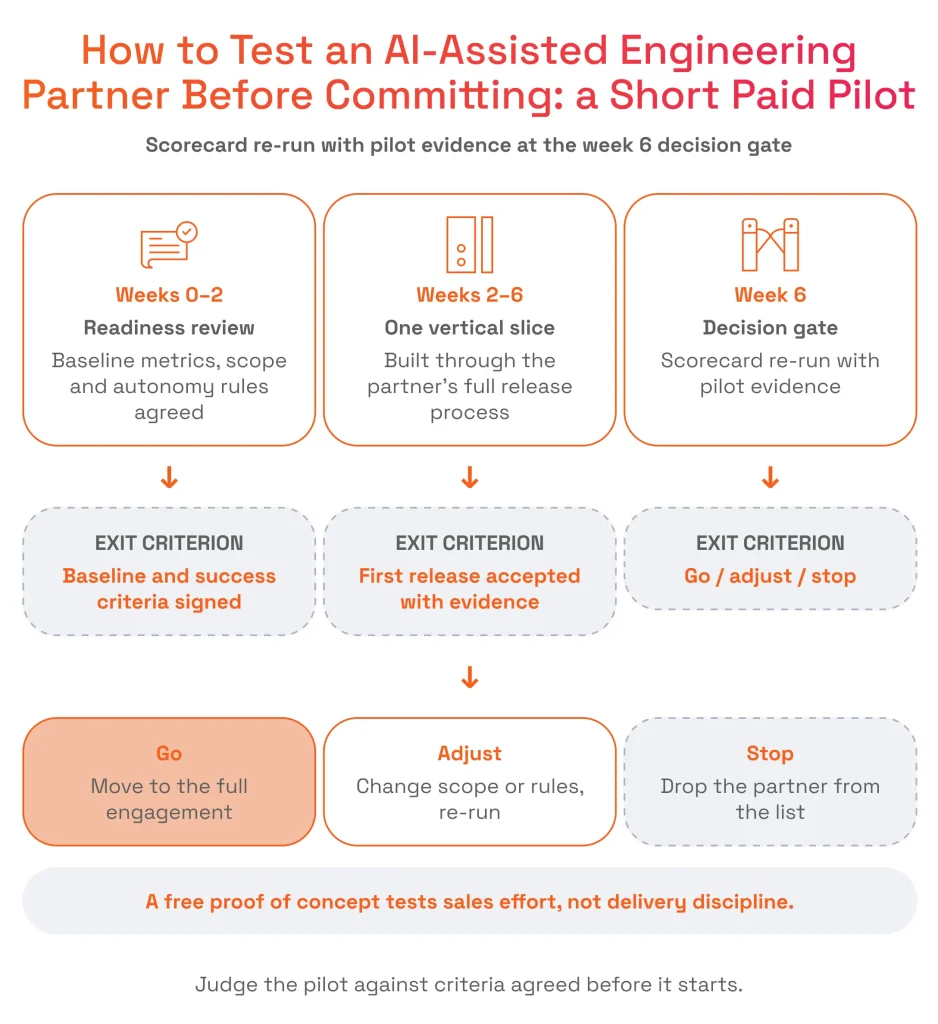
Test a candidate by commissioning a targeted, paid pilot on an active feature branch using their complete verification pipeline. A free proof of concept mostly measures how hard a vendor will work to win the deal. Establishing clear success benchmarks prior to kickoff isolates true operational capability.
The structured timeline below reflects standard SPD Technology engagement phasing:
Weeks | What happens | Exit criteria |
|---|---|---|
0–2 | Readiness review, baseline metrics, scope and autonomy rules agreed | Baseline and success criteria signed |
2–6 | One vertical slice built through the full release process | First release accepted with evidence |
6 | Decision gate | Scorecard re-run with pilot evidence; go / adjust / stop |
Weeks
0–2
2–6
6
What happens
Readiness review, baseline metrics, scope and autonomy rules agreed
One vertical slice built through the full release process
Decision gate
Exit criteria
Baseline and success criteria signed
First release accepted with evidence
Scorecard re-run with pilot evidence; go / adjust / stop
Six weeks in, the pilot has produced a signed baseline and one release accepted with its full evidence record. The go, adjust or stop call that follows rests on how the partner actually delivered, measured against the same scorecard you used to build the shortlist.
Why Choosing SPD Technology as Your AI Development Partner
SPD Technology delivers AI speed that survives production, and every criterion in this article is something it shows clients before they sign. Exploring SPD Technology’s core AI engineering services demonstrates how human engineering judgment governs agent execution across every project stage, advancing agentic engineering across enterprise software initiatives.
- Verification you can inspect: tests for code, evals for AI behavior, independent and adversarial review; the author never judges alone.
- Evidence on every release: change, tests, security, sign-off and rollback, with a named senior engineer approving each release.
- Autonomy matched to risk: money, personal data and architecture stay human-led through structured agentic AI development. Incident Pilot, an AI incident-management system built by SPD Technology for a US fintech platform, cuts incident response time from 60+ minutes to under 30 minutes to yield a pull-request-ready fix while removing the requirement for 24/7 on-call engineering staffing.
- You own the delivery system: specs, tests, evals and agent configuration live in your repository.
- Verified expertise: SPD Technology maintains long-term engineering partnerships with global platforms including PitchBook (spanning over a decade), Morningstar, and Pie Insurance. Discover SPD Technology’s practical methodology for building production AI with Claude across complex enterprise codebases.
Conclusion
Choosing an AI-assisted engineering partner used to come down to how fast a team could deliver. With agents producing most of the first draft, speed tells you much less. When agents write the code, the partner to choose is the one that can prove its output is correct.
If you take one step from this guide, make it the release log. Ask each shortlisted vendor for one, walk through a single release from commit to sign-off, and use what you find to decide which of them earns a paid pilot.
Key Takeaways
- “AI development partner” covers two different purchases, a partner who builds AI and a partner who builds software with AI, so evaluating the wrong capability leads to choosing the wrong firm.
- When coding agents write much of the code, generation becomes cheap and verification decides delivery, so a partner’s ability to prove correctness outweighs its delivery speed.
- A partner that cannot show its test and eval suites, a real release record and written autonomy rules has no inspectable method, whatever its case-study metrics say.
- Specifications, tests, evals and agent configuration left in a vendor’s tooling create lock-in, because your team cannot reproduce or extend how the software was built.
- “Percentage of AI-generated code” measures activity; before/after metrics against a stated baseline are the only evidence of real improvement.
- Weighting verification, release evidence, autonomy rules and ownership at 65% of a scorecard keeps the decision anchored on whether AI speed will survive production.
- A short paid pilot through the partner’s full release process reveals delivery discipline that a free proof of concept and a sales demo cannot.
In short: Selecting an AI development partner requires evaluating how effectively a vendor proves code correctness rather than how fast its agents generate output.
FAQ
How do I choose an AI development partner?
Decide first whether you need a partner who builds AI systems or one who builds your software with AI coding agents, and check its AI expertise and technical expertise in the type of system you need built. Then score candidate firms on the eight criteria, ask for inspectable technical artifacts, and complete a paid pilot on an active codebase slice. Evaluating an AI development partner on verification discipline ensures generated code survives production requirements.
What should I look for in an AI-assisted engineering partner?
Require automated test suites combined with evaluation rubrics and independent code review processes. Ensure the vendor provides written task autonomy rules, a named release approver, and complete release evidence logs for every deployment, and confirm the solution can connect across multiple systems and workflows. Confirm that specifications, tests, evals, and agent configuration files will reside directly within your repository, and that the partner follows a clear ai development process and development process from specification through deployment.
What questions should I ask an AI development partner?
Start by asking to see work from past projects. That includes an evaluation suite the partner actually used, an anonymized release log and the written rules for which tasks an agent can merge without a person approving them. Ask who approves releases, by name, and where the configuration files are kept.
Then move to what happens after launch. Does the AI consulting partner have an AI strategy covering deployment, governance and ongoing optimization? It should be able to show before-and-after performance metrics measured against a baseline. Find out, too, what would make the team change direction once the system is running, and listen for a specific condition in the answer, since a vague one usually means nobody has thought about it.
What are the red flags when hiring an AI development partner?
Some answers should end the conversation. If a vendor’s main measure of success is the percentage of code its AI wrote, it’s tracking output, and output was never the hard part. Be careful with demo portfolios as well, since a project that never reached production says little about how the team handles real users.
Missing documentation is another warning sign. A team that works without written specifications, describes human oversight only in vague terms or keeps agent configurations locked inside its own platform will be hard to hold accountable, and harder to leave. The same goes for a vendor that can’t name who approves releases or compare performance against your historical baselines.
Ask what the partner does about bias and model explainability, and how that work connects to AI performance once the system is live. A credible partner can map its risk controls to a recognized framework such as the NIST AI Risk Management Framework.
Should I choose an AI specialist or a full-service software development company?
Choose by what sits at the core of the product. If the core is a model or AI feature, an AI specialist with strong data and evaluation skills fits, and may be the better choice when the work involves data science-heavy problem framing or advanced domains like computer vision. If you need production software delivered faster with agents, a full-service firm practicing agentic engineering usually fits better, because integration, architecture and release discipline matter as much as AI skill. Many buyers need both from one partner, and many now also compare generative ai capabilities when one partner is expected to cover both model and product delivery.
What is the difference between vibe coding and agentic engineering?
Vibe coding relies on informal, prompt-driven generation checked primarily through ad-hoc manual testing. Agentic engineering operates coding agents within formal specifications, automated tests, eval suites, safety guardrails, and structured human approval workflows. Vibe coding suits early prototypes, whereas production applications demand the deterministic guarantees of agentic engineering.
How much does it cost to evaluate an AI development partner?
Most of the cost sits in the paid pilot; shortlisting calls mainly cost internal time. Pilot cost also varies with the size of the vertical slice, the ai solution being built, whether it requires custom ai, the level of generative ai development involved, team seniority, and AI tooling and model-usage cost, which a transparent partner reports per release. Set a budget ceiling and exit criteria before the pilot starts, and compare pricing models based on what they include, such as post-launch monitoring, retraining, and support.
How long does it take to evaluate an AI development partner?
A focused evaluation usually takes four to eight weeks, but the timeline can expand when ai initiatives affect business operations, customer-facing workflows, or higher-risk approvals: one to two weeks to shortlist and run evidence-based calls, then a paid pilot of about four to six weeks ending in a decision gate. Skipping the pilot saves weeks and leaves delivery discipline untested, especially for AI-powered systems intended to automate decisions or improve customer experiences.