

Human-in-the-loop AI uses human expertise to supervise, validate, or refine AI-generated decisions and predictions. It supports model training, quality assurance, exception handling, and risk management across business processes. When organizations balance automation with human oversight, they can improve AI performance while reducing the impact of inaccurate or high-risk decisions.
Integrating artificial intelligence into business operations promises tremendous benefits, yet the implementation reality tells a sobering story. A staggering 70-80% of AI projects fail to meet their objectives. Even more concerning, recent data shows the situation is worsening — the share of businesses scrapping most of their AI initiatives jumped to 42% in 2025, up from just 17% last year.
Behind these failures often lies a fundamental oversight: ineffective human involvement in AI systems. Human in the loop (HITL) — a technical safeguard and a strategic foundation for sustainable AI innovation — is about to address this challenge.
In this article, we explore how human expertise strengthens AI outcomes across its lifecycle, why HITL matters more than ever, and how organizations can implement it effectively.
Human in the Loop (HITL) Meaning: Beyond the Buzzword
Human in the Loop (HITL) is a design approach for AI systems that intentionally integrates human expertise at critical stages to enhance accuracy, reliability, and alignment with real-world needs. This collaborative framework operates across three key phases:
- Training. Humans curate and label datasets, correct model outputs, and refine algorithms during development. For example, data annotators tag medical images to train diagnostic AI, while engineers adjust misclassified data points (cases where an AI or machine learning model gives the wrong answer) to improve pattern recognition.
- Inference/Decision-Making. In many critical applications, AI systems suggest decisions or actions, but a human ultimately makes the final call or approves the AI’s recommendation before it is implemented. For instance, in healthcare, radiologists verify AI-identified tumors; in the legal industry, lawyers review and make a final judgment regarding documents that an AI model flagged with potential risks. This step prevents automated errors in evaluations.
- Feedback Loops. Humans correct model errors and update training data, creating iterative improvement cycles. Active learning systems, for instance, prioritize low-confidence predictions for human review, refining the AI’s understanding of edge cases over time.
While human-in-the-loop AI is often the most widely discussed model of human oversight, it is not the only approach organizations use to manage AI-driven decisions. Different governance frameworks define when humans participate, how much authority they have, and when intervention is required.
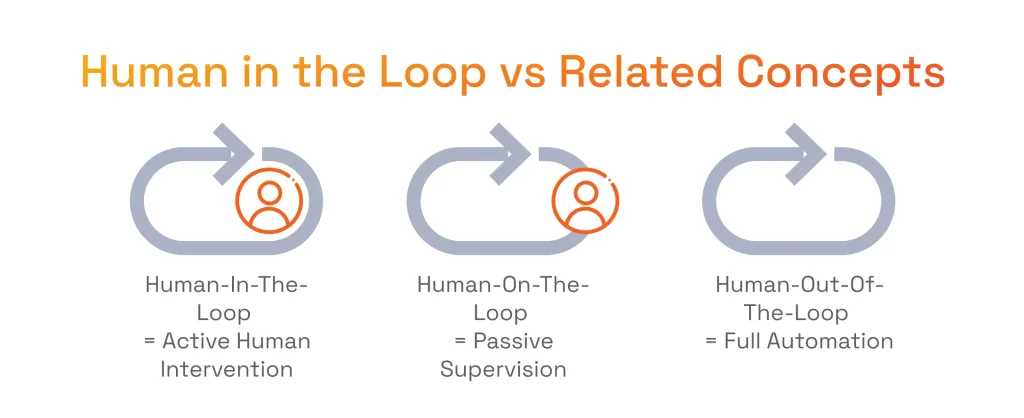
Organizations use different levels of human involvement depending on the importance of the decision, regulatory obligations, and acceptable risk levels. The following comparison outlines the three most common human-centered AI governance approaches.
Factor | Human-in-the-Loop (HITL) | Human-on-the-Loop (HOTL) | Human-in-Command (HIC) |
|---|---|---|---|
Human role | Reviews, validates, or approves AI outputs before action is taken | Monitors system performance and intervenes when necessary | Maintains authority over system objectives, policies, and decision rights |
Human involvement | Required for designated decisions or exceptions | Required only when issues or risks are detected | Required for strategic oversight and critical decisions |
Level of automation | Moderate | High | Varies by implementation |
Decision authority | Shared between AI and human reviewers | Primarily AI-driven with human supervision | Ultimately controlled by humans |
Response speed | Slower due to review steps | Faster because most decisions are automated | Depends on governance structure |
Risk mitigation | High | Moderate | Very high |
Scalability | Moderate | High | Moderate |
Best suited for | Regulated, high-risk, or customer-facing decisions | High-volume operational processes | Safety-critical or strategically important systems |
Example use cases | Loan approvals, fraud investigations, medical diagnosis support | Cybersecurity monitoring, network operations, manufacturing quality control | Defense systems, healthcare governance, critical infrastructure management |
Factor
Human role
Human involvement
Level of automation
Decision authority
Response speed
Risk mitigation
Scalability
Best suited for
Example use cases
Human-in-the-Loop (HITL)
Reviews, validates, or approves AI outputs before action is taken
Required for designated decisions or exceptions
Moderate
Shared between AI and human reviewers
Slower due to review steps
High
Moderate
Regulated, high-risk, or customer-facing decisions
Loan approvals, fraud investigations, medical diagnosis support
Human-on-the-Loop (HOTL)
Monitors system performance and intervenes when necessary
Required only when issues or risks are detected
High
Primarily AI-driven with human supervision
Faster because most decisions are automated
Moderate
High
High-volume operational processes
Cybersecurity monitoring, network operations, manufacturing quality control
Human-in-Command (HIC)
Maintains authority over system objectives, policies, and decision rights
Required for strategic oversight and critical decisions
Varies by implementation
Ultimately controlled by humans
Depends on governance structure
Very high
Moderate
Safety-critical or strategically important systems
Defense systems, healthcare governance, critical infrastructure management
By strategically deploying HITL, organizations balance AI scalability with human judgment. This approach ensures systems remain adaptable, ethical, and context-aware.
What Business Values Does Human in the Loop Create
The human-in-the-loop approach isn’t just a safety feature — it’s a strategic value driver that delivers measurable benefits for businesses that leverage AI. What specific benefits? Here’s a list of the essential ones.
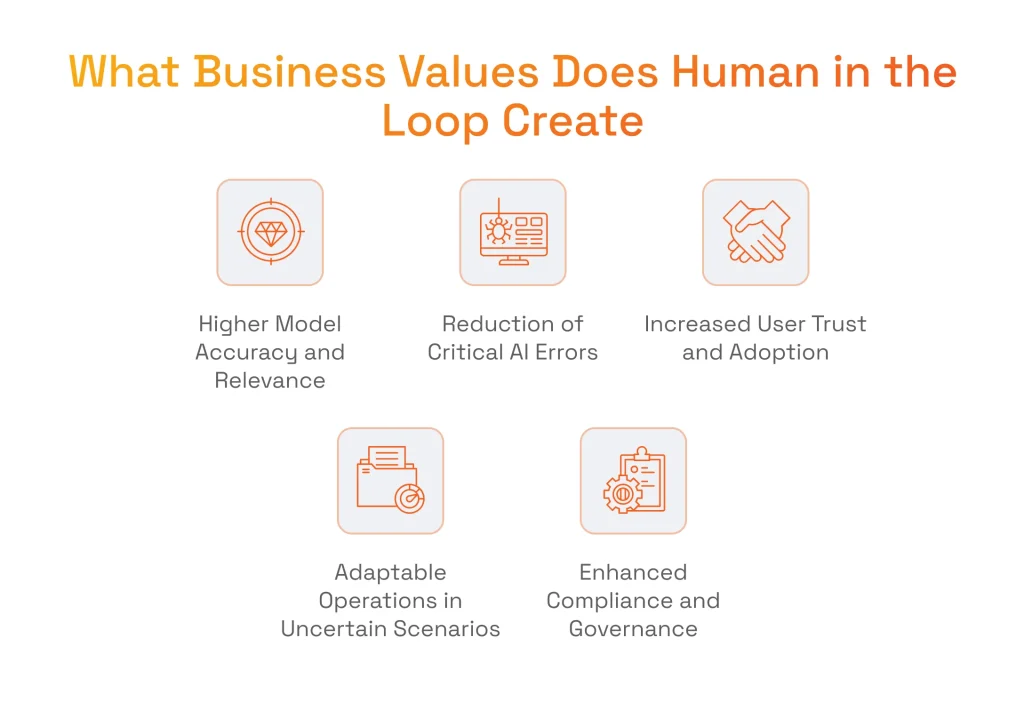
Higher Model Accuracy with Real-World Relevance
Human in the loop automation implies that machine learning teams feed models with specific data during data labeling, model validation, or decision overrides to train algorithms, which provides nuanced context that automated training alone often misses. This work improves model accuracy and makes sure outputs align with actual business needs.
Such a continuous feedback loop between human judgment and machine learning creates a more accurate and consistent system over time and leads to fewer costly errors, better customer experiences, and models that adapt more reliably to changing conditions.
Fewer High-Stakes Errors and Failures
AI without human oversight can optimize for metrics but ignore human values, creating mistakes In high-risk environments, such as finance, healthcare, autonomous systems, or customer service, these mistakes lead to significant financial loss, legal exposure, or reputational damage.
HITL serves as a safety net in such situations as it introduces critical guardrails by involving humans in testing and evaluation to catch and correct errors. This is especially valuable when models lack enough training data or context.
Greater User Trust and Adoption
Without human oversight, guaranteeing accurate model outcomes is challenging. Models can struggle with explaining its results or navigating its reasoning to achieve the required values. HITL strengthens trust by making AI more transparent, human understandable, and aligned with real-world business needs.
Plus, when users know that expert oversight is part of the process, they’re more likely to feel confident using and relying on the system. This is especially true for highly regulated niches, like finance and healthcare, where understanding AI rationale is crucial for avoiding exposure to fraud, misdiagnosis, biased decisions, or compliance violations.
Operational Flexibility in Uncertain Scenarios
In any niche, there are scenarios where typical rule shifts and data patterns evolve. AI models often find these changes unpredictable, which makes them provide inaccurate results. HITL, in turn, allows human judgment to step in when models face uncertainty, incomplete data, or unfamiliar scenarios.
Plus, it introduces quicker responses to real-world variability. This collaboration between humans and AI enables organizations to preserve continuity, accuracy, and control whether it’s handling exceptions, adapting to market changes, or managing crises.
Stronger Compliance and Governance
In regulated industries, ensuring that AI systems operate within legal, ethical, and policy boundaries contributes to stronger compliance. While AI systems alone can not always offer 100% correct results and transparent outcomes, humans make AI-driven systems accountable for their decisions.
Human oversight checks regulatory standards such as GDPR, HIPAA, or the EU AI Act and ensures robust audit trails and documentation, making it easier to demonstrate accountability during reviews or investigations. These human-in-the-loop (HITL) features ensure AI delivers meaningful, responsible, and reliable value to businesses across complex and evolving environments.
Cases Where Human in the Loop Approach Becomes Critical
Now that we understand the business value of human in the loop artificial intelligence, let’s reveal why this system design approach is vital.
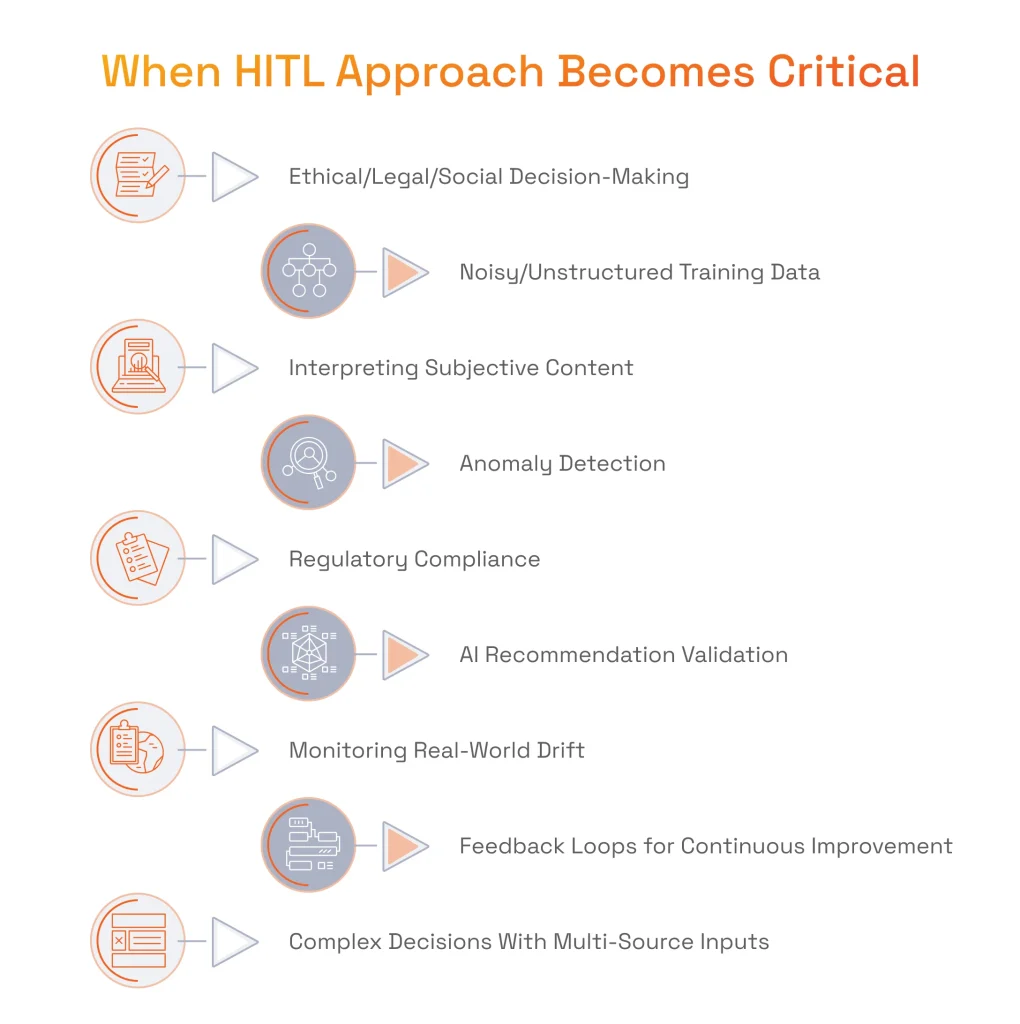
Decision-Making with Ethical, Legal, or Social Implications
When AI is involved in decisions that affect people’s lives — such as hiring, healthcare diagnostics, or legal risk assessments — human oversight is vital. These scenarios carry ethical and legal weight, where fairness, bias mitigation, and social responsibility come into play. Human-in-the-loop ensures that sensitive outcomes reflect not just data patterns, but human values and context.
Training Human in the Loop AI with Ambiguous, Unstructured, or Noisy Data
AI is only as good as the data it learns from — and early in development, that data is often messy. Humans must label, clean, and contextualize ambiguous or inconsistent inputs in fields like natural language processing or computer vision. Human-in-the-loop brings essential domain knowledge and judgment into the training loop, improving model quality from the ground up.
For example, we at SPD Technology, developed a computer vision powered app for seniors’ health and wellness that uses health data in different formats and patterns. To make the solution’s results precise, we collaborated with medical experts to label custom datasets for training of our AI/ML models. Further, we made sure that the data is accurate and reliable by conducting regular data quality reviews under the guidance of medical experts.
Leveraging AI, ML, Computer Vision, Retrieval-Augmented Generation, and Large Language Models to develop a web and mobile health and beauty monitoring app.
Interpreting Subjective Content or Tone
When AI systems analyze content filled with nuance — such as sarcasm, emotional tone, or culturally sensitive imagery — human interpretation becomes indispensable. Human-generated content, language, and visuals often carry meaning beyond what’s literal. Human-in-the-loop helps AI discern intent, sentiment, or offensiveness with greater accuracy, reducing misclassification and improving user experience.
Anomaly Detection in Critical Systems
In sectors like cybersecurity, finance, or industrial automation, rare anomalies may signal major threats or harmless glitches. Machines can flag outliers, but humans are needed to interpret them in context. Human-in-the-loop ensures that high-risk incidents are correctly prioritized, helping avoid costly disruptions while reducing false positives.
Ensuring Regulatory Compliance and Auditability
AI in regulated industries — from finance to healthcare — must follow strict rules. Human-in-the-loop enables humans to review, explain, and document decisions made by machines. This level of auditability is key for meeting legal standards, conducting internal reviews, and maintaining public trust, especially when automated systems operate at scale.
Validating AI Recommendations Before Execution
When AI generates recommendations (e.g., trade suggestions, medical treatments, policy flags) but a human must confirm or override before action is taken, human-in-the-loop ensures appropriate checks and balances. This is particularly important in high-stakes domains like healthcare, where AI may analyze medical images to aid diagnosis, but human doctors must verify AI-detected anomalies before determining treatment.
Monitoring System Drift or Real-World Changes
Markets shift, language evolves, and user behavior changes — often faster than AI models can adapt. Incorporating human-in-the-loop into the generative AI development process allows teams to spot data drift, detect when a model’s performance starts to degrade, investigate root causes, and trigger retraining.
Feedback Loops for Continuous Model Improvement
When human correction or reinforcement is required to fine-tune AI and adapt it to new or edge-case scenarios, human-in-the-loop creates a virtuous cycle of improvement. In human in the loop AI training, the testing and evaluation stage involves humans correcting any inaccurate results the machine produced, particularly where the algorithm lacks confidence. This active learning process constantly enhances the system’s performance.
Complex Multi-Source Decision Inputs
When decisions depend on a combination of structured data, human knowledge, and external context that AI cannot fully comprehend, human-in-the-loop bridges the gap. Humans can integrate information from multiple sources and apply contextual understanding that may be beyond the AI system’s capabilities.
The optimal level of human involvement varies significantly across industries and use cases. Factors such as regulatory requirements, decision criticality, and acceptable risk levels often influence system design, making custom AI development a key consideration for organizations deploying AI in production environments.
Human in the Loop (HITL): Meaning for Different Industries With Examples
In this section, we’ll provide examples of how different industries take advantage of human in the loop AI solutions.
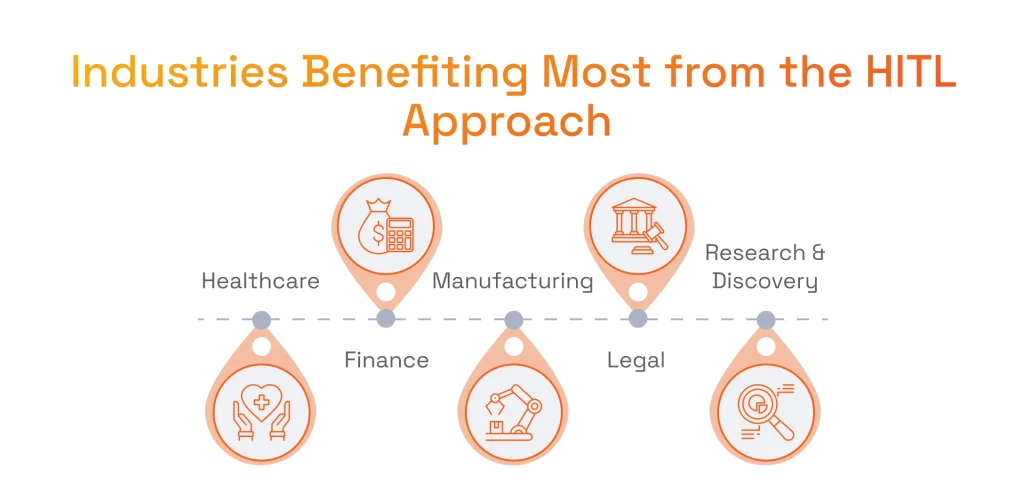
Healthcare
In ophthalmology, AI assists in analyzing eye images to detect diseases such as diabetic retinopathy, glaucoma, and age-related macular degeneration. Ophthalmologists review and validate these AI-generated findings to ensure accurate diagnosis and treatment planning.
Besides medical imaging analytics, machine learning in healthcare helps doctors detect pathologies, execute genomic medicine and drug discovery, monitor remote patients with the help of AI and IoT, and much more.

Serhii Leleko
ML & AI Engineer at SPD Technology
“While working with data in the healthcare industry, it is always important to implement robust data governance policies to maintain patient data’s accuracy, completeness, and integrity. Ensure your organization adheres to strict data security and privacy regulations, such as HIPAA, to safeguard patient confidentiality and comply with legal requirements.”
Manufacturing
Computer vision systems can identify defects in quality control processes, but human inspectors verify critical or ambiguous cases. AI predictive data analytics services forecast potential equipment failures, but maintenance engineers validate these predictions and determine appropriate actions based on the broader operational context. Companies improve their operational efficiency by combining AI and machine learning in the manufacturing industry with the expertise of seasoned quality control professionals.
Legal
Let’s see how artificial intelligence transforms legal services. Contract analysis tools use AI to flag potential issues in legal documents, but lawyers review these findings and make final determinations. In legal research, AI can identify relevant precedents and statutes, but attorneys evaluate their applicability to specific cases. This partnership allows legal professionals to focus their expertise on interpretation and strategy while AI handles more routine document processing.
Finance
Using AI for financial technology companies allows the industry players to deploy fraud detection systems where AI flags suspicious transactions, but human analysts confirm whether these represent genuine fraud. AI algorithms may make initial creditworthiness assessments in credit underwriting, but human underwriters review edge cases or applications with unusual circumstances. This approach is critical given the risks to financial institutions, consumer protection, and financial stability.
Want to learn more about how AI impacts the financial industry in terms of risk management, fraud detection, portfolio management, and more?
Read our article on AI in investment banking.
Research & Scientific Discovery
In drug discovery, AI can identify promising compounds for further investigation, but scientists decide which to pursue based on additional knowledge about biological mechanisms. AI can highlight patterns or anomalies when analyzing research data, but researchers determine their significance and implications. This collaboration accelerates the research process while maintaining scientific severity.
Human-in-the-loop AI delivers value across industries, but the balance between automation and human oversight varies by use case. The table below summarizes how different sectors incorporate human review into AI-driven processes to improve accuracy, compliance, and business outcomes.
Industry | AI Application | Human Role | Business Benefit |
|---|---|---|---|
Banking & Finance | Fraud detection and transaction monitoring | Review suspicious transactions and approve escalated cases | Reduces fraud while minimizing false positives |
Healthcare | Clinical decision support and medical image analysis | Validate diagnoses and treatment recommendations | Improves patient safety and decision accuracy |
Insurance | Claims processing and risk assessment | Review complex, disputed, or high-value claims | Improves accuracy, consistency, and compliance |
Retail & eCommerce | Customer support and content moderation | Handle escalated cases and review sensitive decisions | Improves customer experience and reduces operational risk |
Manufacturing | Automated quality inspection | Verify defects and assess edge cases flagged by AI | Improves product quality and reduces inspection time |
Logistics & Supply Chain | Route optimization and disruption management | Review exceptions and approve alternative actions | Improves operational resilience and delivery performance |
Legal Services | Contract analysis and document review | Validate AI recommendations and assess legal risks | Accelerates review processes while maintaining accuracy |
Industry
Banking & Finance
Healthcare
Insurance
Retail & eCommerce
Manufacturing
Logistics & Supply Chain
Legal Services
AI Application
Fraud detection and transaction monitoring
Clinical decision support and medical image analysis
Claims processing and risk assessment
Customer support and content moderation
Automated quality inspection
Route optimization and disruption management
Contract analysis and document review
Human Role
Review suspicious transactions and approve escalated cases
Validate diagnoses and treatment recommendations
Review complex, disputed, or high-value claims
Handle escalated cases and review sensitive decisions
Verify defects and assess edge cases flagged by AI
Review exceptions and approve alternative actions
Validate AI recommendations and assess legal risks
Business Benefit
Reduces fraud while minimizing false positives
Improves patient safety and decision accuracy
Improves accuracy, consistency, and compliance
Improves customer experience and reduces operational risk
Improves product quality and reduces inspection time
Improves operational resilience and delivery performance
Accelerates review processes while maintaining accuracy
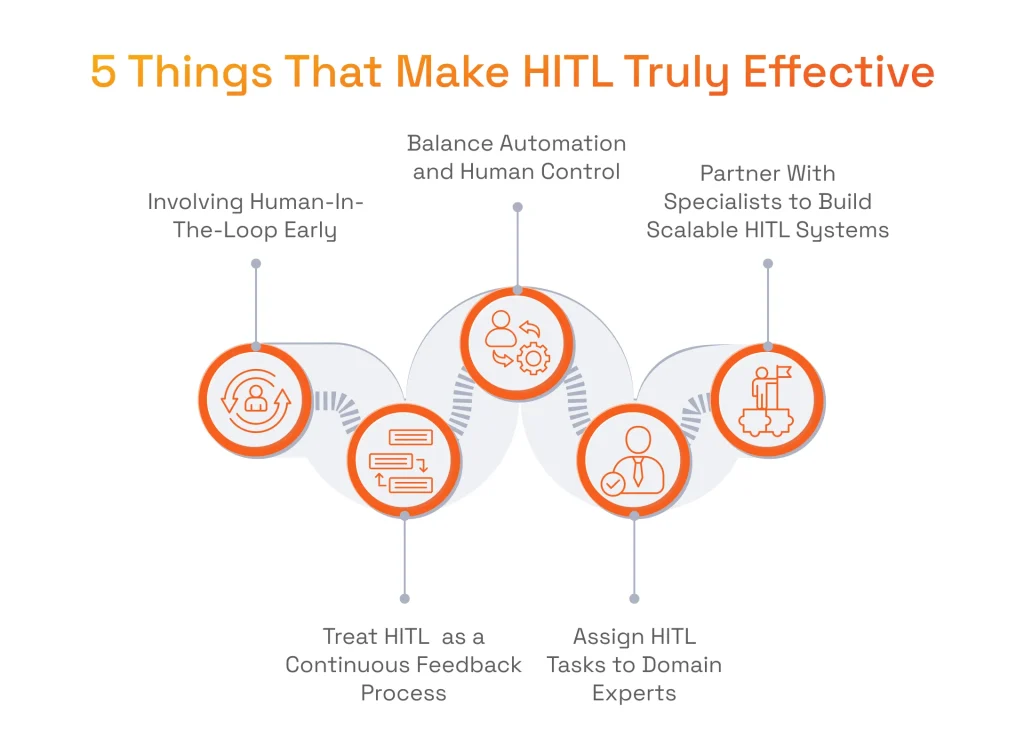
5 Things That Make Human-in-the-Loop (HITL) Truly Effective
Human-in-the-loop systems aren’t automatically effective just because a human is involved. Like any system, they must be thoughtfully designed, strategically timed, and continuously improved. Here’s what defines the ultimate result of AI human in the loop systems.
Incorporating HITL Early — Not After Mistakes Happen
The most successful human-in-the-loop implementations integrate human oversight from the beginning of AI development rather than retrofitting it after problems occur. By incorporating human judgment during initial data selection and labeling, organizations establish a strong foundation for their AI systems.
This proactive approach prevents the propagation of biases and errors that might otherwise become embedded in the system. Early integration of human-in-the-loop also helps shape the AI architecture to accommodate human intervention at appropriate points.
Treating Human-in-the-Loop (HITL) AI as a Continuous Process
Effective human-in-the-loop isn’t a one-time verification step but a continuous feedback loop where human insights constantly improve AI performance. The algorithm becomes more accurate and consistent as humans fine-tune the model’s responses to various cases.
This ongoing collaboration creates an environment where the system becomes increasingly sophisticated. Organizations should establish transparent processes for capturing human feedback, incorporating it into model retraining, and measuring the resulting improvements.
Synergy Human in the Loop Approach: Leveraging External Expertise
Many organizations require external expertise to build effective human-in-the-loop systems, especially when scaling beyond initial pilots. Partnerships with specialized tech vendors providing AI development services can accelerate implementation, avoid common pitfalls, and incorporate best practices across industries.
Serhii Leleko
ML & AI Engineer at SPD Technology
“While new product development companies may lack the established track record and in-depth domain expertise, seasoned ones have refined processes, proven methodologies, and a portfolio of successful launches that foster confidence in the product’s successful launch.”
Striking the Right Balance Between Automation and Human Oversight
Finding the optimal division of labor between humans and AI is crucial. Too much human intervention creates bottlenecks and limits scalability; too little risks errors and missed context.
The best implementations automate routine tasks while reserving human judgment for complex or high-stakes decisions. This balance should evolve as AI capabilities mature and confidence in specific functions increases. Assessing where human intervention adds the most value helps organizations optimize resource allocation.
Involving the Right Experts — Not Just Any Human in the Loop
The value of human-in-the-loop depends heavily on the quality of human judgment involved. Subject-matter experts who understand the domain and the AI’s capabilities provide more valuable guidance than general reviewers. Many organizations lack in-house expertise to effectively supervise AI systems, making it worthwhile to consider partnering with a tech vendor. Collaborating with external experts can help bridge the gap between technical capabilities and domain-specific needs and deliver the strongest results.
Key Takeaways
- Human-in-the-loop AI combines automated decision-making with human oversight, improving accuracy and reducing the impact of AI errors in high-stakes scenarios.
- Fully automated systems increase efficiency, but they can amplify mistakes when models encounter unfamiliar data, edge cases, or rapidly changing conditions.
- Human feedback improves model performance over time by identifying errors, refining outputs, and providing training data for continuous learning.
- Organizations should prioritize human review for decisions involving financial risk, compliance requirements, safety concerns, or significant customer impact.
- Excessive human intervention can slow operations and reduce the benefits of automation, making workflow design critical to balancing accuracy and efficiency.
- Human-in-the-loop systems improve transparency and accountability by ensuring that critical AI decisions remain explainable and auditable.
- The most effective AI strategies automate routine decisions while reserving human expertise for exceptions, ambiguity, and high-risk outcomes.
In short: human-in-the-loop AI enables organizations to balance automation with human judgment, improving accuracy, accountability, and trust. The most successful implementations use AI to accelerate decision-making while ensuring that humans remain responsible for reviewing high-risk, complex, or business-critical outcomes.
FAQ
When does a human-in-the-loop approach hurt the performance and efficiency of AI systems?
A human-in-the-loop approach can reduce efficiency when every decision requires manual review, regardless of risk or complexity. Excessive human involvement may create bottlenecks, increase processing times, and limit the scalability benefits that AI is designed to deliver.
Human review is most effective when applied selectively to high-risk decisions, low-confidence predictions, or exceptional cases. Organizations that require unnecessary oversight for routine decisions often increase operational costs without significantly improving outcomes.
How much does implementing a human-in-the-loop AI workflow cost compared to full automation?
Human-in-the-loop (HITL) AI systems typically cost more to operate than fully automated solutions because they require human review, oversight processes, workflow management tools, and ongoing quality assurance. Implementation costs vary with the complexity of the use case, but organizations often invest $50,000–$250,000+ in HITL workflows, while enterprise-scale AI automation initiatives can range from $100,000 to well over $1 million. The additional investment in human oversight is often justified in regulated, high-risk, or customer-facing environments where accuracy, compliance, explainability, and risk mitigation are critical.
Although full automation may offer lower operational costs at scale, many organizations adopt HITL models initially and gradually increase automation as confidence in model performance improves. This approach helps balance efficiency gains with quality control and business risk management.
What are the most common design mistakes in human-in-the-loop systems?
Common mistakes include assigning humans to review every decision, setting unclear escalation criteria, failing to capture reviewer feedback, and measuring throughput rather than decision quality.
Another frequent issue is treating human reviewers as a compliance checkpoint rather than a source of learning. Effective human-in-the-loop systems continuously incorporate human feedback into model improvement processes. Without this feedback loop, organizations increase costs without improving AI performance.
How do you decide which AI decisions require human review versus full automation?
The decision typically depends on risk, confidence levels, regulatory requirements, and potential business impact. High-risk decisions involving financial transactions, healthcare, compliance, safety, or customer rights often benefit from human oversight.
Many organizations use confidence thresholds to determine when to escalate. For example, AI may automatically process high-confidence decisions while routing uncertain or unusual cases to human reviewers. This approach preserves efficiency while reducing the likelihood of costly mistakes.
What is the difference between human-in-the-loop, human-on-the-loop, and human-in-command AI?
Human-in-the-loop AI requires people to actively participate in the decision-making process by reviewing, validating, or correcting AI outputs before actions are taken. Human-on-the-loop allows systems to operate autonomously while humans monitor performance and intervene only when necessary.
Human-in-command AI gives humans ultimate authority over the system, including when, how, and whether AI can make decisions. This model is often used in highly regulated, safety-critical, or strategic environments where accountability must remain under direct human control.