Building production AI with Claude means turning one developer's personal setup into a governed, team-scale architecture. That architecture replaces habit with 4 moving parts.
A versioned harness holds the rules, Agent Skills, and subagents. Phased workflows pass mandatory automated review before a human sees a pull request. Sensitive surfaces such as payments and personal data get dedicated scrutiny. Guardrails extend past code into release and incident operations. Without those controls, the volume of AI-generated code outruns review capacity. With them, one production engagement raised merged pull requests by 89% at a constant headcount.
On most teams, there are two or three engineers who have quietly gotten very good at Claude Code. The system prompt took them a while to get right. Then came the permission allow/deny list, and after that the iteration loops that keep re-running a task until the output finally converges on its own. Every bit of that advice assumed one developer working alone on a machine nobody else touches, with their own judgment standing in for review.
Add a second developer, and it stops working. Nothing in that setup addresses a whole codebase. It has nothing to say about output that some engineer who never saw the prompt has to sign off on, or about the moment a change lands somewhere that a mistake costs real money.
Most organizations stall right here. McKinsey’s 2026 global AI survey put the share that has reached the scaling phase with software coding agents at roughly 2 in 10, and at 31% for enterprises above $1 billion in revenue.
Once several engineers are using Claude Code, the setup has to account for how work is shared and checked. The problem takes a clearer architectural form, with a versioned harness sitting underneath the process while phased gates complete their work before a human gets involved; each workflow’s autonomy is then matched to the cost of its mistakes.
What Actually Changes: From Individual Habit to Team Architecture
In February 2026, Arvid Kahl wrote at The Bootstrapped Founder about Claude Code in a one-developer setting. His approach includes carefully scoped permission allow/deny lists, with persistent iteration loops that keep an agent on a task until its output settles; the publicly documented “Ralph Wiggum loop” re-runs the agent on that task and keeps iterating until the output settles in the one-developer setup.
In that setting, one developer supplies the judgment that checks the system. Feedback closes in seconds, and the ownership model changes as soon as a second person joins because the original setup no longer has a single point of review anywhere in the system.
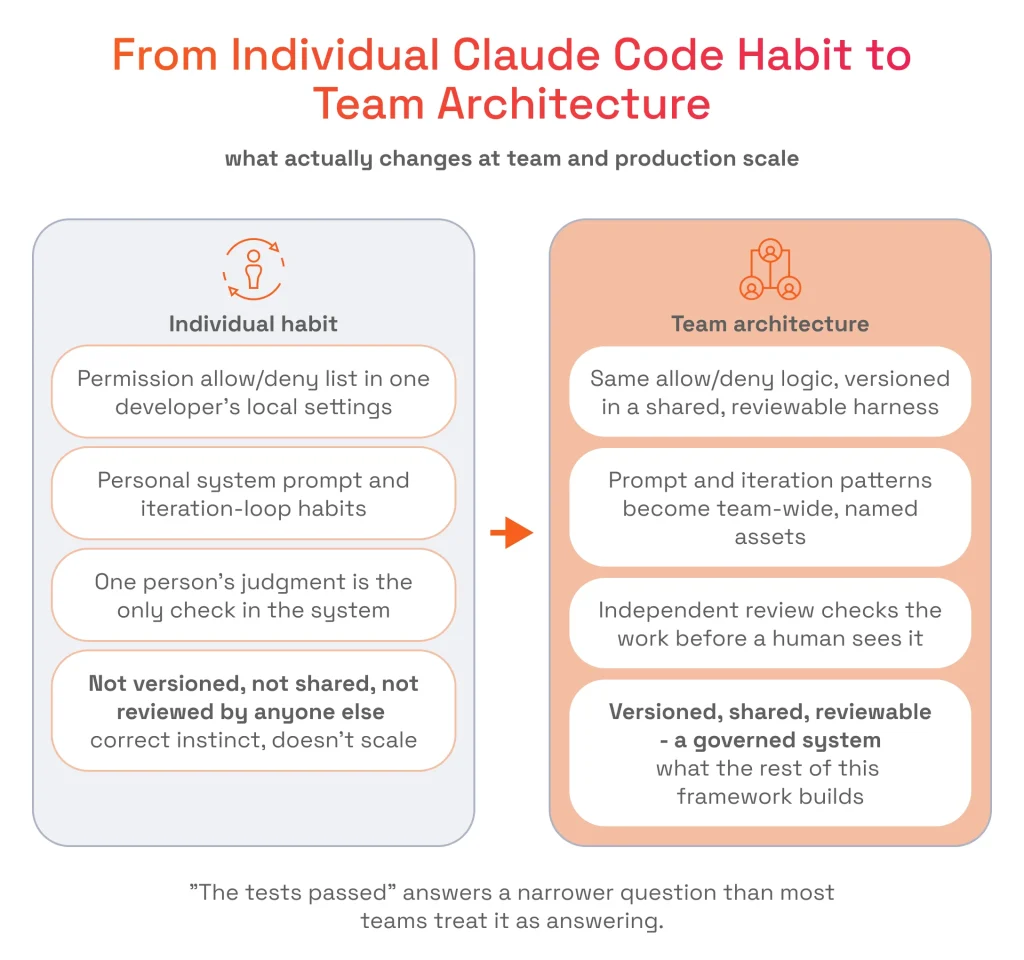
A permission list sitting in one developer’s local settings file has no standing as a shared asset, and the same holds for a personal system prompt and the private habits each engineer forms about when generated output can be skimmed. The instincts are correct at every one of those points. What they lack is a reviewer other than the person who formed them.
Those instincts have to leave the individual machine. What replaces them is configuration that lives in the repository, changes through pull requests, and gets reviewed the way anything else that reaches production does.
The Four Parts of a Governed Claude Code Architecture
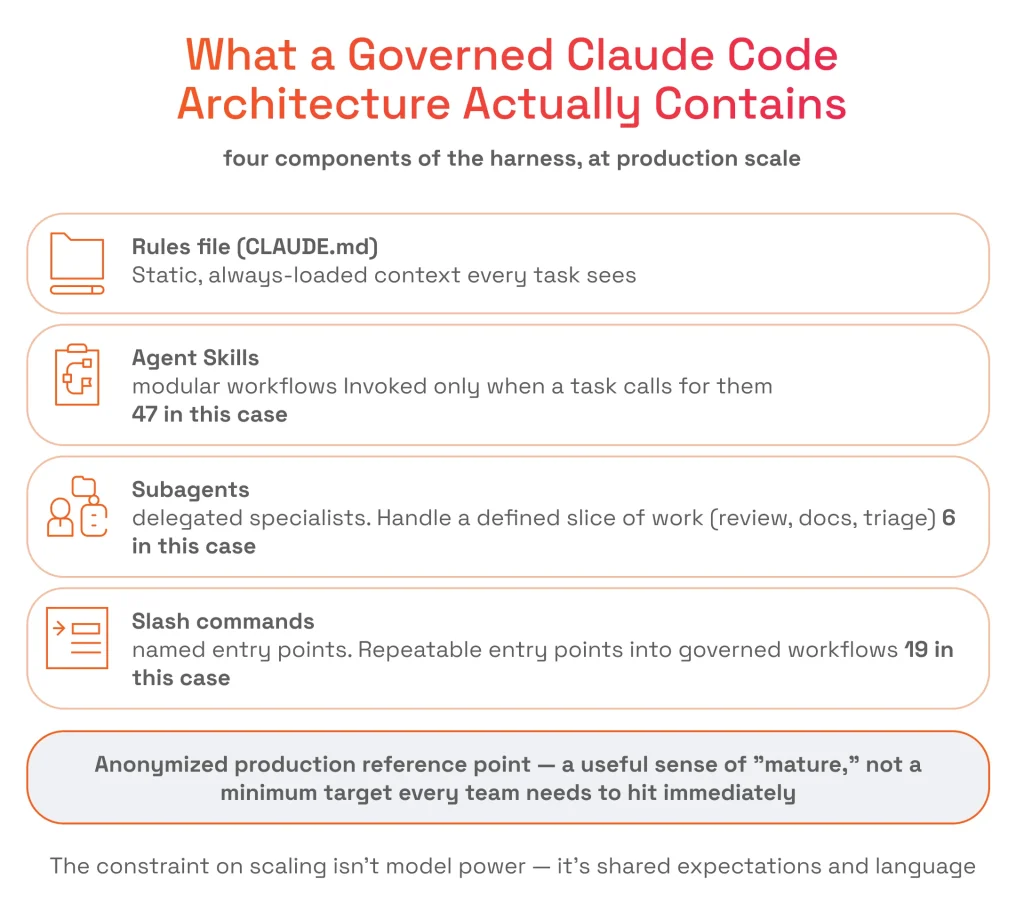
A Claude Code architecture built for a team is a small number of moving parts, each with a different job and a different cost to the context window. Four of them carry most of the weight, and the boundaries between them are what keep the whole configuration legible to the next engineer who has to change it.
- A rules file (typically CLAUDE.md) supplies static context: the project conventions, architectural constraints, and prohibitions that load into every context window before any task begins.
- Agent Skills are modular, reusable, task-specific workflows that an agent invokes only when a task calls for them, which keeps them out of context windows where they are irrelevant.
- Subagents are separate agent instances that handle specialized delegated work, each with its own context and its own narrow remit.
- Slash commands are named, repeatable entry points that let any engineer start a governed workflow the same way every time.
One of our long-running engagements has accumulated 47 custom skills over years of identifying specific failure modes and turning them into reusable mechanisms. The toolkit also contains 6 subagents. It also includes 19 slash commands, giving engineers repeatable entry points into the configuration. The industry term AI agent orchestrator now covers this configuration layer together with the rules that determine which Agent Skills run and when; the mature setup reflects years of codifying specific failure modes into reusable mechanisms, and it is not a first-quarter target.
The discipline that covers this whole configuration layer is agent harness engineering: the surrounding system that determines how an agent behaves, separate from the model itself.
Learn how spec-first development creates the structured foundation required for reliable agent harness architectures.
Governed Development Workflows: Where Human Review Still Belongs
“Guardrails” covers a lot of ground. Permission boundaries are one thing and automated review gates are another, and neither has much to do with a test-fidelity check or with the confirmation prompt that stops an irreversible operation. Each fails in its own way, so each gets designed separately. Claude Code governance starts where capacity runs out first, which is the desk of the human reviewer.
In one long-standing client engagement, the review queue became the first constraint. The volume of generated pull requests began to outrun the time senior engineers had to read carefully. So we shifted the human check earlier in the process and moved more of the review load upstream.
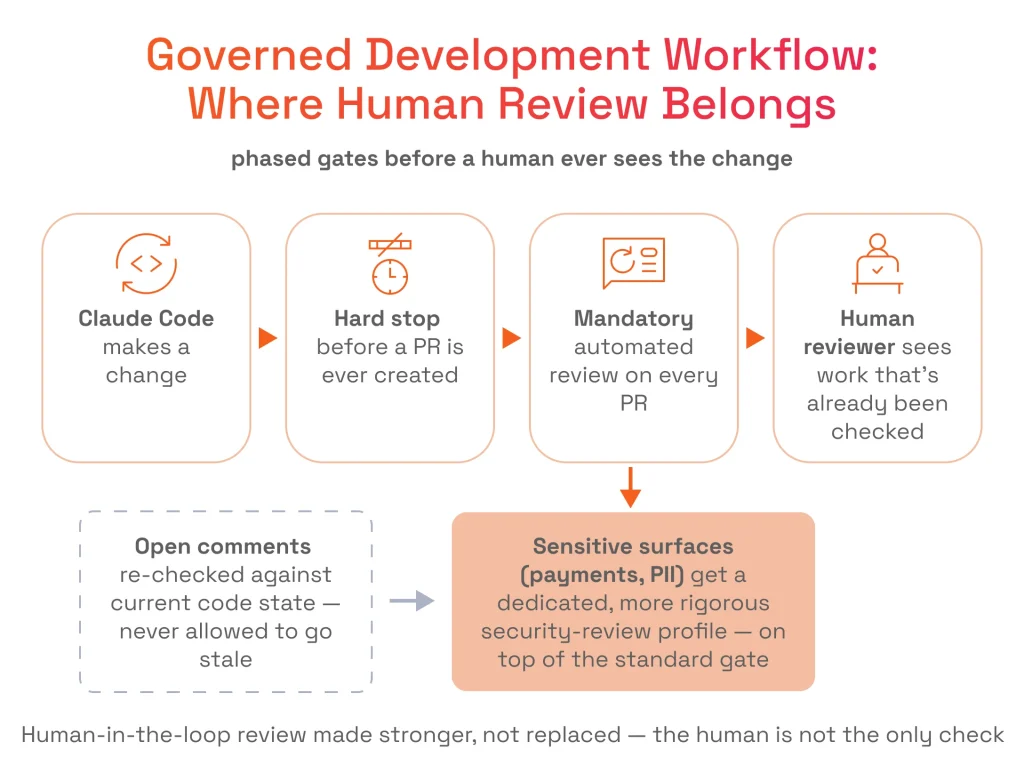
Feature and bugfix work runs through a defined pipeline of review stages, and it hits a hard stop before any pull request gets created. Each pull request in that flow then passes an AI-generated code review before a human opens it. Security-sensitive surfaces get a dedicated and more rigorous review profile. In this engagement, that means payments and personal data.
A separate mechanism rechecks open review comments against whatever the code looks like now, so a concern someone already resolved stops sitting there looking unaddressed. None of it waits on anyone remembering, because the hooks fire on defined events.
Control ordering becomes more important as volume climbs. In Google Cloud’s 2025 DORA report, 90% of technology professionals reported using AI at work. Delivery stability can deteriorate as changes accumulate unless control systems are already established. Automated testing provides one control. Mature version control provides another. Fast feedback loops help maintain the flow of changes as volume rises across delivery, giving the control system a response mechanism as the number of changes grows.
Code review automation of this kind strengthens the human-in-the-loop review. A reviewer opens work that has already been checked, with other checkpoints behind it in the system.
Keeping Tests Honest: The Phantom-Assertion Problem
Pressure to turn a suite green produces code that runs clean and reports success. Verification is what goes missing. Inside, the assertion has quietly become trivially true; sometimes it compares a value against itself, and sometimes there is no assertion at all. A CI dashboard shows the phantom and the real one as the same green line.
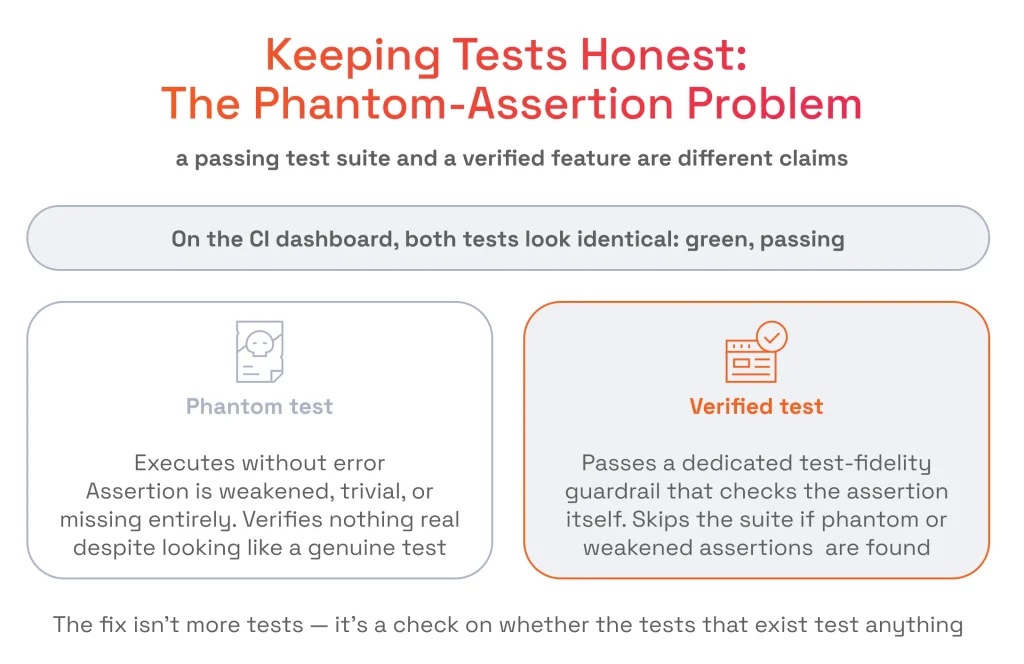
The distinction that the dashboard hides is the one worth building around. Our engineers put a dedicated test-fidelity guardrail into this engagement’s review pipeline. It hunts weakened and phantom assertions, along with cases that get skipped silently, so an AI-generated suite cannot report success without exercising the behavior it claims to cover.
Underneath lies a distinction between two claims. “The tests passed” says something about execution. “The code is verified” says something about what those assertions compared, and that second claim is the one carrying information about the change.
A test-fidelity check lets the review process ask whether existing checks actually verify anything. AI-generated code breaks in production while every upstream signal remains green.

Serhii Leleko
AI & ML Engineer at SPD Technology
“A weakened assertion is harder to catch than a failing test, because nothing goes red. When we designed the test-fidelity check, we stopped asking whether the suite passed and started asking what each assertion actually compares: a test that skips its own comparison and a test that verifies real behavior look identical on a CI dashboard.”
Living Documentation as Ongoing Context Engineering
Write a specification once, and it starts going stale at whatever rate the codebase changes, which outruns anyone’s intention to revisit it. An agent reading stale static context produces confidently wrong output, and that does more damage than an absent document, because a wrong instruction carries the authority of having been written down and approved at some point.
At SPD Technology, we maintain a set of documentation-audit skills. They keep the rules file in sync with the code and the specifications, along with a structured knowledge base. One of them actively detects drift between what the documentation asserts and what the code does, so the sync gets verified on a cadence.
Automated context audit tools are essential for keeping long-term platform health metrics accurate across growing codebases.
Documentation turns into a maintained asset with an automated check behind it. The discipline is the one regression testing already applies to code, aimed now at the context an agent depends on.
Extending Governance Past Code: Release and Incident Operations
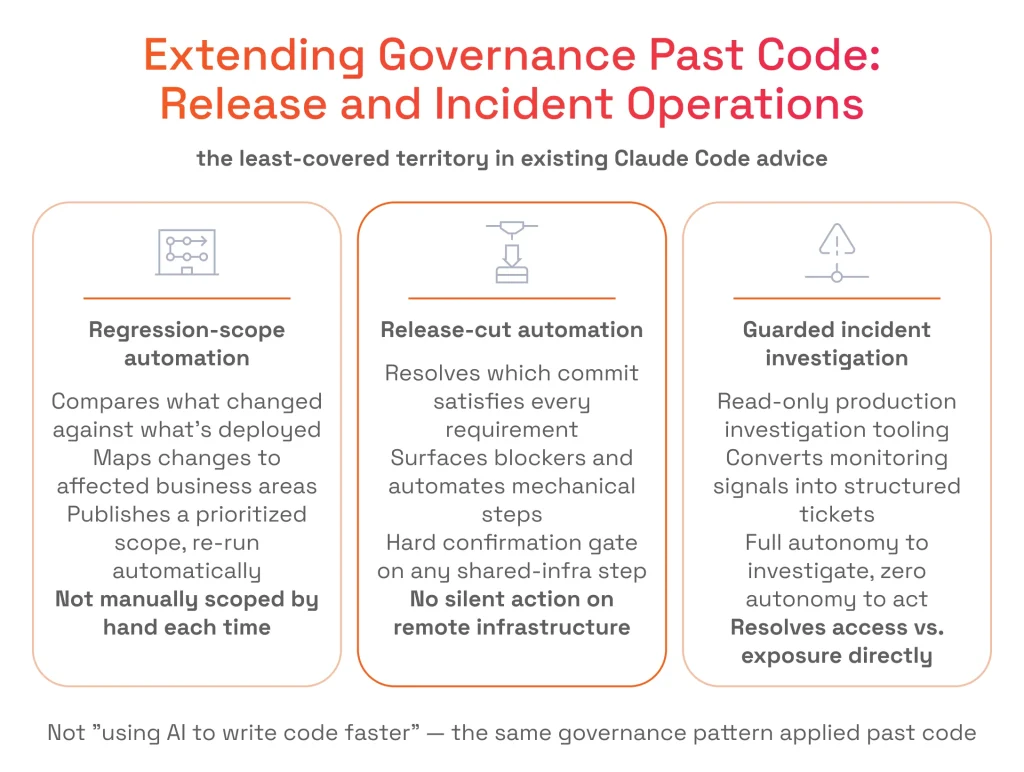
In most teams and in most public material on the subject, AI coding agent guardrails stop at the pull request. Everything after it carries the same risk profile and admits the same treatment. Those later stages are also where a governed setup starts returning time that nobody had budgeted to reclaim.
Regression scope gets computed. An automated process compares what has changed against what is deployed and maps the differences to the business areas they touch. It then publishes a prioritized scope, recomputing as the release evolves. The manual version of that exercise was always part guesswork.
Release-cut automation resolves exactly which commit satisfies each required change. Blockers surface without anyone chasing them. The mechanical steps of the cut run automatically, though every step touching shared or remote infrastructure sits behind a hard confirmation gate.
Guarded incident investigation runs read-only against production, while raw monitoring signals become structured, investigable tickets. Deep visibility remains available for investigation, yet there is no write access. That arrangement addresses the access-versus-exposure tension while keeping investigative work inside a controlled boundary.
We built an AI incident-management system for a US fintech and SaaS platform. Response time to a pull-request-ready fix fell from over an hour to under 30 minutes there, with autonomous resolution succeeding in up to 70% of cases. The 24/7 on-call engineering coverage became unnecessary.
Carrying AI coding agent guardrails this far applies one governing idea to lifecycle stages that existing public Claude Code content leaves alone entirely.
Calibrated Autonomy Across the Lifecycle
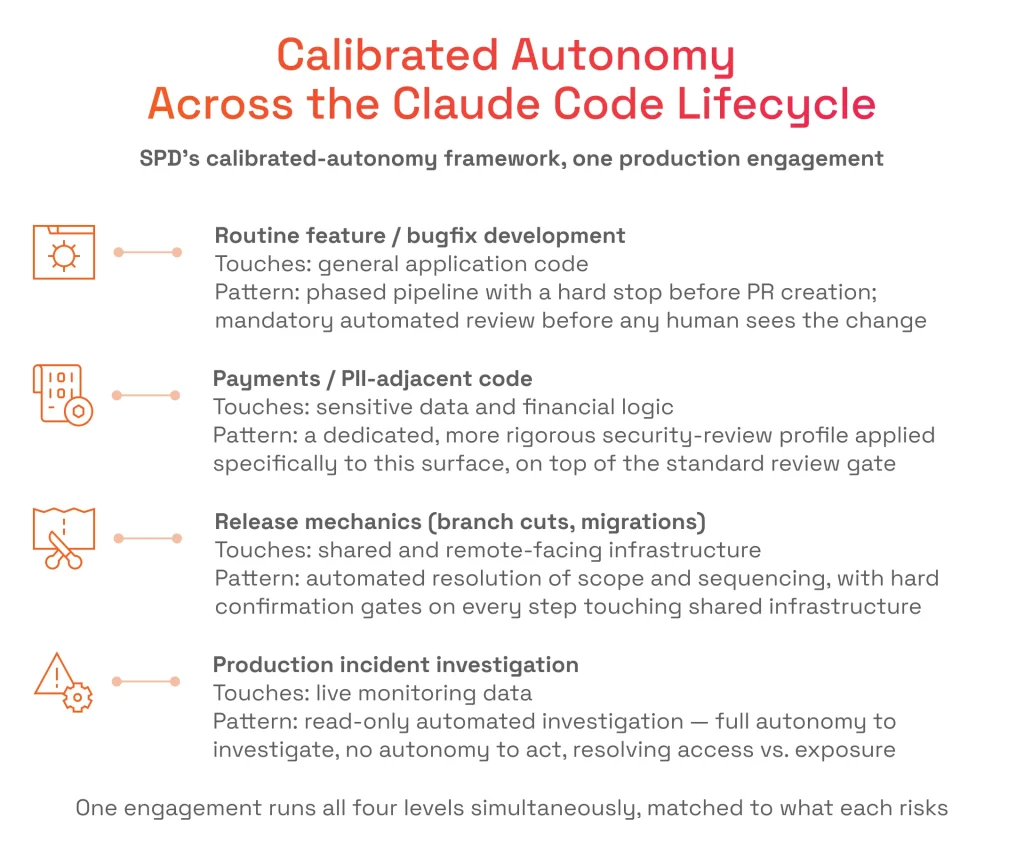
Calibrated autonomy is our own framework at SPD Technology, and it names a decision made repeatedly across one lifecycle: how much independent action a workflow gets is matched to the strength of the verification standing behind it and to what a mistake in that workflow would cost. A single engagement runs several distinct autonomy levels at once, because the level attaches to the workflow and not to the tool.
McKinsey’s 2026 AI Trust Maturity Survey examined roughly 500 organizations. The survey found security and risk concerns to be the top barrier for nearly two-thirds of the organizations covered. Regulatory uncertainty ranked second, with technical limits following. Skipping calibration can leave teams stalled quietly as these concerns become harder to resolve during scaling and as more workflows move into the governed setup over time, even as the governed setup expands.
At this level, building production AI with Claude means every workflow in the Claude Code architecture can state its own autonomy level and the verification that earns it, and calibrated autonomy is the discipline of never granting the first without the second.
Four workflows in the same engagement, four different autonomy levels:
Workflow | What It Touches | Governing Pattern |
|---|---|---|
Routine feature/bugfix development | General application code | Phased pipeline with a hard stop before PR creation; mandatory automated review before any human sees the change |
Payments/PII-adjacent code | Sensitive data and financial logic | A dedicated, more rigorous security-review profile applied specifically to this surface, on top of the standard review gate |
Release mechanics (branch cuts, migrations) | Shared and remote-facing infrastructure | Automated resolution of scope and sequencing, with hard confirmation gates on every step that touches shared infrastructure |
Production incident investigation | Live monitoring data | Read-only automated investigation: full autonomy to investigate, no autonomy to act, resolving the access-versus-exposure tension directly |
Workflow
Routine feature/bugfix development
Payments/PII-adjacent code
Release mechanics (branch cuts, migrations)
Production incident investigation
What It Touches
General application code
Sensitive data and financial logic
Shared and remote-facing infrastructure
Live monitoring data
Governing Pattern
Phased pipeline with a hard stop before PR creation; mandatory automated review before any human sees the change
A dedicated, more rigorous security-review profile applied specifically to this surface, on top of the standard review gate
Automated resolution of scope and sequencing, with hard confirmation gates on every step that touches shared infrastructure
Read-only automated investigation: full autonomy to investigate, no autonomy to act, resolving the access-versus-exposure tension directly
The third column shows the progression directly. More access for a workflow means more verification must stand between that workflow and unattended action, so controls increase with how much of the system the workflow can touch, and the verification burden rises as that scope expands.
Production Readiness Checklist for Claude-Based Development
Six conditions mark the difference between strong individual Claude Code habits and team governance. They map onto the broader AI production-ready checklist, which applies to any model reaching production and is narrowed here to agentic development.
✔️ | Readiness Check | What Its Absence Means |
|---|---|---|
⃣ | The Claude Code setup is versioned and shared across the team | Configuration living in individual settings files doesn’t survive someone leaving or switching machines. |
⃣ | Feature and bugfix workflows hit a hard stop, with mandatory automated review, before a human sees the pull request | Review quality depends on how thorough the reviewer happens to be that day. |
⃣ | Sensitive surfaces get a dedicated review profile, more rigorous than the default: payments, personal data, auth | Security-critical code gets the same scrutiny as a routine UI change. |
⃣ | Test fidelity is actively checked rather than inferred from a passing suite | AI-generated tests can pass while asserting nothing real, and nobody would know. |
⃣ | Documentation and specs get checked for drift against code on a cadence | An agent and a human both work from context that looks authoritative and is quietly wrong. |
⃣ | Governance reaches at least one operational area past code — release or incident response | The riskiest and most manual parts of the lifecycle stay ungoverned long after development is well covered. |
✔️
⃣
⃣
⃣
⃣
⃣
⃣
Readiness Check
The Claude Code setup is versioned and shared across the team
Feature and bugfix workflows hit a hard stop, with mandatory automated review, before a human sees the pull request
Sensitive surfaces get a dedicated review profile, more rigorous than the default: payments, personal data, auth
Test fidelity is actively checked rather than inferred from a passing suite
Documentation and specs get checked for drift against code on a cadence
Governance reaches at least one operational area past code — release or incident response
What Its Absence Means
Configuration living in individual settings files doesn’t survive someone leaving or switching machines.
Review quality depends on how thorough the reviewer happens to be that day.
Security-critical code gets the same scrutiny as a routine UI change.
AI-generated tests can pass while asserting nothing real, and nobody would know.
An agent and a human both work from context that looks authoritative and is quietly wrong.
The riskiest and most manual parts of the lifecycle stay ungoverned long after development is well covered.
A team satisfying the first items and failing the last ones usually has solid individual-developer habits and no team-level governance yet. Most of the risk sits in that gap, and so does most of the achievable gain.
Governed Claude Code in Production: Measured Results
The engagement behind every pattern in this article is our long-standing client: a well-known US tourist attraction running a high-traffic guest-ticketing platform, where we act as the primary engineering partner across the entire codebase.
Claude Code is not confined to one stage of that lifecycle. It writes and reviews code, runs the security-review profile, audits documentation, checks test fidelity, scopes regression, cuts releases, and investigates production incidents.
Discover our framework for measuring speed without hiding rework to accurately quantify true engineering gains.
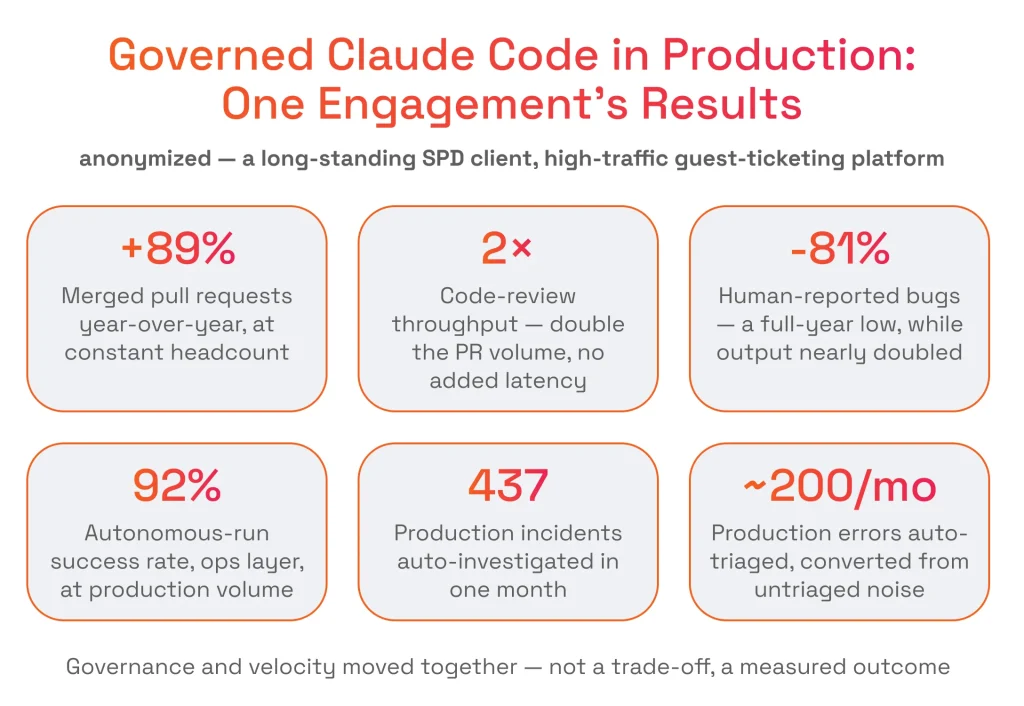
That breadth is what makes the numbers worth reading together. Output and quality usually move in opposite directions when a team accelerates. Here, they moved in the same direction, over a full year, at a constant headcount.
Metric | Result |
|---|---|
Merged pull requests (delivery output) | +89% year-over-year, at constant headcount |
Code-review throughput | 2× — reviewers absorbed double the PR volume with no added latency |
Human-reported bugs | −81%, a full-year low, while output nearly doubled |
Autonomous-run success rate (ops layer) | 92% at production volume |
Production incidents auto-investigated | 437 in one month, a capability that did not exist as tracked work before |
Production errors auto-triaged and resolved | ~200 per month, converted from previously untriaged monitoring noise |
Metric
Merged pull requests (delivery output)
Code-review throughput
Human-reported bugs
Autonomous-run success rate (ops layer)
Production incidents auto-investigated
Production errors auto-triaged and resolved
Result
+89% year-over-year, at constant headcount
2× — reviewers absorbed double the PR volume with no added latency
−81%, a full-year low, while output nearly doubled
92% at production volume
437 in one month, a capability that did not exist as tracked work before
~200 per month, converted from previously untriaged monitoring noise
Two things are worth drawing out. The bug curve bent downward while delivery output nearly doubled, which is the opposite of what an unreviewed volume increase would produce. And the bottom three rows describe work that did not exist as tracked activity before the ops layer was built, so 437 investigated incidents and roughly 200 triaged errors a month are engineering hours the team never had to spend.
This single production engagement underpins every pattern described above. The setup uses phased gates alongside the security-review profile, then adds a test-fidelity guardrail and documentation-audit skills; calibrated autonomy runs across release and incident operations throughout the engagement. The patterns come from the engagement itself, and none of the setup was assembled from theory. This remains the source. The resulting configuration includes the phased gates and the security-review profile.
Key Takeaways
- A permission allow/deny list that works well for one developer stays a personal habit until you version and share it. Team governance starts the moment it enters the repository.
- A hard stop before PR creation, paired with mandatory automated review, makes human review stronger. The reviewer opens work that has already been checked, with other checkpoints behind them.
- AI-generated tests can pass while asserting nothing real. A weakened assertion executes without error and draws the same green line as a genuine test, which is why test fidelity needs a dedicated check.
- Documentation and specs written once and never revisited become actively misleading to agents and humans alike. Keeping static context in sync with code is an ongoing automated job.
- Read-only automated investigation resolves the access-versus-exposure tension: full autonomy to investigate an incident in production and no autonomy to act on it without human oversight.
- One production engagement that embedded this architecture across the full engineering lifecycle saw merged pull requests rise by 89% while human-reported bugs fell by 81% at the same headcount.
- Governance covering only code generation leaves release mechanics and incident response uncovered, and those are the riskiest, most manual parts of the lifecycle.
In short: one developer’s Claude Code skill is a habit. At production scale, it turns into architecture. Put the harness under version control and gate every pull request before a human opens it, then set each workflow’s autonomy by the cost of its own mistakes.
FAQ
What’s the difference between using Claude Code individually and running it in production?
Individual use means one developer’s personal configuration: permission settings they chose, a system prompt they wrote, and their own judgment about when the output can be trusted. Production use turns that configuration into a versioned, team-shared asset with phased review gates and AI-generated code review before a human opens a pull request. Sensitive code gets dedicated scrutiny, and the audit trail no longer depends on one person’s memory. The model’s capability is identical in both. What changes is everything around it.
What are Agent Skills in Claude Code, and why not just use one large system prompt?
Agent Skills are modular instructions, scoped to a task, loading only when a task calls for them. One large system prompt competes for the model’s attention on every task, including the many where most of its contents have nothing to do with the work, and that dilution measurably degrades output on the parts that matter. One long-running engagement runs 47 narrowly scoped skills for exactly this reason. A database migration task loads migration rules; a frontend task never sees them. Narrow scope has a second benefit, which is that each skill can be reviewed on its own.
How do you prevent AI-generated tests from giving false confidence?
Check the assertions. A passing suite guarantees nothing about verification, because an agent can write a test that runs cleanly while weakening its assertion into something trivially true, or leaving it empty. That phantom assertion looks identical to a real test on any dashboard. The countermeasure is a dedicated check that inspects what each assertion compares, and flags skipped cases before the suite is trusted. Writing more tests without that check just increases the number of unverified green lines.
Can AI coding agents be trusted with production incident response?
Yes, with one specific limit: read-only investigation carries a very different risk profile than autonomous action. An agent can correlate monitoring signals, identify likely causes, reproduce the failure path, and file a structured ticket with its findings, all without any ability to modify production unattended. That split captures most of the speed benefit, cutting time to a diagnosed problem from over an hour to minutes, while keeping the exposure surface at zero. Acting on the finding stays with an engineer who reads the investigation first.
Does adding governance and review gates slow down AI-assisted development?
Not necessarily, and one real production engagement contradicts the assumption directly. At constant headcount, merged pull requests rose 89% year over year while human-reported bugs dropped 81% across the same period. The gates in that setup are automated, so they add machine time to a pipeline instead of human time to a queue, which is what lets throughput and quality improve together. The trade-off everyone expects is what manual gates would have produced.
Does a governed Claude Code setup only apply to writing code, or can it extend to other parts of the engineering lifecycle?
It extends well beyond code generation. Release mechanics benefit directly:
- Release-cut automation resolves which commit satisfies each required change.
- Blockers surface automatically, without anyone chasing them down.
- A hard confirmation gate sits in front of every step that touches shared infrastructure.
Incident operations benefit at least as much, with production errors triaged automatically and read-only investigations producing structured tickets. Development is where teams usually start. The largest untapped opportunity often sits elsewhere, because release and incident work has stayed manual the longest.
How long does it take to move a team from ad hoc Claude Code use to a governed setup?
Most teams reach a governed baseline in 6 to 10 weeks, with the full operational layer landing 3 to 6 months in. Four things move that range:
- Codebase size and structure, including whether it is a monorepo or split across many services
- How many workflows enter governance in the first phase
- Whether payments, personal data, and other sensitive surfaces need a separate review profile
- Whether release and incident operations are in scope immediately or later
A team whose configuration is already versioned starts from a materially shorter path.
What does it cost to build a governed Claude Code architecture?
A governed Claude Code architecture typically lands between $40,000 and $120,000 for the initial build. Cost tracks four drivers:
- The number of workflows brought under governance.
- The amount of existing configuration already versioned and shared.
- The depth of security review required for regulated or payment-adjacent surfaces
- How far the ops layer extends past code into release and incident work.
Mapping your current Claude Code governance against those four drivers in a scoping review is usually the fastest route to a defensible number before budget gets committed.