AI engineering enablement means turning scattered individual gains from AI coding tools into an organization-wide practice — teaching engineers new ways of working with agents, and building the technical guardrails that make scaling that behavior safe. The two halves are often treated separately: behavior-change frameworks (like Salesforce's four-level Proficiency Model) address how engineers learn to work with agents, while access and tooling frameworks address what agents are allowed to do.
Guardrails slow delivery when they apply the same review burden to every task regardless of risk. They don’t have to: guardrails that scale with the cost of a mistake — light for routine work, strict for irreversible decisions — let an organization move fast on most work while still controlling its riskiest agent actions.
A working setup on one developer’s machine feels like an enterprise capability. A few senior engineers adopt coding agents, double their personal pull-request output, and demonstrate undeniable gains. Yet across the rest of the organization, adoption stays fragmented, leaving leadership without a clear plan to close the gap safely.
Scaling that early momentum requires solving two problems that organizations usually treat separately. The first is a human learning challenge: teaching engineers to change how they plan, write, and verify code alongside artificial intelligence. The second is an architectural challenge: building technical guardrails that keep autonomous tooling from causing production outages or security incidents.
Structured frameworks exist for teaching engineers how to work with agents. Other frameworks exist for governing what agents can touch. Neither one says how much review a specific change needs — that’s decided ad hoc, task by task, which is exactly why a documentation fix and a payments change end up going through the same approval chain.
What AI Engineering Enablement Actually Means
Enabling an engineering organization to use artificial intelligence is not about writing strategy documents or building internal experiments for a single team’s use. As practitioner Maxime Beauchemin notes, enablement means accelerating adoption for the broader group of engineers who would not otherwise extract value from these tools on their own. It moves the organization past isolated individual setups and informal recommendations into a structured, scalable discipline.
Individual power users often create workflows that cannot scale across a full engineering organization. Without a central enablement practice, teams develop divergent habits, inconsistent code quality standards, and uncoordinated access patterns that create security blind spots.
This functional gap has driven the emergence of dedicated enablement roles across the software industry. Organizations now treat this as a distinct engineering discipline rather than a side project for platform leads, a shift reflected in dedicated hiring across the market, such as OpenAI hiring an Applied AI Engineer for Agent Enablement to formalize how development teams interact with agent systems. Treating enablement as a core practice ensures that tooling improvements, context architectures, and safety constraints scale across every team simultaneously.
The People Side: What Salesforce’s Enablement Model Gets Right
Addressing the human side of enablement requires a clear path for how engineers shift their daily habits. In her analysis of internal enterprise adoption, Caitlin Mann detailed how Salesforce built an agentic engineering enablement strategy for thousands of software engineers by establishing a four-level proficiency framework.
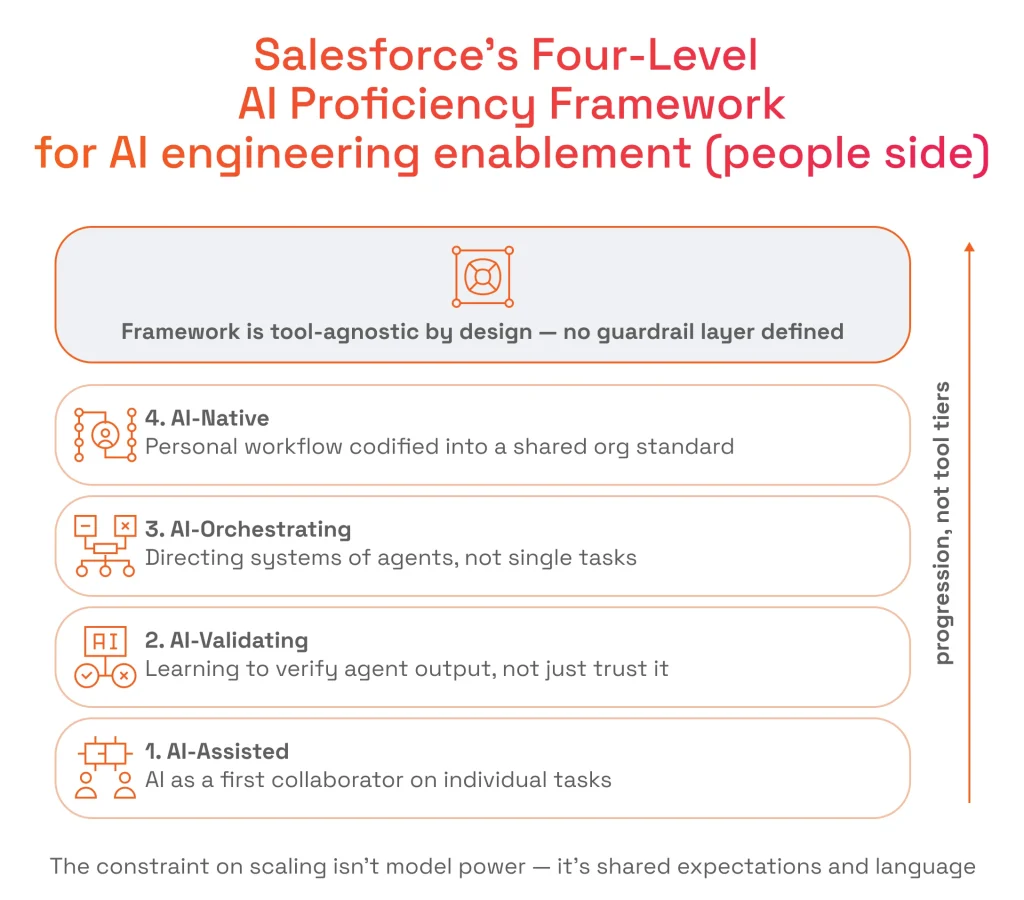
This framework outlines a clear progression for engineering habits:
- AI-Assisted: The engineer uses intelligence tools as a basic collaborator for line-by-line completion and localized code generation.
- AI-Validating: The primary focus shifts from prompt writing to systematic output verification, code review, and edge-case testing.
- AI-Orchestrating: The engineer directs systems of multiple agents across multi-file refactoring and broader feature implementation.
- AI-Native: The engineer’s own way of working with agents becomes the team’s default — the AGENTS.md file they wrote for themselves is the one everyone else starts from.
Salesforce’s research highlighted a critical organizational reality: given access to the same models, engineers naturally invent incompatible workflows. The primary constraint on enterprise productivity is not raw model capabilities, but the absence of a shared operating language and clear expectations.
Salesforce’s framework never tells you what an agent should be allowed to do at each stage — it’s built to teach the habit shift, not to enforce anything. An engineer can hit AI-Native and still be running agents with no access boundaries at all. That’s the gap this article picks up.
The Tooling Side: Why Access Alone Isn’t Enablement
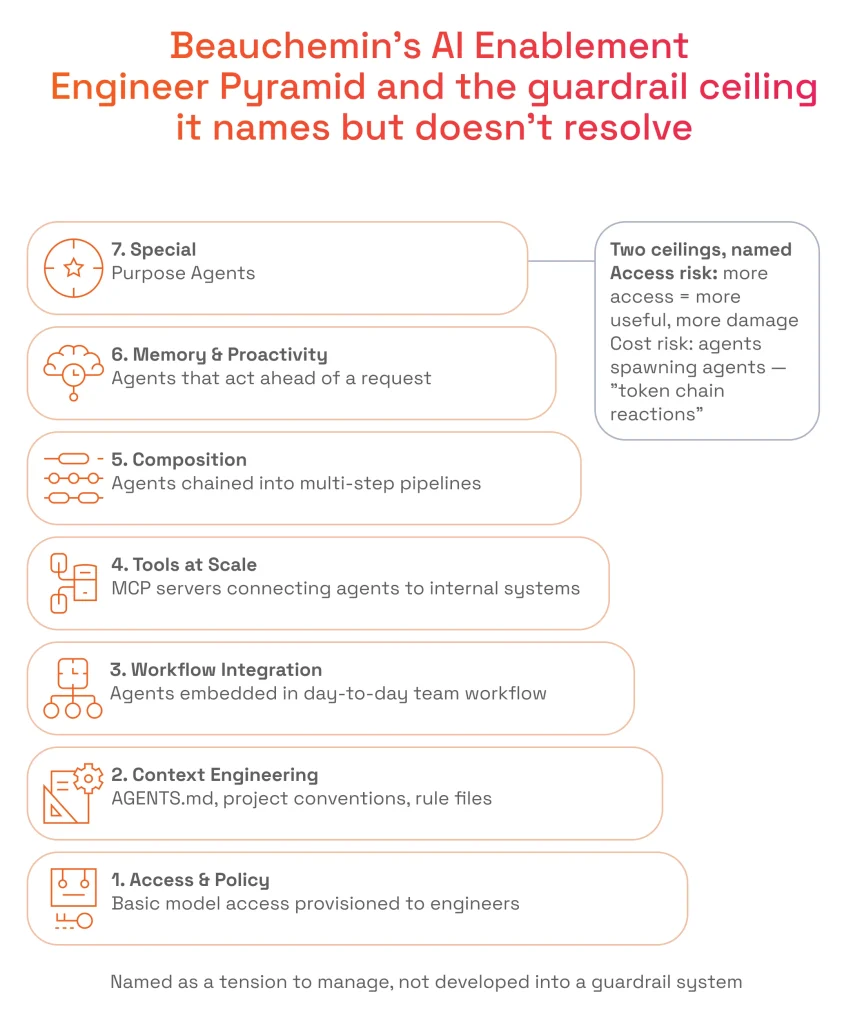
Expanding tool access without a broader ai strategy and technical structure creates operational risk. In his analysis of the AI enablement engineer role, Maxime Beauchemin breaks down the technical stack into a clear hierarchy: basic model access, context engineering through standards like AGENTS.md, workflow integration, tool access via Model Context Protocol (MCP) servers, a centralized control plane, and specialized agent orchestration.
Granting agents deeper system access increases their capability, but it introduces proportional risk to the codebase, infrastructure, and deployment pipelines. Uncontrolled agent loops can also trigger runaway token consumption, escalating infrastructure costs just as quickly as operational risk.
To mitigate these exposure vectors, Beauchemin recommends an incremental trust model, granting read-only access by default and expanding permissions only as an agent proves reliable. While this principle offers sound guidance, traditional management approaches often implement it through manual approval chains, turning governance into a delivery bottleneck.
AI observability should track token consumption, latency, and errors in AI applications as access expands safely.
For how this access-scoping principle gets implemented technically, see Agent harness engineering: architecture, guardrails & tool orchestration.
Guardrails That Scale With Risk, Not Uniformly
Applying identical review requirements to every task causes engineering friction. When a minor documentation update requires the same multi-layered approval chain as a core payment gateway refactor, engineers experience governance as a hindrance rather than a safeguard, especially when guardrail design is driven by technical caution instead of clear business objectives.
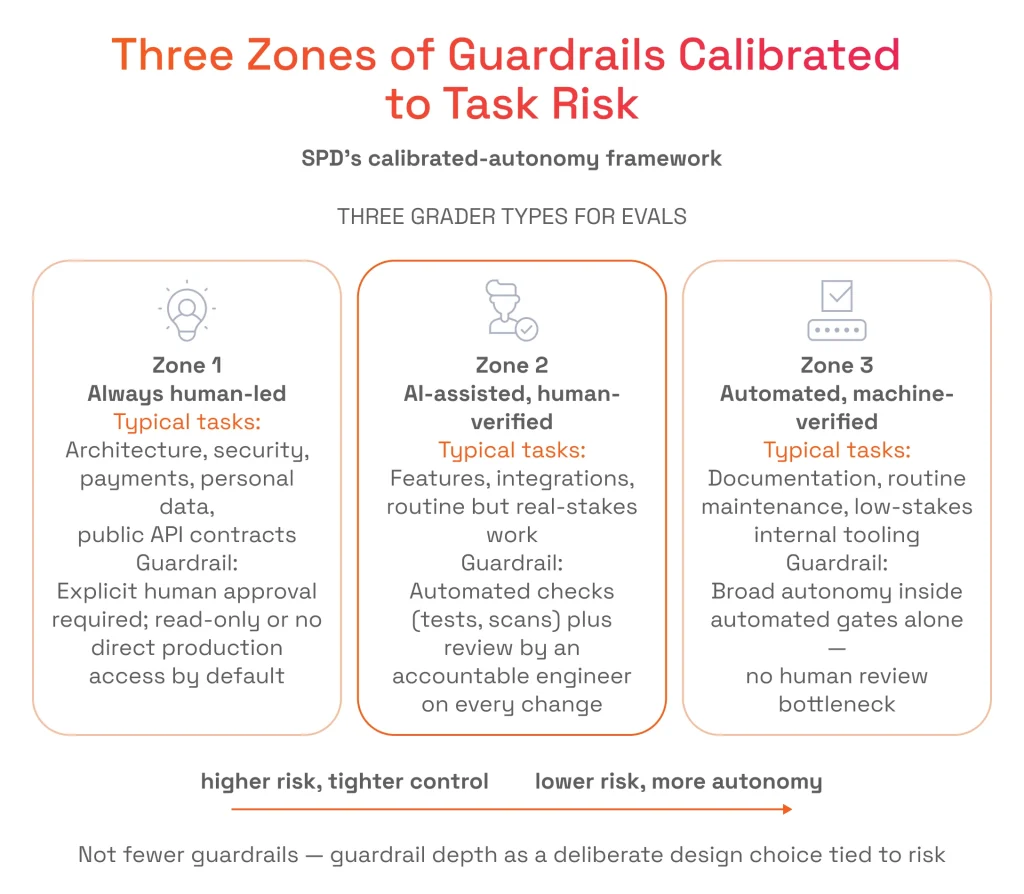
To solve this, SPD Technology uses calibrated autonomy — SPD Technology’s own repeatable operating model for aligning an agent’s operational freedom with the cost of potential failure and the strength of automated verification. Instead of enforcing blanket restrictions, this framework categorizes engineering tasks into distinct operational zones:
Zone | Typical Task Type | Guardrail That Belongs Here |
|---|---|---|
Zone 1 — Always human-led | Architecture, security, payments, personal data, public API contracts | Explicit human approval required, read-only or no direct production access by default |
Zone 2 — AI-assisted, human-verified | Features, integrations, routine but real-stakes work | Automated checks (tests, scans) plus review by an accountable engineer on every change |
Zone 3 — Automated, machine-verified | Documentation, routine maintenance, low-stakes internal tooling | Broad autonomy inside automated gates alone — no human review bottleneck, earned by being cheap to verify and easy to undo |
Zone
Zone 1 — Always human-led
Zone 2 — AI-assisted, human-verified
Zone 3 — Automated, machine-verified
Typical Task Type
Architecture, security, payments, personal data, public API contracts
Features, integrations, routine but real-stakes work
Documentation, routine maintenance, low-stakes internal tooling
Guardrail That Belongs Here
Explicit human approval required, read-only or no direct production access by default
Automated checks (tests, scans) plus review by an accountable engineer on every change
Broad autonomy inside automated gates alone — no human review bottleneck, earned by being cheap to verify and easy to undo
Calibrating autonomy allows organizations to maintain rigorous oversight on critical infrastructure without stalling routine development. A recent McKinsey global survey on AI revealed that while 88% of organizations regularly use artificial intelligence in at least one business function, only about one-third have successfully scaled these programs enterprise-wide. AI can reduce time-to-market by 40–60%, but that gain often goes unrealized when uniform guardrails slow low-risk work. Implementing risk-proportional guardrails removes the operational friction that typically stalls that expansion.
Where Guardrails Should Actually Live: In the Harness, Not in a Policy Document
A rule that only lives on a wiki page depends on someone opening that page at the right moment — and under deadline pressure, that’s exactly when it doesn’t happen. The guardrail was real. It just wasn’t anywhere the engineer was looking.
Effective enablement moves guardrails out of documentation and directly into the execution harness. Configuring sandbox environments, command-blocking hooks, and tool-level permission boundaries ensures that constraints execute automatically. This harness-level approach directly automates the incremental trust model, preventing unauthorized operations without requiring human intervention.
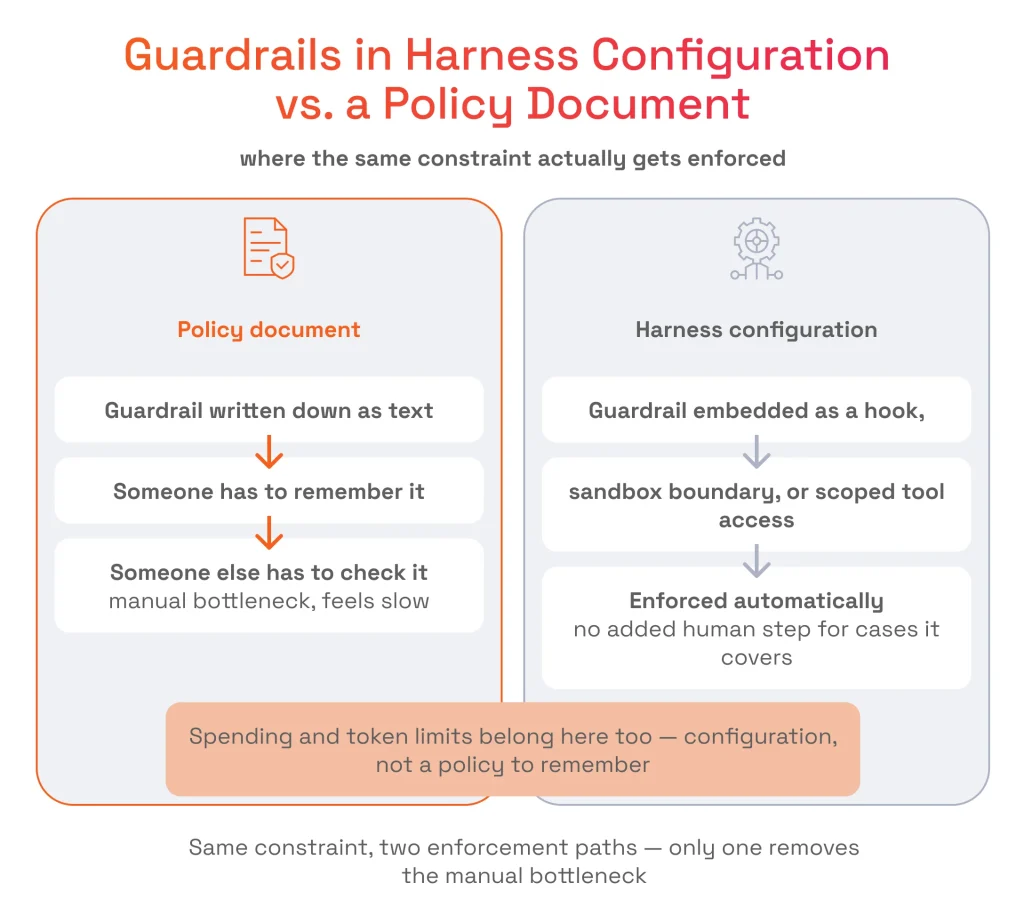
In SPD Technology’s Claude Code engineering and operations enablement for a US ticketing platform, this looked like hard confirmation gates on every remote-facing release step, a dedicated security-review profile for the payments and PII surface, and read-only tooling for production incident investigation, so none of those constraints depended on an engineer remembering them.
Harness enforcement handles what an agent is allowed to touch, but it doesn’t independently confirm whether the output is right. That’s the gap spec-first development closes: writing the specification and acceptance criteria before any code gets generated gives agent output a fixed, structured target to be checked against, rather than relying on after-the-fact review as the only verification step.
Cost controls require the same automated approach. Configuring strict token caps and spending limits within the execution environment prevents runaway loops from escalating resource costs unnoticed.

Serhii Leleko
AI & ML Engineer at SPD Technology
“The failure mode we see most often isn’t a missing rule — it’s a rule that only exists in someone’s head or a wiki page nobody reads under deadline pressure. We moved a client’s ‘don’t touch production config without review’ guardrail out of their onboarding doc and into a harness-level hook that blocks the specific commands that matter. The rule didn’t get stricter. It just stopped depending on someone remembering it.”
Enablement Maturity: Combining the People Path and the Guardrail Path
As engineers advance along the proficiency scale, the complexity of the tasks they delegate to agents expands into higher-stakes environments. A team moving toward orchestrating complex workflows requires technical guardrails that evolve alongside their growing reliance on autonomous tools, and successful AI enablement typically takes six to twelve months to implement as teams mature across both proficiency and governance.
As engineers direct more agents at once, permission scoping stops being enough on its own — the harder question becomes whether the output is actually correct, not just whether the agent was allowed to produce it. Deloitte’s research on agentic AI governance found that only 21% of organization leaders say they have a mature governance framework in place, even as autonomous agents keep deploying faster across their companies.
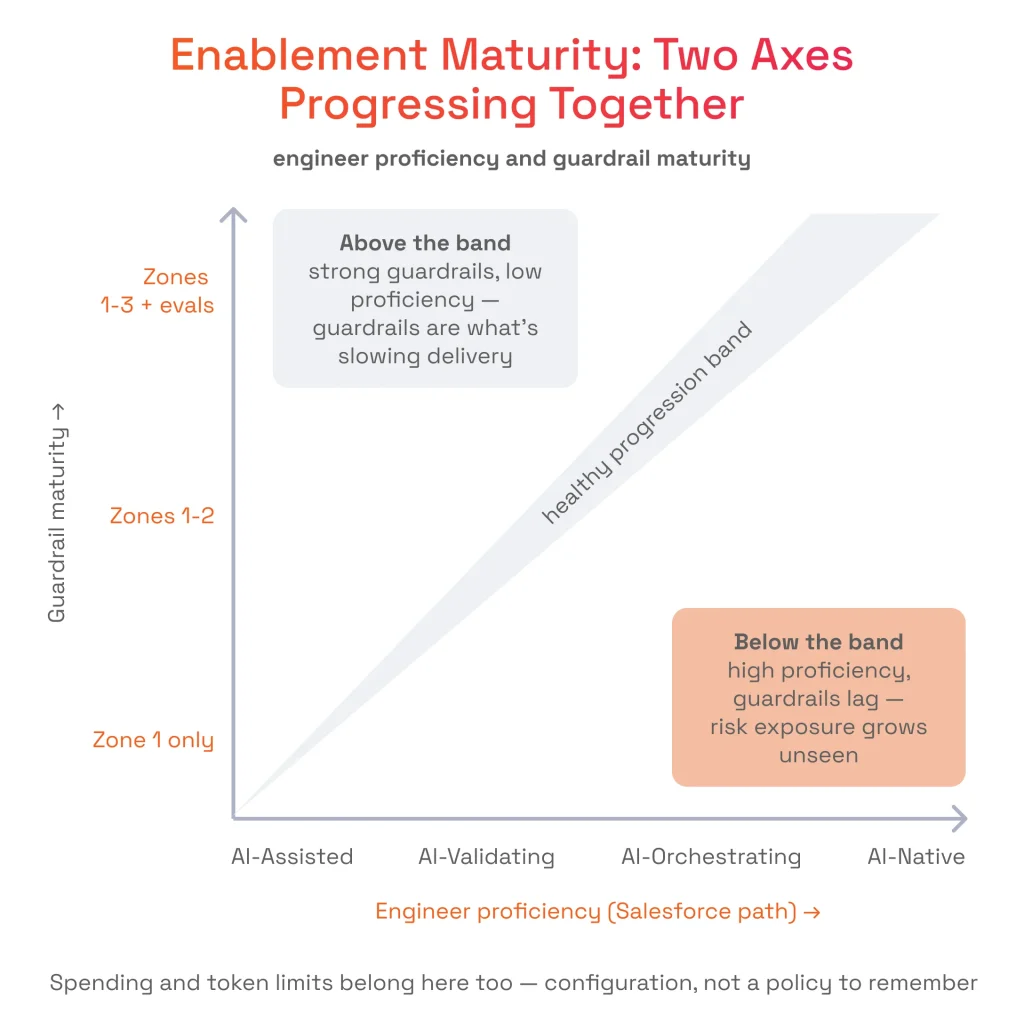
A balanced enablement strategy advances human proficiency and technical governance together. Tracking developer habits alongside harness-level safety controls ensures that team capabilities stay aligned with organizational risk controls — the same discipline that shows up in platform health metrics every scaling CTO should track, where guardrail maturity and proficiency progression sit next to deployment frequency and incident rate as signals of whether the practice is actually holding up. When those two tracks advance together, AI engineering enablement reduces cycle time by 40–60%, and measuring developer productivity through the same lens can also surface shifts in developer experience as enablement matures.
For how output and trajectory quality get verified once agents are operating with real autonomy, see How to evaluate AI agents before production.
Guardrails Without Slowing Delivery: A Practical Checklist
Assessing an organization’s AI readiness for AI adoption across the whole team requires auditing both human workflows and technical controls. Teams can assess their operational readiness through the following checklist:
✓ | Practice | What It Prevents |
|---|---|---|
⃣ | Tasks are mapped to a risk zone before deciding how much guardrail applies | The same review burden being applied to a documentation fix and a payments change |
⃣ | Guardrails are enforced in harness configuration, not only written in a policy document | A guardrail that depends on someone remembering to check it manually |
⃣ | Agent access starts read-only or narrowly scoped and expands as trust is earned | Broad production access being granted before an agent has proven reliable on lower-stakes work |
⃣ | Spending and token limits are set as configuration, not left to provider defaults | An agent spawning further agents overnight and generating a surprise bill |
⃣ | High-risk zones require explicit human sign-off with no exceptions | An irreversible action shipping because an automated check alone judged it acceptable |
⃣ | Engineer proficiency (behavior change) is tracked alongside guardrail maturity | A team’s guardrails staying static while the actual risk of what engineers are directing agents to do keeps expanding |
⃣ | Verification (evals) exists for higher-autonomy work, not just access control | Guardrails answering “was this allowed” while leaving “was this correct” completely unaddressed |
✓
⃣
⃣
⃣
⃣
⃣
⃣
⃣
Practice
Tasks are mapped to a risk zone before deciding how much guardrail applies
Guardrails are enforced in harness configuration, not only written in a policy document
Agent access starts read-only or narrowly scoped and expands as trust is earned
Spending and token limits are set as configuration, not left to provider defaults
High-risk zones require explicit human sign-off with no exceptions
Engineer proficiency (behavior change) is tracked alongside guardrail maturity
Verification (evals) exists for higher-autonomy work, not just access control
What It Prevents
The same review burden being applied to a documentation fix and a payments change
A guardrail that depends on someone remembering to check it manually
Broad production access being granted before an agent has proven reliable on lower-stakes work
An agent spawning further agents overnight and generating a surprise bill
An irreversible action shipping because an automated check alone judged it acceptable
A team’s guardrails staying static while the actual risk of what engineers are directing agents to do keeps expanding
Guardrails answering “was this allowed” while leaving “was this correct” completely unaddressed
Organizing enablement around this checklist highlights structural gaps. AI agents can increase developer productivity by 5–10x, but only when adoption extends beyond a few power users and is supported across the whole team. A team with high developer proficiency but weak harness controls faces unnecessary risk, while strong controls without proficiency growth create delivery bottlenecks.
Organizations seeking to balance control and velocity can engage AI consulting services to design custom governance frameworks. For broader architecture assessments, reviewing an AI Production-Ready Checklist helps ensure all system dependencies are secured before launch.
Our Expertise
SPD Technology approaches enablement as an integrated engineering discipline focused on stronger software development outcomes. The same calibrated autonomy principles used to deploy client architectures govern how engineering teams adopt intelligent development tools:
- Risk-calibrated control: Guardrail depth is established per task risk rather than enforced as a blanket rule across all repositories, maintaining speed where risk is low.
- Progressive access models: System permissions expand incrementally based on verified performance, mimicking structured onboarding paths.
- Harness-level enforcement: Security constraints and rate limits are embedded into version-controlled environment configurations rather than manual checklists.
- Integrated evaluation pipelines: Continuous output verification is implemented alongside access rules, confirming that generated code meets both security standards and functional requirements.
Conclusion
Scaling AI engineering enablement requires pairing developer behavior change with risk-calibrated technical guardrails. Enforcing constraints through automated execution harnesses rather than manual policies eliminates operational bottlenecks while protecting critical infrastructure. The most effective way to accelerate adoption is to ensure that developer proficiency and technical guardrails mature together, maintaining high velocity across every level of organizational growth.
Key Takeaways
- Scattered individual gains from AI coding tools compound into organization-wide productivity only when a team builds shared expectations for what good looks like — without that, the engineers already getting value stay isolated, documented in Salesforce’s own enablement research.
- Guardrails feel like friction specifically when they apply the same review depth to every task regardless of risk — the fix isn’t fewer guardrails, it’s guardrails whose depth actually varies with what’s at stake.
- A guardrail in a policy document only works if someone remembers to check it. Put the same rule in the agent’s harness configuration, and it enforces itself — no one has to remember anything for it to hold.
- Starting agent access read-only and expanding it as trust is earned — a principle credited to practitioner Maxime Beauchemin — prevents broad production access being granted before an agent has proven reliable on lower-stakes work.
- Unconstrained agents that can spawn further agents can spiral in token cost as fast as in risk, which is why spending limits belong in configuration alongside access guardrails.
- As engineers progress toward directing systems of agents rather than single tasks, the guardrail question shifts from “what is this agent allowed to do” toward “how do we verify what it produced” — a distinct discipline (evals) from access control.
- A team’s enablement program is incomplete if it tracks engineer proficiency without tracking guardrail maturity alongside it, or the reverse — the two need to progress together, not as separate initiatives.
In short: Scaling AI engineering productivity requires aligning human proficiency growth with automated, risk-calibrated harness controls that protect critical systems without slowing down routine work.
FAQ
What is an AI Enablement Engineer?
An AI Enablement Engineer is a specialized job focused on accelerating the adoption of artificial intelligence tools across an entire development organization, and in many teams it is still a practical role handled by a specific person before companies formally define the title. Rather than writing individual features or strategy documents, this engineer builds the internal infrastructure, context standards like AGENTS.md files, and harness-level guardrails that allow all developers to use coding agents effectively and safely; these efforts are often owned by leaders dedicated to scaling AI adoption safely across engineering organizations, and the role also helps define the right skills and broader skills needed to assemble effective AI agents with subject-matter input.
Why do AI guardrails slow down development?
Guardrails slow things down when every task gets routed through the same approval chain, whether it’s a typo fix in a README or a change to how refunds get processed. Nobody signs off on the README fix any faster just because it’s obviously safe — it waits in the same queue as the refund change, because the process doesn’t distinguish between them. Match the review depth to what’s actually at stake, and the README fix stops waiting on a human at all.
What’s the difference between AI enablement and just giving engineers access to AI tools?
Simply providing access to tools results in fragmented adoption, where a small subset of power users excels while most people outside that group see little benefit, and most teams struggle with inconsistent practices. Enablement creates an organization-wide discipline that combines structured training frameworks with automated execution guardrails, avoiding brittle setups tied to local config files and machine-by-machine practices, to ensure consistent output quality and security across all teams.
How does an organization measure whether AI enablement is actually working?
Enablement success is measured by tracking developer proficiency progression alongside technical guardrail maturity across the entire organization, using the latest research on developer productivity and developer experience to shape what gets measured. Key indicators include widespread adoption beyond early power users, reduced delivery cycle times on low-risk tasks, stable token expenditure within configured limits, and zero security incidents resulting from unverified agent actions; to prove success, leaders should start with a prioritized list of use cases tied to measurable time savings and prove impact against baselines before expanding investment. A developer intelligence platform designed for platform and DevEx teams can also help standardize measurement and surface reliable trends.
Should every AI agent or workflow have the same level of access and oversight?
No. A doc-update task and a payments refactor shouldn’t clear the same bar before an agent touches them. The doc update can run inside automated checks with nobody watching in real time — it’s cheap to verify and trivial to undo if it’s wrong. A change to how payments get processed needs a human signing off before it ships, because the cost of being wrong there isn’t recoverable the same way. The access level follows from that difference, not from a fixed rule applied to every agent the same way.
Do guardrails replace the need for evaluating whether an agent’s output is actually good?
No. Guardrails and evals are answering different questions. A guardrail can confirm an agent was only allowed to touch a staging branch or call a read-only API — it has nothing to say about whether the code it wrote actually does what was asked. Evals catch the failure guardrails can’t see: output that respected every permission boundary and still shipped a broken feature.