

AI software development cost (the cost of building software with AI coding tools, not of building an AI product) has three layers. The first is plan tiers and seats for tools such as Claude Code, Cursor or GitHub Copilot. The second is token usage: AI coding agents read files, call tools and retry, so they consume far more tokens than chat assistants, and most plans now meter that usage. The third is hidden spend: review and rework time, the maintenance tax on code nobody fully understands, and the CI, eval and governance work that keeps output safe. Teams control spend with model routing, context engineering, budgets and caps, and by measuring cost per merged change rather than cost per seat.
This guide covers the cost of building software with AI coding tools and agents, not the cost of building an AI product. For many engineering leaders the AI line still looks the way it did at rollout: a fixed seat price of $19 to $39 per developer, approved once a year.
That picture broke down in 2026, when the major tools moved to seats plus metered usage and the bill started to reflect how agents actually work. Yet the costs that matter most never reach the AI invoice. Below are the three layers of that spend, a worked budget for a 10-engineer team, and the levers that lower cost per merged change while quality holds.
What Does AI-Assisted Software Development Really Cost?
Every AI software development cost estimate starts with plan tiers and seats, adds tokens and ends with hidden spend. In that cost structure, the third layer is often the largest: in the worked example below, hidden spend makes up 87-98% of the monthly total.
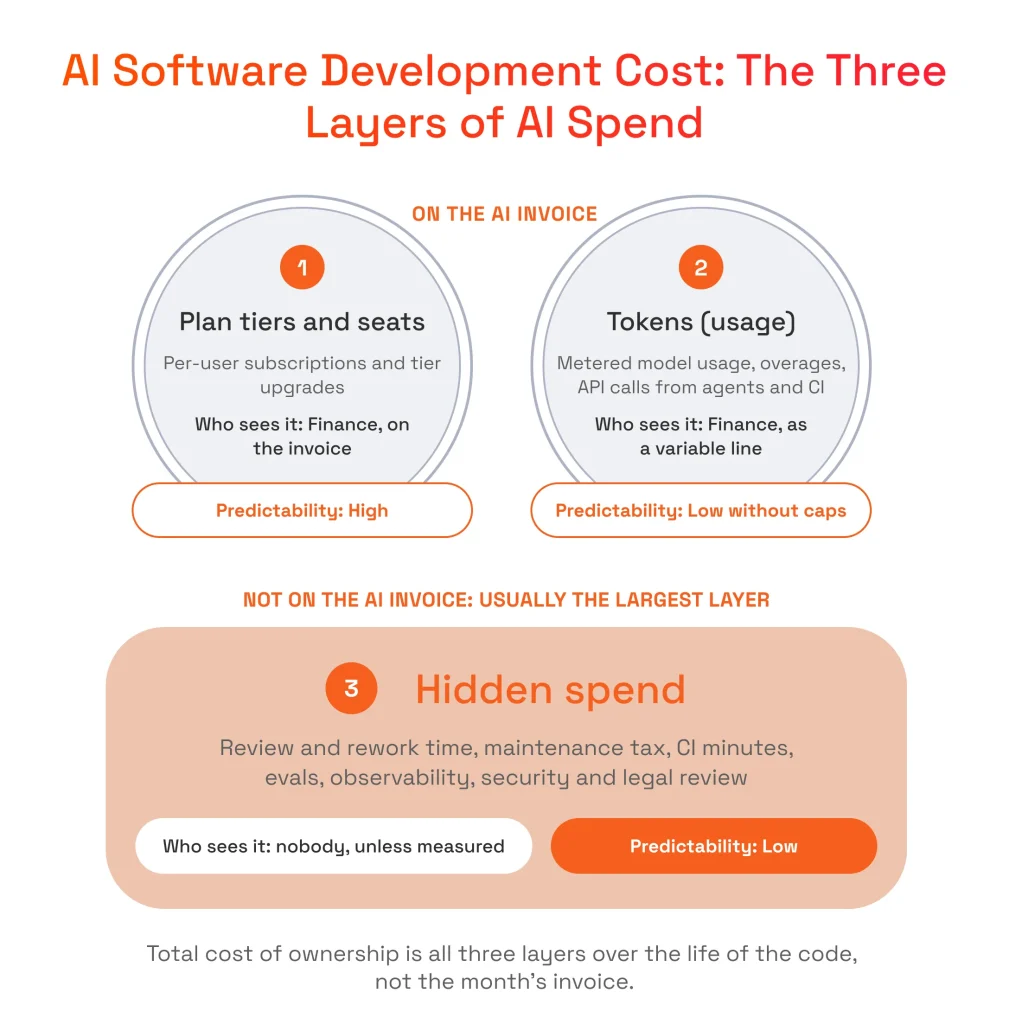
The pressure on AI spend is rising. Gartner forecasts that by 2028 AI coding costs will exceed the average developer’s salary, as token consumption grows and licensing moves to consumption-based pricing. Gartner Peer Insights data already shows nearly a quarter of technology leaders spending $200 to $500 per developer each month on AI coding tokens.
The layers also behave differently over time. Seats change when headcount or tier changes, while tokens shift week to week with how agents are configured. Hidden spend moves slowly and compounds, because code merged this quarter gets reviewed, debugged and modified for years. Finance sees the first two on the monthly bill for AI coding tools. The third sits in engineering hours and infrastructure costs that nobody tags as AI spend.
Layer | What it includes | Who sees it | Predictability |
|---|---|---|---|
1. Plan tiers and seats | Per-user subscriptions and tier upgrades | Finance, on the invoice | High |
2. Tokens | Metered model usage, overages, API calls from agents and CI | Finance, as a variable line | Low without caps |
3. Hidden spend | Review and rework time, maintenance tax, CI minutes, evals, observability, security and legal review | Nobody, unless measured | Low |
Layer
1. Plan tiers and seats
2. Tokens
3. Hidden spend
What it includes
Per-user subscriptions and tier upgrades
Metered model usage, overages, API calls from agents and CI
Review and rework time, maintenance tax, CI minutes, evals, observability, security and legal review
Who sees it
Finance, on the invoice
Finance, as a variable line
Nobody, unless measured
Predictability
High
Low without caps
Low
Total cost of ownership (TCO) is all three layers added up over the life of the code: the upfront cost of rollout and enablement plus the ongoing and maintenance costs that run well past any one month’s invoice.
Layer 1: What Do AI Coding Tool Plans and Seats Cost?
AI coding tools price per seat across individual, team and enterprise tiers. Through 2026 the main vendors moved from flat seats to usage-based pricing, with seats that include an allowance. Anything beyond that allowance is billed at model rates.
Three pricing models now sit behind those tiers. A flat seat buys a fixed allowance, and the vendor absorbs the variance. A seat with usage pools or credits shares an allowance across the team and bills overages. A pay-as-you-go API has no seat at all and meters every token, which suits CI jobs and automation running outside an editor.
For a single developer, the visible Claude Code cost starts at the Pro plan and rises through Max and Ultra, while team plans add pooled API credits on top of each seat. The Cursor cost picture changed twice in 2026: Teams split into Standard and Premium seats in June, and in October new customers moved to tiers sold through The X Subscription, with the earlier Pro, Pro+, Ultra and Teams plans kept as legacy. GitHub Copilot moved to usage-based billing on June 1, 2026, with AI Credits included in every seat. Plans like these get revised often as AI tools change, so any cost comparison should carry the date its prices were checked.
Tool | Individual | Team / Business | Enterprise | Usage model (2026) |
|---|---|---|---|---|
Claude Code (Anthropic) | Pro, Max, Ultra | Team Standard and Premium seats, Claude Code on both; Premium carries about 5x the usage | Seat fee plus usage at API rates | Usage limits per seat, usage credits beyond them; Enterprise usage billed at API rates |
Cursor | New: Plus, Premium, Super, Ultra (via The X Subscription); legacy: Pro, Pro+, Ultra | Legacy Teams Standard and Premium seats | Custom | New tiers bill third-party models at API rates; legacy plans keep included usage pools |
GitHub Copilot | Pro, Pro+, Max | Business | Enterprise | Since June 2026, usage-based AI Credits included per seat |
Tool
Claude Code (Anthropic)
Cursor
GitHub Copilot
Individual
Pro, Max, Ultra
New: Plus, Premium, Super, Ultra (via The X Subscription); legacy: Pro, Pro+, Ultra
Pro, Pro+, Max
Team / Business
Team Standard and Premium seats, Claude Code on both; Premium carries about 5x the usage
Legacy Teams Standard and Premium seats
Business
Enterprise
Seat fee plus usage at API rates
Custom
Enterprise
Usage model (2026)
Usage limits per seat, usage credits beyond them; Enterprise usage billed at API rates
New tiers bill third-party models at API rates; legacy plans keep included usage pools
Since June 2026, usage-based AI Credits included per seat
Plans as listed on vendor pricing pages, November 2026. Verify before budgeting.
Seats also buy what usage pricing doesn’t: SSO, admin controls, audit logs, data-use terms and, on Copilot Business, IP indemnity.
Layer 2: Where Does AI Token Cost Come From?
A token is a chunk of text an AI model reads as input or writes as output. In English, a token averages roughly three-quarters of a word. Providers price input, output and cached tokens per million, with output several times more expensive than input and cached input far cheaper. The word-to-token ratio depends on the tokenizer: Anthropic’s pricing documentation notes, for example, that Claude Opus 4.7 and later models produce about 30% more tokens for the same text.
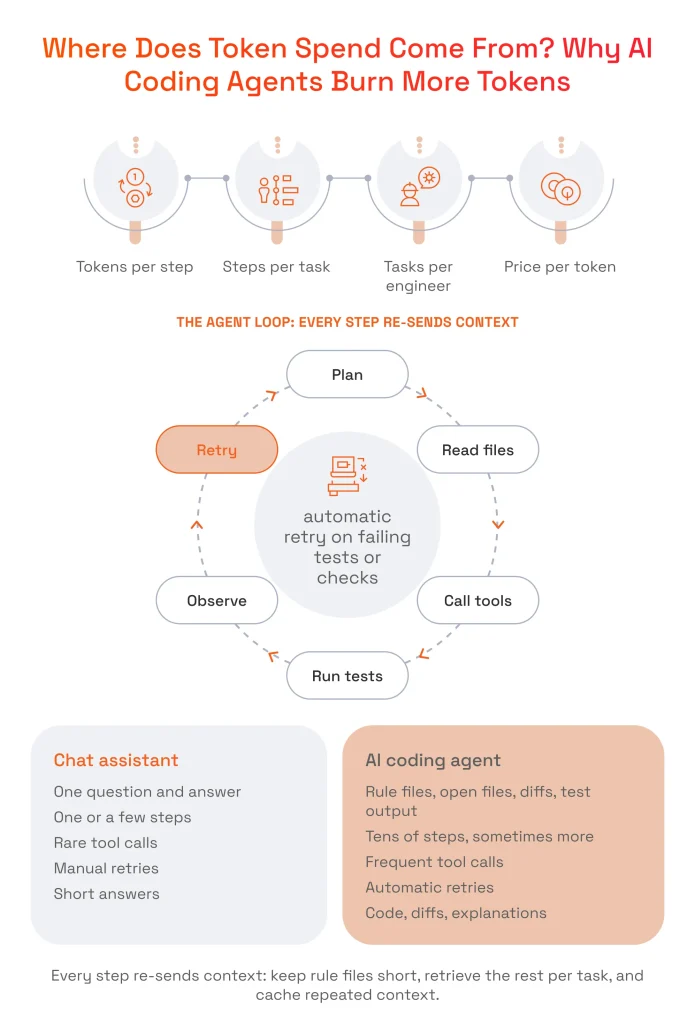
A team’s AI token cost follows one chain, where tokens per step are multiplied by steps per task, tasks per engineer and the price per token. That chain explains why token usage can double without anyone writing more prompts. An agent that takes twice the steps doubles the AI token cost of the same backlog.
Why Does an AI Coding Agent Burn More Tokens Than a Chat Assistant?
An AI coding agent works in an agent loop, where it plans, reads files, calls tools, runs tests, observes the result and retries. A chat assistant answers one question per exchange, so its bill scales with how often people ask. The agent’s bill scales instead with how many steps each task takes and how much context each step carries.
Driver | Chat assistant | AI coding agent |
|---|---|---|
Context per step | One question and answer | Rule files, open files, diffs, test output |
Steps per task | One or a few | Tens, sometimes more |
Tool calls | Rare | Frequent (search, file read, test run) |
Retries | Manual | Automatic on failing tests or checks |
Output tokens | Short answers | Code, diffs, explanations, thinking tokens billed as output |
Driver
Context per step
Steps per task
Tool calls
Retries
Output tokens
Chat assistant
One question and answer
One or a few
Rare
Manual
Short answers
AI coding agent
Rule files, open files, diffs, test output
Tens, sometimes more
Frequent (search, file read, test run)
Automatic on failing tests or checks
Code, diffs, explanations, thinking tokens billed as output
Anthropic’s Claude Code documentation on costs explains that each turn carries file contents, tool calls and multi-step reasoning, and puts agent teams running in plan mode at approximately 7x the tokens of a standard session. Gartner reports software engineering leaders seeing token use rise as much as 100x when they move from coding assistants to agentic platforms.
How Does Context Size Drive the Bill?
Context engineering means giving the agent the right structured context for the task, which is usually much less than all of it. Every step in the loop re-sends that context, so a bloated rule file or a full test log piped into each call multiplies cost across every task.
The fix starts by separating static from dynamic context. Always-loaded rule files stay short, and Anthropic recommends keeping CLAUDE.md under 200 lines. Engineering the setup around a coding agent treats those files as maintained code. Everything else is retrieved per task, and Agent Skills load their instructions only when invoked.
Prompt caching softens the repeat cost. Cache reads are billed at 5% of base input on Claude Opus 5.5 and Sonnet 5.5. That said, a cache miss after a break re-processes the full context at the normal rate. The context window caps what each step can carry, one of the properties of LLMs that shape these choices.
In one case, a library of 47 custom skills, 6 subagents and 19 slash commands now holds the engineering conventions of a ticketing platform for an iconic US landmark attraction. Knowledge that once lived in people’s heads became reusable workflows that agents load when a task calls for them.

Serhii Leleko
AI & ML Engineer at SPD Technology
“When I open the first month of agent usage data on a client team, the heaviest line is usually context: a rule file that has grown past a thousand lines, full test logs piped into every step, sessions left open across unrelated tasks. Fixing those habits lowers token spend before anyone touches model choice.”
What Do Frontier, Mid-Tier and Small Models Cost per Million Tokens?
Model choice is the second big multiplier after context, and the price spread between generative AI model tiers is wide. The LLM pricing comparison below groups current models by the work they typically handle.
Tier | Typical use | Example models | Input, $ per 1M tokens | Output, $ per 1M tokens |
|---|---|---|---|---|
Frontier | Hard reasoning, architecture, difficult bugs | Claude Fable 5.1; Claude Opus 5.5; GPT-5.6 Sol | 4-10 | 20-50 |
Mid-tier | Most implementation and review | Claude Sonnet 5.5; GPT-5.6 Terra; Gemini 3.1 Pro | 2-2.50 | 10-15 |
Small / fast | Autocomplete, classification, simple edits | Claude Haiku 5.5 (prompts up to 100K tokens); GPT-5.6 Luna; Gemini 3.8 Flash | 0.10-0.75 | 0.50-3.75 |
Open-weight via hosted providers | Cost-sensitive tasks | DeepSeek V4 Pro; Qwen3.7-Plus; gpt-oss-120B | 0.15-1.32 | 0.60-3.96 |
Tier
Frontier
Mid-tier
Small / fast
Open-weight via hosted providers
Typical use
Hard reasoning, architecture, difficult bugs
Most implementation and review
Autocomplete, classification, simple edits
Cost-sensitive tasks
Example models
Claude Fable 5.1; Claude Opus 5.5; GPT-5.6 Sol
Claude Sonnet 5.5; GPT-5.6 Terra; Gemini 3.1 Pro
Claude Haiku 5.5 (prompts up to 100K tokens); GPT-5.6 Luna; Gemini 3.8 Flash
DeepSeek V4 Pro; Qwen3.7-Plus; gpt-oss-120B
Input, $ per 1M tokens
4-10
2-2.50
0.10-0.75
0.15-1.32
Output, $ per 1M tokens
20-50
10-15
0.50-3.75
0.60-3.96
The same task can cost very different amounts depending on the model that runs it. An agent that writes 2 million output tokens in a day costs about $40 to $100 on a frontier model and roughly $1 to $8 on a small or open-weight one. That spread is what makes model routing worth the effort.
Teams weighing the open-weight row can compare Chinese vs Western open-weight models. For running those models on your own GPUs, see what it takes to self-host an LLM.
Layer 3: What Hidden Spend Does Not Show Up on the AI Invoice?
The largest hidden costs of AI-assisted development sit outside the AI invoice. They include engineer time spent reviewing and reworking output and the future cost of changing code nobody fully understands. The infrastructure and governance that make AI output safe to ship add operational costs of their own.
Each of these lines can be measured, though few teams do so before the first budget review. The table maps every hidden cost to its driver, the metric that exposes it and the practice that brings it down.
Hidden cost | What drives it | How to measure it | What reduces it |
|---|---|---|---|
Review and rework | Low first-pass success; large AI-generated diffs | Review hours per change; rework rate | Specs, tests and evals before generation; smaller changes |
Maintenance tax | Code accepted without full understanding | Cost of change over time; incidents in AI-touched areas | Tests, documentation, architecture rules |
CI and eval compute | More changes, more test and eval runs | CI minutes, eval runs per change | Targeted test selection, cached runs |
Observability and governance | Logging, policies, audit trails | Platform time, tool cost | Shared templates, automation |
Security remediation | Insecure or hallucinated dependencies | Findings per change | Static code scanning (SAST), dependency allow-lists, guardrails |
Legal and procurement | Tool terms, data use, IP | Review hours per tool | One approved tool stack |
Enablement | Training, rule files, skills | Hours per team | Reusable context assets |
Hidden cost
Review and rework
Maintenance tax
CI and eval compute
Observability and governance
Security remediation
Legal and procurement
Enablement
What drives it
Low first-pass success; large AI-generated diffs
Code accepted without full understanding
More changes, more test and eval runs
Logging, policies, audit trails
Insecure or hallucinated dependencies
Tool terms, data use, IP
Training, rule files, skills
How to measure it
Review hours per change; rework rate
Cost of change over time; incidents in AI-touched areas
CI minutes, eval runs per change
Platform time, tool cost
Findings per change
Review hours per tool
Hours per team
What reduces it
Specs, tests and evals before generation; smaller changes
Tests, documentation, architecture rules
Targeted test selection, cached runs
Shared templates, automation
Static code scanning (SAST), dependency allow-lists, guardrails
One approved tool stack
Reusable context assets
Security remediation earns its own line because agents can pull in insecure or hallucinated dependencies at speed. That pattern ranks among the main AI-generated code security risks, and findings that surface late add to deployment costs.
Why Does Review and Rework Time Cost More Than Tokens?
The first-pass success rate is the share of AI-generated changes accepted through review and testing without rework. When it is low, the team pays twice, once in tokens for the failed attempt and again in engineer hours to fix it. Vibe coding means prompting and accepting output without specs or tests. It is cheap per prompt and expensive per shipped change.
Writing the spec first, as in spec-first development, gives the agent a target and the reviewer a checklist. Review effort then follows risk. Changes touching money, sensitive data or architecture get human approval under a human-in-the-loop design, and lighter review applies where automated checks are strong. We call this calibrated autonomy: AI freedom matched to risk, task by task, with a named senior engineer approving each release. Rework belongs on the budget as well. DORA 2025 links AI adoption to higher throughput and higher delivery instability, and each unstable release lands back on a software engineer’s desk.
What Is the Maintenance Tax on AI-Generated Code?
The maintenance tax is the extra future cost of changing code that nobody on the team fully understands. It builds up as AI technical debt, where each change that passed tests without being truly read makes the next change slower and riskier. Teams scaling AI-generated code pay it in longer debugging sessions and more incidents in AI-touched areas. Tests that document behaviour, evals for AI-dependent features, architecture rules in rule files and smaller reviewed changes keep it in check.
What Infrastructure, Security and Governance Overhead Should You Budget For?
More merged changes mean more CI minutes, more eval runs and more load on cloud infrastructure, and all three grow with output before anyone notices. Observability for agent activity, secrets management and policy setup take platform time, especially where agents reach enterprise or legacy systems. Legal teams also spend hours reviewing each tool’s terms on data use, IP and whether proprietary data can end up as training data. Shared guardrails turn much of that setup into a one-time investment reused across teams.
Want a working method for keeping AI-generated changes reviewable? Read our guide on how to trust AI-generated code.
Worked Example: What Is the Monthly AI Spend for a 10-Engineer Team?
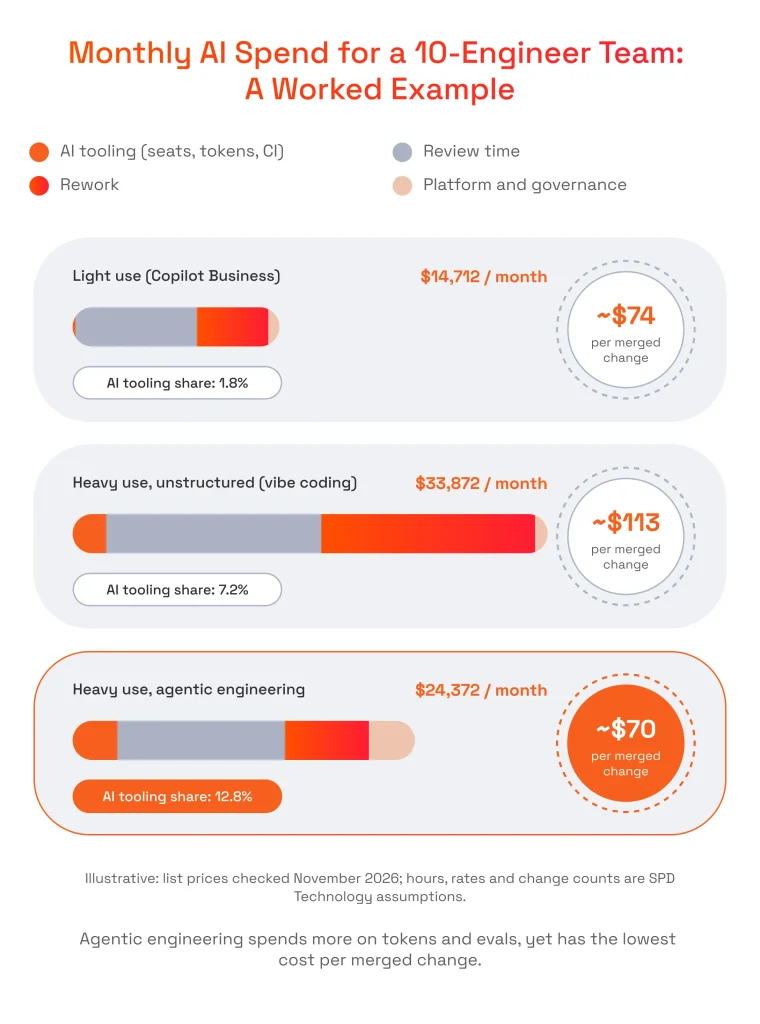
For a 10-engineer team, the AI invoice is often the smaller part of the total. Review and rework time decide whether AI lowers cost per change.
Line | Light use (Copilot Business) | Heavy use, unstructured (vibe coding) | Heavy use, agentic engineering | Formula / assumption |
|---|---|---|---|---|
Seats | $190 | $200 | $200 | Light: GitHub Copilot Business at $19/user/month (includes $19 of AI Credits). Heavy: Claude Enterprise at $20/seat/month plus usage at API rates (check the minimum seat count; a capped alternative is Claude Team Premium at $125/seat monthly) |
Token usage | $0 (within included credits) | $2,000 | $2,500 | Anthropic’s Claude Code documentation: enterprise average of about $150-250 per developer per month at API rates. Unstructured = $200 × 10; agentic = top of range, because specs, tests and planning runs add tokens |
CI and eval compute | $72 | $222 | $422 | GitHub Actions Linux 2-core at $0.006/min after 3,000 included minutes (Team plan): 15,000 / 40,000 / 40,000 minutes; agentic adds ~$200/month of eval-model tokens (SPD Technology assumption) |
Review time | $8,500 | $15,300 | $11,900 | Changes × review hours × $85 loaded hourly cost; 0.5 h / 0.6 h / 0.4 h per change (SPD Technology assumptions) |
Rework | $5,100 | $15,300 | $5,950 | (1 − first-pass rate) × changes × 2 fix hours × $85; first-pass success 85% / 70% / 90% (SPD Technology assumptions) |
Platform and governance time | $850 | $850 | $3,400 | 10 / 10 / 40 hours × $85 (the agentic column pays for specs, eval suites and agent configuration upkeep) |
Total per month | $14,712 | $33,872 | $24,372 | Sum of the lines above |
Merged changes | 200 | 300 | 350 | SPD Technology assumptions; replace with delivery-system data |
Cost per merged change | ~$74 | ~$113 | ~$70 | Total ÷ merged changes |
AI tooling share of total | 1.8% | 7.2% | 12.8% | (Seats + tokens + compute) ÷ total |
Line
Seats
Token usage
CI and eval compute
Review time
Rework
Platform and governance time
Total per month
Merged changes
Cost per merged change
AI tooling share of total
Light use (Copilot Business)
$190
$0 (within included credits)
$72
$8,500
$5,100
$850
$14,712
200
~$74
1.8%
Heavy use, unstructured (vibe coding)
$200
$2,000
$222
$15,300
$15,300
$850
$33,872
300
~$113
7.2%
Heavy use, agentic engineering
$200
$2,500
$422
$11,900
$5,950
$3,400
$24,372
350
~$70
12.8%
Formula / assumption
Light: GitHub Copilot Business at $19/user/month (includes $19 of AI Credits). Heavy: Claude Enterprise at $20/seat/month plus usage at API rates (check the minimum seat count; a capped alternative is Claude Team Premium at $125/seat monthly)
Anthropic’s Claude Code documentation: enterprise average of about $150-250 per developer per month at API rates. Unstructured = $200 × 10; agentic = top of range, because specs, tests and planning runs add tokens
GitHub Actions Linux 2-core at $0.006/min after 3,000 included minutes (Team plan): 15,000 / 40,000 / 40,000 minutes; agentic adds ~$200/month of eval-model tokens (SPD Technology assumption)
Changes × review hours × $85 loaded hourly cost; 0.5 h / 0.6 h / 0.4 h per change (SPD Technology assumptions)
(1 − first-pass rate) × changes × 2 fix hours × $85; first-pass success 85% / 70% / 90% (SPD Technology assumptions)
10 / 10 / 40 hours × $85 (the agentic column pays for specs, eval suites and agent configuration upkeep)
Sum of the lines above
SPD Technology assumptions; replace with delivery-system data
Total ÷ merged changes
(Seats + tokens + compute) ÷ total
Agentic engineering spends more on tokens, evals and platform time than unstructured use, yet it delivers the lowest cost per merged change, because fewer changes come back for rework.
The AI software development cost model above compares three ways the same in-house team might work, using list prices checked in November 2026. Engineer time is priced at a loaded $85 an hour: the BLS median wage for software developers, $65.38 an hour (May 2025), multiplied by 1.3 for benefits and overhead. For senior teams with a higher hourly rate, the total rises in every column. Every hour, rate and count above is an SPD Technology assumption, so replace them with your own data to see your actual cost.
Sources for the worked example:
- GitHub Copilot plans and AI Credits: GitHub Copilot plans and the GitHub post on usage-based billing (June 1, 2026): Business $19/user/month, Enterprise $39/user/month.
- Claude plans: Claude pricing: Team Standard $25/seat monthly ($20 annual), Team Premium $125/seat monthly ($100 annual), Enterprise $20/seat plus usage at API rates.
- Claude Code costs documentation: about $13 per developer per active day and $150-250 per developer per month across enterprise deployments, under $30 per active day for 90% of users.
- Cursor pricing: new tiers via The X Subscription; legacy Teams Standard $40/user/month, Teams Premium $120/user/month.
- Anthropic API pricing: per-token rates by model, for routing comparisons.
- GitHub Actions billing documentation: Linux 2-core hosted runner $0.006/min since January 1, 2026.
- U.S. Bureau of Labor Statistics, Software Developers (OEWS May 2025, SOC 15-1252): median $135,980/year, $65.38/hour.
These estimates are illustrative, based on published list prices and the assumptions stated above, and do not constitute a public offer.
AI Cost Management: How Do You Reduce AI Development Spend?
Effective AI cost management comes down to four moves. Teams route tasks to the cheapest model that passes its checks, give agents less but better context, cap usage and measure cost per merged change. Gartner’s guidance points the same way: classify tasks as developer-led, developer-with-agent or fully agent-led, practice context engineering and match model choice to task complexity.
What Is Model Routing and How Does It Support LLM Cost Optimization?
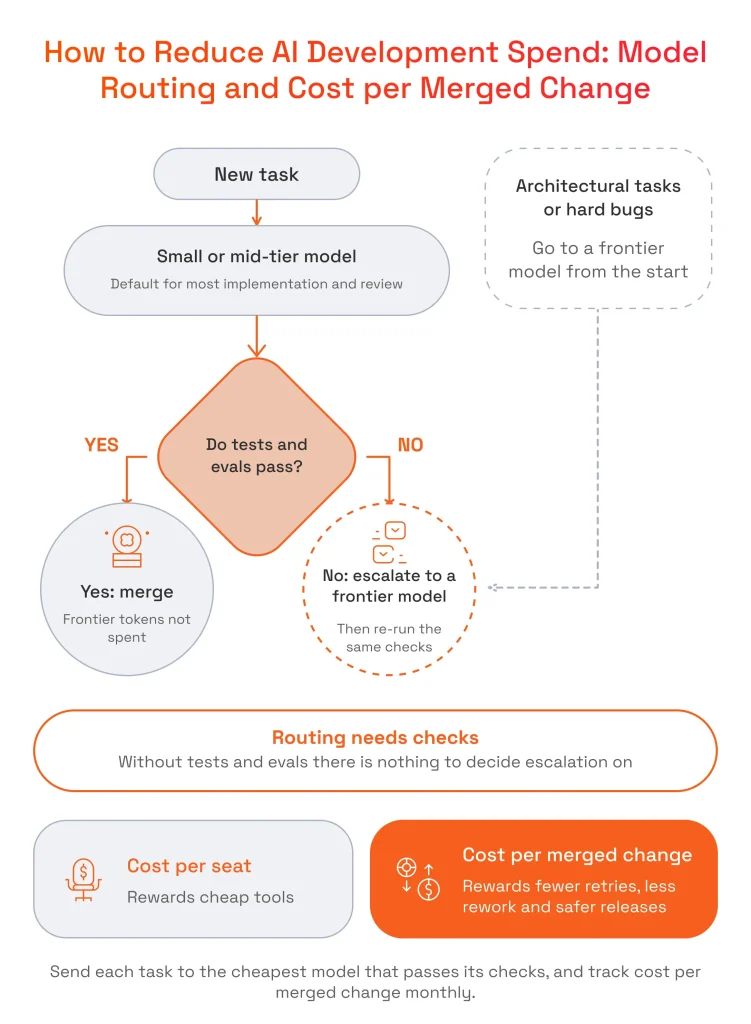
Model routing is sending each task to the cheapest model that can pass its checks, so frontier-model tokens are spent only where they change the outcome. In practice the default is a mid-tier or small model, with escalation to a frontier model when tests or evals fail or the task is architectural. As of November 2026, Sonnet 5.5 costs 20x more per input token than Haiku 5.5 on prompts up to 100K tokens. That gap gives routing the widest spread of any lever in LLM cost optimization.
Routing only works when something can fail, and the test suites and evals of eval engineering supply that signal. Non-urgent work such as overnight eval suites can also move to batch pricing where the provider offers it.
How Do Budgets, Caps and Per-Team Token Usage Tracking Work?
All three vendors priced earlier now let admins set spend limits per seat, team or organization. Limits help only when someone watches them, so pair them with alerts and dashboards by team and task type, tracked alongside platform health metrics. Each team also needs a named budget owner who reads those numbers monthly, a role that FinOps services formalize across cloud and AI tooling costs.
Experimentation budgets for new AI initiatives belong on a separate line from production delivery budgets, so a week of trials with a new agent leaves delivery numbers intact. Gartner also flags missing feedback loops on AI usage. Putting high-token workflows on the sprint retrospective agenda closes that gap: the team that ran them explains the spike in its own words.
Why Measure Cost per Merged Change, Not Cost per Seat?
Agentic engineering is AI working inside human-defined specs, tests, evals and feedback loops, the model behind an agentic development workflow. Cost per seat rewards cheap tools, while cost per merged change rewards fewer retries, less rework and safer releases. That metric falls as the first-pass success rate climbs, even when the token line grows.
Paired with DORA delivery metrics, it keeps AI-enhanced development velocity from being bought with instability. On the landmark attraction’s ticketing platform, for example, merged output rose 89% against a flat 2025 baseline at constant headcount. Matching that gain otherwise would have required roughly 0.9x additional engineering capacity.
Each lever below trims only a small part of the cost of AI on its own. Together, the levers move cost per merged change in the direction finance wants to see.
- Route each task by type and escalate only on failed checks.
- Trim rule files; let retrieval and Agent Skills carry the rest.
- Enable prompt caching wherever the provider supports it.
- Cap and alert per team.
- Write specs and tests before any code generation.
- Run evals in CI on every change that touches AI-dependent behaviour.
- Review by risk.
- Track cost per merged change every month and share it with finance.
Ready to set a baseline before scaling? See how to pilot and measure the ROI of AI-assisted software engineering.
How SPD Technology Approaches AI Development Cost Optimization
SPD Technology designs AI-assisted delivery so that each release costs less than the last, measured against the client’s own baseline, and still survives production. That approach is built into our AI/ML development services, whether a client is adopting AI in one team or across enterprise-grade systems. We’ve been in the business for 20 years and have delivered 470+ projects. As your trusted AI-engineering partner, our team owns both the architecture and the execution, so cost and delivery decisions for AI projects sit in the same place.
- Less review and rework spend. On a US landmark attraction’s ticketing platform, code-review throughput doubled and human-reported bugs fell 81% against a flat 2025 baseline at constant headcount. AI operations grew tenfold in one month, from 38 to 443 pipeline runs in August 2026, at a 92% autonomous-run success rate, and about 200 production errors are now auto-triaged and resolved each month. Humans approve every PR and remote action, and production investigation stays read-only, the same principle behind AI-native development teams.
- Fewer engineer hours per incident. Incident response at a US fintech/SaaS platform used to depend on engineers on call around the clock. The AI system SPD Technology built for incident management now reaches a PR-ready fix in under 30 minutes, down from 60+. It resolves up to 70% of incidents autonomously and removes the need for 24/7 on-call engineering.
- Model choice that cuts cost. The data pipeline behind a B2B financial-data publisher’s documents combines specialized NLP, vision and extraction components with a GPT-based step. The pipeline grew from 25 to 50+ source document structures, while costs fell 5x and processing ran 3x faster.
- Enablement you keep. Specs, tests, evals and agent configuration live in the client’s repository and stay the client’s by contract, which is how our agentic AI development services keep context assets working for the in-house team after handover. Specs, tests and evals act as release gates, and a named senior engineer approves every release.
- We run what we recommend. Our specialists are Claude-certified architects, and SPD Technology is a Select-tier member of the Claude Partner Network (Services Track). They use Claude Code across development, QA, releases and operations, and that hands-on experience shapes how we approach building production AI with Claude.
Conclusion
The seat price is the smallest number on an AI engineering budget. What decides the total is how agents use tokens and how much of their output comes back for review and rework. Teams that route each task to the cheapest model that passes its checks, give agents the context they need and no more, cap spend per team and track cost per merged change can show finance whether AI is making delivery cheaper. The next step is a cost model built on your own team, tools and baseline.
Key Takeaways
- Because AI coding tools moved to seats plus metered usage in 2026, the monthly AI bill now varies with how agents are used, not only with headcount.
- Because an AI coding agent re-sends context and calls tools on every step, a single agent task can use far more tokens than a chat answer.
- Because every step re-sends context, trimming rule files and retrieving only relevant context lowers token spend on every task.
- A low first-pass success rate makes teams pay twice, once in tokens and again in engineer time to fix the output.
- Code accepted without full understanding carries a maintenance tax that raises the cost of every later change.
- Model routing cuts spend only when tests and evals exist, because escalation to a frontier model needs a check that failed.
- Measuring cost per merged change, rather than cost per seat, shows whether AI is making delivery cheaper.
FAQ
How much does AI-assisted software development cost per developer per month?
Seats for AI coding tools typically cost $19 to $200 per developer per month, depending on tier and vendor. Usage on top varies with how heavily agents are used; Anthropic’s Claude Code documentation puts the enterprise average at about $150-250 per developer per month. Review, rework and CI time usually cost more than seats and tokens combined. Budget with a measured pilot rather than list prices, and verify current vendor pricing before committing.
Why do AI coding agents cost more than chat assistants?
An AI coding agent works in a loop: it plans, reads files, calls tools, runs tests and retries until checks pass. Each step re-sends context such as rule files, code and test output, and produces code and diffs as output. A chat assistant usually answers once with short output. As a result, an agent task can consume many times more tokens than a chat answer.
Is a flat-rate plan or pay-per-token API cheaper for an engineering team?
Seats with an included allowance are usually cheaper for steady, moderate use and easier to budget. A pay-per-token API can be cheaper for light or uneven use and is often necessary for automation in CI or custom agents. Many teams combine both: seats for interactive work and API budgets for automated workloads. Compare plans against a month of measured usage, not estimates.
How can you cut AI token cost without hurting code quality?
Route routine tasks to cheaper models and escalate to frontier models only when tests or evals fail. Keep always-loaded rule files short and retrieve other context per task. Use prompt caching where providers support it. Write specs and tests before generation so more changes pass on the first attempt, which cuts both token spend and rework.
Does AI-assisted development lower the total cost of a software project?
It can, but only when output is verified. Faster generation lowers implementation cost, while low first-pass success, review load and maintenance tax can raise total cost of ownership. Teams that use specs, tests, evals and risk-based review typically see lower cost per merged change. Measure against your own baseline rather than relying on vendor productivity claims.
What is a token in an LLM?
A token is a small unit of text (a word, part of a word or punctuation) that a large language model reads or writes. In English, a token is roughly three-quarters of a word on average. Providers price model usage per million input and output tokens, usually charging more for output. Token counts grow with context size, so long prompts and repeated file reads raise cost.
What is model routing?
Model routing sends each task to the cheapest model that can pass its checks, so frontier-model tokens are spent only where they change the outcome. Routine edits and classification go to small or mid-tier models; hard reasoning or failed checks escalate to stronger models. Routing depends on automated tests and evals to decide when to escalate. It is one of the most effective levers for LLM cost optimization.