

Eval engineering is the practice of systematically scoring how AI systems’ output quality and reasoning paths hold up. A minimum viable eval suite combines 15 to 30 real test cases, a capability versus regression split, and a spot-checked LLM judge to prevent silent failures before scaling, delivering rigorous verification in days. You know your MVP actually works when it consistently passes these real-world cases, withstands regression checks across updates, and demonstrates reliable outputs and reasoning beyond curated demos.
Your AI product passes every demo. Investors nod, users say it’s impressive, and the manual test runs you’ve done all came back clean. Yet none of that tells you whether the system works. In fact, MIT’s report on enterprise AI deployments found that 95% of generative AI pilots never produced measurable financial impact.
Companies that build evaluation into the process fare differently. Databricks’ analysis of its own platform data found that teams using evaluation tools get roughly 6x more AI projects into production than teams that don’t.
Eval engineering is the discipline behind results like that. Splunk’s engineering blog published a detailed breakdown of the discipline, and freeCodeCamp, the widely-read coding education site, ran a full technical handbook on building an eval platform. However, both assume that a team with production traffic and a dedicated evaluation budget is already in place. Early MVPs do not have that.
This article examines the distinction between successful prototype performance and true operational functionality, using a real case where a team learned the hard way, then builds the minimum viable eval suite an MVP-stage team can put together in days.
“It Works in the Demo” Isn’t the Same as “It Works” for AI Systems
So here’s freeCodeCamp’s case study from the handbook: A team built a RAG-based legal research tool running semantic search over case law, tested it against 40 hand-picked questions, and shipped it to a group of lawyers once every answer looked right. Three weeks in, a paralegal flagged an answer that cited the wrong statute.
The evaluation dashboard looked healthy due to a high 0.91 faithfulness score, leading the team to assume the answers were solid. However, because no one measured context recall, the retriever was actually missing key information needed for multi-part questions. For this reason, the retriever had been failing on multi-hop questions, and every metric tracked was blind to that gap.
That system passed every eval its team had built, and still failed on the one nobody had thought to build. This kind of gap is usually narrow and fixable once named, illustrating the classic 80% problem in practice. While AI tools make a demo-ready product fast to build, most teams never reach the harder remaining work required to prove it actually works.
What’s Actually Different: Tests, Evals, and Eval Engineering for AI Projects
Tests and evals answer different questions, though the terms get used interchangeably enough to blur that.
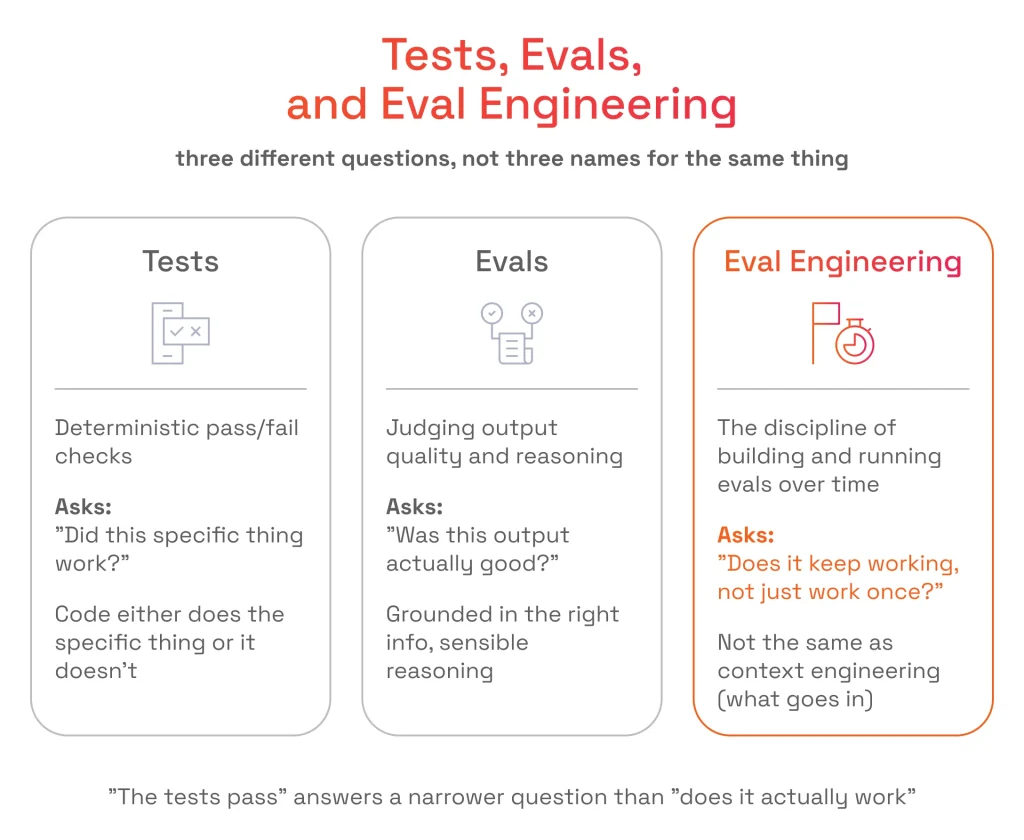
A test is a deterministic pass/fail check (essentially a code-based eval) like a unit test confirming the API returns the right status code.
An eval judges something a simple assertion can’t reach like whether an answer made sense, whether it was grounded in the right information, whether the system took a sensible path there.
Eval engineering sits above both. Testing asks whether something works once, while eval engineering asks whether it keeps working as you swap in different models, update training data, tweak prompts, or even switch model providers. It’s a separate discipline from context engineering, too. One determines what information a model has to work with, the other judges whether the output is actually good. That exact distinction defines how to evaluate AI agents before they reach production.
An MVP still benefits from understanding that distinction without needing the enterprise version of the discipline behind it.
Why the Enterprise Version of Eval Engineering Is the Wrong Size for an MVP
The enterprise version of eval engineering, as Splunk lays it out, runs on a three-tier architecture:
- Offline dataset evaluation before anything ships;
- CI/CD gates that block a release automatically;
- Continuous production monitoring once live.
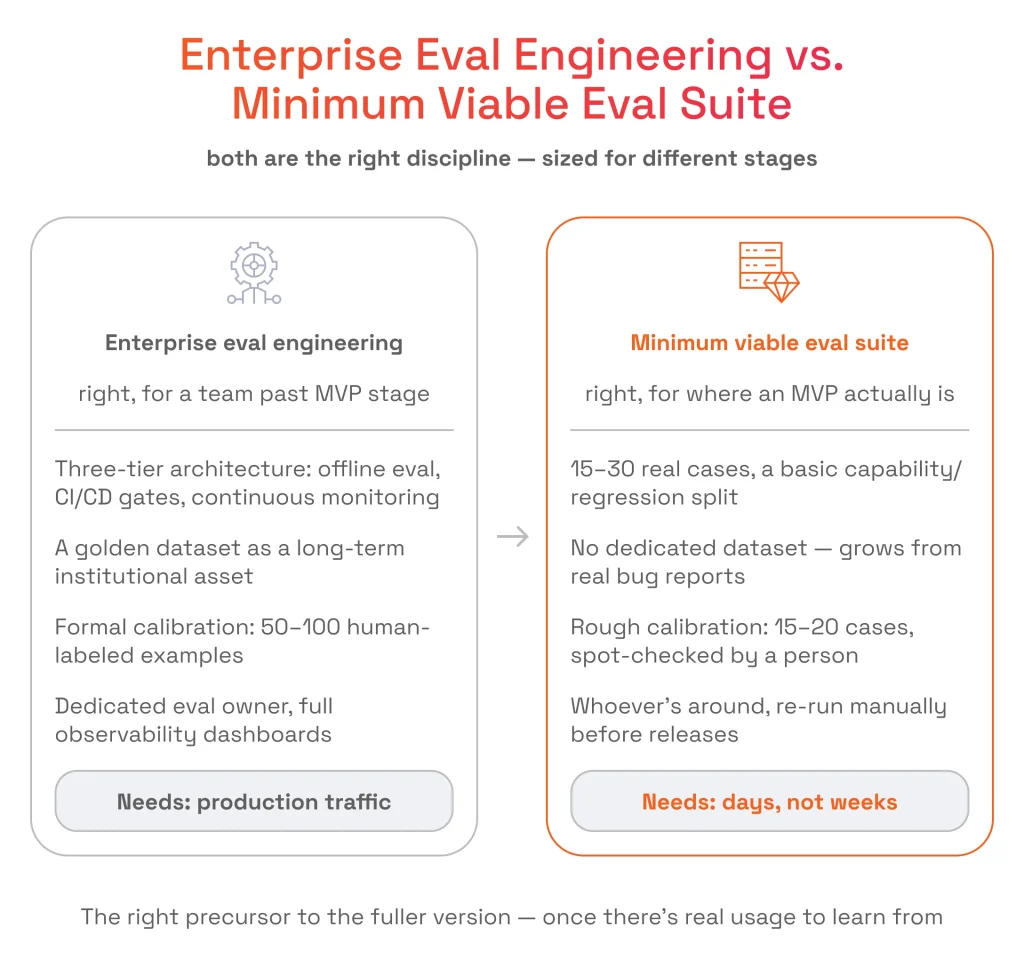
Underneath sits a golden dataset maintained as a long-term asset, calibration built on 50 to 100 human-labeled examples for checking an AI judge against human agreement, and full observability dashboards. This is genuinely useful for a team with production traffic and engineering time to keep the system honest.
An early MVP usually has neither, lacking both meaningful production data to monitor continuously and a clear owner for evaluation, with no settled picture of which failure modes actually matter for its users yet. Trying to build a full platform before any of those foundations are in place just forces teams to guess at the design.
The same discipline scales down quite naturally. You can run tests for what is deterministic, use evals for what is not, and build a small set of real cases with a basic way to catch regressions. This takes just a few days to set up, requires a fraction of the scope, and serves as a sensible stepping stone toward a fuller platform once you have real usage to learn from. That matters given Gartner’s prediction that over 40% of agentic AI projects will be canceled by the end of 2027, largely over unclear business value and inadequate risk controls.
The Minimum Viable Eval Suite: What AI Engineers Have to Actually Build First
A minimum viable eval suite really only comes down to four basic components, and you can put them together without needing any of the heavier infrastructure mentioned earlier. Each is sized specifically for a product without production traffic yet, built from what the team already knows about how it’s supposed to behave.
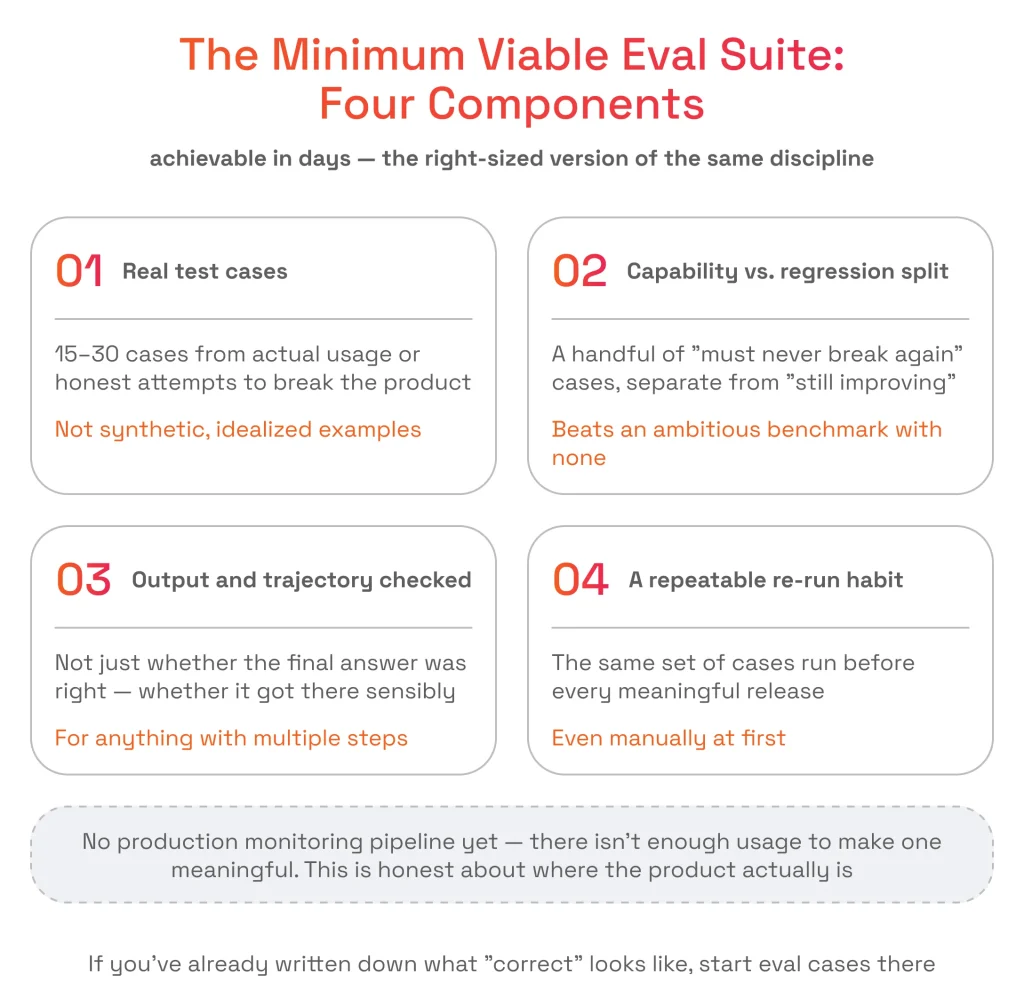
If your team practice includes writing down clear requirements for each feature beforehand, spec-first development becomes the most obvious source for your initial eval cases. The underlying specification already holds the exact judgment calls that your evaluation needs to measure.
Component | What It Looks Like at MVP Scale |
|---|---|
Real test cases | 15 to 30 real cases drawn from actual usage, the team’s own honest attempts to break the product, and known edge cases |
Capability vs. regression split | A handful of regression cases that must never break again, kept separate from capability cases the team is still working to get right |
Output and trajectory both checked | Checks both the final answer and whether the sequence of tool calls or reasoning steps a multi-step process took actually made sense |
A repeatable re-run habit | The same set of cases re-run before every meaningful release, done manually at first if needed |
Component
Real test cases
Capability vs. regression split
Output and trajectory both checked
A repeatable re-run habit
What It Looks Like at MVP Scale
15 to 30 real cases drawn from actual usage, the team’s own honest attempts to break the product, and known edge cases
A handful of regression cases that must never break again, kept separate from capability cases the team is still working to get right
Checks both the final answer and whether the sequence of tool calls or reasoning steps a multi-step process took actually made sense
The same set of cases re-run before every meaningful release, done manually at first if needed
LLM-as-Judge Without a Full Calibration Pipeline
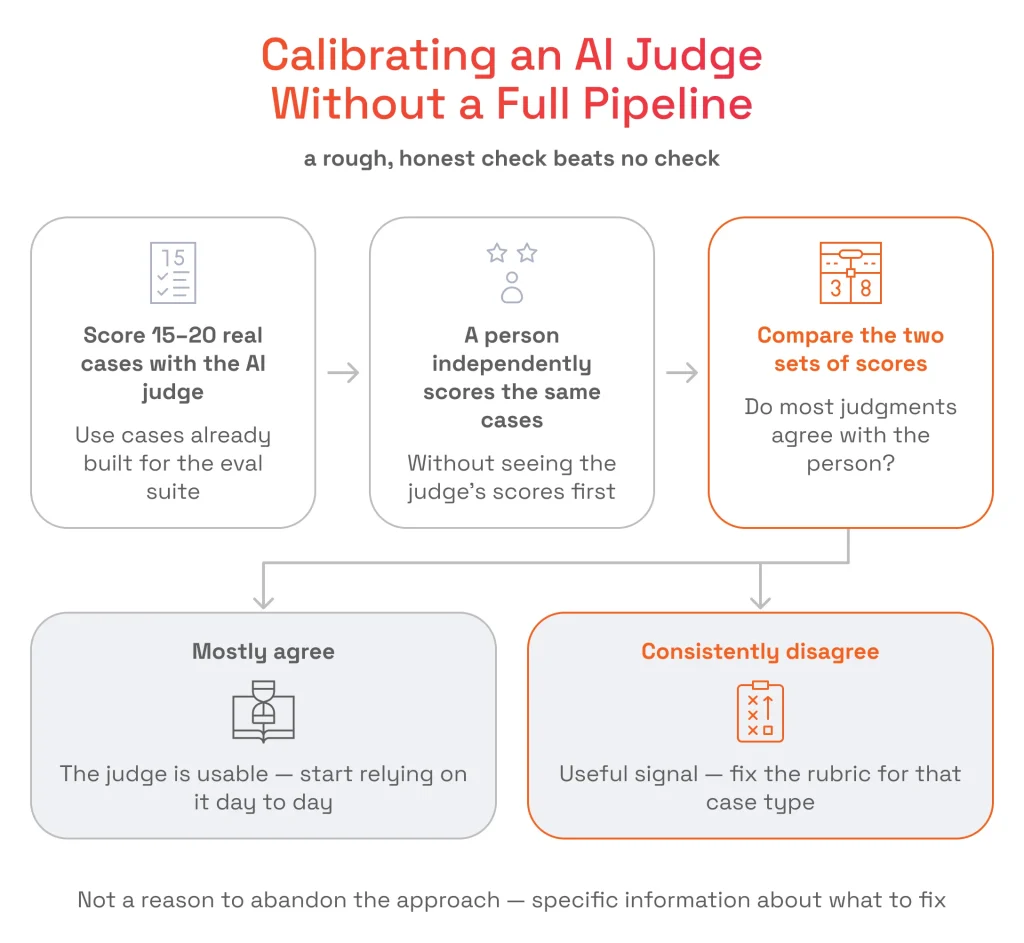
LLM-as-judge means using an AI model to score another AI system’s output against a written rubric, instead of a person reading every response. Often, it is the most realistic option for a team without headcount for manual review at scale. It carries a real risk without calibration, as freeCodeCamp’s methodology documents a systematic bias where an uncalibrated judge favors longer or more formal-sounding answers regardless of whether they are actually better.

Serhii Leleko
AI & ML Engineer at SPD Technology
“An uncalibrated judge drifts unnoticed and creates false positives by praising the wrong behavior, like favoring wordy answers over accurate ones. To fix this, you must run a structured evaluation across a representative dataset to measure bias, then refine the prompt rubrics and adjust for false-positive rates.”
To calibrate an MVP, you can simply take 15 to 20 real cases from your eval suite, run them through the AI judge, and have a human verify the outputs. If the human and judge mostly agree, the judge is ready to use. If they disagree on a specific type of case, that gives you clear feedback on how to refine your rubric. While freeCodeCamp’s full methodology calls for 50 to 100 labeled examples and a Spearman correlation above 0.80, this lighter alternative is intentionally sized for a much smaller suite.
Tying Evals to an Actual Decision in AI Development
An evaluation suite only earns its keep when it directly drives a decision. It should tell you whether to ship a specific change, open the product to more users, or pitch investors with confidence. A score sitting on a dashboard that nobody acts on is just static noise.
A single simple rule carries most of the practical weight of a much larger system. If a release fails a regression test, it simply does not ship, and enforcing that firm boundary is what converts noticing a bug into actually preventing one.
It also matters during due diligence. Being able to show investors the specific cases you test before every release, along with your actual results, serves as concrete proof during early AI POC development discussions with investors.
Growing the Eval Suite as the Product Grows
You can turn nearly every real bug report, support interaction, or unexpected piece of user behavior into a new evaluation case and this error analysis process is what keeps the suite growing from reality rather than guesswork. At this stage, adding these examples by hand is completely sufficient, so there is no need to worry about setting up automated pipelines right away.
The strongest evaluation cases always come from actual user failures, such as a concrete bug report, a confused support conversation, or an edge case no one anticipated. Relying on hypothetical issues dreamed up in planning meetings before real usage happens leads to a much weaker test suite, which holds true whether you are operating at an enterprise scale or building an early prototype.
As that habit builds a genuinely useful case set and real production traffic starts arriving, the fuller three-tier approach from more enterprise-focused guides starts to make sense. Moving from vibe coding to production-grade delivery is the natural next step once that habit is paying off.
Understanding if an early AI product actually delivers value comes down to evals, because traditional testing alone falls short here. You do not need the complex infrastructure built for enterprise scale, which is typically meant for a much later stage. A lightweight, effective version can be put together in a couple of days, and the checklist below provides a clear, actionable way to get started right now. Growing the suite this way is an incremental improvement process.
MVP Eval Readiness Checklist
This is a quick self-check on where an eval practice stands today. It takes a few minutes and shows the current gap plainly.
-
A set of real test cases exists, drawn from actual usage or honest attempts to break the product, so verification never rests entirely on whoever runs the demo.
-
These cases get re-run before every meaningful release, so a regression can’t ship unnoticed just because nobody thought to re-check.
-
Capability and regression cases are kept separate, so “still improving” and “must never break again” are held to two different bars.
-
Trajectory is checked for multi-step features, so a correct answer reached the wrong way doesn’t get mistaken for a reliable one.
-
Any AI judge in use has been spot-checked against human judgment, so automated scores are confirmed against a person’s opinion before anyone relies on them.
-
Bug reports and support conversations routinely become new eval cases, so the suite grows from real failures as they happen.
Checking two or three of these items gives an early MVP a solid baseline on the way from idea to investor-ready MVP. Skipping them means your proof of concept relies entirely on demos, which you should address well before scaling or fundraising.
For the fuller production-readiness picture once eval coverage is in place, compare these action items against our own AI production-ready checklist.
Our Expertise in AI Eval Engineering
At SPD Technology, the evaluation process is built directly into machine learning and AI development from day one, always matched to the actual stage of the product. That means starting with a modest, realistic eval suite for an early MVP and expanding it into broader coverage as real user traffic grows and the product moves toward its next generation of capabilities.
- Test cases grow out of real specifications and actual usage patterns, with a domain expert on your engineering team guiding which scenarios are most critical to cover, backed by domain knowledge of where a product like yours typically breaks.
- Capability cases and regression cases are tracked separately right from the first release, keeping the excitement of new improvements distinct from the non-negotiables that must never break again.
- For agentic systems, the reasoning path gets checked as closely as the final answer, so a multi-step process that reaches the right output the wrong way still gets caught.
- Any AI-based scoring gets sanity-checked against human judgment before anyone relies on it, and it gets recalibrated whenever the product or prompt shifts.
- The findings and test cases from this practice become a complete record of your standard delivery process, giving you clear evidence ready for due diligence whenever an investor asks.
Key Takeaways
- One legal-research AI passed every faithfulness test its team built, yet still failed in production because no one verified whether the retriever returned all the required information.
- Traditional tests verify code execution, while evals measure reasoning quality. An AI product can pass every code test and still fail to produce acceptable outputs.
- Enterprise-grade evaluation setups are useful, but they require traffic and engineering time that early-stage products simply do not have yet.
- A lean suite of 15 to 30 real cases, a regression split, and a spot-checked judge takes only a few days to set up while catching most major issues.
- Uncalibrated judges often favor longer or more formal answers regardless of accuracy, making quick human spot-checks essential before trusting the metrics.
- Halting a release whenever a regression test fails delivers most of the value of a complex system by preventing known bugs from reaching users.
- Real bug reports and support conversations make better evaluation cases than any hypothetical scenarios created during early planning meetings.
In short: An AI MVP that demos well hasn’t been proven to work. A minimum viable eval suite, buildable within days, closes that gap.
FAQ
What is eval engineering, and how is it different from testing?
Eval engineering builds systems that judge whether the outputs of AI applications are genuinely good, going far beyond code based assertions. Unlike traditional software where testing checks if deterministic logic executed properly, evaluation measures reasoning quality, accuracy, and domain relevance.
Traditional software tests ask if a specific function executed without throwing an error, whereas building evals involves asking if a response was well reasoned and appropriate. Because of this infinite surface area, an AI assistant can pass every traditional code based eval and still produce consistently poor results for users.
Do I need a full eval engineering platform for my MVP?
You do not need a full platform right away, and building one prematurely often wastes valuable engineering time.
Enterprise platform features like continuous monitoring across production data and complex governance systems are designed for teams with heavy traffic. For an early development process, a minimum viable set of eval checks with 15 to 30 real test cases, a capability and regression split, and automated evaluators spot-checked by human review captures most of the value in a few hours.
How many test cases do I need to know if my AI product actually works?
While there is no single magic number, 15 to 30 well chosen cases from real world outcomes provide a solid baseline for many AI projects at the MVP stage. Rather than relying on synthetic data or generic metrics, software engineers and domain experts should curate examples based on real data and actual user friction. What matters most is having clear eval criteria so an evaluator can make reliable binary decisions on each case before every release.
What is LLM as a judge, and can a small team use it without a data science background?
LLM as a judge simply means using a capable model to score your application outputs against a written rubric instead of having a person manually read every single response. AI engineers on small teams can easily run alignment sessions without deep data science backgrounds by having a human review 15 or 20 outputs scored by the model. High agreement means the automated judge is ready for your eval pipelines, while consistent disagreement highlights where prompt adjustments or rubric refinements are needed.
What is the difference between output evaluation and trajectory evaluation for an MVP?
- Output evaluation looks only at whether the final answer was correct;
- Trajectory evaluation examines the steps taken to get there, including tool calls and intermediate reasoning.
In agentic systems or complex LLM applications, a model might arrive at a correct final answer through a flawed path or lucky guess. Checking trajectory steps prevents downstream issues that simple output checks miss, catching hidden failures before they surface on slightly different inputs in production.
When should I upgrade from a minimum viable eval suite to a full evaluation platform?
The right time to upgrade from MVP to a full evaluation platform comes with real production traffic, when continuous monitoring over live production system data yields actionable insights. Once you have dedicated domain expertise to manage evaluation as an ongoing practice, moving toward fuller infrastructure becomes worth the effort.
Attempting to build complex evaluation platforms before real AI adoption happens usually leads to guessing what to measure, whereas growing your suite incrementally based on real error analysis builds a much stronger foundation for long term quality standards.