

An AI production readiness checklist defines the requirements for building scalable and secure systems with monitoring, testing, and controlled deployment processes. Missing these practices leads to unstable performance, exposure of sensitive data, and undetected errors under real traffic.
An AI system can pass every test and still break once real users arrive. That’s because systems rarely break before launch. They break after, when real users interact with them, and real data introduces variability. Load increases, inputs change, and dependencies behave differently.
At that point, “working” no longer reflects reality. Testing environments hide these conditions, while production systems expose them. AI systems widen this gap, with unpredictable outputs and behavior that shift over time.
Even so, teams often skip AI readiness while nothing is failing. Shipping takes priority. That choice becomes visible in production, where small gaps lead to failures that affect users and slow down AI project development.
A production-ready checklist helps teams identify gaps earlier in production readiness reviews and establish a baseline for AI readiness. In this article, we’ll define what production-ready means, map common failure points, and show how to maintain readiness as systems evolve.
What Production-Ready AI Actually Means
Production-ready AI means a system meets defined readiness criteria and can operate reliably under real-world conditions, including load, concurrency, failures, and unpredictable inputs.
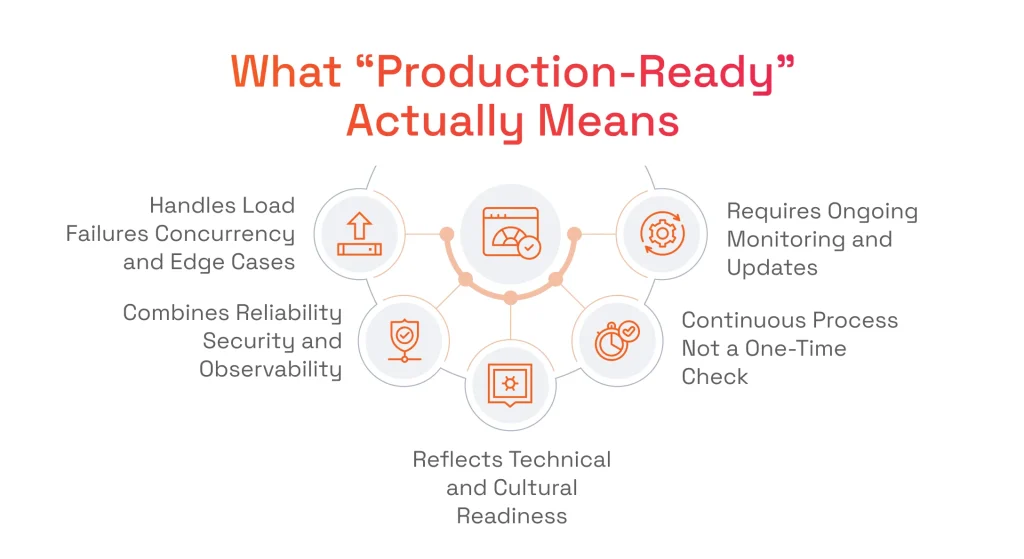
A production-ready system continues to function when traffic spikes, requests overlap, and dependencies degrade or fail. It handles real data that doesn’t align with test scenarios and accounts for edge cases that only surface after launch. AI systems increase this risk, as outputs vary, models depend on external services, and behavior shifts as data changes. A system that performs well in testing can still fail when exposed to real-world conditions.
Production-Ready Software Handles Real-World Conditions
Production systems operate under constant variability. Requests arrive in parallel without proper rate limits, inputs differ in structure, and failures occur as part of normal operation. A production-ready system is built to handle these conditions without disrupting core functionality.
It processes concurrent requests efficiently, maintains stability under load, and continues operating when dependencies respond slowly or return errors. Edge cases are expected and handled consistently. AI agents add complexity through non-deterministic outputs and evolving data, which makes stable behavior harder to maintain over time.
Production Readiness Combines Reliability, Security, and Observability
Production readiness is defined by reliability, security, and observability working together. These standards are commonly adopted by top AI development companies. Reliability ensures the system remains stable under stress and meets service level agreements. Security protects sensitive data and enforces access controls. Observability provides visibility into system behavior and enables teams to detect and diagnose issues early.
These capabilities require more than just defined service-level objectives, infrastructure, and strong operational readiness. Clear ownership, defined processes, and coordination between product and engineering teams are necessary to maintain system stability over time.
Production Readiness Is a Continuous Process, Not a One-Time Check
Production-ready describes the system’s ability to operate under current conditions, not a one-time validation before production launch. Systems change after deployment, which makes ongoing production readiness reviews necessary. Configurations evolve, integrations are added, and usage grows. AI systems shift as data and dependencies change. Maintaining readiness requires continuous monitoring, regular readiness reviews, validation against real data, and ongoing adjustments based on system behavior and change management.

Serhii Leleko
AI/ML Engineer at SPD Technology
“Production readiness is a moving baseline. Every change in data, configuration, or traffic shifts system behavior. Without continuous validation against real inputs, systems drift away from expected performance while still appearing operational.”
What Happens When Your System Isn’t Production-Ready
Gaps in AI readiness don’t stay hidden. They surface as soon as systems face real data, real users, and real pressure. Testing environments filter out variability, while production systems expose it. That’s where weaknesses turn into failures that affect both performance and user experience.
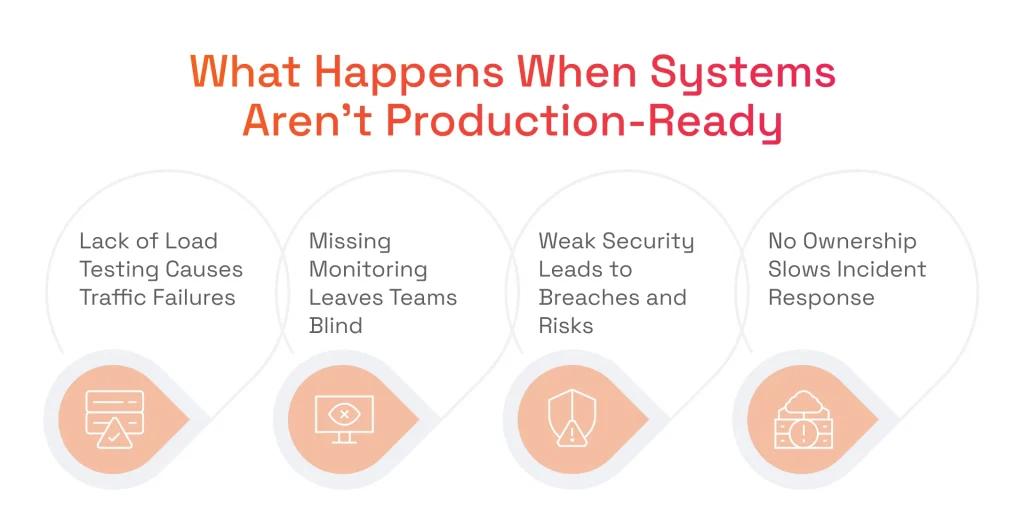
A missing readiness checklist and weak production readiness standards lead to predictable outcomes. Each gap introduces risk, and those risks compound as the system scales. What looks like a minor issue in development becomes a system-wide problem in production, especially when operating AI at scale.
Curious how early-stage systems are built before readiness becomes critical? See how we built an AI-Assisted MVP in 3 days.
Skipping Load Testing Causes Failures Under Real Traffic
Systems that haven’t been tested under load fail when demand increases. Traffic spikes expose resource limits, and concurrent requests slow down processing. AI systems are more sensitive to this. Generative AI workloads take longer to process, which increases error rate and degrades response quality under sustained load.
Lack of Monitoring Leaves Teams Without Visibility
Without logs, metrics, and alerts, teams don’t see what’s happening inside the system. Issues are detected late without human oversight, often via user complaints rather than system signals. That delay increases downtime and makes debugging more difficult. AI systems introduce silent changes, as model drift and data quality issues affect outputs without clear indicators. These patterns highlight how expectations around AI differ from real-world performance, as seen in AI hype vs. reality.
Weak Security Leads to Breaches and Compliance Risks
Security gaps remain hidden until they are exploited. Missing access controls and weak security practices expose sensitive data. Without security scans and vulnerability checks, systems operate with hidden risks. AI systems increase exposure through training data and data pipelines, especially when regulated data is involved. This risk is already visible in practice, with 77% of companies reporting AI-related breaches in the past year.
Missing Ownership Slows Incident Response and Recovery
Unclear ownership delays response during incidents. Teams don’t know who is responsible, and escalation paths are undefined. Recovery slows down while teams coordinate manually. AI systems increase complexity, making clear ownership with a structured incident response plan critical to limiting impact.
Production Readiness vs. Real-World Risk
Every missing step in a production-ready checklist creates a known risk. These risks don’t stay theoretical. They appear in production systems when real conditions expose them.
A readiness checklist serves to map cause to consequence. It shows what happens when certain practices are skipped and how those decisions affect system behavior and business outcomes.
The table below lays this out.
Missing Readiness Element | What Happens in Production | Technical Impact | Business Impact |
|---|---|---|---|
No load and stress testing | System fails under real traffic spikes | Resource exhaustion, timeouts, crashes | Lost revenue during peak usage, poor user experience |
No monitoring and observability | Failures go undetected until users report them | No logs, missing metrics, blind debugging | Increased downtime and slower incident resolution (high MTTR) |
No rollback strategy | Failed deployments cannot be reversed quickly | Broken releases remain live, unstable system state | Prolonged outages and customer churn |
No clear service ownership | No one responds quickly during incidents | Delayed debugging, unclear responsibility | Slower recovery, operational chaos |
Weak access control and secrets management | Unauthorized access or credential leaks | Exposed APIs, compromised systems | Security breaches, legal and compliance risks |
No data encryption (at rest/in transit) | Sensitive data can be intercepted or leaked | Data exposure vulnerabilities | Regulatory penalties and loss of trust |
No automated testing (unit/integration) | Bugs reach production unnoticed | Broken functionality, unstable releases | Increased support load and user dissatisfaction |
No CI/CD pipeline or standardized deployment | Manual errors during releases | Inconsistent environments, failed deployments | Higher failure rate and slower delivery cycles |
No environment parity (staging vs production) | Code works in staging but fails in production | Configuration mismatches, hidden bugs | Unpredictable behavior after launch |
No disaster recovery or backups | Data loss during failures | Irrecoverable system state | Critical business disruption |
No defined SLOs/SLIs | No clear definition of “system health” | Untracked performance degradation | Poor decision-making and unclear priorities |
No structured logging | Debugging incidents becomes slow and complex | Missing context, hard-to-trace errors | Increased downtime and engineering costs |
No automated readiness checks | Issues are missed before deployment | Inconsistent quality across releases | Higher risk of production incidents |
No continuous readiness process | The system degrades over time as changes accumulate | Configuration drift, unnoticed failures | Growing technical debt and instability |
Missing Readiness Element
No load and stress testing
No monitoring and observability
No rollback strategy
No clear service ownership
Weak access control and secrets management
No data encryption (at rest/in transit)
No automated testing (unit/integration)
No CI/CD pipeline or standardized deployment
No environment parity (staging vs production)
No disaster recovery or backups
No defined SLOs/SLIs
No structured logging
No automated readiness checks
No continuous readiness process
What Happens in Production
System fails under real traffic spikes
Failures go undetected until users report them
Failed deployments cannot be reversed quickly
No one responds quickly during incidents
Unauthorized access or credential leaks
Sensitive data can be intercepted or leaked
Bugs reach production unnoticed
Manual errors during releases
Code works in staging but fails in production
Data loss during failures
No clear definition of “system health”
Debugging incidents becomes slow and complex
Issues are missed before deployment
The system degrades over time as changes accumulate
Technical Impact
Resource exhaustion, timeouts, crashes
No logs, missing metrics, blind debugging
Broken releases remain live, unstable system state
Delayed debugging, unclear responsibility
Exposed APIs, compromised systems
Data exposure vulnerabilities
Broken functionality, unstable releases
Inconsistent environments, failed deployments
Configuration mismatches, hidden bugs
Irrecoverable system state
Untracked performance degradation
Missing context, hard-to-trace errors
Inconsistent quality across releases
Configuration drift, unnoticed failures
Business Impact
Lost revenue during peak usage, poor user experience
Increased downtime and slower incident resolution (high MTTR)
Prolonged outages and customer churn
Slower recovery, operational chaos
Security breaches, legal and compliance risks
Regulatory penalties and loss of trust
Increased support load and user dissatisfaction
Higher failure rate and slower delivery cycles
Unpredictable behavior after launch
Critical business disruption
Poor decision-making and unclear priorities
Increased downtime and engineering costs
Higher risk of production incidents
Growing technical debt and instability
Systems don’t fail without warning. Failures follow known paths: no load testing leads to crashes under traffic, no monitoring delays detection, and weak access controls expose sensitive data. AI systems make this more visible with data quality issues, model drift, and changing inputs. Small gaps become larger problems once the system is exposed to real data and user behavior.
Industry data confirms this pattern: 98% of teams have experienced negative outcomes due to gaps in production readiness, ranging from increased change failure rates to missed delivery timelines.
Core Components of Production Readiness
Production readiness is defined by a set of core capabilities that ensure systems behave predictably under real-world conditions. Addressing these specific areas minimizes risk and prevents unmanaged system behavior. Together, they form the foundation for transitioning AI from a lab experiment to a reliable business tool, which reflects the goals of scalable AI/ML development.
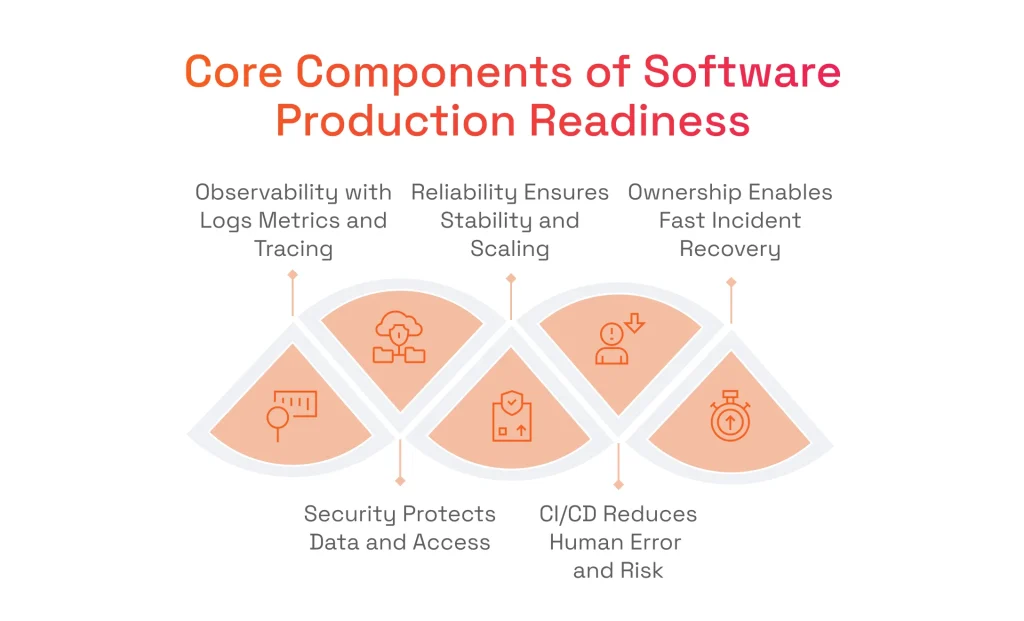
Observability and Monitoring Provide System Visibility
Systems need continuous visibility of system behavior to operate reliably. Logs capture events, metrics track performance, and tracing shows how requests move across services and dependencies.
Key indicators such as latency, error rate, throughput, and saturation reflect system health in real time. Without observability, issues remain hidden until users report them, which increases downtime and makes debugging harder. Monitoring enables faster response, clearer diagnosis, and better control over system behavior with a human-in-the-loop approach.
Security and Compliance Protect Sensitive Data
Security and compliance checks cover how data is handled across the entire system. Encryption protects data at rest and in transit, ensuring that information remains secure during storage and transfer. Secrets management prevents credentials and API keys from being exposed, while access controls restrict who can interact with services and data pipelines.
AI systems increase exposure through continuous data flows across pipelines. Without proper controls, sensitive data can be leaked or misused. Compliance requirements define how data must be handled, especially in regulated environments, while strong security practices reduce risk and maintain trust.
Reliability and Scalability Ensure System Stability
Systems need to remain stable as usage grows and conditions change. Load testing and stress testing reveal bottlenecks before they affect users.
Serhii Leleko
AI/ML Engineer at SPD Technology
“Scaling AI systems introduces interaction effects that don’t appear in isolated tests. Latency, concurrency, and external APIs influence model behavior under load. If these factors aren’t validated together, systems degrade in ways that standard testing doesn’t reveal.”
As demand increases, auto-scaling and capacity planning help adjust capacity in response to traffic, while redundancy mechanisms reduce the impact of component failures. Disaster recovery ensures systems can restore data and state after outages. Stability depends on handling both growth and failure.
Deployment and CI/CD Reduce Human Error
Deployment processes need to be consistent and repeatable. Manual steps introduce variability, which increases the likelihood of failed releases. CI/CD pipelines backed by strong DevOps expertise remove that variability by standardizing how changes move through build, test, and release stages.
Automated checks with human review, such as static code analysis, improve deployment readiness before release, while version control and continuous integration ensure traceability and reversibility. Rollback strategies and feature flags enable fast recovery, and consistent environments prevent mismatches between testing and production.
Ownership and Incident Management Enable Fast Recovery
Unclear ownership slows incident response and increases downtime. Systems remain unstable while teams coordinate responsibilities. Clear service ownership, on-call rotation, and escalation paths ensure faster response. Runbooks guide the handling of common failures, and structured incident management with a human in the loop helps establish governance, reduce confusion, and improve recovery speed.
Production Readiness Checklist
A production-ready checklist gives teams a structured way to assess AI readiness before and after deployment. Built on principles similar to how to write software requirements, the checklist covers the core areas that affect how systems behave under real conditions. This helps identify gaps early, though the checklist itself doesn’t replace ongoing validation.
🟧 Ownership & Incident Management
◻ Service owner is assigned
◻ On-call rotation is defined
◻ Escalation paths are documented
◻ Runbooks exist for common failures
🟦 Observability & Monitoring
◻ Centralized logging is implemented
◻ Metrics tracking is configured
◻ Distributed tracing is enabled
◻ Alerts are tied to thresholds
🟧 Security & Compliance
◻ Data is encrypted at rest and in transit
◻ API keys and credentials are stored securely
◻ Access controls (RBAC) are enforced
◻ Vulnerability scans are automated
🟦 Reliability & Scalability
◻ Load and stress testing are completed
◻ Auto-scaling is configured and tested
◻ Backups and restore procedures are validated
◻ Redundancy mechanisms are implemented
🟧 Deployment & CI/CD
◻ CI/CD pipeline is implemented
◻ Automated unit and integration tests are running
◻ Rollback strategy is defined and tested
◻ Environment parity between staging and production is ensured
🟦 Testing & Validation
◻ Unit tests are implemented
◻ Integration tests validate dependencies
◻ Stress testing identifies breaking points
◻ Failure scenarios are tested
The value depends on how the AI readiness checklist is used. It works best as a diagnostic tool, helping teams link each item to a specific risk and prioritize work before AI deployment, rather than reacting later.
As systems evolve, data foundations change, dependencies grow, and assumptions shift, so the checklist needs regular updates. Used this way, it supports ongoing AI readiness, not just a one-time pre-launch step.
What This Means for Teams Building AI Products
AI systems often look stable early on. Controlled data, low traffic, and predictable inputs create a sense of readiness. That changes once real usage begins. Inputs vary, edge cases increase, and system behavior shifts under load.
For teams, this is where production readiness becomes visible as a product issue. System stability affects user experience, adoption rates, and the cost of scaling. Teams that treat production readiness as part of product strategy are better positioned to avoid these issues, especially when supported by experienced partners like SPD Technology.
Production Readiness Becomes Critical After Early Traction
After initial traction, systems move beyond internal testing and demos. Real users introduce variability, and data quality becomes less consistent. Inputs no longer follow expected patterns, and usage becomes harder to predict. At this stage, AI deployment requires stronger control over how the system handles changing inputs and increasing demand. Without it, performance becomes less stable.
Systems Fail at the Point Where Growth Begins
Growth introduces pressure that testing environments don’t replicate. Load increases, requests overlap, and external services respond more slowly. Hidden dependencies begin to affect system behavior. AI systems amplify this. Model drift and data quality issues affect outputs, and weak points begin to surface under sustained usage.
Fixing Readiness Late Is More Expensive Than Building It Early
Fixing gaps after release is harder. Changes affect multiple components, and coordination becomes more complex. Technical debt accumulates, and incident response slows. Teams that invest in readiness early maintain stability and avoid costly rework as they scale AI. SPD Technology applies this approach by integrating production-readiness practices into delivery from the start, rather than as a post-launch fix. This approach strengthens the overall software product development process.
Learn how to avoid late-stage fixes in the 90-day path from vibe-coded MVP to production system.
Key Takeaways
- Production-ready means the system performs reliably under real-world conditions, including load, failures, and unpredictable inputs.
- Treating production readiness as a one-time check leads to system degradation as data, dependencies, and configurations evolve.
- A production-ready checklist provides structured validation across system layers, but requires engineering discipline and continuous monitoring to remain effective.
- Delaying production readiness creates technical debt that slows scaling and increases operational costs.
- AI systems introduce additional risk through model drift, edge cases, and dependencies on external APIs and data pipelines.
- Missing monitoring, observability, and rollback plans leads to delayed incident detection and increased downtime during failures.
In short: AI code can pass testing and reach production, but only structured engineering and continuous production readiness prevent failures under real-world conditions.
FAQ
What is a production readiness checklist?
A production readiness checklist is a structured framework used to verify that a system can reliably operate under real-world conditions. It covers reliability, security, observability, and deployment strategies. Teams use it to identify potential gaps both before and after an AI model is deployed.
What makes software production-ready?
Production-ready software is characterized by its ability to remain stable under load and resilient against unpredictable inputs. It protects sensitive data, provides granular visibility through comprehensive monitoring, and supports controlled deployments. Beyond technical specs, these systems also require clear ownership and established incident response processes to maintain operational stability over time.
Why do systems fail after deployment?
Systems often fail after deployment because real production conditions expose gaps that isolated testing environments fail to cover. Inadequate load testing, weak monitoring, and data quality issues lead to failures under high traffic and edge cases. AI systems specifically exacerbate this through model drift and evolving data inputs.
How do you test production readiness?
Testing production readiness includes load testing, stress testing, and end-to-end integration tests across all system dependencies. Monitoring is configured to track key performance metrics and detect real-time anomalies. Teams should also simulate failure scenarios with chaos engineering to validate automated recovery processes.
What is the difference between product readiness and production readiness?
Product readiness confirms that features meet user needs and business goals, focusing on usability and success criteria. In contrast, production readiness focuses on how the system operates under strenuous conditions, including stability, security, and recovery. Both are required for successful AI adoption; essentially, one focuses on what the product does, while the other governs how it behaves.
What are the most important production readiness checks?
Key checks include observability setup, automated testing, robust access controls, and validated CI/CD pipelines. Teams must also validate rollback plans, incident response processes, and system behavior under peak load. These checks significantly reduce the risk of catastrophic failures in production systems.