

AI-native development teams ship faster without sacrificing quality by redesigning the delivery process around AI agents. The redesign rests on three connected changes. Written specifications become the unit of work, automated evaluation loops share verification with human code review, and agent autonomy scales with the cost of a mistake. Teams that skip the redesign usually see individual speed gains stall in review bottlenecks.
Many engineering organizations today follow a similar path. A team rolls out AI tools, and within weeks engineers draft code and close tickets noticeably faster, so it seems safe to expect team delivery to speed up as well. In practice, that expectation often fails. Microsoft’s own IT organization saw individual developers speed up after adopting AI assistants, and the gains stayed at the individual level.
DORA’s analysis of balancing AI tensions shows how common this is. It reports that 90% of technology professionals use AI at work and over 80% believe it has made them more productive. Higher adoption is also associated with rising delivery instability alongside throughput, because the process around the tools was built for traditional development with no agents involved. AI-native development can combine faster delivery with stable quality through a specific set of connected mechanisms, which are the spec as the unit of work, automated evaluation working beside human review, and autonomy set by risk. Two documented cases show each of them in action.
The Hard Lesson Every AI-Native Team Learns First
The pattern appears in engineering organizations of every size. AI-native teams usually start as groups of individually faster engineers who expected those gains to add up, and then they discover that the delivery pipeline absorbs the gains before they reach production.
Microsoft Digital, the company’s IT organization and its Customer Zero, began its AI-native transformation ad hoc roughly a year before describing it in the Microsoft Inside Track account of its AI-native approach. Sudhakar Sadasivuni, principal group engineering manager at Microsoft Digital, calls the discovery the team’s hard lesson. Improving the productivity of individual developers did not raise the productivity of the team.
Microsoft’s explanation points at the process around the tools. In a traditional engineering organization, the software development lifecycle is designed around human handoffs, and every handoff loses some of the original intent as each person rebuilds their own mental models of the task. New AI capabilities sped up the work inside each stage but left every handoff in place, so the gaps stayed where they were. An AI-native SDLC begins by shrinking those gaps.
The first instinct inside Microsoft Digital was simply to go faster, which led to a phase of vibe coding. Mridul Verma, senior software engineer at Microsoft Digital, describes that phase as speed without direction that turned into expensive chaos, and he credits spec-driven development (SDD) with giving the team both velocity and a clear vector. The correction was to write a living specification before implementation. The failure modes of vibe coding will be familiar to anyone in software development who has studied why AI-generated code breaks in production.
Microsoft’s experience fits a broader finding. DORA’s 2025 research on AI-assisted development describes AI as an amplifier of an organization’s existing strengths and weaknesses. In software engineering terms, a lifecycle built on lossy handoffs amplifies its own losses and quietly absorbs whatever the tools gain. Microsoft solved the problem by changing its process, which leads to the question of what that process looks like in practice.
What Actually Separates AI-Native From AI-Enabled Development
Teams call themselves AI-native for very different reasons, and the label often covers little more than broad adoption of AI technology. A commonly used industry framing sorts teams into four stages of AI adoption.
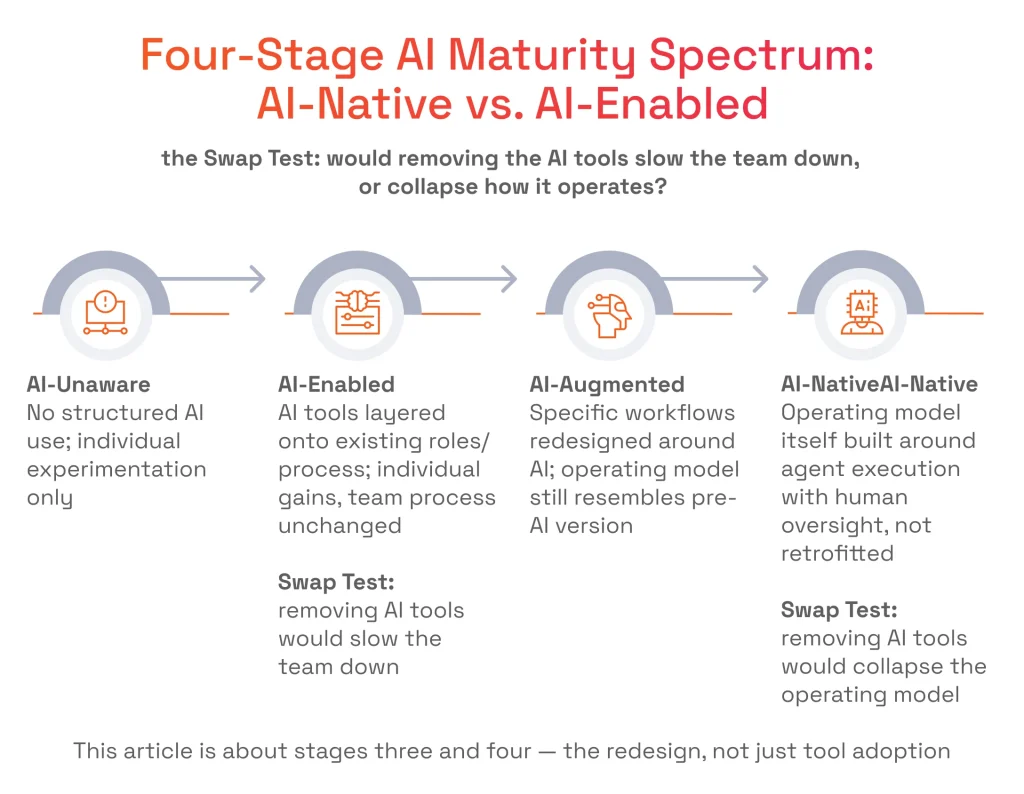
The stage depends on how the operating model is built, and the volume of AI use says little about where a team sits. Adopting AI-native platforms can support the shift, though the stage stays the same until the way the team works changes too.
Stage | What Changes |
|---|---|
AI-Unaware | No structured AI use; individual experimentation only |
AI-Enabled | AI tools layered onto existing roles and process; individual productivity improves while team-level process stays the same |
AI-Augmented | Specific workflows redesigned around AI; the overall operating model still resembles the pre-AI version |
AI-Native | The operating model itself is built around agent execution with human oversight from the start |
Stage
AI-Unaware
AI-Enabled
AI-Augmented
AI-Native
What Changes
No structured AI use; individual experimentation only
AI tools layered onto existing roles and process; individual productivity improves while team-level process stays the same
Specific workflows redesigned around AI; the overall operating model still resembles the pre-AI version
The operating model itself is built around agent execution with human oversight from the start
The distinction between AI-native and AI-enabled becomes concrete with a diagnostic sometimes called the Swap Test. The test is to remove the AI tools and see what happens next. A team that would slow down is AI-enabled. A team whose whole way of operating would stop working is AI-native, because the specs, review gates, and task routing of AI-native systems all assume agents do the execution.
AI-native means the entire system is designed around agents, with AI embedded in how work is planned, delegated, and checked. The comparison with cloud native is useful here, since cloud native applications were designed for the cloud from their first architecture decisions.
Teams that feel a gap between individual and team speed usually sit at the AI-Enabled or AI-Augmented stage. At that point they embed AI into existing processes and keep the review and handoff structure of traditional teams and traditional systems. The move from AI-Augmented to AI-Native is where the fundamental rethinking of the operating model happens, and it is where review, specs, and verification all have to change.
Why Review Becomes the Real Bottleneck for an AI-Native Development Team
Faster code generation moves the constraint downstream. Once agents generate outputs faster than people can judge them, human review capacity sets the pace for the whole team.
OpenAI’s account of building an agent-first internal product names human time and attention as the team’s one truly scarce resource. As code throughput rose, the post reports, the bottleneck shifted to human quality assurance capacity.
DORA’s research describes the same pressure from another angle. The time AI saves on writing code is frequently reallocated to auditing and verification. That reallocation is the handoff gap from Microsoft’s experience appearing again at the review step, where a reviewer has to reconstruct intent that nobody wrote down.
Consider a team where every change passes through one uniform, human-only, pre-merge gate, whatever it touches. A typo fix and other routine tasks wait in the same queue as a change to transaction logic, reviewed by the same people, and the queue grows with every gain in coding speed. All the code lands in one line, so cycle time stretches even as engineers draft code faster. This is how individual acceleration turns into flat team delivery for many software teams.
The lever, then, is a routing decision about the AI role in each type of change. A team has to decide which changes need a human before merging at all, and which ones can be verified by other means. That decision-making is where engineering leaders have the most influence, because it lets reviewers spend their critical thinking on the changes that need it most. In SPD Technology’s Claude Code engineering and operations enablement for a US ticketing platform, every pull request in the governed flows passed automated review before a human saw it, and reviewers absorbed double the PR volume with no added latency while human-reported bugs fell 81%.

Moving From Pre-Merge Review to Post-Merge Verification With Care
Relocating review can look like going faster by checking less. The approach holds up only where automated evaluation is strong and mistakes are cheap to reverse, so the real engineering work lies in deciding where that line sits.
At OpenAI, human review of pull requests is optional, most reviews happen agent-to-agent, and merge gates are minimal. For a bug, the agent records one video demonstrating the failure and a second demonstrating the resolution before it opens a pull request, and it escalates to a human only when judgment is required. The videos document how the agent reached its answer, which is what trajectory evaluation means in practice. Each change also runs against its own isolated, bootable app instance per git worktree, with an ephemeral logs, metrics, and traces stack that is torn down when the task ends. This setup is a concrete form of sandboxed permissions for autonomous agents.
Together, these practices form evaluation loops, which are automated checks that run continuously and block or flag a change when quality regresses. In effect, they work as quality gates for AI-generated output. OpenAI’s post states clearly that its minimal-gate approach would be irresponsible in a low-throughput environment and that its results depend on that repository’s specific structure and tooling. At SPD Technology, our position builds on that caveat. For security-sensitive, irreversible, or payment-touching changes, moving review to after merge removes the check entirely.
Our team draws the line with a framework called calibrated autonomy. The autonomy a change receives, including whether a human reviews it before or after merge, is matched to how strong the verification around it is and how costly the change would be if it were wrong. Where that matching calls for a person, the principles of human-in-the-loop design determine where the person sits and what they see.
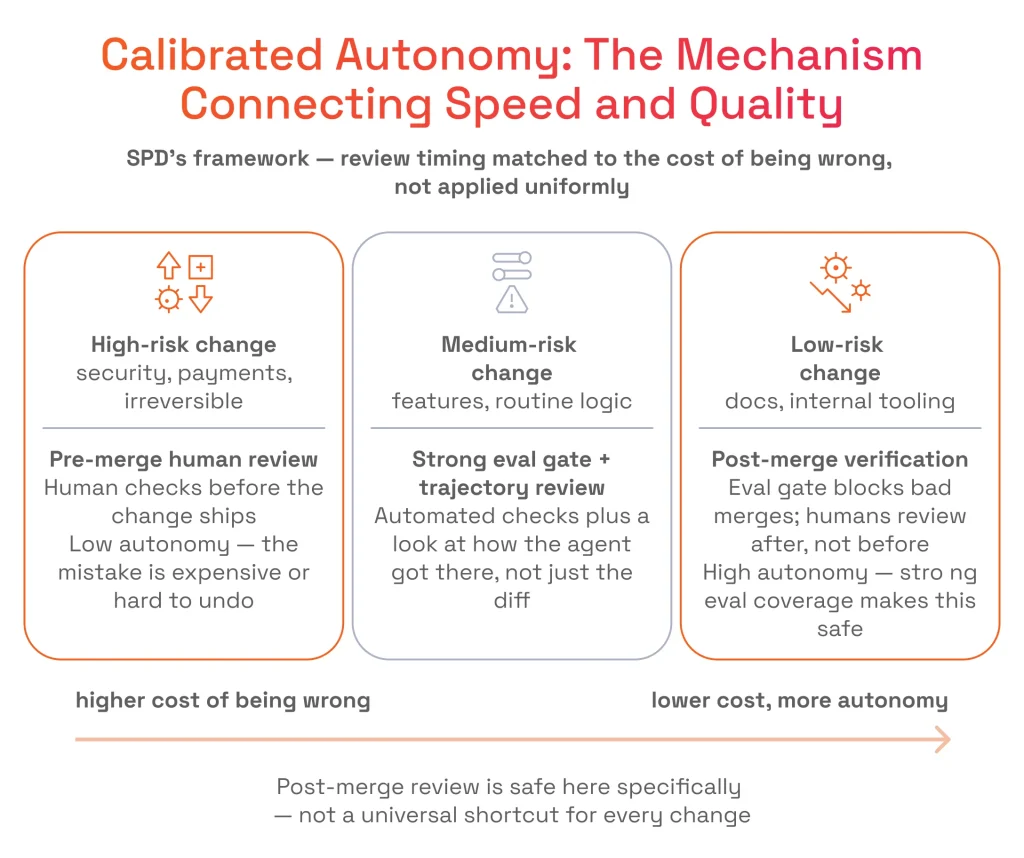
An agentic engineering layer that we built for a US fintech rewards platform shows the framework at work. The agent detects a production incident, runs root-cause analysis, writes the fix, and opens the pull request on its own. It never merges, and every fix passes standard human code review before production. Investigation runs with full autonomy, while the irreversible step keeps a human gate.

Serhii Leleko
AI & ML Engineer at SPD Technology
“We decide where review sits change by change, and the question is whether a mistake would surface cheaply after merge. A documentation fix with strong eval coverage fails loudly and reverts in minutes. A change to how a cashback reward is calculated can pass every check and stay wrong for weeks. Same pipeline, same agent, and a completely different answer to when a human looks.”
This distinction works only if the evaluation layer reliably catches the loud failures. That reliability comes from a deliberate discipline of evaluating AI agents before production.
Spec as the Unit of Work
Matching autonomy to the cost of being wrong requires knowing what wrong means before an agent starts. In spec-first development, a written specification carries that definition, and the spec becomes the unit a team plans, delegates, and verifies. A good spec also translates product vision into acceptance criteria that AI models can execute against.
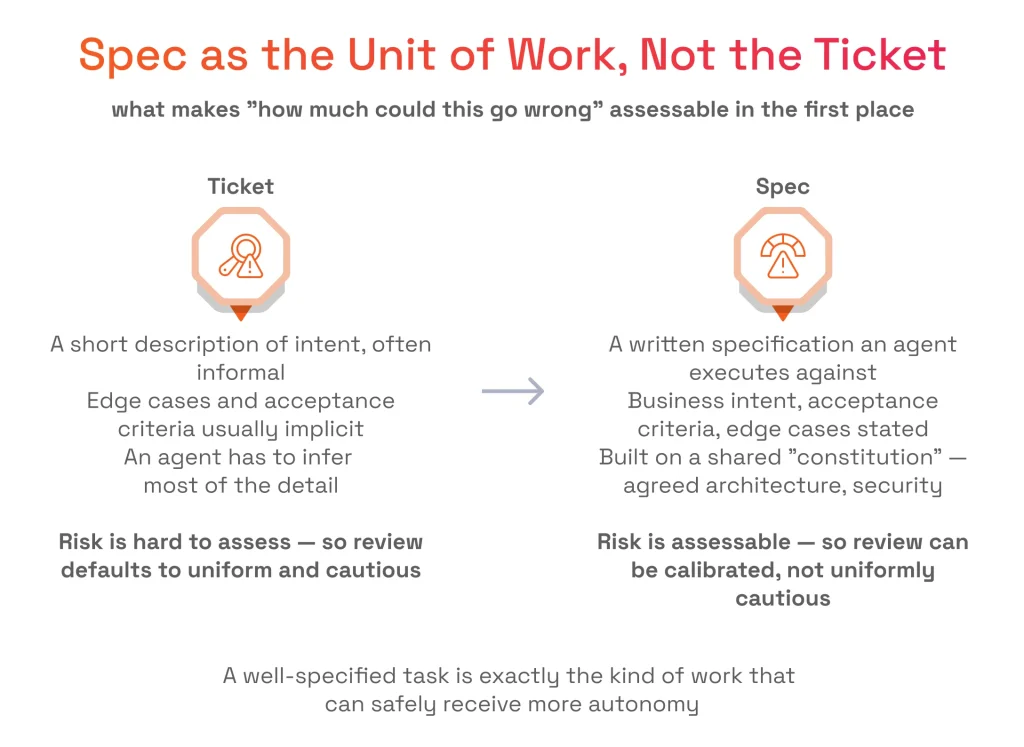
Microsoft Digital’s specs capture business intent, acceptance criteria, and edge cases before the development phase begins, and they live under version control in the same repository as the code. Before any spec is written, teams agree on a constitution covering architectural principles, governance requirements, security standards, and development limitations. The constitution plays the role that governance frameworks play elsewhere in the business, and it is built team-wide so people and AI agents begin from the same context.
OpenAI applies a similar idea to agent context. Its AGENTS.md file is kept to roughly 100 lines and works as a table of contents pointing into a structured docs directory, with linters and CI jobs checking that the documentation stays current.
A well-specified task can safely receive lighter-touch review, because the spec states what correct looks like before an agent writes anything. A vague ticket leaves the agent to infer intent and the reviewer to reconstruct it, which pushes the change back toward full human scrutiny.
The Flywheel of Assets That Should Grow Every Week
Codebases grow in every team that uses AI. An AI-native engineering team also grows its verification infrastructure at the same pace, because each agent failure turns into a permanent fix.
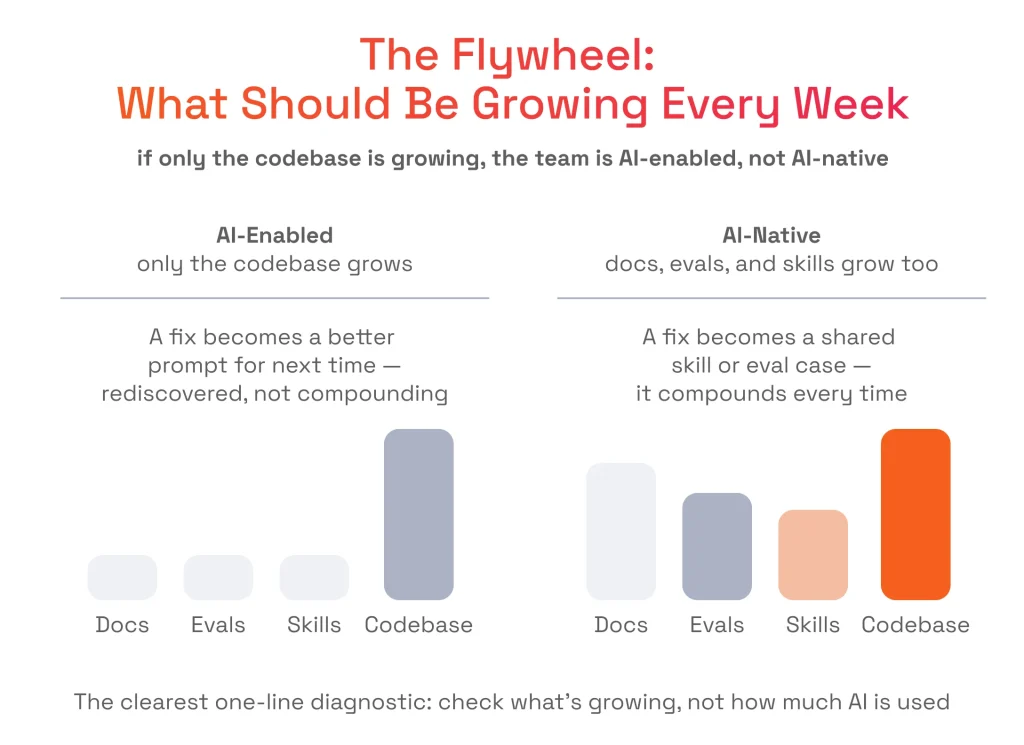
A weekly observation shows the difference quickly. When a team’s documentation, suite for eval engineering for AI products, and shared skill library expand each week, that team is operating natively with AI. If only the codebase grows, the team is still AI-enabled.
OpenAI’s team captures review comments, refactoring pull requests, and user-facing bugs as documentation updates, or encodes them into tooling. That habit replaced a more expensive one. The team once spent every Friday, 20% of its week, cleaning up low-quality AI output by hand, and that effort stopped scaling until the team encoded a set of golden principles into the repository and ran recurring background cleanup tasks.
False positives are a recurring cost of any incident agent, and in SPD Technology-developed rewards platform engagement they account for 30 to 35% of cases. Each one is fed back to tune the agent’s prompts and repository documentation. Every incident also produces a structured root-cause analysis that is stored automatically, so failure patterns build up into a knowledge base that survives engineer turnover and becomes an internal capability of the team. The setup relies on Agent Skills, which are encoded, reusable engineering standards an agent draws on, written as custom skills for each repository.
Observability belongs in the same loop. It is the instrumentation that shows what happened during a task, while evaluation decides whether the result is good enough to ship, and the flywheel needs both.
Two Documented Case Studies and What Their Numbers Show
Documented cases of AI-native delivery with clear sourcing are rare, and these two measure different things.
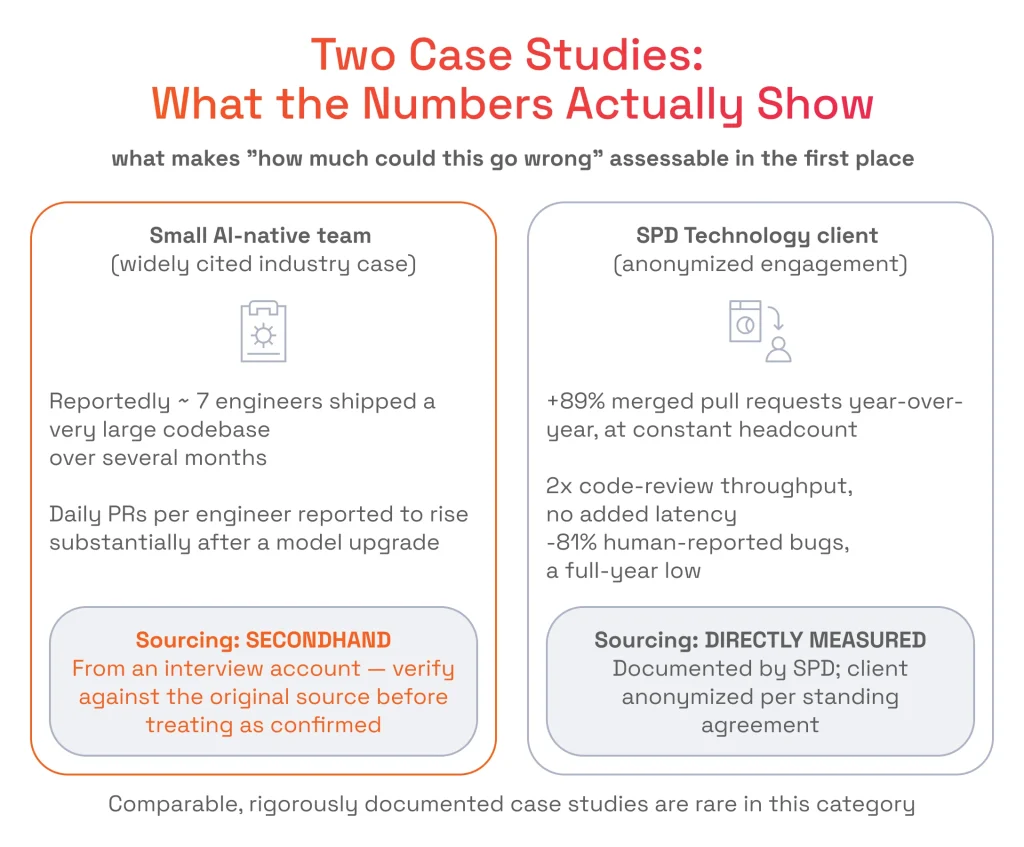
OpenAI’s pull request figures are self-reported in Ryan Lopopolo’s harness engineering post and haven’t been independently audited, and the post notes that the results depend on that repository’s structure and tooling. The SPD Technology figures come from the published incident pilot case study.
Case | Reported Result |
|---|---|
OpenAI internal product team (three engineers, growing to seven) |
|
SPD Technology client engagement (US fintech rewards platform, anonymized) |
|
Case
OpenAI internal product team (three engineers, growing to seven)
SPD Technology client engagement (US fintech rewards platform, anonymized)
Reported Result
- ~1,500 merged pull requests over five months, averaging 3.5 per engineer per day, with throughput rising as the team grew;
- roughly one million lines of agent-written code;
- OpenAI’s own estimate of about one-tenth the hand-coding time.
- Incident acknowledged in ~2 minutes;
- PR-ready fix ~24 minutes after detection (previously 60+ minutes);
- 65 to 70% of incidents resolved correctly without rework; no on-call rotation required.
AI-Native Readiness Checklist
Each practice described above can be checked against how a team works today. Every item pairs a practice with the failure its absence tends to produce.
-
Work starts from a written spec with acceptance criteria, since a ticket or a one-line prompt leaves the agent to infer intent and the reviewer to reconstruct it.
-
An automated eval gate blocks or flags a merge when quality regresses, so verification stops depending on a human noticing every problem by eye.
-
Review posture varies with the risk of each change, because applying the same review depth to a documentation fix and a payment change starves one and over-serves the other.
-
Every agent failure ends as a new skill, rule, or eval case in the repository, because a better prompt fixes one session and a shared fix covers every future task.
-
The eval suite and documentation grow measurably alongside the codebase, which keeps quality attached to speed as output rises.
-
Individual productivity gains have been checked against team-level throughput and defect metrics, since assuming one implies the other is the exact assumption Microsoft Digital found to be false.
A team with AI tools widely adopted and few of these practices in place is AI-enabled, which is a legitimate stage, and the distance to AI-native is structural. The first unchecked item from the top is usually the cheapest place to start.
For the release side of the same question, AI production-ready checklist covers what AI systems need before they go live.
Expertise of Our AI Native Engineering Team
At SPD Technology, we built one agentic layer on Claude Code for a fintech client, covering code review, incident response, and feature development across the software delivery process. Rollout ran in six phases, beginning with repository configuration and automated code review in CI/CD well before any autonomous incident work. The agent reviews every pull request before a human signs off, and it never merges its own fixes. We track delivery gains by measuring speed without hiding rework.
- Specs, decision records, and test plans live as versioned assets in the client’s own repository from day one.
- Agent autonomy is set per task type and matched to verification strength and to what a wrong change would cost. This is SPD Technology’s calibrated autonomy in practice, applied across one cross-functional team that owns both architecture and execution.
- Repository conventions and runbooks sit in files the agent reads on every task (CLAUDE.md in the incident-response engagement), and false positives feed back into them.
Conclusion
AI-native teams ship faster without sacrificing quality because they redefine the unit of work and the shape of verification, and they place review according to the risk of each change. Tool adoption produces individual speed, and the process around the tools decides whether that speed reaches production intact. Once that process is in place, delivery is no longer constrained by how quickly reviewers can work through a single queue, and speed starts to show up in business outcomes. The same logic will apply to the next generation of agentic AI tooling, since each new layer still depends on the process around it.
The practical next step is modest. Work through the readiness checklist, find the first missing practice, and start there, which locates the actual gap faster than adding another layer of new tools.
Key Takeaways
- Microsoft Digital found that better individual developer productivity did not raise team productivity, so AI tool adoption alone is unlikely to speed up team delivery.
- The clearest AI-native test is removal. A team that would only slow down without its AI tools is AI-enabled, and a team whose operating model would stop working is AI-native.
- Once agents produce work faster than people can judge it, human review capacity becomes the constraint, which is the old SDLC handoff gap appearing again at the merge step.
- Moving review to after merge works for low-risk changes backed by strong evaluation loops, and applying it to irreversible or payment-touching changes removes the check entirely.
- A written specification makes the cost of a wrong change assessable before work starts, which lets a task safely receive more agent autonomy.
- A growing eval suite, documentation set, and skill library signals an AI-native team, and growth in the codebase alone signals a team that is still AI-enabled.
- In one SPD Technology engagement, an agent that never merges its own fixes cut time to a PR-ready incident fix from 60+ minutes to about 24, with 65 to 70% resolved correctly without rework.
In short: an AI-native development team gets speed and quality together by redesigning specs, verification, and autonomy, since the tools alone deliver only individual speed.
FAQ
What’s the difference between an AI-native team and an AI-enabled team?
An AI-enabled team adds AI tools to unchanged tickets, reviews, and roles, while an AI-native team redesigns the operating model itself. In the redesigned model, specs become the unit of work, automated evals share verification with human review, and each change receives autonomy according to its risk.
An AI-native organization applies the same redesign across all of its teams. The quickest way to tell the two apart is removal. Take the tools away, and an AI-enabled team slows down, while an AI-native team finds that its whole way of operating stops working.
Why doesn’t individual AI productivity automatically translate into team-level speed?
Team bottlenecks are structural, and AI tools speed up the work inside each step while leaving the structure in place. Handoffs still lose intent, every change still waits in the same uniform review queue, and vague specs still force reviewers to reconstruct what a change was supposed to do.
Is moving code review to after merge a good practice?
Moving code review to after merge works well for low-risk changes backed by strong eval coverage, where a mistake surfaces quickly and reverts cheaply.
Security-sensitive, irreversible, or high-stakes changes keep a human before merge, because moving their review later removes the check entirely. Where review does move later, trajectory review helps. When an agent records how it reproduced a bug and then shows the fix working, for example with a short recording of each, reviewers get evidence beyond the final diff.
What does spec-driven development mean for an AI-native team specifically?
Spec-driven development makes a written spec with scope, acceptance criteria, and edge cases the unit an agent executes against and a reviewer verifies against.
Some teams add a shared constitution before any spec is written, covering architectural principles, governance requirements, and security standards, so people and agents work from one context. The spec also makes autonomy assessable, since it defines what a correct result looks like, and so what a wrong change would cost, before work begins.
How do you know if your team is actually AI-native, or just using a lot of AI tools?
Look at what grows besides the code.
- AI-native team. Documentation, the eval suite, and the shared skill library grow every week, because each agent failure becomes a reusable fix for future tasks. Those fixes build on each other, so the same mistake becomes less and less likely.
- AI-enabled team. The codebase is the only thing that grows week over week, however heavily the team uses AI tools.
Can a small or mid-size team realistically become AI-native?
Yes. Some documented agent-first teams have started with just three engineers and seen throughput rise as they grew, so team size is rarely the limiting factor. The core mechanisms of written specs, eval gates, and risk-based review are process and governance questions.
Small teams can often put them in place faster than large organizations, because they have fewer handoffs to redesign and fewer people to align on a shared constitution. Cross-functional pods inside larger companies have the same advantage.
How much does it cost to move a team from AI-enabled to AI-native?
Cost depends on scope, so the safest way to set it is to pilot the new process on one real workflow first. AI coding tools run from about $19 per user per month for GitHub Copilot Business to $100 to $200 per engineer for premium agent plans such as Claude Code, Cursor, or Codex. Many pilot-stage AI engagements cost $10,000 to $49,999. Teams should also expect three to six months of adjustment before gains show up.
How long does the transition to an AI-native development process take?
The first changes arrive within weeks, and the full operating model takes about six months to settle. In one year-long study of AI tool adoption, use of a new AI coding tool accelerated in months two and three and peaked at 83% by month six. Most enterprises report measurable ROI within three to six months.