

An AI governance framework is the set of policies, roles, controls and evidence that governs how a company builds and uses AI systems. It decides which systems may run, how they are approved, monitored and stopped, and who is accountable for them. For regulated companies, the framework starts with an inventory of every AI system and a risk assessment that sets each system’s risk level. From there, the company assigns owners and turns principles such as fairness, transparency and human oversight into technical controls enforced in data and AI systems. Those controls map to the EU AI Act, the NIST AI Risk Management Framework, ISO/IEC 42001 and sector rules. Generative AI and agents get specific controls, and audit evidence is kept for every release and decision. A framework works when an auditor can see what each AI system did and why.
An approved AI policy, a responsible AI statement and a steering committee on the agenda can make governance look complete. That sense of completion disappears once AI is embedded in credit, fraud, KYC and customer service decisions. From then on, the board, the regulator and the auditor all ask the same question: which AI does the company run, who approved it, and can anyone prove what it did?
Regulatory requirements are arriving in stages. The EU AI Act transparency obligations have applied since August 2026, and the Annex III high-risk obligations apply from 2 December 2027. In the US, bank model risk guidance was rewritten in April 2026. Getting ready for those dates takes clear definitions, principles turned into controls and evidence, a map of the key AI governance frameworks, and a practical implementation plan that covers agents and maturity.
What Is AI Governance?
AI governance is the set of policies, roles, controls and evidence an organization uses to decide which AI it builds or buys, how that AI is approved, monitored and retired, and who answers for its decisions. An AI governance framework documents that structure so it can be applied to every AI system, from a vendor chatbot to an in-house credit model. As the number of systems grows, the register, workflows and records usually move into an AI governance platform.
Responsible AI governance applies the principles of fairness, transparency and accountability through that structure, so the principles show up as controls in the systems that make decisions. The four disciplines in the table below are layers of one system, each with its own owner. A gap in any layer shows up as a missing record when an auditor asks for it.
AI governance, model governance, data governance and responsible AI
Organizations often use AI governance, model governance, data governance, and responsible AI interchangeably, yet each addresses a distinct layer of risk and accountability.
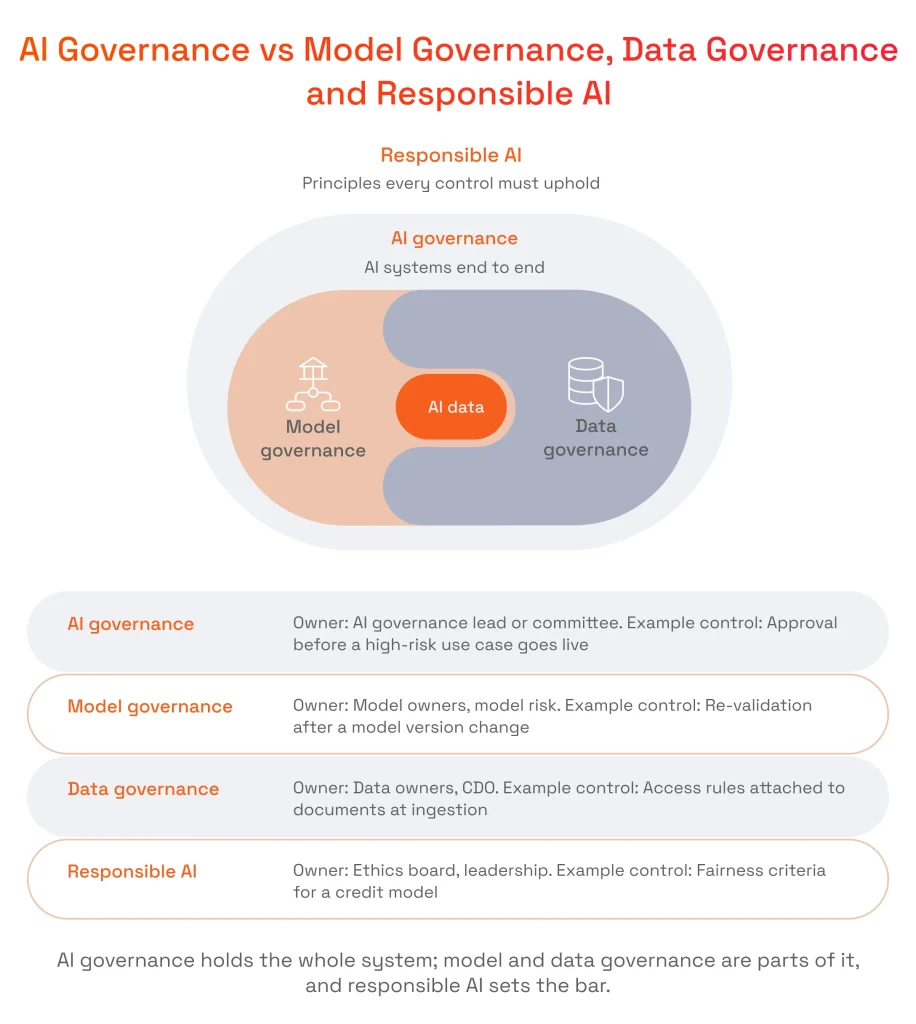
While data and model governance secure the technical foundations, ensuring inputs are reliable and algorithms perform as intended—AI governance and responsible AI establish the overarching organizational rules, oversight, and ethical guardrails. Together, they form an integrated stack that keeps AI systems compliant, trustworthy, and auditable from initial design through retirement.
Discipline | What it governs | Typical owner | Example control |
|---|---|---|---|
AI governance | AI systems end to end: use cases, models, prompts, retrieved data, agents, decisions | AI governance lead / committee | Approval before a high-risk use case goes live |
AI model governance | Models as managed assets: registration, validation, monitoring, retirement | Model owners, model risk | Re-validation after a model version change |
Data governance | Data used by AI: access, lineage, quality, retention | Data owners, CDO | Access rules attached to documents at ingestion |
Responsible AI | Principles and values the controls must uphold | Ethics board, leadership | Fairness criteria for a credit model |
Discipline
AI governance
AI model governance
Data governance
Responsible AI
What it governs
AI systems end to end: use cases, models, prompts, retrieved data, agents, decisions
Models as managed assets: registration, validation, monitoring, retirement
Data used by AI: access, lineage, quality, retention
Principles and values the controls must uphold
Typical owner
AI governance lead / committee
Model owners, model risk
Data owners, CDO
Ethics board, leadership
Example control
Approval before a high-risk use case goes live
Re-validation after a model version change
Access rules attached to documents at ingestion
Fairness criteria for a credit model
A model grounded on ungoverned data inherits every access and quality gap in that data. That is why data governance services usually come before model controls in the build order.
Why Does AI Governance Matter Now for Regulated Companies?
AI governance matters now because AI has moved from pilots into decisions about credit, fraud, onboarding and customer communication, while regulators are setting dates and rewriting guidance. In McKinsey’s State of AI 2026, 44% of respondents say AI is scaling across their enterprise, and 40% of large organizations report scaling AI agents. Scaling is where governance gets tested, and controls added after launch become a release blocker just as a system is due to grow.
- Controls that were optional in a sandbox become mandatory once a team starts moving from MVP to production.
- In the European Union, Article 50 transparency duties have applied since 2 August 2026. The Digital Omnibus on AI, Regulation (EU) 2026/1744, moved Annex III high-risk duties to 2 December 2027.
- US bank supervisors issued SR 26-2 and OCC Bulletin 2026-13 in April 2026 to replace SR 11-7. The guidance places generative and agentic AI out of scope, so banks need their own controls for those systems.
- Shadow AI keeps arriving through AI features inside SaaS products and third-party APIs that nobody registered.
For finance, the exposure is concrete. A biased model inside lending solutions can become a regulatory finding. In fraud, an unexplained block from AI in fraud detection turns into a customer complaint nobody can answer. During onboarding, a chatbot that invents a policy undercuts AI for KYC and compliance, and each case adds reputational cost to the regulatory one.
What Are the Core Principles of an AI Governance Framework?
The core AI governance principles are fairness, transparency and explainability, accountability, privacy and security, and human oversight. Reliability is often added as a sixth.
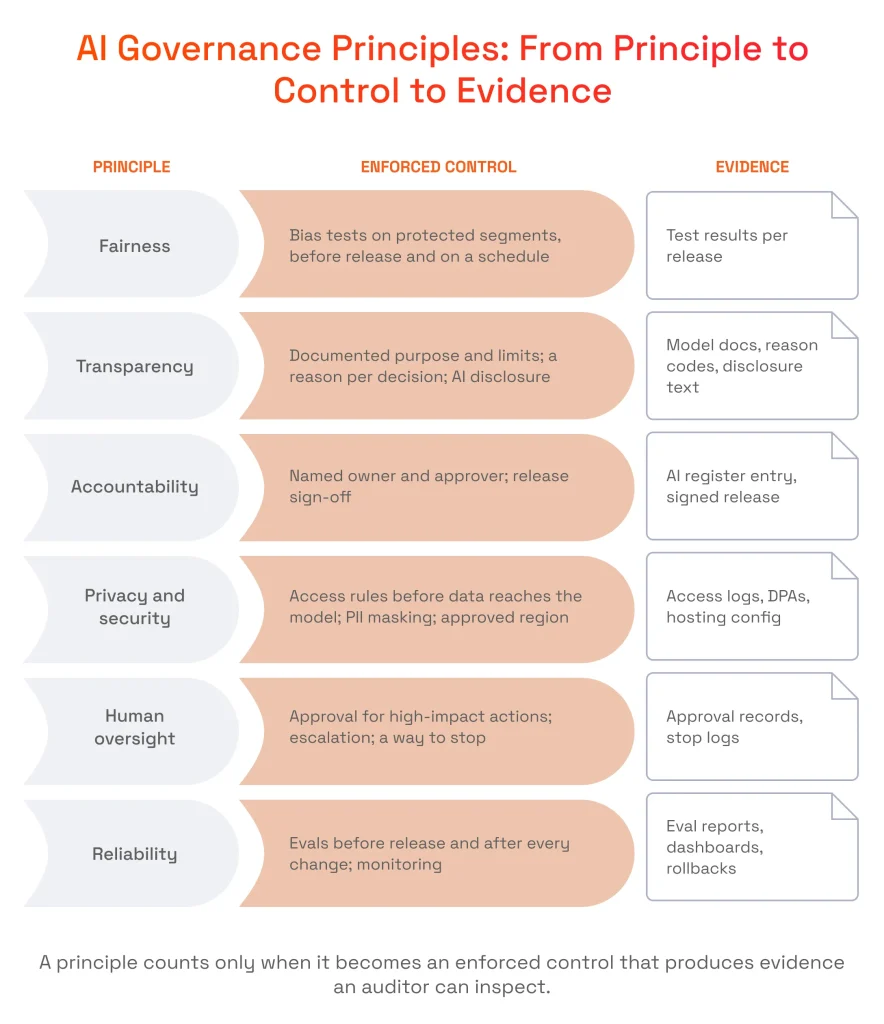
In responsible AI governance, a principle counts only when it becomes a control that leaves evidence. The OECD AI Principles set out a similar set of commitments at the policy level; the table shows how each principle becomes a control.
From principle to control to evidence
Principle | Enforced control | Evidence an auditor can inspect |
|---|---|---|
Fairness | Bias tests on protected segments before release and on a schedule | Test results per release with thresholds |
Transparency and explainability | Documented model purpose, inputs and limits; reasons recorded for each decision; AI disclosure to users | Model documentation; per-decision reason codes; disclosure text |
Accountability | Named owner and approver for every AI system; release sign-off | AI register entry; signed release record |
Privacy and security | Access rules applied before data reaches the model; PII masking; approved hosting region | Access logs; data processing agreements; hosting configuration |
Human oversight | Approval required for high-impact actions; escalation path; ability to stop the system | Approval records; incident and stop logs |
Reliability | Evals against thresholds before release and after every change; production monitoring | Eval reports; monitoring dashboards; rollback records |
Principle
Fairness
Transparency and explainability
Accountability
Privacy and security
Human oversight
Reliability
Enforced control
Bias tests on protected segments before release and on a schedule
Documented model purpose, inputs and limits; reasons recorded for each decision; AI disclosure to users
Named owner and approver for every AI system; release sign-off
Access rules applied before data reaches the model; PII masking; approved hosting region
Approval required for high-impact actions; escalation path; ability to stop the system
Evals against thresholds before release and after every change; production monitoring
Evidence an auditor can inspect
Test results per release with thresholds
Model documentation; per-decision reason codes; disclosure text
AI register entry; signed release record
Access logs; data processing agreements; hosting configuration
Approval records; incident and stop logs
Eval reports; monitoring dashboards; rollback records
Human oversight is placed by risk level. A human in the loop design puts a reviewer on the decisions where a wrong call costs most, so a person does not have to check every output. Privacy holds when permission-aware retrieval applies access rules before data reaches the model. Reliability depends on eval engineering: repeatable scoring against a dataset and thresholds. A one-time test at launch misses changes caused by new data, prompts or model versions, so evals re-run after every change show whether the system still meets its thresholds.
Which Regulations and Standards Should Your AI Governance Framework Map To?
Map your framework to one binding law, one voluntary risk framework, one certifiable standard and your sector rules. For most regulated companies, that means the EU AI Act (if you serve the EU), NIST AI RMF and ISO/IEC 42001, plus SR 26-2 in US banking and DORA in the EU financial sector. For EU AI Act compliance, the AI Act tells you what to document and prove; the other frameworks tell you how governance works in practice.
ISO/IEC 42001 sets out an AI management system and sits alongside other standards your auditors may already use. Hosting belongs in the same map, because DORA treats AI vendors as ICT third parties and AI data residency decides where prompts, embeddings and logs are processed.
Framework | Type | What it asks of you | Status as of November 2026 |
|---|---|---|---|
EU AI Act | Binding EU law | Risk-tiered duties: prohibited practices, high-risk requirements (risk management, data governance, documentation, logging, human oversight, accuracy), transparency duties | Prohibitions and AI literacy since Feb 2025; Article 50 transparency since 2 Aug 2026; Annex III high-risk from 2 Dec 2027 (Regulation (EU) 2026/1744) |
NIST AI RMF 1.0 | Voluntary US framework | Govern, Map, Measure, Manage functions | In use; Generative AI Profile available |
ISO/IEC 42001 | Certifiable standard | An AI management system: policy, roles, risk assessment, controls, improvement | Certifiable since 2023 |
SR 26-2 / OCC Bulletin 2026-13 | US banking supervisory guidance | Model risk management: development, validation, monitoring, governance, third-party models | Issued 17 Apr 2026, replacing SR 11-7; generative and agentic AI stated as out of scope |
DORA | Binding EU law (financial sector) | ICT risk and third-party risk management, including AI vendors | Applies since Jan 2025 |
GDPR Article 22 | Binding EU law | Limits on solely automated decisions with legal or similar effects | In force |
FINOS AI Governance Framework | Open industry catalogue | Finance-specific AI risks and mitigations, incl. agentic risks | v3, Oct 2026 |
Framework
EU AI Act
NIST AI RMF 1.0
ISO/IEC 42001
SR 26-2 / OCC Bulletin 2026-13
DORA
GDPR Article 22
FINOS AI Governance Framework
Type
Binding EU law
Voluntary US framework
Certifiable standard
US banking supervisory guidance
Binding EU law (financial sector)
Binding EU law
Open industry catalogue
What it asks of you
Risk-tiered duties: prohibited practices, high-risk requirements (risk management, data governance, documentation, logging, human oversight, accuracy), transparency duties
Govern, Map, Measure, Manage functions
An AI management system: policy, roles, risk assessment, controls, improvement
Model risk management: development, validation, monitoring, governance, third-party models
ICT risk and third-party risk management, including AI vendors
Limits on solely automated decisions with legal or similar effects
Finance-specific AI risks and mitigations, incl. agentic risks
Status as of November 2026
Prohibitions and AI literacy since Feb 2025; Article 50 transparency since 2 Aug 2026; Annex III high-risk from 2 Dec 2027 (Regulation (EU) 2026/1744)
In use; Generative AI Profile available
Certifiable since 2023
Issued 17 Apr 2026, replacing SR 11-7; generative and agentic AI stated as out of scope
Applies since Jan 2025
In force
v3, Oct 2026
Statuses in the table are as of November 2026. They describe what each rule requires; classifying a specific system still needs legal review.
How Do EU AI Act Risk Tiers Apply to Credit, Fraud and Chatbots?
AI Act tiers depend on use, so the same underlying model can land in different tiers across products. Three common financial use cases show how different the obligations can be.
AI used to assess the creditworthiness of natural persons is high-risk under Annex III and, from 2 December 2027, carries duties for risk management, documentation, logging and human oversight. AI used to detect financial fraud is carved out of that credit-scoring category. If a fraud decision is solely automated and has a significant effect on a person, GDPR Article 22 still applies. A customer-facing chatbot falls under the Article 50 transparency duties, so users must be told they are interacting with AI.
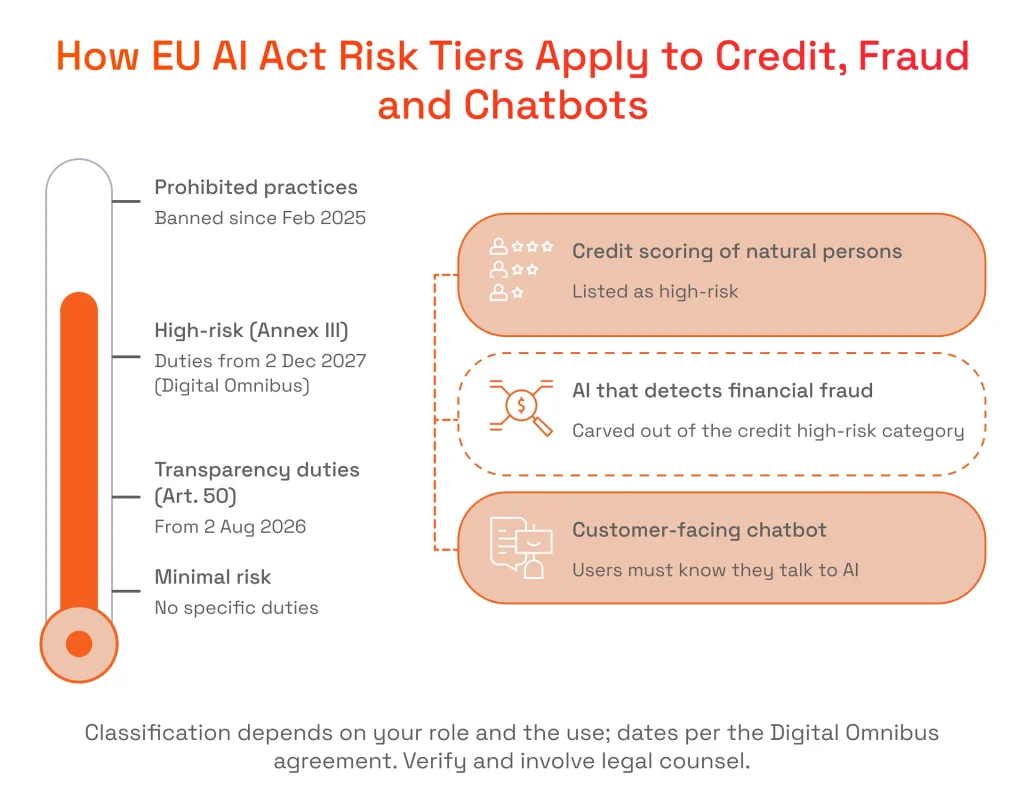
Classification depends on the system’s role and use, so involve legal counsel before fixing a tier. The tier also shapes architecture early in fintech software development, where logging and oversight cost far less to design in than to retrofit.
How Do NIST AI RMF Functions Translate Into Team Responsibilities?
The NIST AI RMF is voluntary, and its practical value is giving each team a clear lane. Govern belongs to leadership and the AI governance committee, who set policy, risk appetite and approval authority. Map belongs to product and risk teams, who document the use-case context, affected stakeholders and potential impacts before anything is built.
Measure is engineering and data science work: evals, bias tests and adversarial robustness checks, all run against agreed thresholds. Manage belongs to operations and risk, who triage issues, apply mitigations, run ongoing monitoring and respond to incidents. For generative systems, the Generative AI Profile applies the same AI RMF structure.
How Do You Build an AI Governance Framework Step by Step?
Building an AI governance framework takes six steps: inventory every AI system, classify each by risk, assign owners and a decision forum, write policies that map to controls, set approval and escalation paths, and monitor with evidence. Enterprise AI governance often breaks at the first step, because a system nobody registered never reaches the other five.
- Inventory. Register vendor models, SaaS features with AI and internal agents alongside in-house AI models. For each system, record the foundation model underneath, because governing production AI built on foundation models starts with that record. Model origin matters too: the trade-offs between Western vs Chinese open-weight models affect hosting, licensing and third-party review.
- Risk tiering. High covers credit, fraud actions and customer-facing advice; medium covers internal decision support; low covers drafting and search.
- Owners and a forum. Each system gets a business owner, and an AI governance committee brings risk, legal, security, data and engineering together.
- Policy. Write the AI governance policy so that every clause names the control that enforces it.
- Approval gates. Set gates per tier and an escalation path that names who can stop a system.
- Monitoring. Production monitoring, incident response plans and periodic audits keep the register accurate as systems change.
Who Owns What in AI Governance?
Ownership gaps surface during incidents, when nobody is sure who may stop a system. The matrix assigns each recurring activity before that question comes up.
Activity | Business owner | Engineering / data | Risk and compliance | Legal | Security |
|---|---|---|---|---|---|
Register and classify a use case | A | R | C | C | I |
Approve a high-risk release | A | R | C (sign-off) | C | C |
Run evals and bias tests | I | R/A | C | I | I |
Data access and retention rules | C | R | C | C | A |
Incident response and stop decision | A | R | C | C | R |
Activity
Register and classify a use case
Approve a high-risk release
Run evals and bias tests
Data access and retention rules
Incident response and stop decision
Business owner
A
A
I
C
A
Engineering / data
R
R
R/A
R
R
Risk and compliance
C
C (sign-off)
C
C
C
Legal
C
C
I
C
C
Security
I
C
I
A
R
R = Responsible (does the work), A = Accountable (owns the outcome), C = Consulted, I = Informed.
Which Controls Apply Across the AI Lifecycle?
AI model governance follows a system across the AI lifecycle, from its first dataset to its retirement.
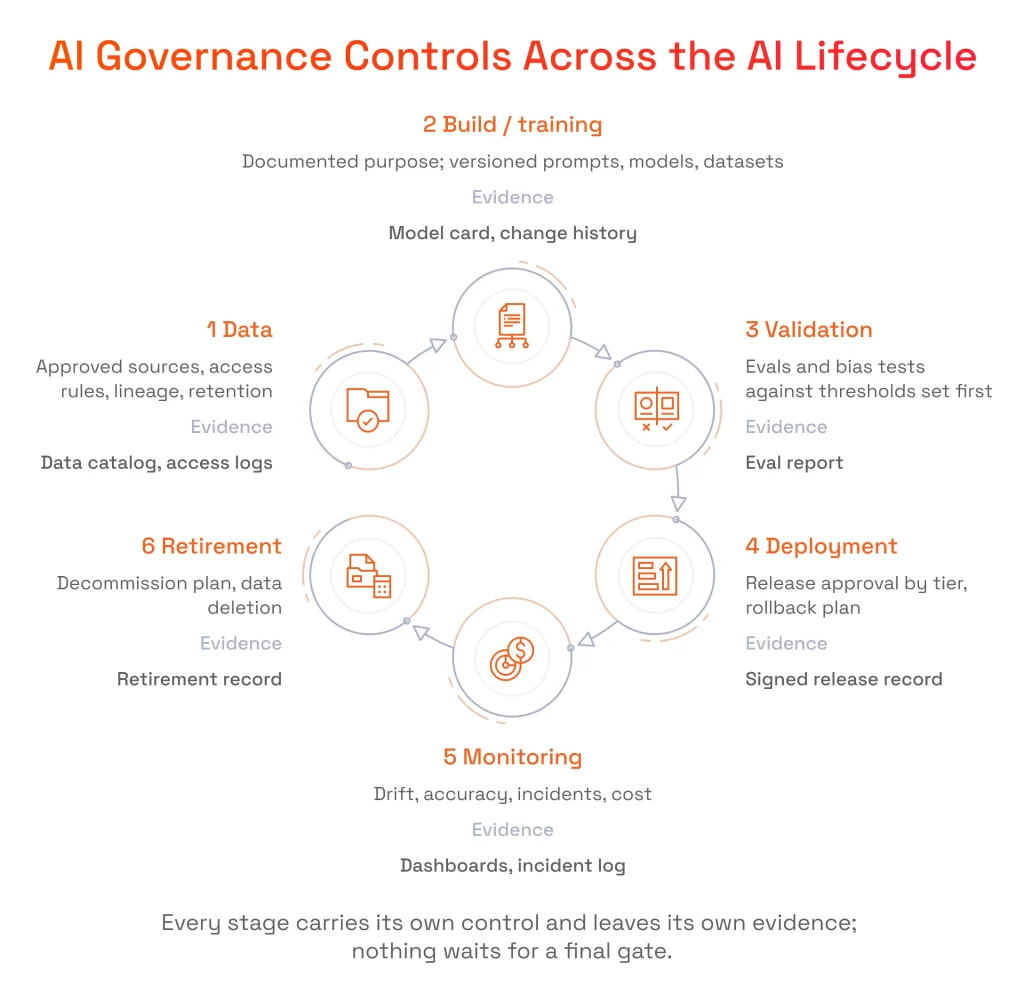
Every stage needs a control with a record behind it; the evidence column lists what an auditor will ask to see.
Stage | Control | Evidence |
|---|---|---|
Data | Approved sources, access rules, lineage, retention | Data catalog entries, access logs |
Build / training | Documented purpose, versioned prompts, models and datasets | Model card, change history |
Validation | Evals and bias tests against thresholds set before testing | Eval report |
Deployment | Release approval by tier, rollback plan | Signed release record |
Monitoring | Drift, accuracy, incidents, cost | Dashboards, incident log |
Retirement | Decommission plan, data deletion | Retirement record |
Stage
Data
Build / training
Validation
Deployment
Monitoring
Retirement
Control
Approved sources, access rules, lineage, retention
Documented purpose, versioned prompts, models and datasets
Evals and bias tests against thresholds set before testing
Release approval by tier, rollback plan
Drift, accuracy, incidents, cost
Decommission plan, data deletion
Evidence
Data catalog entries, access logs
Model card, change history
Eval report
Signed release record
Dashboards, incident log
Retirement record
The Data row depends on a data strategy that settles sources, lineage and retention before any model consumes the data. The Monitoring row is MLOps work, with drift tracking, incident logging and versioned rollbacks wired into the deployment pipeline.
Before a release gate, check the system against our AI production-ready checklist.
How Do You Govern Generative AI and AI Agents?
Generative AI governance deals with output risks such as hallucination, data leakage and prompt injection. Teams building AI agents for production also face action risks: tool misuse, unauthorized transactions and compromised integrations. AI agent governance therefore controls what an agent can do as well as what it can say.
Those controls have to scale with each agent’s autonomy and access. Gartner’s May 2026 forecast expects that by 2027, 40% of enterprises will demote or decommission autonomous AI agents because of governance failures, and warns that uniform governance across all agents leads to failure. Agentic AI governance works when an agent that summarizes documents and an agent that initiates payments follow different rules.
Those rules are enforced in the agent harness, the code around the model that holds permissions, limits, approvals and logs. Agent harness engineering makes each rule testable. At runtime, guardrails for AI engineering enforce input, output and action limits, since a guardrail that exists only in a policy document enforces nothing. Autonomy is then assigned by zone, starting with human-in-the-loop control for the highest-impact actions.
- Always human-led zones cover credit decisions, payments and personal-data changes.
- In AI-assisted, human-verified zones, the agent drafts or recommends and a person confirms before anything takes effect.
- Automated, machine-verified zones handle low-impact tasks where automated checks confirm each result.
Matching every action to its zone is calibrated autonomy, and the zone assignment belongs in the AI register next to the agent’s tool list. Data access is where the order of controls matters most.

Serhii Leleko
AI & ML Engineer at SPD Technology
“When the access checks are run on the generated answer, the restricted paragraph has already been in the model’s context and nothing downstream can take it out again. Permissions have to be applied at retrieval, based on the identity of the person making the request, and every request must log both what was filtered and what was returned.”
The table maps each generative and agent risk to the control that addresses it and the record that proves the control ran.
Generative AI and agent risks, controls and evidence
Risk | Control | Evidence |
|---|---|---|
Hallucinated answer | Grounding in approved sources with citations; refusal when sources are missing; output evaluation | Eval scores; citation logs |
Data leakage | Permission-aware retrieval; PII masking; approved hosting | Access logs; per-request record |
Prompt injection | Input filtering; untrusted-content handling; least-privilege tools | Red-team results; blocked-input logs |
Unauthorized action | Tool allow-lists, amount limits, approval gates | Approval records; trajectory traces |
Wrong path to a right answer | Trajectory evaluation of steps and tool calls | Trace reviews per release |
Compromised tool or MCP server | Vetted integrations, version pinning, supply-chain review | Integration register |
Agent memory retention | Retention and deletion rules for stored context | Retention policy; deletion logs |
Risk
Hallucinated answer
Data leakage
Prompt injection
Unauthorized action
Wrong path to a right answer
Compromised tool or MCP server
Agent memory retention
Control
Grounding in approved sources with citations; refusal when sources are missing; output evaluation
Permission-aware retrieval; PII masking; approved hosting
Input filtering; untrusted-content handling; least-privilege tools
Tool allow-lists, amount limits, approval gates
Trajectory evaluation of steps and tool calls
Vetted integrations, version pinning, supply-chain review
Retention and deletion rules for stored context
Evidence
Eval scores; citation logs
Access logs; per-request record
Red-team results; blocked-input logs
Approval records; trajectory traces
Trace reviews per release
Integration register
Retention policy; deletion logs
Output evaluation checks whether a result was correct and compliant. Trajectory evaluation checks whether the agent took allowed steps and tool calls on the way there. Hallucination controls start with understanding why LLMs hallucinate. Grounding through a RAG pipeline then supplies the citations the evidence column depends on.
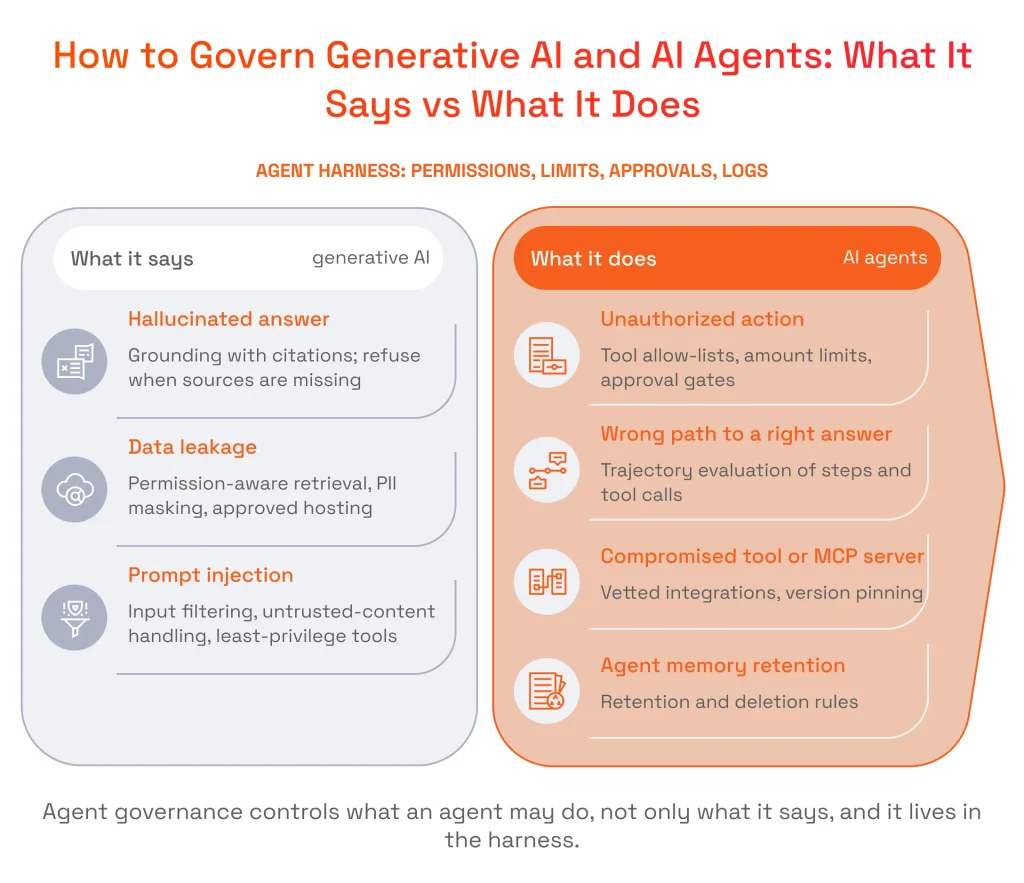
MCP standardizes how agents connect to tools, but permission for each action still has to come from the harness. The FINOS AI Governance Framework v3 lists MCP server compromise among agentic risks, which puts integration vetting next to the AI security risks your security team already reviews. In agentic AI development, these controls belong in the first sprint, before the agent touches a live system.
To set release thresholds for agents, see how to evaluate AI agents before production.
What Does an AI Governance Maturity Model Look Like?
An AI governance maturity model usually has four levels: ad hoc, defined, managed and optimized. The test of each level is what you can show an auditor, and many organizations sit lower than their policy documents suggest.
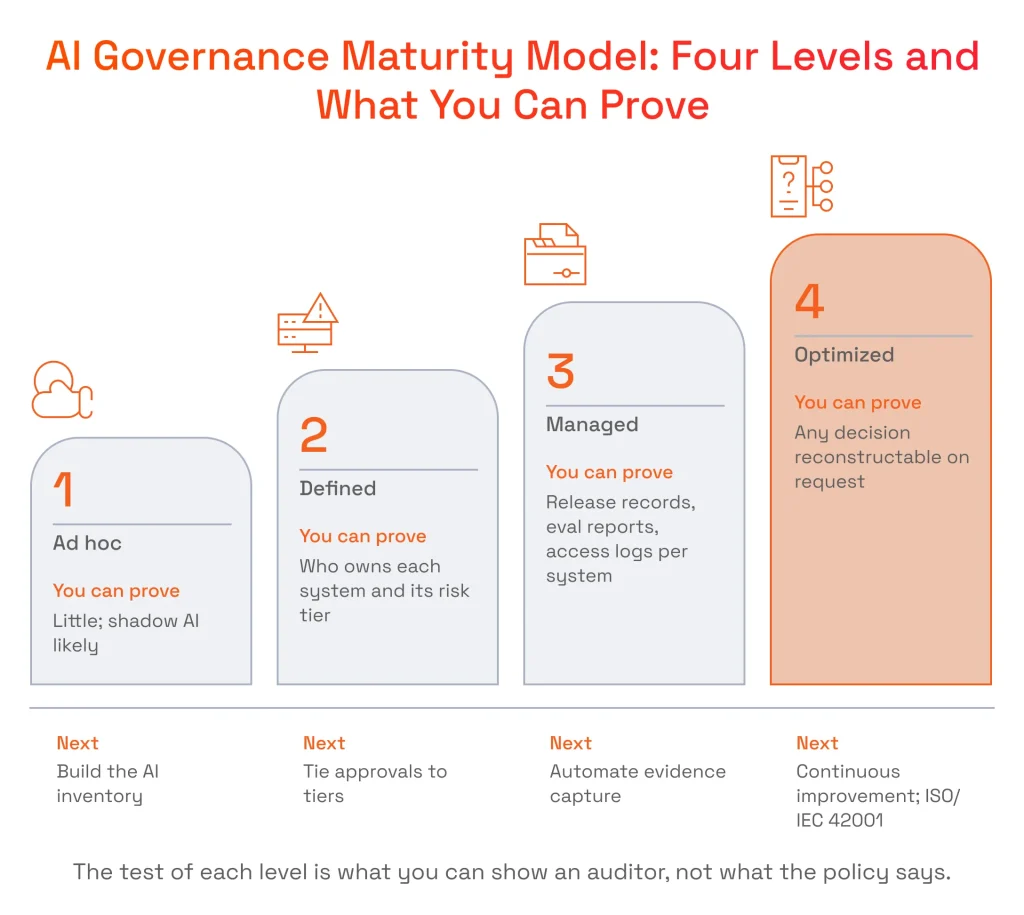
A McKinsey survey on the state of AI trust in 2026 covered about 500 organizations and found average responsible AI maturity rising to 2.3 from 2.0. Even so, only about 30% reach level 3 or higher in strategy, governance and agentic AI controls. The managed level is where evidence first exists per system, which makes it a realistic target for regulated teams.
Level | What exists | What you can prove | Typical next step |
|---|---|---|---|
1. Ad hoc | Teams use AI without a register; policy in draft | Little; shadow AI likely | Build the AI inventory |
2. Defined | Register, risk tiers, policy, named owners | Who owns each system and its tier | Tie approvals to tiers |
3. Managed | Approval gates, evals before release, access controls, monitoring | Release records, eval reports, access logs per system | Automate evidence capture |
4. Optimized | Evidence produced automatically on every release; agents governed with permissions and traces; regular review | Any decision reconstructable on request | Continuous improvement, external certification (e.g., ISO/IEC 42001) |
Level
1. Ad hoc
2. Defined
3. Managed
4. Optimized
What exists
Teams use AI without a register; policy in draft
Register, risk tiers, policy, named owners
Approval gates, evals before release, access controls, monitoring
Evidence produced automatically on every release; agents governed with permissions and traces; regular review
What you can prove
Little; shadow AI likely
Who owns each system and its tier
Release records, eval reports, access logs per system
Any decision reconstructable on request
Typical next step
Build the AI inventory
Tie approvals to tiers
Automate evidence capture
Continuous improvement, external certification (e.g., ISO/IEC 42001)
What Are the Most Common AI Governance Mistakes and Best Practices?
AI governance most often fails in two ways: policies that nothing enforces, and governance that starts after the system is built. The AI governance best practices below pair each common mistake with an auditable fix. Most of these fixes cost less at use-case intake than after launch.
Common mistake | Best practice |
|---|---|
Policy without enforcement | Each policy clause names the control and the evidence it produces |
Governance as a late-stage gate | Classify and set controls at use-case intake, before build |
No inventory | Keep a living AI register, including vendor and SaaS AI |
One-off validation or audit | Re-run evals after every model, prompt or data change |
Same controls for every use case | Scale controls to risk tier |
Governing outputs while agent actions go unchecked | Tool permissions, approval gates and trajectory checks |
Treating vendor AI as out of scope | Third-party AI in the register and under DORA / third-party risk review |
Common mistake
Policy without enforcement
Governance as a late-stage gate
No inventory
One-off validation or audit
Same controls for every use case
Governing outputs while agent actions go unchecked
Treating vendor AI as out of scope
Best practice
Each policy clause names the control and the evidence it produces
Classify and set controls at use-case intake, before build
Keep a living AI register, including vendor and SaaS AI
Re-run evals after every model, prompt or data change
Scale controls to risk tier
Tool permissions, approval gates and trajectory checks
Third-party AI in the register and under DORA / third-party risk review
When Do You Need AI Governance Tooling or Outside Help?
AI governance is mostly operating model and engineering work. A platform helps once you run more AI systems than a spreadsheet can track. Outside help pays off when controls must be built into data and AI systems quickly or a regulatory deadline is fixed. For enterprise AI governance, the work splits into two parts:
- An AI governance platform covers the register, approval workflows and evidence collection.
- Engineering builds permission-aware data access, evals and agent controls inside your own systems, and the platform then records them.
AI consulting helps when inventory and tiering need an outside view. Scoping gets easier once you know how an AI engineering engagement starts, and budget planning depends on the factors behind AI development cost for each system in scope.
If you bring in a partner, use these criteria for choosing an AI engineering partner.
Why Partner With SPD Technology for AI Governance?
SPD Technology engineers the controls AI governance depends on: access rules in the data layer, evals before release, approval gates for high-impact actions and an audit record for every decision, so governance is enforced in the system itself.
That work starts with AI data governance, since every later control assumes you know which data a model may touch. Since 2006, our 650+ specialists have delivered 460+ projects, including for regulated financial companies such as Morningstar and Blackhawk Network.
Onboarding time for the Blackhawk Network merchant portal went from 7 days to under 24 hours once OFAC, EIN and SSN checks ran as part of registration, and over two years the portal onboarded more than 8,000 US businesses. For Morningstar, SPD Technology built an AI/ML web crawler with a validation module that runs data through 150+ business rules before anyone uses it, cutting data storage costs 10× and analysis time from days to hours.
We built AI Incident Pilot for a US fintech and payments SaaS platform. The agent investigates incidents and proposes a PR-ready fix, and a human decides whether it gets merged. Time to a PR-ready fix dropped from 60+ minutes to under 30 minutes, with up to 70% of incidents resolved autonomously.
An AI that investigates production incidents could also change production. That is why, in the automation pipelines we built for a US ticketing platform, AI investigates incidents read-only while humans decide and act. SPD Technology’s information security management system, which covers how we handle client data, personal data and source code, is certified to ISO/IEC 27001:2022 by TÜV NORD.
The mechanism is the same across projects. Calibrated autonomy keeps money, personal data and architecture human-led, and every release ships with an evidence package covering the change, the tests, the security checks, the sign-off and the rollback. Knowledge access runs through governed enterprise RAG, where permissions are applied before the model sees a document and every request records who asked, what was allowed, what was retrieved and what was answered. That is governance that survives production.
Conclusion
An AI governance framework is policies, enforced controls and the evidence those controls leave, working as one system. Regulated companies should map it to the EU AI Act, the NIST AI RMF, ISO/IEC 42001 and their sector rules as they stand in November 2026. AI agents need action controls on top of output controls, because their risk lies in what they do. The practical test is the same for every system: can any AI decision be reconstructed for an auditor on request?
Key Takeaways
- An AI governance framework reduces risk only when each principle is enforced as a control in data and AI systems, because policies that nothing enforces leave no evidence for auditors.
- An inventory of every AI system, including vendor and SaaS AI, comes first, because unregistered AI cannot be classified, approved or monitored.
- Scaling controls to risk tier keeps low-risk AI moving and concentrates approvals, evals and human oversight on credit, fraud and customer-facing decisions.
- The EU AI Act’s Annex III high-risk obligations apply from 2 December 2027, while Article 50 transparency duties have applied since August 2026, so customer-facing AI needs disclosure controls now.
- SR 26-2 replaced SR 11-7 in April 2026 and excludes generative and agentic AI from its scope, leaving banks to govern those systems through their own controls.
- AI agents add action risk to output risk, so agent governance needs tool permissions, approval gates and trajectory evaluation in addition to output checks.
- At the managed maturity level, every release produces an approval record, an eval report and access logs.
In short: AI governance works when an auditor can trace any AI decision back to the control that enabled it and the evidence that control produced.
FAQ
What is AI governance in simple terms?
AI governance is how a company decides which AI it may use, who approves it, how it is checked and who is accountable when something goes wrong. It combines written policies, named owners, technical controls such as access rules and evals, and records that show each control ran.
In regulated firms, these pieces map to laws such as the EU AI Act and to sector rules. Together, they support the responsible use of AI and let the company answer a regulator’s question about any system with evidence.
What are the pillars of an AI governance framework?
The AI governance framework pillars are fairness, transparency and explainability, accountability, privacy and security, and human oversight. Reliability is often added as a sixth.
Each pillar needs an enforced control that leaves evidence, such as bias tests for fairness and decision logs for transparency. Accountability rests on named approvers, privacy on access rules applied before data reaches the model, and human oversight on approval gates for high-impact actions.
How do the EU AI Act and the NIST AI RMF differ?
The EU AI Act is binding EU law with risk-tiered duties and penalties. The NIST AI RMF is a voluntary US framework built on four functions: Govern, Map, Measure and Manage. The AI Act sets what must be documented, logged and proven for AI systems used in the EU, while NIST describes how to organize the work across teams. Many companies structure their program with NIST and use the AI Act to define the evidence their EU systems must produce.
Who is responsible for AI governance in a company?
Accountability sits with the business owner of each AI system, supported by a committee with risk, compliance, legal, security, data and engineering.
- Engineering runs evals and implements controls, and risk signs off high-risk releases.
- Security owns data access and the incident response process around each system.
- Leadership sets the risk appetite that decides which use cases are acceptable and how much autonomy each system receives.
How do you govern AI agents and generative AI?
Generative AI needs output controls such as grounding in approved sources with citations, PII masking, prompt injection defenses and output evaluation. AI agent governance adds action controls, including tool allow-lists, amount limits, human approval for high-impact actions, trajectory evaluation and trace logs. Agent memory and MCP servers also belong in the AI register, with retention rules for stored context and a supply-chain review for every integration.
Does SR 11-7 still apply to AI models in banks?
No. On 17 April 2026, the Federal Reserve, OCC and FDIC replaced SR 11-7 with SR 26-2, issued alongside OCC Bulletin 2026-13 and the FDIC’s parallel guidance.
Core expectations for model development, validation, monitoring and governance remain in place. The guidance also states that generative and agentic AI fall outside its scope, so banks govern those systems through broader risk management, their own AI controls and third-party risk management.
How long does it take to implement an AI governance framework?
The timeline follows the maturity levels.
- Reaching the defined level, with an inventory, risk tiers, owners and policy, is the first milestone and is mostly organizational work.
- Reaching the managed level requires approval gates, evals and access controls wired into each high-risk system.
The effort scales with the number of high-risk systems and the state of existing data governance. For EU credit-scoring systems, plan back from the fixed Annex III date of 2 December 2027.
How much does it cost to implement an AI governance framework?
Cost is driven by scope and starting point. The main drivers are the number of AI systems in the inventory and how many sit in the high-risk tier. Existing data access and lineage controls lower the engineering effort, while missing controls raise it. Automated evidence capture costs more upfront and less per release afterward. A licensed governance platform, if you choose one, adds a separate line on top of the engineering work inside your data and AI systems.