

AI in customer service combines conversational interfaces, predictive analytics, intelligent routing, and workflow automation to improve how businesses support customers. It helps organizations resolve inquiries faster, personalize interactions, and manage growing support volumes. When implemented effectively, AI can reduce first response times by 37% while improving customer satisfaction and operational efficiency.
Do your customers feel truly heard? Nowadays, customer expectations are rising, and consumer patience wears thin. They expect instant personalized service. Today, 71% of customers anticipate tailored interactions from companies, raising the bar for every support experience. Your service teams often struggle, stretched to their limits, as they try to keep up with this constant demand and deliver a consistent customer experience. It’s a tough spot for any business aiming to grow.
Traditional customer service models just aren’t built for this kind of pressure. Relying solely on human agents can lead to slow response times, high costs, and declining service quality. Burnout becomes a real threat, especially when a business expands quickly. This model simply can’t scale efficiently when customer interactions surge, harming the overall customer service experience.
AI in customer support is no longer about rigid script-following chatbots. Instead, AI technology serves as an intelligent layer that offers real-time support throughout the entire customer journey. Furthermore, it reveals key insights that drive overall business growth.
The conversation is shifting. AI is turning customer service from a cost center into a growth engine. This article unpacks that transformation by examining how AI is changing customer service, how it has evolved, and the tangible business impact, illustrated with examples.
Why Using AI in Customer Service Is No Longer Optional
Customer service. It’s often seen as a necessary cost, a department that handles complaints and fixes issues. But what if that perspective is costing you more than you think? Rethinking this model starts with understanding the use of AI in customer service as a growth lever.
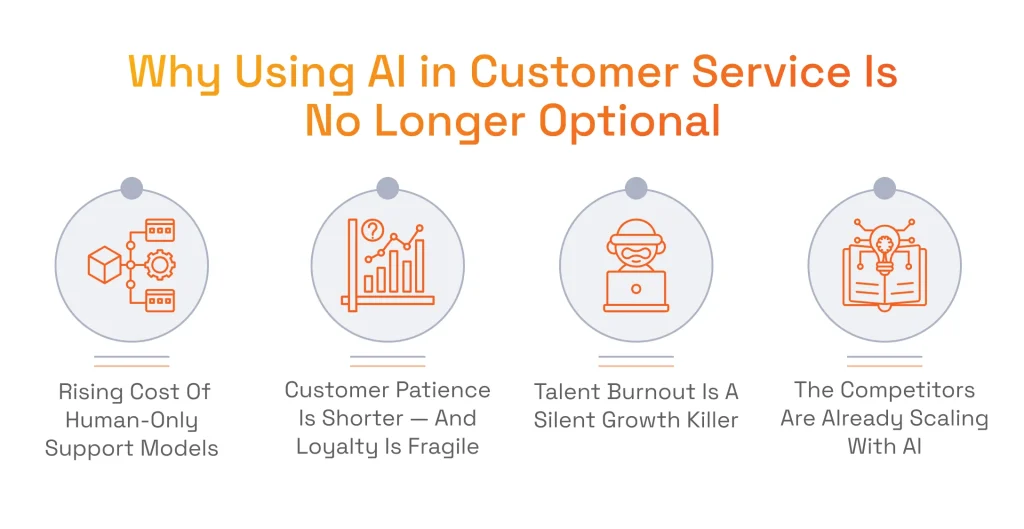
For many businesses, relying heavily on a human-only customer service model presents a growing financial burden. Every phone call, every email, and every customer service interaction in contact centers requires human hours, training, and management. As your customer base grows, so do the costs of the customer experience, which creates a direct, often painful, correlation between your success and your operational spending.

Serhii Leleko
AI&ML Engineer at SPD Technology
“The core issue isn’t just human cost, it’s about the exponential growth of that cost. As your business scales, service expenses can quickly spiral out of control. The goal is to design scalable architectures that decouple growth from your spending.”
Beyond the immediate budget, there’s the escalating issue of customer patience. In today’s always-on world, people expect immediate answers and quick resolutions. Gone are the days of waiting on hold for ten minutes or sending an email and expecting a reply the next day. If one can’t get their customer needs addressed quickly, they simply take their business elsewhere. Loyalty, once given, now has to be earned with every interaction.
Then, consider the human element of your customer service team. Your agents face immense pressure. They field repetitive customer queries, deal with frustrated customers, and navigate strict performance metrics. Losing experienced agents silently undermines your growth potential. Implementing AI for customer service, in turn, can alleviate the pressure on your agents.
Your competitors aren’t waiting around, adding to the pressure. Many have already begun integrating AI into their customer service operations to keep pace with rising customer demand. They handle customer queries 24/7, scale their support during peak periods, and resolve issues quickly and efficiently. Understanding the benefits of AI in customer service is the first step toward closing the gap.
Companies achieve cost reductions while simultaneously boosting customer satisfaction and widening a gap that could leave traditional models struggling to keep up. Many businesses find navigating this shift easier by considering the advantages of strategic technology consulting.
Modern conversational AI solutions aren’t just basic chatbots but responsive systems that improve every touchpoint. Natural language processing and machine learning help effectively manage common customer inquiries. By utilizing natural language processing (NLP), these intelligent chatbots understand context and interpret intent, allowing them to resolve routine inquiries without human intervention. Chatbots can answer frequently asked questions, assist with basic troubleshooting, and guide customers through simple transactions, such as order tracking or account updates.
AI-powered systems offer 24/7 availability. Also, AI brings unparalleled scalability. Human teams in contact centers can realistically manage only a limited number of interactions at once. AI agents, conversely, handle thousands simultaneously.
Automation frees your customer service agents to focus on more complex issues that truly require human empathy and problem-solving skills. Giving agents this freedom improves their productivity and allows them to focus on building real human connections. This capability gets to the core of how AI can be used in customer service: to automate routine tasks and free up human expertise.
As customer expectations rise and support volumes increase, organizations are rethinking traditional service models. The following table highlights the key differences between human-only customer service operations and AI-powered support environments across availability, scalability, responsiveness, and business impact.
Capability | Traditional Customer Service | AI-Powered Customer Service |
|---|---|---|
Availability | Limited by business hours and staffing levels | Available 24/7 |
Scalability | Requires additional hiring and training | Handles large volumes of interactions simultaneously |
Response speed | Dependent on queue length and agent availability | Near-instant responses for routine inquiries |
Personalization | Varies by agent knowledge and experience | Delivers data-driven personalization at scale |
Cost structure | Costs increase as support volumes grow | Supports growth with lower incremental costs |
Customer insights | Limited visibility into interaction trends | Analyzes large volumes of customer interactions |
Issue resolution | Primarily human-driven | AI-assisted or automated for routine requests |
Capability
Availability
Scalability
Response speed
Personalization
Cost structure
Customer insights
Issue resolution
Traditional Customer Service
Limited by business hours and staffing levels
Requires additional hiring and training
Dependent on queue length and agent availability
Varies by agent knowledge and experience
Costs increase as support volumes grow
Limited visibility into interaction trends
Primarily human-driven
AI-Powered Customer Service
Available 24/7
Handles large volumes of interactions simultaneously
Near-instant responses for routine inquiries
Delivers data-driven personalization at scale
Supports growth with lower incremental costs
Analyzes large volumes of customer interactions
AI-assisted or automated for routine requests
In such a way, we transform the human role from resolving repetitive tickets to managing high-value customer interactions. Instead of being a support worker, the agent becomes a relationship manager, using AI-powered customer service tools to handle the ‘what’ while focusing on the ‘how’ and ‘why’ of the customer relationship.
These AI-driven systems collect extensive customer data from every interaction. In fact, they can analyze up to 100% of customer interactions to assess performance, ensure compliance, and identify areas for agent coaching, while also capturing common questions, preferences, past behavior, and recurring pain points. Analyzing this data provides deep insights into customer behavior. You can then use predictive analytics to refine your services and continually improve customer support processes.
Curious how AI can decipher customer behavior for business gains?
Find out more in our piece on AI for customer behavior analysis.
From Scripts to Intelligence: The Transformation of AI in Customer Service
Remember those early chatbots? The ones that could answer exactly five pre-programmed questions, and if your query deviated, you hit a dead end? The role of AI in customer service has come a very long way from those simple scripts.
In 2025, AI operates as a sophisticated layer of intelligence woven into every customer touchpoint. It supports customers directly, empowers your human agents, and connects disparate systems to deliver experiences that are fast, deeply personalized, and even predict needs before they arise. Modern artificial intelligence and customer service work together to create truly personalized interactions.
Serhii Leleko
AI&ML Engineer at SPD Technology
“From a development perspective, the real leap isn’t just natural language processing. It’s about building models that infer user intent, anticipate next steps, and integrate with backend systems for real action.”
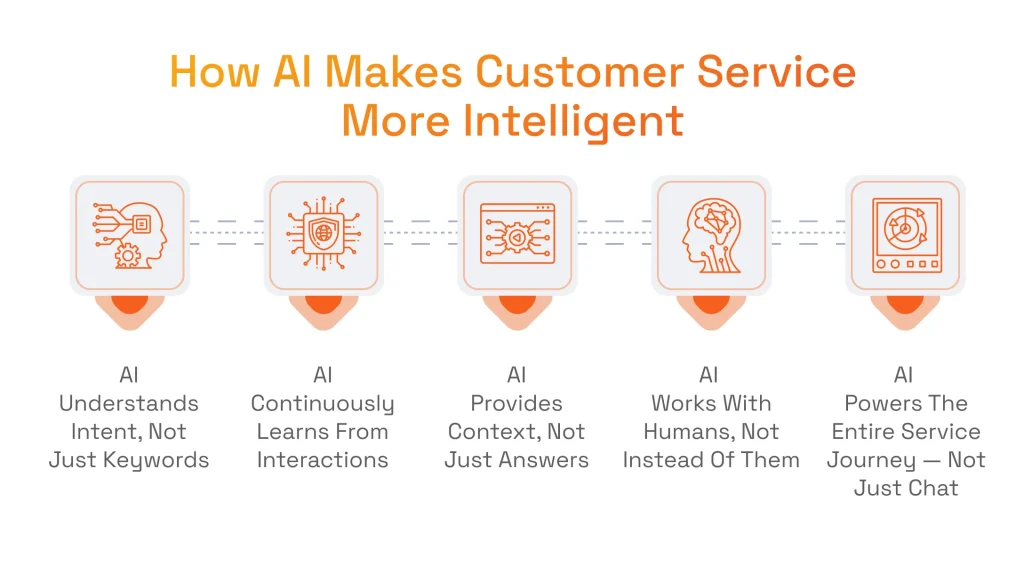
The core difference lies in understanding. Old systems listened for keywords. Modern AI understands intent, not just keywords. When a customer types “My card isn’t working,” AI doesn’t just search for “card” or “working.” It identifies the underlying problem, such as a payment issue, a frozen account, or perhaps a fraud alert. In such a way, it offers truly relevant help rather than a list of generic FAQs. This deep understanding is a key feature of advanced machine learning in banking systems that personalize interactions.
Beyond understanding, today’s generative AI is built to improve. It continuously learns from interactions. Every customer conversation, every resolved issue, and every piece of customer feedback becomes data that refines its knowledge and response capabilities. This constant learning loop means the system gets smarter over time and better at adapting to new questions and emerging trends in customer behavior.
Modern AI provides context, not just answers. Imagine a customer chatting about a recent order. An intelligent generative AI solution won’t just pull up the order number. It will also know their purchase history, previous support interactions, and preferred contact methods to ensure conversations flow naturally.Perhaps the most important shift in how AI in customer service works is its collaboration with humans, not their replacement. Far from replacing your team, AI enhances human interaction as a powerful assistant. It handles routine inquiries, summarizes lengthy call transcripts, and even suggests responses to agents in real time. This partnership between customer service and AI frees your human agents from mundane tasks, allowing them to focus on situations that need a human touch. AI tools also act as digital co-pilots that suggest relevant knowledge base articles, draft email responses, and provide real-time recommendations to help agents solve problems faster.
AI powers the entire service journey, and it isn’t just chat. Think beyond a simple chatbot window. AI can route calls intelligently, analyze sentiment in real time, personalize website experiences, and even proactively reach out to customers based on predicted needs. More than a tool, AI in customer service becomes the connective tissue for a more cohesive service experience across all channels from initial inquiry to post-resolution follow-up.
Modern customer service AI relies on multiple technologies working together rather than a single chatbot or automation tool. The table below outlines the core AI technologies behind intelligent customer support and the role each plays in improving service delivery.
Technology | Primary Function | Customer Service Example |
|---|---|---|
Natural language processing (NLP) | Understands customer intent and context | Chatbots and virtual assistants |
Machine learning (ML) | Learns from interactions and improves performance | Improved response accuracy over time |
Generative AI | Creates contextual and personalized responses | Conversational support and content generation |
Sentiment analysis | Detects customer emotions and intent | Escalating frustrated customers to agents |
Predictive analytics | Anticipates customer needs and behaviors | Proactive support notifications |
Voice AI | Processes and responds to spoken requests | Intelligent call automation and voicebots |
Technology
Natural language processing (NLP)
Machine learning (ML)
Generative AI
Sentiment analysis
Predictive analytics
Voice AI
Primary Function
Understands customer intent and context
Learns from interactions and improves performance
Creates contextual and personalized responses
Detects customer emotions and intent
Anticipates customer needs and behaviors
Processes and responds to spoken requests
Customer Service Example
Chatbots and virtual assistants
Improved response accuracy over time
Conversational support and content generation
Escalating frustrated customers to agents
Proactive support notifications
Intelligent call automation and voicebots
For example, we built a high-load AI chatbot for an online fashion retailer. It uses a LangChain backbone to orchestrate large language models and data embeddings for question answering. This enabled 99% of queries to be processed within 10 seconds, with 100% uptime during peak hours of 30 requests per second, significantly improving their customer service efficiency.

Artificial intelligence in customer support no longer functions merely as a tool; it has become a strategic asset. Intelligence doesn’t just make support more efficient; it transforms it into a strategic asset that delivers concrete business outcomes. This is the modern reality of AI and customer service.
Using AI for Customer Service: The Business Impact of the Transformation
The theory behind AI in customer service is compelling, but what about the numbers? For decision-makers, the real question boils down to return on investment. The results from companies already deploying AI speak for themselves. We aren’t discussing incremental improvements — we’re talking about real numbers of the very economics of customer support, including reducing cost through automation.

The ROI of using AI for customer service is clear when you examine key performance metrics. Businesses that adopt AI see a 37% reduction in first response time. Responding to a customer almost instantly makes a difference. That quick initial touch can calm frustrations and set the stage for a positive interaction. Beyond that, the time it takes to resolve an issue entirely drops by 52%. Imagine cutting the resolution time in half. That means happier customers, fewer follow-ups, and a more efficient operation overall.
Then there’s the direct impact on your bottom line. Routine tasks, which often consume a large portion of your team’s time, see an astounding 90% reduction in labor costs when handled by generative AI. This isn’t about eliminating jobs; it’s about redirecting human talent to more value-adding activities.
Better service doesn’t just mean cost savings. It directly influences customer happiness and even revenue. Companies report a 15-20% increase in customer satisfaction after implementing AI. This metric highlights the positive correlation between artificial intelligence and customer satisfaction. AI enables tailored solutions for individual customer needs, providing personalized recommendations and self-service options. Satisfied customers are loyal customers who are more likely to recommend your business. In a compelling twist, some customer service operations using AI even see a 32% increase in revenue. The link between customer service and artificial intelligence here is clear: better experiences lead to more sales.
Beyond the standard speed metrics, decision-makers should track self-service adoption rates and agent productivity gains. These KPIs offer a more granular view of how AI-driven systems are maturing within the organization, proving that success isn’t just about answering faster, but about resolving smarter.
As we can see, a well-managed service experience can become a growth driver, not just a necessary expense. Businesses are using AI to do more than just cut expenses. They change their customer service departments into scalable engines for growth, directly contributing to their market leadership and profitability. This includes specialized areas, such as AI for retail, where efficiency gains are immediate.
The question isn’t whether AI can deliver these results, but when you’ll start seeing them in your operations.
Implementing AI in customer service requires more than deploying a chatbot. Successful initiatives align technology, processes, customer expectations, and business goals to ensure measurable results. The following checklist can help organizations prepare for a successful AI customer service implementation.
-
Define customer service objectives and success metrics
-
Identify repetitive inquiries suitable for automation
-
Assess existing customer data, knowledge bases, and support workflows
-
Select priority channels for AI deployment, such as chat, voice, email, or messaging platforms
-
Establish clear escalation paths to human agents
-
Review privacy, security, and compliance requirements
-
Integrate AI with CRM, support, and analytics platforms
-
Launch a pilot deployment with measurable KPIs
-
Monitor response quality, resolution rates, and customer satisfaction
-
Continuously refine models using customer interaction data and feedback
Artificial Intelligence in Customer Service: Cross-Industry Use Cases & Success Stories
When it comes to artificial intelligence in customer service, the business impact isn’t confined to a single sector. Its adaptable nature means companies across various industries are finding creative ways to deploy smart systems. Identifying which use cases will provide the most value for a specific business is a critical function of AI consulting services.
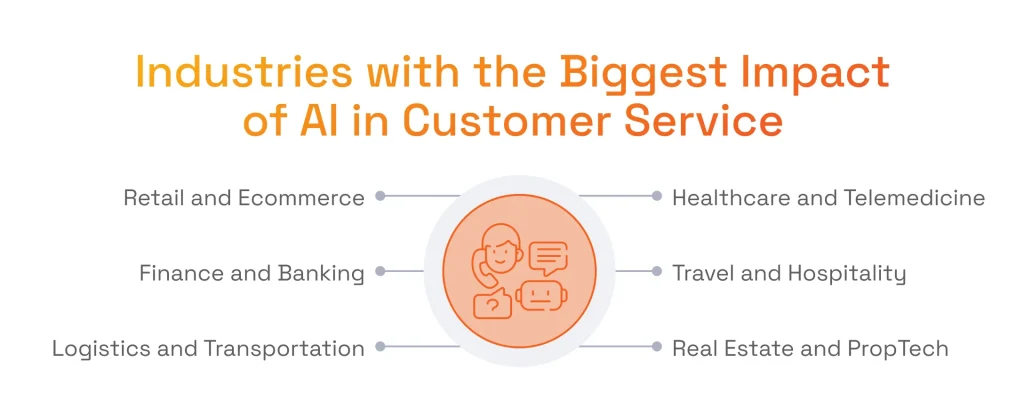
Retail and eCommerce
Customers today expect retailers to bridge their online and physical store experiences for accurate 360-degree service. If a customer buys something online, they still want the option to pick it up or return it in an offline store. Similarly, in-store shoppers appreciate being able to use chatbots online to address any issues that may arise later. Such clear customer sentiment indicates strong demand for flexible online and in-store services, which many brands address through retail software development.
Retail really went into digital. Companies are weaving technology into every part of the shopping and service cycle, supported by custom eCommerce development solutions that enable seamless omnichannel experiences. AI-powered customer service handles routine inquiries, processes returns, and offers personalized product recommendations based on browsing history and preferences. Automation frees up sales associates to focus on in-store customer engagement, leading to a more satisfying shopping journey.
Finance and Banking
In the financial sector, trust and accuracy are fundamental. Generative AI enhances customer service by providing secure, rapid responses to common banking queries. Chatbots can help with account balances, transaction histories, and even guide customers through loan applications or investment options. Using artificial intelligence for customer support in this way both secures accounts and streamlines legitimate interactions, especially when implemented via custom fintech solutions.
AI also plays a critical role in risk management, particularly in credit card fraud detection. It can analyze vast amounts of transaction data in real time to spot suspicious patterns and protect customer accounts. The need for high security, accuracy, and compliance in this sector often necessitates the development of custom AI solutions.
Logistics and Transportation
Logistics companies manage incredibly complex networks, often supported by logistics and supply chain development. AI in customer service helps them keep customers informed and resolve shipping issues efficiently. Automated systems improve service delivery by providing real-time tracking updates, estimated delivery times, and answers to customer queries about shipping.
The value of AI for the customer experience in logistics lies in its ability to deliver real-time information at scale. AI, combined with predictive analytics, enables proactive service by notifying customers of potential delays due to weather or unforeseen circumstances. Discover more in our thorough piece on how AI in logistics transforms operational efficiency.
Healthcare and Telemedicine
Healthcare providers are using AI to streamline patient interactions and improve access to information through healthcare software development. AI-powered virtual assistants can help patients schedule appointments, answer FAQs about common conditions, or guide them through prescription refill processes. In telemedicine, AI can triage symptoms, directing patients to the right specialist or suggesting immediate actions, thereby ensuring faster and more accurate preliminary support and reducing the administrative burden on medical staff.
Read more about the advancements of machine learning in healthcare and its impact on patient care.
Travel and Hospitality
The travel industry relies heavily on efficient customer interactions. AI assistants handle reservations, provide real-time flight status updates, answer questions about baggage policies, and even offer personalized dining recommendations.
Many travelers now expect artificial intelligence in customer service to handle these routine requests instantly. Instant support improves the traveler’s experience and makes trips more enjoyable, while allowing human agents to focus on complex or unexpected issues.
Real Estate and PropTech
The real estate sector, traditionally a manual industry, is adopting AI for more intelligent customer interactions. AI chatbots can answer questions about property listings or schedule viewings as part of real estate software solutions. In property management, AI can handle tenant inquiries about maintenance requests or rent payments, directing them to relevant resources or automatically initiating work orders as needed. Artificial intelligence in customer service streamlines communication and improves responsiveness for both prospective and current clients.
Organizations across industries use AI to address various customer service challenges, from managing high volumes of inquiries to delivering faster and more personalized support. While implementation approaches vary by sector, the underlying goal remains the same: improving customer experiences while increasing operational efficiency. The table below highlights common AI customer service applications and their business impact across industries.
Industry | AI Customer Service Application | Business Outcome |
|---|---|---|
Retail & eCommerce | Product recommendations, order support, and returns assistance | Improved customer experience and operational efficiency |
Banking & Finance | Account support, fraud alerts, and customer assistance | Faster and more secure customer service |
Logistics & Transportation | Shipment tracking and delivery updates | Greater transparency and customer satisfaction |
Healthcare & Telemedicine | Appointment scheduling and patient support | Reduced administrative workload |
Travel & Hospitality | Reservation management and travel assistance | Faster response times and improved guest experiences |
Real Estate & PropTech | Property inquiries and tenant support | Improved responsiveness and service quality |
Industry
Retail & eCommerce
Banking & Finance
Logistics & Transportation
Healthcare & Telemedicine
Travel & Hospitality
Real Estate & PropTech
AI Customer Service Application
Product recommendations, order support, and returns assistance
Account support, fraud alerts, and customer assistance
Shipment tracking and delivery updates
Appointment scheduling and patient support
Reservation management and travel assistance
Property inquiries and tenant support
Business Outcome
Improved customer experience and operational efficiency
Faster and more secure customer service
Greater transparency and customer satisfaction
Reduced administrative workload
Faster response times and improved guest experiences
Improved responsiveness and service quality
Success Stories of Using AI in Customer Support
AirHelp
As a service assisting airline passengers with flight issues, AirHelp faces a constant stream of messages from often-stressed customers. By deploying AI-generated customer support, AirHelp achieved a 65% improvement in average response time. Their AI monitors social media in 16 languages, acting as the first point of contact for thousands, filtering and prioritizing complex requests for human agents. This ensures that even anxious customers receive immediate attention.
Endeksa
This predictive real estate data analytics platform in Turkey, Spain, and Portugal faced overwhelming phone call volumes. By implementing customer service automation, Endeksa cut waiting times by an impressive 59% through smart routing and prioritization. Their chatbot achieved an 88% helpfulness rate, leading to an overall customer satisfaction increase of over 10% and a remarkable 138% increase in leads.
Suitor
This Australian suit rental company struggled with growing customer inquiries, even with a detailed FAQ section. By automating customer service with conversational AI, Suitor managed to automate a whopping 85% of its customer service. Their average response time dropped from 3 minutes to just 15 seconds for live chat and an incredible 6 seconds for the AI chatbot. On average, only 24% of queries now require transfer to a human agent.
What’s Next: Where AI in Customer Service Is Headed
We’ve seen how AI is already reshaping customer service, moving it from a reactive cost to a proactive asset. But what’s on the horizon? The evolution of artificial intelligence for customer interactions is far from over. Expect proactive support capabilities that blur the lines between human and machine interaction, creating experiences that feel increasingly intuitive and personal.

One significant step forward is emotion-aware AI. Future AI systems won’t just understand the words customers use but apply sentiment analysis to detect frustration, urgency, or even delight in their tone and phrasing. By using predictive analytics and AI-driven self-service tools, these systems will anticipate customer needs and proactively address concerns before they arise. An improved human-like understanding enables AI to adjust its responses accordingly. Building this capability is the next frontier for artificial intelligence for customer service.
This goes beyond mere word choice. GenAI capabilities now allow systems to deliver personalized service by adjusting their communication tone in real time. By analyzing customer history and current customer sentiment, the AI technology can pivot from a formal or technical tone to a more empathetic and conversational one, ensuring the human connection supports and reflects real customer emotions even in automated exchanges.
Conversations will become truly seamless across different platforms as context-aware conversations will span channels and time. A customer might start a query on your website chat, then switch to email, and later call your support line. Future AI systems will retain the full context of that interaction, including the complete customer history, regardless of the channel or how much time has passed. Customers won’t need to repeat themselves, leading to a truly effortless experience. AI will also reduce customer wait times by providing instant support, streamlining processes, and minimizing wait times for faster resolution.
Want to see how data-driven insights can predict future market needs?
Check out our article on AI demand forecasting.
We’re also moving towards multimodal AI that will support voice, text, and visual interaction. This includes advanced voicebots that replace rigid and frustrating phone menus with systems capable of understanding natural speech and emotion over the phone.
Imagine a customer holding up a broken part to their phone camera, and the AI instantly recognizes it, pulls up troubleshooting guides, or initiates a replacement order. AI will process and respond to queries that combine voice, text, and visual inputs, offering richer, more natural ways for customers to get help. This vision of integrated AI experience builds on core principles, including the advanced applications of machine learning in retail.
AI will also begin to orchestrate entire processes with end-to-end resolution workflows. Modern AI agents have evolved to the point where they can complete workflows end-to-end without any human intervention, moving beyond simply answering questions to fulfilling complex requests. When necessary, AI can escalate issues to human agents, ensuring that more complex or sensitive problems receive the appropriate attention.
Instead of just answering a question, AI will initiate and manage complete resolution paths. This could mean automatically processing a refund, dispatching a service technician, or updating multiple internal systems without human intervention. The goal is to move from simply responding to queries to fully resolving issues autonomously.
Customer support itself will become a strategic asset by evolving into a source of business intelligence. Every interaction, every problem solved, and every customer preference captured by AI will feed into a larger pool of data. AI-generated content, such as personalized responses, recommendations, and knowledge base articles, will support self-service and enhance customer engagement. This data won’t just improve service; it will uncover more profound insights into product flaws, service gaps, and unmet customer needs. Thus, it directly influences product development, marketing strategies, and overall business direction.
Unlocking this strategic value from customer interactions, of course, takes more than just plugging in a new chatbot or layering AI widgets over existing systems. It calls for a thoughtful AI and business intelligence implementation.
Aligning this with your data infrastructure, customer journey, and growth priorities makes a real difference. That’s precisely where experienced AI and BI development partners can make all the difference, helping you design not just smarter support but a more innovative organization and implement the right technology to improve customer service for your specific needs.
Key Takeaways
- AI-powered customer service automates routine inquiries, reducing response times and allowing human agents to focus on complex customer issues.
- Businesses that rely solely on human support teams face rising operational costs as customer volumes grow, while AI enables support operations to scale more efficiently.
- Modern AI systems understand customer intent and context, which improves resolution quality compared to keyword-based chatbots.
- AI provides 24/7 availability and can manage thousands of simultaneous interactions, reducing wait times during peak demand periods.
- Combining AI automation with human expertise improves customer experiences, while fully automated support can create frustration when complex situations require empathy or judgment.
- AI-powered support generates customer behavior insights that help organizations improve their products, services, and business decisions beyond customer service.
- Organizations that integrate AI with customer data, workflows, and business systems achieve stronger outcomes than those deploying standalone chatbot solutions.
In short: AI is transforming customer service from a reactive support function into a scalable business capability that improves customer experience, operational efficiency, and decision-making. The greatest value comes from combining intelligent automation with human expertise to deliver faster, more personalized, and more effective customer interactions.
FAQ
How much does implementing AI customer service cost compared to hiring human agents?
The cost of implementing AI customer service depends on the complexity of the solution, the number of supported channels, integration requirements, and the level of customization involved. Basic chatbot deployments may cost $10,000–$50,000, while enterprise-grade AI customer service platforms with CRM integrations, conversational AI, analytics, and multilingual support often range from $50,000–$300,000+.
Although the upfront investment can be significant, AI customer service systems can reduce operational costs by automating routine inquiries, providing 24/7 support, and enabling human agents to focus on more complex issues. For organizations with high support volumes, AI often becomes more cost-effective over time than continuously expanding customer service teams.
What are the most common customer complaints about AI-powered support systems?
The most common complaints involve inaccurate responses, difficulty reaching a human agent, lack of contextual understanding, and overly rigid conversation flows. Customers often become frustrated when AI repeatedly misunderstands requests or cannot resolve complex issues.
Many of these problems result from poor implementation rather than the technology itself. Organizations that provide clear escalation paths, continuously improve AI models, and use AI to support rather than replace human agents generally achieve higher customer satisfaction levels.
How long does it take to deploy an AI customer service system?
The deployment timeline depends on the scope of the project, data availability, integration complexity, and customization requirements. Basic AI customer service solutions can often be implemented within 1–3 months, while enterprise deployments involving multiple support channels, CRM systems, knowledge bases, and custom workflows typically require 3–9 months.
A significant portion of the timeline is usually spent preparing support content, training conversational models, integrating business systems, and testing customer interactions. Organizations that already maintain structured knowledge bases and well-documented support processes can often accelerate deployment and achieve faster time-to-value.
What are the risks of replacing human agents with AI in customer service?
Replacing human agents entirely can reduce service quality when customers require empathy, negotiation, judgment, or complex problem-solving. AI performs best when handling repetitive and well-defined requests but may struggle with unusual situations or emotionally sensitive interactions.
Organizations that eliminate human support options risk lower customer satisfaction, escalation challenges, and reputational damage. The most successful customer service strategies use AI to automate routine tasks while allowing human agents to manage higher-value interactions.
What CSAT score drop should companies expect when transitioning to AI customer service?
There is no universal customer satisfaction (CSAT) decline associated with AI adoption. Outcomes depend on implementation quality, use case selection, escalation design, and customer expectations.
Organizations that introduce AI without effective human handoff processes may experience temporary declines in satisfaction during the transition period. However, companies that use AI to improve response speed, availability, and personalization frequently maintain or improve customer satisfaction over time. Measuring CSAT before, during, and after deployment is essential for evaluating customer experience impact.