

AI fraud detection scores hundreds of behavioral and transactional signals in milliseconds, blocking suspicious activity before money leaves the account. It combines machine learning, graph analytics, and behavioral biometrics to baseline each user’s normal activity and flag deviations that rule-based systems miss. With U.S. fraud losses at $15.9 billion in 2025 and instant payment rails settling funds in seconds, real-time AI scoring is now a baseline requirement.
AI in Fraud Detection: From Static Rules to Self-Learning Engines
Early fraud prevention systems were mostly rule-based: they applied a handful of fixed rules, such as single purchase limits, daily velocity caps, or simple point scores, for risky factors like large amounts or foreign locations. If any rule was triggered, the transaction was stopped or pushed to a human reviewer. However, once fraudsters started using AI, ensuring data security in fintech applications required AI-based approaches as well.
The first step forward was supervised machine learning (ML). Models trained on historical fraud could scan every card swipe in milliseconds, running hundreds of risk tests per transaction, far faster and more nuanced than manual rule-tuning. The results speak for themselves: Mastercard reports that its ML-powered fraud system now detects 3 times more fraudulent transactions while reducing false positives 10 times. Plus, these models update themselves as patterns drift, and fraud teams can replace weekly rule pushes with continuous learning.
Today’s best AI-powered fraud prevention systems are even more advanced as they add defenses equipped with deep learning, graph analytics, behavioral analytics, and generative AI. These systems don’t wait for developers to rewrite code to detect specific fraudulent activities. Instead, they retrain on fresh data streams, discover hidden links across accounts, and recalibrate thresholds on the fly. In effect, the fraud stack has evolved from a static checklist into a living system that learns faster than attackers can pivot.

Serhii Leleko
ML & AI Engineer at SPD Technology
“When criminals light the match with AI, financial institutions must answer in kind, fighting fire with fire, to detect, adapt, and shut attacks down before money leaves the system”.
Why Behavioral Analytics Becomes the Foundation of AI-Powered Fraud Prevention
Behavioral analytics is one of the cornerstones of today’s AI-based fraud detection. It spots the slightest signs of potential fraud, such as keyboard cadence, mouse or swipe paths, field-editing rhythm, hesitation time, typical login hour, sequence of screens visited, etc. Then, these signs are fed to ML models, which create a baseline of each customer’s normal digital behavior and then flag any session that is different from that pattern. The need for behavioral analytics is driven by the factors we describe below.
The table below maps each emerging fraud threat to the gap it exploits in legacy systems and the behavioral analytics response that closes it.
Fraud Threat | Why Legacy Systems Miss It | How Behavioral Analytics Catches It |
|---|---|---|
Multi-session, multi-channel attacks | Rules evaluate single events in isolation; slow sequences across visits go undetected | Stitches clicks and swipes across sessions to reveal the full attack arc |
Synthetic identities | Fabricated profiles use valid data fragments; early activity looks intentionally boring | Detects missing micro-signals like natural typing pauses, habitual login times, navigation loops |
Account takeovers with stolen credentials | Same device, location, and login ID pass all rule-based checks | Flags behavioral shifts: pasted passwords, unfamiliar page sequences, altered swipe patterns |
Omnichannel credential fraud | Each channel monitored separately; cross-channel clues get lost | Builds a unified behavioral fingerprint across mobile, web, and POS touchpoints |
Social engineering and deep-fake scams | Victim authenticates voluntarily; every password check passes | Spots stress cues: frantic mouse movement, longer pauses on warnings, atypical session timing |
Instant payment fraud | Funds settle in seconds; no pending state for manual review | Scores hundreds of behavioral signals in milliseconds; blocks suspicious transfers before settlement |
Fraud Threat
Multi-session, multi-channel attacks
Synthetic identities
Account takeovers with stolen credentials
Omnichannel credential fraud
Social engineering and deep-fake scams
Instant payment fraud
Why Legacy Systems Miss It
Rules evaluate single events in isolation; slow sequences across visits go undetected
Fabricated profiles use valid data fragments; early activity looks intentionally boring
Same device, location, and login ID pass all rule-based checks
Each channel monitored separately; cross-channel clues get lost
Victim authenticates voluntarily; every password check passes
Funds settle in seconds; no pending state for manual review
How Behavioral Analytics Catches It
Stitches clicks and swipes across sessions to reveal the full attack arc
Detects missing micro-signals like natural typing pauses, habitual login times, navigation loops
Flags behavioral shifts: pasted passwords, unfamiliar page sequences, altered swipe patterns
Builds a unified behavioral fingerprint across mobile, web, and POS touchpoints
Spots stress cues: frantic mouse movement, longer pauses on warnings, atypical session timing
Scores hundreds of behavioral signals in milliseconds; blocks suspicious transfers before settlement
The following sections explore each threat in depth.
Fraud Has Become More Dynamic and Multi-Session
Traditional fraud detection tuned for single events struggles in 2025 because attacks now unfold across dozens of small interactions spread over minutes, hours, or days. A fraudster might test a stolen card with a micro-purchase, add a new delivery address later, change account credentials from a different device, and execute the big cash out when risk systems have cooled down.
Static rules focus on one event at a time, so they miss slowly executed scams. However, behavioral analytics in AI-powered fraud detection tools stitches together every click and swipe across visits, which allows for revealing the whole plot and catching the fraud while it’s still in process.
Synthetic Identities Behave “Perfectly” — Until They Don’t
Synthetic identities hide behind valid data fragments, so their behavior looks legitimate at first glance. They put correct addresses, make reasonable purchase sizes, and use clean credit files. These fake identities make early life-cycle activity intentionally boring. However, once the credit limit grows large enough, the fraudster suddenly maxes all cards and vanishes.
Traditional rule-based systems either see nothing wrong or flag only at the final blow. In contrast, fraud detection systems powered by custom AI and equipped with behavioral analytics record the subtle, statistical consistency expected from a real human: micro-pauses when typing familiar details, habitual login times, and typical navigation loops. When those micro-signals spread, the system spots the change and blocks transactions or accounts.
Account Takeovers Now Look Like the Real User
Identity theft has grown more sophisticated: fraudsters buy leaked passwords, copy device fingerprints and even route traffic through the victim’s city. To rule-based checks, fraudulent activity looks normal in such cases: same browser, same location, and same login ID. Yet, fraudsters act differently with all of that information: passwords are pasted instead of typing, browsers are flooded with pages the real owner never opens, locations are different from usual ones.
Fraud detection with machine learning and behavioral analytics tracks these tiny changes against the user’s personal baseline. The moment the activity feels “off,” it flags the session, and does it effectively, often before the thief can move any money.
Omnichannel Fraud Requires Behavioral Consistency Checks
Customers often switch between mobile apps, web browsers, and point-of-sale terminals, which creates a perfect window for fraudulent attack. Scammers choose the weakest channel and steal credentials, phish one-time passwords, empty phished one-time passwords, loyalty-point balance within a few minutes.
In such cases, traditional systems monitor each channel in isolation, so clues get lost when an attack occurs. Fraud detection using AI and behavioral analytics, on the contrary, spots cues from every touchpoint, forming a unified behavioral fingerprint independent of channel. When movement, timing, and gestures no longer align across devices, the system spots the cross-channel fraud and triggers an instant response action.
Social Engineering and Human-Led Fraud Are Increasing
Deep-fake voices, scripted chatbots and spoofed phone numbers make it easy to fool customers into sending money to scammers. Because the victim passes every password check, normal rules see an approved user making a voluntary transfer. Nevertheless, the behavior or clicks changes: frantic mouse movements, longer pauses on warning screens, late-night logins, and text pasted from a fake “bank agent.”
Fraud prevention systems for banking solutions equipped with behavioral analytics senses these signals by comparing them with the customer’s past, more balanced, behavior. Thus, it spots the difference and freezes the payment, asks extra questions, or alerts a financial institution employee who can intervene and see if the translation or any other activity is fraudulent.
Real-Time Payments Leave No Time for Manual Checks
Instant payment services, such as RTP, Faster Payments, and Pix, settle money in seconds. There is no pending state where analysts can double check a questionable transfer. If a bank waits even two minutes, the funds are long gone.
Only an automated payment fraud prevention system that scores behavior in real time can be helpful in this case. As a result, fraud detection software development is increasingly focused on building real-time systems that can handle high-speed transactions without compromising security. The behavioral analytics that lie in this system’s core analyze hundreds of the slightest fraud signs and instantly produce a risk score. Legitimate payments are approved, and suspicious ones stop before they empty the account.
Willing to dive deeper into how AI and ML prevent fraud?
Read our featured article on credit card fraud detection using machine learning!
Beyond the Basics: What AI Does for Fraud Detection in 2025
AI and fraud detection are meant to work in tandem in 2025 due to the increasing complexity of financial threats. Enhancing fraud prevention systems with advanced AI/ML development services provides a number of enhancements listed below.
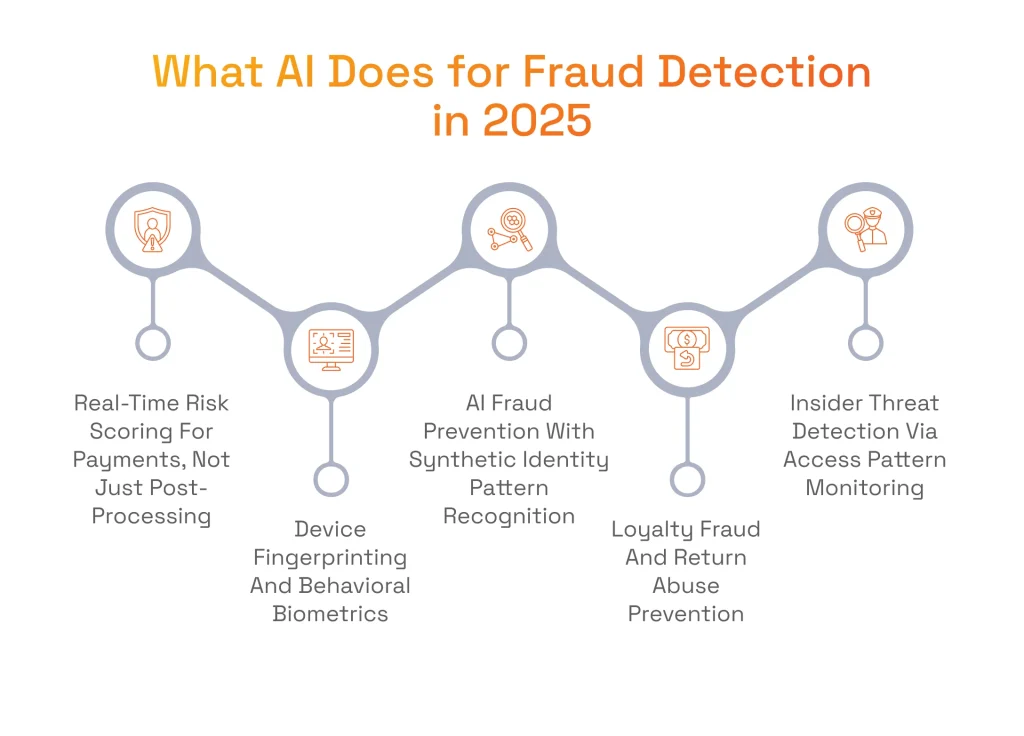
Real-Time Risk Scoring for Payments, Not Just Post-Processing
Today, emerging threats can be identified within 30–50 ms thanks to streaming AI pipelines in the mechanism of payment gateway fraud detection. These systems, which underwent merchant and transaction risk management features development, keep key signals like card history, device fingerprints, behavioral biometrics, and network graph links continuously refreshed in memory. As each transaction moves through the system, the pipeline instantly enriches the transaction data with these pre-cached features, runs a lightweight AI model at the gateway or POS, and returns a real-time risk score.
Device Fingerprinting and Behavioral Biometrics
Static device IDs are no longer enough. Luckily, AI in fraud detection systems combines simple fingerprints with sensor data such as phone tilt, battery patterns, typing speed, and operating-system signals. The model learns each customer’s usual digital journey and notices tiny changes, for example, pasting where the person normally types or swiping at a different angle. After every safe session the baseline is updated, so genuine users pass smoothly while impostors are stopped without extra passwords or CAPTCHAs.
AI Fraud Prevention with Synthetic Identity Pattern Recognition
With AI, fraud detection systems have the potential to spot synthetic identities even though those typically look flawless until cash out. These systems use graph neural networks that study millions of credit-line histories, address links, and bureau records to spot weak warning signs weeks before the fraudster strikes. Extra clues, such as shared devices, and sudden social media activity, help find fake identities even when little credit data exists, which significantly enhances credit card fraud detection.
Loyalty Fraud and Return Abuse Prevention
Modern AI fraud detection software has a reinforcement learning model that reviews buying rhythm, product mix, package-scan images, and courier GPS data to flag suspect returns in real time and prevent point farming and fake returns. Once the system detects signs that are out of the ordinary, it then recommends the lightest action that still protects margin, such as issuing store credit instead of cash. In loyalty programs, tokenised point wallets and live anomaly checks stop large point transfers if the instant scripted patterns diverge from normal returns.
Insider Threat Detection via Access Pattern Monitoring
AI-powered fraud detection has an analytical mechanism that allows spotting fraud that comes from the employees. This mechanism highlights the importance of data analytics in finance as it tracks every privileged click, query, and API call through real-time monitoring, comparing them with peer behavior and personal history. Unusual data exports in the night, sudden USB writes, or repeated lookups of sensitive tables trigger an automatic privilege downgrade and a discreet alert to security staff. By reading intent signals the system moves beyond simple logs to deliver context-aware protection against insider misuse.
Only established tech vendors can expertly navigate data analytics, AI/ML, and behavioral biometrics for fraud detection.
Find the best professionals in the field in our article on the best Fintech development companies.
What’s Next: The Future of AI and Fraud Prevention
With AI, fraud detection can do even more than solving Fintech app development challenges of today. It can be more forward-thinking and become proactive or even autonomous in detecting evolving threads. Below are the enhancements that we can expect in the near future.
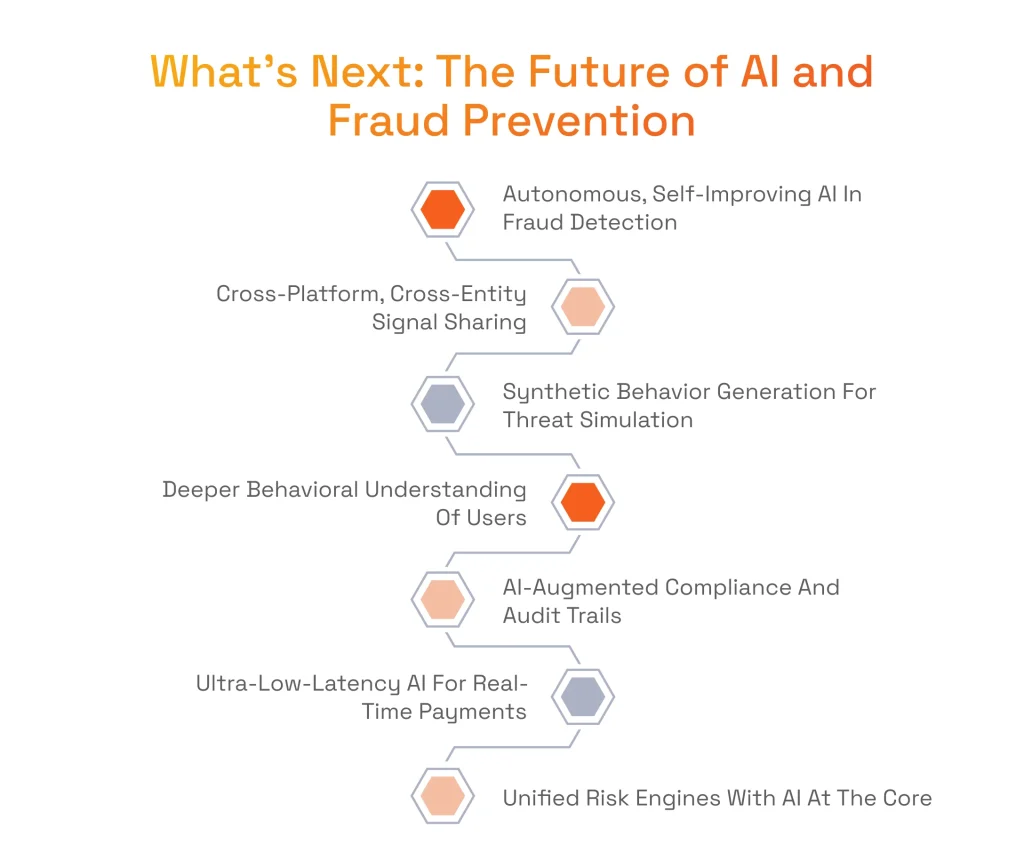
Autonomous, Self-Improving AI in Fraud Detection
The next wave of AI fraud prevention engines will retrain themselves continuously, drawing from live feature stores and streaming labels to keep models constantly fresh. They are going to include:
- Continuous self-retraining from live feature stores and streaming labels keeps models always current.
- Meta learning that fine tunes hyper-parameters on the fly.
- Reinforcement learning that tests “policy nudges” safely in a sandbox.
- Guardrails set by risk teams (e.g., false-positive limits, CX impact).
- Counter measures instant deployment with tighter velocity caps, dynamic CVV tests, micro-authorisation limits.
Cross-Platform, Cross-Entity Signal Sharing
When each bank or merchant stores fraud data in its own silo, criminals can move between institutions undetected. For this reason, fraud detection with AI needs a shared model that can be used by several businesses to ensure a holistic financial threat prevention. Such systems with shared model will have the following capabilities:
- Federated learning that lets banks, PSPs, and merchants train shared models on encrypted updates, not raw data.
- Cross-entity pattern detection, including a single device opening accounts at multiple lenders.
- Data-clean rooms and confidential computing enclaves that share anonymised signals while allowing for seamless implementation of KYC standards, as well as GDPR and CCPA guidelines.
Synthetic Behavior Generation for Threat Simulation
The next frontier in proactive fraud defence is AI that doesn’t just respond to attacks, it creates them. Leveraging generative AI for fraud detection will help simulate fraud scenarios by mimicking human and bot behavior at scale. These synthetic simulations will pressure-test systems, helping security teams discover vulnerabilities before criminals do. AI fraud detection solutions with simulation will involve:
- Generative models trained on real fraud patterns to simulate emerging tactics.
- Synthetic user sessions that stress-test authentication systems, rate limits, and behavioral biometrics.
- Closed-loop simulations that continuously expose model weaknesses.
- Faster testing of new defences against complex multi-step fraud (e.g., social engineering + account takeover).
Deeper Behavioral Understanding of Users
AI for fraud prevention is evolving from simply flagging anomalies to understanding why users behave the way they do. With richer behavioral and contextual data, future systems will distinguish legitimate uncertainty from malicious intent and unlock more precise fraud prevention. This evolution will include:
- Multimodal AI that fuses typing speed, scrolling patterns, device tilt, and even facial cues.
- Real-time analysis of emotional state indicators, such as hesitation or rushed input.
- Personalised behavior baselines trained on long-term activity.
- Adaptive scoring that reflects context (e.g., urgency vs. coercion).
- Reduced false positives by better recognising legitimate behavior variations.
AI-Augmented Compliance and Audit Trails
With fraud payment processing compliance rules becoming more complex and global regulations tightening, requiring AI to show reasoning behind its actions. This is why AI-based compliance tools are expected to automatically generate audit logs, flag policy violations, and produce regulator-ready reports in real time. Using AI to detect fraud in accordance with compliance regulation will include:
- Explainable AI that shows why a transaction was flagged, declined, or escalated.
- Natural language reporting to generate compliant documentation for frameworks like PSD3, DORA, and the EU AI Act.
- Continuous monitoring of model fairness, accuracy, and bias.
- Real-time alerting on threshold breaches (e.g., false-positive rates, discriminatory impact).
Ultra-Low-Latency AI for Real-Time Payments
As instant payment rails like FedNow and SEPA Instant scale globally, fraud engines must match speed with precision to be able to prevent fraudulent transactions. Using AI tools for fraud detection will power decisions in under 50 ms, an engineering and intelligence challenge that demands new architectures with:
- Real-time model inference at the payment gateway or device level.
- Persistent in-memory feature stores for instant access to behavioral and transaction history.
- Distilled models running on GPUs or FPGAs for sub-second decisions.
- Adaptive batching and caching to reduce latency without affecting accuracy.
- Fraud scoring built into the authorization path to meet hard settlement deadlines.
Unified Risk Engines with AI at the Core
Siloed fraud, AML, and credit risk systems create duplication, delays, and blind spots. The banking and financial services industry will use fraud prevention platforms with unified AI models that process all risk types from a single stream of events. This will help to deliver faster and more consistent decision-making. Such unified risk engines will offer:
- One orchestration layer to manage fraud, AML, sanctions, and credit scoring in parallel.
- Sub-models for specific fraud risks that feed into a combined decision policy.
- Shared feature stores and graph networks to reduce data duplication.
- Global customer profiles updated in real time across all risk areas.
Such a combination of next-level AI and fraud prevention systems is inevitable if companies are thriving to accommodate their clients with top-tier security. At the same time, it poses a challenge for many companies as deploying AI requires a large initial investment in infrastructure, expertise, and advanced technologies to keep pace with technological breakthroughs. As one of the solutions, they can leverage the advantages of strategic technology consulting or even hire a dedicated development team. With such expert help, they can blend their Fintech expertise with AI-focused solutions delivery.
Key Takeaways
- US consumers reported $15.9 billion in fraud losses in 2025, and Deloitte projects generative AI could push losses to $40 billion by 2027, a 32% compound annual growth rate driven by deep-fake IDs, chargeback bots, and micro-transaction rings.
- Legacy rules-based fraud systems evaluate transactions as isolated events, which means they miss multi-session attacks that unfold slowly across minutes, hours, or days: behavioral analytics closes this gap by stitching together activity across sessions to reveal the full attack arc.
- Supervised machine learning detects 3x more fraudulent transactions while reducing false positives 10x compared to manual rule-tuning, according to Mastercard. And unlike static rules, these models retrain on fresh data instead of waiting for weekly manual updates.
- Real-time payment rails like FedNow, RTP, and Pix settle funds in seconds with no pending state for manual review, so only AI that scores hundreds of behavioral signals in under 50 milliseconds can block fraudulent transfers before settlement.
- Behavioral biometrics catch fraud that passes every rule-based check: account takeovers using stolen credentials and correct device fingerprints are flagged through behavioral shifts like pasted passwords, unfamiliar page sequences, and altered swipe patterns.
- Federated learning lets banks, payment providers, and merchants train shared fraud models on encrypted updates without exposing raw data, closing the cross-institution blind spots that let criminals move between siloed systems undetected.
In short: AI fraud detection has shifted from a static checklist to a self-learning system, but staying ahead of AI-powered fraud requires real-time behavioral analytics, cross-entity signal sharing, and sub-50ms inference — capabilities that demand significant infrastructure and specialized expertise.
FAQ
How does AI fraud detection compare to rule-based systems in cost and accuracy?
On accuracy, AI substantially outperforms rules-based systems. Mastercard reports its ML-powered fraud system detects 3 times more fraudulent transactions while reducing false positives 10 times compared to manual rule-tuning. Rules-based systems evaluate transactions as isolated events using fixed thresholds, missing the multi-session and behavioral attacks that dominate today’s fraud landscape.
On cost, the picture is more nuanced. AI systems carry higher upfront costs, but lower ongoing costs because models retrain on fresh data automatically instead of requiring constant manual rule updates. Rules-based systems are cheaper to start but accumulate hidden costs: fraud losses from missed attacks, and the analyst hours spent reviewing high volumes of false positives. Over a multi-year horizon, AI typically delivers lower total cost of ownership for any organization processing significant transaction volume.
What are the risks of high false positive rates in AI fraud detection systems?
High false positive rates carry both direct and hidden costs. Directly, every legitimate transaction wrongly declined frustrates customers, damages trust, and can drive them to competitors since in payments, a single false decline often costs more in lifetime customer value than the fraud it prevented.
Operationally, false positives flood manual review queues, raising labor costs and slowing response to genuine threats. There is also a fairness risk: models that disproportionately flag certain customer segments create discriminatory impact, which exposes the institution to regulatory action under frameworks like the EU AI Act.
The deeper danger is alert fatigue. When analysts face too many false alarms, they begin rubber-stamping or ignoring alerts, which lets real fraud slip through. Balancing detection rate against false positives is the central tuning challenge of any fraud system.
How long does it take to implement AI fraud detection in a live payments environment?
A focused deployment integrating a pre-built fraud model with existing payment infrastructure typically takes 3-6 months. A custom system with proprietary models, behavioral biometrics, and real-time scoring built into the authorization path takes 9-15 months. These ranges are approximate and vary significantly based on data readiness, transaction volume, regulatory scope, and the complexity of existing infrastructure. Every deployment is different, so treat these figures as planning estimates rather than guarantees.
What data is required to train an AI fraud detection system effectively?
Effective fraud models require several data types.
- Transaction data (amounts, timestamps, merchant categories, payment methods) forms the core.
- Behavioral data (keystroke cadence, mouse and swipe patterns, session timing, navigation sequences) powers the behavioral analytics layer.
- Device and network data (device fingerprints, IP addresses, sensor signals like phone tilt and battery patterns) helps distinguish genuine users from impostors.
- Labeled historical fraud data (confirmed fraudulent and legitimate transactions) to learn the difference, and class imbalance is a constant challenge because fraud is rare relative to legitimate activity.
- Graph data linking accounts, addresses, and devices is essential for detecting synthetic identities and fraud rings.
What are the failure modes of AI fraud detection when fraud patterns evolve?
The primary failure mode is model drift. As fraudsters change tactics, a model trained on past patterns becomes progressively less accurate, silently missing new attack types until losses surface.
A related risk is adversarial adaptation: sophisticated fraudsters probe the system to learn its thresholds, then deliberately structure attacks to stay below detection limits, such as micro-transaction rings that flood platforms with tiny transactions. Models can also overfit to historical fraud, becoming excellent at catching yesterday’s attacks while blind to novel ones.
Concept drift in legitimate behavior causes problems too. When customer behavior shifts (a new app version, a holiday shopping spike), the model may misread normal activity as anomalous, spiking false positives.