

Choosing the right partner for AI development outsourcing comes down to proof that a vendor’s systems hold up in production on data like yours. Verify six capabilities before you sign: AI systems kept in production for months with measured results; strong data engineering and governance; a repeatable evaluation process run on your own data; MLOps and monitoring after launch; security and compliance terms, with contracts assigning you the code, data pipelines, eval suites and model artifacts; and experience in domains where mistakes cost money. Ask for a monthly run-cost estimate next to the build quote, and agree on a documented exit plan before signing. Then run a short, paid pilot with clear go/no-go criteria before committing to a long-term contract.
If you have already decided on AI development outsourcing for an AI/ML or LLM-based product or feature, the hard part now is the shortlist. Every vendor can show a polished demo on curated inputs. Few can show the same system working on production data like yours, after launch, under your compliance and security rules. That gap surfaces months later as rework, an unquoted monthly inference bill, or IP stuck in the vendor’s environment.
This guide covers the capabilities to verify, what AI costs to build and run, the main risks and how to manage them, a due diligence checklist, questions to ask, red flags, and how to run a pilot that turns the evaluation into a buying decision.
What Should You Look for in an AI Development Outsourcing Partner?
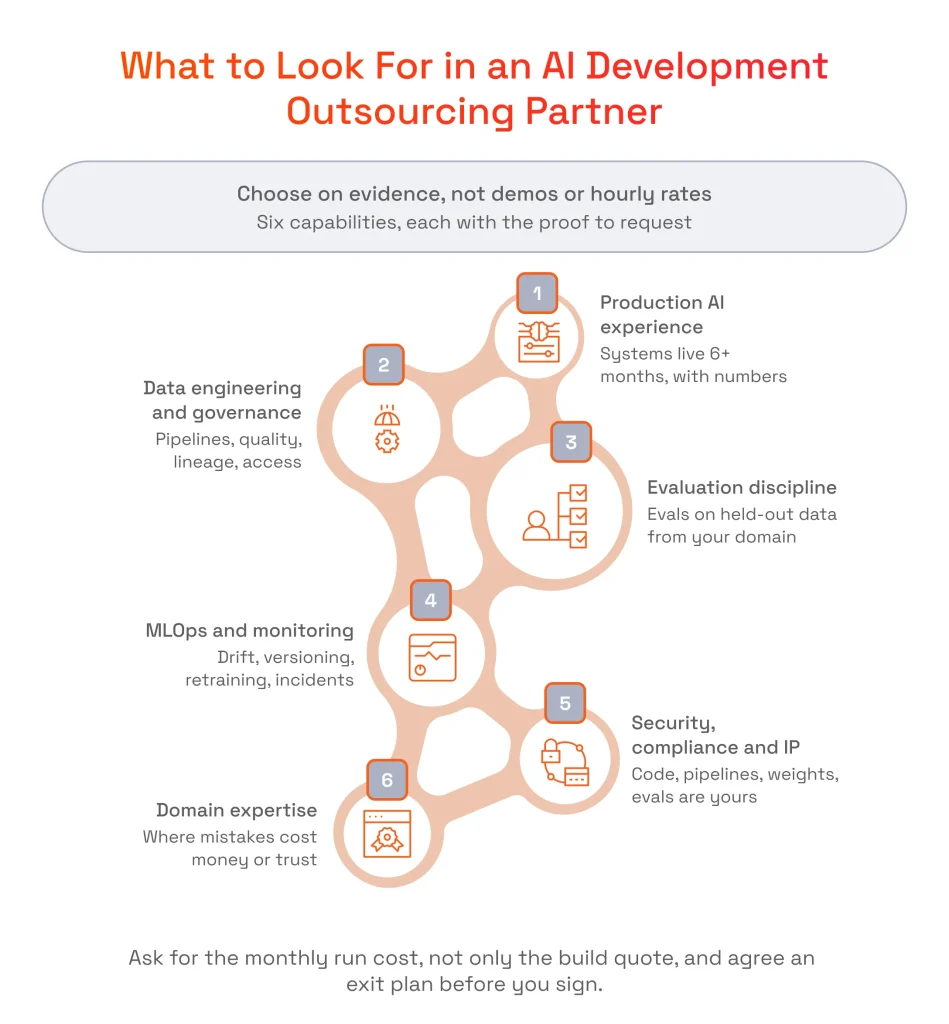
Six engineering and operational capabilities separate an AI outsourcing vendor with a real AI team from one that can only assemble a convincing prototype. Assess your shortlist against these six areas, and vendors have to go beyond slide decks and show artifacts from live systems, past incidents and actual delivery before you sign a Master Services Agreement.
- Production AI experience: ask for the architecture, uptime figures and post-launch incident logs of a system that has been live for at least 6 months.
- Data engineering and governance: ask for examples of ingestion pipelines, automated data quality checks, data lineage tracking and role-based access control for ML and retrieval workloads.
- Evaluation discipline: require a documented method for building a held-out test set from your domain data and running automated evaluations before every release.
- MLOps and monitoring: inspect the tooling for observability, model drift detection, artifact versioning, retraining triggers and incident response.
- Security, compliance and IP: look for active security certifications, strict data handling controls, IP assignment covering code, data pipelines, fine-tuned weights, deployed models and eval suites, and a documented exit plan.
- Domain expertise: check for delivery in regulated or high-stakes environments where model errors cost money, trigger regulatory penalties or damage customer trust.
A prototype proves an idea on curated inputs. A production AI system holds up under real users, real data and real money, with monitoring, a fallback path and a named engineer on call.
What Should You Decide Before Shortlisting AI Development Companies?
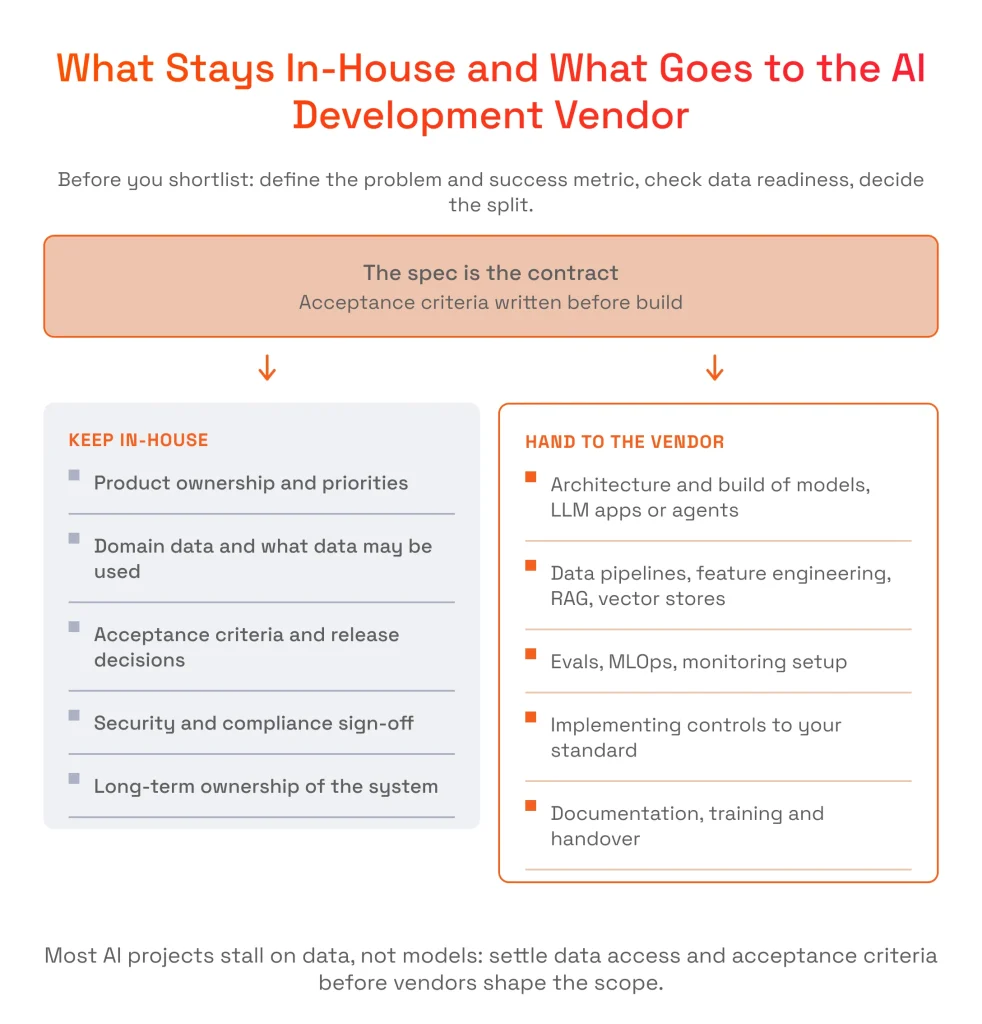
Before you compare AI development companies, define three inputs internally: the business problem and its target metric, the real state of your data, and the boundary between what your team keeps and what the vendor runs. Without them, vendor discovery sessions produce vague estimates you cannot compare, and architectural control drifts to the vendor.
Start by linking every proposed use case to one measurable business outcome. A good problem statement defines the baseline process, the target metric (for example, less manual document handling time, a set accuracy on a labeled dataset, or higher checkout conversion) and the operational constraints, such as maximum acceptable latency. A metric set internally stops vendors from optimizing for numbers that never reach your P&L.
Next, audit your data readiness across storage, ownership, labeling coverage and access permissions. Many engineering leaders overestimate how clean and accessible their historical records are until a vendor starts building ingestion pipelines. Gartner predicts that through 2026, organizations will abandon 60% of AI projects unsupported by AI-ready data, so check schema consistency and access before any external engineer bills an hour.
With the metric and data baseline in place, write down formal acceptance criteria before you request quotes, so the specification becomes the benchmark the vendor’s delivery is measured against. Then set the operating boundary: your team keeps strategic control, and the vendor takes on the engineering work.
Keep in-house | Hand to the vendor |
|---|---|
Product ownership and priorities | Architecture and build of models, LLM apps or agents |
Domain data and the decision on what data may be used | Data pipelines, feature engineering, RAG and vector stores |
Acceptance criteria and final release decisions | Evals, MLOps, monitoring setup |
Security and compliance sign-off | Implementing controls to your standard |
Long-term ownership of the system | Documentation, training and handover |
Keep in-house
Product ownership and priorities
Domain data and the decision on what data may be used
Acceptance criteria and final release decisions
Security and compliance sign-off
Long-term ownership of the system
Hand to the vendor
Architecture and build of models, LLM apps or agents
Data pipelines, feature engineering, RAG and vector stores
Evals, MLOps, monitoring setup
Implementing controls to your standard
Documentation, training and handover
Which Capabilities Separate a Production AI Vendor From a Demo Shop?
A strong AI development company can show you the working artifacts behind every capability it lists. A slide deck says nothing about what happens when real user traffic hits your endpoints. Judge engineering quality by how a vendor runs production systems, moves data, tests releases, handles security, applies domain rules and uses AI in its own delivery.
Production AI Experience
Ask each shortlisted vendor to walk you through an AI system it has run in production for at least 6 months, focusing on what broke after launch and how the team diagnosed and fixed it. Mature MLOps shows in how engineers handle post-launch degradation, not in how smoothly the first deployment went. Model drift is the decline in output quality over time as input data, user behavior or upstream model versions change, with no change to your application code.
A global payments fintech needed underwriting and risk scoring that would hold up at volume, so SPD Technology built a scalable risk management tool within a 5+ year partnership. It underwrote 5M+ applications in a single year, and true-positive alerting doubled the merchant termination rate.

In a vendor’s track record, look for hard operational metrics such as tail latency and sustained uptime at real concurrency. For example, the high-load support chatbot for an online fashion store, a French B2C retailer, runs on LangChain with a Mistral LLM and RAG on AWS. It answers 99% of queries in under 10 seconds and kept 100% uptime at 30 requests per second during peak hours.
Use the AI Production-Ready Checklist to test what “in production” means before you accept a vendor’s claim.
Data Engineering and Data Governance
A model’s output is only as good as the data behind it. Check that the vendor can turn raw, scattered enterprise data into clean, governed inputs: automated ingestion pipelines, schema validation, end-to-end data lineage and fine-grained access control across structured warehouses and unstructured document stores. In retrieval-augmented generation (RAG), where an LLM answers from your own documents retrieved at runtime, chunking, embedding quality, vector indexing and data governance sit at the center of the engineering work.
SPD Technology built an AI/ML trend detection pipeline for a global investment data platform that ingests about 50,000 articles a day (around 18M a year) from 3,000+ sources to spot market trends and niches. The work is part of a partnership of more than 10 years that also covered earlier cloud migration and microservices.
Good data engineering also cuts storage and speeds up analysis. SPD Technology’s engineers built an AI/ML web crawler for Morningstar that collects data from 500+ sites with 2 people instead of 20, cut collection time from 2-3 days to 2-3 hours and lowered storage costs tenfold.
Model Evaluation and Quality Assurance
LLMs and probabilistic classifiers are non-deterministic, so unit tests alone cannot show whether a release is safe to ship. Evals are repeatable automated tests of non-deterministic AI behavior against a clear rubric and a held-out test set, and they must use your business data, not the vendor’s demo set. They measure task completion, factual accuracy, hallucination rate and policy compliance. High accuracy on the vendor’s demo data tells you nothing about your real customer queries and edge-case documents.
Teams that test thousands of prompts use LLM-as-judge: an evaluator model, calibrated against human domain ratings, scores outputs at scale. Those scores feed regression suites and drift monitoring, so any quality drop shows up when prompts, retrieval indexes or model versions change. For multi-step workflows, output evaluation scores the final answer, and trajectory evaluation checks the steps and tool calls AI agents took on the way.

Serhii Leleko
AI & ML Engineer at SPD Technology
“When a client asks how we will prove quality, the first thing we agree on is a held-out set built from their own data and frozen before anyone on our team has seen it. Demo accuracy mostly measures how carefully the examples were picked. Thresholds agreed on that frozen set, and rerun on every release, are what tell you the system will still be right in month six.”
Security, Compliance and IP Ownership
Enterprise AI systems handle sensitive customer data, proprietary financial data and regulated processes, so security architecture and legal ownership are core evaluation criteria. Confirm that the vendor has audited baseline controls: SOC 2, ISO 27001, GDPR procedures, and HIPAA readiness if it will process PHI. Also ask whether it holds or is aligned with ISO/IEC 42001, published in December 2023 and described by its publishers as the world’s first AI management system standard.
Regulatory timelines shape architecture for products aimed at the EU market or regulated sectors. Following the Digital Omnibus on AI, the EU AI Act’s high-risk rules apply from 2 December 2027 for stand-alone high-risk systems and from 2 August 2028 for high-risk AI embedded in regulated products. Logging, transparency and risk management therefore need to be in the architecture now.
Verify the data residency rules, check that third-party model endpoints run under zero data retention terms, and make sure the contract assigns you all custom code, data pipelines, fine-tuned weights, prompts and eval suites. For high-stakes actions, check how the vendor applies technical safeguards and mandatory human-in-the-loop approval, so a model never makes an irreversible financial or clinical decision on its own.
Domain Expertise in Your Industry
An AI software development company working in a regulated space such as fintech, payments, insurance or healthcare should already understand audit trails, PII redaction, explainability and domain-specific edge cases. Teaching a generalist team payment settlement, clinical coding or actuarial underwriting costs months of budget and raises your compliance exposure. A specialist generative AI development company moves through discovery faster, because its engineers already know which failure modes trigger an audit.
For a US FSA/HSA payments company, SPD Technology delivered AI eligibility classification at 80%+ accuracy, kept 200,000+ eligible healthcare products in sync and closed the platform’s HIPAA and SOC 2 gaps.
How the Vendor Uses AI in Its Own Delivery
Engineering teams increasingly use coding assistants and agents to speed up delivery, and that creates new quality risks when the tools are not held to verification gates. Ask every vendor how its engineers use coding agents and what stops a subtle logic bug or a vulnerable dependency from reaching your codebase. Agentic engineering means agents work within formal specs, automated tests, evals and mandatory senior human review, so every release can be verified independently.
Without those guardrails, AI-accelerated development produces technical debt faster and adds security risks in AI-generated code that your own security team will eventually have to fix.
How Much Does AI Development Outsourcing Cost?
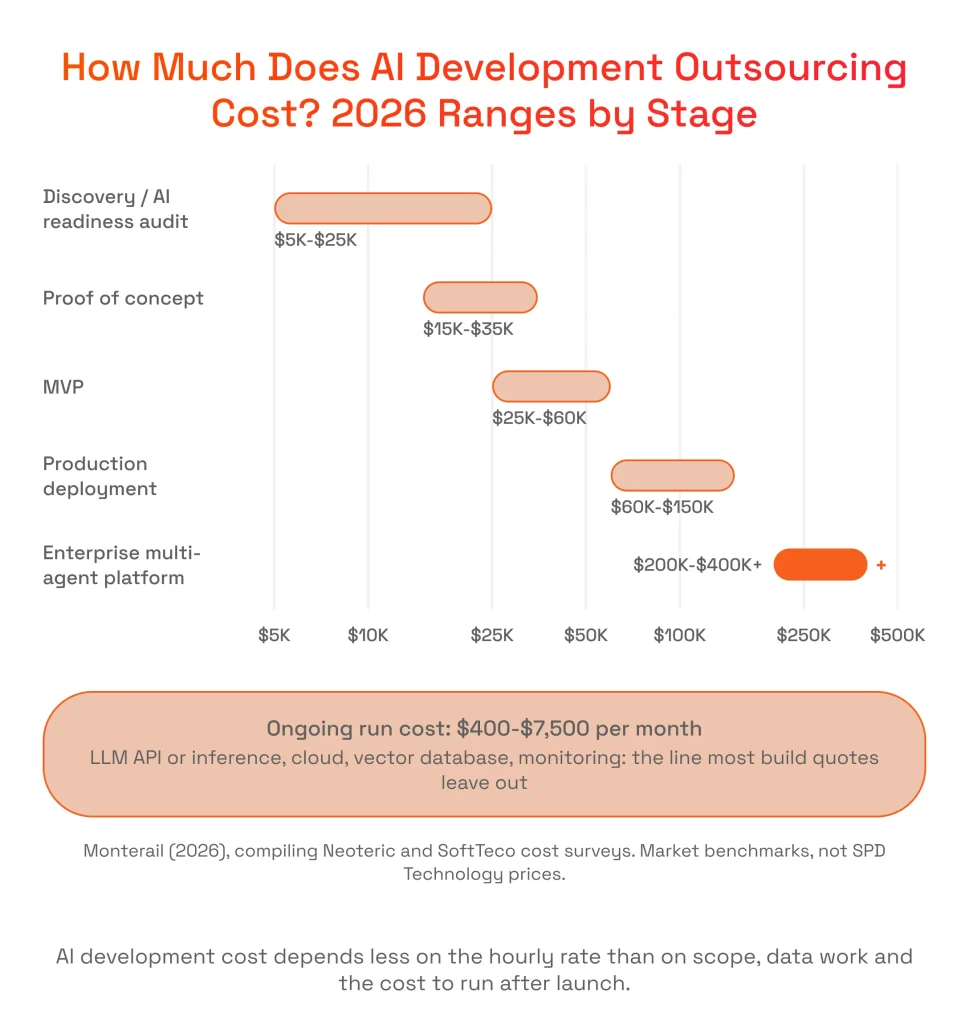
AI development cost depends far more on functional scope, upstream data work and the monthly cost of running the model after launch than on the vendor’s blended hourly rate. Comparing raw hourly rates across proposals misleads, because an established engineering company includes project management, QA, security review and DevOps in its rate. A low-rate staffing vendor either bills those separately or leaves them out until quality collapses. When you compare proposals, separate fixed costs from usage-based model and infrastructure costs, particularly if the scope includes LLM APIs or other usage-billed services.
Match the contract model to how mature and predictable your scope is.
Model | How it works | Best for | Watch out for |
|---|---|---|---|
Fixed price | Agreed scope and price | Pilots and well-specified phases | Change requests; quality cut to fit price |
Time and materials | Pay for hours used | Discovery, evolving scope | Needs strong governance and reporting |
Dedicated team | Monthly team cost | Long-term product work | Seniority mix; knowledge staying with the vendor |
Outcome-based (partial) | Part of fee tied to agreed metrics | Mature, measurable use cases | Hard to define fair metrics; rarely suits a first project |
Model
Fixed price
Time and materials
Dedicated team
Outcome-based (partial)
How it works
Agreed scope and price
Pay for hours used
Monthly team cost
Part of fee tied to agreed metrics
Best for
Pilots and well-specified phases
Discovery, evolving scope
Long-term product work
Mature, measurable use cases
Watch out for
Change requests; quality cut to fit price
Needs strong governance and reporting
Seniority mix; knowledge staying with the vendor
Hard to define fair metrics; rarely suits a first project
Whatever the contract model, seven workstreams drive the total cost:
- data preparation and labeling, including training or optimizing machine learning models
- integration with existing systems
- evaluation and QA
- infrastructure and inference (tokens per request × volume × price)
- MLOps and monitoring
- security and compliance work
- maintenance and model updates
Typical 2026 cost ranges for an outsourced AI project, by stage:
Stage | Typical cost (USD) | Typical duration | What it usually includes | What drives the upper end |
|---|---|---|---|---|
Discovery / AI readiness audit | $5k-$25k | 1-4 weeks | Use-case selection, data audit, architecture options, success metrics | Number of use cases, data sources to review |
Proof of concept | $15k-$35k | 3-6 weeks | One use case on sample data, first eval results, feasibility verdict | Data cleaning, custom models instead of APIs |
MVP | $25k-$60k | 1-3 months | Working product slice for real users, basic monitoring, evals | Integrations, UI, security requirements |
Production deployment | $60k-$150k | 2-6 months | Hardened system, MLOps, observability, guardrails, compliance work, handover | Regulated data, uptime targets, scale |
Enterprise multi-agent platform | $200k-$400k+ | 6+ months | Several agents or models, orchestration, governance, multiple integrations | Number of workflows, audit requirements |
Ongoing run cost | $400-$7.5k per month | Monthly | LLM API or inference, cloud, vector database, monitoring | Request volume, model choice, context size |
Maintenance and improvement | 15-25% of build cost per year | Monthly / quarterly | Drift fixes, re-evaluation, model version updates, new features | Rate of change in data and providers |
Stage
Discovery / AI readiness audit
Proof of concept
MVP
Production deployment
Enterprise multi-agent platform
Ongoing run cost
Maintenance and improvement
Typical cost (USD)
$5k-$25k
$15k-$35k
$25k-$60k
$60k-$150k
$200k-$400k+
$400-$7.5k per month
15-25% of build cost per year
Typical duration
1-4 weeks
3-6 weeks
1-3 months
2-6 months
6+ months
Monthly
Monthly / quarterly
What it usually includes
Use-case selection, data audit, architecture options, success metrics
One use case on sample data, first eval results, feasibility verdict
Working product slice for real users, basic monitoring, evals
Hardened system, MLOps, observability, guardrails, compliance work, handover
Several agents or models, orchestration, governance, multiple integrations
LLM API or inference, cloud, vector database, monitoring
Drift fixes, re-evaluation, model version updates, new features
What drives the upper end
Number of use cases, data sources to review
Data cleaning, custom models instead of APIs
Integrations, UI, security requirements
Regulated data, uptime targets, scale
Number of workflows, audit requirements
Request volume, model choice, context size
Rate of change in data and providers
When you compare delivery regions, specialist AI/ML talent commands up to a 40% premium over general software engineering rates. Typical 2026 hourly rates for AI/ML engineers by region:
Region | Example countries | General developer | With AI/ML premium |
|---|---|---|---|
Nordics | Sweden, Finland | $80-$140/hr | $110-$195/hr |
Western Europe | UK, Germany, Netherlands | $64-$128/hr | $90-$180/hr |
Southern Europe | Spain, Italy, France | $37-$77/hr | $52-$108/hr |
Central Europe | Poland, Czechia | $32-$100/hr | $45-$140/hr |
Eastern Europe | Ukraine, Romania, Bulgaria | $45-$70/hr | $63-$98/hr |
Region
Nordics
Western Europe
Southern Europe
Central Europe
Eastern Europe
Example countries
Sweden, Finland
UK, Germany, Netherlands
Spain, Italy, France
Poland, Czechia
Ukraine, Romania, Bulgaria
General developer
$80-$140/hr
$64-$128/hr
$37-$77/hr
$32-$100/hr
$45-$70/hr
With AI/ML premium
$110-$195/hr
$90-$180/hr
$52-$108/hr
$45-$140/hr
$63-$98/hr
These are indicative market ranges, not SPD Technology prices, and are not a public offer.
After launch, spending shifts to the run cost: inference and token cost at scale, drift fixes, provider model version changes, continuous re-evaluation and production support. Model routing lowers run cost by sending each task to the cheapest model that can pass its checks.
What Are the Risks of AI Development Outsourcing, and How Do You Manage Them?
The biggest risks in AI development outsourcing are losing control of your data and IP, getting locked in to the vendor, inheriting rework hidden behind a polished demo, and watching quality drift after launch. Each one has a contractual or architectural control. Good AI vendor risk management means naming those failure modes during procurement and writing the matching technical gates into your statement of work.
One of the biggest hazards is AI technical debt: cost that compounds from unversioned prompts, untested ingestion pipelines, undocumented data assumptions and unmanaged third-party model dependencies. Avoid cutting corners to hit a demo date, and put architectural guardrails in place from the start.
The table below sets out a practical AI vendor risk management framework, pairing eight common failure modes with technical and contractual mitigations.
Risk | What it looks like | Mitigation |
|---|---|---|
Data privacy and residency | Your data processed in unknown regions or used for training | Data processing agreement, approved model endpoints and regions, no-training terms |
IP and model ownership | Vendor keeps weights, prompts, pipelines or eval data | Contract assigns code, data pipelines, fine-tuned weights, prompts and eval suites to you |
Vendor lock-in | Proprietary platform or undocumented setup | Build in your accounts and repos; standard tooling; exit plan with transition period |
Weak knowledge transfer | Only the vendor understands the system | Documentation, runbooks, pairing with your team, handover milestones |
Hidden rework (AI technical debt) | Prototype-grade code, unversioned prompts, untested pipelines | Specs, tests and evals as acceptance gates; versioned prompts and configs |
Quality drift after launch | Accuracy drops as data or model versions change | Monitoring, scheduled re-evaluation, alerting, a named owner |
Run-cost surprises | API and infrastructure bills above plan | Run cost in the proposal, budgets and alerts, model routing |
Communication and accountability | Unclear owner for decisions and incidents | Named senior lead, RACI, release approval rules |
Risk
Data privacy and residency
IP and model ownership
Vendor lock-in
Weak knowledge transfer
Hidden rework (AI technical debt)
Quality drift after launch
Run-cost surprises
Communication and accountability
What it looks like
Your data processed in unknown regions or used for training
Vendor keeps weights, prompts, pipelines or eval data
Proprietary platform or undocumented setup
Only the vendor understands the system
Prototype-grade code, unversioned prompts, untested pipelines
Accuracy drops as data or model versions change
API and infrastructure bills above plan
Unclear owner for decisions and incidents
Mitigation
Data processing agreement, approved model endpoints and regions, no-training terms
Contract assigns code, data pipelines, fine-tuned weights, prompts and eval suites to you
Build in your accounts and repos; standard tooling; exit plan with transition period
Documentation, runbooks, pairing with your team, handover milestones
Specs, tests and evals as acceptance gates; versioned prompts and configs
Monitoring, scheduled re-evaluation, alerting, a named owner
Run cost in the proposal, budgets and alerts, model routing
Named senior lead, RACI, release approval rules
What Belongs on an AI Vendor Due Diligence Checklist?
AI vendor due diligence covers six areas: production results, technical depth, security and compliance, the named team, release verification and contract terms. Do not rely on marketing material or references arranged by sales, which will show the best cases. Your technical and procurement leads need access to primary engineering artifacts for every row of the checklist.
Area | Check | Evidence to request |
|---|---|---|
Portfolio and references | Comparable AI systems in production 6+ months | Case studies with numbers; a reference call with a CTO |
Technical assessment | Architecture, data, evals, MLOps | Sample architecture, eval report, monitoring dashboard |
Security review | Certifications, data handling, access | SOC 2 / ISO 27001 reports, DPA, sub-processor list |
Team and seniority | Named people and their experience, including data engineers where relevant | CVs in the statement of work; replacement rules |
Delivery method | How releases are verified | Sample release evidence: tests, eval results, approvals, rollback |
Contract terms | IP, exit, SLAs, liability | IP assignment, exit and transition clause, SLAs, run-cost commitments |
Area
Portfolio and references
Technical assessment
Security review
Team and seniority
Delivery method
Contract terms
Check
Comparable AI systems in production 6+ months
Architecture, data, evals, MLOps
Certifications, data handling, access
Named people and their experience, including data engineers where relevant
How releases are verified
IP, exit, SLAs, liability
Evidence to request
Case studies with numbers; a reference call with a CTO
Sample architecture, eval report, monitoring dashboard
SOC 2 / ISO 27001 reports, DPA, sub-processor list
CVs in the statement of work; replacement rules
Sample release evidence: tests, eval results, approvals, rollback
IP assignment, exit and transition clause, SLAs, run-cost commitments
If your technical team wants an objective second view on security architecture, cloud isolation or data handling before sign-off, an independent AI infrastructure audit shows configuration gaps that a standard compliance report misses.
What Questions Should You Ask AI Vendors Before You Sign?
The ten questions to ask AI vendors below are hard to answer well with only a demo to go on. A good answer names a person on the vendor’s side, gives a concrete example and ends up in your statement of work.
Question | A good answer sounds like |
|---|---|
Which AI system have you run in production for 6+ months, and what broke? | A specific incident, how it was found and fixed |
How will you measure quality on our data? | Held-out evaluation set, metrics, thresholds agreed before build |
What happens when the model provider changes or retires a version? | Re-evaluation process, version pinning, who pays |
What will this cost to run per month at our volume? | A run-cost estimate with assumptions |
Who owns the code, data pipelines, weights, prompts and eval suites? | You do, in writing |
Who exactly will work on this, and how senior are they? | Named people in the statement of work |
How do you verify every release, including AI-generated code? | Specs, tests, evals, senior approval, release evidence |
How do you handle our data and where is it processed? | DPA, regions, no-training terms, access logs |
What would you refuse to build or advise against? | A considered no, with the reason and a better alternative |
How do we exit if we need to? | Exit plan, transition period, documentation |
Question
Which AI system have you run in production for 6+ months, and what broke?
How will you measure quality on our data?
What happens when the model provider changes or retires a version?
What will this cost to run per month at our volume?
Who owns the code, data pipelines, weights, prompts and eval suites?
Who exactly will work on this, and how senior are they?
How do you verify every release, including AI-generated code?
How do you handle our data and where is it processed?
What would you refuse to build or advise against?
How do we exit if we need to?
A good answer sounds like
A specific incident, how it was found and fixed
Held-out evaluation set, metrics, thresholds agreed before build
Re-evaluation process, version pinning, who pays
A run-cost estimate with assumptions
You do, in writing
Named people in the statement of work
Specs, tests, evals, senior approval, release evidence
DPA, regions, no-training terms, access logs
A considered no, with the reason and a better alternative
Exit plan, transition period, documentation
The real test is how vague a vendor gets. A team that can verify every release can pull up the eval scorecard from last Thursday’s deploy while you are still on the call.
If the vendor will build with AI coding agents, add the questions in our guide to choosing an AI-assisted engineering vendor.
Which Red Flags Should End the Conversation?
Some answers on a discovery call tell you most of what you need to know. If one of these comes up, end the evaluation there rather than spend a quarter on a vendor that will not reach production.
- Guaranteed accuracy before the vendor has seen your data or edge cases
- Proposals that cover model training or prompt engineering but omit evaluation suites and post-launch monitoring
- A sales process built on a UI demo, with nothing on data pipelines, latency budgets or fallback architecture
- Vague answers on where customer data is processed, which sub-processors receive prompts, and whether third-party APIs log the data
- Case studies made only of hackathons, internal accelerators or short-lived prototypes with no long-term production metrics
- Contract or licensing clauses that leave fine-tuned weights, prompt templates or evaluation datasets with the vendor
- Build quotes with no itemized monthly inference and infrastructure forecast, or no clarity on whether you get a full team or isolated staffing
- Senior architects in the pitch, then an unvetted junior team on delivery
- “Agentic” labels on basic single-turn retrieval chatbots
- AI-generated code merged without tests or senior review (vibe coding at client scale)
If a vendor has already delivered an early build and you suspect corners were cut, check whether an AI-built prototype is ready for production before you fund the next phase.
Why Should You Start With a Pilot Before a Long-Term Contract?
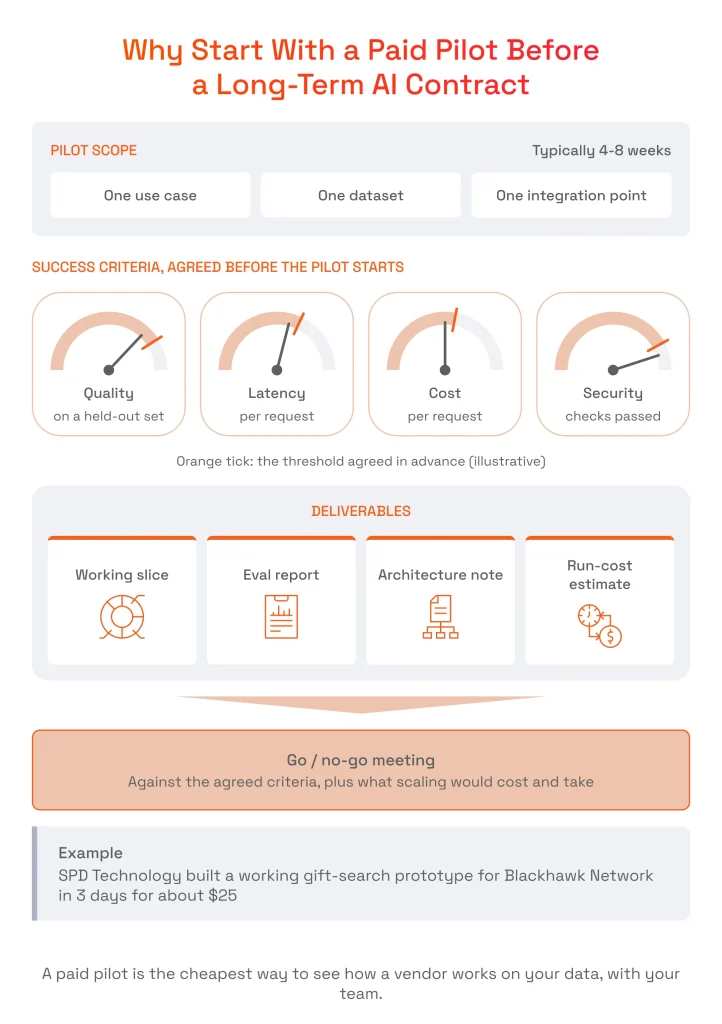
A paid, tightly scoped pilot with agreed go/no-go criteria is the safest way to see how an external team works on your data, alongside your in-house team, and how it documents the architecture before you commit to a multi-quarter contract. It is more realistic than a speculative proof of concept on clean sample files, because a pilot tests data access, security boundaries, evaluation thresholds and unit economics for real.
Pilot element | Recommendation |
|---|---|
Scope | One use case, one dataset, one integration point |
Duration | Typically 4-8 weeks |
Success criteria | Quality on a held-out set, latency, cost per request, security checks passed |
Deliverables | Working slice, eval report, architecture note, run-cost estimate |
Go / no-go | Decision meeting against the agreed criteria; what scaling would cost and take |
Pilot element
Scope
Duration
Success criteria
Deliverables
Go / no-go
Recommendation
One use case, one dataset, one integration point
Typically 4-8 weeks
Quality on a held-out set, latency, cost per request, security checks passed
Working slice, eval report, architecture note, run-cost estimate
Decision meeting against the agreed criteria; what scaling would cost and take
A pilot that passes moves on to MVP and then to production. Most surprises on the way from pilot to production are data or latency issues the pilot already pointed to.
The first step can be small. For Blackhawk Network, SPD Technology validated an AI gift assistant that uses semantic search to handle vague, emotional gift queries as an MVP in 3 days for $25 on Replit. The assistant later raised search-to-purchase conversion by 12.5% and items per order by 16%.
Before the pilot starts, set the baseline you will measure it against: our ROI guide shows how.
Why Partner With SPD Technology for AI Development Outsourcing?
SPD Technology builds its AI/ML development services around the production, governance and ownership standards in this guide, so technical buyers can check the engineering discipline before committing to a long engagement. Since 2006, with 650+ talents and 470+ projects delivered, we build systems that survive production, not just a demo, and stay accountable for them after launch. Whether you need help defining the solution or want your own spec delivered to a production standard, the evidence below applies.
- Measurable production outcomes. Besides the systems above, SPD Technology built a credit card fraud detection module that saved its client up to 40% of financial losses and went live in 3 months, and an AI/ML PDF data extraction pipeline for a B2B financial intelligence publisher. Combining NLP, YOLO, Camelot/AWS Textract and GPT, the pipeline processes documents 3x faster at 5x lower cost and scaled from 25 to 50+ source document structures.
- Evidence on every release. Each production deployment comes with an evidence package: the exact code or prompt change, automated test results, eval metrics on held-out data, security checks, senior sign-off and a tested rollback plan.
- You own the delivery system. Application code, data pipelines, specs, test suites, eval datasets and agent configurations live in your cloud accounts and repositories and are yours by contract, so handover is clean and there is no lock-in.
- Calibrated autonomy in delivery. Decisions on money movement, personal data and core architecture stay human-led. A named senior engineer approves every release, and any code that touches payments or PII passes a dedicated security review gate.
- Regulated domain experience. Our engineers have built data and AI systems for Morningstar, Blackhawk Network and Pie Insurance, and our fintech teams work to PCI DSS, SOC 2 and GDPR requirements every day.
- Partners you can check. SPD Technology is an AWS Select Tier Services Partner, an Adyen service partner and a Select-tier member of the Claude Partner Network (Services Track), with Claude-certified architects.
- Flexible entry points. Whether you are scoping agent projects or validating an AI strategy first, engagements run as dedicated project teams or staff augmentation, depending on scope, with clear specifications and measurable acceptance gates.
See what a first engagement includes: scope, deliverables and success criteria.
Conclusion
Success with AI development outsourcing depends on replacing slide-deck promises with engineering evidence before you commit to a long-term contract. Assess vendors on a 6-month production track record, data governance, automated evaluations on your own held-out data, MLOps observability, IP assignment and transparent run-cost modeling, and the difference between a demo shop and a production team becomes clear. Technical due diligence and the right contract terms protect your architecture from creeping technical debt, silent quality drift and vendor lock-in. A properly scoped, paid pilot then turns vendor selection into an engineering decision based on real metrics from your own data.
If you have already narrowed your shortlist and want to see how our engineers perform on your data, start with a scoped pilot.
Key Takeaways
- AI demos run on curated datasets, so only systems a vendor has kept in production for months show whether it can deliver yours.
- Accuracy on the vendor’s data does not predict accuracy on yours, so agree a held-out eval set and thresholds before the build starts.
- Most AI spend moves from build to run after launch, so a proposal without a monthly run cost is incomplete.
- If weights, prompts, data pipelines and eval suites stay with the vendor, switching later means rebuilding them, so assign them to the client in the contract.
- Model quality drifts as data and provider versions change, so monitoring, re-evaluation and a named owner must be part of scope.
- A short paid pilot with go/no-go criteria exposes a vendor’s real working method at a fraction of the cost of a failed long contract.
In short: choose the vendor that proves production results on your data, prices the run cost and assigns you the IP, then confirm the choice with a paid pilot.
FAQ
How much does it cost to outsource AI development?
AI development cost depends on scope, data work and the run cost after launch more than on the hourly rate. 2026 market benchmarks compiled from vendor surveys put a proof of concept at roughly $15,000-$35,000, an MVP at $25,000-$60,000 and a production deployment at $60,000-$150,000, with monthly run costs from a few hundred to several thousand dollars. Data preparation, integration, evaluation, MLOps and compliance work are the main drivers. Ask every shortlisted vendor for an itemized build estimate and a run-cost projection at your expected volume, with token and cloud costs stated separately.
How do I protect IP and data when outsourcing AI development?
Write IP assignment clauses into the contract that give you ownership of all custom code, data pipelines, fine-tuned weights, prompt templates and eval suites. Sign a data processing agreement that names approved cloud regions and model endpoints, with zero data retention terms, so your data never trains a third-party model. Have engineers work inside your own cloud accounts and repositories so access can be revoked at once, and agree a documented exit plan before you sign.
How long does an outsourced AI project take from pilot to production?
A focused pilot typically takes 4-8 weeks, and turning a validated pilot into a production AI product often takes a few months, depending on data readiness, legacy integrations, compliance reviews and support expectations. Schedules stall most often when teams lack timely access to production data or start building without written acceptance criteria and an evaluation plan. Ask for a phased AI/ML project timeline with go/no-go gates between discovery, pilot, MVP and production, and agree early when your team takes over monitoring.
What certifications should an AI development company have?
Look for SOC 2 Type II and ISO 27001 as the security baseline, ISO/IEC 42001 where held, documented GDPR procedures, and HIPAA readiness with a signed business associate agreement for US health data. Company-level certifications cover the organization’s controls, so your workload still needs its own review of data isolation and model hosting. Ask for the audit reports themselves, since website badges prove nothing.
When should a company build AI in-house instead of outsourcing it?
Build in-house when the AI capability is your core differentiator, needs daily iteration for years, and you can hire and keep senior AI engineers. Outsource when you need production AI experience quickly, lack specific skills such as MLOps or evaluation, or want to validate a use case before hiring. Many companies use a hybrid split: product ownership, domain data and final decisions in-house, build and operations with a vendor, with knowledge transfer planned from day one.
What should an AI vendor due diligence process include?
A sound process covers production references with measured outcomes, a technical assessment of architecture, data pipelines, evals and MLOps, a security and compliance review, CVs of the named engineers, and contract terms covering IP, exit, SLAs and run cost. Ask for a sample of how releases are verified, speak directly with a reference client’s technical lead, and finish with a paid pilot on your own data.
What is the difference between an AI prototype and a production AI system?
A prototype shows that an AI concept can work on clean, hand-picked inputs in a controlled environment. A production system serves live users and messy real-world data, with observability, fallbacks, security guardrails, evaluation gates on every release and a named engineering owner. Most engineering cost and operational risk sit in that transition, so check which systems a vendor has kept in production for months.
How do you evaluate an AI vendor’s model quality?
Before development starts, agree a frozen held-out test set built from your own domain data, with target thresholds for task accuracy, hallucination rate, tail latency and cost per request. Require automated evals with regression tracking on every release. For generative AI apps, check how LLM-as-judge scoring is calibrated against human domain ratings; for multi-step agents, make sure trajectory evaluation inspects intermediate tool calls as well as the final output.