

The future of software engineering is humans managing AI agents. Agents now code, test, and refactor a growing share of the codebase, so the engineer’s job shifts from writing syntax to expressing intent: writing the specification, designing context and boundaries, verifying output with tests and evals, and owning the release.
Generation is getting cheap. Judgment, verification, and accountability are not. Teams that treat this as agentic engineering deliver faster without losing control because agents work inside human-defined constraints and feedback loops. Teams that only add tools shift the cost to code review and rework.
Agent output stopped being the constraint on your team some time ago. Review didn’t scale with it, and for engineering leaders, the future of software engineering is now a question of how work, roles, and teams change when humans manage AI agents.
Throughput has increased, yet nobody became the named owner of what the agents merged last sprint. Google Cloud’s 2025 DORA report, based on responses from almost 5,000 technology professionals, found that 90% use AI at work and that throughput rises with adoption, while delivering software to spec remains an open question.
This article defines the terms, describes what agents can and cannot do today, and sets out a workflow for managing them. It also gives an honest answer on replacement, the skills that grow in value, and how to prepare an engineering team.
What Is the Future of Software Engineering?
The future of software engineering is an operating-model question. A team adopts coding agents in a week, then spends a year rebuilding the work around them. The shift fits in one sentence: engineers move from writing code to directing, checking, and owning the work of AI agents.
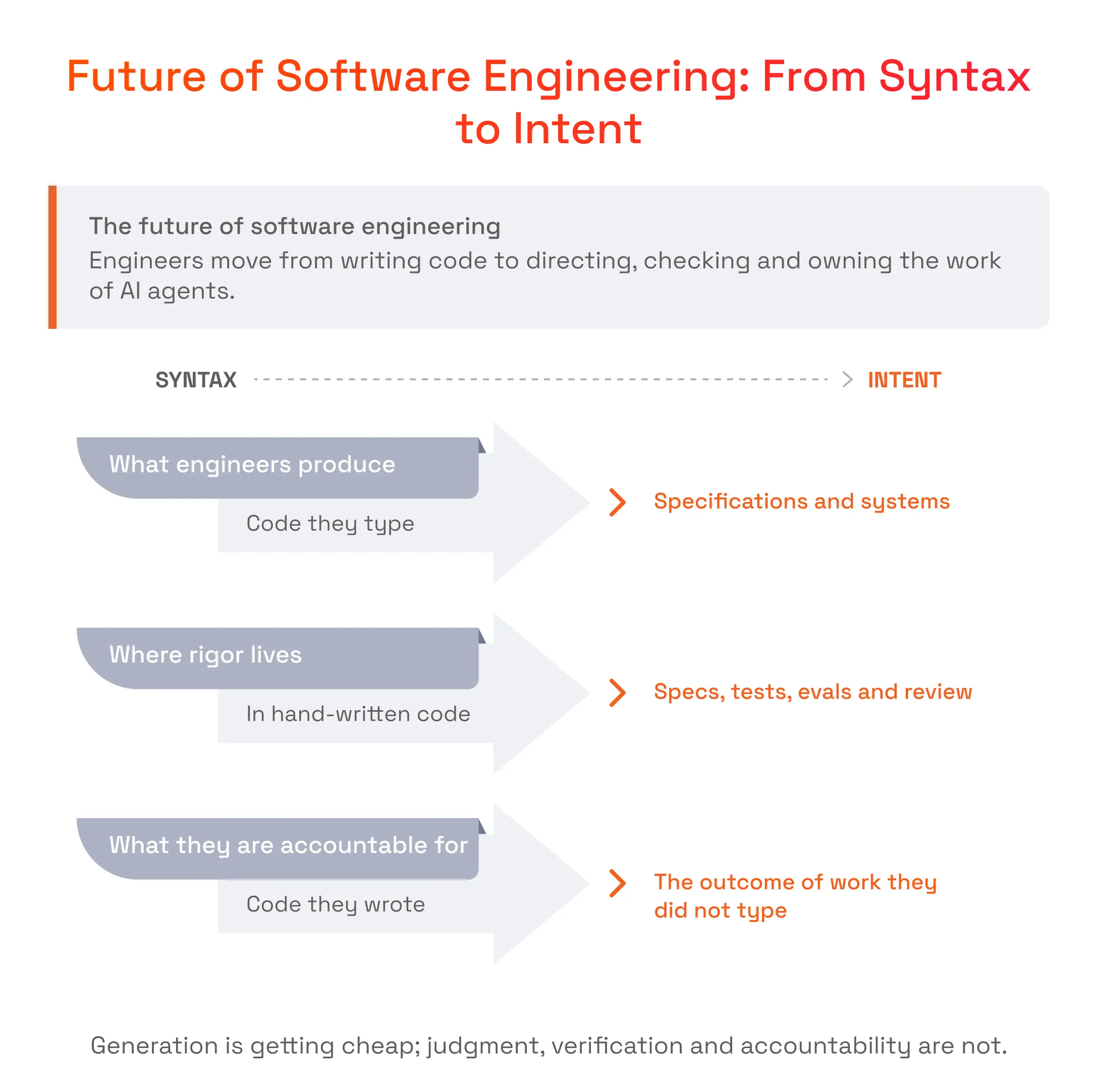
The shorthand is from syntax to intent. The spec comes first: a specification with intent, constraints, and acceptance criteria. The agent writes the matching syntax. Engineers still read code every day, but a team living through the future of software engineering with AI sees this change first in the editor and in code review.
Three things move at once. Engineers produce specifications and systems, so code becomes one output among several. Thoughtworks, reporting from its 2026 Future of Software Development retreat, describes rigor shifting into specs, tests, evals, and review, where someone still pays for it. And accountability lands on the outcome of work the engineer didn’t type. That last one catches people out. An engineer who understands how LLMs behave writes constraints that hold.
Andrew Ng puts the binding constraint elsewhere again. He argues that cheaper code shifts the expensive judgment toward deciding which feature should be built at all. Code has become cheaper to produce; that decision still sits with a person.
What Can AI Coding Agents Do in 2026 and Where Do They Still Fail?
AI coding agents can now plan multi-step changes, edit many files, run tests, and open pull requests, but they still miss edge cases, integration details, and business rules that only verification catches. Capability and trust moved at different speeds, and leaders now manage the gap between the two.
A coding agent runs a loop: perceive, plan, act, observe, iterate. It runs in the editor, in the terminal, and in the background in CI. The background runs in CI are the ones nobody watches.
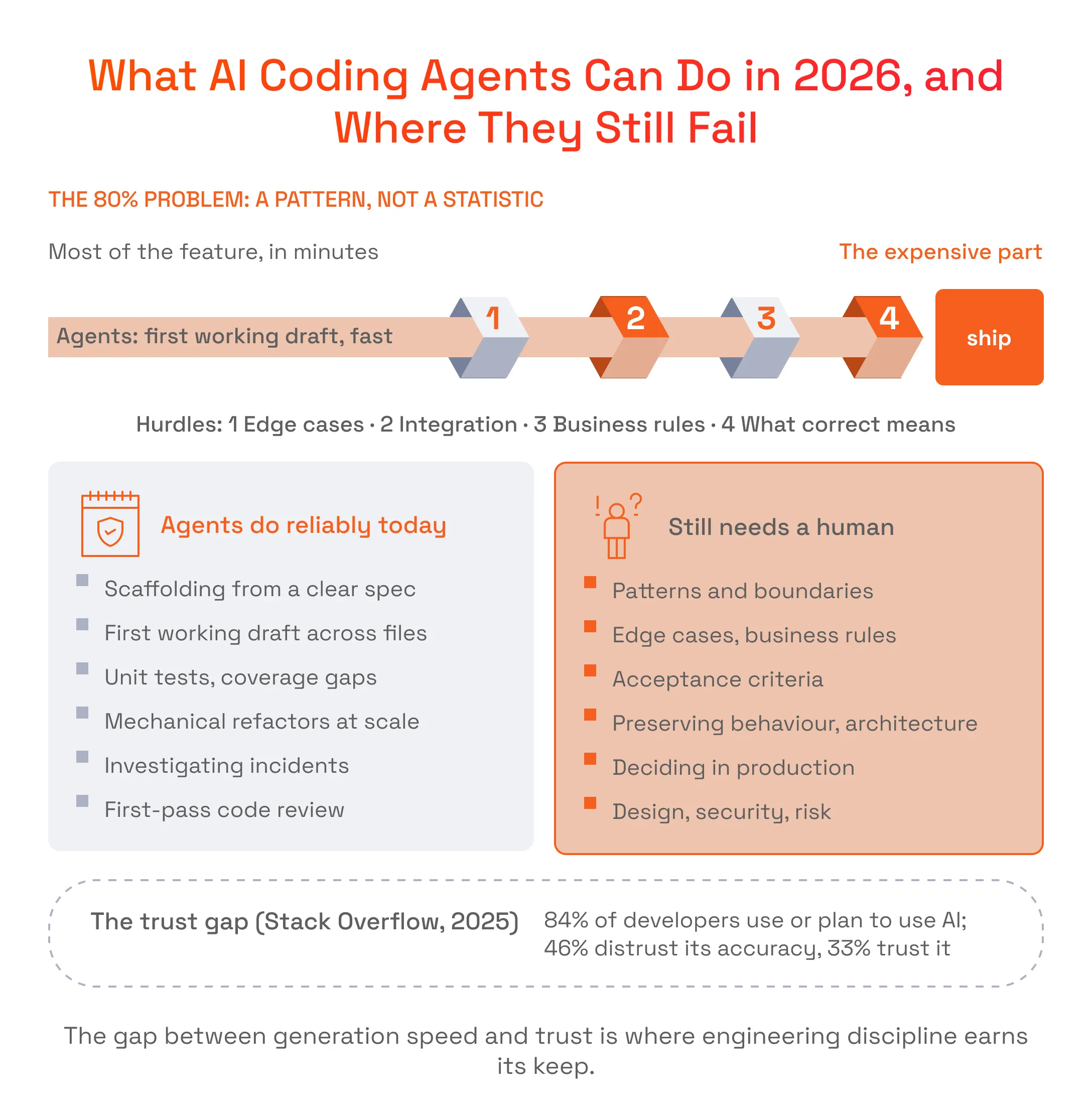
The 80% problem starts with a quick feature draft. An agent drafts most of a feature fast, and the remainder holds the integration details, the business rules, and the question of what “correct” means here. Most teams budget for the draft and pay for the remainder.
The split between agent work and human work runs task by task.
Task | What Agents Do Reliably Today | What Still Needs a Human |
|---|---|---|
Scaffolding and boilerplate | Generate quickly from a clear spec | Choosing the pattern and boundaries |
Feature implementation | First working draft across files | Edge cases, business rules, integration |
Tests | Generate unit tests, find coverage gaps | Deciding what correct means, acceptance criteria |
Refactoring and migration | Mechanical changes at scale | Preserving behavior through characterization tests, architecture decisions |
Debugging and incidents | Investigate, propose a fix | Deciding and acting in production |
Code review | First-pass review, style and obvious defects | Design, security and risk judgment |
Task
Scaffolding and boilerplate
Feature implementation
Tests
Refactoring and migration
Debugging and incidents
Code review
What Agents Do Reliably Today
Generate quickly from a clear spec
First working draft across files
Generate unit tests, find coverage gaps
Mechanical changes at scale
Investigate, propose a fix
First-pass review, style and obvious defects
What Still Needs a Human
Choosing the pattern and boundaries
Edge cases, business rules, integration
Deciding what correct means, acceptance criteria
Preserving behavior through characterization tests, architecture decisions
Deciding and acting in production
Design, security and risk judgment
Adoption and trust came apart. Stack Overflow’s 2025 Developer Survey, with more than 49,000 respondents, found that 84% use or plan to use AI tools, while 46% distrust the accuracy of the output and 33% trust it. METR’s 2025 randomized controlled trial measured the cost: 16 experienced developers took 19% longer across 246 real tasks in their own mature repositories with early-2025 tools, then estimated afterward that AI had sped them up by about 20%.
In its February 2026 follow-up, METR leans toward a real speedup from newer tools while calling its own new estimate unreliable, because developers who most want to use AI increasingly decline to take part. For leaders, neither the 19% nor the enthusiasm holds up as evidence; only their own baseline does.
Quality is the other side of the coin. Whether AI-generated code survives production depends on the structure around the model. A first-pass review that misses security risks in AI-generated code approves a pull request that looks clean but isn’t.
Generation got fast. Trust did not, and until a team can show evidence that a given change is correct, every hour saved in the editor comes back as an hour spent in review.
What Do Humans Still Own When AI Agents Write the Code?
Humans own intent, architecture, verification, and accountability: what to build, which constraints it must satisfy, whether it is right, and the decision to release it. No agent owns any of the four, and each one ends with a named person signing.
- Intent and priorities, meaning what gets built and in what order
- Architecture and trade-offs, including the boundaries agents work inside
- Verification and acceptance, meaning tests, evals, and what counts as done
- Release decisions and accountability, especially where money, personal data and security are involved
Generation is the cheap part. Verification, judgment, and direction are the craft now, and a team still rating engineers on volume of functional code is measuring the thing that got cheap.
Conductor vs. Orchestrator: Two Ways to Manage AI Agents
A conductor guides one agent in real time inside the IDE, steering it and reviewing each edit as it appears. An orchestrator delegates decomposed, well-specified tasks to several agents asynchronously and reviews the results against tests and evals, which is what AI agent orchestration means in a working development environment. Managing AI agents starts with knowing which mode a task deserves.
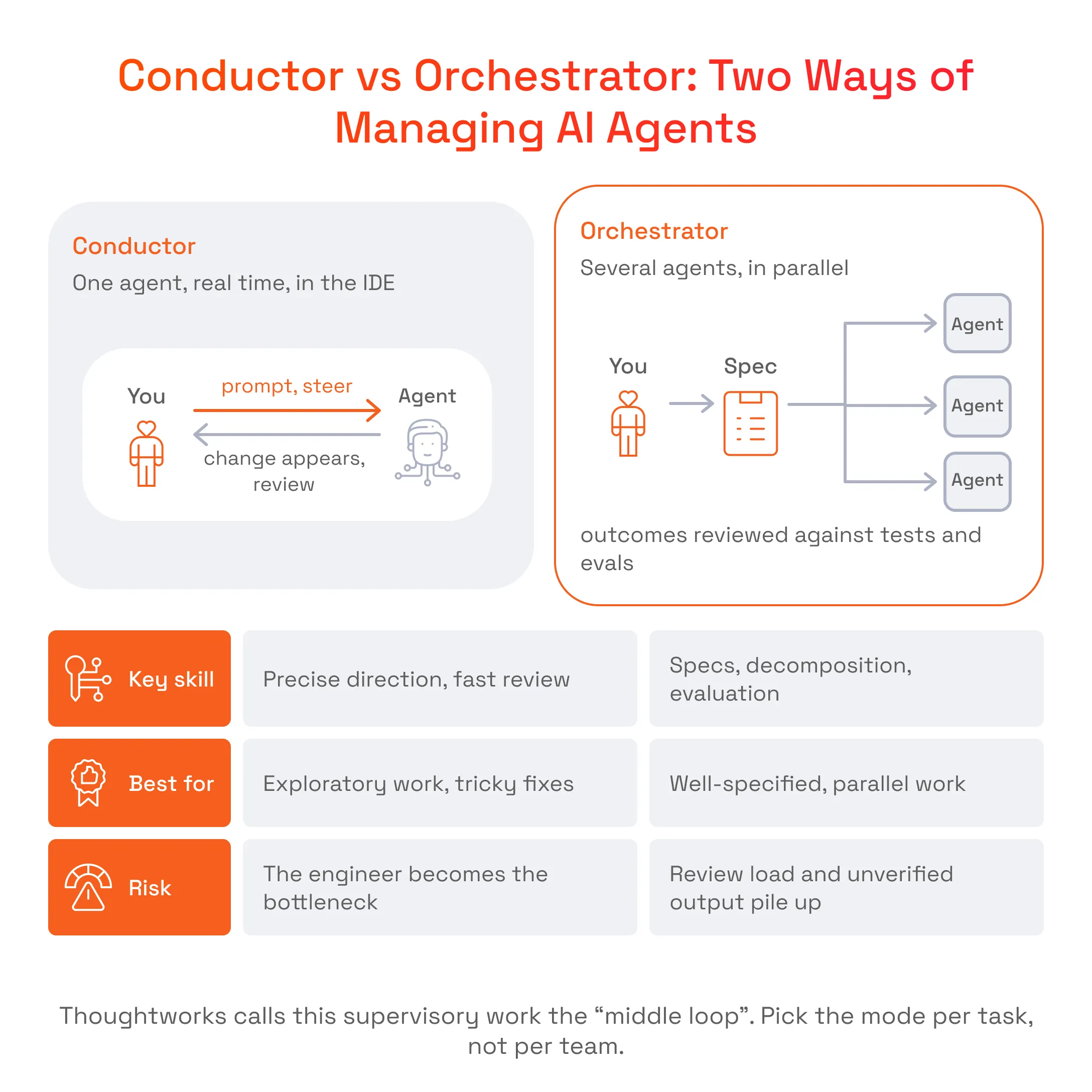
Thoughtworks calls this supervisory work between writing code and releasing the middle loop. That loop is where the senior day goes now, and it stays invisible in any tracker built around tickets and commits.
The two modes differ in what they demand and in how they fail.
Conductor | Orchestrator |
|---|---|
Interaction | Real-time, one agent, in the IDE |
Main activities | Prompting, steering, reviewing changes as they appear, interactive debugging |
Key skill | Precise direction and fast review |
Best for | Exploratory or unclear tasks, tricky fixes |
Risk | Engineer becomes a bottleneck |
Conductor
Interaction
Main activities
Key skill
Best for
Risk
Orchestrator
Real-time, one agent, in the IDE
Prompting, steering, reviewing changes as they appear, interactive debugging
Precise direction and fast review
Exploratory or unclear tasks, tricky fixes
Engineer becomes a bottleneck
The mode is a per-task choice. An unclear bug in unfamiliar code earns an hour of hands-on investigation; a well-specified migration across forty files does not. The engineer makes that call before writing a single prompt.
Why Verification Becomes the Core Engineering Skill
Tests and evals answer different questions. Tests check deterministic behavior: input X returns Y. Evals judge non-deterministic behavior against a rubric that covers task success, quality, correct tool use and policy compliance. Keeping tests and evals straight matters, because using one where the other belongs produces green runs that mean little.
Output evaluation scores the final artifact against the rubric. Trajectory evaluation looks at the path the agent took: which tools it called, where it went wrong and how it reached an answer that may look fine on the surface. That is how it surfaces failure modes a passing test can miss.
Manual review is usually the first response to rising agent output, and it stops scaling early. Thoughtworks reports verification as the constraint on delivery once agents produce at volume, which is what multi-agent review queues make visible. Risk tiering is the answer, because not every change earns the same scrutiny.
Where a person sits in that pipeline is a design decision, and the human-in-the-loop approach describes where to put them. The automated half rests on evals that encode what good looks like for your product. Together, those two mechanisms carry most of the answer to how to trust AI-generated code at merge.
How Is Agentic Engineering Different From Vibe Coding?
Agentic engineering is a disciplined way of building software in which AI agents work inside human-defined constraints, tests, evals and feedback loops, so every release can be verified rather than just generated. The difference is structural. Both approaches produce working code on a good day; only one produces evidence.
Vibe coding has a place. It suits prototypes and throwaway code, and it gets risky when prototype practice reaches production. A team can check whether a vibe-coded prototype is ready for production before that question arrives as an incident.
Input, verification and autonomy move together across the spectrum, with the spec carrying the weight at the far end.
Vibe Coding | Structured AI-Assisted Coding | Agentic Engineering |
|---|---|---|
Input | Informal prompts | Prompts plus rule files |
Verification | “Looks right” | Code review plus some tests |
Agent autonomy | Unbounded within the session | Limited, supervised |
Good for | Prototypes, experiments | Everyday features in small teams |
Main risk | Hidden defects, security gaps | Review overload |
Vibe Coding
Input
Verification
Agent autonomy
Good for
Main risk
Structured AI-Assisted Coding
Informal prompts
“Looks right”
Unbounded within the session
Prototypes, experiments
Hidden defects, security gaps
Agentic Engineering
Prompts plus rule files
Code review plus some tests
Limited, supervised
Everyday features in small teams
Review overload
Context engineering decides what an agent knows and can use: instructions, knowledge, memory, examples, tools and guardrails, with static rule files always loaded and dynamic context retrieved when needed. An agent is the model plus its harness.

Serhii Leleko
AI & ML Engineer at SPD Technology
“Teams keep switching models when agent output degrades. In our experience, the model is rarely the variable that matters. What decides reliability is the layer around it: the rule files, the scoped tools, the sandbox, the evals, and whether a failed run teaches the system anything. We rebuild that layer before we touch the model, because a stronger model inside a weak harness just fails faster.”
Follow that through, and the engineer’s output changes shape. It becomes the factory: the system that produces software from specs, context, agents, tests, quality gates, and feedback loops.
What Does Managing AI Agents Look Like on a Real Team?
In a team that manages AI agents well, engineers write the specification, decompose the work into tasks agents can verify, delegate, review results against tests and evals, and own each merged change. None of that is new management theory. It is ordinary delivery discipline applied to a worker that types faster than any human can read.
The sequence is stable across teams, and a working agentic development workflow runs in this order:
- Specify intent and acceptance tests.
- Curate context: rule files such as AGENTS.md, Agent Skills, and docs.
- Decompose into verifiable tasks.
- Delegate to agents with scoped permissions.
- Verify with tests, evals, and risk-tiered human review.
- Merge with a named owner.
- Observe in production and feed failures back into specs and evals.
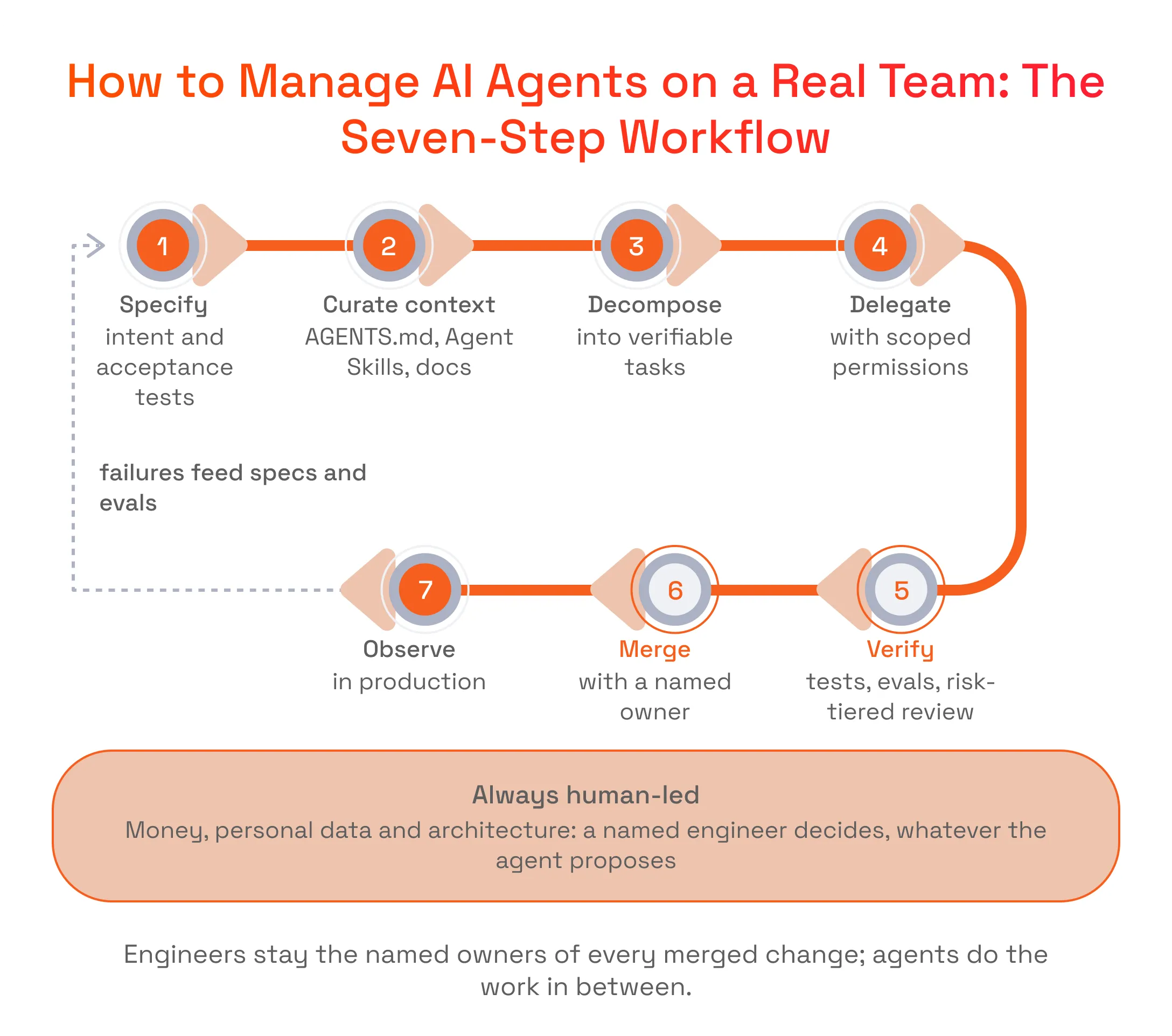
Autonomy matches the cost of a mistake. Humans decide on money, personal data and architecture. Most other features run AI-assisted and human-verified, while low-risk, well-tested changes are automated and machine-verified. Thoughtworks describes similar tiers based on risk and blast radius, and the guardrails that enforce them make AI agent orchestration auditable.
Before agents touch production, run the AI production-ready checklist.
Roles change without anyone changing their title. Seniority shapes the conductor vs. orchestrator balance, and the table shows what changes in each role.
Role | What Changes | What Grows in Value |
|---|---|---|
Staff / principal engineer | Less hands-on code, more system design | Architecture, specs, harness and eval design, final review |
Senior engineer | Orchestrates several agents | Decomposition, verification, mentoring |
Junior engineer | Writes less boilerplate | Supervised practice, reading and testing code, learning what good looks like |
Platform team | Owns the paved road for agents | Shared harness, permissions, observability, cost controls |
QA / test engineer | From manual checks to eval design | Eval datasets, rubrics, regression suites |
Engineering manager | Measures the system, not activity | Cost of change, rework, review load |
Role
Staff / principal engineer
Senior engineer
Junior engineer
Platform team
QA / test engineer
Engineering manager
What Changes
Less hands-on code, more system design
Orchestrates several agents
Writes less boilerplate
Owns the paved road for agents
From manual checks to eval design
Measures the system, not activity
What Grows in Value
Architecture, specs, harness and eval design, final review
Decomposition, verification, mentoring
Supervised practice, reading and testing code, learning what good looks like
Shared harness, permissions, observability, cost controls
Eval datasets, rubrics, regression suites
Cost of change, rework, review load
Governed automation is the mechanism underneath all of it. For a US ticketing platform, we embedded Claude Code in daily engineering with 47 custom skills, 6 subagents, and 19 slash commands versioned in the client’s own repository. Incidents are investigated read-only: the agent gathers evidence, and a human decides.
Will AI Replace Software Engineers?
Will AI replace software engineers? Every engineering leader gets asked, and the answer is no. AI is replacing much of the typing, and the need for engineering judgment rises as software becomes cheaper to produce. The exposure sits one level down, where developers start their careers.
What disappears is narrow: handwritten boilerplate, routine tasks, and first-draft code are going away or already gone.
What grows covers more ground:
- System design and architectural judgment
- Specification writing and acceptance criteria
- Verification, evals and release evidence
- Domain knowledge and business sense
- Direction of agent work, which is how AI-native development teams ship faster without invisible rework
- Soft skills, because more of the work is negotiation about intent
Andrew Ng expects fewer jobs to be lost than feared, while acknowledging a harder market for graduates and that layoffs attributed to AI often have other causes. In an industry where tech companies lay off and hire at the same time, that reading holds up better than either extreme.
The junior pipeline is the real exposure. If agents absorb the hands-on struggle, junior developers lose the path that produced judgment, and in five years there are fewer seniors to review anything. Nodeland argues that fundamentals matter again, IBM frames it as rebuilding the pipeline with structure, and Thoughtworks describes design quorums where seniors lead design while juniors prompt alongside non-AI learning checkpoints. The future of software development turns on whether leaders treat this as org design.
Keep hiring juniors and redesign their first year around supervised verification. Then measure whether any of it lowered the cost of change, because the ROI of AI-assisted software engineering shows up in rework and change failure rate long before velocity.
Which Skills Will Software Engineers Need Next?
The skills that grow in value are the ones agents cannot supply: systems thinking, specification writing, verification, domain understanding, and agent management. Agents optimize locally. They don’t weigh the user, the budget, or the next two years of the codebase.
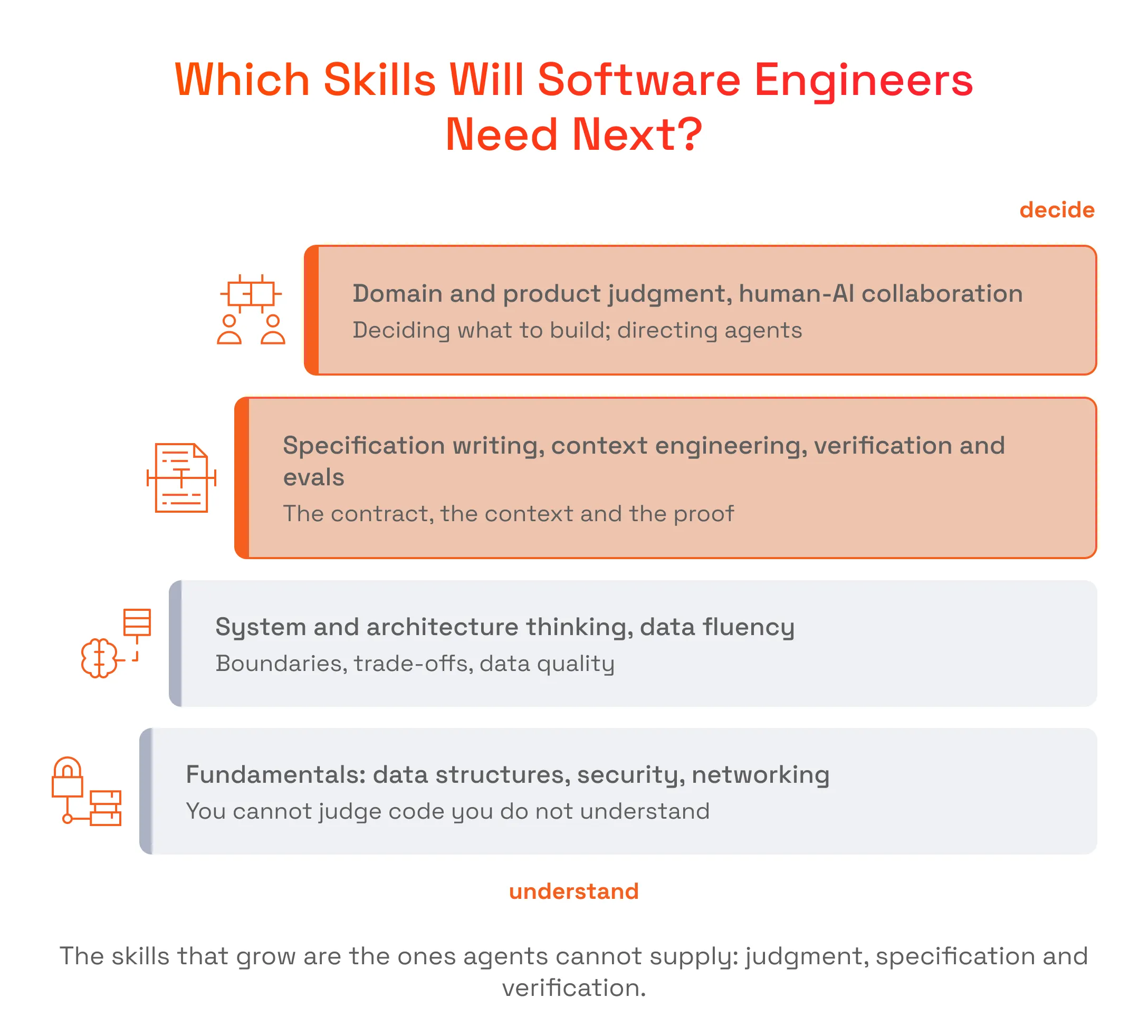
Ownership now runs end to end. The engineer who specified a feature owns the user outcome, which pulls them closer to the product manager who sized it, the data analytics it feeds, and the support queue it generates six months later. Strong human-AI collaboration holds that span together.
This is the set worth building hiring and growth plans around.
Skill | Why It Matters More With AI Agents | How to Build It |
|---|---|---|
System and architecture thinking | Agents optimize locally; humans own boundaries and trade-offs | Design reviews, ADRs |
Specification writing | The spec is the contract agents work to | Spec-first practice, acceptance tests |
Verification and evals | Generation is cheap, trust is not | Eval design, test strategy |
Context engineering | Agent quality depends on what it knows | Maintain rule files, skills, docs |
Fundamentals: data structures, security, networking | You cannot judge code you do not understand | Deliberate non-AI practice |
Data fluency | AI systems are data systems | Data lineage and quality ownership |
Domain and product judgment | Deciding what to build is the new constraint | Product pairing, customer exposure |
Human-AI collaboration | Managing agents is a delegation skill | Conductor and orchestrator practice |
Skill
System and architecture thinking
Specification writing
Verification and evals
Context engineering
Fundamentals: data structures, security, networking
Data fluency
Domain and product judgment
Human-AI collaboration
Why It Matters More With AI Agents
Agents optimize locally; humans own boundaries and trade-offs
The spec is the contract agents work to
Generation is cheap, trust is not
Agent quality depends on what it knows
You cannot judge code you do not understand
AI systems are data systems
Deciding what to build is the new constraint
Managing agents is a delegation skill
How to Build It
Design reviews, ADRs
Spec-first practice, acceptance tests
Eval design, test strategy
Maintain rule files, skills, docs
Deliberate non-AI practice
Data lineage and quality ownership
Product pairing, customer exposure
Conductor and orchestrator practice
Computer science fundamentals sit under every row. An engineer who cannot read the code cannot judge it, which is the whole argument for keeping deliberate practice with no model running on the growth plan.
How SPD Technology Approaches AI Agent Management
SPD Technology engineers the system humans use to manage AI agents (specs, context, harness, evals, and release evidence), and our agentic AI development services leave that system in the client’s repository. Autonomy is calibrated to risk: money, personal data, and architecture stay human-led. A named senior engineer approves every release, and the author of a change never judges it alone, so review stays independent.
Every release carries an evidence package: the change, the tests, the security checks, the sign-off and the rollback path. Rule files, skills, subagents and eval suites are versioned in the client’s repository, and the patterns behind them come from building production AI with Claude.
Three engagements carry the proof.
For a US ticketing platform, governed Claude Code moved into daily engineering, and these gains came at constant headcount:
- +89% delivery output
- 2× code-review throughput
- −81% human-reported bugs
- 92% autonomous-run success on automation pipelines
VayaPin, a geolocation and digital-addressing platform, was running a small engineering team across three systems at once. Claude now writes, reviews and refactors 100% of production code across all three under engineer supervision, and the engineers keep the specification, the review and the release decision.
Our team also built an incident management agent that investigates an alert and opens a pull request with a proposed fix. It never merges on its own. Time to a PR-ready fix fell from 60+ minutes to under 30 minutes, up to 70% of incidents are resolved autonomously, and the 24/7 on-call rotation is no longer needed.
Where the org change has to be planned before the tooling, our AI consulting starts with the operating model and the measurement. SPD Technology is a Select-tier member of the Claude Partner Network (Services Track) with Claude-certified architects, and AI speed that survives production is the point of all of it.
See what starting an AI-assisted engineering engagement looks like, including scope, deliverables and success criteria.
Conclusion
The future of software engineering is humans leading AI agents. The decisive work is specification, verification and ownership, and all three end with a person named in a release note. Leaders who build that system now get speed that survives production.
Teams that only buy tools get faster rework. The cost lands two quarters later, in review queues that never shorten and a change failure rate nobody can account for. That outcome follows from an operating-model decision taken early and then left alone.
The next move is scoping what that system looks like on your own repositories.
Key Takeaways
- Because AI coding agents make code generation cheap, the scarce engineering work shifts to specifying intent, verifying output, and owning what ships.
- Because agents produce code faster than people can review it, verification through tests, evals, and risk-tiered review becomes the main constraint on delivery speed.
- Engineers who run only one agent at a time become the bottleneck, so teams gain the most when senior engineers orchestrate several agents against clear specs.
- Agentic engineering differs from vibe coding in the structure around the model (specs, context, guardrails, tests and evals), and that structure is why it survives production.
- If agents absorb all junior-level work, teams lose the path that produces future seniors, so junior roles need redesign around supervised verification.
- Measuring lines of code or prompts hides rework, so leaders should track change failure rate, first-pass yield, and cost per merged change.
In short: humans leading agents is an operating-model decision a leader owns, and no tool purchase makes it for them.
FAQ
Will AI replace software engineers?
No, AI will not replace software engineers. It replaces much of the typing, and the need for engineering judgment rises as software gets cheaper to produce. The exposure is the junior-to-senior path, which builds judgment through supervised work. Teams that keep hiring juniors and restructure their first year around supervised verification end up with a bench of future seniors.
What will software engineers do when AI agents write most of the code?
They specify, verify, and own. Specification means writing the intent, constraints, and acceptance criteria the agent works to. Verification means building tests and evals that check whether the output meets those criteria, and reading the code to understand the design. Ownership means a named engineer stands behind each merged change, including the ones nobody typed. The hard part moves earlier, into deciding what correct means.
What is the difference between vibe coding and agentic engineering?
The difference is structural. Agentic engineering is a disciplined way of building software in which AI agents work inside human-defined constraints, tests, evals and feedback loops, so every release can be verified rather than just generated. Vibe coding prompts a model and accepts whatever looks right, which is fine for prototypes and code without long-term maintenance. In production, it tends to surface as bugs months after deployment.
How do you manage several AI coding agents on one team?
Break the work into verifiable subtasks, give each agent scoped permissions and check results with tests and evals. A senior engineer acts as orchestrator, running several agents against clear specifications, while an engineer working in the IDE handles the tasks that are still unclear. Review capacity is the bottleneck, so changes are ranked by risk and close reading goes where a mistake is expensive.
What skills will software engineers need in the next five years?
Systems and architecture thinking, specification writing, verification and eval design, domain knowledge and the ability to direct agents. Software fundamentals matter more than ever, because an engineer who cannot read code cannot evaluate what the agent created. Data fluency earns its place too, because an AI system is a data system.
How should engineering leaders prepare their teams for AI agents?
Start with the operating model and the measurement, then the tooling. Pick one project, take a baseline of cycle time, change failure rate and rework, and run a bounded pilot against it. Write the rule files agents work from, build the eval suites that decide correctness and tier review by risk so attention goes where a mistake is expensive. Track cost per merged change, since volume now measures the cheap part.
How much does it cost to set up an agentic engineering workflow for a team?
By SPD Technology’s estimates, a bounded enablement pilot on one repository usually costs $10,000–$50,000, and agent tooling adds roughly $19–$200 per engineer per month at November 2026 list prices.
Cost tracks four things. The number of repositories and systems sets the starting point, because each needs its own context and conventions. The amount of existing specification determines how much writing happens before any agent runs. Eval suites built from scratch are usually the biggest line item. The review and permission model accounts for the rest.
How long does it take for a team to start managing AI agents in production?
The first changes land within weeks; the complete operating model takes about six months. Phase one is a bounded pilot on one project with a baseline, taking four to six weeks, so there is something to measure against. Phase two covers specifications, context and guardrails, and holds most of the writing. Phase three adds evals and risk-tiered review, which determine how much autonomy the team can hand over. Consolidating governance under a named owner takes roughly three more months, which is where the six-month figure comes from.