

Strong SaaS development companies design for multi-tenancy, security and scale from the first release, because those foundations are expensive to retrofit once paying customers depend on the product. When comparing SaaS software development companies, score each vendor on the same criteria: multi-tenant architecture and tenant data isolation, SaaS portfolio depth, subscription billing, security and compliance, observability, pricing transparency, and code ownership after launch. Ask each vendor for delivery evidence, such as time to a first working prototype and time from approved change to production. Among the prominent software engineering vendors identified are SPD Technology, Netguru, Vention, ELEKS, ScienceSoft, Simform, Brocoders, and Radixweb.
Only 29% of respondents from companies with less than $100 million in revenue told McKinsey their organizations have reached the AI scaling phase, compared with nearly half at companies above $5 billion. Scaling a SaaS product is even harder for these smaller companies, because every new customer shares the same product, so tenant data isolation, SSO and billing have to work for all of them at once. An MVP built for the first few customers rarely has those foundations, so teams often turn to SaaS development companies for help. Adding those foundations after launch usually means at least a partial rebuild, because the AI MVP scaling risks that appear once real tenants arrive tend to sit deep in the architecture.
The right partner builds those foundations into the platform before the next growth stage, which keeps rework small and lets the product grow with its customers. Finding that partner is the hard part, so we publish a shortlist with a weighted scorecard, cost and engagement models, and questions to ask before signing, and score SPD Technology by the same criteria as every other company on it.
Top SaaS Development Companies in 2026: Comparison Table
Every company on the shortlist has SaaS application development services by name, shows SaaS case studies with multi-tenant or subscription products, and holds a Clutch rating of 4.8 or higher.
Company | HQ | Founded | Team size | Hourly rate | Clutch | Best fit |
|---|---|---|---|---|---|---|
SPD Technology | London, UK | 2006 | 650+ | $50-99 | 4.8 | Scaling SaaS platforms; AI-native MVPs taken to production; fintech and data-heavy products |
Netguru | Poznań, Poland | 2008 | 250-999 | $50-99 | 4.8 | Design-led MVPs for funded startups |
Vention | New York, US | 2002 | 1K-10K | $50-99 | 4.9 | Long-term dedicated |
ELEKS | Tallinn, Estonia | 1991 | 1K-10K | $50-99 | 4.8 | Data- and ML-heavy SaaS |
ScienceSoft | McKinney, US | 1989 | 500-999 | $50-99 | 4.8 | Broad enterprise capability, low entry budget |
Simform | Orlando, US | 2010 | 1K-10K | $25-49 | 4.8 | Cloud-native builds on AWS |
Brocoders | Tallinn, Estonia | 2014 | 50-249 | $50-99 | 5.0 | Startup and mid-market SaaS |
Radixweb | Frisco, US | 2000 | 250-999 | $25-49 | 4.8 | Legacy-to-SaaS modernization |
Company
SPD Technology
Netguru
Vention
ELEKS
ScienceSoft
Simform
Brocoders
Radixweb
HQ
London, UK
Poznań, Poland
New York, US
Tallinn, Estonia
McKinney, US
Orlando, US
Tallinn, Estonia
Frisco, US
Founded
2006
2008
2002
1991
1989
2010
2014
2000
Team size
650+
250-999
1K-10K
1K-10K
500-999
1K-10K
50-249
250-999
Hourly rate
$50-99
$50-99
$50-99
$50-99
$50-99
$25-49
$50-99
$25-49
Clutch
4.8
4.8
4.9
4.8
4.8
4.8
5.0
4.8
Best fit
Scaling SaaS platforms; AI-native MVPs taken to production; fintech and data-heavy products
Design-led MVPs for funded startups
Long-term dedicated
Data- and ML-heavy SaaS
Broad enterprise capability, low entry budget
Cloud-native builds on AWS
Startup and mid-market SaaS
Legacy-to-SaaS modernization
Rates, team sizes and ratings shift often across the global SaaS market, so the table works best as a starting filter, with each figure confirmed with the vendor before a first call.
For products that are AI-first, the top AI development companies are worth comparing alongside this shortlist.
SaaS Software Development Companies to Shortlist: Profiles
All eight companies specialize in SaaS development and show SaaS case studies with multi-tenant or subscription products. They cover design-led MVPs, data-heavy products, AWS builds, mid-market SaaS and legacy modernization, so most buyers will find a match. They’re also based in different regions, from London to New York, which helps if time zone or rates matter to you.
SPD Technology
- HQ: London, UK
- Founded: 2006
- Team size: 650+
- Hourly rate: $50-99
- Clutch rating: 4.8
SPD Technology delivers SaaS product development from MVP to platform for teams whose product has traction but whose architecture hasn’t caught up. Its services add architecture governance, AI-coding guardrails and a scalability plan in three phases: an audit, a foundation rebuild and an optional platform health subscription, all running alongside the client’s roadmap. The project for Phoenix Security serves as a prominent example of the team’s expertise. SPD Technology rebuilt the scaling architecture of a vulnerability management platform now trusted by 380+ companies, which delivers 12x faster risk reduction at 7x lower cost.
Netguru
- HQ: Poznań, Poland
- Founded: 2008
- Team size: 250-999
- Hourly rate: $50-99
- Clutch rating: 4.8
Netguru covers the path from product discovery and rapid prototyping to MVP development, cloud architecture and platform engineering. For an edtech SaaS provider, Netguru built a multi-tenant web application on Node.js and Vue and delivered the MVP ahead of a major state contract. At the platform stage, it helped a calendar scheduling marketplace grow from a consumer booking app into a full business management platform, with the partnership expanding from a single team extension into a strategic co-creation alliance.
Vention
- HQ: New York, US
- Founded: 2002
- Team size: 1,000-10,000
- Hourly rate: $50-99
- Clutch rating: 4.9
Long-term dedicated teams and SaaS development from discovery to scale define Vention’s profile. For one of the company’s projects, Vention has worked from the MVP stage onward, adding 35+ engineers in two months to build the mobile apps, a venue portal and CI/CD pipelines, over an engagement that has run 8.5 years and now supports 40K studios in 30 countries. For a product with a multi-year roadmap that needs one partner from MVP to platform, Vention is worth a close look.
ELEKS
- HQ: Tallinn, Estonia
- Founded: 1991
- Team size: 1,000-10,000
- Hourly rate: $50-99
- Clutch rating: 4.8
ELEKS focuses on SaaS products in which data carries most of the value, with services that run from PoC development and product design to data platforms, DevOps and long-term support. For one of its clients, ELEKS built the first prototype and delivered the portal in four months, and the platform it has supported since 2017 now integrates data from more than 60 sources across 14 European gas markets. That combination of data engineering and long-term product work makes ELEKS a practical choice when analytics features drive the pricing plan.
ScienceSoft
- HQ: McKinney, US
- Founded: 1989
- Team size: 500-999
- Hourly rate: $50-99
- Clutch rating: 4.8
With broad enterprise capability and a dedicated SaaS practice, ScienceSoft covers SaaS consulting, multi-tenant architecture design, development, QA and long-term evolution under one vendor. For a SaaS advertising provider, ScienceSoft re-engineered the application into a multi-tenant one and refactored its code, which lowered the client’s maintenance costs. Teams that launch an MVP first and plan to grow it into a full platform will find that combination useful.
Simform
- HQ: Orlando, US
- Founded: 2010
- Team size: 1,000-10,000
- Hourly rate: $25-49
- Clutch rating: 4.8
Simform concentrates on cloud-native SaaS platforms, with services that span product strategy, product engineering, cloud and DevSecOps, and managed services after launch. For a sports technology company, whose early prototype could not give each school its own branding, fees and access rules, Simform built a multi-tenant platform on Azure in which every school runs as its own tenant. That path from prototype to multi-tenant product suits teams whose first version has outgrown its original setup.
Brocoders
- HQ: Tallinn, Estonia
- Founded: 2014
- Team size: 50-249
- Hourly rate: $50-99
- Clutch rating: 5.0
For startup and mid-market teams, Brocoders offers SaaS and MVP development alongside project takeover, software audit and application modernization. For CondoGenie, Brocoders replatformed a condo management system first built in 2009 into a multi-tenant SaaS and has kept it current for eight years. Companies whose existing product needs a multi-tenant foundation and a long-term engineering partner are the typical match.
Radixweb
- HQ: Frisco, US
- Founded: 2000
- Team size: 250-999
- Hourly rate: $25-49
- Clutch rating: 4.8
Radixweb specializes in legacy-to-SaaS modernization, with dedicated SaaS application and product development services alongside MVP builds. For a pharma marketing provider, Radixweb rebuilt a desktop-based SaaS app on a multi-tenant microservices architecture and migrated 60 TB of production data without disrupting the live system, which let the platform handle up to 70% more user load. That kind of migration makes Radixweb relevant when an established product has to keep the business logic it already holds.
What Do SaaS Development Companies Actually Deliver?
A SaaS development company designs, builds and operates subscription software that many customers share, so it has to solve multi-tenancy, billing and continuous delivery as part of the product itself. Of the three, multi-tenancy shapes the architecture earliest, because billing and releases both depend on how the product separates one customer from another.
Multi-tenancy means one running system serves many customer organizations, called tenants, while keeping each tenant’s data and settings apart, and that separation is called tenant data isolation. In most SaaS data layers, isolation has to hold in every query, which is why it shapes the schema long before the first enterprise customer asks about it.
The trade-off behind multi-tenant SaaS platforms is well-explained in the Azure Architecture Center’s multitenant guidance. It says that tenants share some or all resources, which brings cost efficiency and operational efficiency along with new complexity. That complexity also sets SaaS work apart from a typical custom software development engagement, where a single client means the single-tenant vs multi-tenant decision rarely comes up. In practice, SaaS applications as different as learning management systems and payment platforms rely on the same set of capabilities.
Capability | What it includes | Why it is SaaS-specific |
|---|---|---|
Discovery and product design | Scope, user flows, UX, pricing-plan logic | Plans and limits shape the architecture |
Multi-tenant architecture | Tenant model, data isolation, roles and permissions | One codebase serves every customer safely |
Billing and subscriptions | Plans, trials, usage metering, invoicing, payment integration | Revenue depends on it working without manual fixes |
Integrations and APIs | Public API, SSO, third-party connectors | Customers expect the product to fit their stack |
Security and compliance | Access control, encryption, audit logs, SOC 2 / GDPR readiness | Enterprise buyers ask for it before they sign |
DevOps and observability | CI/CD, infrastructure as code, per-tenant monitoring | Frequent releases without downtime |
Post-launch support | Maintenance, scaling, handoff to an in-house team | A SaaS product keeps changing after launch |
Capability
Discovery and product design
Multi-tenant architecture
Billing and subscriptions
Integrations and APIs
Security and compliance
DevOps and observability
Post-launch support
What it includes
Scope, user flows, UX, pricing-plan logic
Tenant model, data isolation, roles and permissions
Plans, trials, usage metering, invoicing, payment integration
Public API, SSO, third-party connectors
Access control, encryption, audit logs, SOC 2 / GDPR readiness
CI/CD, infrastructure as code, per-tenant monitoring
Maintenance, scaling, handoff to an in-house team
Why it is SaaS-specific
Plans and limits shape the architecture
One codebase serves every customer safely
Revenue depends on it working without manual fixes
Customers expect the product to fit their stack
Enterprise buyers ask for it before they sign
Frequent releases without downtime
A SaaS product keeps changing after launch
Discovery is where UI/UX design and pricing-plan logic, including any usage-based pricing, get settled together, because plan limits change what each screen shows. The public API defined at the same stage also underpins any mobile app development, so mobile clients inherit the same tenant model as the web product.
From there, getting from an idea to a first version is the work of AI MVP development, where the tenant model should already be chosen. The harder stage comes with business growth, when going from MVP to platform means more tenants, heavier data and enterprise security reviews arriving at once.
How to Evaluate SaaS Software Development Companies: A Scorecard
Choosing the right SaaS development company becomes more objective with the scorecard.
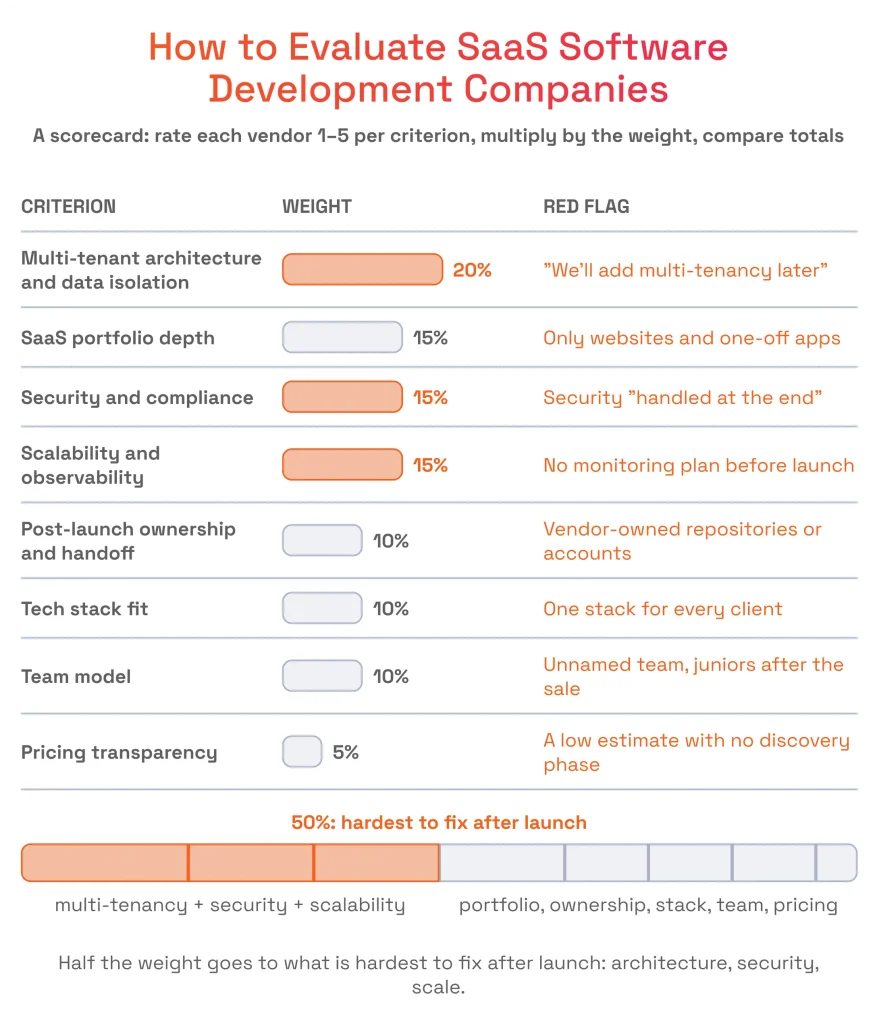
The scorecard asks you to score each vendor 1 to 5 per criterion, multiply by the weight and compare totals. The weights reflect what is hardest to fix after launch, so tenant architecture carries the heaviest weight and pricing the lightest, although you can adjust them to your own business objectives.
Criterion | Weight | What to ask | Red flag |
|---|---|---|---|
Multi-tenant architecture and data isolation | 20% | Which tenant model would you use for us, and how is data isolated? | “We’ll add multi-tenancy later” |
SaaS portfolio depth | 15% | Which subscription products with billing have you shipped and still support? | Only websites and one-off apps |
Security and compliance | 15% | How do you handle access control, audit logs and SOC 2 / GDPR readiness? | Security “handled at the end” |
Scalability and observability | 15% | How do you load-test, and what do you monitor per tenant? | No monitoring plan before launch |
Post-launch ownership and handoff | 10% | Who owns code, cloud accounts and documentation, and how does handoff work? | Vendor-owned repositories or accounts |
Tech stack fit | 10% | Why this stack for our product and hiring market? | One stack for every client |
Team model | 10% | Who is on the team, how senior, and how stable? | Unnamed team, juniors after the sale |
Pricing transparency | 5% | What is included, and how are changes priced? | A low estimate with no discovery phase |
Criterion
Multi-tenant architecture and data isolation
SaaS portfolio depth
Security and compliance
Scalability and observability
Post-launch ownership and handoff
Tech stack fit
Team model
Pricing transparency
Weight
20%
15%
15%
15%
10%
10%
10%
5%
What to ask
Which tenant model would you use for us, and how is data isolated?
Which subscription products with billing have you shipped and still support?
How do you handle access control, audit logs and SOC 2 / GDPR readiness?
How do you load-test, and what do you monitor per tenant?
Who owns code, cloud accounts and documentation, and how does handoff work?
Why this stack for our product and hiring market?
Who is on the team, how senior, and how stable?
What is included, and how are changes priced?
Red flag
“We’ll add multi-tenancy later”
Only websites and one-off apps
Security “handled at the end”
No monitoring plan before launch
Vendor-owned repositories or accounts
One stack for every client
Unnamed team, juniors after the sale
A low estimate with no discovery phase
Ask About Multi-Tenancy, Data Isolation and Scalability
A SaaS development team that has run multiple SaaS platforms in production answers a few questions very differently from a generic builder. The first is which tenant model it recommends for your product and why, and the second is how one customer’s data is kept from another’s across the SaaS data layers, background jobs and API. From there, it helps to ask what changes when the tenant count grows tenfold and how the team monitors each tenant’s experience.
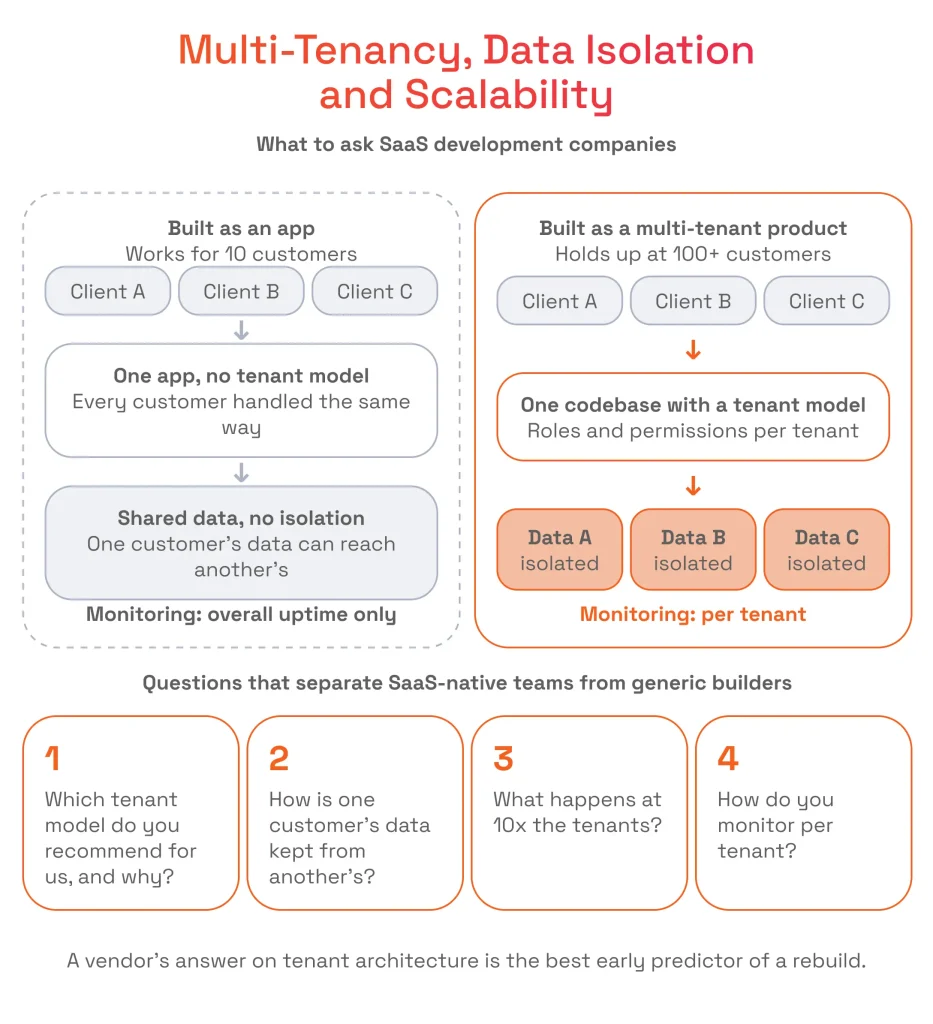
SaaS developers who have lived through those situations answer with concrete trade-offs, and vendors promising scalable solutions should be able to back that promise with load tests. Per-tenant monitoring also belongs to the platform health metrics a vendor should define before launch, so one customer’s slow dashboard becomes a signal before it turns into a support ticket.

Oleksandr Boiko
Delivery Director at SPD Technology
“In a growing MVP, the tenant boundary usually breaks first. If the customer ID is checked only in the interface, any report or AI feature that queries the database directly can expose another customer’s data.”
Ask for Delivery Evidence, Not Portfolio Adjectives
Portfolio pages tend to describe outcomes in adjectives, which makes many vendors sound alike.
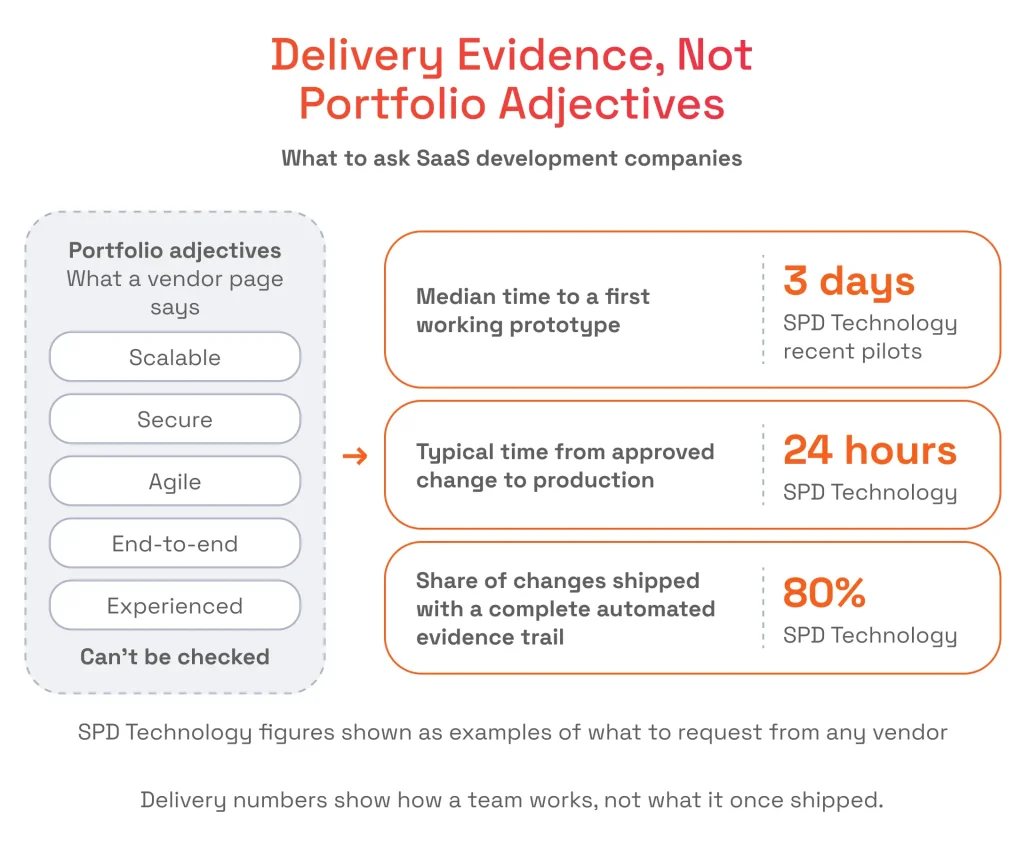
Numbers that describe how the team ships today give a clearer picture, and SPD Technology’s own figures show what a specific answer looks like:
- median time to a first working prototype (SPD Technology: 3-day median on recent pilots);
- typical time from approved change to production (SPD Technology: 24 hours);
- share of changes shipped with a complete automated evidence trail (SPD Technology: 80%).
These numbers matter because they describe current practice, which AI-enhanced development velocity makes measurable for any team that tracks it. In the same way, an evidence trail on each change is how a buyer can trust AI-generated code a vendor ships.
SaaS Development Cost, Timeline and Engagement Models
Clutch’s 2026 pricing guide, built from verified client reviews, puts most listed software development companies at $25 to $49 per hour. Even so, two vendors at the same rate can land at very different totals, because scope and architecture decide how much work the product needs, and a tenant model chosen badly in the first release gets paid for a second time during the rebuild.
That is why the most reliable way to price a SaaS project is a discovery phase, a short, paid form of SaaS development consulting in which the vendor examines scope, architecture options and risks before committing to an estimate. It also gives both sides a shared definition of the first release.
Once discovery is done, the SaaS development process moves through MVP, first paying customers and scale. The path from MVP to production is where tests, monitoring and tenant isolation get hardened for real traffic. At the first-paying-customers stage, an investor-ready MVP also needs billing, security answers and metrics that hold up in due diligence.
Running cost deserves its own line in that plan, since cloud infrastructure, third-party services and, for AI features, token spend per customer all belong in the unit economics of a SaaS business from the first pricing plan.
Engagement models then decide who carries the risk when scope moves, which tends to happen once real users arrive. Fixed-price SaaS development solutions suit a well-defined MVP, while the time and materials model pairs naturally with an agile development methodology because scope can shift between sprints.
Model | How it works | Fits when | Risk |
|---|---|---|---|
Fixed price | Agreed scope for an agreed sum | A well-defined MVP | Rigid once real users change the scope |
Time and materials | Pay for time spent, scope can move | Requirements are still evolving | Needs milestones to control budget |
Dedicated team | A stable team works only on your product | A growth-stage product with a long roadmap | You carry more of the product management |
Model
Fixed price
Time and materials
Dedicated team
How it works
Agreed scope for an agreed sum
Pay for time spent, scope can move
A stable team works only on your product
Fits when
A well-defined MVP
Requirements are still evolving
A growth-stage product with a long roadmap
Risk
Rigid once real users change the scope
Needs milestones to control budget
You carry more of the product management
Once the product has paying customers and a roadmap longer than any single fixed scope, a dedicated development team becomes the practical option for both ongoing support and new features.
Red Flags When Hiring a SaaS Development Company
Most vendor problems surface early in sales conversations, provided you know what to listen for. A specialized SaaS development agency should handle each point comfortably, so every signal in the list points to a gap that would otherwise land on your budget later.
Red flags include:
- A portfolio behind comprehensive SaaS development services that turns out to be web development and one-off apps, which means multi-tenancy and billing would be first attempts on your budget.
- A low estimate with no discovery phase, because the vendor is pricing a scope it hasn’t examined.
- No technical lead on the sales call, so the vendor’s technical expertise is represented by people who won’t make the architecture decisions.
- No answer on tenant isolation or security, a sign both will be retrofitted after an incident or an audit request.
- No test or CI/CD plan, which leaves releases dependent on manual checks even though release discipline is a core part of DevOps services.
- No plan for post-launch ownership, handoff or ongoing maintenance, which leaves the code and accounts tied to the vendor.
Building SaaS With AI: What to Ask a Vendor in 2026
Google Cloud’s 2025 DORA report found that 90% of respondents use AI at work, and that AI adoption lifts delivery throughput while still weighing on delivery stability.
With that tension in mind, teams developing SaaS applications with AI sit somewhere between vibe coding, which means fast, informal prompting that works for prototypes, and agentic engineering, in which AI writes code inside specs, tests and human review. The useful question is which approach the vendor uses for production code and how it enforces that choice.
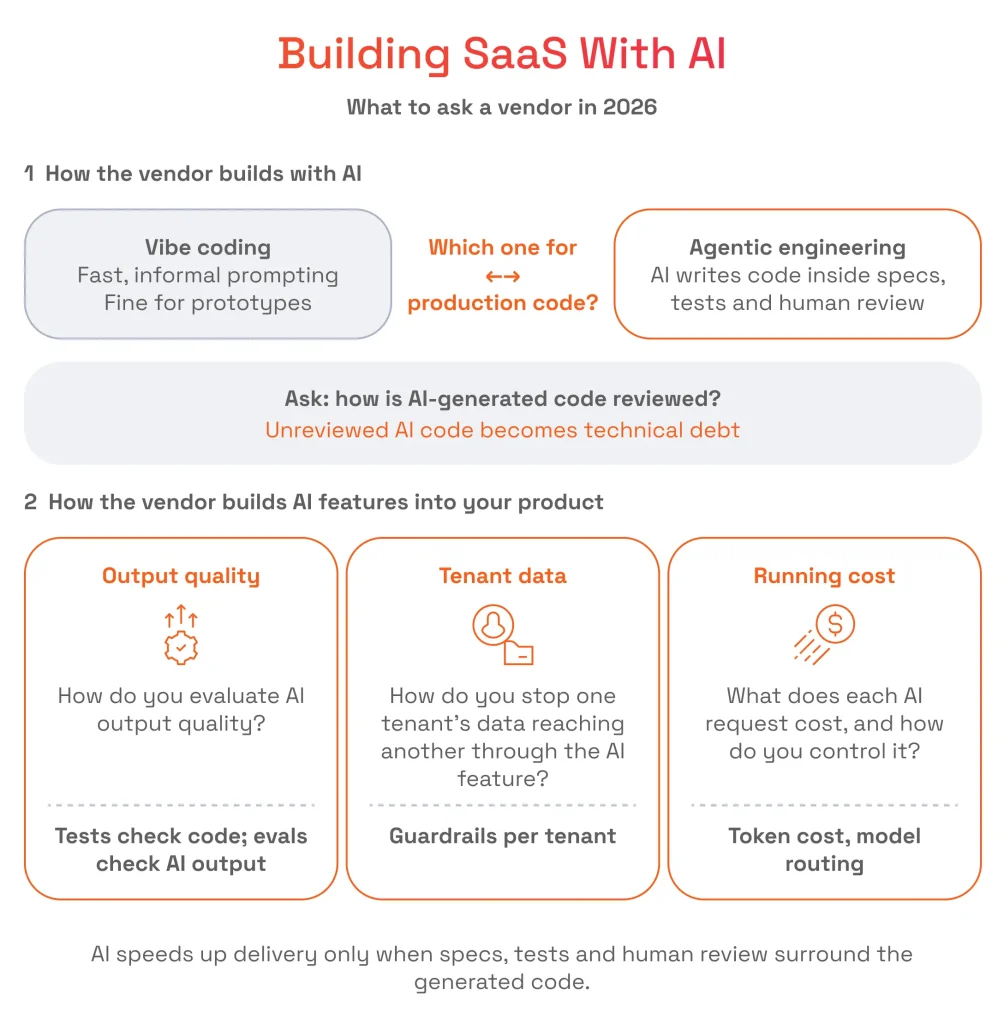
The answer matters because unreviewed AI-generated code breaks in production and turns into technical debt the client pays to remove, which is the stability cost the DORA findings point to. At SPD Technology, for example, AI-native development teams work inside specs, tests and review on every production change.
The AI features themselves need a second set of questions. One is how the vendor evaluates output quality, given that tests check deterministic code while evals score AI output against rubrics. Another is how its guardrails stop one tenant’s data from reaching another through an AI feature, and a third is what each AI request costs and how token budgets and model routing keep that cost in check. A vendor with clear answers on all three can also explain how to take a prototype to production without losing what made it work.
Questions to Ask Top SaaS Development Companies Before You Sign
The scorecard tells you how to weigh answers, and these eight questions put those answers on the table in a first call.
Question | What a good answer confirms |
|---|---|
Which multi-tenant model would you use for our product, and why? | The team has built real SaaS products |
How is each customer’s data isolated? | Security is designed in from the start |
Which subscription and billing systems have you shipped? | Revenue logic won’t be a first attempt |
Can you show delivery numbers, such as time to first prototype and time from approved change to production? | Claims are backed by evidence |
Who owns the code, cloud accounts and documentation? | You can leave without a rebuild |
What do you monitor after launch, per tenant? | Problems are found before customers report them |
How do you review AI-generated code and evaluate AI features? | Speed comes with reliability |
What does the handoff to our in-house team look like? | The partnership has a planned end state |
Question
Which multi-tenant model would you use for our product, and why?
How is each customer’s data isolated?
Which subscription and billing systems have you shipped?
Can you show delivery numbers, such as time to first prototype and time from approved change to production?
Who owns the code, cloud accounts and documentation?
What do you monitor after launch, per tenant?
How do you review AI-generated code and evaluate AI features?
What does the handoff to our in-house team look like?
What a good answer confirms
The team has built real SaaS products
Security is designed in from the start
Revenue logic won’t be a first attempt
Claims are backed by evidence
You can leave without a rebuild
Problems are found before customers report them
Speed comes with reliability
The partnership has a planned end state
Our Expertise
SPD Technology’s software product development services cover SaaS product development from first version to platform. That work produces secure cloud-based solutions, with the architecture, delivery process and verification that keep a product working as customers multiply.
- SPD Technology served as the sole software development partner for Phoenix Security, a UK-based cybersecurity firm, building its vulnerability management platform from concept to launch. Today, the platform enables a 12x faster risk-reduction process at 7x lower cost than competing tools and is trusted by over 380 international organizations.
- A US document-management provider with 30+ years in the market and Fortune 500 clients needed to move 20TB of legacy data to the cloud. For that cloud migration, SPD Technology built a multi-tenant architecture with complex role management into the document management system , and file-download time dropped substantially.
- Built from scratch under multi-state regulatory requirements, the billing system and data platform for US InsurTech Pie Insurance raised the average check by 30%, tripled ACH payment adoption and cut operational time by 40%. The same regulatory groundwork carries into SPD Technology’s billing software development for products with complex plans.
- Our engineers turned our client’s internal reference-call assistant into a public SaaS product that brings workflow automation to scheduling, conducting and analyzing reference calls. For the Fortune 500 clients of this US recruitment and background-screening tech company, the product cut onboarding costs by about 30%.
Key Takeaways
- SaaS products usually fail at scale because multi-tenancy, data isolation and billing were treated as later work, so a vendor’s answer on tenant architecture is the strongest early predictor of a rebuild.
- Vendor rankings in the SaaS market carry their author’s perspective, so scoring every candidate on the same weighted criteria produces a more reliable comparison than any single list.
- Delivery evidence, such as time to a first working prototype and time from approved change to production, shows how a team works today and predicts delivery better than a portfolio.
- Hourly rate is a weak guide to total cost, because architecture decisions made in the first weeks determine how much rework the product needs later.
- A low estimate with no discovery phase is a red flag, because the vendor is pricing a scope it hasn’t examined.
- AI coding tools speed up delivery only when specs, tests and human review surround the generated code, and without them that speed turns into technical debt.
- A contract that withholds code, cloud accounts and documentation from the client makes changing vendors a rebuild.
In short: choose the SaaS partner whose architecture answers and delivery numbers hold up on the scorecard, and own everything it builds.
FAQ
How do I choose a SaaS development company?
To choose a SaaS application development company, score every SaaS development partner on the same weighted criteria, which cover multi-tenant architecture and tenant data isolation, SaaS portfolio depth, security and compliance, scalability and observability, team model, pricing transparency, and code ownership after launch.
Each vendor should also share delivery numbers, such as time to a first working prototype. A paid discovery phase before the full contract is the lowest-risk way to test a vendor.How much does SaaS development cost and how long does it take?
Clutch’s 2026 pricing guide puts the average software development project at about $132,000 over roughly 13 months, with most listed companies charging $25 to $49 per hour.
For custom SaaS application development, treat those figures as a baseline, since multi-tenancy, billing and scope move the total more than the hourly rate. Ask each vendor for a staged estimate covering discovery, MVP and scale.
Should I go cloud-native for SaaS from day one?
In most cases, yes, because managed cloud computing services from the top cloud service providers give a new SaaS product automatic scaling, deployment automation and costs that grow with usage, without a dedicated operations team. A well-structured multi-tenant application on managed services is usually enough at launch, and it can be split into microservices once usage shows which parts need to scale separately.
What is the difference between a SaaS development company and a general software agency?
- A general software agency builds an application for one customer.
- A SaaS development company builds multi-tenant SaaS solutions that many customers share, so it has to solve tenant data isolation, subscription billing, self-service onboarding and continuous releases.
Who owns the code and infrastructure after launch?
You should own the code and infrastructure, and the contract should assign you the source code, cloud accounts, domains, third-party service accounts and documentation, with repositories in your organization from the start.
If the vendor holds the accounts, changing vendors or moving development in-house can require a partial rebuild, so agree on a handoff plan before signing.
What technical pillars should a modern SaaS product have?
A successful SaaS product needs multi-tenant architecture with strict data isolation, role-based access control and SSO, reliable subscription billing, API-first design, automated testing and CI/CD, and per-tenant observability. Products with AI features also need evals for output quality, guardrails on data access, and control over token cost.