

An eWallet development company builds the product behind a wallet interface, including a double-entry ledger that tracks balances; KYC and AML checks at onboarding; integrations with card processors, payment gateways, and bank rails; security; and daily reconciliation against the funds actually held at the bank or partner.
The wallet type decides the license, and the license decides scope and budget, so the regulatory route gets chosen before the feature list does. Closed wallets that spend only with the issuer stay light on compliance, while open wallets that send money to third parties need an e-money or money transmission license, or a licensed partner standing behind the balances. That single choice sets the ledger design, the integration list, and the size of the compliance workstream, which is why eWallet app development services are scoped backward from the regulatory route. An MVP wallet app with basic identity checks typically runs $50,000 to $150,000.
You are shortlisting development partners for a wallet app, comparing portfolios, hourly bands, and how fast each team can get an iOS build into TestFlight. From that angle, the work looks like a product problem made of onboarding, top-up, transfers, and a balance screen, the same shape as any other project in digital payments.
A wallet that holds customer money looks like a mobile app and behaves like a small bank because it keeps balances, moves funds to third parties, and answers to a supervisor for every figure on the balance screen. That supervision starts with capital, since an electronic money institution needs at least EUR 350,000 in initial capital at the time of authorization under EU Directive 2009/110/EC, which puts the licensing question into your funding plan long before it reaches your lawyers.
Most lists of eWallet development companies rank app developers and stay quiet on licenses, ledgers, and reconciliation, which is the part of building digital wallets that decides whether the product survives its first audit. SPD Technology publishes this one and appears in it. What follows is the shortlist, then the decisions in the order a wallet program forces you to make them.
Top eWallet App Development Companies in 2026: Comparison Table
Each company here offers eWallet, digital banking, or payment app development as a named service, and each shows published payments work on its own site. SPD Technology is listed first as the publisher of this list, and the remaining eWallet app development companies follow in no particular order.
Hourly bands here come from public profiles. They move with team composition and contract length, so a procurement lead should treat them as a starting point and get a real number from each vendor during scoping. The band also tells you almost nothing about fit for mobile wallet app development. Two companies quoting $50 to $99 an hour could be a product studio in one case and a payments engineering team in another.
Company | Founded | Hourly Rate | Payments Focus | Best Fit |
|---|---|---|---|---|
SPD Technology | 2006 | $50–99 | Digital banking, payment platforms, fraud detection, Adyen integration | Fintechs and enterprises building wallets on serious payment infrastructure |
Cleveroad | 2011 | $50–99 | End-to-end eWallet and fintech apps | Compliance-ready builds for startups and SMEs |
Netguru | 2008 | $50–99 | Product design and fintech apps | Design-led consumer wallets |
Intellias | 2002 | $50–99 | Digital banking and embedded finance | Enterprises and high-load platforms |
Itexus | 2013 | $25–49 | Fintech and digital banking software | Fintech startups |
Softjourn | 2001 | $50–99 | Payments and card-related solutions | Card and prepaid programs |
Fingent | 2003 | $25–49 | Custom software with payment features | Mid-market companies modernizing systems |
DeepInspire | 2000 | $50–99 | Payments engineering | Teams needing dedicated payments specialists |
Company
SPD Technology
Cleveroad
Netguru
Intellias
Itexus
Softjourn
Fingent
DeepInspire
Founded
2006
2011
2008
2002
2013
2001
2003
2000
Hourly Rate
$50–99
$50–99
$50–99
$50–99
$25–49
$50–99
$25–49
$50–99
Payments Focus
Digital banking, payment platforms, fraud detection, Adyen integration
End-to-end eWallet and fintech apps
Product design and fintech apps
Digital banking and embedded finance
Fintech and digital banking software
Payments and card-related solutions
Custom software with payment features
Payments engineering
Best Fit
Fintechs and enterprises building wallets on serious payment infrastructure
Compliance-ready builds for startups and SMEs
Design-led consumer wallets
Enterprises and high-load platforms
Fintech startups
Card and prepaid programs
Mid-market companies modernizing systems
Teams needing dedicated payments specialists
Company details as of October 2026.
eWallet Development Companies by Region: Short Profiles
The eWallet development companies below are grouped by region because timezone overlap and data residency come up in the first scoping call, usually from the Head of Compliance. Region also decides which rails a team has touched, since a vendor that has integrated SEPA, Faster Payments, and local card schemes in Europe has not necessarily worked with ACH, state-by-state licensing, or US sponsor banks.
eWallet App Development Companies in Europe and the UK
SPD Technology
London, UK, with delivery centers across Europe · founded 2006 · $50–99 per hour
SPD Technology has engineered payment and digital banking software since 2006 and now runs a 650+ person organization across European delivery centers. The work covers payment processing platforms, fraud detection, merchant onboarding, and settlement systems for fintech clients. Teams are staffed by dedicated financial software developers who stay with a product through architecture, integration, and scale, with 460+ delivered projects behind the custom software development practice and compliance requirements designed into the architecture rather than retrofitted after an audit.
Card acquiring work runs through our Adyen integration services as an Adyen implementation partner, alongside an AWS partnership for the infrastructure, and the same engineers work on the banking systems that sit behind merchant settlement and reporting.
Netguru
Poznań, Poland · founded 2008 · $50–99 per hour
Product design sits at the front of what Netguru publishes, paired with fintech application work since 2008. On a wallet program, design strength shows up in the identity verification funnel, where drop-off during document capture decides how many accounts ever get funded. The company pairs that design practice with mobile app development across iOS and Android, so a consumer wallet with a demanding onboarding flow is the case where the pairing earns its rate.
Intellias
Kraków, Poland · founded 2002 · $50–99 per hour
Intellias lists digital banking and embedded finance among its named practices and points enterprises and high-load platforms toward it. That matters on payroll day, when top-ups, transfers, and card authorizations spike inside the same hour. Working since 2002, the company sells to financial institutions and large platform owners, where procurement, security review, and a multi-year roadmap are part of the engagement rather than an afterthought.
DeepInspire
L’viv, Ukraine · founded 2000 · $50–99 per hour
Payments engineering is the specialism DeepInspire publishes, and the company has worked in it since 2000. Teams that want dedicated payments people working beside their own engineers are the stated fit, often on rail integration and settlement. That model suits a product team that already owns its roadmap and needs specialists who can reason about payment flows, retries, and reconciliation breaks without being briefed on the basics.
Itexus
Warszawa, Poland · founded 2013 · $25–49 per hour
Since 2013, Itexus has delivered fintech and digital banking software, with fintech startups named as its core segment. That segment is the one most likely to launch under a Banking-as-a-Service partner first and pursue its own license later. The $25–49 band puts the company at the accessible end of the list, which fits an early-stage team testing whether its digital financial services idea holds up before committing to a licensed build.
Softjourn
Wrocław, Poland · founded 2001 · $50–99 per hour
Softjourn names card and prepaid programs as its published fit and has built payments and card-related software since 2001. Those programs drag processor integration and PCI DSS scope into the same project. A team that has already run a card program through certification knows which questions the processor asks in week one, which shortens the part of the schedule that payment providers, rather than the engineering team, control.
eWallet App Development Companies in the USA
Cleveroad
New York, US · founded 2011 · $50–99 per hour
Cleveroad names end-to-end eWallet and fintech app development as a service line, running from discovery and compliance scoping through to post-launch support. Compliance-ready builds for startups and SMEs are the stated fit. For a founder who needs a first release that will survive a partner bank’s due diligence, that positioning matters more than portfolio screenshots, and digital wallet app development is listed among the named verticals on the company’s own site.
Fingent
White Plains, NY · founded 2003 · $25–49 per hour
Fingent builds custom software with payment features and has done so since 2003, in the $25 to $49 band. Mid-market companies modernizing existing systems are the stated fit, which in wallet terms usually means a balance sitting on top of an ERP or loyalty database that already owns the customer record. Where the wallet is one module inside a wider modernization program, custom fintech solutions get scoped alongside the systems they have to read from, and the integration map matters more than the app itself.
Which Type of eWallet Are You Building?
Four wallet types cover almost every project, and the thing that separates them is where the money is allowed to go. A ride-hailing platform that tops up ride credit and a telecom that lets users cash out to any bank account run different regulatory products, even when the screens look alike. Answer this question first, because every later decision inherits it.
Wallet Type | What Users Can Do | Typical Owner | Regulatory Weight |
|---|---|---|---|
Closed | Spend a balance only with the issuing company; refunds return to the same balance | Retailers, marketplaces, ride-hailing and gaming platforms | Lightest; often outside e-money rules, depending on the country |
Semi-closed | Spend at a network of partner merchants; usually no cash withdrawal | Loyalty coalitions, multi-brand groups | Medium; limits and registration often apply |
Open | Pay anywhere, send money to anyone, withdraw cash, and make merchant payments in store or online | Banks, licensed fintechs, telecoms | Heaviest; an e-money or money transmission license, or a licensed partner |
Crypto | Hold and transfer digital assets | Exchanges, Web3 products | Separate rules for crypto-asset services |
Wallet Type
Closed
Semi-closed
Open
Crypto
What Users Can Do
Spend a balance only with the issuing company; refunds return to the same balance
Spend at a network of partner merchants; usually no cash withdrawal
Pay anywhere, send money to anyone, withdraw cash, and make merchant payments in store or online
Hold and transfer digital assets
Typical Owner
Retailers, marketplaces, ride-hailing and gaming platforms
Loyalty coalitions, multi-brand groups
Banks, licensed fintechs, telecoms
Exchanges, Web3 products
Regulatory Weight
Lightest; often outside e-money rules, depending on the country
Medium; limits and registration often apply
Heaviest; an e-money or money transmission license, or a licensed partner
Separate rules for crypto-asset services
Pass-through wallets such as Apple Pay and Google Pay keep tokenized card credentials on the device while the money stays in the underlying account, and most custom projects are stored-value wallets, which is exactly why regulation attaches to them. Once users can send money to anyone, the build turns into how to make a money transfer app, with payout rails, beneficiary screening, and per-transfer limits behind every tap. Crypto sits on its own track, where crypto payment solutions bring custody, key management, and travel rule obligations that e-money law never addresses.
The type also decides how far the product sits from traditional payment methods. Closed and semi-closed mobile wallets act like prepaid balances with a better interface, while an open wallet competes with a current account and inherits its obligations.
Do You Need a License? Regulation Comes Before Code
A wallet that holds customer funds or sends money to third parties almost always needs a license, either its own or one held by a partner standing behind the balances. The Head of Compliance will want to know who officially owns the balance long before anyone decides where it lives in the database. The table below sets out what each major jurisdiction typically requires and the route companies most often take to reach the market without holding a license themselves.
Region | What Typically Applies | Common Shortcut |
|---|---|---|
European Union | Authorization as an electronic money institution; PSD2 rules including Strong Customer Authentication; safeguarding of customer funds | Operating as an agent or distributor of a licensed e-money institution |
United Kingdom | FCA authorization as an electronic money institution; safeguarding requirements | Partnering with an FCA-authorized firm |
United States | Registration with FinCEN as a money services business; money transmitter licenses state by state | Partnering with a sponsor bank through a Banking-as-a-Service provider |
Everywhere | KYC and AML checks, sanctions screening, transaction monitoring; PCI DSS if card data is handled; data protection law | Specialist KYC and monitoring providers integrated into the wallet |
Region
European Union
United Kingdom
United States
Everywhere
What Typically Applies
Authorization as an electronic money institution; PSD2 rules including Strong Customer Authentication; safeguarding of customer funds
FCA authorization as an electronic money institution; safeguarding requirements
Registration with FinCEN as a money services business; money transmitter licenses state by state
KYC and AML checks, sanctions screening, transaction monitoring; PCI DSS if card data is handled; data protection law
Common Shortcut
Operating as an agent or distributor of a licensed e-money institution
Partnering with an FCA-authorized firm
Partnering with a sponsor bank through a Banking-as-a-Service provider
Specialist KYC and monitoring providers integrated into the wallet
In the US, a wallet that transmits funds is a money services business, so registration runs through FinCEN Form 107 within 180 days of the business being established, with renewal every two years and civil and criminal penalties attached to failing to register. State money transmitter licenses then stack on top of that federal registration, one application at a time, which is why US launch maps usually start with a handful of states.
Across the EU, Article 4 of Directive 2009/110/EC sets the initial capital floor for an electronic money institution at EUR 350,000, which has to be in place at the time of authorization and therefore shapes the size of your first raise before a single engineer joins. Article 9 leaves room for smaller issuers, since a Member State may waive parts of the authorization regime while average outstanding e-money stays under EUR 5,000,000. Closed-loop and niche products often launch inside that threshold and re-plan as volume grows toward the full regime.
The European framework is also in transition. As of October 2026, the EU had agreed on PSD3 and the Payment Services Regulation, which were expected to fold e-money institutions into the payment institution regime.
Two routes exist from here. You obtain your own license, which gives full control over economics and product at a slow and costly pace, or you operate under a licensed partner such as a sponsor bank, an e-money institution, or a Banking-as-a-Service provider, which moves faster but requires giving up control and a share of revenue. For vendor selection, the test is whether the company can design for either route and integrate cleanly with a licensed partner’s account, card, and reporting APIs. The compliance layer runs across both routes, and onboarding and KYC automation is where identity checks, sanctions screening, and risk tiers are integrated into the sign-up flow.
The same rules apply whether the wallet funds a card at a terminal or online payments on a merchant site, because what triggers supervision is holding and moving customer money, not the channel the payment travels through.
This article is general information about how wallet regulation works and is not legal advice.
Custom Build, White-Label, or Banking-as-a-Service?
Most wallets in production combine all three routes, with a custom app and custom business logic sitting on top of infrastructure someone else is licensed to run. The decision is really about which layer you want to own on the day a partner changes its pricing or its roadmap.
Route | What You Get | When To Choose | Trade-Off |
|---|---|---|---|
White-label wallet | A ready product with your branding | You need to test a market quickly | Limited features; dependence on the vendor’s roadmap |
Banking-as-a-Service plus custom app | Licensed accounts, cards and payments through APIs; your own app and logic | You want a distinct product without your own license | Per-transaction fees; reliance on the provider and its bank |
Fully custom platform | Your own ledger, integrations and, usually, license; a digital wallet platform you can extend without asking a vendor | The wallet is your core business, and volume justifies it | Highest cost and longest timeline |
Route
White-label wallet
Banking-as-a-Service plus custom app
Fully custom platform
What You Get
A ready product with your branding
Licensed accounts, cards and payments through APIs; your own app and logic
Your own ledger, integrations and, usually, license; a digital wallet platform you can extend without asking a vendor
When To Choose
You need to test a market quickly
You want a distinct product without your own license
The wallet is your core business, and volume justifies it
Trade-Off
Limited features; dependence on the vendor’s roadmap
Per-transaction fees; reliance on the provider and its bank
Highest cost and longest timeline
A white-label e-wallet gets you branded screens quickly, and the first feature request that falls outside the vendor’s roadmap becomes a commercial negotiation, which is the trade-off at the center of the custom vs. white-label payment platform decision.
Owning the stack means controlling the ledger structure, retry behavior, and certification timeline. That’s where wallet payment software development really operates. If your margins derive from an aspect that would be considered a corner case by any boxed solution: perhaps a unique fee strategy, a particular disbursement timing scheme, or even an unusual loyalty policy, it makes perfect sense to pursue custom eWallet development.
eWallet App Features: MVP vs. Full Product
A first release has to do four things well: onboard a verified user, take money in, send money out, and show a correct balance on every refresh. Everything else can wait for evidence that people are using the first four. The split below is the one most wallet roadmaps settle into by the second planning cycle.
Area | MVP | Full Product |
|---|---|---|
Onboarding | Sign-up, identity verification, basic limits | Tiered KYC, business accounts and sub-user accounts, document re-verification |
Funding | Bank card or bank transfer top-up | Open banking, cash-in networks, salary deposits |
Payments | P2P transfers, QR code payments | NFC tap-to-pay and contactless payments, bill payments, recurring payments |
Cards | None, or one virtual card | Virtual and physical cards, Apple Pay and Google Pay provisioning |
Currency | One currency | Multi-currency support with balances and FX |
Security | Biometric authentication, device binding, transaction PIN | Risk-based and multi-factor authentication, behavioral fraud detection |
Engagement | Notifications, transaction history | Cashback, loyalty, budgeting tools |
Back office | User lookup, manual holds, basic reports | Dispute handling, compliance cases, finance and regulatory reporting |
Area
Onboarding
Funding
Payments
Cards
Currency
Security
Engagement
Back office
MVP
Sign-up, identity verification, basic limits
Bank card or bank transfer top-up
P2P transfers, QR code payments
None, or one virtual card
One currency
Biometric authentication, device binding, transaction PIN
Notifications, transaction history
User lookup, manual holds, basic reports
Full Product
Tiered KYC, business accounts and sub-user accounts, document re-verification
Open banking, cash-in networks, salary deposits
NFC tap-to-pay and contactless payments, bill payments, recurring payments
Virtual and physical cards, Apple Pay and Google Pay provisioning
Multi-currency support with balances and FX
Risk-based and multi-factor authentication, behavioral fraud detection
Cashback, loyalty, budgeting tools
Dispute handling, compliance cases, finance and regulatory reporting
Every entry in the right-hand column brings either an integration or a compliance obligation, so features are added in response to usage patterns the support queue already shows. The four MVP capabilities are app layer work, and that is where most of the mobile payment app development effort lands in release one.
The funding and payments sections diverge because each digital wallet integration has its own sandbox environment, certification process, and error handling. Mobile wallet applications typically exceed budgets because of this section, where one simple line item in a feature list can hide six weeks of work to get certified by a credit card processor.
Under the Hood: What an eWallet Development Company Must Get Right
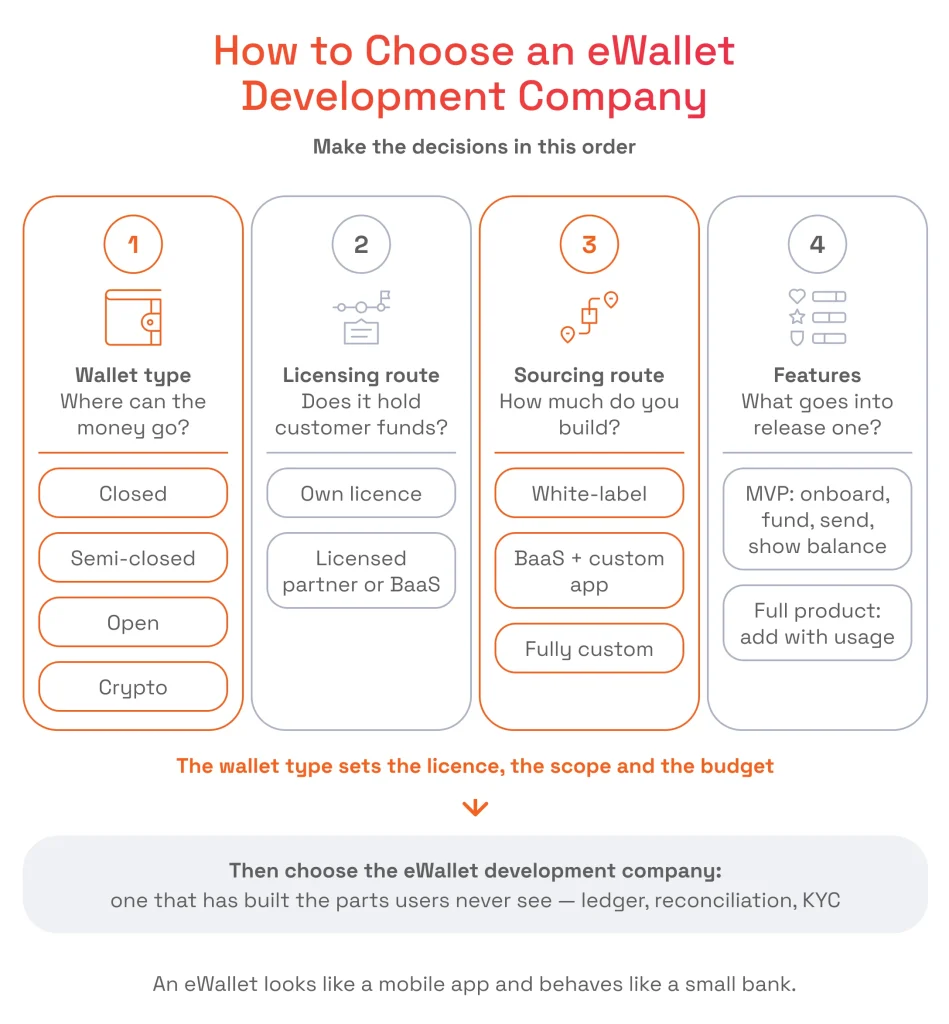
The parts of a wallet that users never see decide whether it works. A balance screen checks the ledger, and a transfer transaction involves many postings that must survive timeouts, partner failures, and retries due to poor wireless reception. Seven questions separate an eWallet development company that has moved money in production from one that has shipped only interfaces, and they all trace back to how to build a payment app that stays accurate despite failures.
- A double-entry ledger. Every movement of money is recorded twice, so balances always add up. Ask how the company has built one.
- Reconciliation. Wallet balances are reconciled daily against the funds actually held at the bank or partner. Ask how mismatches are found and resolved.
- Idempotent transactions. A retried request must never move money twice. Ask how duplicates are prevented, down to the idempotency key and its storage.
- KYC and AML integration. Identity checks, sanctions screening, and transaction monitoring are wired into onboarding and payments. Request which providers they have integrated.
- Payment rail integrations. Card processors, bank transfers, and local methods each behave differently. Ask which rails they have connected, and in which countries. Every payment gateway integration carries its own settlement timing and failure codes.
- Security by design. Tokenization, encryption, device binding, and strong authentication are what keep transactions secure once volume arrives.
- Limits, holds, and disputes. Real wallets need controls for fraud, chargebacks, and frozen funds. Check the back-office tooling, including the fraud detection software that determines when a hold is placed.
Items 1 and 2 carry a deadline now. From 7 May 2026, under FCA Policy Statement PS25/12, UK payment and e-money firms must reconcile safeguarded funds at least once each reconciliation day, file a monthly safeguarding return, and arrange an annual safeguarding audit under CASS 15, which turns ledger design into an audit artifact.
A company that answers all seven questions from its own delivery history has built a financial product before. Those seven answers are also the fastest way to tell whether a vendor has built secure financial applications or only the screens in front of them, since fraud detection systems, holds, and dispute tooling rarely appear in a portfolio and always appear in a production wallet.

Oleksandr Boiko
Delivery Director at SPD Technology
“Teams reach for the ledger too late. When balances are derived from a transactions table, every reconciliation break turns into a forensic exercise, and a safeguarding regime expects you to explain that break the same day you find it. Double-entry postings make the break visible at the moment it happens, which is the only point at which it is cheap to fix.”
How Much Does eWallet App Development Cost, and How Long Does It Take?
We budget an MVP payment app carrying basic KYC at $50,000 to $150,000, and custom fintech builds we deliver run from $50,000 to $700,000 and above as complexity, compliance scope, and integration depth grow. Compliance work across KYC/AML, PCI DSS, and SOC 2 often accounts for 15% to 25% of total development cost, and maintenance adds 15% to 20% of the initial build every year after launch. Compliance engineering carries more of the fintech app development cost than a first budget usually allows for.
Other vendors’ custom eWallet app development ranges fall in the same territory. A basic wallet with balances, P2P transfers, and history is quoted at roughly $30,000 to $50,000, a mid-tier wallet with multi-currency balances and loyalty features at $80,000 to $150,000, and an enterprise wallet with banking integrations and custom APIs at $200,000 and above. The gap between those numbers and ours is mostly compliance scope, the line item that gets cut first in a quote and added back first in delivery.
Most of the eWallet app development cost sits in places no user ever sees, and the drivers below are the ones that move a quote between those bands.
Cost Driver | Why It Moves the Budget |
|---|---|
Wallet type and licensing route | An open wallet with its own license needs far more compliance work than a closed wallet |
Number of integrations | Each payment rail, KYC provider, and card program adds build and test time |
Platforms | iOS, Android, and web multiply interface work |
Cards | Issuing virtual or physical cards adds a processor integration and PCI DSS scope |
Countries and currencies | Each market adds local payment methods and rules |
Security and compliance depth | Audits, penetration tests, and monitoring are recurring costs |
Cost Driver
Wallet type and licensing route
Number of integrations
Platforms
Cards
Countries and currencies
Security and compliance depth
Why It Moves the Budget
An open wallet with its own license needs far more compliance work than a closed wallet
Each payment rail, KYC provider, and card program adds build and test time
iOS, Android, and web multiply interface work
Issuing virtual or physical cards adds a processor integration and PCI DSS scope
Each market adds local payment methods and rules
Audits, penetration tests, and monitoring are recurring costs
The timeline follows the same drivers through six phases: discovery and compliance scoping, design and architecture, MVP build, integrations and certification, pilot launch, and scale. An MVP usually takes 4 to 6 months with a team of 5 to 7 engineers, while published ranges put a full-featured wallet with security audits, several platforms, and deeper integrations at 9 to 12 months, and enterprise programs at 12 months and beyond. Platform count feeds straight into the UI/UX design workload, since iOS, Android, and web each need their own interaction model for one transfer flow.
Certification at card processors is where dates slip most often, since the partner controls that calendar. Writing certification lead times into the development process while the first sprint plan is still a draft costs less than discovering them in month five.
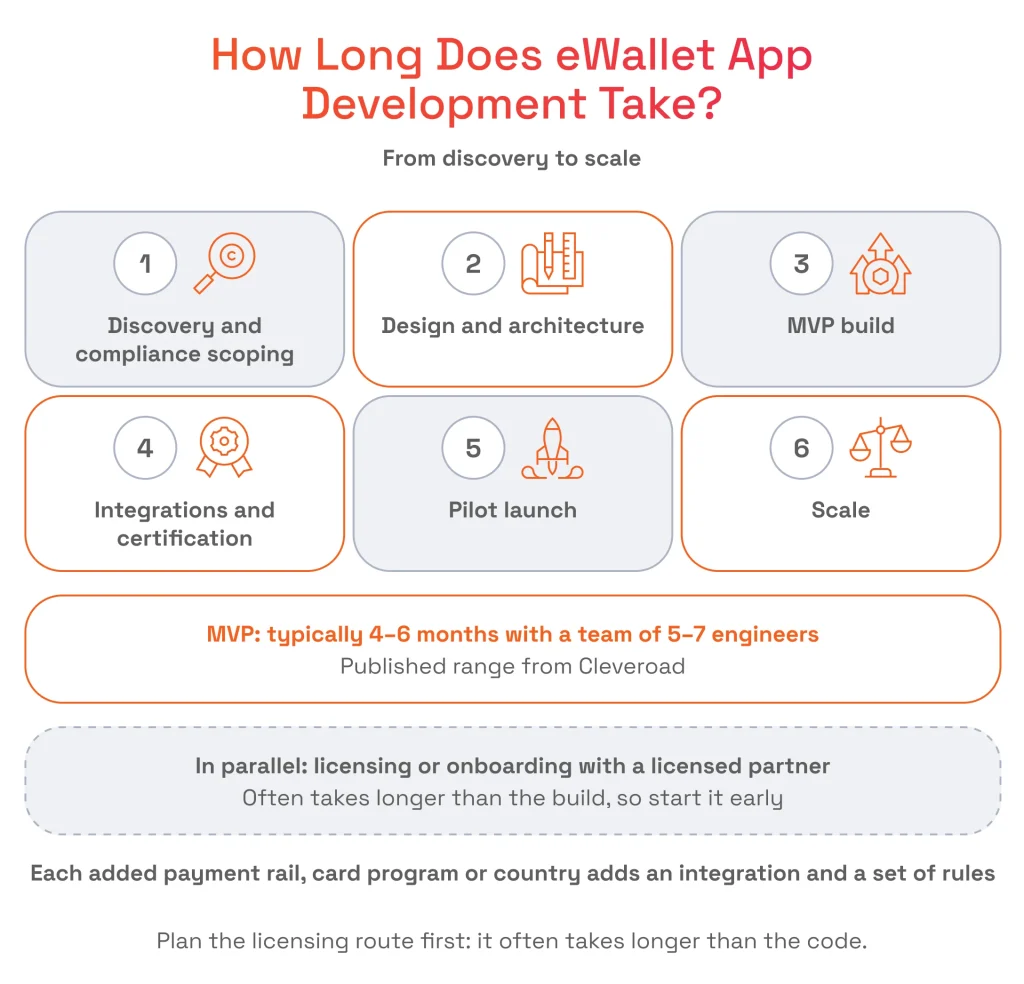
Licensing and partner onboarding run in parallel with development and frequently take longer than the build itself.
Why Choose SPD Technology
SPD Technology has engineered payment and digital banking software since 2006, with 650+ people and delivery centers across Europe, working as an Adyen implementation partner and an AWS partner. An eWallet is assembled from the same components we build for payment companies, which is where digital banking solutions and wallet architecture overlap almost completely.
Wallet Building Block | What SPD Technology Builds |
|---|---|
Payments and integrations | Payment processing platforms and integrations with processors, gateways, and local methods |
Onboarding and KYC | Automated onboarding with identity and sanctions checks |
Fraud and risk
| Real-time fraud detection and risk scoring |
Settlement and reconciliation | Settlement, fee calculation and reconciliation systems |
Mobile and web apps | Banking and payment applications for iOS, Android and web |
Compliance engineering | PCI DSS, PSD2 and GDPR requirements designed into the architecture |
Architecture and scale | Scalable digital payment solutions built for volume growth, multi-region deployment, and peak-day load |
Wallet Building Block
Payments and integrations
Onboarding and KYC
Fraud and risk
Settlement and reconciliation
Mobile and web apps
Compliance engineering
Architecture and scale
What SPD Technology Builds
Payment processing platforms and integrations with processors, gateways, and local methods
Automated onboarding with identity and sanctions checks
Real-time fraud detection and risk scoring
Settlement, fee calculation and reconciliation systems
Banking and payment applications for iOS, Android and web
PCI DSS, PSD2 and GDPR requirements designed into the architecture
Scalable digital payment solutions built for volume growth, multi-region deployment, and peak-day load
One team owns architecture and execution through launch and scale, and our fintech software development model covers the wallet, designed for your own license or for a Banking-as-a-Service partner, with no handoff between the people who design it and the people who ship it. Every block in the table above is something we already build for payment clients, which is what makes digital wallet solutions an assembly problem for us rather than a first attempt.
Key Takeaways
- An eWallet that holds customer funds is usually a regulated financial product, so the licensing route has to be chosen before development starts.
- The wallet type sets the scope: a closed wallet can launch with light compliance, while an open wallet needs a license or a licensed partner.
- Operating under a licensed partner or a Banking-as-a-Service provider shortens time to market, at the cost of per-transaction fees and less control.
- An MVP wallet runs $50,000 to $150,000 and takes 4 to 6 months with a team of 5 to 7 engineers, while a full product with cards, multi-currency balances, and several markets runs to $700,000 and above over 9 to 12 months.
- Wallet balances stay correct because of a double-entry ledger and a daily reconciliation run, which is why those two matter more than any feature a user can see.
- Add a payment rail, a card program, or a country, and you add an integration plus a set of rules to comply with. Cost follows that count far more closely than it follows screen count.
- A company with only mobile app experience can deliver the interface but not the financial core, so ask every candidate how it has built ledgers, reconciliation, and KYC flows, since the teams behind the best-rated mobile wallet apps are rarely the teams that built their ledgers.
In short: choose an eWallet development company based on its track record in money movement and regulatory compliance, and settle on the wallet type and licensing route first, because those two decisions set the scope, the budget, and the right partner.
FAQ
What does an eWallet development company do?
An eWallet development company designs and builds eWallet products, covering the mobile and web apps along with the systems behind them. That work includes user onboarding with identity checks, the ledger that tracks balances, integrations with banks, card processors, and payment methods, security, and back-office tooling for support and finance teams. A digital wallet app is the visible part; the ledger, the reconciliation job, and the compliance tooling are what the engagement is actually priced on.
Experienced companies also help plan the licensing and compliance route, since the choice between an own license and a Banking-as-a-Service partner changes the architecture before any screens are designed.
How much does it cost to develop an eWallet app?
We price an MVP payment app with basic KYC at $50,000 to $150,000, and custom fintech builds we deliver reach $700,000 and above. Published ranges from other vendors sit in the same territory, with basic wallets quoted from around $30,000 and enterprise wallets from $200,000.
The 5 main drivers include: wallet type and licensing route, number of payment and KYC integrations, supported platforms, whether cards are issued, and the number of countries and currencies in scope. Compliance, audits, and monitoring continue to cost after launch, typically 15 to 20% of the build each year.
How long does it take to build an eWallet app?
An MVP typically takes 4 to 6 months with a team of 5 to 7 engineers. A full product with virtual and physical cards, multi-currency balances, and several markets takes considerably longer, with published ranges putting a full-featured mobile wallet application at 9 to 12 months and enterprise programs beyond that, because each market adds local rails and local rules. Licensing, or onboarding with a licensed partner, runs in parallel with development and often outlasts it, so that track should start in week one of discovery.
Do I need a license to launch an eWallet?
Usually yes, if the wallet holds customer funds or sends money to third parties. In the EU and UK, that typically means authorization as an electronic money institution, which carries an initial capital floor of EUR 350,000 under Directive 2009/110/EC, with FCA authorization and safeguarding duties in the UK. In the US, it means money transmitter licenses state by state alongside FinCEN registration as a money services business. Many companies launch faster under a licensed partner or a Banking-as-a-Service provider. Confirm the route with legal counsel.
What is the difference between closed, semi-closed and open eWallets?
A closed wallet can be used only with the company that issues it, such as a retailer’s app balance or ride credit. A semi-closed wallet spends across a network of partner merchants, usually without cash withdrawals, which is the common form of loyalty coalitions. An open wallet can pay any merchant, send money to anyone, and allow cash withdrawals, so it carries the heaviest requirements, generally requiring an e-money or money transmission license, or a licensed partner standing behind the balances.
Should we build a custom eWallet or use a white-label solution?
Use a white-label wallet to test a market quickly with standard features and someone else’s roadmap. Choose Banking-as-a-Service with a custom app when you want a distinct product and licensed accounts, cards, and payments through APIs without holding your own license, accepting per-transaction fees in exchange. Build a fully custom platform when the wallet is your core business and transaction volume justifies owning the ledger, the integrations, and usually the license as well, which is also the point at which supporting multiple currencies and local rails stops being a vendor configuration screen and becomes your own roadmap.
How do I choose an eWallet development company?
Ask every candidate to show seven things from work it has already delivered:
- A double-entry ledger they have built and still run in production.
- Reconciliation against partner balances, and how a break gets found and resolved.
- Idempotent handling that stops a retry from moving money twice.
- KYC and AML providers they have integrated, by name.
- Payment rails they have connected, and in which countries.
- Tokenization and how it keeps card data out of PCI DSS scope.
- Back-office tooling for limits, holds, and disputes.
A mobile portfolio answers none of these seven.
Does an eWallet need to be PCI DSS compliant?
PCI DSS applies as soon as the wallet stores, processes, or transmits cardholder data, which happens the moment cards are used for top-up or issued to users. Tokenization and a hosted or vaulted card flow cut the share of systems that fall inside scope, keeping the primary account number away from your own servers. Issuing virtual or physical cards pushes scope outward again by adding a processor integration. PCI DSS sits alongside licensing and AML obligations, never in place of them.