

The best MVP development companies include SPD Technology, Netguru, thoughtbot, Altar.io, Uptech, ScienceSoft, Brocoders and NIX. The strongest of them show verifiable delivery evidence, hand you the code and the tests, and have a path from prototype to production. When comparing MVP software development companies, score each one on the same criteria: scope and discovery discipline, engineering evidence, code and IP ownership, team model, security basics, and the post-MVP path. Ask for delivery numbers, such as time to a first working prototype, that a case-study page cannot supply. Choosing between AI MVP development companies, also ask how AI-generated code is reviewed and tested before release.
A shortlist of well-reviewed MVP development companies feels like most of the work. Reviews show that past clients liked the relationship: responsive managers, met deadlines, a smooth demo day. They rarely show whether the code held up once real users arrived, or whether the founder could hand it to another team.
The gap between a pleasant engagement and a durable codebase surfaces after launch, when switching vendors can mean rebuilding the product. This article gives a shortlist, a scorecard for any vendor, the drivers behind cost and timeline, and five questions to ask before signing. SPD Technology publishes this list and is scored by the same criteria as every other company on it.
Top MVP Development Companies in 2026: Comparison Table
The table below covers top MVP development companies a founder can realistically shortlist this year. Each company offers MVP development as a named service, shows startup products that reached real users, and holds a rating of 4.7 or higher on Clutch, the B2B review directory. Use the table as a first filter that tells you who to call, then use the scorecard further down to decide what to ask.
Company data from Clutch and company websites, as of October 2026.
Company | HQ | Founded | Hourly rate | Min project | Clutch | Best fit |
|---|---|---|---|---|---|---|
SPD Technology | London, UK | 2006 | $50–99 | $5,000+ | 4.8 | AI-native MVPs built to scale; taking AI-built prototypes to production; fintech and data-heavy products |
Netguru | Poznań, Poland | 2008 | $50–99 | $50K+ | 4.8 | Design-led, investor-ready MVPs |
thoughtbot | New York, NY | 2003 | $150–199 | $10,000+ | 4.9 | Engineering-first builds with a US team |
Altar.io | Lisboa, Portugal | 2015 | $50–99 | $50K+ | 4.9 | Founder-led discovery and product strategy |
Uptech | Kyiv, Ukraine | 2016 | $25–49 | $25,000+ | 4.9 | Full-cycle product delivery on a lean budget |
ScienceSoft | McKinney, US | 1989 | $25–49 | $5,000+ | 4.8 | Regulated industries, low entry budget |
Brocoders | Tallinn, Estonia | 2014 | $50–99 | $10K+ | 5.0 | SaaS MVPs |
NIX | Tampa, FL | 1994 | $50-99 | Undisclosed | 4.8 | Full-cycle delivery with a large bench |
Company
SPD Technology
Netguru
thoughtbot
Altar.io
Uptech
ScienceSoft
Brocoders
NIX
HQ
London, UK
Poznań, Poland
New York, NY
Lisboa, Portugal
Kyiv, Ukraine
McKinney, US
Tallinn, Estonia
Tampa, FL
Founded
2006
2008
2003
2015
2016
1989
2014
1994
Hourly rate
$50–99
$50–99
$150–199
$50–99
$25–49
$25–49
$50–99
$50-99
Min project
$5,000+
$50K+
$10,000+
$50K+
$25,000+
$5,000+
$10K+
Undisclosed
Clutch
4.8
4.8
4.9
4.9
4.9
4.8
5.0
4.8
Best fit
AI-native MVPs built to scale; taking AI-built prototypes to production; fintech and data-heavy products
Design-led, investor-ready MVPs
Engineering-first builds with a US team
Founder-led discovery and product strategy
Full-cycle product delivery on a lean budget
Regulated industries, low entry budget
SaaS MVPs
Full-cycle delivery with a large bench
If you need an AI capability inside a product you already run, a list of top AI development companies is the closer match. Founders whose product depends mainly on reporting, dashboards or data pipelines can compare data analytics companies built for that work. Founders still deciding whether to build at all can start with AI consulting companies, which help test the business case before any code exists.
Best MVP Development Companies to Shortlist: Profiles
The profiles follow the table’s selection method, so each of these MVP development companies passed the same filter before it was written up. The US MVP development companies on the list are thoughtbot, ScienceSoft and NIX.
SPD Technology
HQ: London, UK
Founded: 2006
Hourly rate: $50–99
Min project: $5,000+
Clutch: 4.8
Best fit: AI-native MVPs built to scale; taking AI-built prototypes to production; fintech and data-heavy products
SPD Technology builds AI-native MVPs through its Zero to One service and takes AI-built prototypes to production through Vibe to Scale. Its Diligence Fund Distribution MVP was delivered on time and on budget to support a US wealth management startup’s investor fundraising, and the AI Gift Assistant MVP was validated with a working prototype in 3 days. The fit is founders building an AI-native product and teams whose prototype has to become a real product.

Netguru
HQ: Poznań, Poland
Founded: 2008
Hourly rate: $50–99
Min project: $50K+
Clutch: 4.8
Best fit: Design-led, investor-ready MVPs
Netguru builds design-led MVPs, with design and the first release handled by one team. In a Clutch review, a healthcare technology client describes a small Netguru team building its Android and iOS MVP, including GPS and scheduling features, within six months. The fit is founders who want a design-led, investor-ready MVP.
thoughtbot
HQ: New York, NY
Founded: 2003
Hourly rate: $150–199
Min project: $10,000+
Clutch: 4.9
Best fit: Engineering-first builds with a US team
thoughtbot builds engineering-first MVPs with a US team, often starting with design sprints and prototyping. In a Clutch review, a software company describes a two-week discovery sprint that ended with a working prototype of an AI program that interviews authors to gather content for their books. The fit is founders who want engineering-first builds in US working hours.
Altar.io
HQ: Lisboa, Portugal
Founded: 2015
Hourly rate: $50–99
Min project: $50K+
Clutch: 4.9
Best fit: Founder-led discovery and product strategy
Altar.io was founded by former startup founders and builds MVPs that start with definition and product scoping. A Clutch reviewer reports that the analytics platform Altar.io built for an accounting company is now in use at many large accountancy practices. The fit is founders who want founder-led discovery and product strategy before the build.
Uptech
HQ: Kyiv, Ukraine
Founded: 2016
Hourly rate: $25–49
Min project: $25,000+
Clutch: 4.9
Best fit: Full-cycle product delivery on a lean budget
Uptech starts with product discovery before MVP scoping, then builds web apps and mobile applications, covering research, design and development. In a Clutch review, a real estate tech startup describes Uptech building its platform on TypeScript, Node.js and React, with the same team owning the work from initial concept and user research through MVP development; that upfront work helps sharpen the startup’s value proposition. The fit is founders who want full-cycle product delivery on a lean budget.
ScienceSoft
HQ: McKinney, US
Founded: 1989
Hourly rate: $25–49
Min project: $5,000+
Clutch: 4.8
Best fit: Regulated industries, low entry budget
ScienceSoft builds MVPs and SaaS products under ISO 9001 and ISO 27001 certification. Its site reports more than 4,200 success stories, including projects for Walmart, eBay and NASA JPL. The fit is founders in regulated industries who need a low entry budget.
Brocoders
HQ: Tallinn, Estonia
Founded: 2014
Hourly rate: $50–99
Min project: $10K+
Clutch: 5.0
Best fit: SaaS MVPs
Brocoders builds SaaS MVPs, mostly on Node, React and React Native. Its published case studies include Condogenie, a condo-management SaaS product with 60K users. The fit is founders launching saas startups or a SaaS MVP.
NIX
HQ: Tampa, FL, US
Founded: 1994
Hourly rate: $50–99
Min project: Undisclosed
Clutch: 4.8
Best fit: Full-cycle delivery with a large bench
NIX provides full-cycle software development through a team of more than 3,000 professionals. In a Clutch review, a fintech company describes NIX adding development and QA resources to its in-house team. The fit is products that need full-cycle delivery with a large bench.
What MVP Software Development Companies Deliver, and Which Type Fits You
An MVP development company takes a product idea through discovery, prototype, first release and iteration rather than a simple handoff. Discovery is the scoping work that decides what to build before anyone writes code, starting with idea validation around a clear target audience before development begins. MVP software development companies deliver a minimum viable product that real users can rely on, plus the code, tests and documentation behind it. For an AI-first product, AI MVP development follows the same sequence, with AI coding tools speeding up the first drafts.
The distinction that matters most sits between a prototype and a production-ready MVP. A clickable or AI-built prototype shows the idea and works like a proof of concept you can put in front of a few people. A production-ready MVP handles real users, real data and the failure cases nobody demoed. It should isolate the smallest testable unit as a focused product, covering only the core features needed to validate assumptions rather than a broad feature list or the final product. Its code, tests and documentation are also what an investor’s technical reviewer asks to see during technical due diligence on an investor-ready MVP.
Pick the vendor type before you compare names, because each type carries its own risk. To choose the right company, founders should look for an MVP development partner with experienced teams that keep attention on core value and help reduce initial scope effectively. Teams offering full-service delivery through software product development services sit at one end of the range, and a single freelancer sits at the other.
Vendor type | Best for | Typical risk | What to verify |
|---|---|---|---|
Freelancers | A narrow, well-defined build on a small budget | One person, no backup, uneven testing | Past shipped products; who covers QA and DevOps |
Boutique studios | Early founders who want close attention | Limited bench if the scope grows | Team stability; what happens after launch |
Full-service agencies | Larger scope, several platforms, compliance | Higher cost, junior staff after the sale | Named team and seniority; discovery process |
AI-native product engineering partners | Fast builds that must hold up in production; AI-built prototypes that need hardening | Speed without verification, if the process is weak | How AI output is reviewed, tested and evidenced |
Vendor type
Freelancers
Boutique studios
Full-service agencies
AI-native product engineering partners
Best for
A narrow, well-defined build on a small budget
Early founders who want close attention
Larger scope, several platforms, compliance
Fast builds that must hold up in production; AI-built prototypes that need hardening
Typical risk
One person, no backup, uneven testing
Limited bench if the scope grows
Higher cost, junior staff after the sale
Speed without verification, if the process is weak
What to verify
Past shipped products; who covers QA and DevOps
Team stability; what happens after launch
Named team and seniority; discovery process
How AI output is reviewed, tested and evidenced
Once an MVP proves demand and moves toward product-market fit, the work turns into custom software development on the same codebase, which is why the vendor type should match where the product is headed.
How to Evaluate MVP Development Companies: A Scorecard
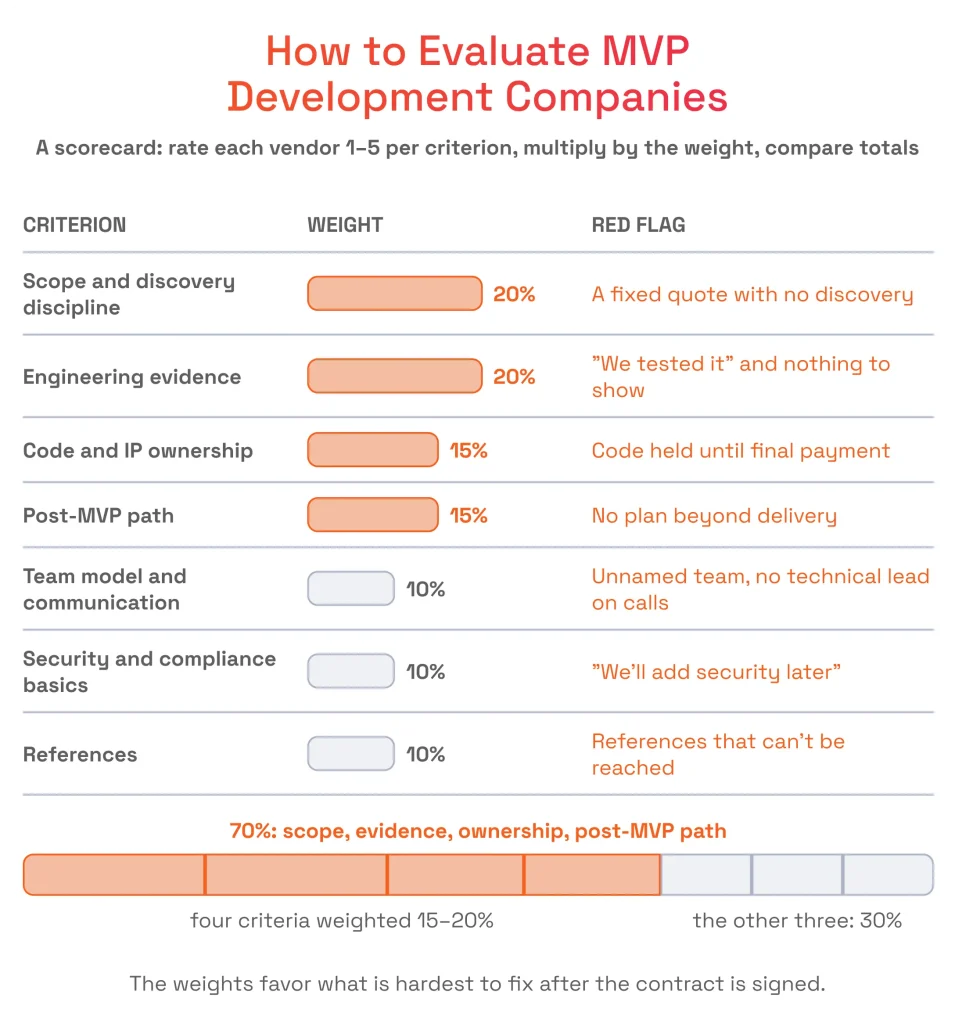
A scorecard turns a vague impression of MVP development companies into totals you can compare side by side. Score each vendor 1–5 per criterion, multiply by the weight, and add up the results. The weights favor what is hardest to fix after the contract is signed, so the scorecard should also test technical expertise and technical architecture early, because both are expensive to correct later. That is also why scope discipline carries a heavy share, and spec-first development is the practice behind it: scope, acceptance criteria and tests written before code.
Criterion | Weight | What to ask | Red flag |
|---|---|---|---|
Scope and discovery discipline | 20% | Which feature did you talk a client out of building, what value proposition sat behind that cut, and why? | A fixed quote with no discovery |
Engineering evidence | 20% | Can you show tests, CI results and delivery numbers from a recent project? | “We tested it” and nothing to show |
Code and IP ownership | 15% | Do we get repository access from day one and full IP assignment? | Code held until final payment |
Post-MVP path | 15% | What happens after launch: warranty, iteration, scaling? | No plan beyond delivery |
Team model and communication | 10% | Who is on the team, how senior, how do you run a transparent process with regular updates, and how often do we talk? | Unnamed team, no technical lead on calls |
Security and compliance basics | 10% | How do you handle authentication, data protection and secrets? | “We’ll add security later” |
References | 10% | Can we speak to two founders you built for in the last year? | References that can’t be reached |
Criterion
Scope and discovery discipline
Engineering evidence
Code and IP ownership
Post-MVP path
Team model and communication
Security and compliance basics
References
Weight
20%
20%
15%
15%
10%
10%
10%
What to ask
Which feature did you talk a client out of building, what value proposition sat behind that cut, and why?
Can you show tests, CI results and delivery numbers from a recent project?
Do we get repository access from day one and full IP assignment?
What happens after launch: warranty, iteration, scaling?
Who is on the team, how senior, how do you run a transparent process with regular updates, and how often do we talk?
How do you handle authentication, data protection and secrets?
Can we speak to two founders you built for in the last year?
Red flag
A fixed quote with no discovery
“We tested it” and nothing to show
Code held until final payment
No plan beyond delivery
Unnamed team, no technical lead on calls
“We’ll add security later”
References that can’t be reached
Use the table to compare vendors consistently, not to justify a favorite after the fact. If two firms land close, the right MVP development partner is usually the one whose answers stay concrete under follow-up, especially on discovery discipline, because that is how teams prevent scope creep before it turns into cost and delay.
Ask for Delivery Evidence You Can Check
An automated evidence trail is the record of tests, checks and reviews attached to each change before it ships. It matters more now because AI-assisted teams produce more changes. Google Cloud’s 2025 DORA report, drawn from nearly 5,000 technology professionals, found that AI adoption lifts delivery throughput while its relationship with stability stays negative. Its authors trace that instability to a higher volume of changes arriving without strong automated testing, mature version control and fast feedback loops.
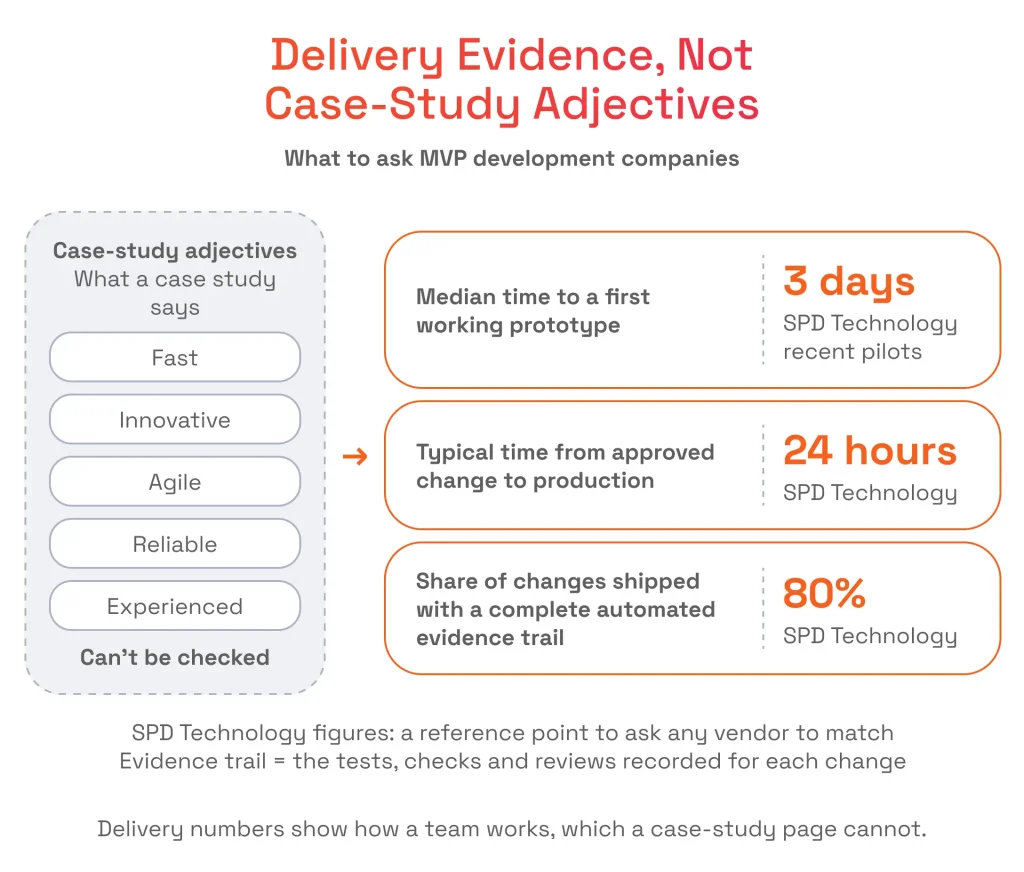
SPD Technology’s own figures give a reference point you can ask any vendor to match: a 3-day median to a first working prototype on recent pilots, 24 hours typical time from approved change to production, and 80% of changes shipped with a complete automated evidence trail. A team that tracks its delivery can share its own equivalents on request, so founders can compare vendors side by side on scores and startup track record.
For the reviewer’s side of that conversation, see how to trust AI-generated code.
Check Who Owns the Code, the Tests and the Infrastructure
Code ownership terms decide whether you can ever leave the vendor you pick. The AI production-ready checklist covers the technical side, and the contract should cover the six points below.
- You get repository access from day one, so every commit is visible as it lands.
- The contract includes full IP assignment, the legal transfer of ownership of the code, designs and documentation to your company.
- The architecture is documented well enough for a new engineer to find their way around in days.
- A test suite covers the core user flows and runs on every change.
- CI/CD, the automated pipeline that tests and deploys each change, is set up and handed over with the code.
- Cloud accounts and third-party services are registered in your company’s name.
If any of these is missing at handover, changing vendors can mean a rebuild.
AI MVP Development Companies: What Changes When AI Writes the First Draft
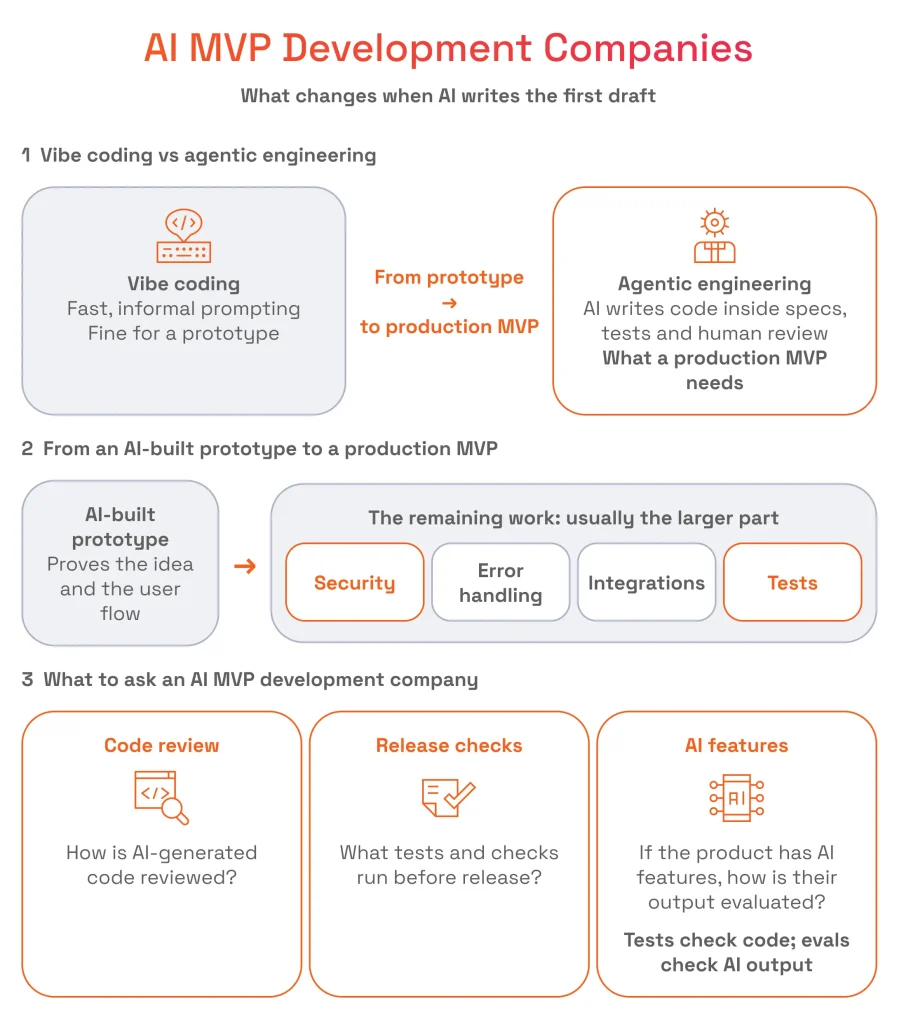
Vibe coding is fast, informal prompting of AI tools, and it is fine for a prototype. Agentic engineering is AI writing code inside specs, tests and human review, which is what a production MVP needs. Many AI-focused teams still rely on Agile methodologies, so the useful difference is how each one reviews, tests, and validates AI-assisted output before it ships. Every one of the AI MVP development companies you speak with will use AI coding tools, so the useful question is where each team draws the line between the two.
Three questions show where that line sits:
- How is AI-generated code reviewed before it merges?
- What tests and checks run before each release?
- If the product has AI features, how is their output evaluated? Tests check deterministic code, while evals score AI output against rubrics. Eval engineering for an MVP explains how to set those up early.
An AI-built or no-code prototype can become a production MVP, and the remaining work on security, error handling, integrations and tests is usually the larger part of the job. That hardening is where developers lose time: in Stack Overflow’s 2025 Developer Survey, 66% named AI solutions that are almost right as their biggest frustration, and 45% said debugging AI-generated code takes longer. The patterns behind why AI-generated code breaks in production repeat across products. Founders planning to take a prototype to production should see that hardening priced into the first estimate.
Oleksandr Boiko
Delivery Director at SPD Technology
“A prototype answers whether anyone wants the product. An MVP has to answer what happens when a payment fails, a user enters data nobody planned for, or two hundred people sign up in the same hour. When a founder brings us an AI-built prototype, the first thing we look for is which parts already have a test proving they work, because those are the parts we can keep without a rebuild.”
The full sequence is covered in our dedicated article on how to build an AI-driven MVP. After launch, gathering user feedback helps shape the next iteration once the hardened MVP is live, and customer feedback shows whether the product still matches real needs.
Red Flags When Hiring an MVP Development Company
Some signals rule a vendor out before you reach the scorecard. Each one is quick to spot in a proposal or on a first call, and each predicts a problem you would otherwise pay to discover.
- A fixed scope and price with no discovery means the vendor is pricing work it hasn’t examined.
- A proposal built around a long, exhaustive feature list instead of a reduced first release is a red flag.
- A proposal with no test or CI plan leaves you with code nobody can change safely.
- Code held back until final payment turns your own product into a bargaining chip.
- Weak post launch support is a red flag because maintenance, fixes, and iteration start as soon as real users arrive.
- References that can’t be verified usually cover for projects that ended badly.
- Pressure for a single big-bang launch with no staged releases removes every chance to catch problems early.
A quote far below the rest usually means missing work that returns later as AI technical debt: AI-generated code that works now and is costly to change later.
The AI MVP scaling risks article shows where that debt tends to surface first.
MVP Development Cost and Timeline: What Drives Them
Published price ranges for MVPs vary too widely to quote responsibly. Five drivers decide where a specific MVP lands, so the useful move is to ask each vendor how its estimate accounts for them.
Driver | Why it moves cost and timeline | What to ask in the estimate |
|---|---|---|
Scope | Each user role and core flow adds design, build and test work | Which features are in the first release, and which were cut |
Integrations | Payments, identity checks and third-party APIs bring their own failure cases to handle | Which integrations are included and how each is tested |
Compliance | Rules such as HIPAA, SOC 2 or PCI DSS add architecture and review work from day one | Which standards apply and how compliance is evidenced |
Team seniority | Senior engineers cost more per hour and usually need fewer correction cycles | Who is named on the team and at what level |
How AI is used in delivery | AI speeds up first drafts; review and testing decide whether that speed holds | How AI-generated code is reviewed and tested |
Driver
Scope
Integrations
Compliance
Team seniority
How AI is used in delivery
Why it moves cost and timeline
Each user role and core flow adds design, build and test work
Payments, identity checks and third-party APIs bring their own failure cases to handle
Rules such as HIPAA, SOC 2 or PCI DSS add architecture and review work from day one
Senior engineers cost more per hour and usually need fewer correction cycles
AI speeds up first drafts; review and testing decide whether that speed holds
What to ask in the estimate
Which features are in the first release, and which were cut
Which integrations are included and how each is tested
Which standards apply and how compliance is evidenced
Who is named on the team and at what level
How AI-generated code is reviewed and tested
Feature prioritization frameworks such as MoSCoW help cut the first release to essential functionality. A founder starting from a blank page also pays for research and user flows through UI/UX design. Each added platform, such as native apps through mobile app development, brings its own build and test cycle. What compliance does to scope is shown in an MVP for a payment platform.
The contract model shapes the number too. A fixed price on an unexamined scope moves the risk into change requests, while time and materials keeps the trade-offs visible week by week, which matters even more for early-stage teams working with tight budgets. For a worked timeline, see the 90-day path from MVP to production.
US MVP Development Companies vs Distributed Teams
Where the team sits shapes time zones, contracts and compliance as much as the hourly rate, and it is a trade-off that early-stage startups, funded startups, and established companies weigh differently based on cost, compliance, and proximity. The table compares the two models on the factors founders weigh most often.
Factor | US-based team | Distributed team |
|---|---|---|
Time zone | Full overlap | Partial overlap; needs agreed working hours |
Contracting and IP | US law by default | Check governing law and IP assignment |
Compliance | Familiar with US rules (for example HIPAA, SOC 2) | Ask for evidence of the same standards |
Cost | Higher hourly rates | Lower rates for comparable seniority |
Factor
Time zone
Contracting and IP
Compliance
Cost
US-based team
Full overlap
US law by default
Familiar with US rules (for example HIPAA, SOC 2)
Higher hourly rates
Distributed team
Partial overlap; needs agreed working hours
Check governing law and IP assignment
Ask for evidence of the same standards
Lower rates for comparable seniority
A distributed model works well when you run a dedicated development team with agreed overlap hours and a named technical lead. Many US MVP software development companies also deliver with distributed engineers, so ask where the team actually sits. Some scale-ups and enterprise clients use this model too when governance is clear.
Five Questions to Ask Top MVP Development Companies Before You Sign
These five questions turn the scorecard into a script for the first sales call, helping founders choose the right mvp and find the right mvp development partner, not just compare sales pitches. Each one has an answer you can confirm with a document, a dashboard or a contract clause.
✓ | Question | What a good answer confirms |
|---|---|---|
☐ | Which feature would you cut from our first release, and why? | Product thinking, not scope expansion |
☐ | Can you show delivery evidence from a recent project? | Tests, CI results and real numbers exist |
☐ | Do we own the code, tests and cloud accounts from day one? | You can leave without a rebuild |
☐ | How do you review and test AI-generated code? | Speed doesn’t come at the cost of reliability |
☐ | What happens in the 90 days after launch? | There is a path from MVP to a product that scales |
✓
☐
☐
☐
☐
☐
Question
Which feature would you cut from our first release, and why?
Can you show delivery evidence from a recent project?
Do we own the code, tests and cloud accounts from day one?
How do you review and test AI-generated code?
What happens in the 90 days after launch?
What a good answer confirms
Product thinking, not scope expansion
Tests, CI results and real numbers exist
You can leave without a rebuild
Speed doesn’t come at the cost of reliability
There is a path from MVP to a product that scales
Specific answers to all five put a vendor on the shortlist, and a vague answer to question 2 or 3 is enough reason to keep looking; experienced development teams should also answer with specifics on mobile and web development, ownership, and post-launch execution when relevant.
MVP Development with SPD Technology — Our Expertise
SPD Technology provides MVP development services for founders building a digital product meant to survive their first real users. We engineer the specs, tests and delivery evidence that make a fast build trustworthy.
- New builds (Zero to One). Embeddings-based smart search, matching asset managers with financial advisors even when their profiles use different wording, powers the MVP we built for a US asset and wealth management startup. A web crawler built in one week with Apify feeds the matching, and the MVP was delivered on time and on budget to support the client’s investor fundraising.
- Fast validation to production. Search-to-purchase conversion rose 12.5% and items per order rose 16% after an eCommerce gift card platform rolled out its AI gift assistant. The work started with a Replit prototype built from plain-language requirements in 3 days for about $25, which enabled rapid validation before we built the production semantic search, a search that matches what shoppers mean when their queries are vague.
- Prototype to production (Vibe to Scale): architecture review, tests and hardening for AI-built and freelancer-built prototypes, including cloud solutions for handover when relevant, so the parts that already work can stay.
Conclusion
The right MVP development company proves how it delivers, hands over the code and the tests, and has a plan for what comes after launch. A scorecard applied to all the MVP development companies on your list is more reliable than any published ranking. The next step is concrete: score three shortlisted companies, then take the five questions to the first call and note which answers arrive with evidence.
Key Takeaways
The points below compress the scorecard and the reasoning behind it. Each one links a cause to the consequence a founder ends up paying for.
- A vendor’s position on a published ranking shows nothing about how that vendor delivers, so scoring every candidate on the same weighted criteria produces a more reliable shortlist.
- A working prototype and a production-ready MVP are different deliverables: the prototype shows the idea, while the MVP has to handle real users, real data and failure cases.
- Delivery evidence, such as time to a first working prototype and the share of changes shipped with automated checks, shows how a team works in a way a case-study page cannot.
- A fixed quote with no discovery phase means the vendor is pricing a scope it hasn’t examined, which leads to scope disputes and overruns.
- If the contract doesn’t give you the code, the tests and the cloud accounts from day one, changing vendors later can mean rebuilding the product.
- AI coding tools make the first version fast, but without specs, tests and human review the remaining work on security, error handling and integrations returns as technical debt.
- The cheapest MVP quote is rarely the cheapest product, because strong mvp services reduce the first release to the essential assumptions instead of expanding it into a full build before the product can scale.
In short: choose the software development company for an early-stage product that can prove delivery, ownership, and a post-launch path.
FAQ
How do I choose an MVP development company?
Score each candidate on the same criteria: scope and discovery discipline, engineering evidence, code and IP ownership, post-MVP path, team model, security basics and references. To choose the right MVP development company, founders should look for a product development company with a startup track record, relevant technical expertise, and a transparent process. Ask for delivery numbers and a recent client you can call. A paid discovery phase before the main contract is the lowest-risk way to test how a vendor works.
How much does MVP development cost and how long does it take?
Cost and timeline follow scope more closely than hourly rates. A narrow MVP with one user role and few integrations sits at the low end of any quote; payments, identity checks, compliance such as HIPAA or PCI DSS, AI features and extra platforms each add build and test time. Paid discovery turns a range into a scoped estimate.
Will I own the code of my MVP?
You should, but only if the contract says so. Ask for full IP assignment, repository access from day one, and cloud and third-party accounts registered in your company’s name. Ownership should also cover the test suite, CI/CD setup and documentation, because code without them is hard for another team to take over.
Should I hire a freelancer, an agency or an AI-native MVP development company?
A freelancer suits a narrow, well-defined build on a small budget. An mvp development agency is often the better fit for non-technical founders who need end-to-end support across web and mobile. An agency suits a larger scope that needs design, several platforms or compliance, and same team handling mobile and web development usually improves coordination after launch. An AI-native product engineering partner suits founders who want a fast build that holds up in production, or who have an AI-built prototype that needs hardening.
What should an MVP development company deliver besides the code?
Expect discovery outputs (scope, user flows, architecture, with the technical architecture documented for future scaling), a test suite, a CI/CD pipeline, documentation, access to all accounts and infrastructure, post-launch support, and a plan for the months after launch, not only handover artifacts. These decide whether the MVP can be maintained, extended and defended when founders face the questions investors ask about AI development.
Can an AI-built prototype be turned into a production MVP?
Yes, but rarely as it stands: an early-stage product usually needs hardening before it becomes a production MVP. An AI-built prototype usually proves the idea and the user flow, often for web and mobile prototypes, saas platforms, e commerce platforms, or other digital products in multiple industries and the public sector. Reaching production takes an architecture review, security fixes, error handling, integrations and tests. Some parts can be kept and others rebuilt, so a short assessment should come before any estimate.