

Choosing the right data analytics partner comes down to five things: domain expertise across all analytics types, industry-specific experience, a full-service offering from strategy to deployment, a modern AI/ML-enabled tech stack, and proven client results. With global data volume set to more than double by 2028 and half of all business decisions expected to be AI-augmented by 2026, the gap between companies that implement analytics effectively and those that don’t is widening fast.
According to a Gartner survey of data and analytics and AI leaders, organizations with successful AI initiatives invest up to 4x more in data and analytics foundations than their peers. Yet only 39% of technology leaders are confident their current AI investments will have a positive impact on financial performance. This gap between investment intent and confidence makes the question not whether to leverage data analytics, but how to implement it effectively. Should companies go through lengthy and complex processes of recruiting and training existing employees, or is it more convenient and effective to partner with data analytics companies for management consulting and delivery?
The latter can actually solve many headaches: outsourcing data & analytics services provides immediate access to experienced professionals, emerging technologies, and ready-made solutions. So, teaming up with a trusted partner can actually put data analytics initiatives on a whole new level. The main challenge here is to choose the right one. To help you choose wisely, we outline the leading data analytics providers and recommendations on how to find the one that best fits your project.
Top 10 Analytics Companies to Partner with in 2025
Shortlisting companies might be overwhelming since there are thousands of firms that operate on the market. To make this task easier for decision makers, we compiled a curated list of top data analytics companies.
Company | Founded | Core Expertise | Industries Served |
|---|---|---|---|
SPD Technology | 2006 | Data Analytics, Data Engineering, BI, AI/ML, Cloud | Finance, Healthcare, Retail, Education, Manufacturing, Logistics, Real Estate, Construction, Legal |
Denologix | 2002 | Big Data, Advanced Analytics, AI/ML, BI, Data Quality, Information Management | Finance, Telecommunications, Healthcare, Retail |
Edvantis | 2005 | BI, Data Science, Predictive & Descriptive Analytics, Big Data, Software Development | Healthcase, Retail, High-Tech, Real Estate, Fintech, Public Sector, Transportation |
Traction Consulting Group | 1999 | Business Analytics, Power BI, Odoo, Digital Transformation for SMBs | Finance, Sales, Marketing, Operations, Service, Manufacturing |
Indium | 1999 | Data Engineering, BI & Data Visualization, AI Engineering, IoT & Edge Analytics, Software Development | Healthcare, Technology, Gaming, Retail, Manufacturing, BFSI |
Ampersand Consulting | 2012 | Data Strategy, Data Management & Governance, Predictive Analytics, Visualization, Data Engineering, AI/ML & LLMs | Education, Legal, Marketing, Career, Technology |
Data Understood | 2018 | Data Audit, Data Strategy, BI & Visualization, Data Literacy Training, Data Science & Statistical Analysis | Technology, Legal, Media, Manufacturing, Finance, Healthcare |
Made in Tandem | 2010 | Data Strategy Consulting, Digital Transformation, Legacy Modernization, Process Digitization, Cloud & Software Engineering | Finance, climate/AgTech, loyalty & digital services |
NaNLABS | 2013 | Data Engineering, Cloud Data Platforms, Real-time Data Processing, AI-driven Solutions, Analytics | Cybersecurity, Insurance, Automotive, SaaS & Digital Platforms |
InData Labs | 2014 | Big Data Analytics, Predictive Analytics, Forecasting, Recommendation Systems, Generative AI & LLMs, NLP, Cognitive Computing | eCommerce, Marketing & Advertising, Logistics, FinTech, Digital Health, IoT |
Company
SPD Technology
Denologix
Edvantis
Traction Consulting Group
Indium
Ampersand Consulting
Data Understood
Made in Tandem
NaNLABS
InData Labs
Founded
2006
2002
2005
1999
1999
2012
2018
2010
2013
2014
Core Expertise
Data Analytics, Data Engineering, BI, AI/ML, Cloud
Big Data, Advanced Analytics, AI/ML, BI, Data Quality, Information Management
BI, Data Science, Predictive & Descriptive Analytics, Big Data, Software Development
Business Analytics, Power BI, Odoo, Digital Transformation for SMBs
Data Engineering, BI & Data Visualization, AI Engineering, IoT & Edge Analytics, Software Development
Data Strategy, Data Management & Governance, Predictive Analytics, Visualization, Data Engineering, AI/ML & LLMs
Data Audit, Data Strategy, BI & Visualization, Data Literacy Training, Data Science & Statistical Analysis
Data Strategy Consulting, Digital Transformation, Legacy Modernization, Process Digitization, Cloud & Software Engineering
Data Engineering, Cloud Data Platforms, Real-time Data Processing, AI-driven Solutions, Analytics
Big Data Analytics, Predictive Analytics, Forecasting, Recommendation Systems, Generative AI & LLMs, NLP, Cognitive Computing
Industries Served
Finance, Healthcare, Retail, Education, Manufacturing, Logistics, Real Estate, Construction, Legal
Finance, Telecommunications, Healthcare, Retail
Healthcase, Retail, High-Tech, Real Estate, Fintech, Public Sector, Transportation
Finance, Sales, Marketing, Operations, Service, Manufacturing
Healthcare, Technology, Gaming, Retail, Manufacturing, BFSI
Education, Legal, Marketing, Career, Technology
Technology, Legal, Media, Manufacturing, Finance, Healthcare
Finance, climate/AgTech, loyalty & digital services
Cybersecurity, Insurance, Automotive, SaaS & Digital Platforms
eCommerce, Marketing & Advertising, Logistics, FinTech, Digital Health, IoT
Now, let’s take a closer look at each company.
1. SPD Technology
- Location: UK
- Number of employees: 600+
- Pricing: $50 – $99
- Founded: 2006
- Clients: PitchBook, MorningStar, BlackHawk Network, Roche
- Clutch Rating: 4.9
SPD Technology is a software engineering company that offers end-to-end development services for a vast array of projects. The company’s world class analytics allow their clients to experience the advantages of strategic technology consulting, AI/ML development (including GenAI assistants and AI-powered virtual agents), data analytics, business intelligence – all that in addition to standard software design and engineering services. Their team is well-versed in delivering solution development and analytics projects across payment processing solutions, financial fraud detection software for FinTech, marketing automation and customer analytics platforms for eCommerce, patient engagement and clinical analytics solutions with patient outcomes for healthcare data platforms, predictive maintenance and supply chain optimization systems for Logistics, and contract analytics and eDiscovery solutions for LegalTech.
2. Denologix
- Location: Canada
- Number of employees: 200+
- Pricing: $150 – $199
- Founded: 2002
- Clients: CIBC, Aviva, SAS
- Clutch Rating: 4.7
Denologix is a premier analytics and information management company specializing in the implementation of Big Data, AI, ML, and advanced analytical solutions. The company has positioned itself as a global market leader in data quality excellence and has been recognized in the leader’s quadrant for Big Data and BI for over 15 consecutive years. Denologix serves a diverse range of industries and delivers software for finance, telecommunications, and healthcare organizations and is praised for their professionalism, technical expertise, and ability to deliver tailored solutions.
3. Edvantis
- Location: Poland
- Number of employees: 400+
- Pricing: $25 – $49
- Founded: 2005
- Clients: Nowtilus, Freenet, SEMDATEX
- Clutch Rating: 4.8
Edvantis is a software solution development company with a strong focus on BI and data science. They are known for their commitment to digital transformation and building high-quality, scalable IT solutions. Their portfolio includes projects for companies of all sizes and diverse domains. Edantis is open to building projects from scratch or supporting and enhancing existing solutions. When it comes specifically to data analytics, they offer the knowledge of 50+ professionals in this field and are ready to blend data analytics expertise with skills in machine learning and artificial intelligence, predictive and descriptive analytics as well as Big Data.
4. Traction Consulting Group
- Location: US
- Number of employees: ≈50
- Pricing: $150 – $199
- Founded: 1999
- Clients: Acromag, Mdxhealth, Comm-Fit, Organic 3
- Clutch Rating: 4.9
Traction Consulting Group is a digital transformation firm specializing in implementing, enhancing, and supporting technology solutions tailored to small and midsize businesses. One of the major areas of the company’s expertise is business analytics services that are implemented through such solutions as Microsoft Power BI and Odoo. The firm emphasizes understanding the unique challenges faced by business owners and senior leaders in different industries, including finance, sales, marketing, operations, service, and manufacturing, and tailors technology solutions to address specific needs.
5. Indium
- Location: India
- Number of employees: 5000+
- Pricing: <$25
- Founded: 1999
- Clients: Atlas Air, Convey, Li & Fung
- Clutch Rating: 4.7
Indium is a solution development company with over 2 decades of experience and skills in desktop and mobile development, AI engineering, DevOps, and data science. The fact that the company is the place for nurturing an impressive number of employees makes it possible to cover almost every aspect of software development, from start to finish, for any industry. When it comes to data analytics solutions, Indium offers data engineering, modernization, BI and data visualization, IoT and Edge analytics. Through these diverse services, the company empowers businesses to harness the full potential of their data.
6. Ampresand Consulting
- Location: US
- Number of employees: ≈50
- Pricing: $150 – $199
- Founded: 2012
- Clutch Rating: 4.9
Ampresand Consulting is one of the best data analytics services providers that offers expertise in data strategy, management, governance, predictive analytics, and visualization. This broad know-how to analytics allows the company to design and implement data storage and processing systems capable of managing substantial information volumes, then utilize skills in data engineering, data governance, LLMs, AI, and ML to deploy analytical techniques. With the help of Ampresand Consulting, businesses can fully outsource their analytics initiatives, expecting a full-fledged solution that meets business needs.
7. Data Understood
Data Understood is a data consultancy firm that transforms businesses through data management and analytics solutions. Their professional services are designed to bridge gaps in strategy, skills, and technology, enabling different businesses to get the most out of their data assets. The company focuses on data audit, data strategy consulting, BI and data visualization, data literacy training, data science and statistical analysis. Such an all-encompassing approach to data services allows their clients to address many data initiatives at once: they can gain insights into their operations, optimize decision-making, and enhance business performance.
8. Made in Tandem
- Location: US
- Number of employees: ≈50
- Pricing: $150 – $199
- Founded: 2010
- Clients: Beyond Finance, The Climate Corporation, ampliFI Loyalty Solutions
- Clutch Rating: 4.9
Made in Tandem is the digital transformation company that focuses on modernizing legacy systems, digitalizing processes, and scaling to enterprise operations. Their data efforts are based on data strategy consulting and beneficial for businesses that experience rapid growth, struggle with data silos, or planning modernization. The company’s strategic services can be further supported by software engineering and cloud computing expertise to ensure data initiatives achieve their intended outcomes.
9. NaNLABS
- Location: Argentina
- Number of employees: ≈200
- Pricing: $50 – $99
- Founded: 2013
- Clutch Rating: 4.9
NaNLABS is a data engineering company that delivers cloud, real-time data processing, and AI-driven solutions. This company has demonstrated its data expertise across various sectors, including cybersecurity and insurance analytics, automotive analytics, and SaaS and digital platforms. With those skills and experience under their belt, NaNLABS team will be an ideal partner for businesses looking to eliminate data silos, streamline data ingestion, and facilitate robust analytics.
10. InData Labs
- Location: Lithuania
- Number of employees: 80+
- Pricing: $50 – $99
- Founded: 2014
- Clients: Wargaming, AsstrA, Captiv8, GSMA
- Clutch Rating: 4.9
InData Labs is a data science firm with expertise in Big Data, predictive analytics, forecasting, and the development of recommendation systems. They also specialize in generative AI, including ChatGPT solutions and LLMs, as well as NLP. The company offers cognitive computing services such as sentiment analysis, risk assessment, fraud detection, and behavioral recommendations. Businesses seeking advanced analytics solutions will find the partnership with InData Labs fruitful, especially if they operate in sectors like eCommerce, marketing and advertising, logistics, fintech, digital health, and IoT, given InData Labs’ extensive experience in these domains.
The Growing Role of Companies Analytics for Business Success
The amount of data will inevitably increase. According to Statista, global data volume is forecast to reach 394 zettabytes by 2028, more than double the 182 zettabytes estimated for 2025. Only companies that know how to extract the most value from this data will thrive since they will know more about their business performance and customers. In practice, data analytics enable customers to act on insights faster across key workflows.
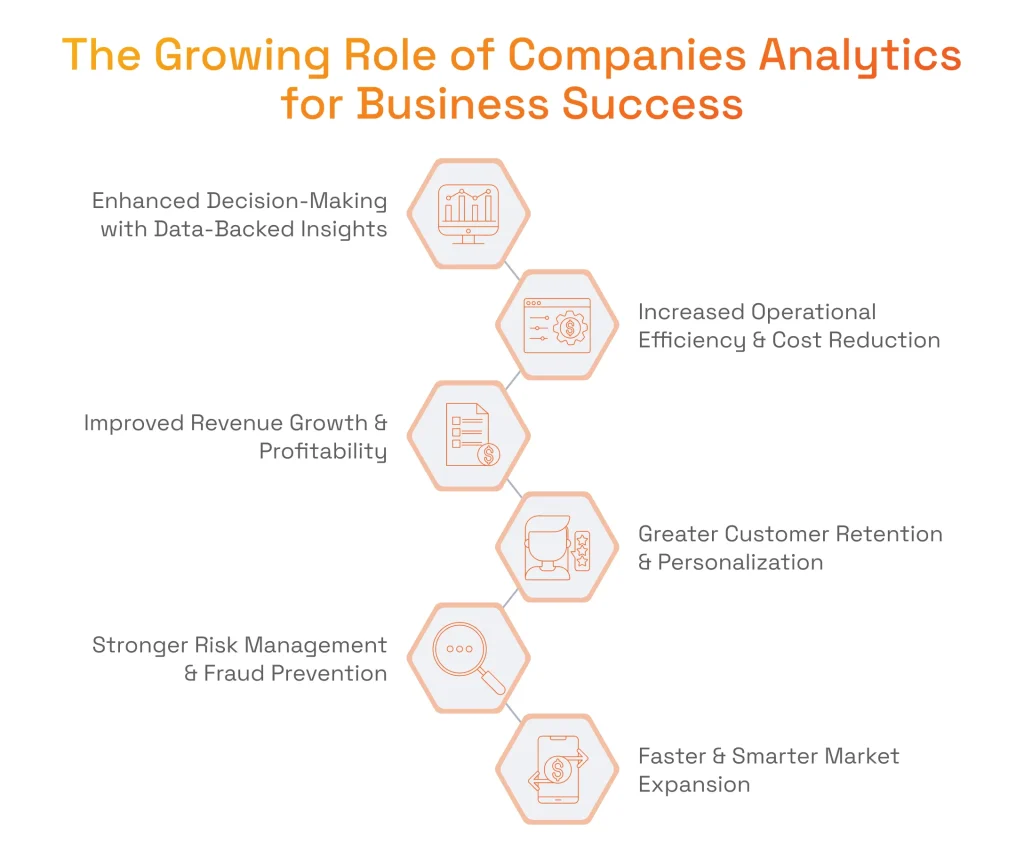
Analytics can leverageBig Data and its business impact to provide businesses with the possibility to track key performance indicators (KPIs), identify supply and demand, optimize stock levels, track equipment performance, analyze engagement rates on advertising channels, and more. Data-driven companies also gain a clearer picture of their customers: who they are, what they want, and how they behave. They will be able to analyze purchasing patterns, personalize marketing efforts, improve customer service, and anticipate future needs. These insights drive broader business improvements, such as:
- Enhanced Decision-Making with Data-Backed Insights: Companies that chose to leverage analytics services and solutions in conjunction with AI can use real-time and historical data (e.g., trends, patterns, and correlations) to form decisions. According to Gartner’s top data and analytics predictions, by 2026 half of all business decisions will be augmented or automated by AI agents — a shift that extends well beyond marketing into inventory management, budgeting allocations, equipment maintenance schedules, pricing strategies, workforce management, and more.
- Increased Operational Efficiency & Cost Reduction: Companies that leverage analytics will see their enterprises become more efficient as a result of informed decisions. They will experience how new ways for workforce and budget allocations allow saving money, how better marketing and pricing strategies attract new customers, how advanced precision medicine solutions connect patients to health centers and improve patient care, and how streamlined inventory management allows employees to plan their work efforts. For instance, predictive maintenance using advanced analytics in manufacturing typically reduces machine downtime by 30-50% and increases machine life by 20-40%, directly cutting maintenance and outage costs.
- Improved Revenue Growth & Profitability: According to Gartner, organizations with the highest maturity of AI-ready data and analytics capabilities are achieving up to 65% greater business outcomes, including revenue growth and cost optimization. Once analytics navigates the budgeting for equipment repairs, supply chain management, inventory control, workforce allocation, and other work initiatives, companies will gain greater financial visibility into how to optimize each operation to reduce waste and minimize unnecessary expenses. In this manner, businesses can spend every penny with the aim to maximize ROI.
- Greater Customer Retention & Personalization: It is found that data-driven organizations are 23x more likely to acquire customers, 6x more likely to retain them, and 19x more likely to be profitable. Analytics service allows companies to segment audiences, predict customer needs, optimize pricing, and tailor marketing efforts. In such a way, they can set up personalized customer experiences, which increases brand loyalty and reduces the likelihood of customers turning to competitors. This leads to higher conversion rates and more repeat purchases.
- Stronger Risk Management & Fraud Prevention: When combined with artificial intelligence and machine learning, analytics can evaluate business systems by identifying patterns, anomalies, and suspicious activities. As a result, it can flag fraudulent transactions, unusual network behaviors, or discrepancies in financial reports and enable businesses to take immediate action for enabling proactive risk assessment and bolstering security measures. One of the examples of combining new data sources with advanced analytics showed increased fraud detection by ~60% while cutting false positives by ~50%.
- Faster & Smarter Market Expansion:According to Deloitte’s State of AI in the Enterprise report, 66% of business leaders view AI as critical to success. Still, only 38% believe their use of AI actually differentiates them from competitors, making how companies implement analytics the decisive factor, not whether they adopt it at all.

Dmytro Tymofiiev
Delivery Manager at SPD Technology
“To unlock the true power of analytics, it is important to use it in conjunction with AI and ML. Working with both these technologies will allow, for example, accelerate discovery, predict customer behaviors, optimize resources, and anticipate market shifts long before competitors do.”
What Makes Top Data Analytics Companies Stand Out
With data analytics, companies can establish streamlined and optimized processes, achieving significantly higher productivity and effectiveness. To fully leverage analytics, businesses should partner with a leading analytics firm. But how can a company ensure it has chosen the right partner? Below are the key criteria to consider.
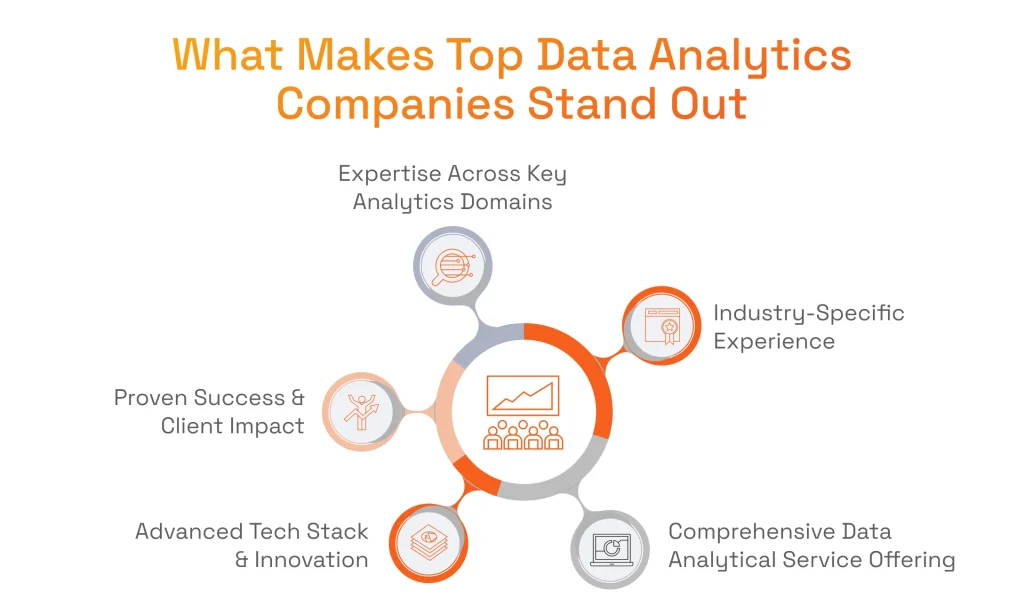
Expertise Across Key Analytics Domains
Data analytics encompasses several specialized domains, each providing insights tailored to specific areas of business, whether it’s identifying customer behavior patterns, optimizing operational efficiency, or forecasting market trends. An understanding across all analytics domains ensures end-to-end data management, resulting in increased accuracy and reliability of generated insights. What’s more, companies with an understanding of all the nuances of analytics can effectively integrate emerging technologies such as artificial intelligence and machine learning, which will further enhance analytics capabilities. Ultimately, broad analytics expertise allows organizations to remain flexible and adaptable, swiftly adjusting decisions in accordance with shifts in demand, market trends, or competition.
Pioneering analytics firms should have deep expertise in the following analytics domains:
- Descriptive Analytics: Provides an understanding of the company’s past performance by summarizing historical data and clearly showing past events, trends, and outcomes.
- Diagnostic Analytics: Analyzes data to identify the root causes of past events, uncovering factors and relationships that influenced specific outcomes.
- Predictive Analytics: Helps businesses anticipate outcomes by using statistical models and ML to forecast future trends or behaviors based on historical data.
- Prescriptive Analytics: Recommends optimal actions and strategies by combining predictive insights with decision-making algorithms.
- Real-Time Analytics: Analyzes data immediately as it’s generated, providing insights for quick response to emerging events, risks, or opportunities.
Industry-Specific Experience of a Data Analytics Firm
A strong analytics firm understands that data challenges differ by industry. Each domain has unique types of data, regulatory requirements, operational goals, and customer demands, and this is why the approach to analytics must be tailored to specific demands of critical business functions.
For example, particular attention must be paid to data-related regulations in a system that belongs to a healthcare analytic company since non-compliance can lead to fines, legal penalties, or even business shutdown. Or when working with data analytics in retail, technical teams need expertise in analyzing customer purchase histories and browsing behaviors to personalize recommendations.
Depending on the industry a particular business belongs to, it can confidently regard technology vendors as experienced data and analytics companies when their experts demonstrate deep knowledge in the following areas:
- Finance & Banking: Expertise in fraud detection, risk assessment, regulatory compliance, credit scoring, customer segmentation, predictive analytics, algorithmic trading, and digital asset services (e.g., crypto analytics, AML monitoring, custody and transaction risk).
- Healthcare: Competency in patient data management and multimodal clinical analytics across a health system, including predictive modeling for disease detection, clinical trials analytics, patient engagement tools (including powered virtual agents voice for call deflection and self-service), healthcare outcomes analysis, and compliance with healthcare data regulations. Plus, expertise in building a communications solution that integrates scheduling, reminders, and patient messaging into workflows is a huge point for choosing a company.
- Retail & eCommerce: Skills in customer behavior analysis, demand forecasting, inventory optimization, pricing analytics, personalized recommendations, and marketing performance analytics.
- Manufacturing & Logistics: Proficiency in supply chain optimization, predictive maintenance, production efficiency analytics, quality control analytics, logistics management, and real-time monitoring that connects the physical and digital worlds via IoT and operational data.
Comprehensive Data Analytical Service Offering
Leading providers offer a robust suite of services. Companies that offer end-to-end services, from consulting to maintenance and support, can ensure that every factor in data initiatives is aligned with overarching objectives from the very beginning. During the initial planning phase, partners can jointly determine the technology stack, the scope and volume of tasks, and the required budget, maintaining consistency throughout subsequent phases. This structured approach helps eliminate budget overruns, reduces risks of project delays, and ensures efficient resource allocation.
To ensure the chosen vendor can lead the entire project from start to finish, it is important that they provide the following services:
- Data Strategy Consulting Services: Advising companies on how to strategically align analytics initiatives with their broader business goals to maximize value.
- Data Engineering: Designing, building, and maintaining scalable data pipelines and infrastructure, including cloud migrations, to reliably process and store data.
- BI & Dashboard Development: Developing intuitive, user-friendly business intelligence platforms and dashboards that allow users to visualize data and make informed decisions easily.
- AI/ML Model Development: Creating and deploying advanced predictive and prescriptive analytical models to identify patterns, forecast trends, and recommend actions.
- Data Governance & Compliance: Implementing policies and systems to securely manage data, ensuring compliance with industry-specific regulations and standards.
Advanced Tech Stack & Innovation
Setting up analytics means applying efforts to data collection, storage, engineering as well as data quality management, exploration, visualization, etc. Each of those aspects requires competence in working with specialized tools or even combinations of tools. Plus, leveraging analytics often requires an understanding of related fields, such as cloud computing, AI, and ML, since a modern analytics program often leverages advanced artificial intelligence for prediction, automation, and anomaly detection. This knowledge is essential because AI-driven insights, predictive modeling, and cloud-based infrastructure enable organizations to extract maximum value from their data.
A top analytics services company need to be skilled in:
- Cloud Analytics: Leveraging platforms such as AWS, Azure, and Google Cloud provides scalable, flexible, and secure computing resources.
- Big Data Frameworks: Utilizing technologies like Apache Spark and Hadoop allows analytics firms to manage, process, and analyze massive datasets.
- Machine Learning Expertise: Mastery of popular ML frameworks including TensorFlow, PyTorch, and Scikit-learn enables firms to build and deploy sophisticated predictive and prescriptive models.
- Data Visualization: Using robust visualization tools like Tableau, Power BI, and Looker helps transform complex analytics results into clear, accessible insights.
- Data Warehousing and Data Lakes: Creating data warehouse design with platforms like Snowflake, BigQuery, and Redshift to organize, store, and manage large volumes of structured data, and setting up data lakes with Apache Spark, Amazon S3, and Presto for working with unstructured data.
Discover the key differences between data warehouses vs data lakes in our dedicated article.
Proven Success of a Data Analysis Company & Client Impact
Evaluating a vendor’s technical expertise might not be enough. Taking into account delivering measurable results of their professional services must be an important part of interviewing as well. In such a way, businesses can understand that an analytics firm focuses on the results and not only technical implementation.
For many tech companies, analytics expertise must be also supported by:
- Case Studies & Success Stories: Real-world examples demonstrate the company’s ability to solve specific business challenges for fintech, retail, logistics, and healthcare systems, etc. through analytics.
- Industry Recognition & Certifications: Validation of expertise, such as awards or certifications highlight the company’s commitment to excellence.
- Client Retention & Reviews: Positive feedback, reviews, and testimonials from clients who maintain long-term partnerships, illustrate the consistent ability to deliver results.
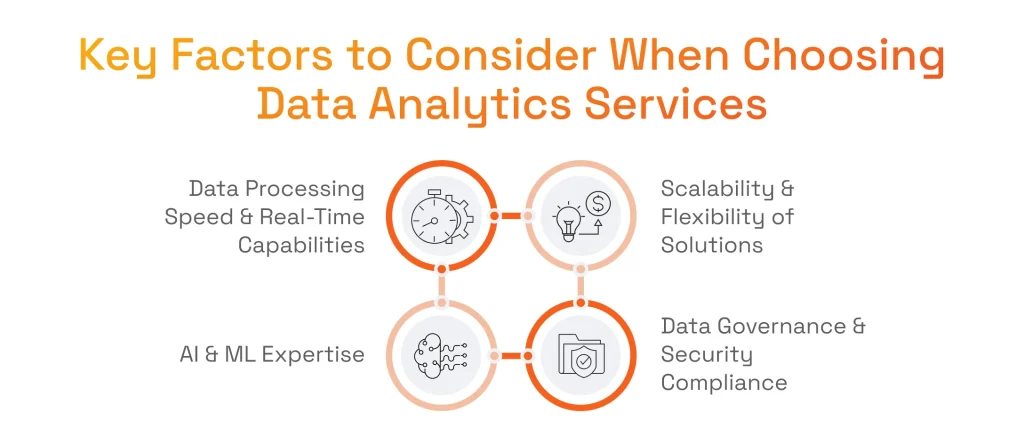
Key Factors to Consider When Choosing Data Analytics Services
Good reviews, a perfectly suitable list of services, solid years on the market – all these are important factors to consider when looking for a partner for implementing analytics. However, to ensure that the partnership helps future-proof the project, there are more criteria to verify before signing a collaboration contract.
Scalability & Flexibility of Delivered Solutions
Businesses often experience growth, changing demands, and shifts in market conditions. Some or all of these factors require scaling data analytical services as part of the inevitable evolution of a business. The important part is to make this evolution uninterrupted. This is where scalable solutions become irreplaceable. They ensure that the analytics infrastructure enables partners to handle increased volumes of data, growing user demands, and expanded analytical tasks without significant disruption or cost. At the same time, this scalability must accommodate new types of data, emerging business priorities, or new technology introduced in analytics processes.
Data Governance & Security Compliance
Effective data governance means data accuracy, consistency, proper use, and, consequently, flawless compliance. The urgency of getting this right is only growing: Gartner predicts that by 2028, 50% of organizations will implement a zero-trust posture for data governance, driven by the proliferation of unverified AI-generated data, with the firm warning that organizations can no longer implicitly trust data or assume it was human-generated.
Companies are racing to respond because a business implements strategic risk frameworks that safeguard its customers against unauthorized access, breaches, and misuse when governance and compliance measures are in place for analytics. This is especially vital for industries such as finance, healthcare, and eCommerce, as failing to meet compliance standards can result in severe financial penalties and reputational harm.
AI & ML Expertise in Data Analysis Companies
A business that leverages analytic services and does not combine them with the capabilities offered by artificial intelligence and ML loses opportunities to use its data to the fullest. It has the possibility to analyze historical data, generate descriptive insights, and visualize data through dashboards but misses out on predictive analytics, automated pattern recognition, anomaly detection, personalized recommendations, or real-time forecasting. Without ML algorithms and artificial intelligence capabilities, a business cannot be fully prepared for future trends as well as is unable to automate complex decision-making processes or derive deeper insights from datasets.
Data Processing Speed & Real-Time Analytics Capabilities
If a company has analytics expertise but lacks real-time capabilities and high-speed data processing, it means they can only clean, analyze, and transform data in a scheduled manner. In turn, instantaneous insights, continuous data streaming, and automated decisions can not be enabled. This leads to delay in decision-making as well as inability to form certain real-time business scenarios. As a result, companies lag behind competitors and lose their customers.
Dmytro Tymofiiev
Delivery Manager at SPD Technology
“Analytics alone is powerful, but when you pair it with other technologies like cloud, ML, IoT, real-time analytics, and Big Data, you unlock entirely new possibilities. Working with combinations of technologies lets us rapidly process huge volumes of data, automate intelligent decisions at the edge, and deliver actionable results faster than ever before.”
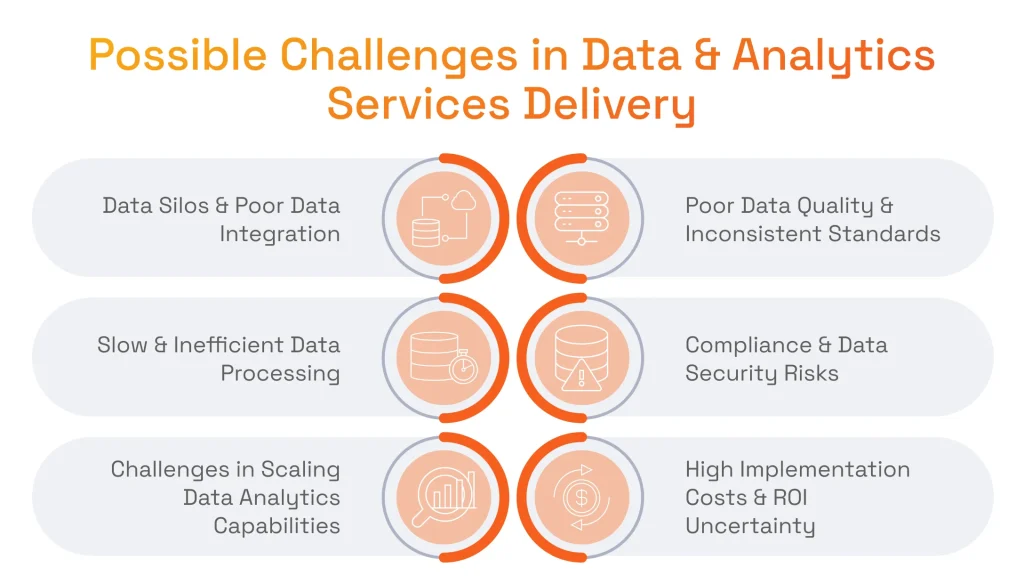
Possible Challenges in Data & Analytics Services Delivery and How We Overcome Them
For many companies, analytics is a pressing necessity, and they hurry to set it up in their systems without considering some preparation work concerning the management of data and infrastructure requirements. This leads to dealing with the results of multiple issues. However, we know how to address these challenges from the very beginning.
Data Silos & Poor Data Integration
It often happens that companies deal with numerous disconnected systems for accounting, customer relationships, enterprise planning, and other functions. Data from these systems can come in different formats, structures, and schemas. They can be incompatible and, thus, impossible to unify. This incompatibility does not allow companies to get a holistic view of the data and leverage it for complete insights. This issue is very common as a McKinsey survey found that 80% of organizations reported some divisions operating in silos, which led to decision-making difficulties.
This is where the importance of data integration becomes apparent. From our experience, most companies can benefit from the following solutions:
- Using master data management practices to unify and make consistent critical data entities, such as customers, products, and suppliers.
- Building a data warehouse for a built-in data platform with a single source of truth for structured data or creating a data lake for unstructured data.
- Developing custom APIs or microservices to make the company’s systems communicate in real-time.
Poor Data Quality & Inconsistent Standards
While working on analytics projects, we noticed that many data has errors, duplicates, or missing fields. This prevents our team from setting up analytics processes in the way that they derive accurate and relevant insights. When each team or system uses different naming conventions, data types, or collection methods, aggregating data becomes difficult. As a result, it can lead to inconsistent results in analyses and wasted investments.
A IBM Institute for Business Value report found that 43% of chief operations officers identify data quality issues as their most significant data management challenge, and over a quarter of organizations estimate they lose more than $5 million annually due to poor data quality, with 7% reporting losses of $25 million or more. Making matters worse, Gartner predicts that through 2026, organizations will abandon 60% of AI projects unsupported by AI-ready data.
To solve this challenge, we typically follow best practices in data quality management, including:
- Documenting rules around data creation, access, updates, and archiving.
- Adopting uniform schemas to ensure data fields are standardized to avoid duplications or mismatches.
- Validating data entry to catch errors (e.g., correct formats, mandatory fields) in data early.
Read our article on data quality management best practices to discover how to eliminate data inconsistencies and errors.
Slow & Inefficient Data Processing
When setting up analytics services for businesses, we often stumble upon large volumes of disparate data. This is why systems cannot process this data or process it with some delays. From our experience, we can say that these inefficiencies typically appear from outdated legacy systems, poorly optimized data pipelines, or a lack of integration among various data sources.
Setting up modern architecture helps us to overcome this challenge. The process usually entails:
- Leveraging cloud infrastructure benefits to improve performance and speed.
- Introducing automated data pipelines and well-structured data integration methods to reduce manual bottlenecks.
- Utilizing in-memory processing and parallelization to expedite analysis.
Compliance & Data Security Risks
Working with customer data is always a high-stakes process, and our clients always were extremely cautious about ensuring their data usage practices comply with regulations (e.g., GDPR, CCPA, or HIPAA). We understand this cautiousness since solely under GDPR, there have been 2,685 fines totaling over €6.11 billion as of March 2026, with the total passing the €6 billion mark for the first time.
In order to help clients to adhere to laws and regulations and protect their customers, we leverage the following measures:
- Implementing data governance frameworks aligned with applicable regulations and best practices regarding data retention, access control, and encryption.
- Conducting regular audits and vulnerability assessments ensure ongoing compliance.
- Incorporating automated monitoring tools help identify breaches early.
Challenges in Scaling Data Analytics Capabilities
Our clients often complain that the rapid growth of their businesses usually comes with the surge of complex data sources. This makes their existing analytics infrastructures lag and decrease in performance. At the same time, scaling these capabilities can be daunting, as legacy systems may not be ready to accommodate large spikes in data processing. This is a common issue for modern organizations since 85% respondents in a Deloitte survey reported a significant acceleration in digital transformation, and 40% specifically flagged “modernizing data infrastructure” as a key challenge, with 40% rating their data maturity only “low” or “medium.”
The following DevOps services and DataOps practices help us enable companies get the most out of data and analytics services while maintaining flawless performance:
- Using containerized platforms that enable on-demand resource expansion without massive upfront investment in hardware.
- Utilizing modular approaches to make analytics environments become more resilient and easier to update.
- Leveraging automation and orchestration tools to balance workloads,
- Opting for well-structured data architectures (e.g., data lakes or lakehouses) to align analytics growth with real-time business needs.
High Implementation Costs & ROI Uncertainty
Our clients often have a tight budget for adopting new analytics platforms: they find it difficult to opt for a whole business overhaul to incorporate data analytics into all the processes. From our experience, we know that when leadership is unconvinced of the potential benefits data analytics will bring, they may underfund or prematurely halt analytics initiatives.
To help companies stand on the data-driven path and be financially comfortable about it, we suggest:
- Beginning with well-defined goals and performance metrics that clarify the expected business impact.
- Implementing updates gradually to see tangible value early and foster buy-in and confidence among stakeholders.
Why Hiring a Trusted Analytics Services Company Is Key for Turning Raw Data into Strategic Advantage
Equipped with the help of a professional company, a business can tap into expertise in emerging technologies. Only in this way, it is possible to truly grasp all the benefits of data analytics and its combination with AI/ML, IoT, and other technologies. Below we explain why.
Expert-Led Data Transformation & Management
Analytics services companies bring in-depth experience in crafting an enterprise data strategy and establishing a robust data strategy framework, which serve as the blueprint for how data is collected, stored, processed, and utilized across the organization.
Experts can also develop a data strategy roadmap that ensures every phase of data handling, including data acquisition, quality control, integration, and warehousing, aligns with broader business objectives.
Learn every stage of data strategy framework development in our insightful guide.
Advanced AI & ML Capabilities of Data and Analytics Companies
A professional analytics firm can use AI and ML to enhance data initiatives. Thanks to leveraging these technologies, tech companies enable organizations to go beyond traditional descriptive analytics and into predictive and prescriptive analytics.
Seamless Integration with Business Ecosystems
A trusted analytics company understands how to connect data across CRMs, ERPs, and enterprise lifecycle solutions for end-to-end visibility. With their know-how, businesses can get a unified data environment where all business units can collaborate based on data-driven insights.
Data Security, Compliance & Risk Mitigation
A tech company that offers professional analytics services brings rigorous protocols, state-of-the-art encryption measures, and detailed governance strategies to protect sensitive information. Simultaneously, these protection measures help to comply with GDPR, HIPPA, OFAC, or any other relevant regulations.
Unlock the Power of Your Data with SPD Technology’s Data Analytics Services
With a trusted company by your side, it is always possible to implement even the most complex analytics initiatives. We strive to be such a partner and support companies in:
- Seamless Data Integration across Platforms: We execute our data warehousing expertise to consolidate disparate data sources (e.g., CRM, ERP, cloud applications, and legacy systems) into a single repository.
- High-Quality, Validated, and Secure Data Pipelines: Our team implements rigorous data validation checks and automated monitoring to ensure that your pipelines remain free of errors and anomalies.
- AI-Driven Analytics for Predictive and Real-Time Decision-Making: We support analytics with AI solutions development to identify patterns, predict trends, and introduce real-time interventions for critical processes.
- Regulatory Compliance and Best-in-Class Security: Our solutions are developed in strict accordance with global and industry-specific regulations, including GDPR, HIPAA, CCPA, and beyond.
- Cost-Efficient, Scalable, and Future-Ready Analytics Solutions: We deliver value-driven solutions by utilizing cloud-based platforms, containerization, and modular architectures for on-demand resource allocation.
Our Data Analytics Services and Solutions Delivered: Successful Projects
As one of the leading companies, we helped dozens of businesses to drive insights and act upon them to enhance growth strategies.
Transportation Construction Redefined with AI-Driven Data Analytics
HaulHub, a B2B2C company operating in the transportation construction industry, sought to expand its unified EDOT platform to better serve a complex ecosystem of agencies, contractors, vendors, and suppliers.
Business Challenge
The client turned to our help in integrating advanced analytics, automating workflows, and making possible real-time collaboration in several areas of its operations. Those areas were digital inspections, project visibility, and AI-driven image processing. Additionally, they needed to manage over 70 million ticket records and develop an OLAP system capable of near real-time insights. Meeting stringent security, scalability, and role-based access requirements further underscored the need for a reliable solution.
SPD Technology’s Approach
We approached the project goals by building high-performance web and mobile applications, leveraging Java (Quarkus on AWS Lambda) for the backend, Swift and Kotlin for mobile apps, and a serverless architecture for flexible scaling.
To make this system work without interruptions, we integrated internal and external data sources, built scalable pipelines, and optimized PostgreSQL databases to seamlessly handle eTickets and construction data. Custom visualization dashboards were developed using React.js, Chart.js, Recharts, and Mapbox for actionable insights. AI/ML components, powered by OpenAI ChatGPT and multiple AWS Bedrock models, enabled advanced capabilities such as automated reporting, image processing, and traffic analysis.
Value Delivered
Our holistic approach to designing HaulHub’s transportation construction system ensured a scalable and full-fledged platform with real-time data flow, improved decision-making, and secure interactions among all platform stakeholders.

Key Takeaways
- Organizations with successful AI initiatives invest 4x more in data and analytics foundations than peers, but only 39% of tech leaders are confident those investments will pay off, making partner selection the critical variable, not budget size.
- 43% of COOs cite data quality as their most pressing challenge, and Gartner predicts 60% of AI projects will be abandoned through 2026 due to AI-unready data. This means implementation fails before analytics even begins without a partner who addresses data foundations first.
- Analytics without AI and ML delivers only descriptive insights. Companies that don’t combine both miss predictive modeling, automated anomaly detection, real-time forecasting, and personalization, leaving the highest-value capabilities entirely untapped.
- 80% of organizations operate with data silos that block decision-making. A partner without proven data integration experience across CRMs, ERPs, and cloud systems cannot deliver the unified data environment analytics requires to function accurately.
- GDPR fines have surpassed €6.11 billion across 2,685 cases as of March 2026 for finance, healthcare, and eCommerce companies, data governance and compliance expertise in a partner is not a nice-to-have but a direct risk mitigation requirement.
In short: The right analytics partner solve data quality, integration, compliance, and AI readiness before any insight generation begins, which is where most analytics initiatives fail.
FAQ
Why is data-driven analytics of interest to companies?
Data-driven analytics helps organizations gain actionable insights, optimize operations, and make evidence-based decisions. With those functions performed by analytics, companies get the chance to drive innovation, improve customer experiences, and maintain long-term competitiveness.
How companies are using big data and analytics?
In healthcare, companies use analytics to unify the health system’s tech stack across EHRs, portals, scheduling, contact centers, and billing to map the patient journey end to end. Paired with AI, it can improve patient access and overall patient access through self-scheduling, digital intake, and call deflection, often via a level patient communications solution. AI agents can transform patient experience and help physicians personalize care by surfacing timely insights and improving follow-up. Prominent examples are Artera and Epic MyChart. Artera’s virtual agents support access workflows, and Epic supports “digital front door” scheduling and patient access to health info.
In finance, analytics drives fraud/AML and risk detection, credit and personalization, and production and investment strategies using large-scale data and ML to optimize decisions and pricing. For example, JPMorgan Chase has described using AI/ML at scale for fraud detection and payments insights.
In technology, recommendation engines power personalization and job alert analytics, while marketing automation uses predictive models to choose next-best timing, channel, and message. For example, LinkedIn has shared how ML personalizes job recommendations to support job discovery and alerts.
In energy and commodity trading, analytics supports market signals, forecasting, risk limits, and operational constraints, linking physical supply-chain logistics with trading decisions and execution.
What should you look for when selecting a data analytics company?
When choosing a data analytics partner, prioritize their domain expertise: they must understand your specific industry’s compliance laws and data structures. Look for proven technical mastery in your existing tech stack (e.g., Snowflake, AWS, or Azure). Evaluate their data governance and security frameworks to ensure they meet stringent data protection standards. Finally, look for an outcome-driven approach: they should focus on translating complex data points into actionable business strategies, rather than just delivering flashy, superficial dashboards.
How much do data analytics companies typically charge for analytics projects?
Data analytics project costs vary based on complexity, data volume, and geographic location. For basic implementations or standalone dashboards, companies typically charge between $20,000 and $80,000. Intermediate projects involving custom data pipelines or predictive modeling average $50,000 to $150,000. Complex, enterprise-level big data platforms frequently exceed $250,000 to $1,000,000+. Alternatively, hourly consulting rates range from $25 to $50 for offshore teams to $150 to $350+ per hour for senior, US-based enterprise specialists.
What are the most common red flags when vetting a data analytics vendor?
Watch out for these critical warning signs during the vetting process:
- One-Size-Fits-All Templates: Avoid vendors offering rigid, out-of-the-box dashboards without exploring your unique data architecture.
- Vague Data Security Protocols: If a vendor cannot clearly explain their encryption, access controls, and compliance standards, walk away.
- Guaranteed 100% Data Accuracy From Day One: Data cleaning is a messy, iterative process; overpromising reveals a lack of real-world experience.
- Poor Communication: Technical teams who rely purely on dense jargon and fail to explain insights in plain, business-friendly terms will hinder your long-term collaboration.
What questions should you ask a data analytics company before signing a contract?
Before signing a contract, protect your investment by asking these key questions:
- Who owns the intellectual property of the custom data pipelines and code developed during this project?
- What is your specific protocol for handling data breaches, and what security certifications (like SOC 2 Type II) do you hold?
- How do you handle dirty, unstructured, or missing data during the ingestion phase?
- Can you break down the ongoing post-launch support costs, software licensing fees, and cloud infrastructure costs that aren’t included in this initial implementation budget?
What is the difference between a data analytics company and a business intelligence firm?
A business intelligence firm focuses on setting up systems that organize your existing business data so you can look backwards and see what already happened. They build the data infrastructure, connect your databases, and create the day-to-day dashboards and automated reports your team needs to track current sales, inventory, or daily operations. Think of them as the team that builds the clear rearview mirror and dashboard for your car.
A data analytics company focuses on digging into your data to figure out why things happened and predict what will happen next. They employ data scientists who use advanced statistical modeling and machine learning to find hidden patterns, run experiments, and build predictive tools (like forecasting customer churn or optimizing pricing). Think of them as the team that helps you steer into the future by predicting road conditions ahead.