

Open weight vs open source comes down to what is released and what you may do with it. An open weight model publishes its trained parameters for download, usually without the training code or data, under a license that may restrict commercial use, user scale, fields of use or derivatives. Open source AI, under the Open Source Initiative’s definition, also releases the code and enough data information to rebuild and study the model, with freedom to use, modify and share it for any purpose. Most models marketed as “open” (Llama, DeepSeek, Qwen, Gemma) are open weight. Neither label settles commercial rights: the license on the exact model version does, so legal teams should review it clause by clause before engineering builds on it.
Engineering teams settle on an accessible model family when early evaluation scripts return promising generation quality. The selection feels complete once the repository clone succeeds and local inference runs reliably across test prompts.
Then legal asks what the license actually permits, and nobody has read it. User thresholds, use policies, naming rules for derivatives and regional exclusions sit in custom licenses, and the terms change between versions of the same model family. Meta’s Llama licenses, for example, require any company with more than 700 million monthly active users on the release date to ask Meta for a separate license. This guide gives you a three-question test, a map of license types, a clause-by-clause checklist for counsel and a decision path.
Open Weight vs Open Source: What Is the Difference?
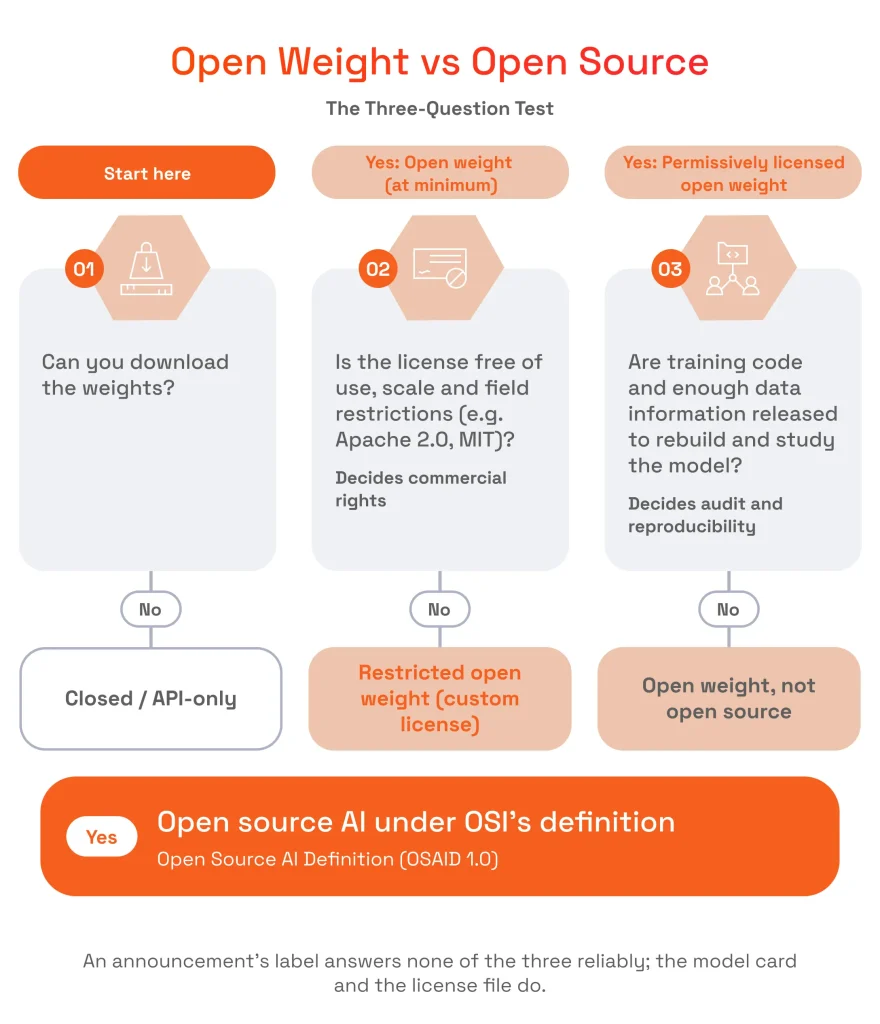
Open weight answers whether you can download the model’s parameters and run them on hardware you choose. Open source answers whether you have the freedom to run, study, modify and redistribute the whole system, along with the materials needed to understand how it was trained.
Downloading a model and having the right to use it are separate questions. The three-question test keeps them apart:
Question | If yes | If no |
|---|---|---|
1. Can you download the weights? | Open weight (at minimum) | Closed / API-only |
2. Is the license free of use, scale and field restrictions (e.g. Apache 2.0, MIT)? | Permissively licensed open weight | Restricted open weight (custom license) |
3. Are training code and enough data information released to rebuild and study the model? | Open source AI under OSI’s definition | Open weight, not open source |
Question
1. Can you download the weights?
2. Is the license free of use, scale and field restrictions (e.g. Apache 2.0, MIT)?
3. Are training code and enough data information released to rebuild and study the model?
If yes
Open weight (at minimum)
Permissively licensed open weight
Open source AI under OSI’s definition
If no
Closed / API-only
Restricted open weight (custom license)
Open weight, not open source
Industry reporting routinely calls a model “open source” when its weights carry a permissive software license, which only answers question 2. The Open Source Initiative’s definition also requires question 3: training code and documented data information. For commercial rights, question 2 is the one that decides. For internal risk assessments, scientific reproducibility and deep safety audits, question 3 matters.
Press releases and repository headlines answer none of the three questions reliably. The model card and the LICENSE file do.
What Is an Open Weight Model?
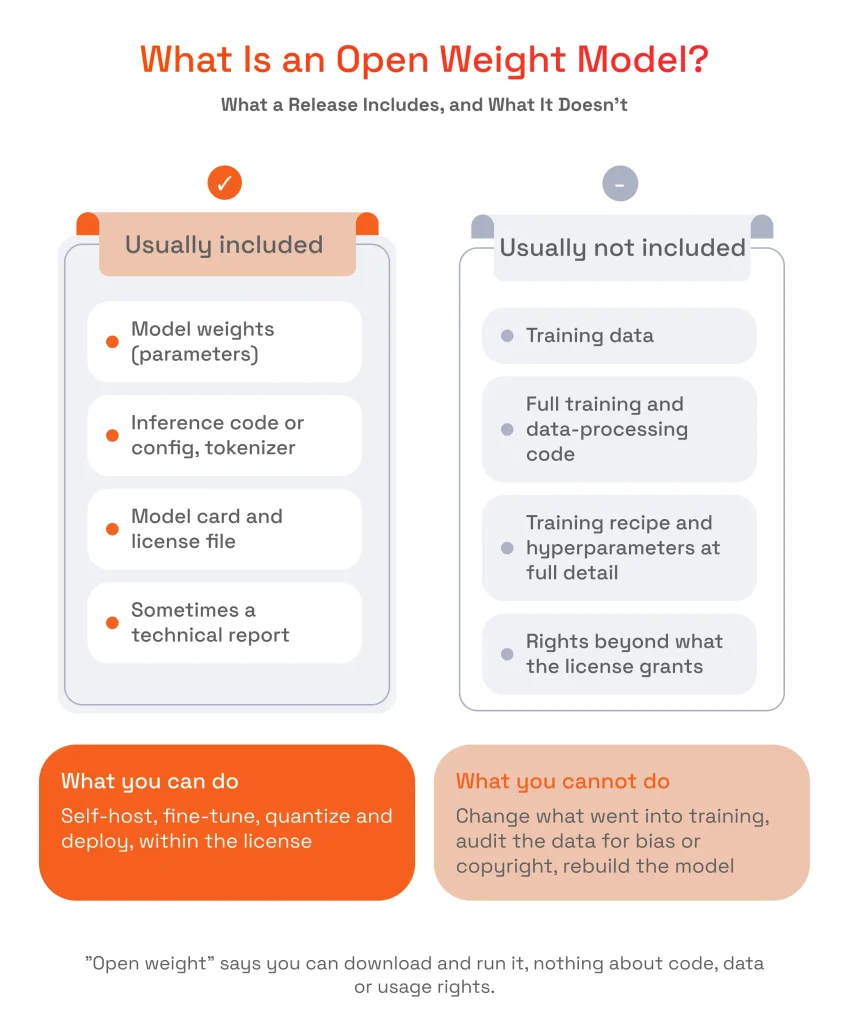
An open weight model is a trained neural network whose parameters are published for anyone to download and run, under a license. You can host it on your own hardware and deploy it on your own infrastructure; the term says nothing about training code, training data or usage rights.
Enterprise teams adopting an open weight LLM should know what the release package actually delivers:
Usually included | Usually not included |
|---|---|
Model weights (parameters) | Training data |
Inference code or config, tokenizer | Full training and data-processing code |
Model card and license file | Training recipe and hyperparameters at full detail |
Sometimes a technical report | Rights beyond what the license grants |
Usually included
Model weights (parameters)
Inference code or config, tokenizer
Model card and license file
Sometimes a technical report
Usually not included
Training data
Full training and data-processing code
Training recipe and hyperparameters at full detail
Rights beyond what the license grants
With the weights in hand, teams can self-host an LLM, quantize it, profile latency and run it behind their own firewall. Product teams can also fine-tune a base model for a narrow business task through generative AI development services.
Downloading the weights also means accepting whatever went into them. Fine-tuning adds new behavior on top, while the original data mix stays exactly as the lab left it, along with any copyrighted or biased material it may contain. Outside the lab, nobody can inspect that corpus or retrain the model from scratch to see how it learned what it knows. Gary Marcus has argued that this is the core weakness of weights-only releases, since a model outsiders can’t rebuild is a model they can’t properly study.
Popular open weight families include Llama, Gemma, Qwen, DeepSeek, Mistral and gpt-oss. License details here reflect their status as of November 2026; licenses change between versions, so check the model card for the exact checkpoint.
Small open weight models are often the practical choice for a narrow task. SPD Technology built a custom, lightweight LLM for a US EdTech company, tailored to children aged 9-12. At roughly 3B parameters, it is a compact model fine-tuned for one audience, which is exactly the kind of derivative the license questions in this guide apply to.
What Makes an AI Model Truly Open Source?
In October 2024, the Open Source Initiative published OSAID 1.0, its Open Source AI Definition. The test borrows its freedoms from software: anyone may use the system for any purpose, study how it works, change it and pass it on. The freedoms are only half of it. A qualifying release also has to include what an engineer would need to actually change the model, which OSAID spells out as the parameters, the complete code used to train and run the system, and detailed information about the training data.
OSAID asks for data information detailed enough that a skilled person could build a substantially equivalent system: where the data came from, how it was selected and curated, and how it is licensed. It does not always require publishing the raw training dataset, which copyright or privacy may make impossible. Some open source advocates argue that data information without the data itself sets the bar too low.
Very few models pass. OLMo from the Allen Institute for AI and EleutherAI’s Pythia publish their training code and training data alongside the weights, which puts them in a small group. For an engineering team, a model like that can be rebuilt from scratch, so when an auditor asks why it behaves the way it does, the answer can come from the training run itself. That is what an open source LLM under OSAID gives you. Most teams shipping commercial products work with open weight releases instead, and they read the license line by line.
The strictness comes from software licensing. OSI’s original Open Source Definition forbids discrimination against persons, groups or fields of endeavor, so a license that caps users or bans certain uses can’t be an OSI-approved license, whatever the release post calls it. That single clause disqualifies most of the models on a typical enterprise shortlist.
Why Does the License Matter More Than the Label?
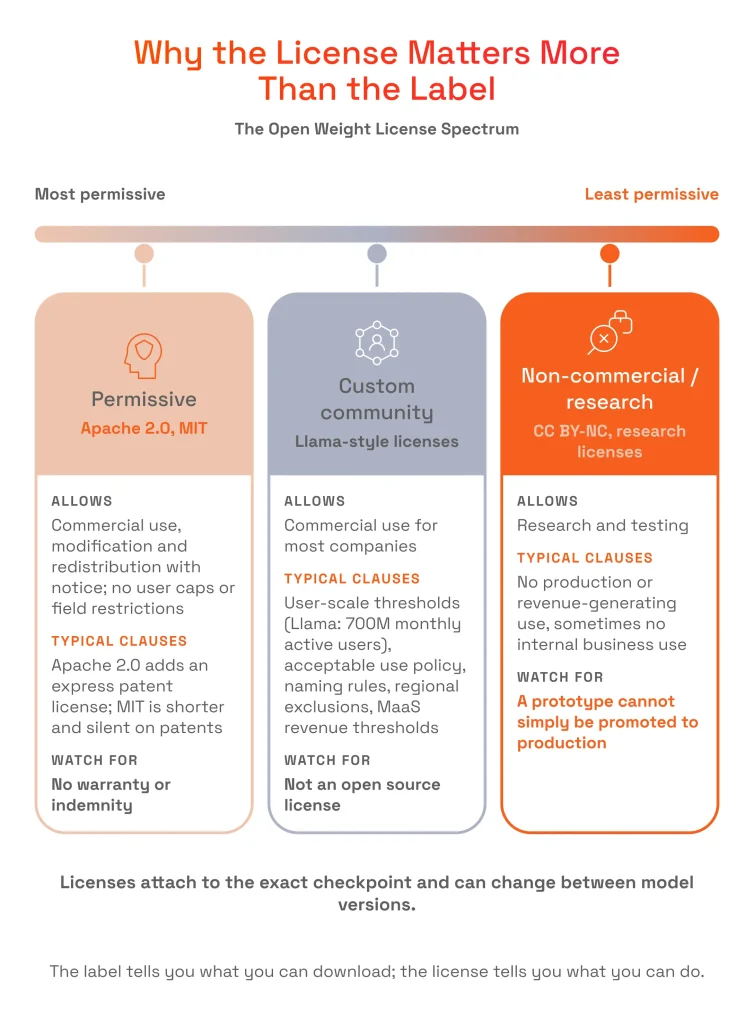
“Open” is a label; the license is a contract. Two models both called open can carry opposite terms, and the same family can change its license between versions. The public label is positioning, while the license is an enforceable agreement that sets your product rights.
Calling a weights-only or restricted release “open source” borrows the goodwill of the term without its freedoms, a practice often called open-washing. The loose usage is everywhere: in an April 2025 survey by McKinsey, the Mozilla Foundation and the Patrick J. McGovern Foundation, 63% of respondents’ organizations said they use an open source AI model, with Meta’s Llama family and Google’s Gemma collection among the most common. Respondents named cybersecurity (62%), regulatory compliance (54%) and intellectual property infringement (50%) as their top concerns.
Commercial permissions attach to the specific model checkpoint rather than the family name. Meta’s Llama 3.2 release withheld rights for its multimodal models from individuals domiciled in the EU and companies with a principal place of business there, while its 1B and 3B text models carried no such restriction. DeepSeek moved its V3 series from a custom license to MIT with the DeepSeek-V3-0324 checkpoint in March 2025. Usage restrictions and export controls can also change access and deployment rights by region or use case.
Model origin raises its own procurement questions, covered in Western vs. Chinese open-weight models. On licensing alone, three types of license shape what you can build.
What do permissive licenses like Apache 2.0 and MIT allow?
Permissive licenses let companies build commercial applications, modify the model through fine-tuning and redistribute derivative checkpoints, as long as they keep attribution notices and ship the license text. An Apache 2.0 license imposes no user caps, field-of-use exclusions or revenue sharing.
Patents are where the two licenses part ways. Apache 2.0 includes an express patent license, and anyone who sues claiming the work infringes a patent loses that license. The MIT License is far shorter and says nothing about patents at all, which is worth raising with counsel whenever patent exposure matters to your product.
OpenAI released gpt-oss-120b and gpt-oss-20b under Apache 2.0 in August 2025, with open weights but without training code or dataset sources. DeepSeek released DeepSeek-V3-0324 and DeepSeek-R1 under MIT.
Permissive licenses still come without warranties or intellectual property indemnity. Cloud providers that host these models add their own platform terms for API use and data privacy.
What do custom community licenses like Llama’s restrict?
Llama is the license most teams end up reading closely. The Llama 3 license from April 2024 lets almost any company build and sell on the model, and its best-known clause only bites at enormous scale. A company whose products already had more than 700 million monthly active users in the month before release has to ask Meta for its own license, and Meta decides at its sole discretion whether to grant one. A startup can read that clause and move on. For a handful of the largest platforms in the world, it’s the first thing legal checks.
The rest of the Llama 3 license matters to everyone. Licensees remain bound by an Acceptable Use Policy, and products built on the model must prominently display “Built with Meta Llama 3” on a related website, user interface, blog post, about page or product documentation. A model created or fine-tuned from Llama 3 and then distributed must start its name with “Llama 3.”
Earlier Llama licenses also barred using the model’s outputs to improve other large language models; Meta dropped that restriction in Llama 3.1. Regional terms remain: as Meta’s Llama FAQ explains, the acceptable use policies for Llama 3.2, Llama 3.3 and Llama 4 withhold rights for multimodal models from EU-based companies and individuals. EU customers can still use a product built on those models, and text-only models such as Llama 3.3 70B are not affected.
Google’s Gemma shows how quickly these terms can move. Gemma 1, 2 and 3 ship under Google’s Gemma Terms of Use, which require anyone redistributing the weights to pass Google’s use restrictions on to every recipient. Gemma 4, released on April 2, 2026, ships under standard Apache 2.0 instead, and the current Gemma Terms of Use exclude it. Custom licenses like Llama’s and the earlier Gemma terms allow commercial use for most companies, but they are not open source licenses under OSI’s definition.
What blocks production use under non-commercial and research licenses?
A research license is the easiest kind to read: no paid use. Creative Commons BY-NC terms work the same way, and some vendor research licenses go further by covering internal business use too. A team that builds an internal tool on one of these may be outside the license without realizing it.
Prototyping against a research-only checkpoint creates rework later. Swapping the core model after building prompt chains around it can change performance just as investors start asking the questions covered in AI PoC development: investor questions. Establish commercial rights before the model goes into production code.
Open Weight vs Open Source vs Closed Models: How Do They Compare?
Closed, restricted open weight, permissively licensed open weight and open source AI models differ in what the developer releases and what the license lets you do. Each question in the three-question test draws one line between them, so any model lands in exactly one column: question 1 separates closed models, question 2 splits restricted from permissive licenses, and question 3 picks out the few releases that meet OSAID.
Factor | Closed (API-only) | Restricted open weight | Permissively licensed open weight | Open source AI (OSAID) |
|---|---|---|---|---|
Weights downloadable | No | Yes | Yes | Yes |
Training code | No | No | Usually no | Yes |
Training data information | No | Partial at best | Partial at best | Yes, detailed |
Commercial use | Under provider terms | Yes, with conditions | Yes | Yes |
User or revenue thresholds | Provider terms | Often | No | No |
Fine-tuning | Provider-dependent | Yes, within license | Yes | Yes |
Redistribute weights / derivatives | No | With conditions (naming, notices) | Yes, with notices | Yes |
Reproduce and audit training | No | No | No | Yes |
Typical examples (verify) | Frontier APIs | Custom community licenses | Apache 2.0 / MIT releases | OLMo |
Factor
Weights downloadable
Training code
Training data information
Commercial use
User or revenue thresholds
Fine-tuning
Redistribute weights / derivatives
Reproduce and audit training
Typical examples (verify)
Closed (API-only)
No
No
No
Under provider terms
Provider terms
Provider-dependent
No
No
Frontier APIs
Restricted open weight
Yes
No
Partial at best
Yes, with conditions
Often
Yes, within license
With conditions (naming, notices)
No
Custom community licenses
Permissively licensed open weight
Yes
Usually no
Partial at best
Yes
No
Yes
Yes, with notices
No
Apache 2.0 / MIT releases
Open source AI (OSAID)
Yes
Yes
Yes, detailed
Yes
No
Yes
Yes
Yes
OLMo
The capability gap between closed and open models is real, and it’s small. Stanford HAI’s AI Index 2026 puts the top closed model 3.3% ahead of the top open one as of March 2026, up from 0.5% in August 2024, and six of the top ten models on the Arena leaderboard are closed. A few points of benchmark score rarely decide the choice alone, so where your data goes and what the license allows usually carry more weight. When the hardest tasks need a frontier model and procurement accepts a vendor API, building production AI with Claude can be the better path. When data must stay inside your network, a permissively licensed open weight model gives you deployment control, though not full auditability: only an OSAID-compliant release offers that.
What Should Your Legal Team Check Before Adopting a Model?
Legal can’t judge a license without knowing how the model will ship. An internal tool, a SaaS feature and an on-device app can each make a different clause the problem, so start from the deployment plan.
The checklist below frames questions for your counsel, and the legal conclusions belong to them. One more question for whichever provider runs inference for you: are your requests processed in its data centers or on infrastructure you control?
Clause | Question to answer | Why it matters | Red flag |
|---|---|---|---|
Commercial use | Is revenue-generating use permitted? | Research licenses block production | “Non-commercial” or “research only” |
Scale thresholds | Are there user, revenue or MaaS limits? | Growth can trigger a new agreement | Thresholds you could reach in the product’s lifetime |
Acceptable use policy | Which uses are prohibited, and can the list change? | Breach can terminate the license | Policy incorporated by reference and updatable unilaterally |
Territory | Are any regions or entities excluded? | Some licenses exclude certain jurisdictions | Exclusions covering your entity or customers |
Attribution and naming | Must products display a notice or derivatives carry the model’s name? | Affects branding and UI | Mandatory product naming |
Derivatives and fine-tunes | Do fine-tuned or merged models inherit the license? | Your fine-tune may not be freely yours | Restrictions on distributing derivatives |
Outputs | Any limits on using outputs, e.g. to train other models? | Affects distillation and data pipelines | Output-use bans |
Redistribution | Can you ship weights to customers or devices? | On-prem and edge deployments | Redistribution only under the same license |
Patents, warranty, indemnity | Is there a patent grant? Any warranty or indemnity? | Allocation of IP risk | No patent grant and no indemnity in a high-risk use |
Termination and changes | Can the licensor terminate or change terms for existing versions? | Long-term product risk | Unilateral termination rights |
Governing law | Which law and venue apply? | Enforceability and dispute cost | Unfamiliar jurisdiction |
Provenance | Is the source of the weights verified and the training data documented? | Supply-chain, copyright and audit questions | Unofficial uploads; no data documentation |
EU AI Act | Which general-purpose AI and deployer obligations apply to this model and use? | Obligations depend on the model, license and use case | Assuming “open source” exempts you |
Clause
Commercial use
Scale thresholds
Acceptable use policy
Territory
Attribution and naming
Derivatives and fine-tunes
Outputs
Redistribution
Patents, warranty, indemnity
Termination and changes
Governing law
Provenance
EU AI Act
Question to answer
Is revenue-generating use permitted?
Are there user, revenue or MaaS limits?
Which uses are prohibited, and can the list change?
Are any regions or entities excluded?
Must products display a notice or derivatives carry the model’s name?
Do fine-tuned or merged models inherit the license?
Any limits on using outputs, e.g. to train other models?
Can you ship weights to customers or devices?
Is there a patent grant? Any warranty or indemnity?
Can the licensor terminate or change terms for existing versions?
Which law and venue apply?
Is the source of the weights verified and the training data documented?
Which general-purpose AI and deployer obligations apply to this model and use?
Why it matters
Research licenses block production
Growth can trigger a new agreement
Breach can terminate the license
Some licenses exclude certain jurisdictions
Affects branding and UI
Your fine-tune may not be freely yours
Affects distillation and data pipelines
On-prem and edge deployments
Allocation of IP risk
Long-term product risk
Enforceability and dispute cost
Supply-chain, copyright and audit questions
Obligations depend on the model, license and use case
Red flag
“Non-commercial” or “research only”
Thresholds you could reach in the product’s lifetime
Policy incorporated by reference and updatable unilaterally
Exclusions covering your entity or customers
Mandatory product naming
Restrictions on distributing derivatives
Output-use bans
Redistribution only under the same license
No patent grant and no indemnity in a high-risk use
Unilateral termination rights
Unfamiliar jurisdiction
Unofficial uploads; no data documentation
Assuming “open source” exempts you
Investors ask where each model came from and under what terms, so a clean record of every fine-tune and its base license matters for an investor-ready MVP.

Serhii Leleko
AI & ML Engineer at SPD Technology
“Engineers tend to treat a fine-tune as their own model because they paid for the GPUs and curated the training set. The base license still travels with those weights. Our default is to assume every adapter, merged checkpoint or distilled student inherits the parent’s terms until counsel says otherwise, and to store that license in the model registry next to the eval scores, where the people shipping the model will actually see it.”
Teams shipping into the EU have a regulation to read alongside the license. Rules for providers of general-purpose AI models have applied since 2 August 2025, and the European Commission’s guidelines for general-purpose AI providers explain how they work. A provider that releases a model under a free and open-source license, with public weights, architecture and usage information, is excused from some of the documentation. That exemption ends where systemic risk begins, and the copyright policy and training-content summary stay mandatory either way. Deployers carry their own obligations on top, so confirm the current requirements with counsel.
Keeping a verified license record for every production model version takes tooling, the kind set up through MLOps consulting and development.
How Do You Choose a Model With Licensing in Mind?
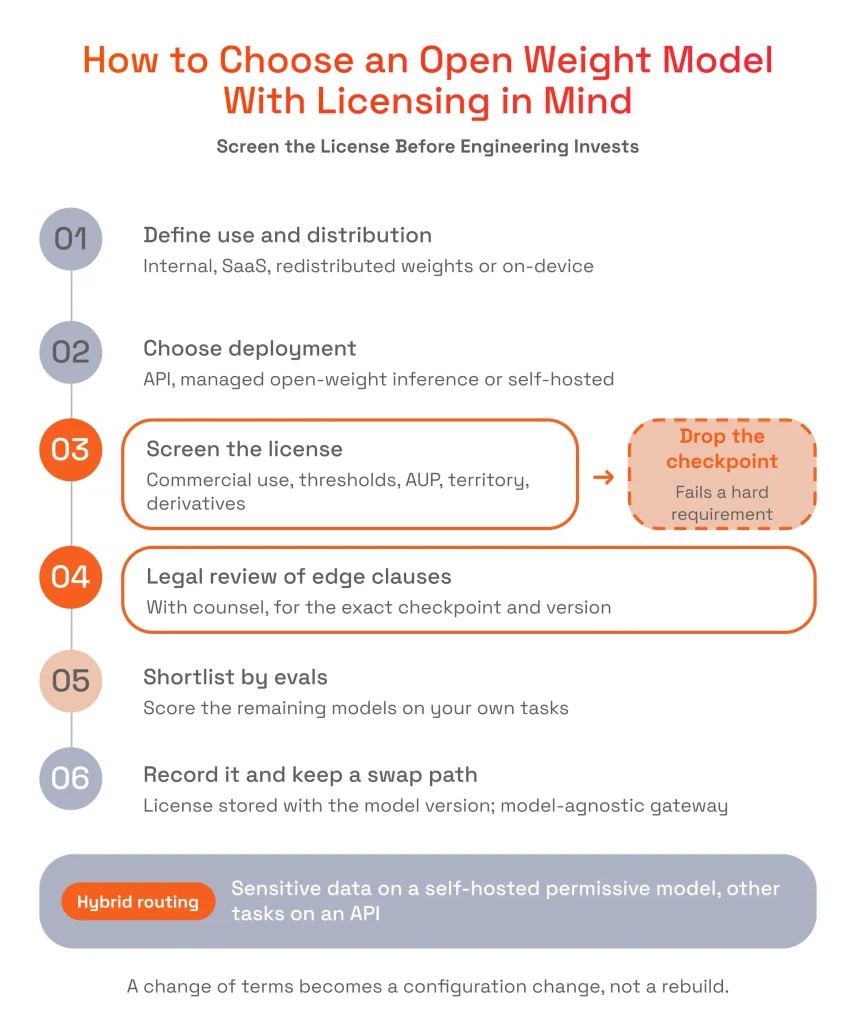
Decide how the model will ship before you compare what it can do. That plan tells you which license clauses matter, so the license screen comes next, then evals on your own tasks for whatever survives, and finally an integration built to swap one checkpoint for another if the terms change.
The six steps below follow that order. The license screen is the step built to knock candidates out early; counsel and evals can still drop one later.
Model selection with licensing · 6 steps, one drop-out branch
- Define use and distribution: whether the system powers an internal back-office tool, a multi-tenant cloud service, client-managed software or edge hardware decides which clauses carry risk.
- Choose deployment: a provider API, managed open-weight inference or self-hosted servers changes who processes your data, whose terms apply and what AI-assisted development really costs.
- Screen the license: drop any checkpoint whose terms fail a hard requirement before engineering invests in prototypes, and check whether the release uses a standard license or custom terms.
- Legal review of edge clauses: anything the screen can’t settle on its own, such as a user threshold the product might reach in five years, goes to counsel along with the deployment plan.
- Shortlist by evals: score the remaining candidates on your own tasks with systematic eval engineering; a better license does not make a model a drop-in substitute.
- Record it and keep a swap path: store the license with the model version in your registry and connect applications through a gateway, using agent harness engineering, so you can replace a checkpoint without rewriting the product.
The eval criteria should include production numbers, not only quality scores. Built on LangChain with a Mistral LLM and RAG architecture on AWS, the support chatbot SPD Technology delivered for a French B2C fashion e-commerce retailer processes 99% of queries in under 10 seconds. It held 100% uptime at 30 requests per second during peak hours. Numbers like these belong in the eval criteria before anything gets scored, because a model can clear the license screen and still lose the shortlist on latency.
Hybrid routing lets you balance cost and risk by sending sensitive data to a self-hosted, permissively licensed model and general reasoning tasks to a commercial API.
Before go-live, check the integration against our AI Production-Ready Checklist.
Why Choosing SPD Technology
SPD Technology helps engineering and product teams choose, integrate and run models with the license treated as an engineering requirement from discovery to production, through dedicated AI/ML development services. Our engineers work alongside your legal counsel: we design an implementation you can defend, and your attorneys make the legal calls.
- Regulated, high-stakes delivery. For a global investment data platform, we built and maintain an AI/ML trend-detection pipeline processing roughly 50,000 articles a day from 3,000+ sources, in a partnership spanning more than a decade. For Morningstar, we applied 150+ business rules to financial report data and built an AI/ML web crawler across multiple sources, cutting data storage costs tenfold and analysis time from days to hours. We also deliver data platforms for Pie Insurance and work as an Adyen service partner on payments.
- Model-agnostic architecture. The product talks to a gateway and the gateway talks to the model, so replacing Llama with gpt-oss after a license change is a configuration edit plus an eval run, not a rebuild.
- Evals before every model change. Replacements are scored on your own tasks before they ship, and a named senior engineer approves every release.
- Clean handover. Documentation, integration tests, deployment configuration and model records live in your repository and stay yours by contract, which simplifies IP questions in investor diligence.
- Closed models where they fit. When a closed frontier model fits the work better, our Claude-certified architects run it under governed workflows, including a dedicated security-review gate for payments and personal data, as described in our guide to building production AI with Claude.
Conclusion
Open weight is usually enough to build a product on; it just isn’t the same promise as open source. What you may do is decided by the license on the exact checkpoint, read against how you will ship: internal tool, SaaS, redistributed weights or on-device. Record that license next to the model version, integrate through a gateway and keep evals ready, so a change in terms means swapping a checkpoint rather than rebuilding the product. The label tells you what you can download; the license on the exact checkpoint tells you what you can do.
If you need help choosing and integrating a model, see how to choose an AI development partner.
Key Takeaways
- Because “open weight” only means the parameters can be downloaded, the label says nothing about commercial rights, which the license sets entirely.
- Under the Open Source Initiative’s definition, open source AI also requires training code and detailed data information, so most models marketed as open are open weight.
- A permissive license such as Apache 2.0 or MIT removes user caps and field restrictions, yet still provides no warranty or indemnity.
- Custom community licenses usually allow commercial use for most companies while adding thresholds, use policies, naming rules or regional exclusions that legal must check against the product’s lifetime.
- Because licenses attach to specific checkpoints, approving Llama 3 did not settle Llama 3.2, whose multimodal models withhold rights from EU-based companies, so every new model version needs its own license check.
- Fine-tuned and merged models can inherit the base model’s license, so a derivative stays bound by its parent’s terms until counsel confirms otherwise.
- Integrating models through a model-agnostic gateway and testing replacements with evals turns a license change into a configuration change that leaves the product intact.
FAQ
What is the difference between open weight and open source AI?
An open weight model publishes its trained parameters for download, usually without training code or data, under a license that may restrict how it is used. Open source AI, as defined by the Open Source Initiative, also releases the code and detailed data information needed to study and rebuild the model, with freedom to use, modify and share it for any purpose. Most models marketed as open source are more accurately open weight, because they release weights without the full materials required to reproduce the model. The three-question test separates them: download, license restrictions, reproducibility. Commercial rights depend on the license of the specific model version.
Can open weight models be used commercially?
Often yes, within the terms of the specific license. Models under Apache 2.0 or MIT can generally be used commercially with attribution. Custom licenses may add user thresholds, acceptable use policies, naming requirements or regional exclusions, and research licenses may prohibit commercial use entirely. Check the license file for the exact checkpoint and review it with counsel.
Is Llama open source?
Not under the Open Source Initiative’s definitions, although Llama is often described as an open source LLM. Llama models are open weight: commercial use is permitted for most organizations, but the Llama Community License includes a 700 million monthly-active-user threshold and an acceptable use policy, and both conflict with the Open Source Definition’s ban on discriminating against persons or fields of endeavor. Training data and full training code are not released. Check the license for the specific Llama version you plan to use.
What does the Open Source AI Definition require?
OSAID 1.0, published by the Open Source Initiative in October 2024, requires that an AI system grant the freedoms to use, study, modify and share it for any purpose. It requires the preferred form for modification: model parameters, the complete code used to train and run the system, and data information detailed enough for a skilled person to build a substantially equivalent system. It does not always require publishing the raw dataset. Few models meet it today.
Which open weight models have permissive licenses?
OpenAI’s gpt-oss models and Google’s Gemma 4 ship under Apache 2.0, and DeepSeek-V3-0324 and DeepSeek-R1 ship under MIT. Many Qwen and Mistral checkpoints also use Apache 2.0, while some of their flagship releases carry custom or commercial terms. Allen Institute for AI’s OLMo goes further by releasing training code and data. Licenses are set per checkpoint and change between versions, so confirm the license on the model card before relying on it.
Is an Apache 2.0 license on the weights enough to call a model open source?
It makes the weights openly licensed, which is what matters most for commercial rights. Under the Open Source AI Definition, a model also needs released training code and detailed data information to count as open source AI. Many permissively licensed models withhold those, so they are best described as open weight with a permissive license. The distinction matters most for auditing and reproducing the model.
Do fine-tuned models inherit the base model’s license?
Usually, yes. Training on your own data leaves the base model’s terms in place, because a fine-tuned or merged model is a derivative of its parent. Under the Llama 3 Community License, a distributed derivative has to start its name with “Llama 3,” and anyone redistributing a derivative of Gemma 3 or an earlier version must pass Google’s use restrictions along with it, while Gemma 4 derivatives follow Apache 2.0. Apache 2.0 and MIT ask for attribution and little else. Read the derivative clauses before a fine-tune leaves your servers.
Does the EU AI Act treat open source models differently?
The EU AI Act exempts providers of general-purpose AI models released under free and open-source licenses, with public weights, architecture and usage information, from some documentation duties. The exemption does not apply to models with systemic risk, and copyright-policy and training-content-summary duties remain. Companies deploying a model keep their own obligations. Confirm current requirements and dates with counsel.