Multi-PSP connectivity follows five architecture patterns. Failover handles a provider outage; cascading retries recover a declined transaction by routing it to another provider; smart routing selects a provider based on cost or region in advance; and load balancing continuously splits traffic. A unified abstraction layer normalizes data underneath all four, and without it, every pattern is rebuilt per provider.
One provider handled everything for a long stretch. Then it didn’t. Card payments stopped outright for a few hours one afternoon, or the declines climbed with no second route to send the recovery attempt down, or a market launch stalled because the payment methods local customers expect never appeared on that provider’s rails.
On paper, adding a second PSP (payment service provider) is a single decision. Look closer, and it splits into several. Each connectivity pattern addresses its own kind of failure, and the heaviest choice in the set is the one sitting under the other four.
These PSPs operate in a market that fragments and regionalizes as it scales. Transactions valued at $2.0 quadrillion pass through it every year, and, based on 3.6 trillion transactions, McKinsey estimates their revenue at $2.5 trillion. At this scale, reliability and routing precision are key to profitability.
Building a resilient checkout means defining exactly why the business needs a second provider, evaluating the five connectivity patterns, establishing the normalized data model beneath them, and weighing custom PSP integration services against a third-party orchestration platform.
Why Businesses Connect to More Than One PSP
A single provider can cap both the technical resilience and the financial efficiency of a growing platform. Engineering teams usually cite failover as the primary reason to add a second provider. However, disaster recovery rarely justifies the cost on its own.
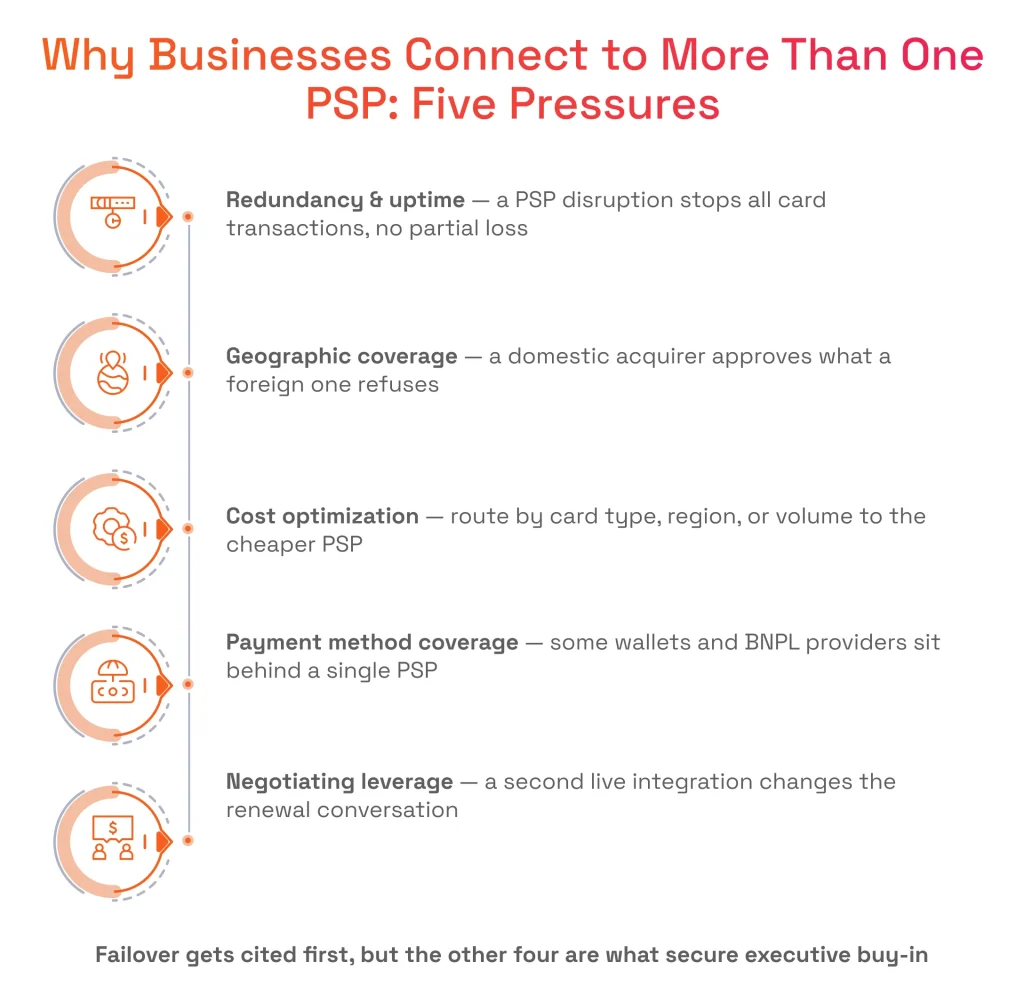
Five pressures push companies toward a second provider, and they arrive in different orders depending on where the growth is coming from. While failover addresses technical risk, the four that follow failover focus on revenue and cost, which usually secure executive buy-in.
- Redundancy and uptime. A disruption in a PSP means all card transactions stop immediately. There is no possibility of degradation or partial loss. Integrating a secondary PSP that works and stays ready helps revenue flow during the recovery of the primary one.
- Geographic coverage and local acquiring. No provider offers the best payment methods and acquiring rates across all markets, and a domestic acquirer within a given payment corridor routinely approves transactions that a foreign one refuses. Our comparison of single vs. multiple payment gateways works through where that boundary usually falls.
- Cost optimization. Routing of transactions by card type, geographical region, or volume to the PSP that charges less lowers the overall cost of transaction processing. On the margins where the difference is small, it builds up month after month.
- Payment method coverage. Some payment methods have only one door in. Certain wallets sit behind a single PSP, and the same is true of some BNPL providers and of local bank transfer schemes in individual markets. Juniper Research puts the worldwide digital wallet population at 4.5 billion in 2025, on track to reach 6 billion by 2030. That 35% growth over five years makes wallet coverage a market-entry constraint on par with licensing. Our work on digital wallet integration sits on that side of the problem.
- Negotiating leverage. At renewal, a merchant with one provider has nothing to push against. The conversation changes the moment a second integration is live and could take the volume.
Five Multi-PSP Connectivity Patterns
Integrating a second provider is a decision about what the system does when a transaction is ready to be sent. Five multi-PSP connectivity patterns answer that question in different ways, and a mature setup usually runs several of them at once.
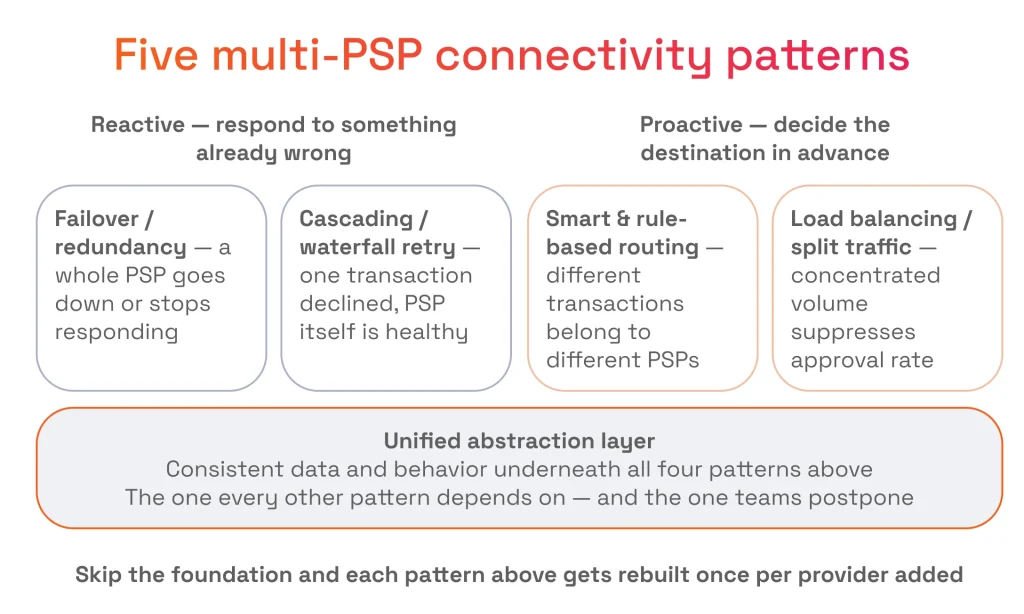
Four of them act at transaction time. Two of those react to something that has already gone wrong, either a provider failing or a payment being refused, while the other two pick the destination in advance. The fifth pattern sits beneath the rest and determines the cost of building and changing.
Pattern | Problem It Solves | Trade-off |
|---|---|---|
Failover / redundancy | An entire PSP goes down or stops responding | Needs real-time health monitoring and a hot-standby integration kept warm at the backup PSP |
Cascading / waterfall retry | One transaction is declined while the PSP itself is healthy | Adds latency with every retry attempt and needs limits so repeat attempts avoid fraud flags |
Smart & rule-based routing | Different transactions belong to different PSPs by cost, payment method, or geography | Rules need ongoing tuning as PSP pricing, authorization performance, and method support change |
Load balancing & split traffic | All volume concentrated on one PSP creates risk and can suppress authorization rates | Splitting volume dilutes the volume discounts and negotiating leverage a single relationship offers |
Unified abstraction layer | Every pattern above needs consistent data and behavior, whichever PSP handles the transaction | The most engineering-intensive pattern to build, and the one the other four depend on |
Pattern
Failover / redundancy
Cascading / waterfall retry
Smart & rule-based routing
Load balancing & split traffic
Unified abstraction layer
Problem It Solves
An entire PSP goes down or stops responding
One transaction is declined while the PSP itself is healthy
Different transactions belong to different PSPs by cost, payment method, or geography
All volume concentrated on one PSP creates risk and can suppress authorization rates
Every pattern above needs consistent data and behavior, whichever PSP handles the transaction
Trade-off
Needs real-time health monitoring and a hot-standby integration kept warm at the backup PSP
Adds latency with every retry attempt and needs limits so repeat attempts avoid fraud flags
Rules need ongoing tuning as PSP pricing, authorization performance, and method support change
Splitting volume dilutes the volume discounts and negotiating leverage a single relationship offers
The most engineering-intensive pattern to build, and the one the other four depend on
Failover & Redundancy
Failover moves traffic away from a disrupted PSP. Several inputs go into the decision. Status endpoints and error rates are obvious among them. However, authorization latency is also equally important. Rolling success rate will indicate degradation even when status endpoints are still green. Cross the threshold and a circuit breaker opens, sending new transactions to a standby PSP kept warm enough to take live volume immediately.
What separates this pattern from the others is the level at which it judges. Failover looks at the provider, so if one card is refused, the state remains untouched, while the same threshold calculation has to run backward before traffic is routed back home. How much of this works depends on where the stored card credentials sit. Held in the primary’s vault, they cannot be charged by the standby, which leaves failover useful for new cards only.
Cascading / Waterfall Retry
Cascading retry handles a single refused payment by routing it to a second provider, while the one that refused it continues working perfectly. The decline code decides whether that happens at all. Soft declines often clear elsewhere, as do timeouts and temporary risk holds, whereas a closed account will be refused everywhere, and sending it anyway wastes latency and generates a fraud signal for no reason.
An idempotency key that works across both providers must travel with each attempt, because the first attempt can still settle after the second has already gone through. Capping and spacing out attempts keep the downstream fraud engine from seeing a burst of tries against one card and flagging it as card testing. Any 3DS authentication the customer completed the first time should carry over to the retry, sparing them a second challenge on one payment.
Smart & Rule-Based Routing
Before attempting a transaction, smart routing has already chosen where it will go. The rules read a card BIN and currency, weigh region and ticket size, and price the negotiated cost per card network before routing the payment. Working from information available in advance is what puts interchange exposure within this pattern’s reach, along with local approval odds and settlement currency along with it.
Routing rules also develop in stages. Static rules specify a PSP for each condition; dynamic rules can be changed without redeployment; and adaptive routing assigns providers based on the most recent authorization information, doing so automatically. Every step sacrifices oversight for greater accuracy, because a rule set no one touches becomes obsolete as providers’ pricing and performance change.
Load Balancing & Split-Traffic
Load balancing is a pattern that permanently distributes volume across providers. Allocation runs on fixed percentages or shifts dynamically toward whichever PSP posts the better authorization rate for a segment. Approvals are part of the benefit, since some issuers score heavily concentrated volume through a single PSP differently from the same volume spread across several PSPs.
The weight split enables experiments: send a fraction of traffic to the new provider while comparing its authorization rates with those of the existing one. The two expenses are incurred with a weight split: volume commitments secured with one provider lose their value under volume sharing, and all reporting questions become multi-provider, which the reconciliation system needs to accommodate.
Unified Abstraction Layer
One shape for a transaction, whichever PSP processed it: that is what the unified abstraction layer provides, as a normalized internal data model with an API contract over it. Routing and failover read from that model, reporting and reconciliation too, which keeps provider-specific branches out of the codebase. Status mapping becomes a one-time job at the adapter boundary, where whatever one provider calls authorized or captured, and whatever the next calls settled or refunded, resolves into a single internal state machine.
Card credentials belong in the same layer. A business whose stored cards sit in one PSP’s vault is connected to several providers and still tied to one where it counts, which is why network tokens and a vault the business owns make routing real for returning customers.
Most teams underbuild the layer itself, treating it as a refactor to schedule after the second provider is live, when it is the foundation on which the other four patterns stand. Our breakdown of payment orchestration layers goes deeper into how that contract gets defined.
The normalized model is what allowed eight separately acquired eCommerce platforms at Blackhawk Network to become one system of 80+ services, in a distributed systems unification delivered by SPD Technology, along with the BI reporting layer above it. Data covering $30B in annual load value moved into that model, and the reporting system built on top now handles 40M+ records per day across 100+ report types.

Oleksandr Boiko
Delivery Director at SPD Technology
“The abstraction layer is the part teams postpone because it doesn’t ship as a visible feature. Then the second PSP arrives, and every routing rule, every webhook handler, every reconciliation job grows a provider-specific branch. Building the normalized transaction model first is what makes the third PSP a configuration change instead of another integration project.”
Technical Requirements for Multi-PSP Integration
The patterns above describe behavior. Underneath them sits a set of components that has to exist before any of that behavior holds up under load, and each one maps to a specific failure that appears in its absence.
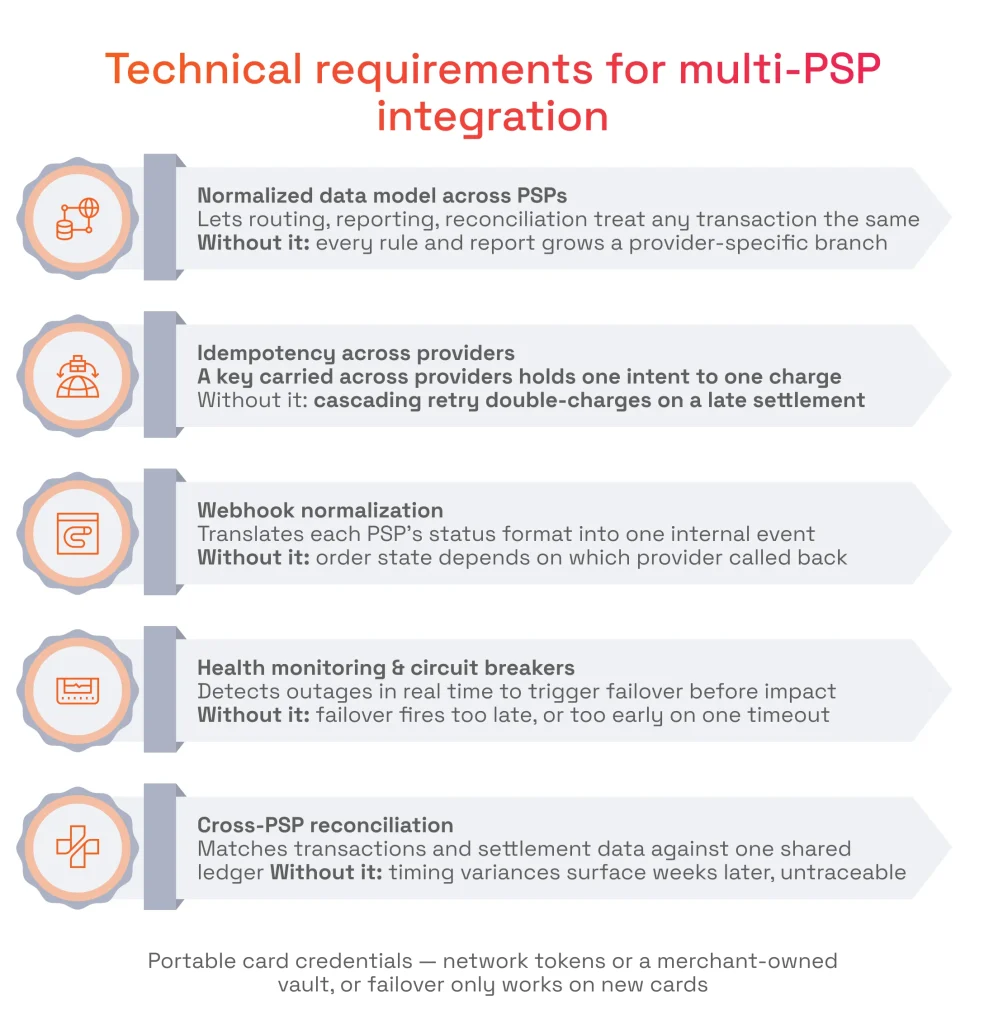
Scoping a second provider? Read the table below as a build backlog and as a shortlist of what keeps the system auditable once volume spreads out.
Requirement | Why It's Needed | What Breaks Without It |
|---|---|---|
Normalized data model across PSPs | Lets routing, reporting, and reconciliation logic treat a transaction the same way regardless of which PSP processed it | Every rule and every report grows a provider-specific branch, and each new PSP repeats the work |
Idempotency across providers | An idempotency key carried across providers holds one payment intent to one charge | A cascading retry double-charges the customer when the first PSP settles the original attempt late |
Webhook normalization | Translates each PSP’s own status-update format into one consistent internal event | Order state depends on which provider sent the callback, and transaction status mapping drifts |
Health monitoring and circuit breakers | Detects PSP outages or degraded performance in real time to trigger failover before customers are affected | Failover fires late, on customer complaints, or early, on a single timeout |
Cross-PSP reconciliation | Matches transactions and settlement data from every provider against one shared ledger | Settlement timing differences surface weeks later as variances nobody can trace |
Portable card credentials | Network tokens or a merchant-owned vault lets any connected provider charge a stored card | Failover and cascading retry work on new cards only, since PSP-issued tokens stay inside the PSP that issued them |
Requirement
Normalized data model across PSPs
Idempotency across providers
Webhook normalization
Health monitoring and circuit breakers
Cross-PSP reconciliation
Portable card credentials
Why It's Needed
Lets routing, reporting, and reconciliation logic treat a transaction the same way regardless of which PSP processed it
An idempotency key carried across providers holds one payment intent to one charge
Translates each PSP’s own status-update format into one consistent internal event
Detects PSP outages or degraded performance in real time to trigger failover before customers are affected
Matches transactions and settlement data from every provider against one shared ledger
Network tokens or a merchant-owned vault lets any connected provider charge a stored card
What Breaks Without It
Every rule and every report grows a provider-specific branch, and each new PSP repeats the work
A cascading retry double-charges the customer when the first PSP settles the original attempt late
Order state depends on which provider sent the callback, and transaction status mapping drifts
Failover fires late, on customer complaints, or early, on a single timeout
Settlement timing differences surface weeks later as variances nobody can trace
Failover and cascading retry work on new cards only, since PSP-issued tokens stay inside the PSP that issued them
Two of them reach past engineering hygiene into compliance: health monitoring and card credential handling. The EU’s Digital Operational Resilience Act has been in force since 17 January 2025, covering more than 20 categories of financial entities along with their ICT third-party service providers. For firms in scope, ESMA’s framing places health monitoring of a PSP dependency within the compliance perimeter, along with documented resilience of the connection itself. Our write-up on payment security architecture covers how PCI DSS scope shifts once a second provider enters the flow.
Challenges in Multi-PSP Integration
Failure here is predictable, and most of it traces back to a handful of early decisions. All five below have turned up in production payment systems our team joined, some to build the multi-PSP integration and some to repair one. The order roughly tracks the cost to fix each one once it has been running unnoticed.
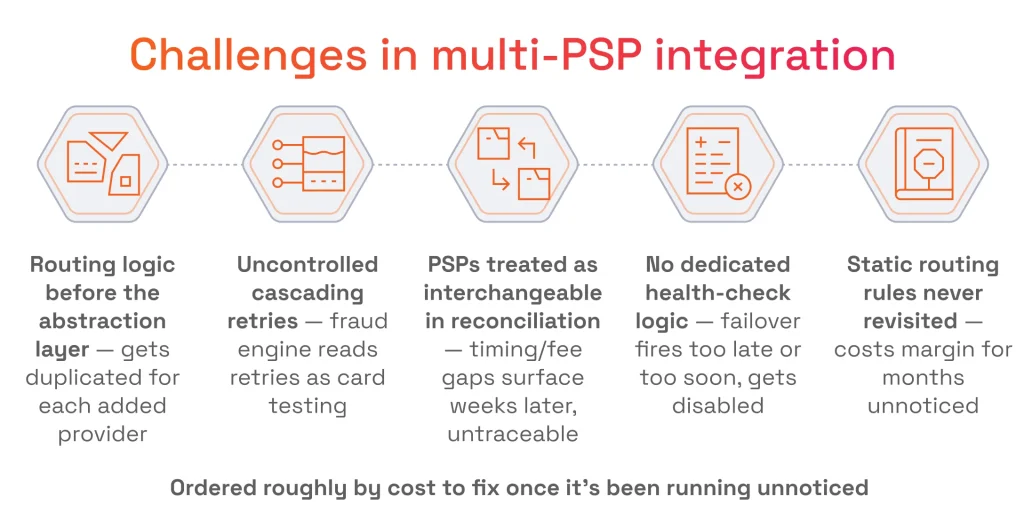
Building Routing Logic Before the Abstraction Layer
The routing rules written before the normalized model get duplicated for each additional provider. The first one is clean because it deals with only one data structure. The second one makes provider-identity conditionals mandatory in all routing logic, and webhooks and reconciliation scripts follow the same pattern. The third provider repeats the same trick again.
Our experts create a build process where the abstraction layer comes first, followed by the implementation of routing, failover, and reporting functionality. With each additional payment service provider, you add one adapter and configure one more item.
Uncontrolled Cascading Retries
The second provider fires retries too often, causing the fraud engine to interpret them as card testing. This results in new declines and reduces the merchant’s reputation with the acquiring bank. Retry limits and retry pauses must be fine-tuned based on the PSP’s risk tolerance. The idempotency key must be strong enough to pass the hop between two payment service providers.
Our payment engineering experts built the event-driven card-linked-offer architecture for a US fintech startup, where reward attribution must tie to real card transactions without double-crediting anyone. Plaid connectivity and exactly-once processing carried that requirement, reaching sub-second reward attribution and 48-72 hour payout readiness. Our notes on merchant risk monitoring at scale cover the same problem from the monitoring side.
Treating All PSPs as Interchangeable in Reconciliation
Settlement timing varies from provider to provider. So do fee structures, and so do reporting formats. Build cross-PSP reconciliation as an extension of single-PSP reporting, and the gaps show up weeks later, as variances nobody can trace back to a transaction. That engine needs a model of its own. Settlement files from every provider are posted to a single ledger, with each PSP’s fees broken out separately.
The merchant settlement platform SPD Technology built for Blackhawk Network now serves 37,000+ users, with report generation and commission calculation automated across the entire flow after both were run manually and stopped scaling with the merchant base. That platform sits within a partnership that has been running for 7+ years, beginning with NimbleCommerce in 2008.
No Dedicated Health-Check Logic
Failover without any special health-check logic is either too late, triggering after customers have already left the checkout, or too soon, triggering on a one-time timeout when everything was running fine. Both cases will teach the team not to trust such an approach, and the untrusted failover will be switched off.
Our engineers design circuit breakers based on both uptime and success-rate criteria over a rolling period, so tripping is based on payment activity, while a ping only indicates that an endpoint responded. The same applies to recovery thresholds: volume is restored step by step when the primary channel’s success rate is fine.
Static Routing Rules That Are Never Revisited
Routing rules configured at the beginning will lose relevance as PSP pricing changes, authorization performance shifts by region, and PSPs add or remove support for payment methods. Meanwhile, the rules will run, costing margin or conversions for months before someone reviews the configuration. We integrate rule-set review into our ongoing payment operations automation process and evaluate it based on live performance data.
Build vs. Buy: Custom Integration Layer vs. Orchestration Platform
With the patterns sorted out, the build-vs.-buy decision comes down to a binary choice: do it yourself for the connectivity layer or choose a solution that already covers it. Both approaches will take you to several providers, but they differ in engineering ownership after implementation and in the future flexibility of your stack.
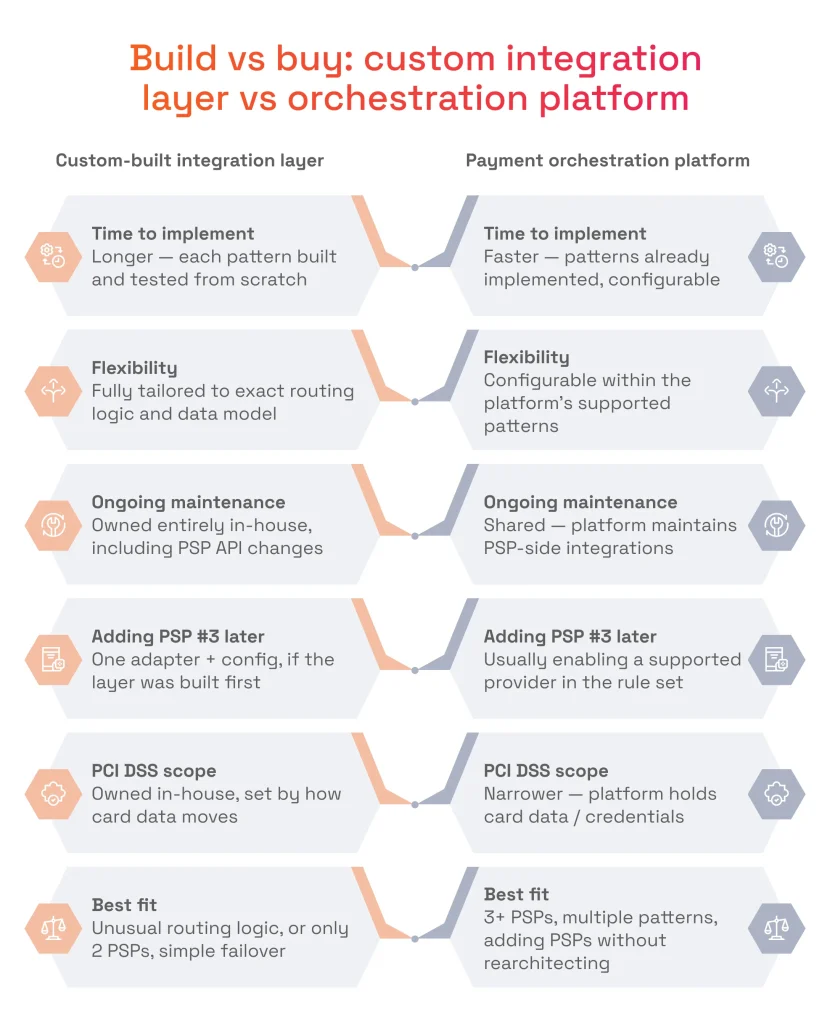
The table below sets out the factors that usually decide it.
Factor | Custom-Built Integration Layer | Payment Orchestration Platform |
|---|---|---|
Time to implement | Longer: each pattern is built and tested from scratch | Faster: patterns are already implemented and configurable |
Flexibility | Fully tailored to the business’s exact routing logic and data model | Configurable within the platform’s supported patterns and rule engine |
Ongoing maintenance | Owned entirely in-house, including adapting to each PSP’s API changes | Shared with the platform provider, who maintains PSP-side integrations |
Adding PSP #3 later | One new adapter plus a configuration entry, provided the abstraction layer was built first | Usually enabling a supported provider and mapping it into the existing rule set |
PCI DSS scope | Owned in-house, with scope set by how card data moves through the layer | Narrower in-house scope where the platform holds card data and provider credentials |
Best fit | Teams with specific routing logic not well served by existing platforms, or only 2 PSPs and simple failover needs | Teams connecting to 3+ PSPs, needing multiple patterns, or wanting to add PSPs without re-architecting |
Factor
Time to implement
Flexibility
Ongoing maintenance
Adding PSP #3 later
PCI DSS scope
Best fit
Custom-Built Integration Layer
Longer: each pattern is built and tested from scratch
Fully tailored to the business’s exact routing logic and data model
Owned entirely in-house, including adapting to each PSP’s API changes
One new adapter plus a configuration entry, provided the abstraction layer was built first
Owned in-house, with scope set by how card data moves through the layer
Teams with specific routing logic not well served by existing platforms, or only 2 PSPs and simple failover needs
Payment Orchestration Platform
Faster: patterns are already implemented and configurable
Configurable within the platform’s supported patterns and rule engine
Shared with the platform provider, who maintains PSP-side integrations
Usually enabling a supported provider and mapping it into the existing rule set
Narrower in-house scope where the platform holds card data and provider credentials
Teams connecting to 3+ PSPs, needing multiple patterns, or wanting to add PSPs without re-architecting
The deciding variable is usually how unusual the routing logic is. A marketplace splitting payouts across sellers by jurisdiction will quickly hit the limits of a rule engine. At the same time, a retailer routing by card type and region will find those rules already supported. Our comparison of payment gateway vs. payment orchestration cleanly separates the two layers. Evaluating vendors is easier after reading how payment orchestration platforms implement these patterns internally.
Why Consider SPD Technology for Multi-PSP Integration
SPD Technology has built these patterns into production payment systems and repaired them there as well. Normalized abstraction layers and idempotent retry logic sit in that record, as do cross-provider reconciliation and health-check-driven failover. Twenty years and 460+ delivered projects stand behind that record. PSD2 obligations and compliance-by-design architecture also stay in-house, with the same 650+ engineer organization writing the routing code.
One team owning both architecture and execution is what PSP integration services mean in this context.
Full-Cycle Payment Processing Architecture: Poynt
An all-in-one omnicommerce payment system went live in five months for Poynt, replacing what would otherwise have been a stack of separately procured tools. The delivery covered full-cycle payment processing, settlement, and the third-party integration API, with the PayFac model bringing transaction cost savings that a reseller arrangement could not reach.
The engagement has now run for 5+ years, and the relationship survived the client’s acquisition with the same team continuing on the platform. Continuity matters most in payments, where the people who designed the settlement flow are the ones who can safely change it.
Multi-Provider Integration at Platform Scale: NimbleCommerce
NimbleCommerce needed a white-label eCommerce platform that could sell across many markets, each with its own payment infrastructure and provider landscape. SPD Technology served as the sole technology vendor for the build and integrated 27 third-party payment systems into the platform, along with an AI reporting and analytics module.
The platform went live across the US, Canada, Mexico, Greece, the UK, and other European markets, and the company was later acquired. Integrating 27 providers into one product is the same normalization problem that a multi-PSP integration poses, scaled up until shortcuts are no longer survivable.

Whether the requirement is a custom-built abstraction layer beneath two providers or a full orchestration platform spanning several, SPD Technology’s payment engineering team can scope the approach against a specific PSP mix and volume profile. Our fintech development outsourcing model embeds that team within your delivery process.
Key Takeaways
- The ability to route payments to another PSP in case of failure is the most important factor driving businesses to connect to multiple PSPs. The other four are geographic coverage, cost optimization, payment instrument coverage, and negotiation leverage.
- Five architectural patterns cover almost every multi-PSP use case: failover, cascading retry, smart rules-based routing, load balancing, and a unified abstraction layer sitting beneath all four.
- The unified abstraction layer is the pattern every other pattern depends on, because without a normalized data model across PSPs, routing, failover, and reconciliation logic all get rebuilt once per provider added.
- Failover responds to a PSP becoming unreachable by moving new traffic to a standby provider; cascading retry responds to a single declined transaction by rerouting that transaction before marking it as failed.
- Two PSPs with straightforward failover are a reasonable first step, provided the abstraction layer beneath them is designed to carry smart routing and load balancing later.
- The most common technical failure in multi-PSP work is a silent one. Idempotency and reconciliation break as soon as transactions split across providers, and the ledger drift surfaces months later.
In short: the pattern a team picks determines what its multi-PSP setup can do, and the abstraction layer underneath determines the cost of adding each additional provider. Building the unified data model before the routing logic is what keeps the second, third, and fourth PSP from turning into three separate integration projects.
FAQ
What are the main patterns for connecting to multiple PSPs?
Five patterns make this possible. Failover redirects new payments to the secondary PSP when a primary PSP fails. Cascading retry retries a payment rejected by one PSP, even though that PSP still works. Smart rule-based routing decides the PSP upfront based on pricing, card type, or geographic location. Load balancing distributes traffic evenly between PSPs. The last pattern is a unified abstraction layer that includes a normalized data model, a status language, and card credentials that all your connected PSPs can charge.
Where a transaction goes is settled by the first four. The fifth keeps any of them from being rebuilt each time another provider joins.
What’s the difference between failover and smart routing in multi-PSP setups?
Failover is reactive and depends on the state of a provider, redirecting traffic to a backup PSP whenever it fails due to health checks or a success rate dropping below some threshold. Smart routing is proactive and decides the provider per transaction before the payment is attempted, using rules based on cost, card network, currency, or region.
They fire at different moments and answer different questions, and mature setups keep both. Routing picks the best provider on an ordinary day. Failover covers the day that the provider goes quiet.
What is a cascading (waterfall) payment retry?
In a cascading retry, a payment declined by one PSP goes to a different provider before the customer sees a failure. What separates it from failover is the health of the original provider, which may be perfectly fine. The decline points to a risk flag or something the issuing bank sees in that single payment.
Retry ladders need three things: a cap on attempts, a deliberate delay between them, and enough decline-code awareness to stop, because re-presenting a hard decline achieves nothing. Push retries too hard, and downstream fraud detection reacts, since repeated tries against one card look a lot like card testing.
Do I need a unified API layer if I’m only using two PSPs?
Yes. With two providers and no normalization layer, you have to build routing logic, failover, reporting, and reconciliation twice, since each provider has its own API and data structures. Changes will also need to be done in two places. A unified internal model and contract keep this logic single-sourced, with thin adapters handling vendor-specific peculiarities, so your application can process orders without knowing which vendor handles authorization.
No piece gets underbuilt more often at the two-provider stage, and none gets rebuilt in more of a hurry once a third arrives, leaving duplicated branches unmanageable.
How does load balancing across PSPs improve authorization rates?
Some issuers assess transaction behavior differently depending on whether a single PSP or multiple PSPs process it. That results in different approval rates right from the start. Load balancing helps reduce operational risks during volume spikes when there is no single rate limit or period of degraded service affecting all transactions.
Cadence is what separates the two. Load balancing runs continuously as a standing configuration; failover waits for a provider to fail a health threshold.
How much does a multi-PSP integration cost?
A rough estimate would be somewhere between $60,000 and $120,000 for two providers, the abstraction layer, one connectivity pattern, and basic reconciliation. Three providers, several patterns, full-fledged reconciliation, and compliance services would move the starting point closer to $150,000.
Cost tracks a handful of factors. How many providers you connect matters, and so does how many connectivity patterns you support. Bigger than either: does a normalized abstraction layer exist yet, or does it have to be built first? Reconciliation scope across providers rounds out the estimate, together with whatever compliance work the payment flows drag in. Patterns move the figure further than providers do, since the layer is built once, and every provider after that comes down to an adapter.
How long does it take to add a second PSP?
The work breaks into phases: define the normalized data model and internal API contract, build the provider adapter with webhook normalization, implement the chosen failover or routing pattern, and then extend reconciliation and health-check logic to cover both providers. Teams with an abstraction layer already in place move through this considerably faster, since only the adapter phase is genuinely new work. Teams building the layer and the integration simultaneously carry both efforts.
In practice, adding a second PSP on top of an existing abstraction layer takes 4 to 8 weeks, while building the layer and the first additional integration together more often takes 3 to 5 months, depending on the depth of reconciliation and compliance work in scope.
What’s the difference between a PSP integration and a payment orchestration platform?
PSP integration connects business systems to a single PSP’s API. Authentication and transaction processing occur over the same connection, along with webhooks and the imposed data format. A payment orchestration system manages integrations and provides routing, failover, and load balancing through a single interface.
Productizing the unified abstraction layer is what those platforms actually sell. Merchants configure the connectivity patterns; the vendor maintains the underlying gateway adapters. Judging one means asking whether its internal model matches how the business itself thinks about a transaction. Custom-built PSP integration services can reach the same capability, with the model defined around the business instead.