Payment orchestration platforms sit between a business and its payment providers, routing each transaction, handling failover, and centralizing tokenization and reconciliation. Buying delivers that layer in weeks with per-transaction fees and vendor-owned PCI compliance; building takes months and returns full routing control. Without either, every new provider added directly expands integration work and PCI DSS scope.
Most businesses don’t realize they need a payment orchestration layer until payment acceptance starts breaking under scale. It usually begins with symptoms rather than a strategy: a manual reconciliation process that becomes too painful to maintain, a revenue-impacting outage at a primary processor, or ad hoc routing rules accumulating in the application code.
When those friction points force a change, leadership teams face a payment orchestration platform market flooded with buyer’s guides published by vendors selling the exact platforms they recommend. That dynamic obscures the build vs. buy payment orchestration platform question underneath it: should you adopt an off-the-shelf system that taxes every transaction, or finish building the layer internally to fully own your routing logic?
This guide covers the architecture behind payment orchestration platforms, the signals that demand one, and a neutral framework to evaluate the build-versus-buy decision.
What Is a Payment Orchestration Platform?
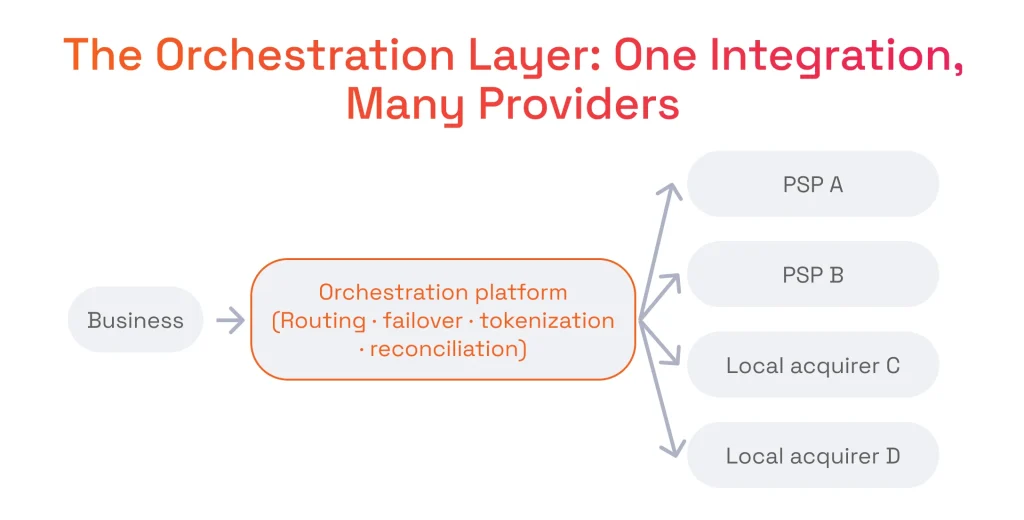
A payment orchestration platform is the software layer connecting a business to multiple payment providers through a single integration, then centrally managing routing, failover, and reporting across all of them. The distinction from a gateway is narrow in description and consequential in practice: a gateway connects a business to one processor, while orchestration coordinates many and decides which one handles a given transaction.
Three kinds of businesses actually run payment orchestration software. Those with two or more PSPs already in production, those operating across territories where local acquiring conditions differ sharply, and those at volumes where a percentage point of declines or an hour of provider downtime carries a number finance can quote.
McKinsey’s 2025 Global Payments Report describes an industry generating $2.5 trillion in revenue from 3.6 trillion transactions and fragmenting into competing regional systems rather than converging on one. That is the condition a coordination layer exists to absorb. The components are the same whether that layer is bought from a vendor or produced through custom payment orchestration platform development. What changes is who owns them.
How Payment Orchestration Works
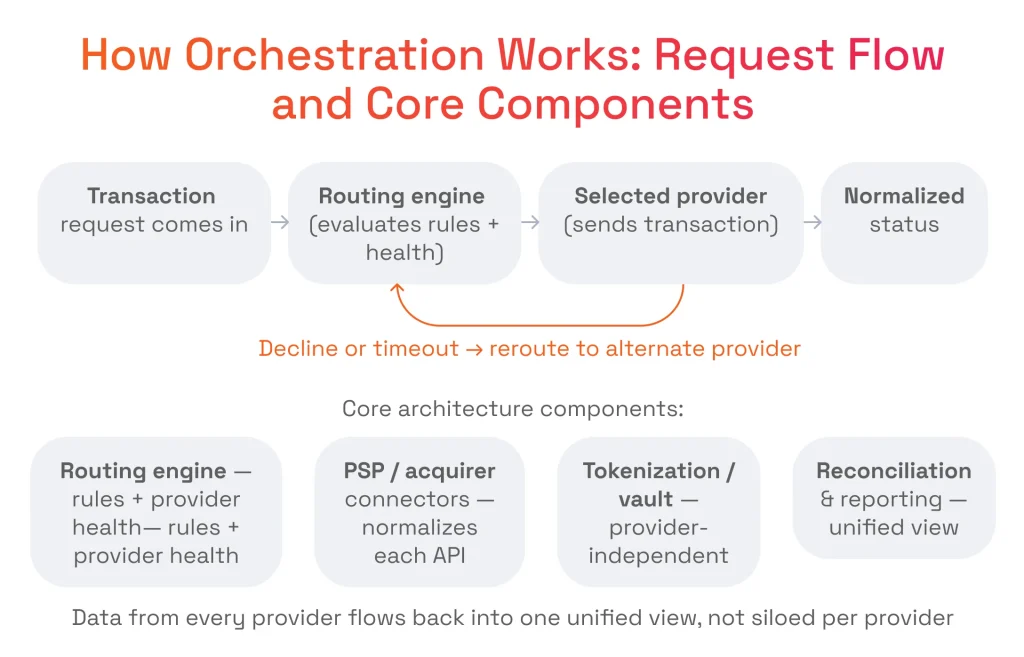
Orchestration is a decision made per transaction, not a configuration set once at integration time. Every authorization request passes through a rules evaluation before it reaches any provider.
- The request arrives at the orchestration layer carrying amount, currency, card type, and customer geography.
- The routing engine evaluates rules against live provider health, processing cost, geography, and card type, then selects a target.
- The transaction goes out through that provider’s connector, and the response — approval, decline, soft decline, timeout — is normalized back into one internal status format.
- On a timeout or a provider-side decline that does not indicate a genuine refusal, the layer reroutes to an alternate provider instead of returning a failure to the customer.
Each connector below the orchestration layer still does the work a direct integration does. The engineering behind how to build a payment gateway does not disappear under orchestration; it gets written once and standardized behind one interface. Stopping short of that leaves a multi-gateway payment architecture, where several gateways run side by side with no layer deciding between them.
The data layer is where the difference compounds. Transaction and settlement records from every connected provider land in one schema rather than sitting in each provider’s own dashboard, which is what makes unified reporting and cross-provider reconciliation possible at all.
Payment service providers run this same pattern inside their own platforms, routing across the acquirer relationships they hold. The routing and normalization patterns behind how PSPs design payment orchestration layers describe the same architecture seen from the provider’s side of the connection.
Payment Orchestration Platform Architecture: Core Components
Payment orchestration platform architecture divides into four components with distinct responsibilities, and weakness in any one of them tends to surface as a symptom attributed to another.
Component | What It Does |
|---|---|
Routing engine | Evaluates rules and live provider health to select the best provider for each transaction |
PSP / acquirer connectors | Normalizes each provider’s API and webhook format into one internal standard |
Tokenization / vault | Stores payment credentials independently of any single provider for cross-provider portability |
Reconciliation & reporting | Unifies transaction and settlement data across every connected provider into one view |
Component
Routing engine
PSP / acquirer connectors
Tokenization / vault
Reconciliation & reporting
What It Does
Evaluates rules and live provider health to select the best provider for each transaction
Normalizes each provider’s API and webhook format into one internal standard
Stores payment credentials independently of any single provider for cross-provider portability
Unifies transaction and settlement data across every connected provider into one view
Understanding these individual components is only the first step. The true value of a payment orchestration platform emerges when these distinct parts interact dynamically during a live transaction.
The token vault, routing engine, and provider connectors must work in perfect synchronization to evaluate, route, and potentially retry a payment in milliseconds. The flowchart below maps out exactly how this automated request flow operates in practice.
Payment Orchestration vs. Payment Gateway
Orchestration does not replace a gateway. It coordinates one or more of them, and a business adopting orchestration usually keeps every gateway relationship and payment services contract it already had. What changes is where the routing decision lives and who normalizes the result.
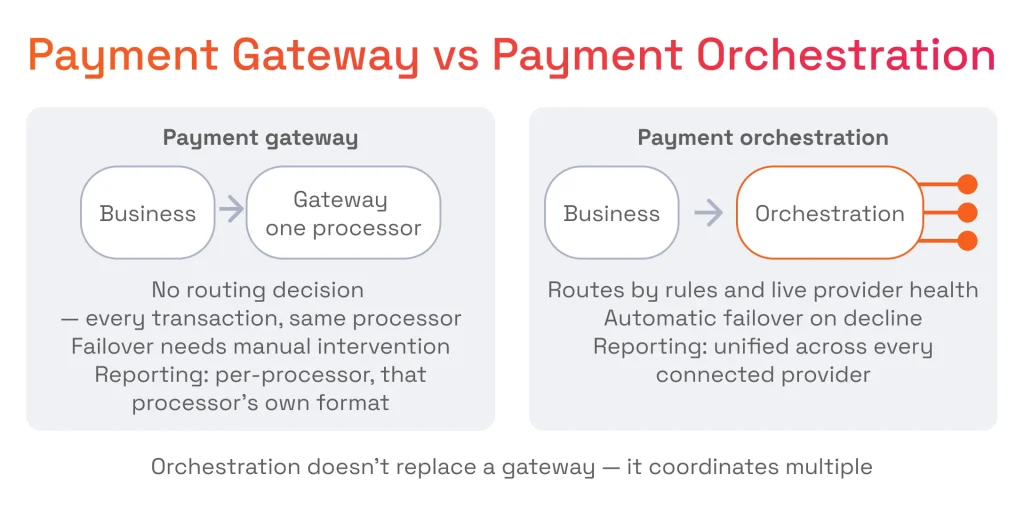
The table below sets out the functional split. While pricing models, contract terms, and stack positioning fall outside this scope, a full payment gateway vs. payment orchestration comparison covers them in detail.
Payment Gateway | Payment Orchestration Platform |
|---|---|
Connects a business to one payment processor | Connects a business to multiple providers through one integration |
No routing decision — every transaction goes to the same processor | Routes each transaction based on rules and live provider health |
Failover requires manual intervention or a separate system | Automatic failover to an alternate provider on decline or outage |
Reporting is per-processor, in that processor’s own format | Reconciliation and reporting are unified across every connected provider |
Payment Gateway
Connects a business to one payment processor
No routing decision — every transaction goes to the same processor
Failover requires manual intervention or a separate system
Reporting is per-processor, in that processor’s own format
Payment Orchestration Platform
Connects a business to multiple providers through one integration
Routes each transaction based on rules and live provider health
Automatic failover to an alternate provider on decline or outage
Reconciliation and reporting are unified across every connected provider
Key Benefits of Payment Orchestration Platforms
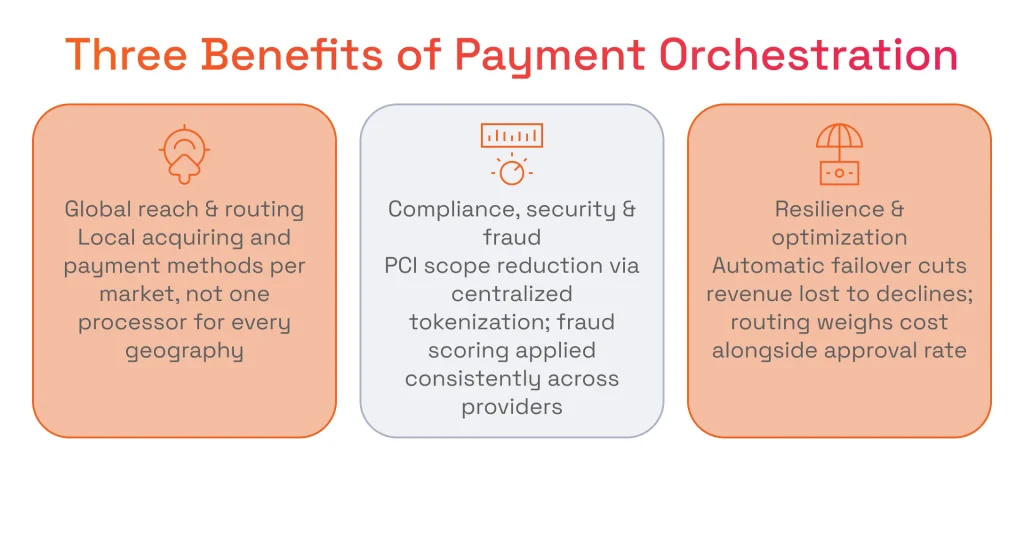
The benefits of payment orchestration software split along stakeholder lines, and different people in the same company will weigh them unequally. A CFO reads the payment performance and processing fee line, a security lead reads the PCI scope line, an engineering lead reads the maintenance line. All three trace back to the same architectural move: one integration point serving various payment methods instead of many.
Global Payment Orchestration Platform: Multi-Acquirer Routing & Connectivity
Reach is the first thing multi-acquirer connectivity buys. A single processor’s coverage map decides which markets a business serves well and which it serves badly, and pushing every transaction through that one processor no matter the geography produces strong domestic authorization rates and weak ones everywhere else.
Routing to a local acquirer per market, with local payment methods available at checkout — iDEAL, Bancontact, domestic card schemes — changes both acceptance and the customer experience at the moment of payment. Approval rates typically improve most in exactly the markets a single provider covers thinly.
Compliance, Security & Fraud Prevention
Centralized tokenization is the compliance angle. With each integration handling raw card data along its own route, PCI DSS scope increases with every additional provider; having one vault keeping the credentials and sending tokens to providers keeps the scope manageable. In this respect, the PCI Security Standards Council’s tokenization guidelines establish how tokenization of primary account numbers will take systems out of the scope of PCI DSS assessment, provided that these systems really cannot access the vault or de-tokenization functionality.
Fraud detection is centralized because of the same principle: one risk model analyzing all transactions, not individual provider solutions that don’t communicate their signals.
Resilience & Payment Optimization
Single-provider payment solutions have no fallback path. When the processor degrades, checkout degrades with it, and that revenue does not come back later. Automatic failover reroutes to an alternate provider on a timeout or provider-side decline, turning an outage into a latency spike.
Intelligent routing extends the same mechanism into economics. It enables routing payments by processing cost alongside approval rate, so a marginal gain in authorization performance does not quietly pay for itself in higher transaction costs.
Do I Need a Payment Orchestration Platform?
Most businesses do not need an orchestration layer, and adopting one early adds a component to maintain without a problem to solve. The threshold for an enterprise payment orchestration platform is not revenue or headcount. It is a set of operational circumstances that show up in decline reports, incident postmortems, and finance’s reconciliation calendar.
Every signal below is observable from data a payments team already holds. None of them justifies an orchestration layer on its own — the case is cumulative, and the pattern matters more than any single row.
✓ | Signal | Why It Matters |
|---|---|---|
☐ | Already running two or more payment providers | Ad hoc, code-level routing between providers is exactly what an orchestration layer replaces |
☐ | Expanding into new countries or regions | Local acquiring and payment method coverage improve approval rates market by market |
☐ | A provider outage has measurably cost revenue in the past year | Automatic failover exists specifically to close this gap |
☐ | Decline rates vary noticeably by provider but aren’t actively routed around | Static, unmanaged routing leaves recoverable revenue on the table |
☐ | Reconciliation across providers is a manual, per-report process | Centralized reconciliation is a core orchestration function, not an add-on |
☐ | Engineering time is spent maintaining multiple direct PSP integrations | That maintenance burden is what orchestration is built to absorb |
☐ | Compliance scope keeps expanding as new providers are added directly | Centralized tokenization contains PCI DSS scope instead of multiplying it per integration |
✓
☐
☐
☐
☐
☐
☐
☐
Signal
Already running two or more payment providers
Expanding into new countries or regions
A provider outage has measurably cost revenue in the past year
Decline rates vary noticeably by provider but aren’t actively routed around
Reconciliation across providers is a manual, per-report process
Engineering time is spent maintaining multiple direct PSP integrations
Compliance scope keeps expanding as new providers are added directly
Why It Matters
Ad hoc, code-level routing between providers is exactly what an orchestration layer replaces
Local acquiring and payment method coverage improve approval rates market by market
Automatic failover exists specifically to close this gap
Static, unmanaged routing leaves recoverable revenue on the table
Centralized reconciliation is a core orchestration function, not an add-on
That maintenance burden is what orchestration is built to absorb
Centralized tokenization contains PCI DSS scope instead of multiplying it per integration
Three or more checked signals make a reasonably strong case for an orchestration layer of some kind. Two or fewer usually means the existing setup still has a runway, and engineering attention belongs elsewhere. Once the case holds, the next question is whether that layer should be bought or built.
Build vs. Buy Payment Orchestration Platform: Custom Development vs. Off-the-Shelf
Either option is justified, but the choice depends on numbers unique to a particular business, not a generalized preference. The buy option excels in terms of speed to market, initial investment, and a vendor offering PCI compliance and maintenance. The downside of buying comes in the form of per-transaction costs that increase exponentially with volume, together with routing rules restricted to what is exposed by the vendor’s rules engine.

Oleksandr Boiko
Delivery Director at SPD Technology
“The switching cost people underestimate isn’t the routing rules — those get rewritten in weeks. It’s the vault. Once a vendor’s token format holds three years of stored credentials, migrating means re-tokenizing every customer through a provider that has no commercial reason to make that fast. That one decision, made on day one, is what determines whether the build-versus-buy question stays open later.”
The build option reverses both and trades them off for months of development and compliance ownership – total routing control, control over the checkout process and cost structure, and per-transaction costs flat once the layer is built. Merchant acquiring margins fell 30% over the last five years while global payments revenues grew by just 6% in 2024, which is the slowest growth rate in a decade for the industry.
Teams that reach this fork usually reach it twice, because the processor connection underneath raises its own build vs. buy payment gateway question: same trade, smaller scope, with acquirer certification rather than routing logic as the cost driver.
Dimension | Buy Vendor Platform | Build Custom Development |
|---|---|---|
Time to launch | Weeks: mostly integration and configuration | Months: full architecture, integration, and certification |
Cost structure | Lower upfront cost, per-transaction fees compound with volume | Higher upfront investment, cost flattens out once built |
Control over routing logic | Limited to what the vendor’s rules engine exposes | Full control: any rule, any provider, any priority |
Compliance ownership | Vendor carries PCI DSS scope and certification | You own PCI DSS scope and the audit trail directly |
Provider flexibility | Constrained to the vendor’s connector catalog | Any provider, added or removed on your own timeline |
Best fit | Speed to market matters more than ownership; volume doesn’t yet justify a build | Payments are core to the product, or volume/margin justify owning the stack |
Dimension
Time to launch
Cost structure
Control over routing logic
Compliance ownership
Provider flexibility
Best fit
Buy Vendor Platform
Weeks: mostly integration and configuration
Lower upfront cost, per-transaction fees compound with volume
Limited to what the vendor’s rules engine exposes
Vendor carries PCI DSS scope and certification
Constrained to the vendor’s connector catalog
Speed to market matters more than ownership; volume doesn’t yet justify a build
Build Custom Development
Months: full architecture, integration, and certification
Higher upfront investment, cost flattens out once built
Full control: any rule, any provider, any priority
You own PCI DSS scope and the audit trail directly
Any provider, added or removed on your own timeline
Payments are core to the product, or volume/margin justify owning the stack
Which path fits depends on your transaction volume, your provider count, and how much routing control your product actually needs. The choice you make today will define your payment margins for years to come. While off-the-shelf solutions get you to market faster, custom builds protect your bottom line as you scale.
Before you lock your business into a vendor’s fee structure or dedicate months of engineering time to a custom build, it pays to evaluate your specific numbers. Let us help you run the math. SPD Technology’s payment engineering team will review both paths against your technical setup, providing an objective, data-driven assessment so you can make the most cost-effective decision for your architecture.
Custom Payment Orchestration Platform Development: When Building Makes Sense
Custom payment orchestration platform development becomes the better economics under three conditions, and they rarely arrive together.
The first is volume: per-transaction vendor fees exceed the fully loaded cost of the engineering team that would own the layer. The second is expressiveness: routing or compliance requirements that none of the top payment orchestration platforms can represent in their rules engines. The latter include a settlement rule tied to a specific acquirer contract, a data-residency constraint, or a fraud signal the platform will not accept as input. The third is strategic: payments differentiate the product enough that renting the decision layer means renting part of the product itself.
The hybrid path is common and entirely legitimate: start on a vendor platform to validate the need, then build once volume and requirements are proven rather than projected.
Common Payment Platform Implementation Challenges
The failure modes in orchestration projects are consistent enough across the payment ecosystem to name in advance. Each one below is architectural rather than tactical, which means the cost of getting it wrong is paid at migration time rather than at launch.
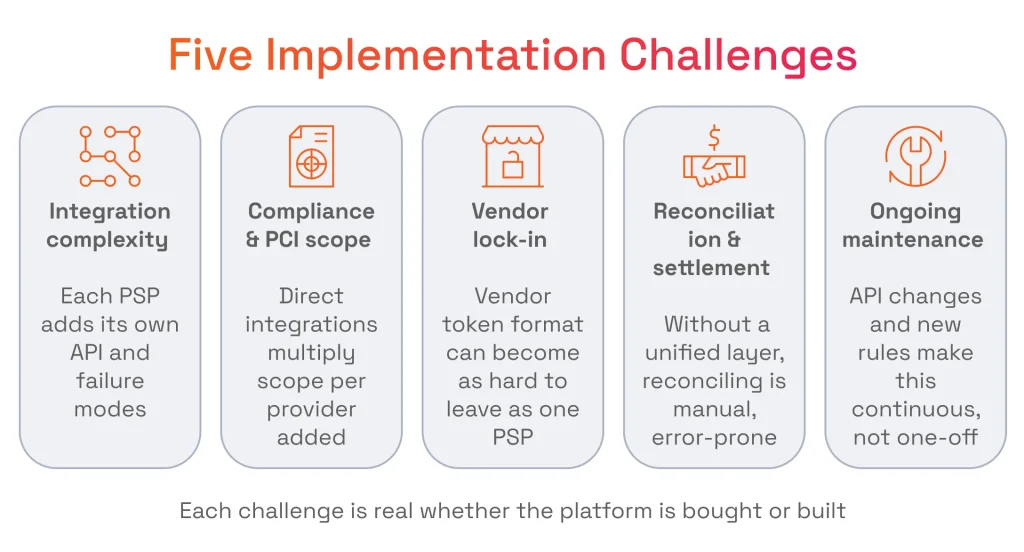
Integration Complexity Across Multiple Providers
Each additional PSP or acquirer comes with its own API idiosyncrasies, webhook delivery model, retry semantics, and failure modes. Lack of true abstraction layers means such differences bleed into payment flows and applications, and the eleventh integration costs more than the third.
We at SPD Technology integrated 27 third-party payment systems into NimbleCommerce’s white-label eCommerce platform as the sole technology vendor for the build, live across the US, Canada, Mexico, Greece, the UK, and other European markets.
Compliance and PCI Scope Across Providers
Integration with providers, each accessing card data on its own path, inflates PCI DSS scope with each new connection rather than constraining it. Centralized tokenization is the way out, and it is vastly cheaper to make an architectural decision in advance rather than fix the problem later.
SPD Technology built an SMB funding platform from scratch in 18 months. The platform is PCI DSS-, GDPR-, and KYC/KYB-compliant by design, and now supports 4,000+ businesses funded and more than $350M in financing. Where the tokenization boundary sits also decides payment gateway compliance and security obligations for every connector below it, so the decision is made once and inherited everywhere.
Vendor Lock-In and Portability
A vendor orchestration platform’s token format and rules engine can become as hard to leave as the single PSP was in the first place, recreating the lock-in the platform was adopted to solve. Stored credentials sit in the vendor’s vault, routing logic is expressed in the vendor’s own configuration language, and the exit cost grows every month. SPD Technology’s 5+ year partnership with Poynt covered full-cycle payment processing, settlement, and third-party integration APIs, with the architecture staying owned by the business rather than rented.
Reconciliation and Settlement Across Providers
Without a unified settlement layer, matching payouts against each provider’s own report format is a manual exercise repeated every period, and the errors surface in financial functions rather than in engineering. SPD Technology delivered a merchant settlement platform for Blackhawk Network serving 37,000+ users, with automated report generation and commission calculation, across a 7+ year partnership. Removing that period-end matching work is where payment operations automation begins to pay for itself.
Ongoing Maintenance Burden
Provider API deprecations, new payment methods from local payment providers, and card network rule updates make orchestration a standing engineering line item rather than a delivered project — true whether the layer is bought or built. The Poynt engagement ran past five years for that reason. Payment infrastructure that stays current requires a team that stays assigned, and the work after launch has a different shape entirely from the work before it.
Custom Payment Orchestration Layers Built by SPD Technology
SPD Technology builds custom payment orchestration layers and multi-provider payment infrastructure for clients. It does not sell a per-transaction orchestration platform, which is why a build-vs-buy answer from this team can land on “buy” without costing anything.
When a business decides to build, the success of the architecture depends on solving three distinct coordination challenges. Our custom development work tackles them directly: normalizing many providers behind a single integration, containing compliance scope at design time, and supporting the infrastructure across years of provider updates.
The following projects demonstrate how we handle each of those requirements in live production environments.
Multi-Provider Integration at Scale: NimbleCommerce
The hard part of 27 payment integrations is not writing 27 clients. It is normalizing 27 response vocabularies, webhook timing models, and partial-failure behaviors into one internal status the rest of the platform can reason about. SPD Technology was the sole technology vendor for NimbleCommerce’s white-label eCommerce build, live across the US, Canada, Mexico, Greece, the UK, and other European markets, with an AI-powered reporting and analytics module reading from that normalized layer.
Long-Term Payment Infrastructure Ownership: Poynt
Payment infrastructure must serve the business over years, not just at launch. SPD Technology’s partnership with Poynt has run for over five years, covering an all-in-one omnicommerce payment system with full-cycle processing, settlement, third-party integration APIs, and transaction-cost savings under a PayFac model. Engineering responsibility did not end at delivery — it moved into keeping a production payment system current as providers and card network rules changed underneath it.

Compliance-by-Design at Launch: SMB Funding Platform
An SMB funding platform was designed from scratch within 18 months with PCI DSS, GDPR, and KYC/KYB requirements taken as an architectural decision, not a launch-time headache. Such prioritization is important because data boundaries and data residency decisions can be made cheaply in advance and will cost much more in implementation. The platform powers 4,000+ businesses and $350M+ in financings.
Key Takeaways
- Payment orchestration vs. payment gateway is a question of scope: a payment gateway connects a business to one payment processor, while an orchestration layer connects to many through a single integration and decides which one handles each transaction.
- The choice of token format on day one determines the cost of migrating away from a vendor platform, because migration requires re-tokenization of all credentials through a provider with no incentive to act quickly.
- Three or more orchestration signals present at once (multiple providers, market expansion, revenue-costing outages, and manual reconciliation) create a reasonably strong case for a dedicated orchestration layer.
- Buying offers speed and vendor-owned compliance, but at the cost of per-transaction fees that scale with volume. Building takes months, compliance is owned internally, and it flattens the fee curve over time.
- Adding additional payment providers without centralized tokenization increases PCI DSS scope with each integration.
- Starting with a vendor platform and building a custom system after proving out volume and routing needs is a sequencing choice.
In short: a payment orchestration platform becomes something to invest in when the signals are there — such as the need to cascade failed transactions, integrate local acquirers, or eliminate engineering bottlenecks — and something to build when fees, routing needs, or compliance control make it better to own the layer than rent it.
FAQ
What is the difference between payment orchestration and a payment gateway?
A gateway connects a business to one payment processor and sends every transaction to it. An orchestration layer connects to several providers through one integration and decides, per transaction, which of them should handle it.
The functional distinctions will be automatic failover if the provider goes down, routing based on cost and live health status, and reconciliation for all connected providers together rather than looking at one dashboard after another. Orchestration runs above and beyond gateways and coordinates them.
How do I know if I need a payment orchestration platform?
The most obvious signal is using more than one payment provider, where routing decisions are made in application code. Add growing into new markets, an outage of a provider resulting in lost revenue, varying decline rates among providers with no routing around the issues, and manual reconciliation every settlement cycle. Three or more of those conditions together make the case.
A single provider handling one market with stable approval rates does not need an orchestration layer, and adding one creates maintenance without solving anything.
Should a business build or buy a payment orchestration platform?
Buy when speed to market matters more than ownership and current volume does not yet justify a dedicated engineering team. Build when per-transaction fees at projected volume exceed that team’s cost, when routing or compliance rules cannot be expressed in a vendor’s rules engine, or when payments differentiate the product.
The deal is concrete for both parties: vendors get PCI compliance and maintenance but limit the routing logic and charge per transaction, while building gives full control but requires direct possession of the audit trail.
What are the core components of a payment orchestration platform’s architecture?
A payment orchestration platform’s architecture rests on four components.
- A routing engine evaluates rules and live provider health to select a target for each transaction.
- Connectors normalize each provider’s API and webhook format into one internal standard.
- A tokenization vault stores payment credentials independently of any single provider.
- A reconciliation layer unifies transaction and settlement data across all of them.
The vault carries the longest consequences of the four, because its token format determines how expensive changing providers becomes years later.
Does a global payment orchestration platform improve payment approval rates?
Routing through local acquirers in each market generally raises approval rates when compared with sending every transaction to one processor independent of geography. Issuers approve domestic acquiring traffic at higher rates than cross-border traffic, and connections to local payment providers can improve approval rates and checkout completion by removing a step where customers abandon checkout.
The size of the gain depends on where the traffic is: a business selling mostly into one home market sees little, while a business with meaningful volume in markets its primary processor covers thinly can see a notable fraction of declines recovered.
Is a payment orchestration platform the same as a payment facilitator (PayFac)?
No. A PayFac is a merchant of record that aggregates sub-merchants under its own acquirer relationship, handling underwriting, onboarding, and settlement on their behalf, and carrying the regulatory obligations that come with it. Orchestration is a routing and coordination layer with no merchant-of-record role and no underwriting responsibility.
The two are frequently combined, and a payment facilitator often runs orchestration internally to route its aggregated volume across acquirers, but the compliance obligations are entirely separate.
How much does it cost to build a custom payment orchestration platform?
Cost is driven by four things: the number of providers integrated and normalized, the complexity of the routing rules, whether tokenization and the vault are owned in-house or delegated, and how much of the system falls inside PCI DSS scope. A layer covering three to five providers with delegated tokenization typically starts in the low six figures (e.g., $150,000 to $300,000), while owning the vault in-house and certifying with multiple acquirers moves the range considerably higher (e.g., $500,000 to $1,000,000+).
The comparison that matters is not build cost against year-one vendor fees. It is build cost plus maintenance measured against three years of cumulative per-transaction fees (which typically range from $0.01 to $0.10 per transaction or 0.5 to 5 bps of volume) at projected volume, which is where the arithmetic usually turns.
How long does it take to build a payment orchestration platform?
The steps are chronological: provider integration and response normalization, the routing engine, tokenization and vault, reconciliation, and certification. Scalability affects the schedule as well.
Certification with each acquirer, not the code, usually sets the critical path — acquirer testing calendars are outside the delivery team’s control. A first production version handling two or three providers commonly lands within four to six months, and a full layer with in-house tokenization and multi-acquirer certification runs closer to nine to twelve.
As a comparable payments build rather than an orchestration-layer estimate, SPD Technology delivered full-cycle payment processing, settlement, and integration APIs for Poynt in 5 months. Sequencing detail sits in this fintech payment integration timeline.