

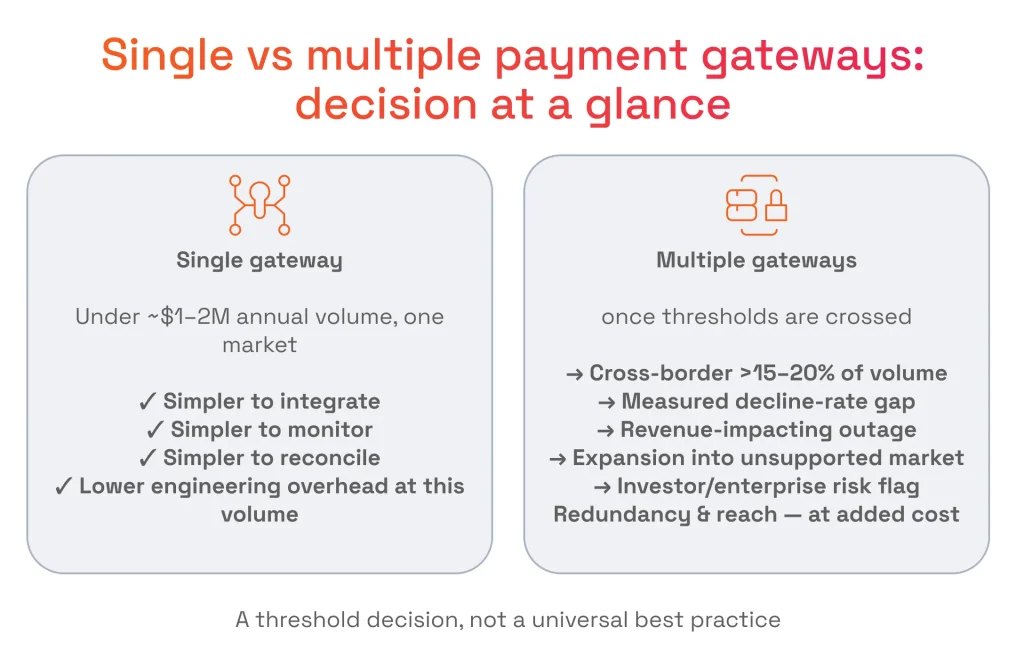
Single vs. multiple payment gateways is a threshold decision driven by transaction volume, cross-border share, decline-rate gaps, and outage tolerance. A single gateway fits most businesses under roughly $2M in annual volume in one market. Crossing that threshold without adding redundancy leaves declines and downtime absorbed as permanent revenue loss.
One payment processor down at 11 AM during your biggest day of sales instantly turns simplicity into a board-level incident. But the silent failure mode is costlier: a low extra rate of decline quietly erodes margin quarter after quarter before the comparative baseline is run.
Processor redundancy is usually considered a luxury that must wait until the incident strikes the status page. However, deciding on one vs. multiple payment gateways is an inflexible calculation based on volume, geography, and exposure to declines.
This article provides a list of engineering benchmarks to make that choice: the goal of each design, the actual maintenance costs of maintaining two gateways, and the right architecture for switchover without disrupting live checkouts.
Why Single vs. Multiple Payment Gateway Decision Is Higher-Stakes Than It Seems
Most engineering organizations expect the standard USD processor to have similar authorization outcomes; however, according to Spreedly’s study, there was a 22.4 percentage-point difference in authorization results between gateways for the same currency. This difference remains unknown until someone tests an alternative gateway against the existing one on the same volume, which very rarely happens before the first quarter’s downturn.
The second problem is the gateway outage, which causes a loss of all revenue rather than just part of it; moreover, the additional payment gateway is often budgeted for the next week rather than a month before this incident takes place. Thirdly, the issue is reach: the median gateway of that test processes transactions in only three currencies, limiting the international conversions in single-gateway infrastructure.
Global payment infrastructure is fragmenting into competing regional systems with diverging standards, which is documented across 50 countries in McKinsey’s 2025 Global Payments Report. Coverage gaps widen as that fragmentation continues, which makes payment gateway redundancy a moving target rather than a fixed one. It also means this is a threshold decision rather than a universal best practice.
What a Single Payment Gateway Actually Optimizes For
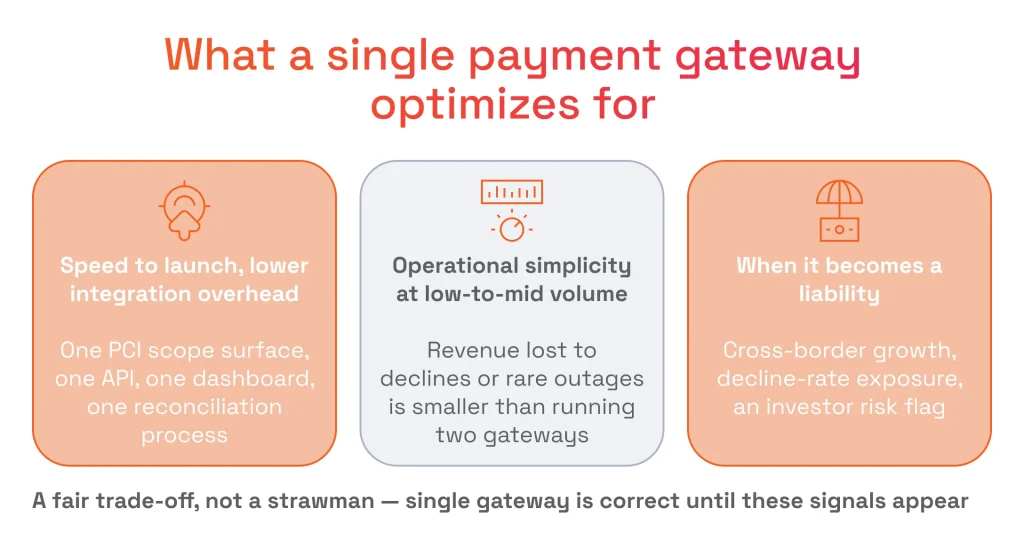
The case for staying on one provider is stronger than multi-gateway content admits, and it is strongest exactly where most scaling companies still sit. A single payment gateway optimizes for the two resources early payment infrastructure is always short on: engineering hours and audit surface.
Speed to Launch and Lower Integration Overhead
Using one API, one dashboard, one reconciliation process, and one compliance surface to maintain up-to-date information is more effective than adding another integration. In the case of adding one more complete gateway integration, a team maintains almost twice as much: from webhook processing to dispute and error handling. The PCI DSS scope question is the one most teams underestimate, and it overlaps directly with payment facilitation compliance.
Operational Simplicity at Low-to-Mid Volume
At a certain level of transaction volume, the revenue lost due to occasional losses of a couple of percentage points or a rare outage is less than the cost of maintaining two gateways. This is purely a financial consideration and nothing more; it is the exact reverse when the volume increases. The important thing here is choosing a payment gateway partner that will cover you for the next two years, not for the previous year.
When Single Payment Gateway Becomes a Liability
There are three things that change the situation and seldom occur at the same time. Transactions involving cross-border operations outpace domestic transactions in volume. Benchmarking by a competitor or the processor shows a decline rate difference. Someone in your enterprise’s purchasing department, a company auditor, or your venture capitalist writes off your single payment processor as a risk factor.
The Benefits and Costs of Multiple Payment Gateways
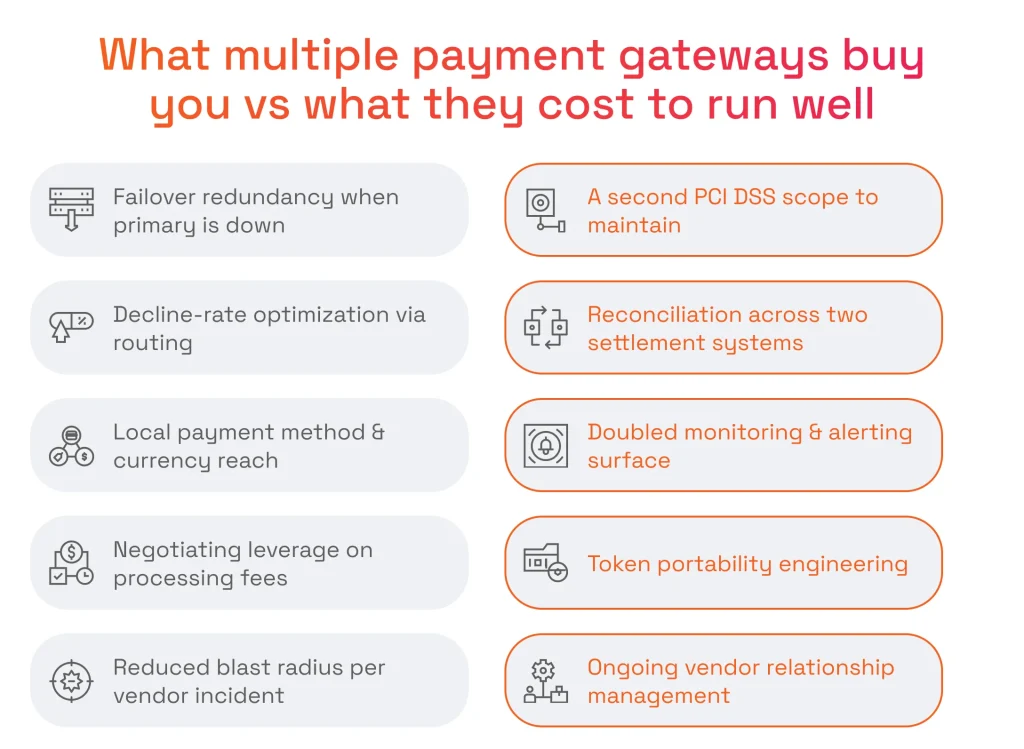
The availability of multiple payment gateways ensures redundancy, options, and increased coverage in markets where a single player does not cover adequately. The clear expense item is easy to quote and predict for budgeting. The typical cost for a payment gateway translates to a 2-3% commission charge plus a flat fee per transaction, all accounted for by finance.
The hidden part is the ongoing cost of integrating with multiple payment gateways, the engineering effort repeating every quarter rather than concluding at go-live. This is what makes an estimate of one-time cost to build a payment gateway an inadequate substitute for the expense of running multiple gateways. Another payment gateway adds another compliance surface, and payment processing compliance considers this scope not annual but continuous.
None of this is unusual at scale. The Merchant Risk Council’s 2026 Global eCommerce Payments and Fraud Report surveyed 1,278 merchant professionals across 37 countries on payment acceptance and fraud management practices, and multi-provider setups are standard practice among them. SPD Technology has worked at the point where that overhead becomes the dominant engineering cost: building a global white-label eCommerce platform for NimbleCommerce as sole technology vendor meant integrating 27 third-party payment systems across the US, Canada, Mexico, the UK, and other European markets.
Weighed side by side, the trade looks like this.
Decision Framework: When the Switch to Multiple Gateways Pays Off
The signals below are the ones that hold up under scrutiny from a CFO or a board, because each is measurable from data a payments team already has. Work through them against the last twelve months of actuals rather than forecasts.
Signal | Points Toward |
|---|---|
Annual processing volume above ~$2–3M and growing | Multiple gateways |
Cross-border transactions exceed 15–20% of total volume | Multiple gateways |
A measured decline-rate gap exists between the current gateway and a competitor in the same market | Multiple gateways |
At least one revenue-impacting outage or degradation in the past 12 months | Multiple gateways |
Expansion planned into a market the primary gateway doesn’t support well | Multiple gateways |
An investor, auditor, or enterprise customer has flagged single-processor dependency as a risk | Multiple gateways |
Engineering team has bandwidth to own a second integration and its reconciliation long-term | Multiple gateways (prerequisite, not optional) |
Volume under $1–2M, single market, no history of outages or decline complaints | Single gateway — stay put |
Signal
Annual processing volume above ~$2–3M and growing
Cross-border transactions exceed 15–20% of total volume
A measured decline-rate gap exists between the current gateway and a competitor in the same market
At least one revenue-impacting outage or degradation in the past 12 months
Expansion planned into a market the primary gateway doesn’t support well
An investor, auditor, or enterprise customer has flagged single-processor dependency as a risk
Engineering team has bandwidth to own a second integration and its reconciliation long-term
Volume under $1–2M, single market, no history of outages or decline complaints
Points Toward
Multiple gateways
Multiple gateways
Multiple gateways
Multiple gateways
Multiple gateways
Multiple gateways
Multiple gateways (prerequisite, not optional)
Single gateway — stay put
Three or more “multiple gateways” signals, especially the difference between the rates of decline between two providers, or the outage record, will normally pay off in less than a year. An engineering bandwidth row left unchecked should be addressed first, because multiple gateways are usually under-engineered and will usually re-create the problem that they are supposed to solve.
The decline-rate item is the one people tend to estimate incorrectly, since false declines appear to be effective fraud prevention when they are actually leaking revenue. According to PYMNTS Intelligence, almost 50% of merchants estimated up to 5% of valid transactions being erroneously declined for fraud, totaling an estimated loss of $50 billion in industry revenue. Before implementing a payment gateway to correct this particular metric, ensure that the metric being considered is relevant to the gateway. A bad risk algorithm will give the same result, and AI in fraud detection helps here.
Two Ways to Architect Multiple Gateways: Direct Integration vs. Orchestration Layer
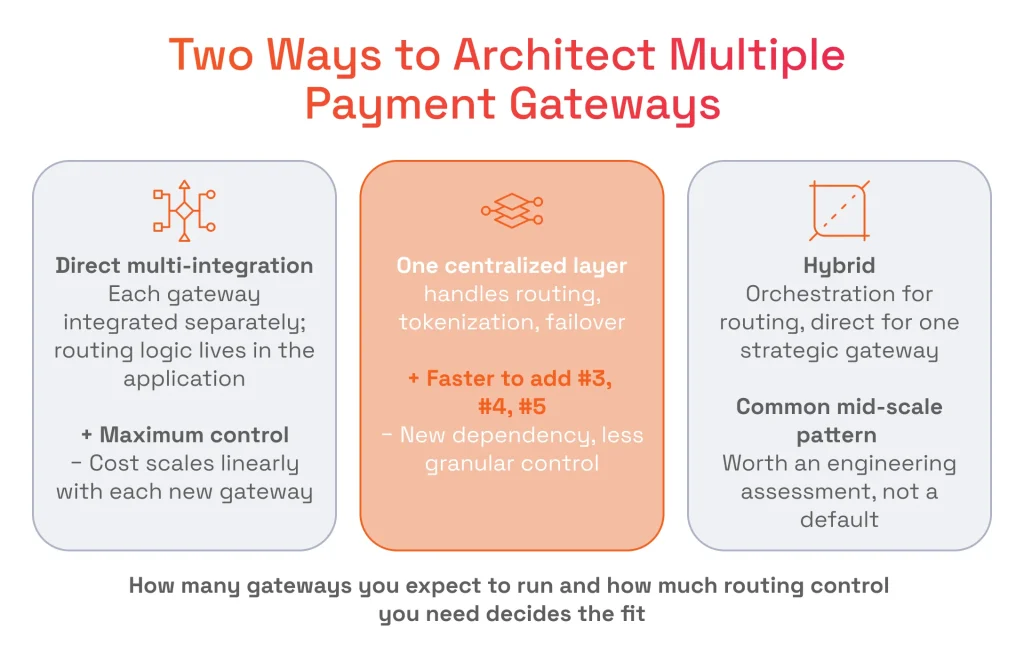
Once the business case clears the threshold, the architecture question decides most of the cost. Both paths below deliver redundancy and routing; they differ in where complexity accumulates and how expensive gateway number three turns out to be.
Direct Multi-Integration
Each gateway is integrated separately into the checkout and settlement flow, with routing logic living in the application layer. This gives maximum control over per-gateway behavior — retry rules, 3DS handling, dispute workflows tuned to each provider. The trade-off is that integration cost scales linearly: the fourth gateway costs roughly what the second did. Teams choosing direct integration should plan for how to build a payment gateway and logic they will own permanently. SPD Technology built an all-in-one omnicommerce payment system for Poynt in 5 months, covering full-cycle payment processing, settlement, and a third-party integration API, across a partnership now past five years.
Orchestration / Routing Layer
A payment orchestration layer sits between the application and every gateway, handling transaction routing, tokenization, and failover in one place. Gateways three, four, and five become configuration rather than engineering projects, which is the entire argument for the pattern. The cost is a new dependency in the critical path of every transaction and less granular control over provider-specific behavior. Building or buying a payment orchestration platform capability is itself a build-versus-buy decision worth costing properly.
Hybrid: Orchestration for Routing & Direct for One Strategic Gateway
A mid-scale team usually arrives here: a payment orchestration layer handles the long tail of regional providers, but the highest-volume gateway maintains a direct integration to have full control of its economics and edge cases. It provides much of the routing flexibility without losing the commercial relationship. It’s a design choice that benefits from engineering evaluation in light of actual traffic patterns rather than defaults.
Migration Path: Adding a Second Gateway Without Breaking Checkout
Architecture selection is the easy part of the equation. Rolling out a second provider without shutting down checkout depends on strict ordering of state management before any traffic switch, and the decisions for payment gateway integration at step one dictate the cost of the following four steps.
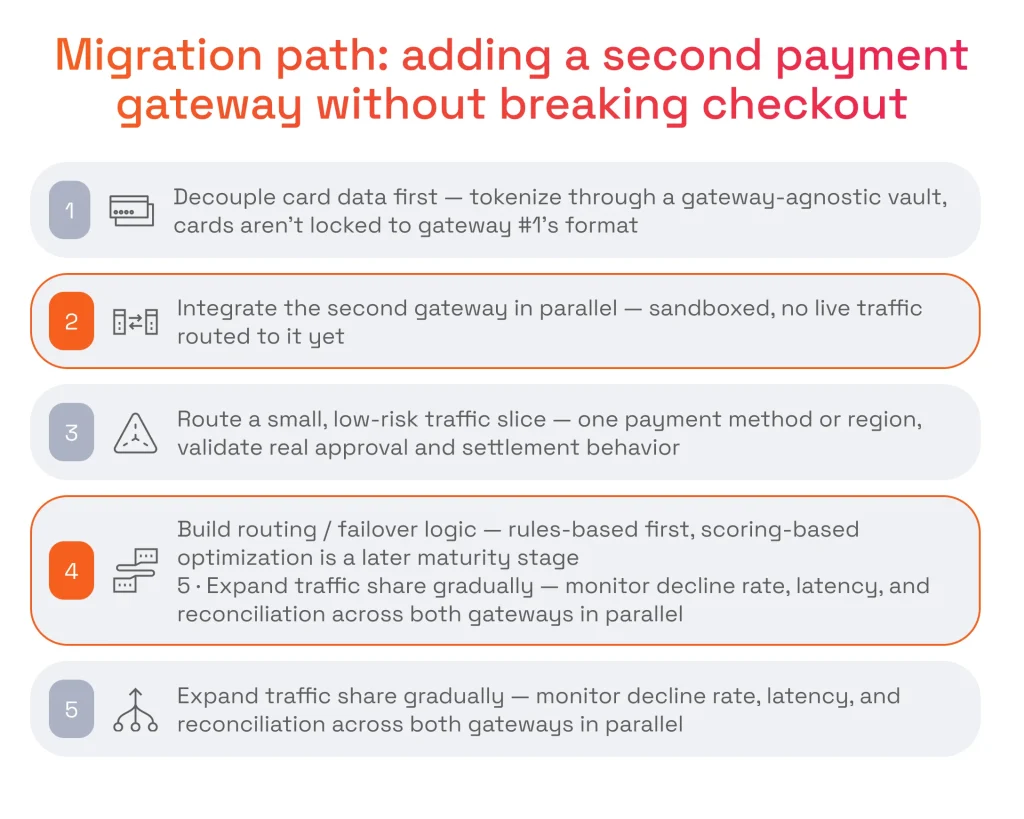
The Five-Step Migration Sequence
- Decouple card data from either gateway first. Tokenize through a gateway-agnostic card vault so cards are never locked to gateway #1’s token format.
- Integrate the second gateway in parallel and sandboxed, with no live traffic routed to it.
- Route a small, low-risk traffic slice — one payment method or one region — to validate real-world approval and settlement behavior.
- Build the routing and failover logic. Rules-based comes first; scoring-based optimization is a later maturity stage, not a day-one requirement.
- Expand traffic share gradually, monitoring decline rate, latency, and settlement reconciliation in parallel across both gateways.
Token portability is the decision point in that list, not a detail inside step one. If token portability wasn’t solved there, every later step becomes harder and costlier to unwind.

Oleksandr Boiko
Delivery Director at SPD Technology
“Teams treat token portability as a migration detail and solve it last. It is the first decision. If cards are vaulted inside gateway #1’s token format, every routing rule, failover test, and reconciliation job built afterward is written against a dependency you cannot remove without going back to customers to re-collect card data.”
SPD Technology’s Expertise: Building Multi-Provider Payment Infrastructure
SPD Technology has built both sides of this decision for clients running real money through production systems: single-processor flows hardened for scale, and multi-provider architectures spanning dozens of integrations across separate regulatory markets. The trade-offs described above come from that delivery work rather than from theoretical modeling. The pattern across those engagements is consistent — the integration is rarely the hard part, and reconciliation, risk, and settlement almost always are.
Multi-Provider Integration at Scale: NimbleCommerce
Operating as the sole technology vendor for the entire build, we integrated 27 third-party payment systems into a white-label B2B eCommerce platform running live across the US, Canada, Mexico, Greece, the UK, and other European markets. The platform accepted payments through many providers across those markets rather than standardizing on one, and SPD Technology built its reporting and analytics module alongside those connections.

Long-Term Payment Processing Partnership: Poynt
SPD Technology executed a 5-month build of full-cycle payment processing, settlement, and a third-party integration API, with transaction cost savings under a PayFac model. That system is what the direct-integration path looks like when one team owns processing and settlement together, and it anchored a partnership now past five years. Poynt was later acquired, and SPD Technology was retained post-acquisition.

Merchant Settlement at Scale: Blackhawk Network
SPD Technology developed and runs the Blackhawk Network merchant settlement platform, which automates reporting and commission calculations for all relationships between merchants in a partnership spanning over seven years, and serves over 37,000 users. This is the aforementioned problem of dual reconciliation costs, which has been resolved as a product, not through manual finance operations.
In terms of fraud risk within the same industry, SPD Technology has developed underwriting and risk scoring systems that underwrote 5 million-plus merchant applications in one year alone and also doubled the merchant termination rate through true-positive alerts. True positives can only be detected when throughput is high enough to require fraud detection with machine learning.
The right architecture follows from the specific volume, geography, and risk profile mapped in the Decision Framework above, not from a general preference for redundancy. SPD Technology’s payment engineering team can assess which side of that framework a business currently sits on, and what the second integration would actually cost to run.

Key Takeaways
- The decline-rate gap between payment gateways reaches 22.4 percentage points on the same currency: a business processing at scale on one gateway is likely absorbing avoidable revenue loss without knowing the size of the gap.
- Single-gateway setups are correct below roughly $1–2M in annual volume in one market. Adding a second gateway earlier adds more engineering overhead than the redundancy is worth.
- The median payment gateway supports only about three currencies, which makes international expansion plans, rather than transaction volume alone, the real trigger for going multi-gateway.
- Running two gateways well requires solving token portability first, by vaulting card data independently of either gateway. Skipping that step makes every later migration step harder to unwind.
- Direct multi-integration gives more control per gateway but integration cost scales linearly with each new provider. An orchestration layer centralizes routing and failover at the cost of a new dependency and less granular control.
- Multi-gateway redundancy without the engineering bandwidth to own reconciliation, monitoring, and vendor management recreates the reliability problem it was meant to fix.
In short: single vs. multiple payment gateways is a threshold crossed by measured volume, decline-rate gaps, and cross-border share, not a best practice a business adopts because it has outgrown feeling small.
FAQ
Do small businesses need multiple payment gateways?
Most do not. A business under roughly $1–2M in annual processing volume, operating in one market with no outage history, spends more on the engineering and compliance overhead of a second gateway than it recovers in declines or uptime.
Adding providers early forces a small team to manage distributed complexity and secondary integrations before either is earning its keep. The exception is coverage: a business whose customers concentrate in a region the primary payment service provider serves poorly should move sooner than volume alone suggests.
What is the main risk of using only one payment gateway?
Approval rate exposure that nobody has measured. A single processor caps approval rates according to its own risk models and local acquiring relationships, and a business on one provider has no baseline for comparison. The analysis of 155 payment gateways found a 22.4-percentage-point gap in decline rates between the best- and worst-performing USD gateways.
The obvious risk is a vendor outage leading to zero checkouts instead of degradation of checkouts, and it mostly happens during peak events. Both are volume-sensitive reasons behind why the same architecture may be right one year and negligent the other year.
What’s the difference between adding a second gateway directly and using an orchestration platform?
Direct integration means that each gateway is connected to both checkout and settlements via application-layer routing logic. The control level is very high, and per-provider behavior is tuned perfectly, but the cost depends linearly on the number of gateways.
The orchestration platform provides a centralized layer between the checkout application and the providers behind it for routing, tokenization, and failover purposes. It helps to scale faster, but adds additional system dependency into the transaction chain. The number of expected providers makes the decision.
How much does it cost to run multiple payment gateways compared to one?
Gateway processing fees usually range around 2-3% of transaction value and a flat per-transaction fee, and that part is scalable by the volume of transactions independently of the number of providers.
The underestimated cost of integrating several payment gateways is everything else after launch: second PCI DSS scope to support and audit, duplicate settlement reconciliation, duplicated monitoring configurations, and additional vendor relationship management. They’re operational headaches, not one-off integration costs. Budget them as ongoing.
How long does it take to add a second payment gateway?
There’s no fixed timeline: it all depends on one pre-requisite — token portability. If you have solved this, the next four phases generally take 4-8 weeks: sandbox integration, small traffic validation, routing and failover, and then gradually increasing traffic. But if you have not, decoupling card data into a gateway-agnostic vault will be the first step, and that itself could take up to 4-6 weeks before anything else, making your migration effort last 2-3 months in total.
The five phases in order: (1) decoupling of card data into a gateway-agnostic vault, (2) second gateway sandbox integration, (3) low-risk traffic validation, (4) routing and failover, (5) increase traffic gradually, keeping track of decline rate and reconciliation. Teams that have already solved tokenization do the latter four phases quickly, while those without it spend most of the time in the former.
Can a business switch from one payment gateway to multiple without downtime?
Yes, if the second gateway will never see live traffic until it is validated. The integration pattern used is parallel integration in the sandbox. A narrowly defined traffic slice — one region, one payment method — is processed via the new processor while the primary takes care of the rest. The settlement reconciliation runs against both gateways during this phase, so any discrepancy gets picked up before the traffic moves over. Any downtime risk comes in when the teams deploy widely to go live with one shot or the card vaults have never been decoupled, and they roll back an invalid routing rule and take checkout down with it.
Is payment orchestration the same as using multiple payment gateways?
No. Multiple gateways are the underlying financial processors; orchestration is one mechanism for managing them. A business can run several gateways through direct integrations with no orchestration layer at all, with routing logic owned at the application layer.