

Payment security architecture is the layer of design decisions above the control list that determines how much of a system falls inside PCI DSS scope, how far a breach spreads, and how fast it can be investigated. Three boundaries define it. The data boundary sets where encryption and tokenization sit, and whether that placement actually reduces scope. The trust boundary sets how the cardholder data environment is segmented and how services authenticate to each other. The observability boundary sets whether forensic logging exists at launch or is retrofitted after an incident.
You already know you need encryption, tokenization, and monitoring. What nobody told you is where they go — and that gap usually surfaces the same way: a Qualified Security Assessor (QSA) walks the architecture diagram, and half the platform you assumed was out of scope turns out to be in it. Every control looked reasonable in isolation.
Most writing on this subject is a checklist of what to implement or a vendor pitch for what to buy. Neither answers the question that decides the outcome: where the boundaries of the system should sit. What’s more, IBM puts the average financial-sector breach at $5.56 million in 2025, second only to healthcare — and that figure is a function of blast radius, which is a boundary property.
Here we assume you already know the controls themselves; our guide to secure payment best practices covers that inventory. What follows works through three boundaries: data, trust, and observability.
Why Payment Security Architecture Decisions Outweigh Individual Controls
Two payment systems can implement an identical control set — TLS 1.3 everywhere, tokenized card data, MFA on every admin path — and land on wildly different PCI DSS scope and breach blast radius. The difference is placement in the data flow, not control quality.
The mechanism is not subtle once you name it. A QSA scopes the cardholder data environment from the architecture diagram, not from your control inventory: any component that can reach the tokenization or de-tokenization process is in scope, whatever protects it.
That reachability question gets answered at design time and is expensive to answer differently later, which is why payment gateway compliance and security is an architectural discipline before it is an operational one. Decisions made before implementation determine whether controls compound — each one narrowing scope further — or simply sit alongside each other.
Our breakdown of payment processing compliance maps the regulatory surface those decisions have to satisfy.
The Three Boundaries of Payment Security Architecture
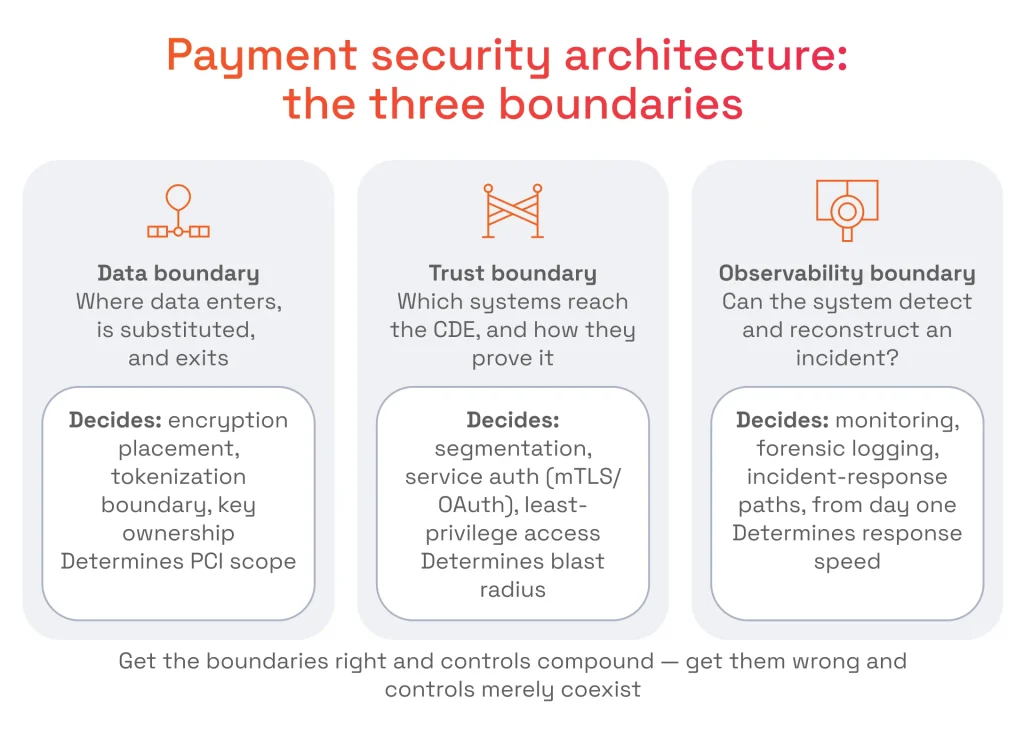
Every payment security architecture provides answers to three key questions, regardless of whether these questions are ever articulated. Where does the sensitive data come in and go out? Which actors are permitted to access the environment in which the data resides? Is the environment able to explain, after the fact, what happened within it?
Answer those deliberately, and the control layer turns into straightforward engineering work. Answer them by default, by letting the implementation decide — and you inherit a scope and a blast radius nobody sized. Each boundary below has a small number of decisions that are hard to reverse once traffic is flowing.
Boundary | Architecture Question It Answers | Key Design Decision |
|---|---|---|
Data boundary | Where does sensitive payment data enter, get substituted, and exit the system? | Point-of-interaction encryption placement; tokenization boundary (vaulted vs. vaultless); key management ownership (self-managed vs. provider-managed HSM) |
Trust boundary | Which systems can reach the cardholder data environment, and how do they prove who they are? | Network segmentation and micro-segmentation of the CDE; service-to-service authentication (mTLS, OAuth 2.0); least-privilege access for engineers and third parties |
Observability boundary | Can this system detect an anomaly and reconstruct what happened, on day one or only after a breach? | Real-time transaction and anomaly monitoring; forensic-ready structured logging; incident response paths defined at architecture time |
Boundary
Data boundary
Trust boundary
Observability boundary
Architecture Question It Answers
Where does sensitive payment data enter, get substituted, and exit the system?
Which systems can reach the cardholder data environment, and how do they prove who they are?
Can this system detect an anomaly and reconstruct what happened, on day one or only after a breach?
Key Design Decision
Point-of-interaction encryption placement; tokenization boundary (vaulted vs. vaultless); key management ownership (self-managed vs. provider-managed HSM)
Network segmentation and micro-segmentation of the CDE; service-to-service authentication (mTLS, OAuth 2.0); least-privilege access for engineers and third parties
Real-time transaction and anomaly monitoring; forensic-ready structured logging; incident response paths defined at architecture time
Data Boundary Design: Where Tokenization and Encryption Actually Reduce Scope
The data boundary is the point beyond which card data ceases to be real card data in your environment and becomes a substitute thereof. The upstream area to this point is always in scope by definition; whether downstream gets out of scope depends entirely on how the boundary was established.
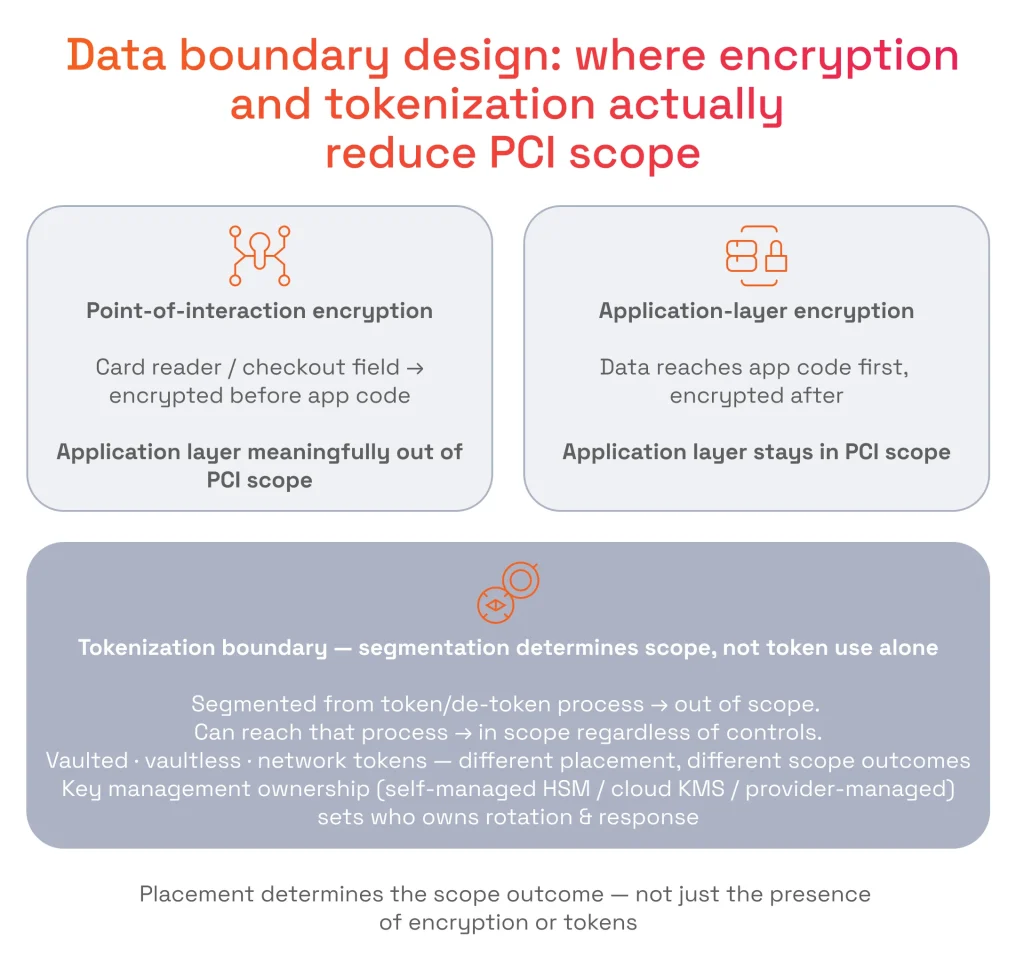
It is also the boundary most often assumed rather than designed, because encryption and tokenization both feel binary — either you have them, or you don’t.
The following three decisions do most of the work.
Point-of-Interaction Encryption vs. Application-Layer Encryption
Encrypting at the point of interaction means the card reader or the hosted checkout field encrypts the PAN before your application code ever sees it. Encrypting at the application layer means your code received the clear value first, then protected it. Both appear as “encryption” on a control list.
The distinction is custody, not algorithm strength. Once application code has held a clear PAN — even briefly, even in memory — that runtime, its logs, its error handlers, and its host are all accessible. Our guide on how to build a payment gateway works through where this capture point belongs in a custom build.
Tokenization Boundary Placement: Vaulted vs. Vaultless, Network Tokens
Tokenization reduces scope only in cases where there is segmentation in the tokenization and de-tokenization process. If a system holds a million tokens but has no access to the de-tokenization endpoint, it will be out of scope. However, it will be in scope if it does have access.
In the case of vaulted tokenization, the mapping is done in the token vault operated by either the client or the service provider, hence limiting scope to the token vault and callers thereof. In vaultless tokenization, the token is algorithmically derived.
Network tokens issued by Visa or Mastercard replace the PAN at the scheme level, so the merchant environment may never hold a de-tokenizable value at all. That is the strongest scope reduction of the three, and the least flexible for anything that isn’t a card-on-file transaction.

Oleksandr Boiko
Delivery Director at SPD Technology
“Teams assume that once card data is tokenized, everything downstream drops out of PCI scope. It doesn’t. A QSA scopes on reachability, not on whether a component handles tokens. If a service can still call the de-tokenization endpoint, it stays in scope no matter how many tokens sit in its database. The scope reduction comes from the segmentation around that endpoint, not from the token itself.”
Key Management and HSM Ownership: Who Holds the Keys
Key ownership is an accountability decision disguised as an infrastructure one. A self-managed HSM gives you full custody and full responsibility for rotation schedules, dual control, and access logging — along with the audit evidence to produce for all of it. Cloud KMS shifts the hardware and availability burden to the provider while leaving policy, rotation cadence, and IAM boundaries yours to defend.
Provider-managed custody, where the PSP or the tokenization service controls the keys, minimizes your accessible footprint and your control at the same time. What matters here is who has to take action within hours of discovery of a possible compromise – and whether you have such a team available.
For the full control inventory behind PCI DSS scope: SAQ levels, the six control objectives, and more — see secure payment best practices.
Trust Boundary Design: Zero-Trust Segmentation for Payment Environments
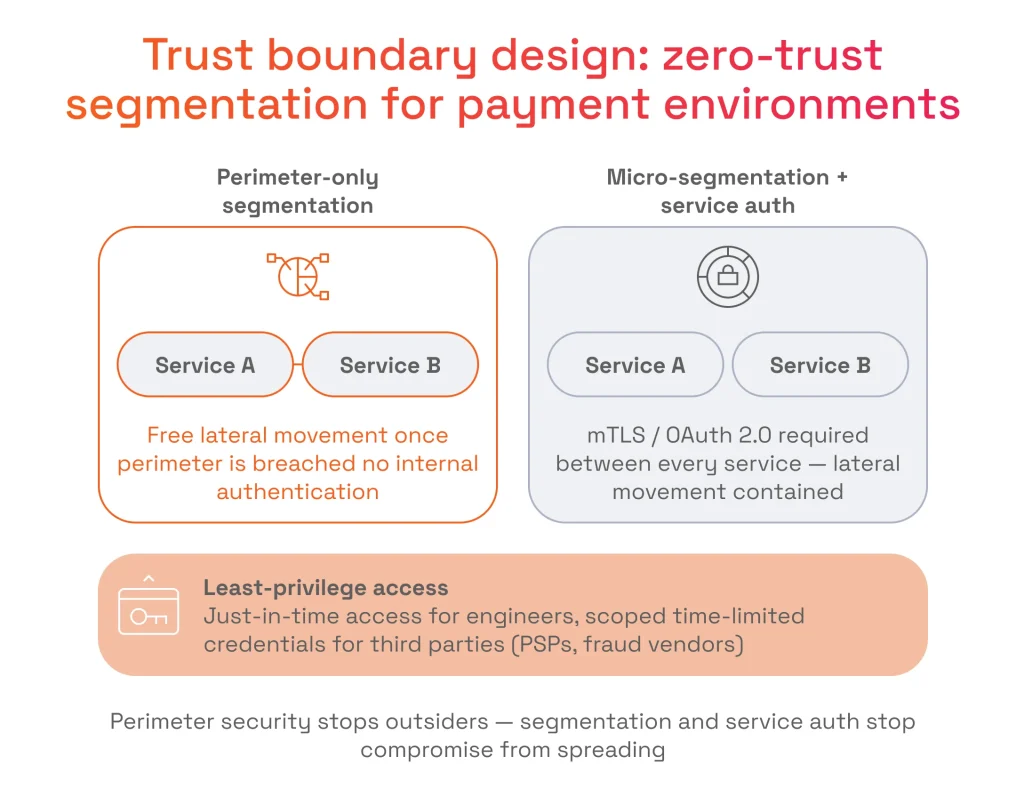
The data boundary determines the existence and location of the sensitive data values. The trust boundary determines who can get close to the sensitive data and what they need to do in order to do so. Payment security architectures typically do well with this outside the perimeter and very badly within it.
Let’s discuss the three decisions that set the shape.
Micro-Segmentation and CDE Containment
Network segmentation is the cheapest scope reduction available: systems with no route to the cardholder data environment fall out of PCI DSS assessment entirely. Micro-segmentation is the finer step. It restricts each component inside the CDE to the specific peers it needs, so a compromised reporting service cannot reach the de-tokenization endpoint just because both live inside the same assessed zone.
Flat CDEs are frequent because they are simple to design and fulfill the criteria for an initial evaluation. They fail the moment any of the services offered within them fails.
Service-to-Service Authentication: mTLS and OAuth 2.0
Within the payment workflow, “never trust, always verify” implies that each service verifies its own identity on each interaction rather than trusting its network placement. Mutual TLS addresses the transport-level issue of “who” is calling, while OAuth 2.0 with scoped tokens answers the API level issue of “what” that caller can do. Both are needed together.
It’s worth the effort because credentials represent the predominant route of entry. Verizon’s 2026 Data Breach Investigations Report revealed that 56% of all simple web application attacks used stolen credentials. In addition, stolen user credentials sell for a median price of $700 on dark web brokers’ exchanges, while administrative credentials fetch nearly double, at $1,300. Perimeter-level authentication essentially provides an attacker with everything inside it, but a stolen credential for a single internal system keeps it limited.
Least-Privilege Access for Engineers and Third-Party Integrations
Standing access by engineers is the most covert form of scope expansion in most payment system architectures. Time-based just-in-time access ensures there’s no constant human access to the CDE with higher permissions for a particular task, which is also time-limited and logged against a ticket.
Third-party integrations must get equal consideration. Fraud vendors, report generators, and PSPs all need scoped and timed credentials for a particular dataset. A single API key that applies to all three vendors represents a single trust boundary pretending to be three.
Observability Boundary Design: Building Monitoring and Response Into the Architecture
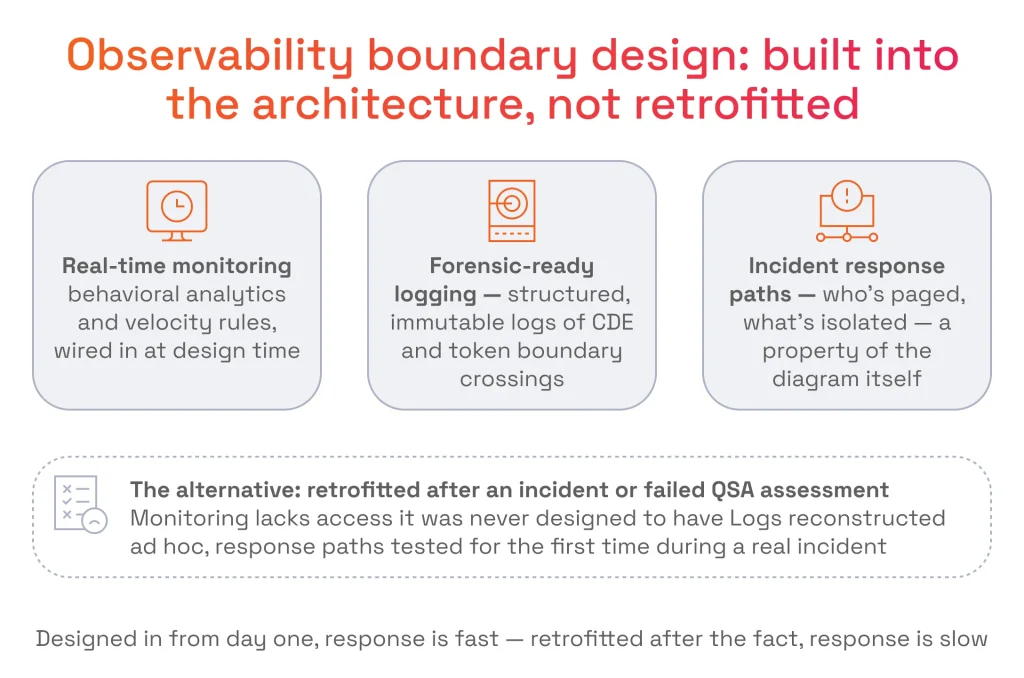
Observability tends to be regarded as a technical concern much more often than it ought to. It is a question of architecture as to whether the payment system is able to recognize an anomaly and piece together what happened: whether the tokenization API logs every single request, whether CDRE crossings can be distinguished from regular internal traffic, whether a transaction can be traced through to its conclusion without merging four different log formats.
The payoff is measurable in breach economics. IBM attributes the first decline in global breach costs in five years to $4.44 million to faster detection and containment powered by AI — capabilities designed in, not purchased later.
Real-Time Transaction and Anomaly Monitoring
Behavioral analytics and velocity rules are architecture inputs before they are model choices. The monitoring layer needs authorization attempts, decline reasons, device and geo signals, and account-level history — and it needs them without being granted a path into the CDE that expands scope.
Solving that usually means publishing sanitized events outward from the payment flow rather than letting the analytics stack reach inward, with feature stores built on tokenized attributes instead of raw PANs. Our guide on fraud detection with machine learning covers how those data paths get designed.
Forensic-Ready Logging: What a QSA or Incident Responder Needs Later
The concept of forensic readiness means ensuring, from the design stage, that any call to the de-tokenization routine, any cross-CDE boundary event, and any privilege escalation is logged as an immutable, structured event. It is immutable because the attacker who can write to logs removes all evidence of their actions. And it is structured because an investigator needs to query fields, not free-text logs.
The question is: Can we figure out which service called for the de-tokenization of a certain token, when, and under what credentials in minutes instead of days? This is how the data model for AI for fraud detection can be justified, as the same data is used to detect fraud and reconstruct it.
Incident Response Paths Defined at Architecture Time
A containment path is a property of the diagram, not a document. If a settlement service is compromised, can it be cut off from the CDE without taking payment acceptance down? Is there a kill switch on a specific provider route, or only on the whole orchestration layer?
Post-launch runbooks document whatever capabilities the architecture provides. Answer the following questions when the boundaries are still lines on paper and the runbook writes itself; answer them during the incident, and you are architecting on the fly.
Architecture Decision Checklist: Choosing Your Payment Security Boundaries
The checklist below transforms the three boundaries into choices that need to be owned. Apply it to your existing diagram rather than to your intentions: applied to an existing system, it works as a gap list, and applied to a design, it becomes an agenda for the review.
Where a row is contested internally, a formal payment gateway security audit settles it with evidence before an assessor settles it for you.
✓ | Decision | Architecture Implication |
|---|---|---|
⃣ | Encryption happens at the point of interaction, before data reaches application code | Application layer can be meaningfully excluded from PCI scope |
⃣ | Tokenization/de-tokenization process is segmented from systems that don’t need to reach it | Only genuinely segmented components stay out of scope — proximity to the process, not use of tokens, determines scope |
⃣ | Key management ownership (self-managed HSM, cloud KMS, or provider-managed) is explicitly assigned | Accountability for key rotation, access logging, and compromise response is clear before an incident, not during one |
⃣ | The CDE is micro-segmented, not just perimeter-segmented | Lateral movement is contained if one component inside the CDE is compromised |
⃣ | Services inside the payment flow authenticate to each other (mTLS/OAuth 2.0), not just to the perimeter | Compromise of one internal service doesn’t grant implicit trust to reach others |
⃣ | Logging of CDE and tokenization-boundary access is structured and immutable by design | Forensic reconstruction is possible without waiting on ad hoc log requests during an incident |
⃣ | Incident response paths (isolation, paging, containment) are defined against the architecture diagram itself | Response time during a real incident isn’t the first time these paths are tested |
⃣ | Third-party orchestration or routing layers connected to the CDE are separately scoped and segmented | Adding payment providers doesn’t silently expand the trust boundary each time |
✓
⃣
⃣
⃣
⃣
⃣
⃣
⃣
⃣
Decision
Encryption happens at the point of interaction, before data reaches application code
Tokenization/de-tokenization process is segmented from systems that don’t need to reach it
Key management ownership (self-managed HSM, cloud KMS, or provider-managed) is explicitly assigned
The CDE is micro-segmented, not just perimeter-segmented
Services inside the payment flow authenticate to each other (mTLS/OAuth 2.0), not just to the perimeter
Logging of CDE and tokenization-boundary access is structured and immutable by design
Incident response paths (isolation, paging, containment) are defined against the architecture diagram itself
Third-party orchestration or routing layers connected to the CDE are separately scoped and segmented
Architecture Implication
Application layer can be meaningfully excluded from PCI scope
Only genuinely segmented components stay out of scope — proximity to the process, not use of tokens, determines scope
Accountability for key rotation, access logging, and compromise response is clear before an incident, not during one
Lateral movement is contained if one component inside the CDE is compromised
Compromise of one internal service doesn’t grant implicit trust to reach others
Forensic reconstruction is possible without waiting on ad hoc log requests during an incident
Response time during a real incident isn’t the first time these paths are tested
Adding payment providers doesn’t silently expand the trust boundary each time
Any unchecked row is an architecture decision that was never made deliberately, and it defaulted to whatever the implementation happened to do. In practice, the tokenization-segmentation and third-party-orchestration rows are where scope most often expands silently, since both feel “already handled” the moment a token or a new provider is added.
Common Architecture Mistakes That Quietly Expand PCI Scope
None of the mistakes below look like mistakes at the time. Each is a reasonable-seeming shortcut that surfaces later as an assessment finding, a widened blast radius, or an investigation that stalls for lack of data.
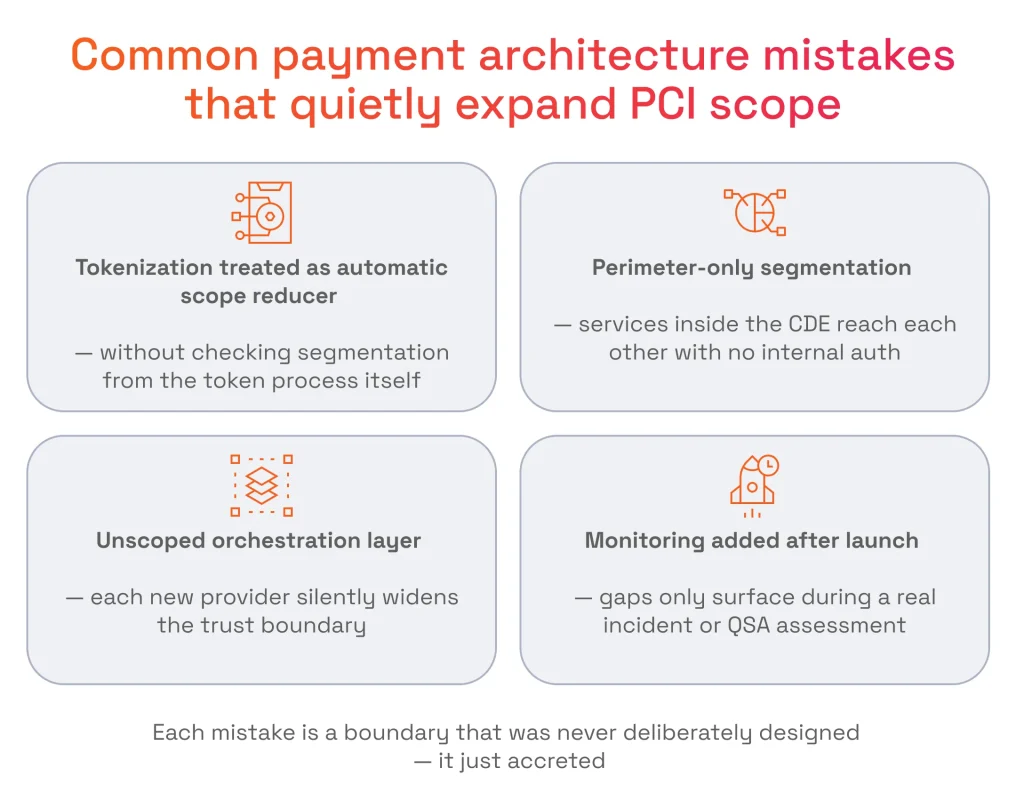
- Treating tokenization as a universal scope-reducer regardless of placement, without checking whether the systems using tokens are actually segmented from the tokenization process. The tokens are real; the scope reduction isn’t, because reachability is what the assessor tests.
- Perimeter-only segmentation: hardening the boundary around the CDE while leaving services inside it able to call each other with no internal authentication. One compromised component then inherits the trust of the entire zone it sits in.
- Connecting a payment orchestration or routing layer to multiple providers without re-scoping it as its own trust boundary. Each added provider widens the attack surface, and the widening happens through a component everyone already considers approved.
- Building monitoring and logging post-launch rather than being integrated into the architecture. The holes become known only when an event occurs or a QSA audit questions something the logs never considered.
SPD Technology Expertise: Architecting Secure Payment Systems
SPD Technology has designed payment architectures across regulated, high-compliance environments — PCI DSS and PSD2 in card processing, HIPAA and SOC 2 where healthcare payments overlap financial ones, GDPR and KYC/KYB in lending infrastructure.
The boundary decisions above come out of that delivery work rather than from a framework. In it, the constraint is rarely a missing control and usually an unclear line between what is assessable and what isn’t.
Three of our partnerships illustrate different sides of it.
Long-Term Payment Processing Architecture: Poynt
Poynt is an all-in-one omnicommerce payment platform. SPD Technology built its full payment processing system, covering full-cycle payment processing, settlement, and third-party integration APIs, and has sustained a 5+ year partnership that was retained after the client was later acquired.
The integration API surface is where data- and trust-boundary decisions get tested hardest: every additional third party is a new entry point that has to be scoped and segmented rather than absorbed into the existing perimeter. That integration architecture is set out in the Poynt payment processing case study.

Compliance-by-Design Architecture: Fundomate
Fundomate is an SMB funding and lending platform SPD Technology built from scratch in 18 months: PCI DSS-, GDPR-, and KYC/KYB-compliant, supporting 4,000+ businesses funded, and more than $350M in financing. Three overlapping regimes on a greenfield build means the boundaries get drawn once, deliberately, instead of being renegotiated under audit pressure later.
That sequencing makes the difference between compliance being easy and compliance being hard. The analysis of payment facilitation compliance deals with the regulatory shape of the model below, and the case study below deals with the delivery.

Regulated-Environment Remediation for FSA/HSA Payments: Binkey
Binkey is an FSA/HSA healthcare-payments product, where payment data and protected health information sit in the same flows. SPD Technology delivered HIPAA and SOC 2 remediation alongside 80%+ AI eligibility-classification accuracy and sub-1-day release cycles on Terraform and GitHub Actions over AWS ECS.
Shipping daily in overlapping compliance regimes is possible only when the observability and access boundaries are made explicit in the pipeline: all releases traceable, all access paths defensible. Our FSA/HSA payments case study deals with the remediation strategy.

The right architecture depends on your compliance regimes, the maturity of what already exists, and how much residual risk the business will hold itself. These are the variables the Architecture Decision Checklist above puts on the table. SPD Technology’s payment engineering team can assess which boundaries in your system were designed deliberately and which accreted by default.
Key Takeaways
- PCI DSS scope is set by the architecture diagram: a QSA scopes the cardholder data environment by which systems can reach the tokenization or de-tokenization process, regardless of what controls those systems carry.
- Tokenization reduces PCI scope only for systems adequately segmented from the tokenization process itself; connecting a system to tokens without segmenting keeps that system in scope.
- Point-of-interaction encryption keeps the application layer meaningfully out of scope. Encryption applied after data has touched application code does not, even though both appear as “encryption” on the same checklist.
- Perimeter-only segmentation stops external attackers and does nothing about lateral movement once one service inside the CDE is compromised — micro-segmentation and service-to-service authentication are what contain it.
- Connecting a payment orchestration or routing layer to additional providers widens the trust boundary each time unless that layer is separately scoped and segmented.
- Key management ownership decides who is accountable for rotation, access logging, and compromise response — a question best answered before the incident that forces it.
- Monitoring and forensic logging designed at architecture time make incident response fast; logging retrofitted after a breach or a failed QSA assessment makes it slow.
In short: payment security architecture, not the control list, decides how much of a system falls in PCI scope, how far a breach spreads, and how fast it’s caught. Get the boundaries right, and the controls are straightforward.
FAQ
What is payment security architecture?
Payment security architecture is the set of design decisions that determine how sensitive payment data moves through a system, which components can reach it, and how activity around it is recorded. It sits above individual controls like TLS 1.3, tokenization, and MFA: those are controls, while deciding where they attach to the data flow is architecture.
The three boundaries that define it are the data boundary, the trust boundary, and the observability boundary. Controls implemented within good boundaries will compound; the very same controls implemented within bad boundaries will secure something that was never chosen.
Does tokenization always reduce PCI DSS scope?
No. Tokenization reduces PCI DSS scope only for systems adequately segmented from the tokenization and de-tokenization process; any component that can reach that process stays in scope regardless of whether it handles tokens. A QSA assesses reachability: a service storing millions of tokens with no route to the de-tokenization endpoint is out of scope, and a service storing none but able to call that endpoint is in.
The reduction comes from segmentation around the process. Network tokens reduce scope most, because the de-tokenizable value never sits in your estate at all.
What’s the difference between point-of-interaction encryption and application-layer encryption?
Point-of-interaction encryption protects the card value at the reader or hosted checkout field, before it reaches your application code. Application-layer encryption happens after your code has already received the clear value. Only the first keeps the application layer meaningfully outside the cardholder data environment, because custody is what an assessor traces, not algorithm strength. Once application code has held a clear PAN, that runtime, its logs, and its host all become accessible.
What is micro-segmentation in a payment security architecture?
Micro-segmentation restricts communication between individual components inside the cardholder data environment, rather than only around its perimeter. Each service is permitted to reach only the peers it needs, so a compromised reporting or analytics component cannot open a path to the de-tokenization endpoint.
Traditional network segmentation separates unrelated systems from the PCI scope, while micro-segmentation reduces the blast radius after an intruder penetrates the assessed environment. Practically, this translates to separation of policy boundaries for tokenization, settlement, and reporting via service-to-service authentication like mTLS.
How does payment orchestration affect payment security architecture?
A payment orchestration or routing layer connects to multiple providers, which makes it a trust boundary in its own right rather than a neutral pass-through. Each added provider introduces new credentials, callback endpoints, and outbound paths from a layer that can typically reach the cardholder data environment. Also, because the component is already approved, the expansion tends to go unexamined.
Orchestration layers that interact with the CDE must be independently scoped, segmented, and re-evaluated each time a new provider is introduced. Thinking of the layer as infrastructure, not a boundary, increases scope without making a decision.
Why should monitoring and logging be part of the architecture instead of added later?
Monitoring and logging depend on what the architecture emits, and no tool can reconstruct records the system never produced. Designing them means every call to the de-tokenization process and every CDE boundary crossing is written as structured and immutable data from the first deployment: structured because an investigator can query fields, and immutable because an attacker with log write access erases the record.
Retrofitted logging leaves gaps that appear during a live incident or a QSA assessment, exactly when they cost most. Detection and containment speed is a direct function of that design choice.
How much does it cost to design a secure payment architecture?
Cost is driven primarily by your PCI DSS scope and whether you are assessing an existing boundary or building a compliant system from scratch. For a full build, in-house development ranges from $50,000–$150,000 for a startup MVP to over $2,000,000 for a multi-region enterprise platform, alongside $130,000–$260,000 per security engineer and 15–25% in annual maintenance. Partnering with a specialized vendor or consultant typically runs $30,000–$120,000 for a startup, scaling up to $400,000 for mid-size architectures and $2,000,000+ for enterprise platforms, at standard day rates of roughly $1,500–$4,500.
Mandatory compliance assessments add recurring expenses, ranging from $1,000 annually for a small SAQ merchant to $50,000–$500,000+ for a Level 1 enterprise Report on Compliance. Ultimately, deliberately designing your data boundary through tokenization or outsourced checkout is your highest-ROI cost lever, as it can eliminate up to 80% of PCI requirements and collapse audit costs by 80–95%.
How long does it take to design or re-architect a payment security architecture?
An architecture assessment generally runs weeks, while a full compliant build runs months. For reference, SPD Technology built an all-in-one omnicommerce payment processing system for Poynt in 5 months, and a PCI DSS-, GDPR-, and KYC/KYB-compliant SMB funding platform from scratch in 18 months. Those are illustrative ranges from delivered work, not quotes for a specific project.
The timeline for a re-architecture is usually governed by how much of the existing data flow has to be rerouted around the tokenization boundary, not by how many controls need configuring.