

Payment operations automation is the use of software to execute, monitor, and reconcile the back-office workflows behind money movement — invoice processing, approval routing, payment execution, and reconciliation — instead of handling them manually. It typically matures in three stages: automating individual tasks (ACH batches, invoice capture, approval workflows), connecting those tasks into end-to-end workflows within a single processor, and coordinating workflows across multiple processors, entities, and currencies as volume grows. Most automation projects stall at the second stage because reconciliation and exception handling — matching transactions across systems and resolving refunds, chargebacks, and routing failures — are harder to automate than payment execution itself, and are where a coordination layer becomes necessary rather than optional.
Invoice capture, approval routing, and ACH payments are automated — and month-end reconciliation still eats several days, with a growing backlog of unresolved refunds, chargebacks, and routing failures. J.P. Morgan’s Payments Outlook 2026 found that 87% of organizations have implemented some level of treasury automation, but only 39% call their systems fully automated — that gap between partial and full automation is exactly where reconciliation stalls.
Forrester’s 2026 payments predictions single out invoice matching and reconciliation as the B2B use cases best suited to agentic automation, which tracks with what actually breaks first in practice. This piece works through the three-stage frame that structures everything below — task automation, workflow automation, coordinated operations — and assumes the basics are already handled. This is about what comes next, and why reconciliation and exceptions, not execution, are usually the real bottleneck.
Why Payment Operations Automation Breaks Down at Scale
A team that automated invoice capture, approval routing, and ACH execution still ends up reconciling by hand once a second processor or entity enters the picture. That’s not a failure of any individual automation — each task genuinely runs faster than it did manually.
The problem is that faster isn’t the same as consistent. Automating a task speeds up that task; it does nothing to make its output match the data format, timing, or identifiers coming out of every other automated task. McKinsey’s 2025 Global Payments Report notes that reconciliation and settlement are still handled manually at most institutions, with some payments companies now applying AI specifically to automate those two processes. Which tracks with what shows up in practice: the stage most teams skip, coordinating automated tasks into one reconciled, exception-aware system, is what determines whether automation reduces manual work or just relocates it.
The Three-Stage Maturity Model for Payment Operations Automation
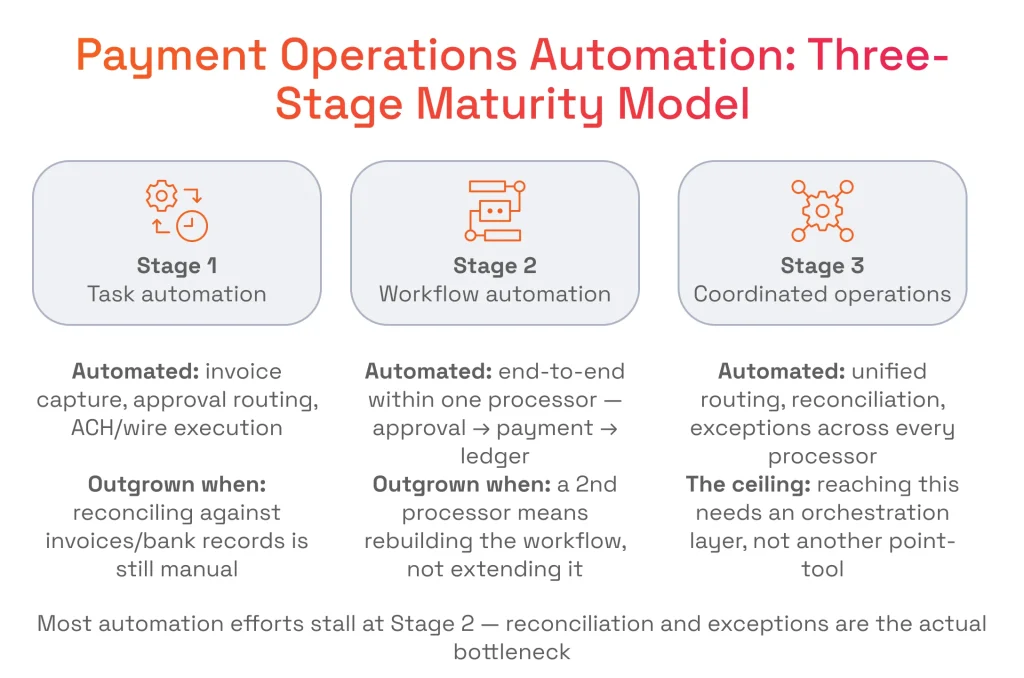
Payment operations automation doesn’t arrive as a single build. It moves through three distinct stages, each with its own scope and its own failure signal that tells you it’s time to move on. Recognizing which stage an operation is actually in — not which stage the roadmap claims — is the first real diagnostic step.
Stage | What's Automated | Signal You've Outgrown It |
|---|---|---|
1. Task automation | Individual steps: invoice capture, approval routing, ACH/wire/virtual-card execution, basic status tracking | Payments execute reliably, but reconciling them against invoices and bank records is still a manual, spreadsheet-driven monthly task |
2. Workflow automation | End-to-end flow within one processor or entity: approval triggers payment, payment triggers a ledger entry, single-source reconciliation | A second processor, entity, or currency is added, and the workflow has to be rebuilt or duplicated rather than extended |
3. Coordinated operations | Unified routing, reconciliation, and exception handling across every connected processor, entity, and currency in real time | This is the ceiling of automation alone — reaching it reliably requires a coordination layer (orchestration), not another point-tool |
Stage
1. Task automation
2. Workflow automation
3. Coordinated operations
What's Automated
Individual steps: invoice capture, approval routing, ACH/wire/virtual-card execution, basic status tracking
End-to-end flow within one processor or entity: approval triggers payment, payment triggers a ledger entry, single-source reconciliation
Unified routing, reconciliation, and exception handling across every connected processor, entity, and currency in real time
Signal You've Outgrown It
Payments execute reliably, but reconciling them against invoices and bank records is still a manual, spreadsheet-driven monthly task
A second processor, entity, or currency is added, and the workflow has to be rebuilt or duplicated rather than extended
This is the ceiling of automation alone — reaching it reliably requires a coordination layer (orchestration), not another point-tool
Build Sequence: What to Automate First in Payment Operations
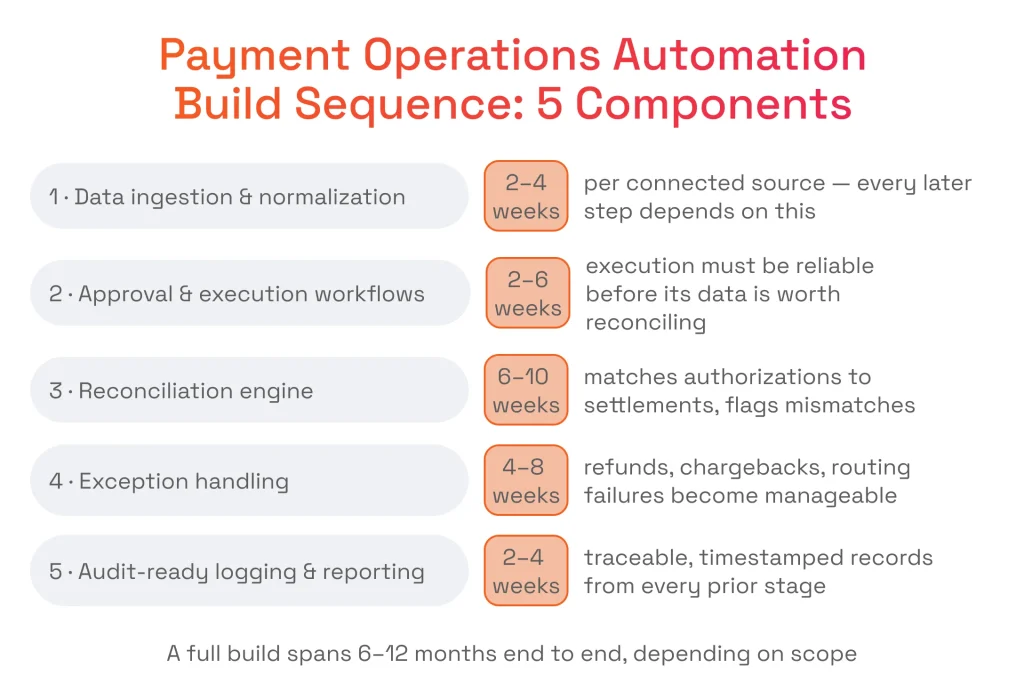
The order matters as much as the components themselves — each layer depends on the one before it produces clean, structured output. Skipping ahead (building an exception engine before reconciliation is solid, for instance) just moves the rework downstream. Processor-integration groundwork like the kind covered under how to build a payment gateway sets up exactly the normalized data this sequence depends on, and the workflow-automation stage draws heavily on the same principles behind billing software development.
Order | Component | Why It Comes Here | Typical Build Effort |
|---|---|---|---|
1 | Data ingestion & normalization | Every later step depends on transaction, fee, and payout data being in one consistent format across processors and banks | 2–4 weeks per connected source |
2 | Approval & execution workflows | Payment execution needs to be reliable and rule-based before its output data is worth reconciling | 3–6 weeks |
3 | Reconciliation engine | Matches authorizations to settlements and flags mismatches — the mechanism that turns normalized data into control, not just visibility | 6–10 weeks depending on processor count |
4 | Exception handling | Refunds, chargebacks, and routing failures only become manageable once reconciliation is already surfacing them systematically | 4–8 weeks |
5 | Audit-ready logging & reporting | Compliance and finance reporting depend on every prior stage producing traceable, timestamped records, not just resolved outcomes | 2–4 weeks |
Order
1
2
3
4
5
Component
Data ingestion & normalization
Approval & execution workflows
Reconciliation engine
Exception handling
Audit-ready logging & reporting
Why It Comes Here
Every later step depends on transaction, fee, and payout data being in one consistent format across processors and banks
Payment execution needs to be reliable and rule-based before its output data is worth reconciling
Matches authorizations to settlements and flags mismatches — the mechanism that turns normalized data into control, not just visibility
Refunds, chargebacks, and routing failures only become manageable once reconciliation is already surfacing them systematically
Compliance and finance reporting depend on every prior stage producing traceable, timestamped records, not just resolved outcomes
Typical Build Effort
2–4 weeks per connected source
3–6 weeks
6–10 weeks depending on processor count
4–8 weeks
2–4 weeks
The Reconciliation Problem: Why Multi-Processor Data Breaks Naive Automation
Reconciliation is where multi-processor automation actually breaks — not because any single processor’s data is wrong, but because it’s wrong relative to every other processor’s version of the same event. The fix runs through three layers, in order: normalizing the data itself, matching authorizations to settlements programmatically, and pulling fees apart at the transaction level.
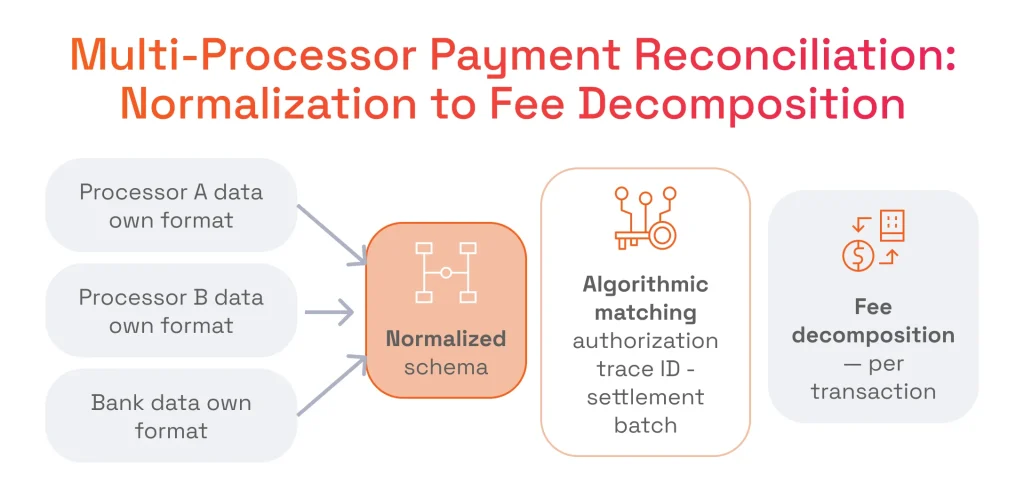
Data Normalization Across Processors
Every processor and bank reports transaction, fee, and payout data in its own format — different field names, different timestamp conventions, different ways of representing a partial refund. Reconciliation is arithmetically impossible until all of it is translated into one internal schema first. Skipping normalization doesn’t just slow reconciliation down — it makes automated matching produce false mismatches that erode trust in the system entirely.
Algorithmic Matching: Authorization to Settlement
Reconciliation stops being a spreadsheet exercise once it has to match an authorization to its eventual settlement programmatically, usually via a trace ID carried through both records. That single mechanism is what lets reconciliation scale past a handful of transactions a day into thousands.

Oleksandr Boyko
Delivery Director at SPD Technology
“Matching authorizations to settlements by trace ID is the one piece of this that can’t be bolted on later. If you build reconciliation without that key from day one, you end up re-engineering the whole matching layer once volume exceeds what a human can eyeball.”
Fee and Interchange Decomposition
Interchange fees, gateway markups, and network assessments need to be separated at the transaction level as part of reconciliation itself. Treating fee analysis as a downstream finance task — something Accounting does after the fact in a separate spreadsheet — just recreates the manual work reconciliation was supposed to eliminate in the first place. This is the same intersection payment facilitation operations sit at, where fee decomposition and compliance apply to the same transaction simultaneously.
Exception Handling: The Part Most Payment Automation Projects Skip
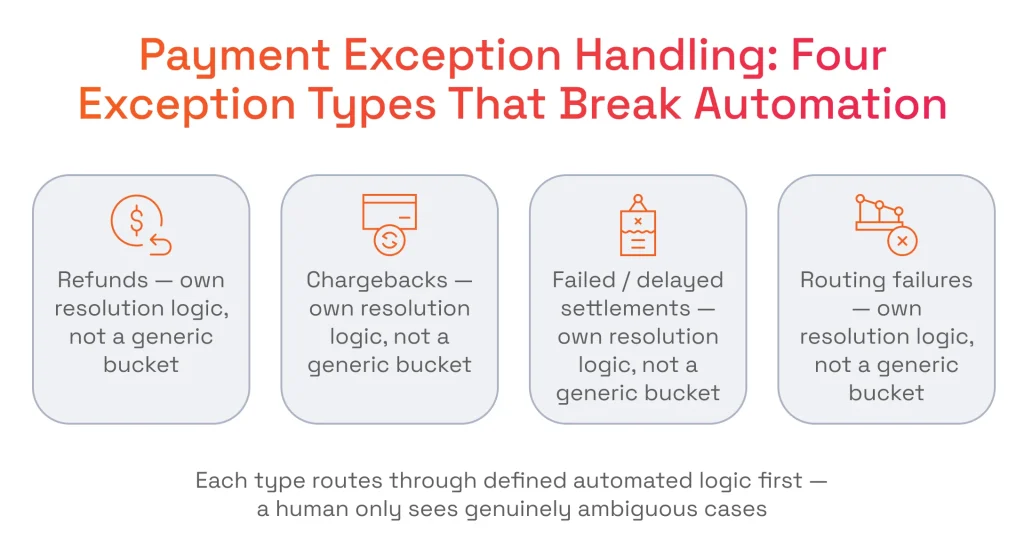
Refunds, chargebacks, delayed settlements, and routing failures are where automated systems quietly fall apart. A team that’s automated execution and reconciliation but not exceptions ends up with a system that handles 90%+ of volume cleanly and dumps the rest into the exact same manual queue automation was meant to eliminate.
The four categories worth automating separately:
- Refunds triggered by customer or merchant action
- Chargebacks and disputes requiring evidence assembly
- Failed or delayed settlements needing retry logic
- Routing failures requiring reassignment to a working processor
Exception handling needs to be programmatic, rules-based routing — with a genuine human-escalation path reserved for cases that are actually ambiguous, not a catch-all for everything the rules didn’t anticipate. Deloitte’s 2026 payments trends report has the firm’s global payments practice lead naming middle- and back-office work — reconciliation, invoice matching, and exception handling — as the next frontier for AI agents, ahead of front-office use cases. Getting exception routing right is also what keeps a system inside payment gateway compliance and security boundaries, since regulators check the same trail exceptions produce. The anomaly patterns that show up in routing failures respond to the same detection logic used in fraud detection with machine learning.
Payment Operations Automation Readiness Checklist
The rows below map directly to the three-stage model above, so a business can see exactly which stage its actual operation has reached rather than which stage its roadmap describes. Most teams check every task-automation row and few coordinated-operations rows — that gap itself is diagnostic.
✓ | Requirement | Stage |
|---|---|---|
☐ | Invoice capture, approval routing, and payment execution run without manual data entry | Task automation |
☐ | Payment status is tracked automatically end-to-end within a single processor or entity | Workflow automation |
☐ | Transaction, fee, and payout data from every processor and bank is normalized into one consistent schema | Coordinated operations |
☐ | Authorizations are matched to settlements programmatically, not by manual lookup | Coordinated operations |
☐ | Refunds, chargebacks, and routing failures are routed through defined automated logic, not a shared manual queue | Coordinated operations |
☐ | Interchange fees and gateway markups are decomposed automatically at the transaction level | Coordinated operations |
☐ | Every reconciled transaction and resolved exception produces a timestamped, audit-ready record | Coordinated operations |
☐ | Adding a new processor, entity, or currency is a configuration change, not a rebuilt workflow | Coordinated operations (orchestration-ready) |
✓
☐
☐
☐
☐
☐
☐
☐
☐
Requirement
Invoice capture, approval routing, and payment execution run without manual data entry
Payment status is tracked automatically end-to-end within a single processor or entity
Transaction, fee, and payout data from every processor and bank is normalized into one consistent schema
Authorizations are matched to settlements programmatically, not by manual lookup
Refunds, chargebacks, and routing failures are routed through defined automated logic, not a shared manual queue
Interchange fees and gateway markups are decomposed automatically at the transaction level
Every reconciled transaction and resolved exception produces a timestamped, audit-ready record
Adding a new processor, entity, or currency is a configuration change, not a rebuilt workflow
Stage
Task automation
Workflow automation
Coordinated operations
Coordinated operations
Coordinated operations
Coordinated operations
Coordinated operations
Coordinated operations (orchestration-ready)
That gap is normal — it’s also where manual effort has quietly relocated, from execution to reconciliation and exceptions. Three or more unchecked rows in the coordinated-operations column signals the next investment should be a coordination layer, not more task-level automation.
When Payment Operations Automation Needs an Orchestration Layer
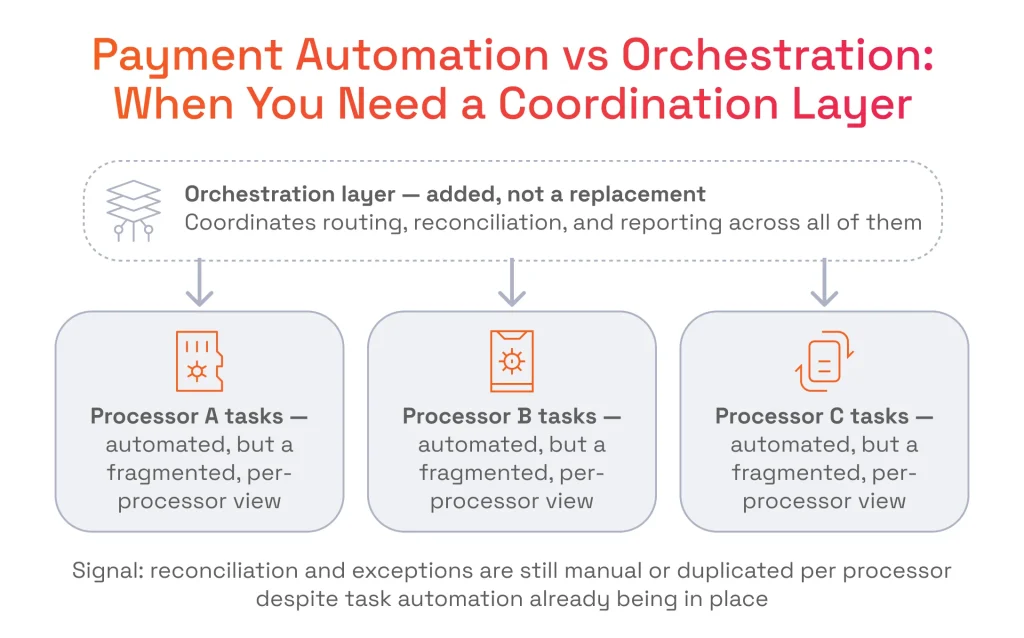
Automation makes individual tasks faster. Orchestration coordinates already-automated tasks across processors, entities, and currencies so they reinforce each other instead of producing three incompatible versions of the same transaction.
The concrete signal from the checklist above: three or more unchecked coordinated-operations rows, especially “adding a new processor is a configuration change.” That’s the practical test of whether workflow automation has quietly hit its ceiling. This transition is additive — a coordination layer sits on top of existing automated workflows rather than replacing them. That coordination layer is what payment orchestration platform development is built to provide: routing, unified reconciliation, and cross-processor exception handling in one architecture.
SPD Technology Expertise: Building Payment Operations Automation at Scale
SPD Technology has built payment operations automation across onboarding, settlement, and event-driven payment flows for real clients over multiple years. The staged build sequence described above isn’t theoretical — it’s drawn directly from that delivery experience, framed around the operational problem each client needed solved rather than a technology checklist.
Automated Onboarding and Compliance Checks — Aggregated Merchant Portal (Blackhawk Network)
Blackhawk Network, a fintech and eCommerce gift-card distribution company, needed to onboard large volumes of small and mid-sized merchants without a slow, manual compliance-review process for each one. SPD Technology built an aggregated merchant portal that automates OFAC, EIN, and SSN compliance checks directly into the onboarding workflow, the kind of automation payment processing compliance work depends on to hold up under audit. The result: 8,000+ US businesses onboarded in two years, with onboarding time cut from seven days to under 24 hours.
Automated Settlement at Scale — Merchant Settlement Platform (Blackhawk Network)
Blackhawk Network also needed automated settlement reporting and commission calculation across a very large merchant base, instead of manually reconciling payouts one at a time. SPD Technology built a merchant settlement platform automating both report generation and commission calculation, sustained across a partnership of more than seven years that originated with NimbleCommerce in 2008. It serves 37,000+ users today.
Event-Driven, Exactly-Once Payment Processing for a Fintech Startup
A US-based fintech startup sitting at the intersection of media and payments, needed reward attribution on card-linked offers to be accurate at the transaction level, with no duplicate or missed reward events under real-time load. SPD Technology built an event-driven card-linked offer architecture with Plaid connectivity, engineered specifically for exactly-once processing. The result: sub-second reward attribution with 48–72 hour payout readiness.
The right next step depends on which stage of the maturity model an operation is actually in. SPD Technology’s payment engineering team can assess where automation is working well and where reconciliation or exception handling has quietly become the new bottleneck.
Key Takeaways
- Automating individual payment tasks makes each task faster but doesn’t make the data from those tasks consistent across processors — that inconsistency is what turns month-end reconciliation into a manual project even after payments themselves are automated.
- Most payment automation efforts stall at the workflow stage — tasks connected end-to-end within one processor or entity — because reconciliation and exception handling across multiple processors require a coordination layer, not more point-level automation.
- Reconciliation effort scales nonlinearly with processor count — a reconciliation engine typically takes 6–10 weeks to build depending on how many processors it has to match against, versus 2–4 weeks for a single normalized data source.
- Automating the happy path of payment execution is comparatively easy; refunds, chargebacks, and routing failures are where most automation projects quietly revert to a shared manual queue, undermining the time saved elsewhere.
- Interchange fees, gateway markups, and network assessments need to be decomposed at the transaction level as part of reconciliation itself — treating fee analysis as a separate downstream finance task recreates the manual work automation was meant to remove.
- Adding a new payment processor, entity, or currency is a configuration change in a coordinated (orchestrated) payment operation, but can mean rebuilding a workflow from scratch — often several additional weeks of engineering — in a task-automation-only setup.
In short: task automation speeds up individual steps, but only a coordination layer turns those steps into a system that reconciles and self-corrects as processors and volume multiply.
FAQ
What is payment operations automation?
Payment operations automation is the use of software to execute, monitor, and reconcile the back-office workflows behind money movement — invoice processing, approval routing, payment execution, and reconciliation — instead of handling them manually. It matures in three stages: task automation, workflow automation within a single processor, and coordinated operations across multiple processors, entities, and currencies. Most projects stall at the second stage, because reconciliation and exception handling resist automation far more than payment execution itself does. A business automating only individual tasks will still see manual reconciliation grow as volume and processor count increase.
What’s the difference between payment automation and payment orchestration?
Automation makes individual tasks — approval routing, payment execution, status tracking — faster and more reliable on their own. Orchestration coordinates those already-automated tasks across multiple processors, entities, and currencies so they work as one system rather than several disconnected ones. A business can have excellent task automation and still lack orchestration entirely, which shows up as duplicated workflows every time a new processor is added. Orchestration sits on top of automation; it doesn’t replace it.
Why does payment reconciliation stay manual even after payments are automated?
Automating payment execution doesn’t standardize the data that execution produces, and that’s why reconciliation stays manual long after payments themselves are automated. Each processor and bank reports transactions, fees, and payouts in its own format, so even perfectly automated payments generate records that still need to be matched by hand. Accenture’s research on finance operations maturity found that organizations with the highest operational maturity are substantially more likely to scale high-value AI use cases successfully and report meaningfully higher revenue growth than lower-maturity peers. Fixing the actual problem takes data normalization and algorithmic matching — faster execution alone doesn’t touch it.
What payment exceptions are hardest to automate?
Chargebacks and disputes are typically the hardest of the four, since resolving them means assembling evidence and interpreting cardholder or merchant intent rather than following a fixed rule. Delayed or failed settlements come next — retry logic has to tell a temporary processor issue apart from a genuine failure, and that distinction resists simple automation. Routing failures and refunds are comparatively straightforward, since both follow clear, rule-based logic. Where most teams actually fail isn’t any single category — it’s collapsing all four into one bucket and routing everything to the same manual queue.
How do you know if a business needs payment orchestration instead of more automation?
Three or more unchecked rows in the coordinated-operations column is the clearest signal, especially the one about adding a new processor being a configuration change rather than a rebuild. When adding a processor, entity, or currency means duplicating an existing workflow instead of extending it, automation alone has already hit its ceiling. A coordination layer becomes the next investment at that point — not another point-tool.
How long does it take to build payment operations automation?
Each stage in the sequence depends on the prior one’s output, so the timeline runs sequentially rather than in parallel. Data ingestion and normalization takes 2–4 weeks per connected processor. Approval and execution workflows add another 3–6 weeks, and the reconciliation engine — the longest single component — runs 6–10 weeks depending on how many processors it has to match against. Exception handling follows at 4–8 weeks, with audit-ready logging closing out the build in 2–4 weeks. Skipping ahead in this order doesn’t save time; it just moves the rework downstream, since every later stage depends on structured output from the one before it.
How much does it cost to build payment operations automation?
Cost tracks the build sequence closely — normalization and reconciliation carry most of the integration work per processor, while a single-processor task-automation build is comparatively inexpensive on its own. Processor count is usually the bigger cost lever than headline scope; a system built for two processors that later needs a third bolted on tends to cost more in rework than the original build did. Teams that bring in a partner specifically for reconciliation and exception handling, rather than the whole build, usually do so because those two stages carry the highest integration risk per processor added.