

Building your own PayFac platform means owning transaction margin, underwriting policy, and the sub-merchant experience directly, rather than sharing all three with a PayFac-as-a-Service provider. The build follows a defined sequence: define the sub-merchant model, secure a sponsor bank and register with card networks, design the ledger, build underwriting, integrate payment processing, engineer split-funding, stand up risk monitoring, then test and launch. The main risks — PCI DSS scope creep, ledger design mistakes, and registration delays — are well understood, and each is manageable with the right architecture decisions made early, before development starts.
Evaluating custom platform engineering against managed PayFac-as-a-Service requires balancing upfront development effort with long-term unit economics. According to Bain & Company, embedded finance transaction values are projected to reach $7 trillion in the US by 2026, driving platform and infrastructure revenue from $21 billion to $51 billion. Software providers capturing this flow face operational choices that dictate margin structures for years.
A clear understanding of architectural requirements, development sequences, and structural failure modes helps technical leaders make informed build decisions. Teams analyzing financial projections and compliance frameworks can examine the business case for payment facilitation to evaluate organizational readiness. This guide outlines the core benefits, step-by-step technical implementation, known development risks, and build-vs-buy criteria for payment facilitation platform development.
Benefits of Building Your Own PayFac Platform
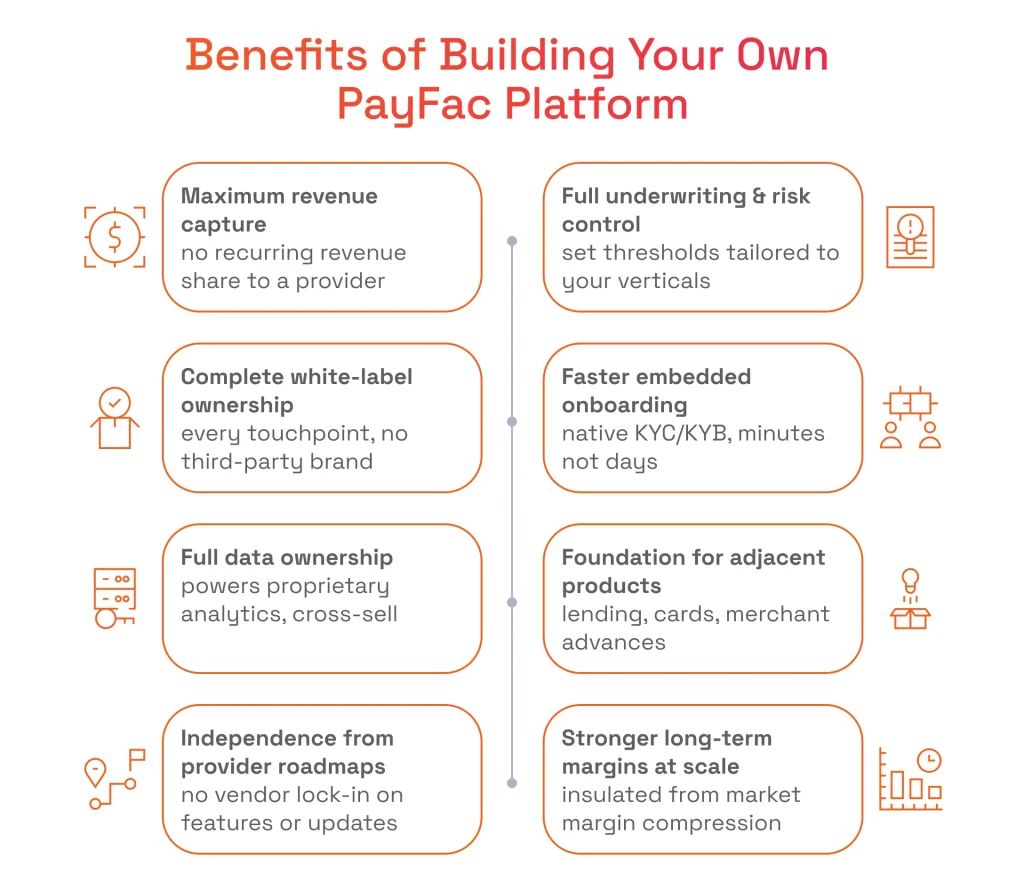
The benefits of building a PayFac platform tend to show up gradually at first and then compound hard once volume scales. Software companies that hire fintech developers to build dedicated payment infrastructure gain direct control over transaction processing, compliance boundaries, and payment operations.
- Maximum revenue capture: Retaining full transaction margins eliminates the recurring revenue share collected by third-party payment facilitation providers.
- Full control over underwriting and risk policy: Internal teams set risk thresholds, instant approval parameters, and manual review triggers tailored to specific industry verticals.
- Complete white-label ownership: The platform owns every customer touchpoint, checkout interface, and merchant statement descriptor without third-party brand attribution.
- Faster, embedded sub-merchant onboarding: Native KYC and KYB verification pipelines allow sub-merchants to register and begin processing transactions within minutes.
- Full data ownership for proprietary analytics and cross-sell: Raw payment records remain inside internal databases, powering custom reporting tools, churn prediction models, and targeted software features.
- A foundation for adjacent financial products: Owning transaction infrastructure supports future financial offerings like merchant cash advances, business cards, and capital lending. Research by Deloitte indicates global payment data monetization could exceed $100 billion annually by 2030 as platforms monetize transaction insights.
- Independence from provider roadmaps: Engineering teams control system updates, feature rollouts, API modifications, and processor integrations without vendor lock-in.
- Stronger long-term margins at scale: Owning the underlying payment architecture insulates platforms from market margin pressures. Data from Deloitte shows traditional merchant-acquiring margins have dropped roughly 30% over the past five years, making infrastructure ownership critical for protecting net yields.
How to Build a PayFac Platform: Step by Step
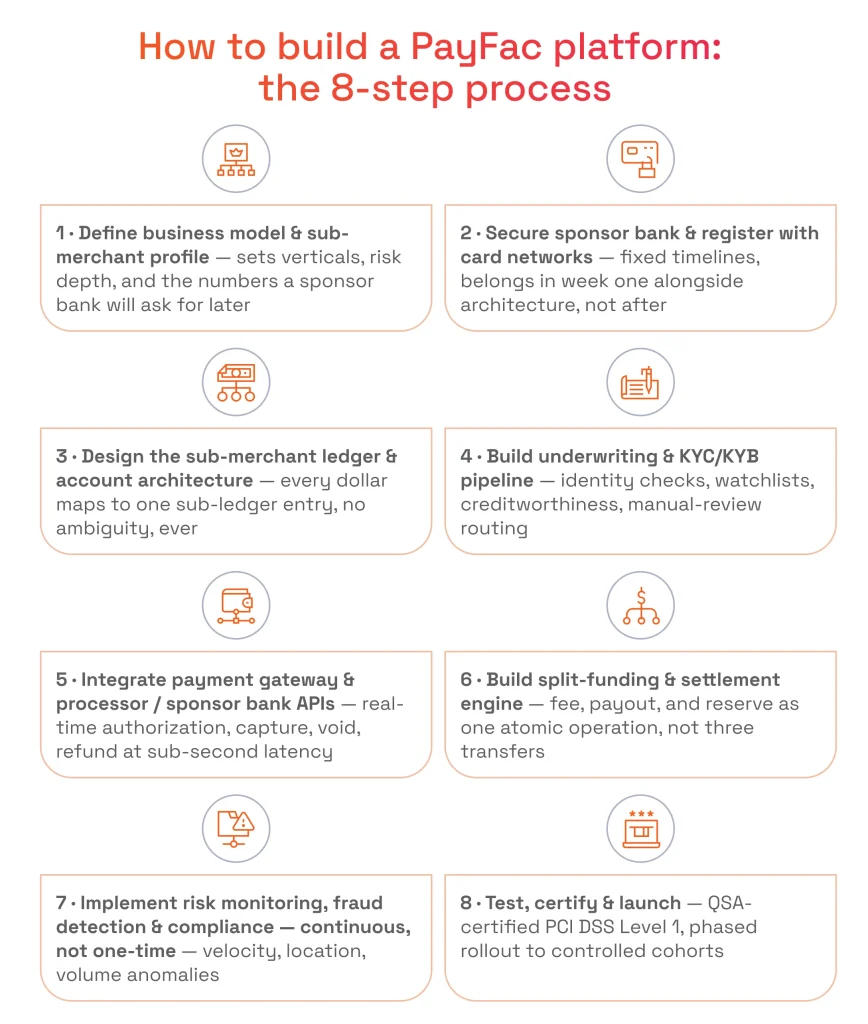
What follows is the order these pieces actually have to come together in — not a checklist to complete in any sequence, but a build where each step constrains the one after it, from the first business decision through the moment the platform can legally process a live transaction.
Step 1: Define Your PayFac Business Model and Sub-Merchant Profile
Everything downstream starts with a handful of decisions about who the sub-merchants actually are — their transaction profiles, the markets they operate in, and how risky their category is by nature. A high-risk vertical isn’t just a label; it changes how deep identity verification has to go, how much gets held back in reserve, and how aggressively the fraud model has to score incoming transactions. What gets decided here doesn’t stay contained to this step, either: expected transaction velocity and chargeback tolerance end up shaping the ledger schema directly, and they’re the same numbers a sponsor bank will ask about when negotiating terms later.
Step 2: Secure a Sponsor Bank and Register with Card Networks
Getting approved by a sponsor bank isn’t a formality — the bank digs into the platform’s security posture, its risk policies, the founders’ backgrounds, and its financial stability, because the bank is the one taking on liability for everything that happens under its acquiring relationship. Only once that approval lands does the sponsor bank turn around and submit the platform’s registration to Visa and Mastercard directly; a platform can’t register with the networks on its own. None of this moves quickly, and none of it can be rushed by adding engineers to the project — which is exactly why sponsor conversations belong in week one, running alongside early architecture decisions instead of waiting for a “we’re ready now” moment that arrives too late to matter.
Step 3: Design the Sub-Merchant Ledger and Account Architecture
A sub-merchant isn’t a line item — it needs its own double-entry ledger, tracking an active balance, pending settlements, reserve holdings, and chargeback exposure independently of every other sub-merchant on the platform. That’s what actually separates a merchant payment platform development build from a simpler payments integration: money moving through the master merchant account has to map to a specific sub-ledger entry every single time, with no ambiguity about which sub-merchant it belongs to. Nothing else in the system gets to override what the ledger says happened. When reconciliation runs, when an audit asks a question, the ledger is the answer.
Step 4: Build the Underwriting and KYC/KYB Pipeline
Automated onboarding pipelines verify business entities, check beneficial owners against watchlists, and evaluate creditworthiness in real time. Systems must orchestrate calls to third-party identity verification services, aggregate tax identification checks, and route high-risk applications to manual review queues.
When engineering the underwriting automation behind Blackhawk Network’s Aggregated Merchant Portal, SPD Technology automated OFAC, EIN, and SSN checks. This system onboarded over 8,000 US businesses across two years while reducing merchant onboarding times from seven days to under 24 hours.
Step 5: Integrate the Payment Gateway and Processor / Sponsor Bank APIs
Payment gateways connect checkout interfaces directly to payment processors and sponsor bank settlement networks. Building specialized merchant payment gateway development components requires implementing ISO 8583 or modern REST APIs for real-time authorization, capture, void, and refund requests. System data models must conform strictly to processor data specifications to maintain sub-second response times and high message delivery rates.
Step 6: Build the Split-Funding and Settlement Engine
When a transaction settles, that single pool of money has to split three ways at once — a fee for the platform, a payout for the sub-merchant, and whatever gets held back in reserve. It sounds like plain arithmetic, and mechanically it is: no formula here is hard. What’s hard is that a settlement engine doesn’t get to treat those three movements as one event just because they happen together in a developer’s mental model.
The money moves through a network, and networks fail mid-request — a processor times out, a bank transfer acknowledges late, a retry fires twice. Every one of those ordinary failure modes turns three separate transfers into a ledger that no longer agrees with itself, and by the time anyone notices, the transaction that caused it is long gone. That’s the actual engineering problem this step exists to solve, and it’s what the quote below gets into directly.

Oleksandr Boyko
Delivery Director at SPD Technology
“The mistake we see most often isn’t in the math — it’s in the transaction boundary. Teams model split-funding as three separate transfers because that’s how the money conceptually moves, and then discover in production that a partial failure between transfer two and three leaves the ledger in a state nothing can reconcile. We engineer it as one atomic operation with a full audit trail specifically because the failure mode isn’t a rare edge case — it’s what happens the first time a processor times out mid-settlement.”
Step 7: Implement Risk Monitoring, Fraud Detection, and Compliance Controls
Underwriting happens once, before onboarding. What comes after is different: a system that never stops watching. Velocity spikes, transactions from a location that doesn’t match the merchant’s history, a sudden jump in volume that has no obvious explanation — any of these can mean a sub-merchant that looked clean at onboarding has started behaving differently. Rules-based alerts catch the pattern, and payment operations automation puts a payout hold on the account automatically, before a human ever has to intervene. Tokenization runs underneath all of this at the same time, stripping raw cardholder data off application servers so the compliance boundary stays clean regardless of what the risk system finds.
Step 8: Test, Certify, and Launch
End-to-end validation involves simulating edge-case transactions, network timeouts, chargeback cycles, and settlement failures inside processor sandboxes. Independent Qualified Security Assessors (QSAs) evaluate cardholder data environments to issue formal PCI DSS Level 1 compliance certifications. Following network authorization, platforms deploy using phased rollouts, onboarding controlled merchant cohorts before opening full public registration.
Risks and Challenges in Building a PayFac Platform
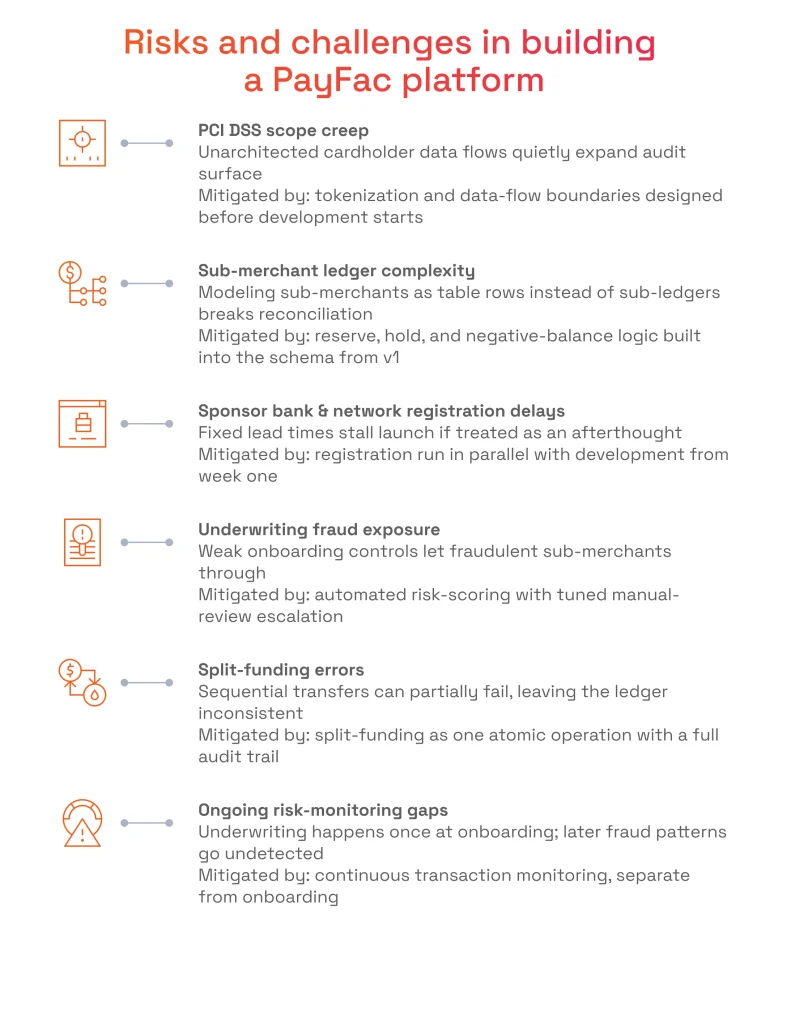
Most PayFac platform risks were knowable before a single line of code got written — the failure modes are recurring, not novel. Merchant risk monitoring at scale is the discipline most of these risks trace back to, since almost every failure mode below either starts there or ends up there eventually. PCI DSS scope deserves its own line, though: a platform’s payment security architecture decisions, made back in Step 3, are what quietly determine how much of the system ends up inside audit scope months later.
Challenge | The Risk | How SPD Technology Mitigates It |
|---|---|---|
PCI DSS scope creep | Cardholder data flows aren’t architected to minimize scope from day one, expanding the audit surface and ongoing compliance cost | SPD Technology designs tokenization and data-flow boundaries before development starts, containing PCI scope from the first version instead of retrofitting it later |
Sub-merchant ledger complexity | Early builds model sub-merchants as rows in a merchant table instead of full sub-ledgers with reserve logic, causing reconciliation failures later | SPD Technology designs the ledger schema with reserve, hold, and negative-balance logic built in from the first version, drawing on production settlement-infrastructure experience (Merchant Settlement Platform, BHN) |
Sponsor bank and card network registration delays | Registration and approval have fixed lead times that engineering effort can’t compress, and stall the whole launch if treated as an afterthought | SPD Technology sequences registration and technical development in parallel from week one instead of treating registration as a downstream step |
Underwriting fraud exposure | Weak onboarding controls let fraudulent or high-risk sub-merchants through, exposing the PayFac to direct financial liability for their losses | SPD Technology builds automated risk-scoring pipelines with tuned manual-review escalation, drawing on experience automating onboarding for 8,000+ merchants (Aggregated Merchant Portal, BHN) |
Split-funding errors | Funds moved as separate sequential transfers can partially fail, leaving the ledger inconsistent and difficult to reconcile | SPD Technology engineers split-funding as a single atomic operation with a full audit trail, not a chain of independent transfers |
Ongoing risk-monitoring gaps | Underwriting happens once at onboarding; without continuous monitoring, fraud and abuse patterns that emerge later go undetected | SPD Technology builds transaction monitoring as a continuous system separate from onboarding underwriting, drawing on experience underwriting 5M+ applications per year (Poynt / GoDaddy fraud detection) |
Challenge
PCI DSS scope creep
Sub-merchant ledger complexity
Sponsor bank and card network registration delays
Underwriting fraud exposure
Split-funding errors
Ongoing risk-monitoring gaps
The Risk
Cardholder data flows aren’t architected to minimize scope from day one, expanding the audit surface and ongoing compliance cost
Early builds model sub-merchants as rows in a merchant table instead of full sub-ledgers with reserve logic, causing reconciliation failures later
Registration and approval have fixed lead times that engineering effort can’t compress, and stall the whole launch if treated as an afterthought
Weak onboarding controls let fraudulent or high-risk sub-merchants through, exposing the PayFac to direct financial liability for their losses
Funds moved as separate sequential transfers can partially fail, leaving the ledger inconsistent and difficult to reconcile
Underwriting happens once at onboarding; without continuous monitoring, fraud and abuse patterns that emerge later go undetected
How SPD Technology Mitigates It
SPD Technology designs tokenization and data-flow boundaries before development starts, containing PCI scope from the first version instead of retrofitting it later
SPD Technology designs the ledger schema with reserve, hold, and negative-balance logic built in from the first version, drawing on production settlement-infrastructure experience (Merchant Settlement Platform, BHN)
SPD Technology sequences registration and technical development in parallel from week one instead of treating registration as a downstream step
SPD Technology builds automated risk-scoring pipelines with tuned manual-review escalation, drawing on experience automating onboarding for 8,000+ merchants (Aggregated Merchant Portal, BHN)
SPD Technology engineers split-funding as a single atomic operation with a full audit trail, not a chain of independent transfers
SPD Technology builds transaction monitoring as a continuous system separate from onboarding underwriting, drawing on experience underwriting 5M+ applications per year (Poynt / GoDaddy fraud detection)
Taken together, these six risks share a pattern: each one is cheapest to fix in an architectural decision made before launch, and expensive — sometimes existential — to fix afterward. A PayFac that gets tokenization boundaries, ledger design, and registration sequencing right in the first few weeks spends the rest of the build on differentiation instead of remediation. The ones that skip this discipline don’t fail all at once; they fail one reconciliation error or one missed fraud pattern at a time, until the cost of the fix outweighs the cost of doing it right from the start.
Build vs. Buy: PayFac Platform vs. PayFac-as-a-Service
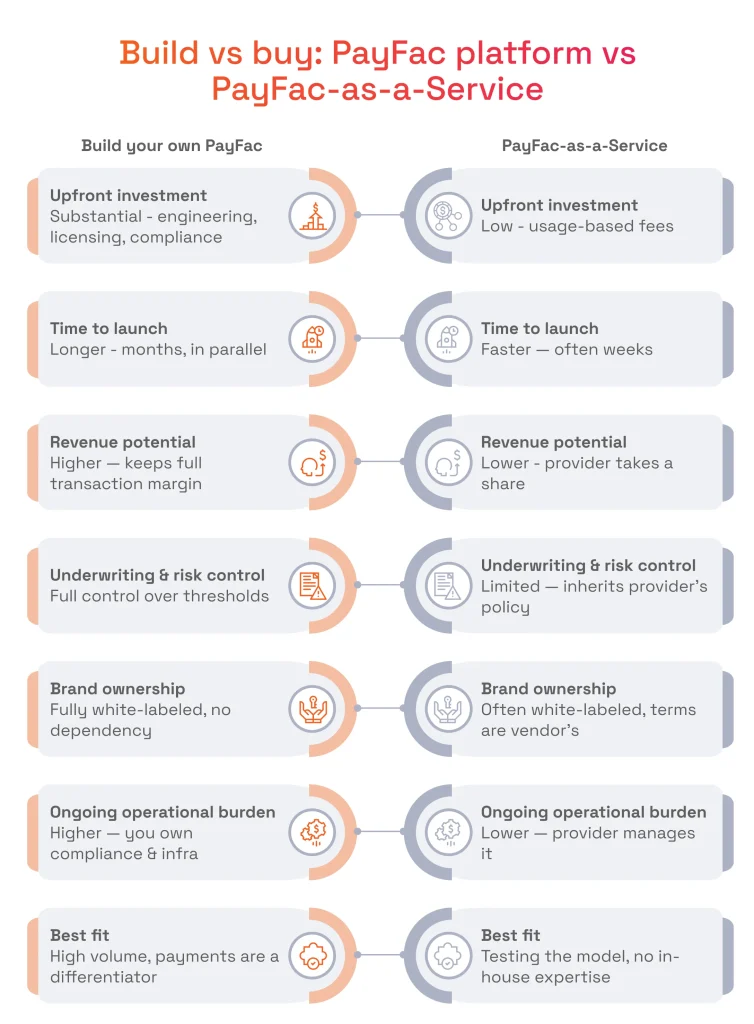
The build vs buy PayFac decision usually comes down to the same three things: how big the long-term business goal is, how much internal engineering capability already exists, and what the financial targets actually require. Modern software platforms frequently employ custom payment orchestration platform development strategies to manage multi-processor setups and preserve operating margins.
Factor | Building Your Own PayFac Platform | PayFac-as-a-Service (PFaaS) |
|---|---|---|
Upfront investment | Substantial — engineering, licensing, and compliance infrastructure (see SPD Technology’s companion article for full cost ranges) | Low — usage-based fees, minimal upfront cost |
Time to launch | Longer — build, registration, and certification run in parallel but still take months | Faster — often weeks, since infrastructure and compliance are already built |
Revenue potential | Higher long-term margin — the platform keeps the full transaction margin | Lower margin — a share of every transaction goes to the PFaaS provider |
Control over underwriting & risk | Full control over approval thresholds and risk tolerance | Limited — inherits the provider’s risk policy and thresholds |
Brand ownership | Fully white-labeled, no third-party dependency in the sub-merchant experience | Often white-labeled, but the underlying infrastructure and terms belong to the provider |
Ongoing operational burden | Higher — the platform owns compliance, risk, and infrastructure maintenance | Lower — the provider manages compliance, risk, and infrastructure |
Best fit | Platforms with high or growing transaction volume where payments are a strategic differentiator | Platforms testing the model, or without in-house payments expertise, that want to launch quickly |
Factor
Upfront investment
Time to launch
Revenue potential
Control over underwriting & risk
Brand ownership
Ongoing operational burden
Best fit
Building Your Own PayFac Platform
Substantial — engineering, licensing, and compliance infrastructure (see SPD Technology’s companion article for full cost ranges)
Longer — build, registration, and certification run in parallel but still take months
Higher long-term margin — the platform keeps the full transaction margin
Full control over approval thresholds and risk tolerance
Fully white-labeled, no third-party dependency in the sub-merchant experience
Higher — the platform owns compliance, risk, and infrastructure maintenance
Platforms with high or growing transaction volume where payments are a strategic differentiator
PayFac-as-a-Service (PFaaS)
Low — usage-based fees, minimal upfront cost
Faster — often weeks, since infrastructure and compliance are already built
Lower margin — a share of every transaction goes to the PFaaS provider
Limited — inherits the provider’s risk policy and thresholds
Often white-labeled, but the underlying infrastructure and terms belong to the provider
Lower — the provider manages compliance, risk, and infrastructure
Platforms testing the model, or without in-house payments expertise, that want to launch quickly
Market shifts highlighted by McKinsey show that roughly half of small businesses now select software vendors as their primary payments provider. This shift transfers primary customer relationships and high-margin processing revenues away from traditional payment acquirers directly to software platforms.
Why Choose SPD Technology for PayFac Platform Development
The systems in this article aren’t hypothetical for SPD Technology — they’re the ones its engineers have already built and had to make work under production load. Settlement logic that can’t tolerate a partial failure, underwriting pipelines that have to move faster than manual review ever could, split-funding that stays reconciled even when a processor times out mid-transaction — these are the specific problems SPD Technology’s 650+ engineers have spent years solving, not a generic capabilities list.
Full-Cycle PayFac-Model Payment Processing — Poynt
For Poynt’s open commerce platform, SPD Technology engineered an all-in-one payment processing ecosystem within five months. The implementation delivered full-cycle payment handling, sub-merchant settlement mechanics, and public integration APIs built on a payment facilitation model. This system foundation established an ongoing engineering partnership spanning over five years.
Merchant Underwriting and Onboarding Automation at Scale — Aggregated Merchant Portal (BHN)
To streamline merchant acquisition for Blackhawk Network, SPD Technology constructed the Aggregated Merchant Portal. The platform automated business verification checks against federal watchlists, tax records, and identity databases. The resulting pipeline onboarded more than 8,000 US businesses over two years, compressing onboarding processing times from seven days to under 24 hours.
Fraud Detection and Risk Management at Scale
To secure high-volume transaction channels, SPD Technology built automated underwriting and continuous risk engines capable of evaluating over 5 million annual merchant applications. The system introduced real-time threat analysis tools that doubled the identification and termination rate of risky merchant accounts.
As a payment facilitation development company offering full-cycle PayFac platform development services, SPD Technology can step in at any stage of that build — full platform, or a single component that’s stalling progress. Organizations evaluating technical roadmaps can engage SPD Technology’s fintech development outsourcing practice to engineer dedicated ledger systems, automated underwriting pipelines, atomic split-funding engines, or complete payment facilitation platforms.
Conclusion
A custom PayFac platform turns payment processing from a cost center into a lasting source of margin, but only for teams willing to make the upfront investment the engineering and compliance work actually requires. The payoff is control — over the merchant experience, the risk policy, and the yield on every transaction — the kind of control a PayFac-as-a-Service arrangement never fully hands over. Getting there means catching ledger and PCI mistakes while they’re still cheap to fix, early in the build, before they surface in production. Whether that tradeoff is worth making comes down to one thing: how much transaction volume the platform already carries, and how much strategic weight payments holds in the business.
Key Takeaways
- Trading a larger upfront investment for full control of underwriting, sub-merchant experience, and long-term margin is the core exchange at the heart of building a PayFac platform.
- Eight phases carry the build from business-model definition through sponsor bank approval, ledger construction, and certification — and the order matters more than any individual phase.
- Nothing compresses sponsor bank due diligence or card network approval. Both run on fixed timelines, which is exactly why they belong on the critical path from week one, not after the engineering team feels ready.
- The sub-merchant ledger is the foundation everything else depends on: model sub-merchants as basic rows instead of full double-entry sub-ledgers, and the reconciliation problems compound at exactly the volume the platform was trying to reach.
- PCI DSS scope is decided early, whether or not a team realizes it — cardholder data flows either get architected to minimize exposure from day one, or the compliance burden grows quietly until it’s expensive to unwind.
- Build-vs-buy isn’t really a universal question. High-volume platforms where payments are a strategic differentiator tend to build; platforms still testing the model tend to start with PayFac-as-a-Service.
In short: building a PayFac platform is a well-scoped engineering project with known risks, not a gamble — the teams that map both the benefits and the failure modes before starting build faster and avoid the mistakes that stall PayFac projects in production.
FAQ
What does it actually take to build a PayFac platform?
A PayFac build sits at the intersection of three different disciplines, and skipping any one of them is usually where projects stall. On the engineering side, that means a double-entry sub-merchant ledger, automated KYC/KYB underwriting, payment gateway interfaces, an atomic split-funding engine, and real-time risk monitoring — all built to work as one system rather than five disconnected services. At the same time, the business has to secure an acquiring sponsor bank, register as a payment facilitator with Visa and Mastercard, and carry the build through PCI DSS Level 1 certification before any of it can go live.
What are the main benefits of building your own PayFac platform instead of using PayFac-as-a-Service?
Developing a custom platform eliminates recurring revenue-share fees paid to third-party providers, allowing the business to retain full transaction margins. It grants total authority over underwriting standards, risk policies, and instant onboarding parameters. Platforms gain complete white-label control over the user experience, full ownership of raw payment data for analytics, and an established foundation for launching secondary financial products like capital lending.
How much does it cost to build a PayFac platform?
Cost swings widely depending on how complex the platform’s sub-merchant model is, how mature the internal engineering team already is with payments, and how many markets and integration partners the build needs to support from day one. According to the business case for payment facilitation, initial investment typically runs $500,000 to $2 million, with annual operating costs adding $200,000 or more on top once the platform is live. Sponsor bank registration fees (card networks like Visa and Mastercard charge roughly $5K annually per network), legal compliance consulting, and PCI DSS audit certification all sit on top of the core development budget, and none of them are optional line items a team can defer.
What’s the biggest risk when building a PayFac platform?
Misarchitecting the sub-merchant ledger and split-funding logic is usually where things go wrong first — a payment processing outage hits, and balance inconsistencies surface that no one can reconcile after the fact. PCI DSS scope creep tends to follow close behind if cardholder data flows weren’t isolated early, since every additional system touching raw card data quietly expands the audit surface and its ongoing cost. Weak onboarding verification is the third failure point, and it’s the one with direct financial teeth: it lets fraudulent sub-merchants through and leaves the platform holding their chargeback liability.
Should we build a PayFac platform in-house or use PayFac-as-a-Service?
Building a custom platform makes sense once transaction volume is high and payments have become a strategic margin driver rather than a background utility. Managed PayFac-as-a-Service is the better starting point for early-stage software companies and platforms still testing embedded payments, or for any team that hasn’t yet built the capital reserves and regulatory maturity ongoing payment operations demand.
How long does it take to build a PayFac platform?
The timeline depends heavily on regulatory approvals that don’t move on an engineering schedule. Core components — the ledger, onboarding pipeline, and API integrations — can typically be built out over several months of focused development. Sponsor bank due diligence and card network registration run on a separate, longer clock set by the bank’s own risk review, and sequencing that approval process alongside early architecture work is what keeps a build from stalling out once the technical side is otherwise ready.
What’s the difference between a sub-merchant ledger and a regular merchant account?
A regular merchant account processes payment volume for a single legal entity using a single bank payout destination. A sub-merchant ledger is a multi-tiered accounting database running inside a master merchant account. It tracks individual balances, hold accounts, rolling reserves, processing fees, and payout schedules for thousands of distinct sub-merchants operating on a software platform.