

Merchant payment platform development means building a full merchant-facing system, including onboarding, checkout, processing, settlement, and reporting, rather than integrating a single third-party gateway. A real platform build spans compliance mapping, PSP and acquirer integration, and network certification, carrying PCI DSS and licensing obligations throughout. The decision to build versus buy depends on transaction volume, control needs, and target margins.
Getting a test card to pass through a third-party payment gateway feels like a finished payment system. But accepting payments is just the top layer. The real engineering begins when you have to handle multi-bank failover, automate merchant background checks, and balance complex payout ledgers. Building a true merchant payment platform means moving from simply using someone else’s API to running the core infrastructure yourself.
Companies take on this extra engineering work to stop giving away transaction fees to aggregators and to control how their merchants onboard. This exact financial incentive is driving rapid industry growth since, according to Global Market Insights, the global embedded finance market reached $149.1 billion in 2025 and is projected to expand to $180.5 billion in 2026, with embedded payments driving nearly half of that total volume. To help teams capture this shift rather than lose margin to third-party providers, this guide breaks down what building that infrastructure actually takes.
What Is a Merchant Payment Platform?
A merchant payment platform is the end-to-end software system a company runs to onboard merchants, accept payments, process and settle transactions, and deliver payout reporting. Unlike standard payment gateway development, which focuses on capturing and encrypting transaction payloads at the point of sale, a platform delivers end-to-end merchant lifecycle management.
This architecture is built for SaaS providers embedding financial tools, multi-vendor marketplaces, and high-volume enterprise organizations. These businesses build their own platforms when off-the-shelf merchant service provider models slow down onboarding, don’t allow custom risk rules, or take too big a cut of transaction volume.
Why Businesses Develop Their Own Merchant Payment Platform
Standard integrations with third-party payment platforms work well during the early stages of growth. However, when a business is processing hundreds of millions of dollars in payments, the limitations of these external platforms begin to cause real operational and financial difficulties. There are four factors that lead scaling businesses to develop their own merchant payment platforms.
- The ability to capture margins comes about because when a company owns the platform it can retain the processing fees which normally go to third parties. As the McKinsey Global Payments Report points out, continuous pricing pressures and regulatory oversight within card-based systems are placing strain on fee-based revenue models, which in turn forces platform operators to take on the infrastructure margins directly.
- Managing onboarding and risk is needed because of custom merchant verification rules, automated underwriting, and individually set risk limits, which enable platforms to speed up merchant approvals without increasing default exposure or relying on strict third-party risk rules.
- The growth of embedded finance is beneficial as it involves integrating payment facilities directly into the main product software, which transforms payment processing from a cost center into a major source of revenue and enables platform owners to directly earn money from transaction volume.
- Multi-region resilience is important since it means that operations have to take place in a number of geographic markets, and it is necessary to have local acquiring agreements and flexible payment routing, something that single-processor systems are unable to offer. As Deloitte has pointed out, multinational companies are experiencing rising costs in their cross-border payments because of fee increases and currency volatility, so it is essential at scale to have direct multi-acquirer and local settlement capabilities.

Oleksandr Boiko
Delivery Director at SPD Technology
“Relying entirely on a third-party PSP limits a growing company’s ability to innovate. Once processing volume reaches hundreds of millions, owning your payment stack gives software platforms full control over onboarding friction, local routing, and unit economics.”
Payment Platform vs. Payment Gateway vs. Payment Processor
To understand how a payment platform is built, you need to separate the roles of gateways, payment processors, and full platform layers. Each handles a different part of a transaction, from start to finish.
Term | What It Does | Role in a Full Platform |
|---|---|---|
Payment gateway | Captures and encrypts payment data at checkout, transmits it for authorization | One component the platform integrates or builds |
Payment processor | Handles authorization and settlement between issuing and acquiring banks | A second component the platform connects to or partners with |
Merchant payment platform | The full system: onboarding, checkout, processing, settlement, reporting, and business-model management | The layer that owns both components and adds onboarding, settlement, and reporting around them |
Term
Payment gateway
Payment processor
Merchant payment platform
What It Does
Captures and encrypts payment data at checkout, transmits it for authorization
Handles authorization and settlement between issuing and acquiring banks
The full system: onboarding, checkout, processing, settlement, reporting, and business-model management
Role in a Full Platform
One component the platform integrates or builds
A second component the platform connects to or partners with
The layer that owns both components and adds onboarding, settlement, and reporting around them
Core Components of a Merchant Payment Platform
A platform is made up of several microservices and functional blocks that run in parallel. Isolating these components lets engineering teams scale individual services without breaking the core processing loop.
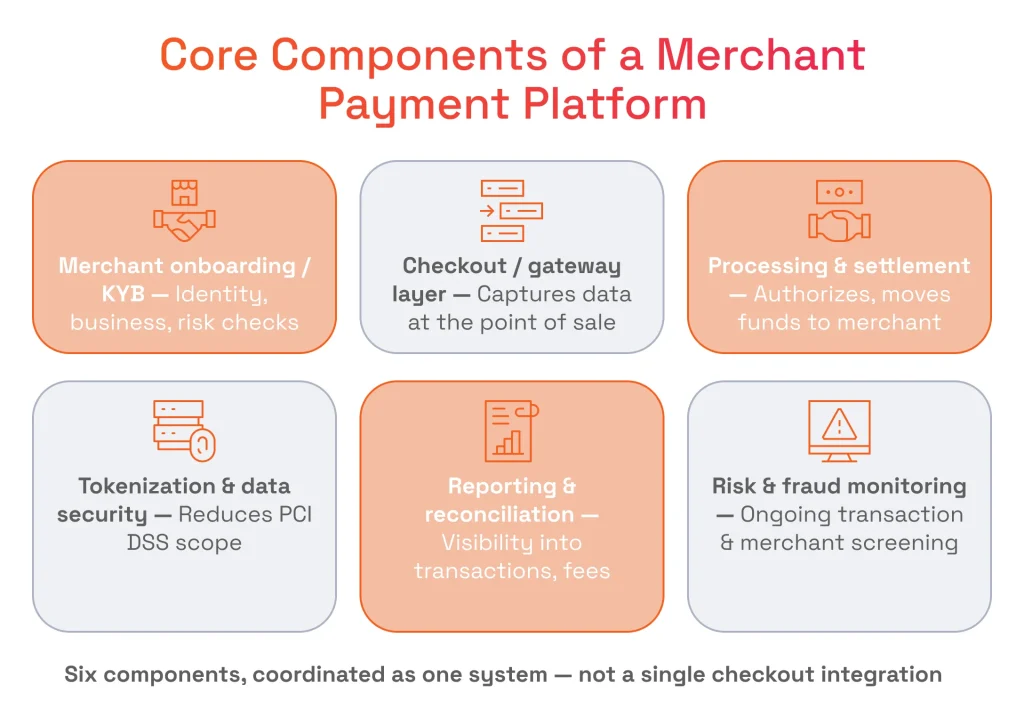
- The process of onboarding merchants and carrying out KYB checks automatically performs the identity verification, business validation, and risk assessment before merchants start processing transactions.
- The checkout or gateway layer encrypts and accepts credit card details, debit card information, or direct debit credentials through online, mobile, or in-store payment interfaces.
- The processing and settlement involve sending authorized transactions to the acquiring networks, managing the ledger entries, and controlling the batching of payments to the merchants’ bank account destinations.
- Tokenization and data security involve replacing the original payment details with secure tokens in order to protect the stored data and separate the security boundaries.
- Reporting and reconciliation involves providing real-time visibility of transactions, together with interchange fees and margin calculations, as well as automatically matching the balances across various provider files.
- The system carries out risk and fraud monitoring by checking incoming transactions against a set of customizable rules and fraud detection tools in order to constantly identify suspicious behaviour.
Component | Primary Function | Key Technical Considerations |
|---|---|---|
Merchant Onboarding / KYB | Verifies and activates merchants — identity, business, and risk checks before they can accept payments | API integrations with verification databases, automated document parsing |
Checkout / Gateway Layer | Captures payment data securely at the point of sale or online checkout | Low latency, high availability, PCI-compliant field hosting |
Processing & Settlement | Authorizes transactions and moves funds between banks to the merchant | Asynchronous messaging, multi-processor protocol translation |
Tokenization & Data Security | Replaces sensitive payment data with tokens to reduce PCI DSS scope | Vault isolation, hardware security module (HSM) key management |
Reporting & Reconciliation | Gives merchants and the platform operator visibility into transactions, fees, and settlement | High-throughput data ingestion, automated ledger balancing |
Risk & Fraud Monitoring | Screens transactions and merchant behavior for fraud and compliance risk on an ongoing basis | Real-time rule evaluation engine, anomaly detection |
Component
Merchant Onboarding / KYB
Checkout / Gateway Layer
Processing & Settlement
Tokenization & Data Security
Reporting & Reconciliation
Risk & Fraud Monitoring
Primary Function
Verifies and activates merchants — identity, business, and risk checks before they can accept payments
Captures payment data securely at the point of sale or online checkout
Authorizes transactions and moves funds between banks to the merchant
Replaces sensitive payment data with tokens to reduce PCI DSS scope
Gives merchants and the platform operator visibility into transactions, fees, and settlement
Screens transactions and merchant behavior for fraud and compliance risk on an ongoing basis
Key Technical Considerations
API integrations with verification databases, automated document parsing
Low latency, high availability, PCI-compliant field hosting
Asynchronous messaging, multi-processor protocol translation
Vault isolation, hardware security module (HSM) key management
High-throughput data ingestion, automated ledger balancing
Real-time rule evaluation engine, anomaly detection
Each component depends on the others, so weak onboarding or incomplete reconciliation puts the entire platform’s compliance and fraud posture at risk.
A detailed breakdown of state management, ledgering, and fault-tolerant architecture is covered in our technical guide to payment system design.
Business Models and Merchant Profiles: Shaping Platform Architecture
The six functional modules are the technical foundation of any processing stack, but they don’t work in isolation. The business model you choose and the merchants you serve shape how these modules get built and configured.
PayFac vs. ISO: Choosing Your Business Model
Choosing whether to operate as a payment facilitator (PayFac) or an Independent Sales Organization (ISO) determines your platform’s operational model. A PayFac aggregates multiple sub-merchants under a single master merchant account and controls onboarding speed, transaction fees, and the user experience.
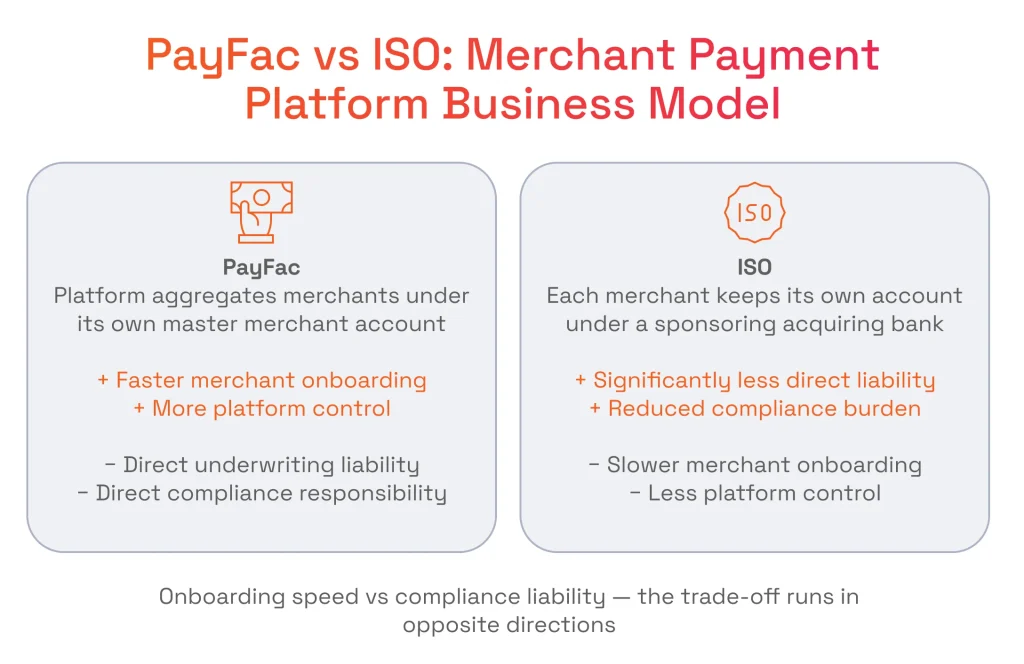
An ISO, on the other hand, functions as a direct referral layer or reseller, where each merchant opens an individual account directly with a sponsoring acquiring bank. McKinsey research notes that larger independent software vendors are increasingly choosing to become payment facilitators so they can directly onboard merchants and own payment processing and compliance themselves, rather than referring that relationship to a third party.
Oleksandr Boiko
Delivery Director at SPD Technology
“We often see teams treat the PayFac choice as an onboarding feature, when it’s really a risk allocation decision. The moment you aggregate merchants under your own master account, you take on underwriting liabilities and scheme compliance obligations that used to sit with the acquiring bank. Most product organizations don’t feel that operational weight until they’re mid-build.”
Payment Processing Platform for Large Merchants
Enterprises with high transaction volume need specialized infrastructure. For large merchants, a payment processing platform focuses on multi-acquirer redundancy, direct network connections, and automated cost optimization, using interchange-plus pricing and dynamic routing to cut fee overhead and keep uptime steady across redundant processing paths.
Payment Acceptance Platform for Digital Merchants
Digital-first businesses need rapid merchant activation and frictionless checkout experiences. A payment acceptance platform for digital merchants focuses on API flexibility, local payment methods, and conversion optimization. These platforms lean on rapid merchant onboarding solutions to reduce drop-off, and support alternative payment methods (APMs), digital wallets, and local clearing systems alongside traditional card rails.
The Merchant Payment Platform Development Process
Building a merchant payment platform is done in several phases, which balance engineering with regulatory compliance certifications.
Phase | Focus | Typical Duration |
|---|---|---|
1. Discovery & compliance mapping | Business model choice (PayFac vs. ISO), target markets, regulatory scope | 3-5 weeks |
2. PSP / acquirer integration | Selecting and integrating processing and acquiring relationships | 4-8 weeks |
3. Core platform build | Onboarding, checkout, reporting, and risk components | 10-16 weeks |
4. Testing & certification | PCI DSS validation, acquirer/network certification | 4-6 weeks |
5. Launch | Phased merchant rollout with active monitoring | 2-4 weeks |
Phase
1. Discovery & compliance mapping
2. PSP / acquirer integration
3. Core platform build
4. Testing & certification
5. Launch
Focus
Business model choice (PayFac vs. ISO), target markets, regulatory scope
Selecting and integrating processing and acquiring relationships
Onboarding, checkout, reporting, and risk components
PCI DSS validation, acquirer/network certification
Phased merchant rollout with active monitoring
Typical Duration
3-5 weeks
4-8 weeks
10-16 weeks
4-6 weeks
2-4 weeks
Online Payment Platform Development for Merchants: What’s Involved
Focusing specifically on online payment platform development for merchants requires building solid API-first architectures and developer tools to support digital payments at scale. Engineering teams must build hosted checkout pages, embedded SDKs, flexible webhooks, and sandbox testing environments. These interfaces allow sub-merchants to add payment functionality to their applications while platforms securely transmit payment information to isolated vault environments, supporting multiple payment methods and handling complex billing needs like recurring payments.
Compliance, Security & Licensing: Building a Payment Security Platform for Merchants
Designing a payment security platform for merchants requires embedding security controls directly into the system architecture rather than treating compliance as a pre-launch checklist item. Achieving PCI DSS compliance represents the baseline operational requirement for any system handling cardholder data. Tokenization services are essential here, replacing sensitive customer’s payment information with non-sensitive identifiers at the earliest ingestion point to minimize the overall payment infrastructure’s audit scope.
Beyond technical data security, platforms face stringent regulatory compliance requirements depending on their operational geography and business model. Operating as a master PayFac often requires formal network registration and compliance with regional financial institutions or payment services directive mandates. Automated KYB checks must be integrated into onboarding flows to satisfy compliance obligations without impacting merchant cash flow or creating manual review backlogs.
- PCI DSS scope reduction: Isolate tokenization vaults to securely transmit payment information and keep core application databases out of Level 1 PCI audit scope.
- Automated KYB/KYC verification: Integrate business registries and sanction screening APIs directly into merchant registration workflows to enable businesses to onboard sub-merchants rapidly.
- Regulatory licensing compliance: Align software permissions with local money services business or payment institution guidelines to support compliant international transactions.
- Fraud prevention & risk screening: Implement real-time velocity screening and fraud prevention tools to spot suspicious activity before payouts occur.
Build vs. Buy: Custom Development vs. Third-Party Platforms
Choosing between custom software development and licensing third-party software shapes your platform’s long-term cost structure, feature roadmap, and compliance profile.
Custom Software Development Payment Platform for Merchants
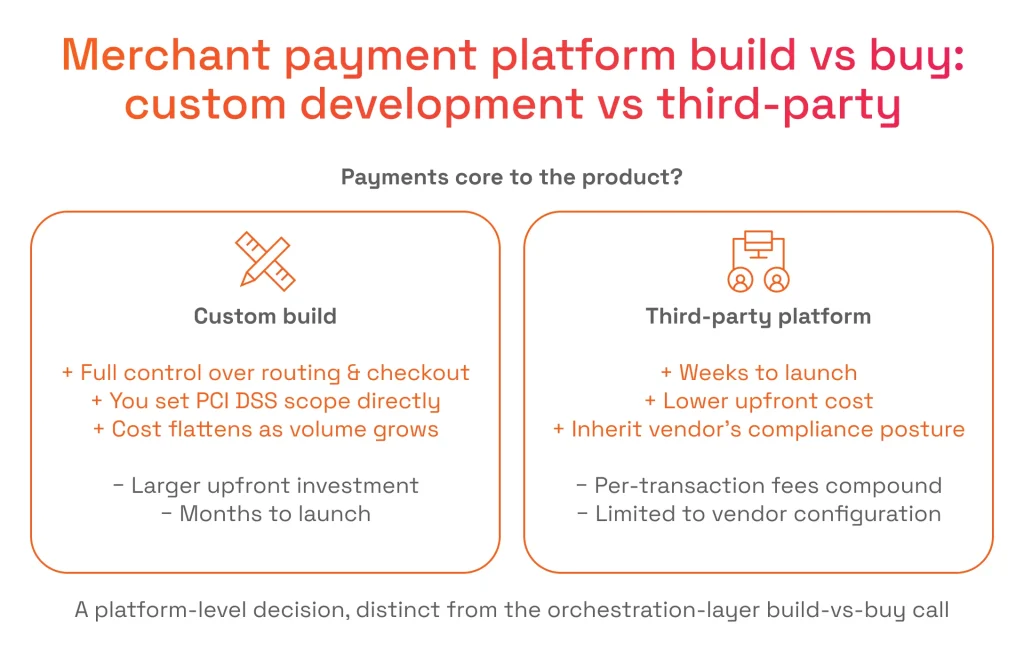
Investing in a custom software development payment platform for merchants gives organizations complete ownership over their underlying payment infrastructure. Building a proprietary payment processing system eliminates perpetual per-transaction SaaS markups, helping companies reduce transaction costs and negotiate direct acquiring rates as volume scales. Developing a tailored payment solution provides the absolute freedom to design custom onboarding flows, build advanced risk engines, and establish dynamic failover rules across multiple payment processors.
Third-Party Payment Platforms for Merchants
Licensing an existing third-party platform or relying on packaged online payment processing services accelerates market entry by providing pre-built integrations, existing regulatory coverage, and out-of-the-box reporting interfaces. However, this speed comes at the direct expense of long-term unit economics. Third-party service providers retain control over platform feature roadmaps, limit custom workflow development, and take a margin on every transaction processed across the platform.
Custom Software Development vs Third-Party Payment Platforms
Dimension | Custom Build | Third-Party Platform |
|---|---|---|
Control over checkout & routing | Full control — every flow and rule is yours to design | Limited to what the platform’s configuration allows |
Time to launch | Months (full platform build, see Timeline section) | Weeks to a few months — mostly integration and configuration |
Cost structure | Larger upfront investment, cost flattens over time as volume grows | Lower upfront cost, but per-transaction or per-seat fees compound with volume |
Compliance ownership | You set PCI DSS scope, choose certifications, and control the audit trail | You inherit the vendor’s existing compliance posture and certifications |
Best fit | Payments are core to the product; volume or differentiation justifies engineering investment | Speed to market matters more than ownership; volume doesn’t yet justify a build |
Dimension
Control over checkout & routing
Time to launch
Cost structure
Compliance ownership
Best fit
Custom Build
Full control — every flow and rule is yours to design
Months (full platform build, see Timeline section)
Larger upfront investment, cost flattens over time as volume grows
You set PCI DSS scope, choose certifications, and control the audit trail
Payments are core to the product; volume or differentiation justifies engineering investment
Third-Party Platform
Limited to what the platform’s configuration allows
Weeks to a few months — mostly integration and configuration
Lower upfront cost, but per-transaction or per-seat fees compound with volume
You inherit the vendor’s existing compliance posture and certifications
Speed to market matters more than ownership; volume doesn’t yet justify a build
The decision comes down to how central payments are to the business and how much volume is behind them. Building gives full ownership of checkout flow, risk logic, and compliance scope, with a larger upfront investment that pays off as transaction volume grows and per-transaction costs flatten out. Buying gets a platform to market faster through pre-built integrations and inherited compliance coverage, but the fees compound with volume and the roadmap stays in the vendor’s hands. Neither path is the default right answer. The fit depends on whether payments are a core product differentiator worth the engineering investment, or a supporting feature where speed matters more than ownership.
While this comparison evaluates the complete platform build, technical considerations regarding third-party orchestration layers and dynamic routing engines are detailed in our analysis of payment orchestration layers.
Common Challenges When Developing a Merchant Payment Platform
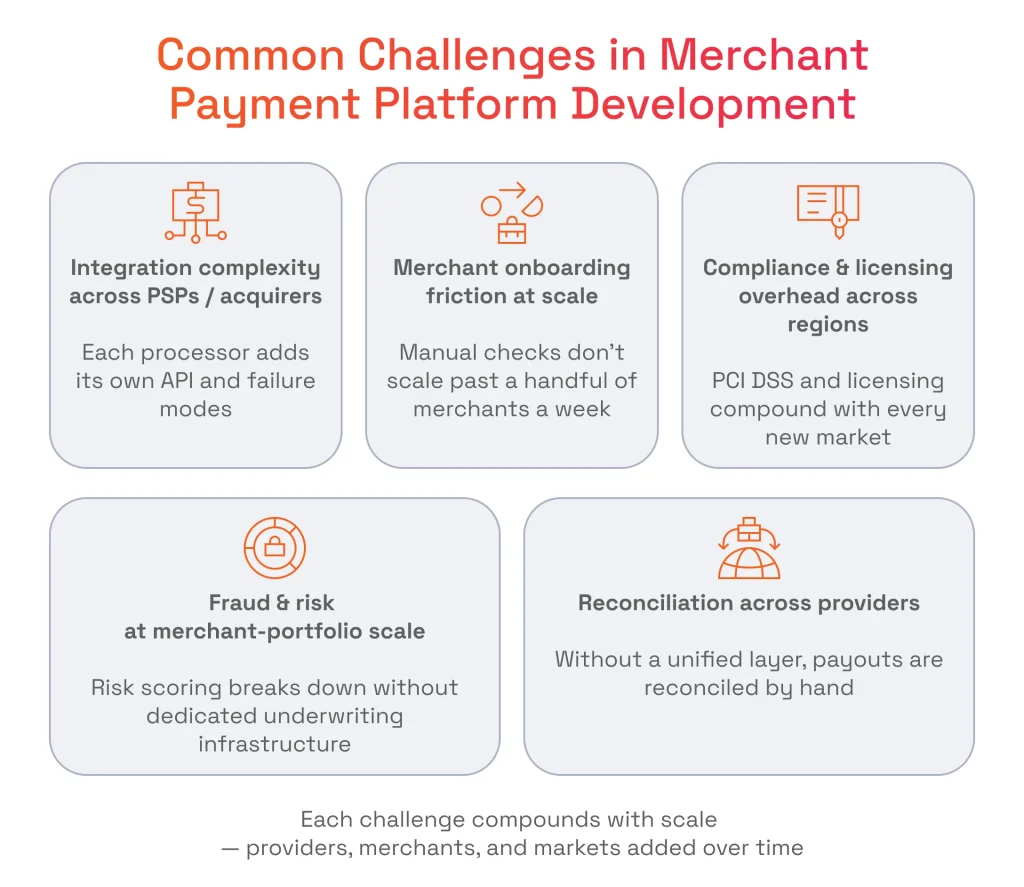
Building platform-level payment software involves navigating technical edge cases, changing compliance requirements, and complex third-party system interactions across a growing payment processing business.
Integration Complexity Across Multiple PSPs and Acquirers
Connecting to multiple payment processors and acquiring networks requires handling disparate API protocols, varying transaction state models, and inconsistent webhook formats. Without a unified internal abstraction layer or payment orchestration platform, connecting multiple payment methods increases maintenance overhead and introduces new failure modes.
We solved this challenge for a global white-label eCommerce platform, NimbleCommerce located in Silicon Valley, USA. Our team served as the sole technology vendor, building a unified internal payment abstraction layer and specialized routing pipeline that normalized disparate API schemas, contrasting state models, and inconsistent webhooks across 27 third-party payment systems.
This modular architecture automated dynamic transaction routing based on region and compliance rules while embedding ML predictive models to optimize approval rates, enabling seamless, white-label payment processing across North America and Europe that ultimately supported the client’s successful acquisition.
Merchant Onboarding Friction at Scale
Manual verification of business documents, tax IDs, and bank details creates operational bottlenecks that slow merchant growth and disrupt merchant cash flow. To maintain scale, onboarding systems must automate verification checks while maintaining strict risk standards.
We eliminated operational bottlenecks in BHN’s Aggregated Merchant Portal for Blackhawk Network by replacing manual document reviews with an API-driven, asynchronous verification pipeline that executed parallel automated checks across OFAC, EIN, and SSN databases upon submission. Our team also added risk-based straight-through processing so that the framework can approve low-risk applications automatically and route only flagged edge cases to underwriters.
At the same time, integrated automated document parsing and real-time status tracking eliminated multi-day back-and-forth delays. These efforts cut verification processing times from 7 days to under 24 hours while onboarding over 8,000 businesses.
Compliance and Licensing Overhead Across Regions
Maintaining regulatory compliance across international transactions requires continuous updates as data privacy, card network rules, and financial licensing laws evolve. Retrofitting compliance into an existing platform after launch introduces risk and inflates development costs.
To accommodate complex regulatory demands for an SMB funding platform, we designed and built a modular platform architecture from scratch over an 18-month timeline. Our engineering team isolated sensitive financial data into secure tokenization vaults to reduce PCI DSS audit scope, implemented privacy-by-design data structures with automated audit logging for GDPR compliance, and built an automated KYC/KYB risk-screening engine.
The platform automated SMB risk evaluation without introducing operational friction, which allows facilitating over $350 million in capital disintermediation across 4,000+ funded businesses.
Fraud and Risk Management at Merchant-Portfolio Scale
Evaluating risk at the individual authorization request level is insufficient when managing an entire portfolio of sub-merchants. Platform operators require portfolio-wide risk scoring systems to detect merchant account takeovers, bust-out fraud, and abnormal chargeback rates before card networks issue penalties.
Our team helped our client to support continuous merchant risk monitoring at scale for portfolios when we engineered a modular risk management platform that combined automated underwriting workflows, real-time transaction screening, and post-transaction monitoring. Built on microservices with a custom analyst dashboard, the system introduced in-house risk scoring and real-time counter engines alongside Camunda-automated KYB workflows.
This enabled automated underwriting for 5+ million annual merchant applications, doubled the merchant termination rate through true-positive fraud alerting, slashed financial losses from 77 to 24 basis points, and cut portfolio chargeback rates in half (1% down to 0.5%).
Reconciliation and Settlement Across Providers
Matching incoming settlement files from merchant account providers against internal ledger entries, processor fees, and merchant payouts is a complex data engineering challenge. Manual ledger matching fails as transaction volumes scale.
Solving high-volume settlement challenges for a merchant settlement platform for BHN, we delivered a centralized settlement engine that replaces manual accounting with an automated, event-driven data pipeline that ingests, normalizes, and reconciles transaction files across multiple processors in parallel.
It executes automated three-way matching, while dynamically applying multi-tier fee structures, platform commission splits, and reserve holds via an immutable double-entry ledger. The engine instantly clears balanced transactions and isolates only flagged exceptions for review. In this manner, it automates end-to-end net payout generation for 37,000+ active users without operational data drift.
Maintaining high system availability across these multi-provider environments while supporting frictionless international transactions requires sophisticated routing strategies and automated failover mechanics, detailed further in our technical guide to smart payment routing.
How to Choose a Development Partner for Your Merchant Payment Platform
Building payment infrastructure requires partnering with an engineering organization that possesses verified domain expertise rather than general custom software development claims.
- Verified PCI DSS and regulatory track record: Ensure the partner has designed, deployed, and successfully audited Level 1 PCI DSS systems in production environments.
- Multi-provider integration experience: Look for engineering teams with direct experience building abstraction layers across multiple acquirers, networks, and alternative payment methods.
- Security-first architecture practices: Confirm that tokenization, data encryption, role-based access control, and audit logging are baked into the architectural design.
- Long-term platform maintenance capability: See if continuous engineering support is available to handle card network updates, API version deprecations, and compliance frameworks.
Consider SPD Technology for Merchant Payment Platform Development
SPD Technology brings 20 years of custom software development experience, backed by a team of over 650 engineers who have delivered more than 460 successful projects. We specialize in domain-grounded engineering, keeping architecture and execution unified under one team without vendor hand-offs. Our approach prioritizes compliance-by-design architectures and human-in-the-loop workflows rather than unmonitored black-box systems.
Multi-Provider Platform at Scale
Since we were the only technology provider, we developed a global white-label eCommerce platform which included integration with 27 different third-party payment systems in the United States, Canada, Mexico, the United Kingdom, and the European markets.
Long-Term Payment Processing Partnership
Over the course of a five-year engineering partnership, we managed to create a complete omnicommerce payment processing infrastructure within five months, offering full-cycle payment processing, automated settlement, and developer API interfaces.
Compliance-by-Design Platform Build
We developed an SMB funding platform entirely from the ground up over a period of 18 months; it was constructed to comply with PCI DSS, GDPR, and KYC/KYB standards from the very beginning, and as a result it facilitated more than $350 million in financing for over 4,000 funded merchants.
Timeline and Cost of Developing a Merchant Payment Platform
Estimating platform development requires evaluating the technical scope, target markets, and regulatory obligations defining your business model.
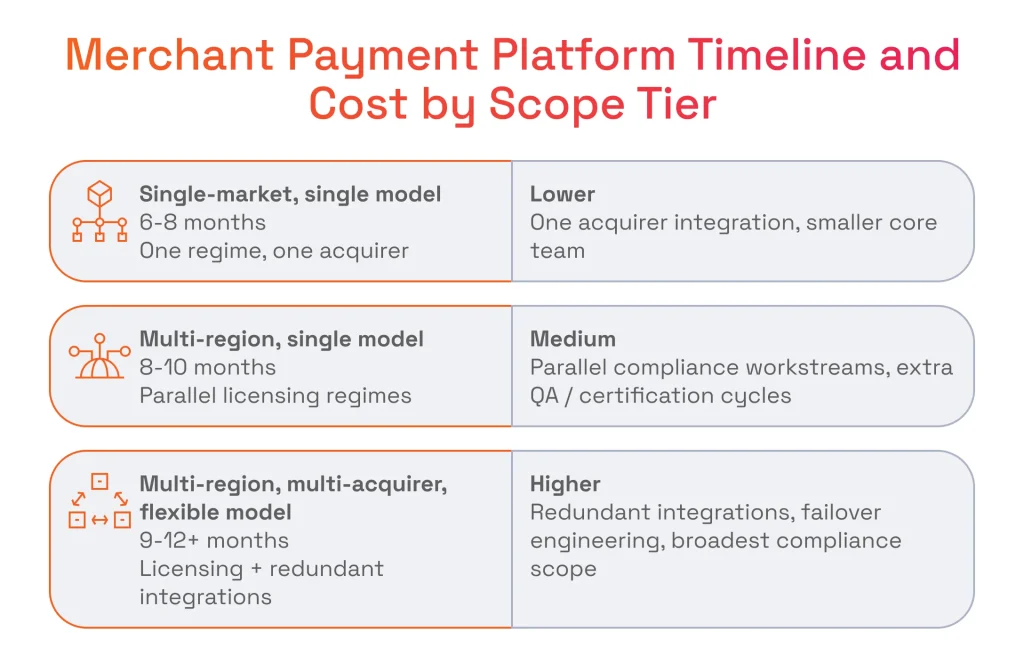
Timeline for Developing a Merchant Payment Platform
A custom platform build typically ranges from 6 to 12+ months. Timeline extensions are mainly driven by the number of regulatory regimes involved and the complexity of acquirer integrations.
Scope | Timeline | Main Timeline Drivers | |
|---|---|---|---|
| 1 | Single-market, single business model (PayFac or ISO) | 6-8 months | One regulatory regime, one primary acquirer relationship |
| 2 | Multi-region, single business model | 8-10 months | Multiple licensing regimes add parallel compliance workstreams |
| 3 | Multi-region, multi-acquirer, flexible business model | 9-12+ months | Compounds licensing complexity with redundant acquirer integrations and failover testing |
Scope
- 1
Single-market, single business model (PayFac or ISO)
- 2
Multi-region, single business model
- 3
Multi-region, multi-acquirer, flexible business model
Timeline
- 1
6-8 months
- 2
8-10 months
- 3
9-12+ months
Main Timeline Drivers
- 1
One regulatory regime, one primary acquirer relationship
- 2
Multiple licensing regimes add parallel compliance workstreams
- 3
Compounds licensing complexity with redundant acquirer integrations and failover testing
Cost of Developing a Merchant Payment Platform
Development costs depend on timeline length and team size. The biggest drivers are how many payment integrations you build, the strictness of your PCI compliance requirements, and whether you need to support both PayFac and ISO models.
Scope | Relative Cost | Primary Cost Drivers |
|---|---|---|
Single-market, single business model | $150,000 – $400,000 | One acquirer integration, one compliance regime, smaller core team |
Multi-region, single business model | $400,000 – $800,000 | Parallel licensing/compliance workstreams, additional QA and certification cycles |
Multi-region, multi-acquirer, flexible business model | $800,000 – $1,500,000+ | Redundant integrations, failover engineering, broadest compliance and certification scope |
Scope
Single-market, single business model
Multi-region, single business model
Multi-region, multi-acquirer, flexible business model
Relative Cost
$150,000 – $400,000
$400,000 – $800,000
$800,000 – $1,500,000+
Primary Cost Drivers
One acquirer integration, one compliance regime, smaller core team
Parallel licensing/compliance workstreams, additional QA and certification cycles
Redundant integrations, failover engineering, broadest compliance and certification scope
Note: figures reflect the platform engineering build only. Card network registration and Money Transmitter Licensing for a PayFac model run separately, and can add $500,000 to several million depending on state footprint and volume.
If you need a phase-by-phase cost breakdown and minimum viable product scoping, check our breakdown on building an MVP for payment platform.
Key Takeaways
- A merchant payment platform includes onboarding, processing, settlement, reporting, and business-model management as a coordinated system.
- The PayFac vs. ISO decision determines who carries onboarding speed and who carries compliance liability. PayFac trades faster merchant activation for direct underwriting and compliance responsibility. ISO keeps onboarding slower but reduces that liability.
- PCI DSS compliance and regional licensing requirements apply from the very start of a real platform build. Retrofitting compliance after the architecture is set costs more than designing for it upfront.
- Large merchants and digital-first merchants need different platform priorities. Enterprise volume justifies multi-acquirer redundancy and negotiated terms, while digital merchants prioritize fast onboarding and broad local payment method coverage.
- Build-vs-buy is a platform-level decision distinct from the orchestration-layer build-vs-buy decision. A business can build its own merchant platform while still buying a third-party orchestration layer for multi-provider routing, or vice versa.
- Integration complexity, compliance overhead, and reconciliation must continue after launch. They compound as a platform adds providers and merchants, which is why proven engineering patterns (abstraction layers, automated onboarding, unified settlement) become more important as a platform scales.
In short: A merchant payment platform is a coordinated system. Building it right means settling the business model, compliance posture, and provider strategy before writing the first line of code.
FAQ
What is the difference between a merchant payment platform and a payment gateway?
A payment gateway is one component in the checkout flow. It captures and encrypts transaction data at the point of sale, then passes it along for authorization, which is the narrow job most payment gateway integration or payment gateway development projects are built to solve. A merchant payment platform is the larger system built around that layer.
It handles onboarding, checkout, processing, settlement, and reporting together, so a business can process payments while also managing the merchant relationship and the compliance obligations that come with it. Integrating a custom payment gateway can take a matter of weeks, while building the platform around it is a much longer engineering effort.
Should a business become a PayFac or work as an ISO?
A PayFac aggregates merchants under its own master account, which means the business takes on direct responsibility for underwriting and compliance in exchange for faster onboarding and full control over the customer experience. An ISO instead refers each merchant to a sponsoring acquiring bank, so the platform provides merchant payment services without carrying that liability directly, though onboarding is slower.
Businesses that want to manage payments and the surrounding merchant relationship as a core part of their product tend to choose PayFac, while those offering payments as a supporting feature more often stay with the ISO model. The right choice depends on how much risk ownership the business is prepared to take on in exchange for speed and control.
How long does it take to build a merchant payment platform?
A full merchant payment platform build typically takes 6 to 12 months, depending on scope. A single market build with one business model, PayFac or ISO, usually runs 6 to 8 months, while a multi-region platform with several acquirer relationships and licensing regimes can take 9 to 12 months or more.
This is longer than most custom payment gateway development projects, which are often measured in weeks, because a platform adds onboarding, compliance, and settlement infrastructure that a gateway alone does not need. Teams building payment processing software at this scale also need a scalable payment gateway architecture underneath it, since a system designed for a single acquirer rarely holds up once transaction volume and provider count grow.
What compliance requirements apply to merchant payment platform development?
PCI DSS applies to any platform handling electronic payments or card data, and tokenization is the main mechanism for keeping that scope contained. Regional licensing requirements, including PayFac registration and money transmitter licensing in some markets, vary widely and shape the PayFac versus ISO decision from the start. A secure solution also needs fraud monitoring built into the transaction flow itself, screening each payment initiation request and verifying sufficient funds in the customer’s account before authorization completes. None of this works as a pre-launch checklist. It has to be part of the architecture from day one.
Is it better to build a custom payment platform or use a third-party platform?
Building makes sense when payments are core to the product, when margin or differentiation depends on owning the stack, or when transaction volume justifies the engineering investment. An established payment platform makes more sense when speed to market matters more than ownership, or when current volume doesn’t justify a build yet.
This is a platform-level decision. It’s separate from the orchestration layer’s build-versus-buy question, which asks whether to build or license the routing layer that coordinates multiple providers.
Businesses running recurring revenue models should also weigh how each option handles subscription fees and dunning logic over time. That cost compounds differently under a custom build than under a third-party platform.
What’s the difference between payment infrastructure for large merchants versus digital merchants?
Large merchants typically justify multi-acquirer redundancy, negotiated interchange rates, and dedicated support tiers that come with enterprise transaction volume. Digital-first merchants generally prioritize fast onboarding, checkout conversion, and broad local payment method coverage over the deep negotiated terms that large merchants pursue.
Both segments are shaped by the same shift, since the global payment gateway market keeps expanding and merchants increasingly expect seamless international transactions as a baseline rather than an advanced feature. A platform serving both needs a global payment strategy flexible enough to configure differently by merchant segment rather than applying one setup to every account.