

Payment reconciliation fails at scale when the underlying architecture was never built to produce reconcilable data. Five components drive that failure. Those are multi-PSP data fragmentation, settlement-timing asymmetry, missing idempotency controls, fee-layer opacity, and a ledger that can’t reconstruct historical positions. The fix is reconciliation architecture that includes normalization, idempotency, and ledger design, applied at the point where data enters the system.
With a single PSP and one settlement rail, payment reconciliation used to close by the end of each business day. Exceptions were rare enough that someone caught them by hand before the next cycle. Then a second PSP came online, or a payout rail, or transaction volume crossed a threshold that made manual matching untenable, and the exception queue started growing faster than anyone could clear it.
When someone looks for an explanation, they find two possible solutions: to buy a tool or to improve the accounting process. However, neither of these explanations accounts for why the data fed into the reconciliation process was difficult to match initially.
The tool option has already been tested at industry scale as McKinsey’s 2025 Global Payments Report found that reconciliation and settlement remain manual at most institutions, even where those institutions have used AI to automate fraud detection and transaction routing. If a tool were the actual fix, reconciliation would already be automated too. It hasn’t, because the failure sits in the architecture generating the data, not the tools or the process trying to reconcile it.
Why Reconciliation Breaks Down Exactly When It Starts to Matter
Reconciliation is not noticeable when it is working but becomes costly as soon as it fails. The fact that there is an increasing backlog shows that there is a failure of the architecture since the team isn’t getting quicker at reconciling data that was never designed to be reconciled.
Most teams encounter this limitation long before reaching enterprise scale, often when transitioning from a single gateway setup and confronting the core trade-offs of payment gateway vs. payment orchestration. This shift usually happens when a second PSP, a payout rail, or an instant-payment method is introduced. The revenue-leakage risk that arises is more difficult to spot and greater in marketplaces or in models involving split payouts, since mismatches accumulate along every stage of the chain.
The Five Root Causes of Reconciliation Failure at Scale
All of these failures can be traced to the fact that the architecture was never designed with the basic reconciliation questions in mind.
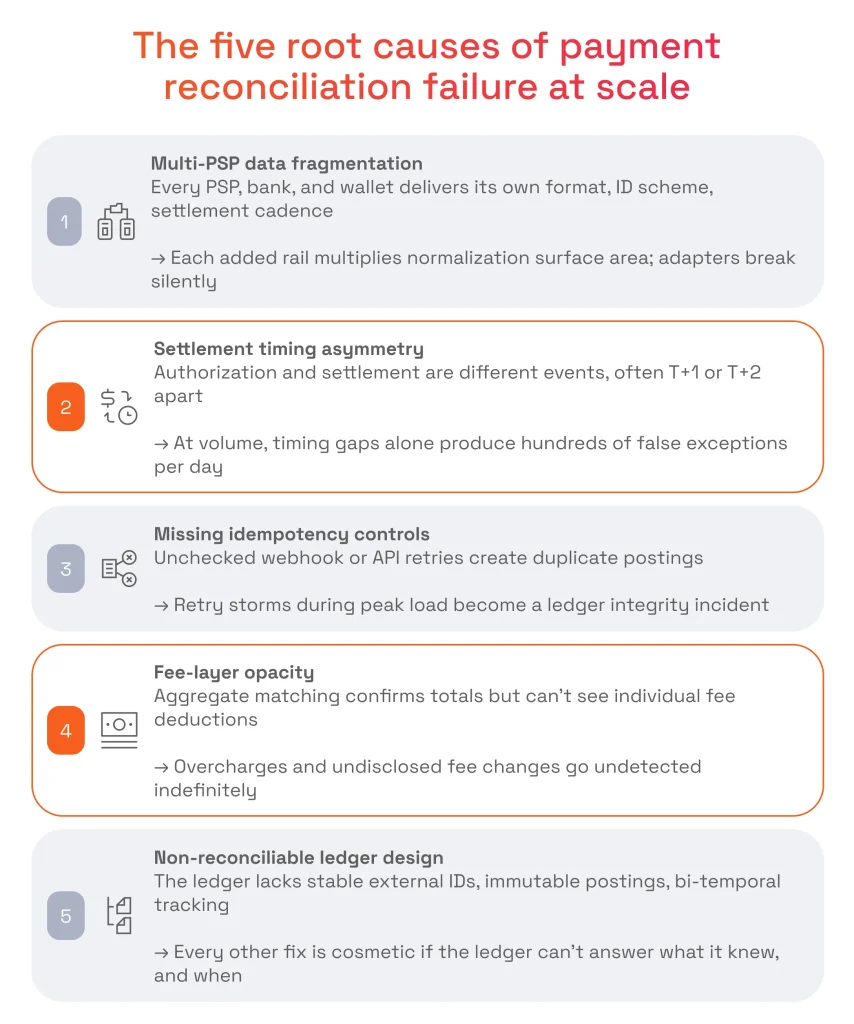
The table that follows shows where this is the case and explains why the problem becomes more severe as the volume, the number of PSPs, and the payout rails increase.
Root Cause | What Happens | Why It Compounds at Scale |
|---|---|---|
1. Multi-PSP data fragmentation | Every PSP, bank, and wallet delivers its own format, ID scheme, and settlement cadence | Each added rail multiplies normalization surface area; bespoke adapters quietly break when a provider changes a field |
2. Settlement timing asymmetry | Authorization and settlement are different events, often T+1 or T+2 apart | At volume, timing gaps alone can produce hundreds of false “missing transaction” exceptions per day |
3. Missing idempotency controls | Unchecked webhook or API retries create duplicate postings due to weak payment security architecture at ingestion | Retry storms during peak load turn a minor delivery glitch into a ledger integrity incident |
4. Fee-layer opacity | Aggregate matching confirms deposit totals but can’t see individual fee deductions | Overcharges and undisclosed fee changes go undetected indefinitely, this is where margin quietly leaks |
5. Non-reconciliable ledger design | The ledger lacks stable external IDs, immutable postings, or bi-temporal tracking | Every other fix is cosmetic if the ledger itself can’t answer what it knew, and when |
Root Cause
1. Multi-PSP data fragmentation
2. Settlement timing asymmetry
3. Missing idempotency controls
4. Fee-layer opacity
5. Non-reconciliable ledger design
What Happens
Every PSP, bank, and wallet delivers its own format, ID scheme, and settlement cadence
Authorization and settlement are different events, often T+1 or T+2 apart
Unchecked webhook or API retries create duplicate postings due to weak payment security architecture at ingestion
Aggregate matching confirms deposit totals but can’t see individual fee deductions
The ledger lacks stable external IDs, immutable postings, or bi-temporal tracking
Why It Compounds at Scale
Each added rail multiplies normalization surface area; bespoke adapters quietly break when a provider changes a field
At volume, timing gaps alone can produce hundreds of false “missing transaction” exceptions per day
Retry storms during peak load turn a minor delivery glitch into a ledger integrity incident
Overcharges and undisclosed fee changes go undetected indefinitely, this is where margin quietly leaks
Every other fix is cosmetic if the ledger itself can’t answer what it knew, and when
How Reconciliation Fails in Production: Five Failure Modes
The way each root cause manifests in a production environment is different. The five patterns listed below are the ones most frequently seen in payment reconciliation post-mortems.
Timing Gaps Across Multi-Rail Settlement
Authorization and settlement are two separate events, the time between them increasing when more than one system is involved. SEPA transfers, ACH batches, and card network settlements each have their own schedule, with different cutoff times and ways of dealing with holidays. A transaction which is authorized late on a Friday in one system may not settle until Tuesday in another, even if there is no actual problem.
The solution is provided by the discrepancy classifier since it has to encode each rail’s settlement convention as a rule, so that a T+1 ACH settlement is not compared using the same clock as a same-day card settlement. Otherwise, all normal delays would be regarded as false exceptions and the team would have to spend its time investigating gaps that had never actually occurred.
Duplicate and Ghost Postings from Retry Storms
In the field of payments, idempotency refers to the situation where a webhook or API call can be made more than once without resulting in more than one entry on the ledger. Since most payment service providers guarantee at-least-once delivery rather than exactly-once delivery, it is to be expected that retries will occur during periods of high demand or because of a provider outage, rather than being regarded as an edge case.
If no idempotency key is enforced at the point where the data is received, then each retry will result in a new transaction without any corresponding entry on the rail side. These phantom postings do not disappear automatically and require a manual adjustment in order to clear the ledger. Eventually, a correction to the way the data is ingested is needed, or the same kind of retry problem will create the same disorder the next time there is a spike in volume.

Oleksandr Boiko
Delivery Director at SPD Technology
“Teams treat a duplicate posting as a bug to patch after the fact, but by the time a ghost entry shows up in the ledger, the retry that caused it has already happened three systems upstream. This is why idempotency has to be enforced at the point where the request enters the system.”
Partial Settlements and Net-of-Fee Reports
A ledger which records the gross amount of each transaction will always display a shortfall when compared with a settlement report that has the fees deducted, since the two figures were never measuring the same thing. The gap appears to be an inconsistency until somebody recalls that the processor had taken out its fee before the funds had arrived.
The solution is to check at the individual transaction level that the amount after deducting fees matches the net settlement amount, rather than checking at the batch level. Checks performed at the batch level can still balance even if multiple transactions within that batch have the incorrect fee assigned, which is precisely the reason why overcharges and compliance anomalies remain undetected for months. This is a critical vulnerability for platforms that rely on automated merchant risk monitoring at scale.
Multi-Hop Drift in Layered Payment Flows
A payment made in a single transaction can pass through a BaaS provider, then a PSP, and then a payout provider before it is finally settled, and at each stage there is a possibility that the amount, the timestamp, or the reference ID will differ from what was recorded by the previous system. This kind of discrepancy will not be detected if reconciliation merely compares the final settled amount with the original transaction.
The way to deal with this is to give each link in the chain its own posting and its own ID number. A discrepancy in the middle of the chain can be hidden within a total that happens to balance at both ends, so the error remains unseen until it builds up over a sufficient number of transactions to become significant.
Exception Queue Collapse
Exceptions which are not classified and dealt with at the time they are spotted simply build up in a queue, and it is because of this unclassified queue that the end-of-month closing process becomes like a fire drill. Since no one is responsible for any individual exception, it ends up having to wait until someone has a moment to go through them all at once.
The longer a gap remains the higher the cost of investigating it. If a discrepancy is spotted on the same day that it occurs then it is simply a matching issue: retrieve the transaction, verify the ID and resolve it. But if the same gap is discovered thirty days later it becomes an archaeology problem since, by then, the context, the logs, and the person who could have explained it are all long gone.
Why “Buy Reconciliation Software” Doesn’t Fix an Architecture Problem
Even if a matching engine is highly capable, it can only deal with the data that is provided to it. Gartner forecasts that by 2026 organisations will give up 60% of AI projects because they lack AI-ready data, and reconciliation tooling comes up against the same obstacle one level lower. Should the underlying architecture not generate normalized transactions, stable IDs at the time of posting, and idempotent ingestion, then a new tool built on top of that architecture will inherit the same scattered, duplicate-prone, opaque data that the previous process had been struggling with. It will merely process that mess more quickly.
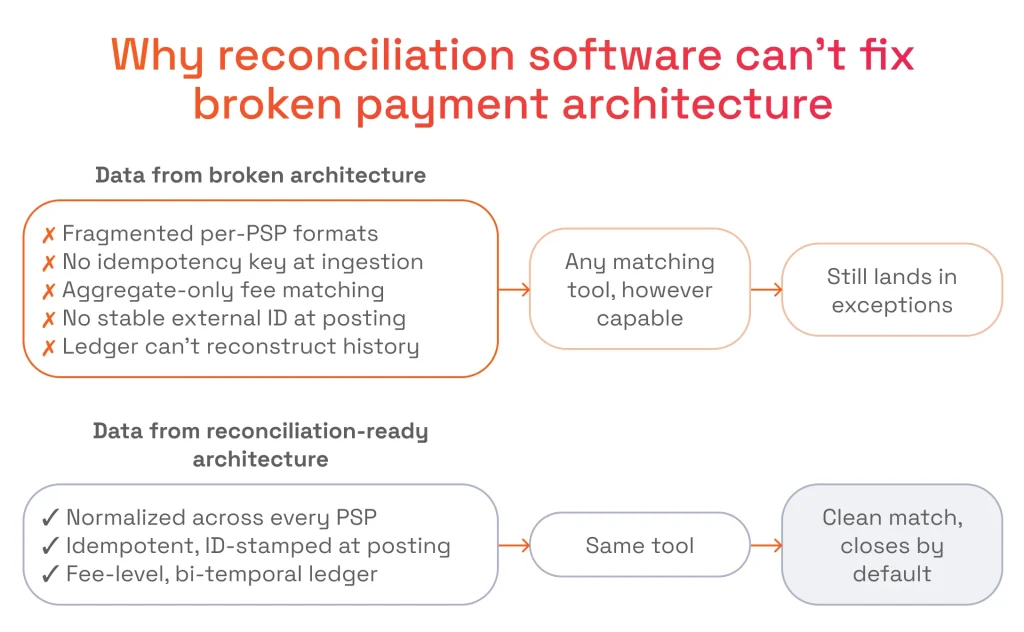
The right question to ask is not which reconciliation tool to buy but whether the payment architecture is actually producing data that can be reconciled. When a team honestly addresses this question, it typically discovers that the problem lies upstream, in the area of orchestration and ledger design, long before it reaches the software responsible for the matching.
The Architecture That Prevents Reconciliation Failure
For each of the root causes mentioned before there is a corresponding architectural solution. The various issues do not involve replacing the payment stack, but do require that reconciliation be treated as a design constraint from the moment the point data enters the system.
Architecture Component | What It Does | Prevents |
|---|---|---|
1. Unified orchestration / normalization layer | Ingests every PSP, bank, and rail into one standardized transaction model at the point of entry | Multi-PSP fragmentation and per-provider adapter drift |
2. Idempotency enforcement at ingestion | Every webhook or API call carries and checks a stable idempotency key before it’s allowed to post | Duplicate and ghost postings from retry storms |
3. Stable external-ID capture at posting time | Every ledger posting stores the PSP, bank, or rail transaction ID at the moment it’s written | Fuzzy amount/date matching and silent mismatches |
4. Bi-temporal, immutable ledger | Records both when an event was effective and when it was recorded; corrections are reversals, never overwrites | Backdated-correction errors, audit gaps, unreconstructable history |
5. Fee-level (not aggregate) matching | Compares each individual deduction against contracted rates at the transaction level | Fee overcharges and undisclosed fee changes hiding inside net settlement totals |
6. Exception classification and routing at detection | Every break is categorized and routed to an owner the moment it’s flagged | Exception queue collapse and stale, hard-to-trace investigations |
Architecture Component
1. Unified orchestration / normalization layer
2. Idempotency enforcement at ingestion
3. Stable external-ID capture at posting time
4. Bi-temporal, immutable ledger
5. Fee-level (not aggregate) matching
6. Exception classification and routing at detection
What It Does
Ingests every PSP, bank, and rail into one standardized transaction model at the point of entry
Every webhook or API call carries and checks a stable idempotency key before it’s allowed to post
Every ledger posting stores the PSP, bank, or rail transaction ID at the moment it’s written
Records both when an event was effective and when it was recorded; corrections are reversals, never overwrites
Compares each individual deduction against contracted rates at the transaction level
Every break is categorized and routed to an owner the moment it’s flagged
Prevents
Multi-PSP fragmentation and per-provider adapter drift
Duplicate and ghost postings from retry storms
Fuzzy amount/date matching and silent mismatches
Backdated-correction errors, audit gaps, unreconstructable history
Fee overcharges and undisclosed fee changes hiding inside net settlement totals
Exception queue collapse and stale, hard-to-trace investigations
It is at this stage that payment orchestration platform development becomes the logical outcome of the argument, rather than a sales pitch added on at the end. Implementing solid payment orchestration layers is what enables normalization, the enforcement of idempotency, and the capture of IDs simultaneously across every PSP and payment route.
-
A stable external ID captured at posting time prevents matching from relying on fuzzy heuristics that fail silently.
-
Enforcing idempotency before a webhook writes to the ledger stops retries from creating ghost postings.
-
Reconciling fees at the transaction level, not just in aggregate, catches overcharges that batch matching misses.
-
A bi-temporal ledger that reconstructs past balances is what makes backdated corrections and audits reliable.
-
Classifying exceptions at detection and matching reconciliation cadence to the fastest rail keeps discrepancies from becoming a month-end fire drill.
-
A single normalized data model across every PSP and rail lets new providers get added by configuration, not a rewrite, and prevents each new rail from becoming its own point of failure.
-
Posting corrections as auditable reversals, not silent overwrites, and tracking the unmatched-exception count in real time keeps the audit trail intact and the backlog visible.
If you answer “yes” to all seven diagnostic criteria, you have a solid underlying data architecture. However, in production, teams in this position often still face operational bottlenecks or scale-related edge cases.
Already have the right architecture but drowning in manual exception handling?
Read our article on payment operations automation to see how automating refunds, chargebacks, and routing failures turns a growing exception queue into one that resolves on its own.
How SPD Technology Builds Payment Reconciliation Architecture
When evaluating how fintech companies build payment platforms for scale, SPD Technology designs the payment system so that it generates data which can be reconciled by default. This involves work on the orchestration layers which standardise all the PSPs and rails, idempotent ingestion that prevents duplicate postings being written, and a ledger structure that enables determination of what a position was at any given time. Below are the examples that illustrate how we work with this in practice.
Event-Driven, Exactly-Once Payment Architecture
To correctly assign a reward linked to a card, it is necessary to be certain that a purchase transaction was processed exactly once. This was the main problem that SPD Technology dealt with for a US fintech company that combined media and payments, by creating an event-driven architecture for card-linked offers with Plaid connectivity incorporated. The system is able to allocate the rewards in less than one second by using exactly-once event processing. This approach to idempotency stops duplicate entries in the ledger during other parts of payment reconciliation, and ensures that payments are ready within 48 to 72 hours.
Settlement Infrastructure at Scale
The merchant business of Blackhawk Network has used a settlement platform that has been developed and maintained by SPD Technology for over seven years and which is now being used by more than 37,000 users. The platform automates the generation of reports and the calculation of commissions in relation to split-payout settlement flows. It automates report generation and commission calculation across split-payout settlement flows, posting and accounting for every leg of a payout on its own rather than as a lump total.
Full-Cycle Payment Processing and Settlement
An all-in-one omnicommerce payment system went live for Poynt in five months, utilizing our PayFac platform development services to cover full-cycle payment processing, settlement, and third-party integration APIs built on a PayFac model. The settlement service itself needed a full internal redesign to handle PayFac-style hierarchical merchant relationships, and later work integrated Adyen as a second processor, whose event-driven architecture didn’t line up with the existing settlement system until that integration layer was rebuilt to absorb it.
Key Takeaways
- Payment reconciliation fails at scale because the payment architecture generating the data was never built to be reconcilable.
- Five root causes drive most reconciliation failures: multi-PSP data fragmentation, settlement-timing asymmetry, missing idempotency controls, fee-layer opacity, and a ledger that can’t reconstruct historical positions.
- Reconciliation software can only match the data it’s handed; an architecture that doesn’t produce normalized, ID-stamped, idempotent data limits what any matching tool can fix.
- Idempotency enforcement at ingestion is the control that prevents the most common production failure: duplicate ledger postings from retried webhooks during peak load.
- A bi-temporal, immutable ledger makes audits and backdated corrections possible, because it can answer what a past position actually was.
- The architectural fix is a unified orchestration layer that normalizes every PSP, bank, and rail into one model, turning a new payment method into a configuration change instead of a reconciliation rewrite.
In short: Reconciliation is addressed at the architecture level, which generates the data, not at the matching level, which lies atop it.
FAQ
Why does payment reconciliation fail as transaction volume grows?
Reconciliation load doesn’t scale linearly with transaction volume. A stray timing gap or an occasional retry self-resolves at low volume.
However, as platforms evaluate single vs. multiple payment gateways and begin adding secondary PSPs, payout rails, or crossing high volume thresholds, manual matching stops being viable and those same timing gaps compound into a massive backlog. Each added source, format, and settlement cadence increases the surface area for mismatches, and that growing surface area is what actually drives the backlog.
What’s the difference between a reconciliation software problem and a payment architecture problem?
Software matches data, and architecture produces the data in the first place. If PSPs aren’t normalized into a common model, IDs aren’t captured at posting time, or retries aren’t idempotent, no matching tool can reconcile that data reliably, however capable it is. A reconciliation tool sitting on top of bad architecture just automates the confusion faster.
What causes duplicate transactions in payment reconciliation?
Duplicate postings are most commonly caused by retried webhooks or API calls that lack idempotency-key enforcement. A payment provider sends the same success event more than once, and without a check, the application layer posts it to the ledger each time. This is especially common during peak load or provider outages, when retries spike.
How much revenue do businesses lose to reconciliation failures?
The direct cost is hard to pin to one figure across industries, and the honest answer depends heavily on payout model complexity. What’s consistent across cases is that the leakage rises with marketplace or split-payout complexity, since untracked deductions accumulate across longer settlement chains before anyone notices them.
What is a bi-temporal ledger and why does it matter for reconciliation?
A bi-temporal ledger records both when an event was effective and when it was recorded in the system, so a historical balance can be reconstructed exactly and a backdated correction doesn’t rewrite history.
This matters for reconciliation because auditors and regulators frequently ask what a position was as of a specific past date, and a ledger that only stores current balances can’t answer that.
How often should high-volume fintechs run payment reconciliation?
Reconciliation cadence should match the settlement window of the fastest-moving rail in the stack: daily as a minimum for PSPs that settle T+1, and continuous or near-real-time for instant payment rails. Running reconciliation less often than the fastest rail settles guarantees a growing gap between what the ledger says and what’s actually true at any given moment.
Can payment orchestration fix reconciliation problems?
Orchestration applies normalization, idempotency enforcement, and stable-ID capture at the point of ingestion, and that combination is what makes downstream reconciliation reliable in the first place. Without an orchestration layer, each new PSP or payout rail becomes its own bespoke integration, each one carrying its own chance of producing irreconcilable data.