

Fraud rules break at high volume because five technical mechanisms degrade at once: rule interaction, latency budget, real-time feature computation, deployment velocity, and review-queue capacity. All five are structural architectural issues. Fixing them requires decoupling rules from deployment, building real-time feature infrastructure, and layering adaptive scoring alongside static rules.
All engineering teams that are developing a payment platform or a high-growth marketplace stumble upon a particular problem when it comes to risk controls. A rules engine that had been working well at lower volumes begins to cause a noticeable increase in false declines, together with growing review queues and previously undetected fraud patterns. Research indicates that this widespread problem results in up to $50 billion in lost revenue each year, with 47% of merchants incorrectly rejecting valid orders. The usual course of action is to carry out a tuning pass, rewrite the edge-case conditions, or add another set of conditional checks into the processing pathway.
That approach addresses the wrong failure point. When transaction throughput reaches scale, executing bloated rulesets across coupled infrastructure creates a compound engineering failure. The issue is structural. To build a production-proven alternative, engineering teams must first understand the five specific technical mechanisms causing static rules to break under volume.
Why Adding More Rules Won’t Fix an Architectural Bottleneck
If a platform’s payment authorization pipeline starts to display increased error rates or processing delays even though it is adhering to secure payment best practices, engineering management generally comes to the conclusion that the fraud detection logic has become outdated. In an effort to fill in any gaps in coverage, the teams add more conditional checks directly into this synchronous transaction pathway. However, this approach always fails because injecting more logic into a system that is already experiencing scaling bottlenecks increases the amount of work the system has to perform. As a result, the system experiences performance deterioration and causes the industry’s false-positive rates to reach the high 90% range as the rules interact under heavy volume.
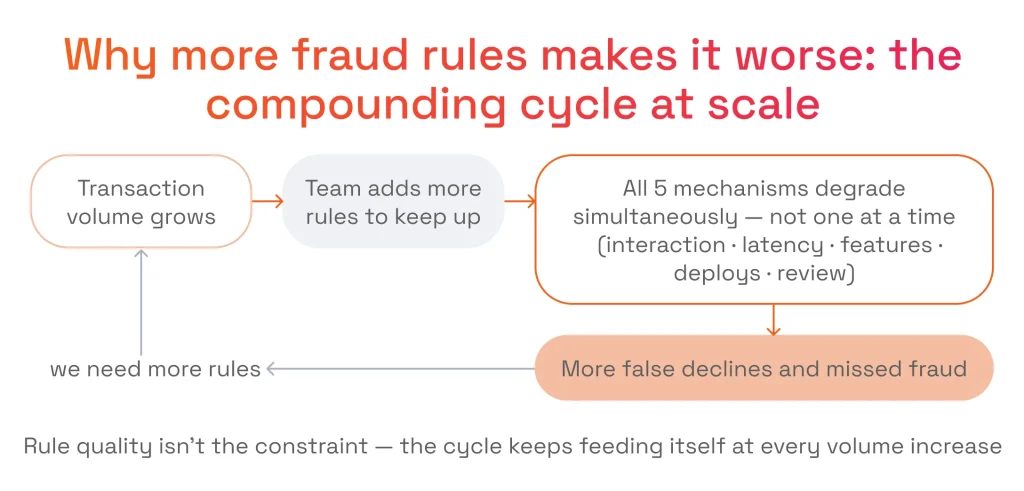
The reason for the drop in performance is that rule interaction, authorization latency budgets, stateful feature computation, deployment synchronization, and the capacity of the operational queue all deteriorate as the volume and the size of the ruleset increase. A rule that has been written perfectly will still fail if the state vector it depends on is out of date or if evaluating it causes the total transaction processing to exceed the gateway timeout threshold.
Grasping this difference alters the way engineering teams deal with the development of fraud detection software and the way they assign their resources. If a system fails as a result of architectural degradation, more sophisticated boolean logic merely increases the load on an already collapsing framework.

Oleksandr Boiko
Delivery Director at SPD Technology
“Teams often respond to a degrading rules engine by writing more rules. Past a few hundred active rules in the same authorization path, every new rule adds interaction risk, latency, and review volume, making things worse. The fix is finding which of the five mechanisms is actually the bottleneck before touching the ruleset again.”
The Five Mechanisms That Break Fraud Rules at Scale
The ability of rule-based systems to withstand heavy loads can be attributed to five particular technical failures. Rather than operating in isolation, these structural bottlenecks interact synchronously during peak throughput, compounding execution overhead across the entire transaction pipeline.
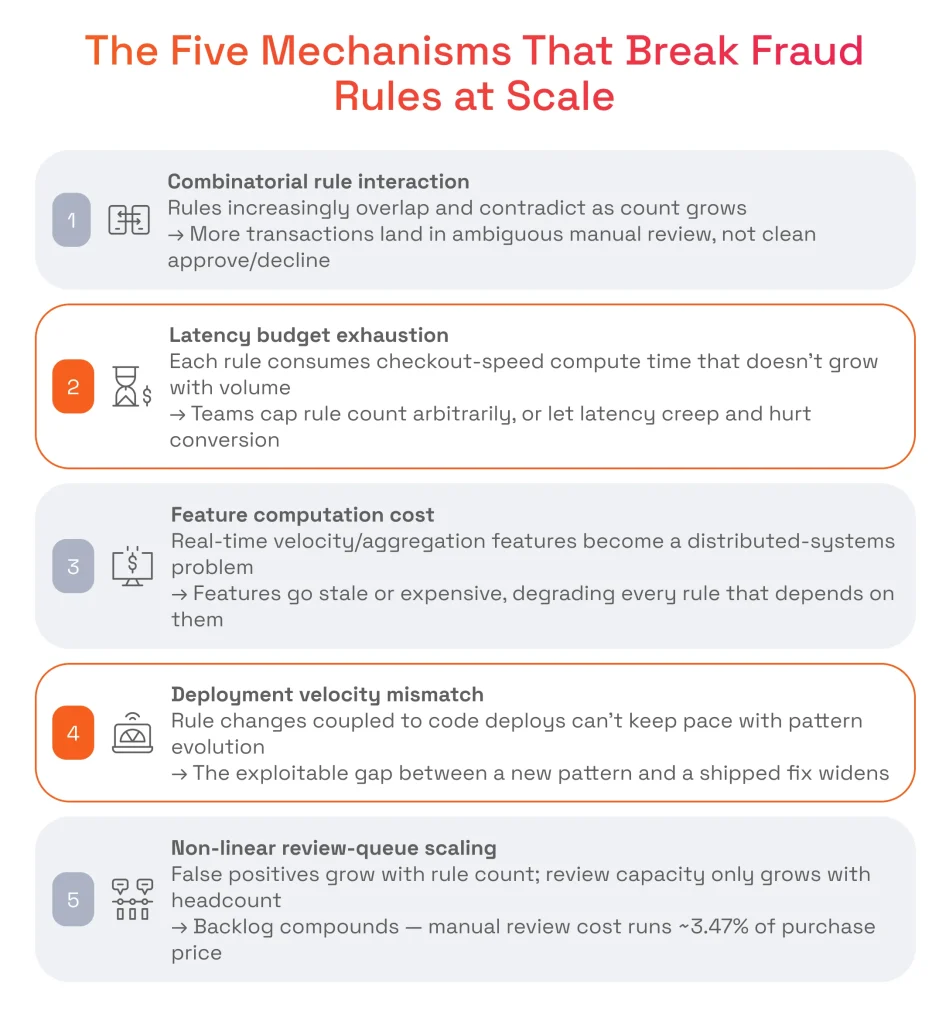
The table below shows how each of these mechanisms moves from a stable baseline to a point at which a systemic failure occurs as the volume of transactions increases.
Mechanism | What Happens as Volume Grows | Consequence |
|---|---|---|
Combinatorial rule interaction | More rules overlap and contradict, producing ambiguous outcomes instead of clean decisions | More transactions land in manual review instead of getting an automated approve/decline |
Latency budget exhaustion | Each rule adds evaluation time against a checkout-speed latency ceiling that doesn’t grow with volume | Teams either cap rule count arbitrarily or let latency creep, hurting conversion |
Feature computation cost | Real-time velocity/aggregation features become a distributed caching and consistency problem at scale | Features become stale or expensive to compute, degrading the accuracy of every rule that depends on them |
Deployment velocity mismatch | Rule changes coupled to code deploys can’t keep pace with how fast fraud patterns evolve at scale | The exploitable gap between a new pattern emerging and a rule shipping to catch it widens |
Non-linear review-queue scaling | False positives grow with rule count while review capacity grows linearly with headcount, if at all | Review backlog compounds, and manual review cost per transaction (cited around 3.47% of purchase price) scales with the backlog |
Mechanism
Combinatorial rule interaction
Latency budget exhaustion
Feature computation cost
Deployment velocity mismatch
Non-linear review-queue scaling
What Happens as Volume Grows
More rules overlap and contradict, producing ambiguous outcomes instead of clean decisions
Each rule adds evaluation time against a checkout-speed latency ceiling that doesn’t grow with volume
Real-time velocity/aggregation features become a distributed caching and consistency problem at scale
Rule changes coupled to code deploys can’t keep pace with how fast fraud patterns evolve at scale
False positives grow with rule count while review capacity grows linearly with headcount, if at all
Consequence
More transactions land in manual review instead of getting an automated approve/decline
Teams either cap rule count arbitrarily or let latency creep, hurting conversion
Features become stale or expensive to compute, degrading the accuracy of every rule that depends on them
The exploitable gap between a new pattern emerging and a rule shipping to catch it widens
Review backlog compounds, and manual review cost per transaction (cited around 3.47% of purchase price) scales with the backlog
These five architectural weaknesses have a cumulative effect throughout all levels of large-scale financial infrastructure, whether your system is establishing merchant risk monitoring on a scale, coordinating complex multi-sided marketplace payouts, or carrying out real-time AML screening across global transaction streams. In all these situations, real-time data streams break static rules, causing transaction lags and heavy manual workloads.
Mechanism Deep Dive: How Each One Actually Breaks
To deal with the breakdown of the addressing system, it is necessary to examine how each failure point functions within the payment microservices. Even though these mechanisms are triggered simultaneously during periods of increased volume, it is essential to regard them as separate structural defects if an architecture that can scale is to be built.
Combinatorial Rule Interaction
The more a ruleset grows, the exponentially greater becomes the number of ways in which the individual rules can overlap and contradict one another. When the volume of transactions is low, conflicts between rules are rare and can be regarded as isolated edge cases. But at a large scale, these edge cases occur constantly.
Two rules which function perfectly individually tend to come into conflict when they are tested against actual customer data. For example, a rule based on a high-velocity IP address might result in a purchase being flagged while a trusted-device rule at the same time approves it. Since the system cannot reach a definite decision, it settles on an ambiguous outcome, which in turn causes genuine transactions to be placed in manual review queues or leads to unnecessary false declines.
Latency Budget Exhaustion
The authorization and checkout processes, which are carried out synchronously, have to adhere to a strict and unchangeable latency limit, this being frequently set at between 200 and 500 milliseconds. Each conditional statement, each database query, and each assessment of state that is included in the execution path takes up a small part of the time that has been allowed.
The longer the active ruleset becomes, the closer the total execution time gets to the limit of the latency ceiling. In order to avoid transaction timeouts when the system is under maximum load, engineering teams have to make immediate concessions. They simply turn off fewer prioritized checks, eliminate the deep validation steps, or carry out the evaluations in asynchronous background processes. As a result, the nature of what the engine is able to detect during a live authorization is changed by this kind of trade-off.
Feature Computation Cost at Scale
Rules which are based on dynamic state context, for example, ‘the number of card attempts in the past 15 minutes’ or ‘the average order value for this device fingerprint over 30 days’, rely on the extraction of features in real time. Yet, when transaction rates are high, carrying out these aggregations synchronously becomes a difficult challenge for distributed systems.
The need to keep feature consistency in real time among distributed memory caches results in a high demand for computing resources and causes delays in the synchronization between regions. If cache invalidation slows down or data synchronization lags, the rules engine then starts to evaluate the incoming transactions based on out-of-date data. As a result, the accuracy of the rule logic is greatly reduced even though the boolean definitions have not changed.
Deployment Velocity Mismatch
If the rules against fraud are built directly into the application code repositories or are linked with the main software release pipelines, then any update to the rule will have to go through the usual engineering CI/CD processes, including regression testing and deployment. This kind of operational arrangement sets a strict minimum on how quickly the risk team can react to ongoing threats.
Fraud rings that are organized actively try to find out the limits of the payment system in order to identify weak points. When a method of attack has been found, the attackers carry out a large number of automated attacks in a short period of time. If it takes days to update a rule to block the pattern because of deployment dependencies, then the time gap between first detecting the threat and putting in place measures to counter it becomes a serious financial vulnerability.
Non-Linear Review-Queue Scaling
The number of ambiguous results caused by conflicting combinatorial rules increases in such a way that the amount of transactions flagged for secondary inspection rises non-linearly in relation to the baseline growth in traffic. However, manual review capacity increases only in proportion to the number of analysts.
The structural mismatch results in a growing backlog. With the volume of transactions increasing, rule collisions cause a rapid rise in transactions that are flagged as ambiguous, and this soon reaches the limit of the analysts’ linear capacity.
Signals Your Fraud Rules Are Breaking at Volume
It is necessary to monitor a number of specific technical and operational metrics throughout the payment infrastructure if structural breakdown is to be identified before it causes system failure. Before the entire platform’s stability is lost, system degradation shows clear signs.
The next checklist shows the typical symptoms of production.
-
More transactions land in “needs review” instead of a clean approve or decline decision. Note: Driven by combinatorial rule interaction.
-
Checkout latency has steadily crept up as more fraud checks were added over time. Note: Caused by latency budget exhaustion.
-
Velocity and aggregation-based rules consistently fire on stale or inconsistent data. Note: Stems from high feature computation costs at scale.
-
New fraud patterns are identified days or weeks before a rule change actually ships to production. Note: Points to a deployment velocity mismatch.
-
The manual review backlog keeps growing rapidly even though operational hiring has kept pace. Note: Triggered by non-linear review-queue scaling.
-
Engineering teams cannot state with confidence which historical rules are still catching active fraud. Note: Highlights combinatorial rule interaction combined with a governance gap.
-
Fraud losses and false decline rates are rising simultaneously across live traffic. Note: Reflects the compounding effect of multiple failure mechanisms at once.
What to Build Instead: Moving Beyond Static Rules at Scale
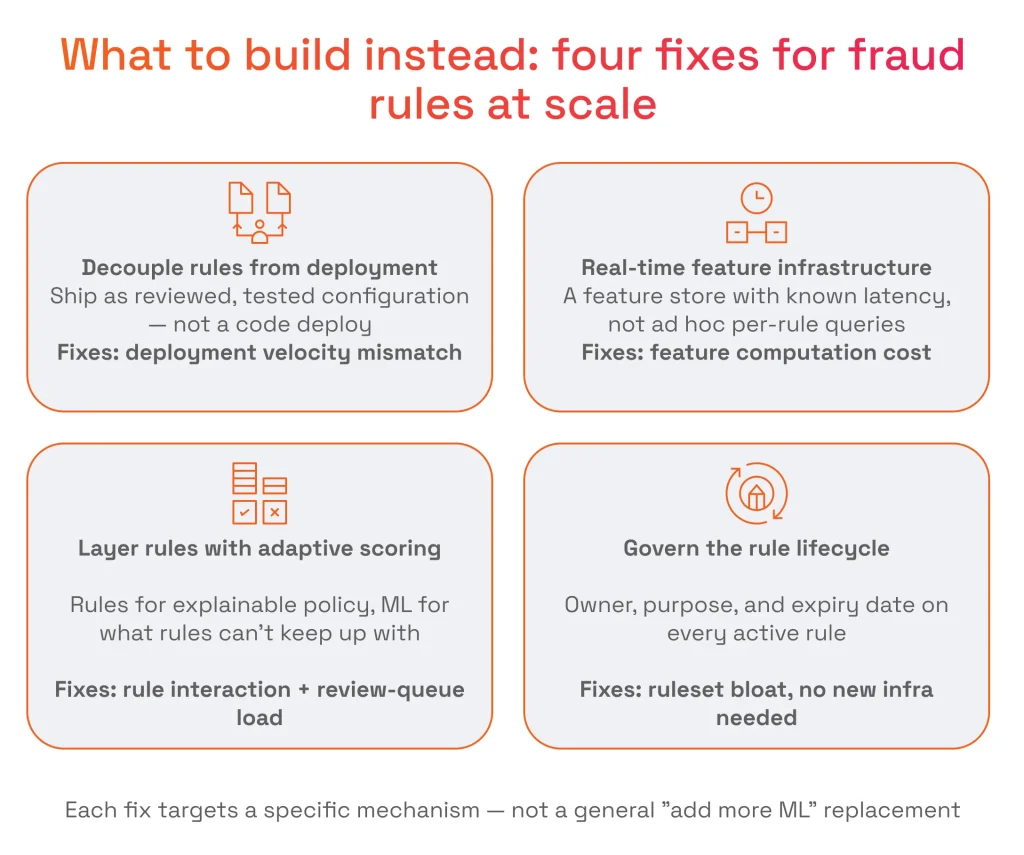
One does not need to give up deterministic logic altogether if one is moving away from a failing rules engine. Rather, what is required is the development of a modern decisioning architecture which separates state, logic, execution, and model evaluation into distinct and scalable platform services.
Decouple Rules From the Deployment Cycle
It is necessary for production engines to separate the execution of risk logic from the release cycles of the application. Fraud rules should either be set out as externalized configuration or be processed by a dedicated domain-specific execution engine which is capable of accepting hot-reloads of business logic without having to restart the services or carry out code deployments. As pointed out in AWS’s Financial Services Modernization Architecture, when modernizing critical transaction pathways, it is essential to decouple the edge business components from the core application code in order to achieve faster deployment rates and greater system resiliency.
By removing the rule definitions from the main codebase, risk analysts are able to draft, test, simulate, and safely deploy updated logic within minutes. Automating these transitions in the workflow is in direct alignment with payment operations automation, thus eliminating the gap in deployment speed and making sure that new attack vectors are countermeasured as quickly as they are detected.
Invest in Real-Time Feature Infrastructure
In order to avoid feature computation having a negative effect on authorization pipelines, platforms should set up specific infrastructure for feature calculation. By using specialized state management tools, such as low-latency feature stores and event-stream processing frameworks, the velocity and aggregation vectors can compute asynchronously outside the synchronous transaction path.
The main decisioning service is able to instantly query pre-computed, low-latency state representations during an authorization check because it continuously calculates state features in memory. This approach ensures that the processing speed remains stable and that the risk logic works with consistent, up-to-date data. Establishing this basis enables the implementation of fraud detection using machine learning for complex pattern recognition. Moreover, the use of modern AI in fraud detection allows engineering teams to identify high-dimensional feature dependencies that static queries completely fail to detect.
Layer Rules With Adaptive Scoring
Static rules are good at carrying out explicit and deterministic business policies but do not perform well in detecting subtle fraud patterns that involve multiple variables. As described in McKinsey’s 2025 Global Payments Report, today’s payment infrastructure needs intelligent capabilities to be deployed directly at the point of transaction, requiring that adaptive decision-making and modular policy engines be incorporated into the execution processes rather than depending on centralized batch rules or manual reviews.
Architecture teams should layer static rules alongside statistical machine learning risk models. In a hybrid scoring model, static rules act as fast pre- and post-filters for hard policy requirements, while an adaptive scoring engine processes complex transaction features to calculate a dynamic risk score. This layered approach eliminates the need to author hundreds of hyper-specific edge-case rules, mitigating combinatorial rule interaction while drastically shrinking manual review requirements.
Govern the Rule Lifecycle
Engineering platforms require explicit structural governance around rule lifecycle management to prevent ruleset bloat. Every active rule in production must have an assigned owner, a documented business objective, measurable performance metrics, and a mandatory sunset date.
Thanks to introducing automated rule auditing pipelines, systems are able to constantly monitor the frequency of execution, the contribution to true positives, and the false-positive overhead. Any rules that do not detect fraud or keep producing redundant triggers are automatically flagged for deprecation, keeping the processing pathway simple without the need for manual cleanup actions. This control framework aligns with payment security architecture principles and ensures the risk logic remains maintainable as the platform grows.
SPD Technology Expertise: Building Fraud Decisioning That Holds at Scale
SPD Technology brings over 20 years of custom software engineering experience to high-volume fintech platforms, backed by a team of 650+ engineers and 460+ successfully delivered projects. We design and implement event-driven, low-latency risk architectures, real-time feature processing pipelines, and production decisioning frameworks built to perform reliably under heavy transaction scale.
Risk-Based Underwriting at Scale
When risk systems depend on static, general rule triggers for merchant onboarding and transaction evaluation, they soon reach an operational limit. If high-volume growth is to be maintained, then it is necessary to have a precise, risk-oriented underwriting system which dynamically assesses complex merchant profiles without either increasing the number of manual reviews or slowing down the decision process.
Our team created the underwriting and alerting infrastructure behind Poynt’s risk decisioning, processing over 5 million merchant applications in a single year while doubling the true-positive termination rate. Thanks to engineering high-precision detection models and real-time alerting mechanisms into the core decisioning pipeline, our team enabled the platform to scale application volume seamlessly while significantly reducing false-positive flags.
Faster Response Cycles for Incident Detection
The total business impact will depend on how quickly problems can be detected and corrected when operational or technical disruptions endanger the platform’s integrity. Response systems based on manual triage are not effective at scaling when there is a high level of operational activity.
For one of our projects, we worked on cutting incident response times from over 60 minutes to under 30 minutes, with up to 70% of issues resolved autonomously, requiring engineering a dedicated AI incident management system for a fintech/SaaS platform. By driving issues directly to a PR-ready fix, our team dramatically accelerated system recovery and automated routine engineering workflows.
Event-Driven, Exactly-Once Decisioning
Because distributed components are involved, it is necessary for high-throughput transactional systems to have strict execution guarantees in order to avoid double-processing, race conditions, and state desynchronization. The difficulty of achieving this is especially noticeable in the areas of financial reward attribution, real-time risk decisioning, and ledger state validation.
To address this for our client, we implemented an event-driven card-linked offer architecture. Operating with sub-second attribution and guaranteed exactly-once processing, it demonstrates the same latency-disciplined engineering required for real-time feature computation.
Key Takeaways
- Relying on static fraud rules at high volume triggers 5 major technical failure points, such as combinatorial rule interaction, latency budget exhaustion, feature computation cost, deployment velocity mismatch, and non-linear review-queue scaling, that drive false-positive rates into the high 90% range and cost the industry up to $50 billion annually.
- Layering hyper-specific conditional rules directly into the synchronous payment path compounds processing load and causes up to 47% of merchants to wrongly reject valid orders during volume spikes.
- Computing dynamic feature aggregations synchronously across distributed memory caches causes rule logic to evaluate against stale data, degrading decision accuracy even when boolean definitions remain correct.
- Coupling fraud rule updates to standard application CI/CD release cycles creates operational delay, widening the window of vulnerability during high-volume automated fraud attacks.
- Decoupling rule evaluation from core code pipelines while pairing static policy logic with real-time feature infrastructure and machine learning models eliminates rule bloat and cuts manual review queues.
- Implementing continuous, automated rule auditing pipelines removes underperforming or redundant logic to stabilize transaction latency and enforce payment security architecture standards.
In short: Static fraud rules break down at high volume due to structural bottlenecks, requiring platforms to decouple logic from core deployments and layer adaptive machine learning alongside deterministic checks.
FAQ
Why do fraud rules stop working as transaction volume grows?
Fraud rules fail at high transaction volumes due to compounding architectural bottlenecks rather than poor rule design. As transaction rates scale, five specific execution issues accelerate simultaneously: combinatorial rule interactions create ambiguous logic states, cumulative evaluation times exceed fixed authorization latency budgets, real-time velocity feature aggregation suffers from cache staleness, code-coupled rule deployments fall behind shifting fraud patterns, and manual review volume scales non-linearly against linear analyst capacity.
What is fraud ruleset bloat?
Fraud ruleset bloat is a governance and system management failure where conditional rules are continuously added to combat new threat patterns without retiring obsolete logic.
Over time, hundreds of unmanaged rules lack clear ownership, performance metrics, or expiration timelines. This bloat inflates system latency, creates hidden rule collisions, and generates excessive false positives while complicating ongoing software maintenance.
Why does adding more fraud rules sometimes make false declines worse?
Adding rules increases the mathematical probability of unintended rule interactions across complex transaction payloads. As the total rule count grows, different rules authored for distinct scenarios frequently overlap, triggering conflicting classifications on valid user requests. Because most engines route ambiguous outcomes to conservative fallbacks, transactions that should pass cleanly end up falsely declined or pushed into manual verification queues.
What is the difference between fraud rules and machine learning-based fraud scoring?
Fraud rules rely on explicit, deterministic boolean statements that offer high explainability but struggle with complex multi-variable analysis. Machine learning fraud scoring evaluates high-dimensional feature sets to generate a probabilistic risk score, adapting efficiently to evolving attack vectors. Mature platforms layer both approaches since rules handle strict policy boundaries while ML models process ambiguous behavioral signals.
How does deployment speed affect fraud detection at scale?
When fraud rules are embedded directly inside application code repositories, introducing or modifying a rule requires completing full software regression tests and deployment pipelines. This coupling caps a team’s response speed to release frequencies rather than detection rates. Fraud rings actively target this time lag, running automated attack patterns during the window between initial detection and production rule deployment.
What should a fraud team do if their review queue keeps growing?
A continuously growing manual review backlog usually points to systemic rule interaction issues rather than a simple analyst staffing shortage. Teams should first pause adding new conditional rules and perform an audit of existing logic to deprecate redundant checks.
Long-term resolution requires decoupling rule configuration from code deploys, implementing real-time feature pipelines to ensure accurate state evaluation, and shifting edge-case decisions to adaptive machine learning scoring models.
How much does it cost, and how long does it take, to move from a static rules engine to a real-time decisioning architecture?
Decoupling rule deployment from code releases is typically the fastest and least expensive fix, often weeks rather than months on top of an existing system. Building real-time feature infrastructure and layering in adaptive scoring is a larger, phased engagement, commonly spanning several months rather than a single release.
What’s the relationship between fraud rules and fraud orchestration?
Fraud orchestration acts as the unified integration and routing layer that connects static rules engines, machine learning scoring pipelines, third-party identity verification services, and device fingerprinting tools into a coherent decisioning flow.
Instead of treating rules and ML models as isolated, competing execution gates, an orchestration engine manages data transformations, executes rules and models in optimized parallel paths, and outputs a single automated decision while maintaining strict latency performance.