

The best AI consulting companies for fintech and SaaS take an AI initiative all the way into production and keep it working there. For fintech, look for proof in regulated work such as fraud detection, payments or credit decisions, with humans approving anything that touches money or personal data. For SaaS, look for control of AI feature cost, tenant data isolation and quality checks on every release. Match the firm type to your situation: strategy houses for board-level direction, global integrators for multi-year programs, engineering-led partners for building and shipping. Our shortlist includes SPD Technology, Accenture, Deloitte, BCG X, EPAM, Quantiphi, Fractal, ScienceSoft and LeewayHertz.
An approved artificial intelligence (AI) strategy deck or an impressive pilot can feel like the hard part is done. Then it meets real users, data and money, where a wrong output costs revenue, margin or a regulator’s trust. Gartner expects over 40% of agentic AI projects to be canceled by the end of 2027 for that reason, citing escalating costs, unclear business value and inadequate risk controls.
Hiring AI consulting companies for fintech is worth considering to deliver AI speed that survives production. SPD Technology publishes this list of companies that can provide valuable advice and offer technical expertise for companies dealing with financial operations. Our team holds itself to these exact standards to reflect our ability to guide clients toward successful, tailored solutions.
Best AI Consulting Companies for Fintech & SaaS in 2026: Comparison Table
Each firm below meets three conditions:
- It offers AI consulting as a named service;
- It shows published work in financial services or software products;
- It is a service firm that does not sell itself as a software platform.
SPD Technology appears first as the publisher, and the remaining consulting companies are grouped by type without a ranking.
Company | Firm type | HQ | Delivers | Best fit in fintech & SaaS |
|---|---|---|---|---|
SPD Technology | Engineering-led AI partner | London, UK; delivery centers across Europe | Strategy through production and handover | Fintech and SaaS teams that need AI in production with evidence on every release |
Accenture | Global integrator | Dublin, Ireland | Strategy through large-scale implementation | Banks and insurers running multi-year, multi-country programs |
Deloitte | Global advisory and audit network | London, UK | Strategy, risk and governance, implementation | Regulated institutions where audit and risk functions lead |
BCG X | Strategy house with build unit | Boston, MA, US | Board-level strategy, selected builds | Executive teams setting AI direction and investment cases |
EPAM | Engineering-led integrator | Newtown, PA, US | Engineering at scale | Large product and platform engineering programs |
Quantiphi | AI-first services firm | Marlborough, MA, US | Applied AI solutions | Document-heavy processes such as onboarding and review |
Fractal | Analytics and AI firm | New York, NY, USA | Decision analytics and AI | Data-rich financial institutions |
ScienceSoft | Mid-market IT services | McKinney, TX, US | Consulting and development | Mid-market companies in regulated workflows |
LeewayHertz | AI development firm | San Francisco, CA, US | AI development on its own platform | Teams wanting fast builds on a ready platform |
Company
SPD Technology
Accenture
Deloitte
BCG X
EPAM
Quantiphi
Fractal
ScienceSoft
LeewayHertz
Firm type
Engineering-led AI partner
Global integrator
Global advisory and audit network
Strategy house with build unit
Engineering-led integrator
AI-first services firm
Analytics and AI firm
Mid-market IT services
AI development firm
HQ
London, UK; delivery centers across Europe
Dublin, Ireland
London, UK
Boston, MA, US
Newtown, PA, US
Marlborough, MA, US
New York, NY, USA
McKinney, TX, US
San Francisco, CA, US
Delivers
Strategy through production and handover
Strategy through large-scale implementation
Strategy, risk and governance, implementation
Board-level strategy, selected builds
Engineering at scale
Applied AI solutions
Decision analytics and AI
Consulting and development
AI development on its own platform
Best fit in fintech & SaaS
Fintech and SaaS teams that need AI in production with evidence on every release
Banks and insurers running multi-year, multi-country programs
Regulated institutions where audit and risk functions lead
Executive teams setting AI direction and investment cases
Large product and platform engineering programs
Document-heavy processes such as onboarding and review
Data-rich financial institutions
Mid-market companies in regulated workflows
Teams wanting fast builds on a ready platform
The Delivers column shows where an engagement typically ends, since some firms stop at AI strategy while others build and run artificial intelligence solutions for the financial industry.
Readers who want a wider view beyond fintech and SaaS can compare more firms in SPD Technology’s general list of AI consulting companies.
Which Type of AI Consulting Firm Fits Your Situation?
Firm type matters more than firm size, because each type is built to deliver a different advisory service. Start from the row that matches your situation, then use the last column to test whether a candidate’s answers fit what you need.
Your situation | What you actually need | Firm type that usually fits | Ask any candidate |
|---|---|---|---|
A bank, insurer or payment company with AI pilots that never shipped | A path to production that passes security, risk and compliance review | Global integrator for group-wide programs; engineering-led partner for specific initiatives | “Show us one release record from a regulated client: what was checked, and who approved it?” |
A fintech or SaaS scale-up adding AI features | Repeatable quality and controlled cost per request, inside your existing product | Engineering-led AI partner | “What will each AI request cost us, and what happens when the model changes?” |
A funded startup whose AI-built prototype now has real users | Hardening what works without a rebuild, and evidence for investor diligence | Engineering-led partner with startup experience | “What do you keep, what do you rebuild, and what do we own at the end?” |
A leadership team that needs an AI direction and business case | Prioritized use cases and an investment case the board will back | Strategy house, or an engineering-led partner that starts with a short assessment | “Who builds what you recommend, and when?” |
Your situation
A bank, insurer or payment company with AI pilots that never shipped
A fintech or SaaS scale-up adding AI features
A funded startup whose AI-built prototype now has real users
A leadership team that needs an AI direction and business case
What you actually need
A path to production that passes security, risk and compliance review
Repeatable quality and controlled cost per request, inside your existing product
Hardening what works without a rebuild, and evidence for investor diligence
Prioritized use cases and an investment case the board will back
Firm type that usually fits
Global integrator for group-wide programs; engineering-led partner for specific initiatives
Engineering-led AI partner
Engineering-led partner with startup experience
Strategy house, or an engineering-led partner that starts with a short assessment
Ask any candidate
“Show us one release record from a regulated client: what was checked, and who approved it?”
“What will each AI request cost us, and what happens when the model changes?”
“What do you keep, what do you rebuild, and what do we own at the end?”
“Who builds what you recommend, and when?”
Throughout our work with financial companies that seek AI advisory, we saw that some businesses want to define the solution together with an AI consulting partner. Others have already decided what AI-powered solutions to build and want them delivered to a provable standard. Both are legitimate starting points that a good partner scopes around specific business needs.
In the first case, we start with a discovery that maps business objectives against the company’s data, systems and regulatory requirements, then narrow AI use cases such as process automation or predictive analytics to those with a clear return and manageable risk. From there, a proof of concept tests the strongest idea on real data and sets the project scope for a roadmap toward measurable business outcomes.
In the second, we usually work on taking an AI-built prototype to production while keeping the parts that already work. A funding round adds its own scrutiny, since the questions investors ask about AI reach past the demo into how the system will behave at scale. Before either conversation, a quick way to check your AI prototype readiness shows where the gaps sit.
The Shortlist: What Each AI Consulting Company Is Best For
The following AI consulting firms’ profiles are grouped by firm type, since the type of firm largely decides where an engagement starts and how far it goes, from setting a direction for AI adoption to running large implementation programs or building and supporting solutions with AI capabilities in production.
Strategy and Advisory Firms
Partner with a firm from this group when leadership needs strategic insight before committing a budget, such as which AI use cases to fund and how to frame the investment case for the board.
BCG X

- Known for: pairing BCG’s strategy work with an in-house build unit of engineers, data scientists and designers.
- Best for: leadership teams setting AI direction and an investment case.
- Worth asking: Which parts of your recommendation will your build team deliver, and which stay with us?
Deloitte
- Known for: risk, controls and regulatory work around AI delivery.
- Best for: regulated institutions where audit and risk functions lead.
- Worth asking: Who owns the production system once the risk review is complete?
Global and Engineering-Led Integrators
These firms suit organizations that already know what they want to build and need scalable solutions delivered across many teams, systems or countries under one program.
Accenture
- Known for: large, multi-country implementation programs across the major cloud ecosystems.
- Best for: group-wide AI programs at banks and insurers.
- Worth asking: Which named team will staff our program, and who approves each release?
EPAM
- Known for: engineering-first delivery on large product and platform programs.
- Best for: organizations that already know what they want built.
- Worth asking: Who shapes product direction if our team hasn’t defined it yet?
ScienceSoft
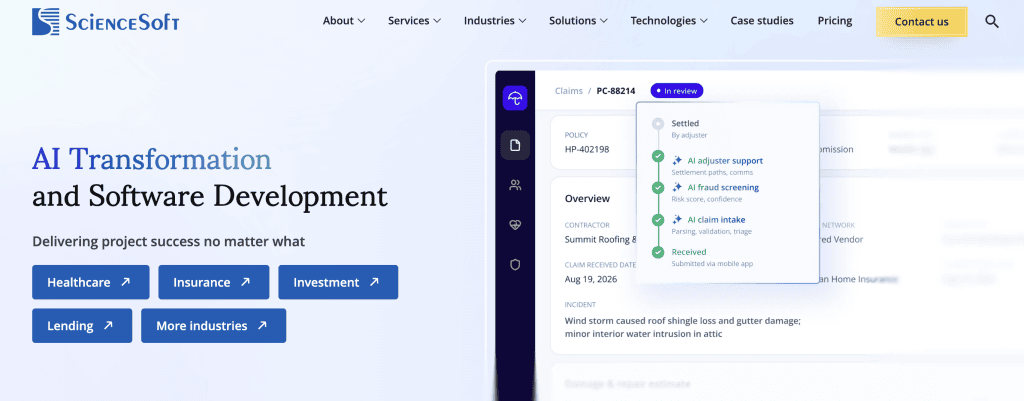
- Known for: IT consulting and software development for mid-market companies.
- Best for: mid-market companies with regulated workflows.
- Worth asking: Which AI system in a regulated workflow can you show us running in production?
AI-Focused Engineering Partners
Engineering partners in this group are the better choice when you need customized AI solutions built, tested and kept running in production on your own data and systems.
SPD Technology
- Known for: AI and software product engineering for fintech and data-heavy companies since 2006, with 650+ people, as an AWS and Adyen partner and a certified Claude (Anthropic) partner. Its AI consulting services run from strategy through production and handover.
- Best for: teams that need AI in production with evidence on every release.
- Not the right fit for: a strategy-only engagement with no intention to build.
Quantiphi
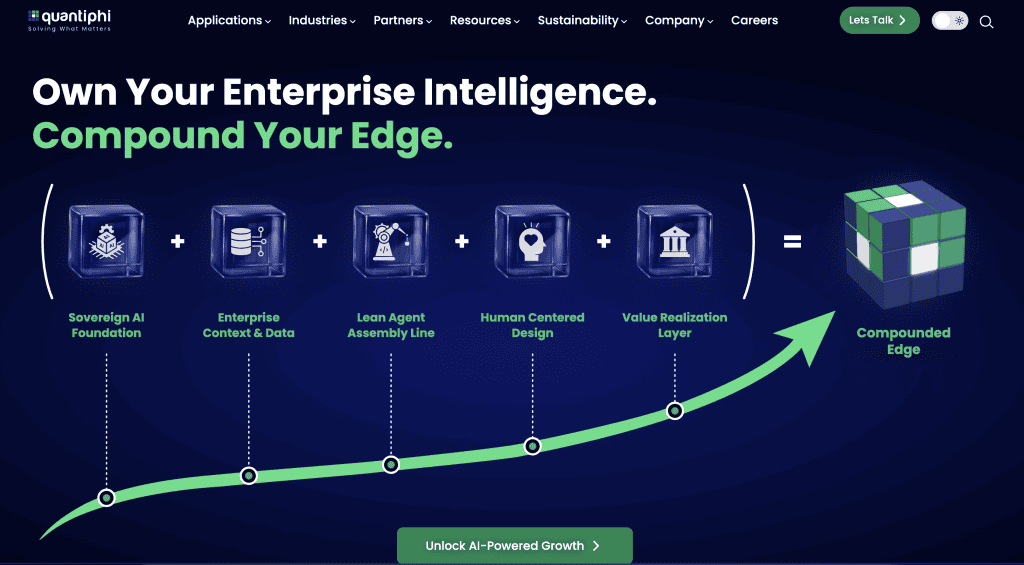
- Known for: applied AI solutions, often in document-heavy processes.
- Best for: onboarding and review workflows.
- Worth asking: How are extraction errors caught before they reach a decision?
Fractal
- Known for: decision analytics and AI for data-rich enterprises.
- Best for: data-rich financial institutions.
- Worth asking: Who monitors and retrains the models after go-live?
LeewayHertz
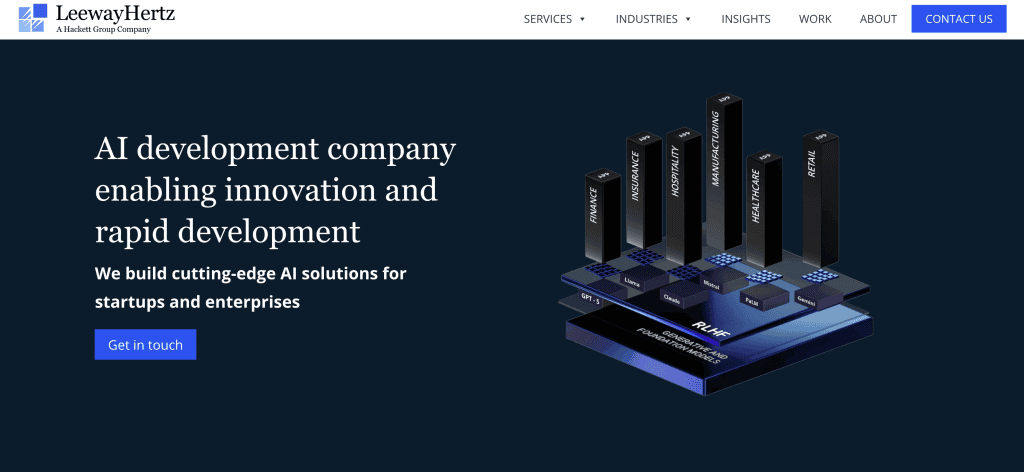
- Known for: AI development, including builds on its own platform.
- Best for: fast builds on a ready platform.
- Worth asking: Which parts of the system run on your platform, and what do we keep if we leave?
Firms in this group concentrate on building and running AI systems. You can find more partners of this kind in our article dedicated to top AI companies.
What AI Consulting Must Cover in Fintech
Setting up AI in fintech asks an AI consultant to deliver two things at once, an accurate AI model and its explainability, meaning a track record of how every decision was made, how it was approved and when.
That record only carries weight if people stay in control of the decisions with real risk attached. Guardrails and human in the loop are often stated as principles, yet they work best when set per task, so anything touching money, personal data or architecture stays human-led. At SPD Technology, we call this calibrated autonomy.
Once those settings are defined per task, they need a home in AI governance, where risk management and regulatory compliance teams can see who approved which decision. The rules behind those approvals differ by use case, and so do the failure modes and the controls a consultant needs to build in for each one.
Use case | What can go wrong | Rules and standards to check | What the consultant should build in |
|---|---|---|---|
Fraud detection | False declines lose revenue; missed fraud loses money | PCI DSS for card data; data protection law. The EU AI Act’s credit-scoring high-risk category excludes systems used to detect financial fraud | Measured baseline, threshold controls, human review of edge cases |
Credit scoring and underwriting | Unexplainable or biased decisions | EU AI Act (Annex III lists credit scoring of individuals as high-risk); fair-lending and model risk guidance | Explainability, bias testing, documented validation |
KYC and AML | Missed alerts; unreviewable automation | AML regulations; record-keeping duties | Human approval of outcomes, full audit trail |
Payments operations | An automated action moves money wrongly | PCI DSS; scheme and partner rules | Read-only access by default; human approval for any money movement |
Customer support AI | Wrong answers about fees, balances or terms | Consumer protection and disclosure rules | Answers grounded in approved sources, escalation to a person, evals before release |
Financial data extraction | Silent errors in figures | Data licensing; accuracy obligations to clients | Validation rules, sampling checks, source traceability |
Use case
Fraud detection
Credit scoring and underwriting
KYC and AML
Payments operations
Customer support AI
Financial data extraction
What can go wrong
False declines lose revenue; missed fraud loses money
Unexplainable or biased decisions
Missed alerts; unreviewable automation
An automated action moves money wrongly
Wrong answers about fees, balances or terms
Silent errors in figures
Rules and standards to check
PCI DSS for card data; data protection law. The EU AI Act’s credit-scoring high-risk category excludes systems used to detect financial fraud
EU AI Act (Annex III lists credit scoring of individuals as high-risk); fair-lending and model risk guidance
AML regulations; record-keeping duties
PCI DSS; scheme and partner rules
Consumer protection and disclosure rules
Data licensing; accuracy obligations to clients
What the consultant should build in
Measured baseline, threshold controls, human review of edge cases
Explainability, bias testing, documented validation
Human approval of outcomes, full audit trail
Read-only access by default; human approval for any money movement
Answers grounded in approved sources, escalation to a person, evals before release
Validation rules, sampling checks, source traceability
Across these use cases, most controls for automating financial workflows follow one pattern, where AI models do the analysis and prepare the action, and a person approves anything that changes money, data or production.
The AI Incident Pilot, built for a US fintech rewards platform, applies the same pattern to engineering work. As an AI agent, a system that plans and takes actions through tools, it investigates production incidents and prepares each fix as a pull request. An engineer reviews every fix before it reaches production, so the agent never merges code itself.
What AI Consulting Must Cover in SaaS
In SaaS, an AI consultant has to protect gross margin, tenant data and release speed at the same time. All three are decided inside the product, so AI consulting for SaaS starts with AI integration into your existing SaaS product development work and its release pipeline.
Release speed raises a new problem once AI enters the pipeline, because ordinary tests can no longer tell you whether an answer is right. Tests check deterministic code, while evals score AI output against datasets and rubrics, before release and after. Teams that evaluate AI agents before production run evals on every release, so they catch quality drops while a fix is still cheap. Margin and tenant data need their own safeguards too, and each concern, from cost per request to how your team adopts AI tools, calls for a specific deliverable from the consultant.
Concern | Why it matters in SaaS | What the consultant should deliver |
|---|---|---|
Cost per AI request | Token spend scales with usage and comes out of gross margin | A cost-per-request estimate, usage limits, and routing of simple requests to smaller models |
Tenant data isolation | An AI feature can leak one customer’s data to another through retrieval or prompts | Access control enforced in the retrieval layer, tested per tenant |
Quality on every release | Model, prompt and data changes can quietly degrade answers | Evals that run in CI and block a release, alongside ordinary tests |
Enterprise sales readiness | Buyers send security questionnaires and ask how AI is governed | Documentation, an audit trail per release, SOC 2-aligned controls |
Ownership and portability | Lock-in to a consultant’s platform slows you down later | Specifications, tests and AI configuration in your repository, yours by contract |
Team adoption | Tools get used inconsistently across engineers | Shared rules and reusable workflows the whole team works from |
Concern
Cost per AI request
Tenant data isolation
Quality on every release
Enterprise sales readiness
Ownership and portability
Team adoption
Why it matters in SaaS
Token spend scales with usage and comes out of gross margin
An AI feature can leak one customer’s data to another through retrieval or prompts
Model, prompt and data changes can quietly degrade answers
Buyers send security questionnaires and ask how AI is governed
Lock-in to a consultant’s platform slows you down later
Tools get used inconsistently across engineers
What the consultant should deliver
A cost-per-request estimate, usage limits, and routing of simple requests to smaller models
Access control enforced in the retrieval layer, tested per tenant
Evals that run in CI and block a release, alongside ordinary tests
Documentation, an audit trail per release, SOC 2-aligned controls
Specifications, tests and AI configuration in your repository, yours by contract
Shared rules and reusable workflows the whole team works from
The team adoption row is where guardrails for AI engineering matter most, since they give every engineer the same rules and workflows. Grounded answers also enhance user experience, which is why generative AI development for SaaS draws responses from approved sources. For the CFO, the payoff compounds, because a well-designed AI feature gets cheaper to extend with each release as its checks and components are reused.
From Strategy to Production: What Each Phase Should Hand You
Judge an AI consulting engagement by what you hold at the end of each phase. Assessment sets the baseline, and an AI infrastructure audit at that stage shows whether your data engineering, cloud infrastructure and access controls can support the use cases you prioritize.
Phase | What you should receive | Warning sign |
|---|---|---|
Assessment | Prioritized use cases, a baseline to measure against, risks named per use case | A long report with no baseline and no owner |
Pilot | A working system on your real data, with acceptance criteria and eval results | A demo on sample data; production “to be scoped later” |
Production | Monitoring, cost tracking, human approval points, and a record for every release | No named person accountable for release approval |
Handover | Specifications, tests, AI configuration and documentation in your repository | Assets that stay on the consultant’s platform |
Phase
Assessment
Pilot
Production
Handover
What you should receive
Prioritized use cases, a baseline to measure against, risks named per use case
A working system on your real data, with acceptance criteria and eval results
Monitoring, cost tracking, human approval points, and a record for every release
Specifications, tests, AI configuration and documentation in your repository
Warning sign
A long report with no baseline and no owner
A demo on sample data; production “to be scoped later”
No named person accountable for release approval
Assets that stay on the consultant’s platform
A gap left in one phase tends to carry into the next, so a missing baseline at assessment usually resurfaces as a pilot nobody can judge or a production system nobody owns within your business operations. That is why project management on an AI engagement should check each handoff against what the phase was meant to deliver.
Teams approaching go-live can work through an AI production checklist to confirm that monitoring, approvals and cost tracking are in place.
What AI Consulting Costs for Fintech and SaaS Companies
The ranges below are third-party market figures published by BD Emerson. SPD Technology’s own prices are not part of this data, so the table works as a benchmark for comparing quotes.
Firm type | Typical blended rate |
|---|---|
Strategy houses | 400-900 per hour |
Global integrators | 150-350 per hour |
Boutique consultancies | 200-400 per hour |
Engineering-led firms | 90-200 per hour |
Firm type
Strategy houses
Global integrators
Boutique consultancies
Engineering-led firms
Typical blended rate
400-900 per hour
150-350 per hour
200-400 per hour
90-200 per hour
According to the same BD Emerson research, taking one meaningful use case from data readiness through monitored go-live most often costs $250,000 to $1.5 million in the mid-market. That figure covers the build, while the larger AI consulting cost appears over the life of the system, since rework, downtime and maintenance are where a cheaper build becomes the expensive one.
In fintech, compliance work and integrations with core and legacy systems push the budget up. In SaaS, request volume and the number of tenants set the bill as usage grows.
Why Choose SPD Technology
SPD Technology is a production-proven AI partner for fintech companies and SaaS businesses, built around AI speed that survives production. We work as an AWS partner, an Adyen service partner and a certified Claude (Anthropic) partner with Claude-certified architects, and those partnerships shape our custom software development and consulting services. Our partnership with Anthropic also informs our team’s work on building production AI with Claude.
- Verify before release. Every release ships an inspectable evidence package, and outcomes are measured against the client’s own baseline. For example, a support AI for a fashion retailer answers 99% of queries in under 10 seconds at 30 requests per second.
- Match autonomy to risk. Money, personal data and architecture stay human-led to protect data security, and a named senior engineer approves every release.
- Transfer the delivery system. Specifications, tests, AI configuration and eval suites live in the client’s repository and belong to the client by contract. In the Space Needle case study, the client team owns 47 custom skills, 6 subagents and 19 slash commands.

Serhii Leleko
AI & ML Engineer at SPD Technology
“When a payment goes wrong, the first questions are which version of the system made the decision, what it was tested against before release, and who approved it. We build the release record so each of those answers takes minutes to find. A team that has to reconstruct them from chat logs and memory has an audit problem waiting to happen.”
Credit Card Fraud Detection for an eCommerce and Financial Services Platform
Business Challenge
An eCommerce and financial services platform whose customers pay by mobile money or bank card faced growing fraud losses from unauthorized transfers and compromised accounts. It needed fraud prevention that stops fraud while letting legitimate customers through.
Our Solution
The five-layer fraud detection system combines supervised models, an ensemble of gradient-boosting models scoring each transaction, with anomaly detection for new fraud patterns. It draws on 700+ behavioral features such as transaction velocity, location anomalies and device fingerprints, and a real-time scoring API decides whether to approve, ask for two-factor authentication or block. Monitoring and automated retraining keep the machine learning models current, and a team of 6 delivered the system in 3 months.
Delivered Outcomes
- 40% lower fraud-related losses;
- Manual review workload cut by more than 50%;
- About 10% higher checkout success, as fewer legitimate payments were blocked;
- Live in 3 months, with results measured 6 months after deployment.
AI Market Analysis for a Global Investment Data Platform
Business Challenge
A global provider of data on private and public capital markets had to process about 50,000 news articles a day as its sources grew from 100 to several thousand. Key facts about companies’ capital and investment rounds were often missing from public data, and customers wanted better tools to spot emerging investment opportunities.
Our Solution
Within a partnership of more than a decade, our team delivered an AI market-analysis feature in 6 months. Engineers built a crawling mechanism that gathers missing company investment data and a summarization model that fills gaps automatically. On top of that, AI models group similar companies, a trend-detection model works across news mentions, and a dashboard presents the results for data analysis.
Delivered Outcomes
- 50% less manual data processing;
- About 50,000 articles processed daily (18 million a year);
- Emerging investment spaces tracked grew from 70 to 125;
- Delivered in 6 months.
AI Incident Pilot for a US Fintech Rewards Platform
Business Challenge
A US fintech running a consumer cashback and rewards platform relied on engineers in Europe for production support. On-call cover consumed 20 to 30% of the monthly engineering budget, time-zone gaps delayed responses, and the manual path from alert to fix took over an hour and interrupted feature work.
Our Solution
The AI agent handles the incident lifecycle, from detection, investigation and root-cause analysis to issue creation, a proposed fix and a pull request for human review. It works inside the client’s existing tools, including Jira, Sentry and Slack, and follows the codebase’s own conventions and runbooks. It never merges code, since an engineer reviews every fix before it reaches production.
Delivered Outcomes
- Incidents acknowledged in about 2 minutes;
- A review-ready fix in under 30 minutes, down from 60+ minutes;
- 65 to 70% of incidents resolved correctly without rework;
- 24/7 coverage without an on-call rotation, with support cost moved from 20 to 30% of the engineering budget to a predictable subscription.
Key Takeaways
- Firm type predicts the outcome of an AI consulting engagement better than firm size. Strategy houses produce direction, global integrators run multi-year programs, and engineering-led partners ship working systems.
- Fintech AI that touches money or personal data needs human approval and a record of every release, because a regulator, an auditor or a card scheme will eventually ask how a decision was made.
- Every AI request in a SaaS product carries a token cost, so an AI feature designed without cost controls erodes gross margin as usage grows.
- A pilot proves an AI system can work once, and evals run on every release show it keeps working after the model, the data or the prompt changes.
- An engagement with an AI consulting firm that ends with a slide deck leaves the move into production, the hardest part of the work, for someone else to solve.
- Specifications, tests and AI configuration kept in the consultant’s environment force a restart when the engagement ends. Kept in your repository, they let your team carry on.
In short: choose the AI consulting company whose type fits your stage, stakes and stack, and whose work you can inspect release by release.
FAQ
What does an AI consulting company do for a fintech business?
An AI consulting company helps a fintech business choose AI use cases, check data and regulatory constraints, and take the chosen system into production. Typical work covers fraud detection, credit decisions, KYC and AML, payments operations, wealth management and customer support.
Good consultants also set human approval for anything touching money or sensitive financial data and keep a record of every release, so the business can show an auditor how each decision was made.
How is AI consulting for SaaS different from AI consulting for fintech?
- Fintech AI consulting centers on risk, meaning explainable decisions, human approval and audit trails.
- SaaS work centers on economics and scale, with cost per AI request, tenant data isolation and quality checks on every release as the main concerns.
A SaaS company selling to financial institutions such as global banks needs both, because its customers pass their own regulatory requirements down to it as a condition of the contract.
How much does AI consulting cost?
Blended rates for AI consulting run from roughly $90 to $900 per hour depending on firm type, according to BD Emerson’s 2026 figures. Engineering-led firms sit around $90 to $200, boutiques at $200 to $400 and strategy houses at $400 to $900. A single use case taken to production in the mid-market typically costs $250,000 to $1.5 million, so compare cost over the system’s life, including rework and maintenance.
How long does it take an AI consulting engagement to reach production?
A single, well-scoped use case can reach production in months. In SPD Technology’s own work, a fraud detection system went live in 3 months and an AI market-analysis feature in 6 months. Timelines for implementing AI stretch when data needs cleanup, when integrations with core and legacy systems multiply, or when compliance review starts late. To keep the schedule honest and streamline processes across teams, ask for a dated plan whose final milestone is production.
Should we hire a strategy consultancy or an engineering-led AI partner?
Hire a strategy consultancy when the open question is direction, such as which use cases to fund, what investment they need and which operating model fits.
An engineering-led partner fits when the question is delivery, meaning getting a specific system into production, where it can start improving operational efficiency, and keeping it reliable. Many companies need a short assessment first and delivery straight after, ideally from one accountable partner that carries the work through.
How do AI consultants handle compliance in financial services?
AI consultants start by identifying which rules apply to each use case, such as PCI DSS for card data or the EU AI Act for credit scoring. They then design controls to match, including explainability, bias testing backed by data analytics on past decisions, human approval for high-risk actions and an audit trail for every release. Final interpretation of complex financial regulations stays with your compliance and legal teams, who confirm how each rule applies to your business.
What should we own when an AI consulting engagement ends?
Whether the consultant builds custom software solutions or adapts its own platform, you should own the specifications, source code, tests, evaluation datasets, AI configuration and documentation, stored in your own repository and assigned to you by contract, along with the release records. If these assets stay on the consultant’s platform, your team can’t maintain or extend the system without them. Confirming ownership terms before the engagement starts keeps every future change in your hands.