

MOTO payments are card-not-present transactions in which the customer provides card details over the phone or by mail, and a merchant agent enters them into a virtual terminal. The payment carries a MOTO flag in the authorization request, passes through the gateway to the acquirer and the issuer, and settles like any other card transaction.
Since the cardholder is not authenticated, MOTO transactions fall outside 3-D Secure, cost more than card-present acceptance, and leave fraud chargeback liability with the merchant. They also change PCI DSS scope: call recordings and stored card data widen it, while a hosted virtual terminal can keep merchants on SAQ C-VT.
MOTO payments look like the simplest transaction a platform can process. A customer reads corporate card details over the phone, an agent keys them in, and the money moves. But the payment carries its own flag, fee level, PCI scope and fraud liability, and no one authenticates the cardholder at any point.
That gap matters at scale. Card fraud losses dipped 1.2% to $33.41 billion in 2024, and the Nilson Report projects they will reach $41.06 billion by 2030. Card-not-present channels built without the right controls are where much of that exposure sits.
This guide is for PSPs, ISOs, PayFacs and B2B platforms whose merchants want to take phone and mail orders. It covers how MOTO works and is flagged, how it compares with card-present and eCommerce payments, its fees and fraud liability, PCI DSS scope, recurring use, 3-D Secure, and what a platform has to build to offer it.
What Are MOTO Payments?
MOTO transactions are card-not-present transactions in which the cardholder gives card details by phone or in writing, and an agent enters them into a virtual terminal on behalf of the merchant. MOTO stands for mail order telephone order, a channel that existed long before online payments. No physical card reaches a terminal, and the cardholder is never physically present.
They happen in routine settings. A distributor takes a telephone reorder for inventory on a Tuesday afternoon. A hotel reservation desk takes a booking by phone, a call center closes a sale, and a catalog order arrives by post. Utility and healthcare bills get paid the same way by customers who never pay online. Each of these is a phone or mail order that ends with an agent keying in card details.
Where the line is drawn depends on which definition you follow, and that is the trap. Adyen’s point-of-sale documentation limits MOTO to regular mail, fax and telephone, treats the channel as part of the acquiring agreement, and excludes email. The EBA has stated that manually keyed card payments are not automatically MOTO transactions. Platforms follow the definition in their own acquirer agreement, since that is the one the flag must match.
How Does a MOTO Transaction Work, Step by Step?
A MOTO payment travels the same rails as any other card payment, so MOTO payment processing uses infrastructure the platform already has. The differences sit at the front end, where card details are entered and the terminal records how the order arrived. Seven steps run in between.
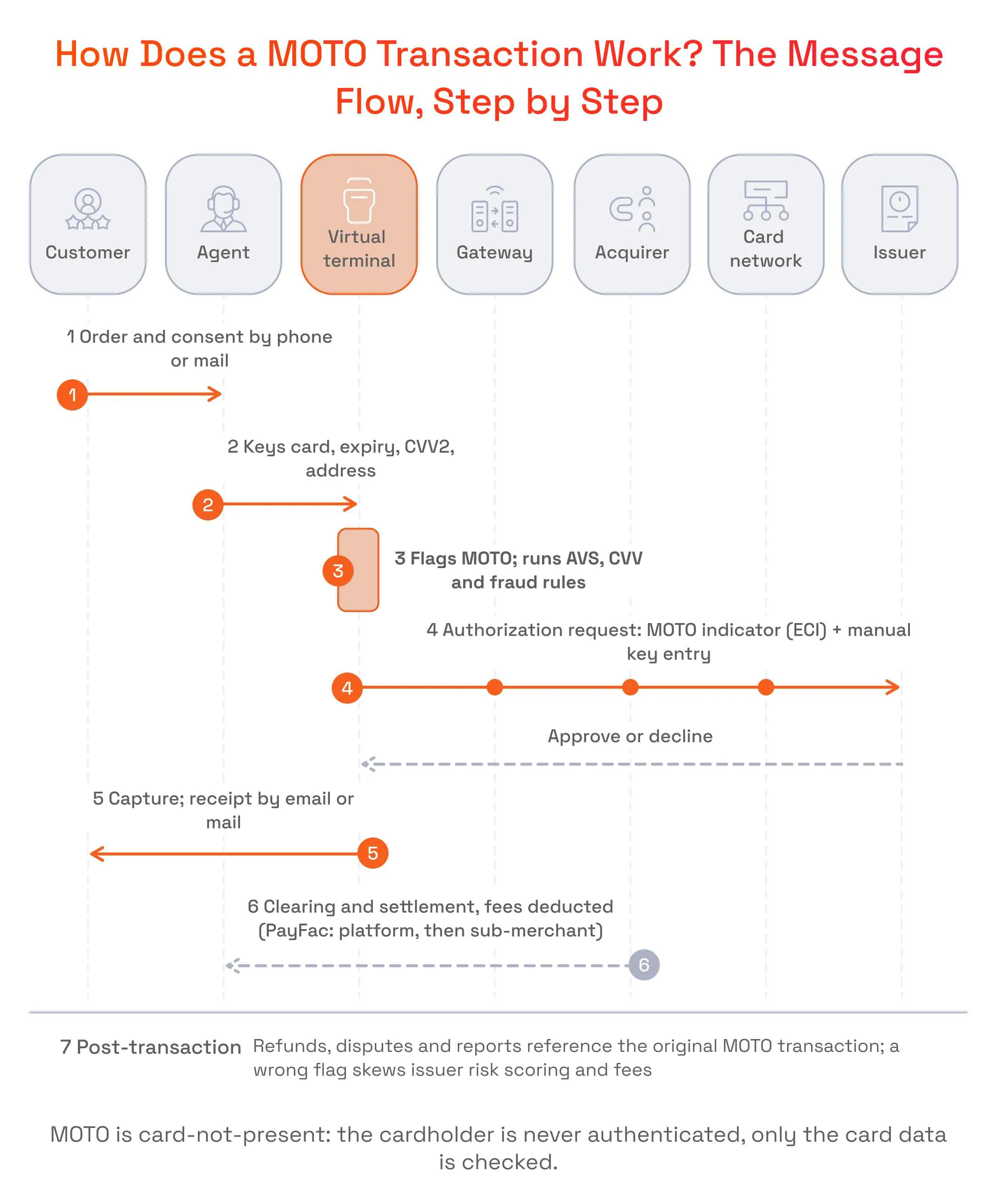
- Order and consent. The customer places the order by phone or mail and authorizes the charge.
- Data capture. The agent keys card number, expiry, CVV2 and billing address into the virtual terminal, which runs in a browser, or the customer enters digits on the keypad with DTMF capture.
- Flagging and screening. The terminal marks the transaction as MOTO and runs the address verification service, CVV and fraud rules.
- Authorization. The MOTO payment gateway sends the request to the acquirer, the card network and the issuer, which approves or declines.
- Capture and receipt. The merchant confirms the order, and the customer gets a receipt by email or mail.
- Clearing and settlement. Funds settle to the merchant, or for a PayFac, to the platform and then the sub-merchant, with fees deducted.
- Post-transaction. Refunds, disputes and reporting reference the original MOTO transaction.
The list does not show who owns each step. Capture, flagging, screening and the review queue run inside the platform, while merchant eligibility by category and the indicator values an acquirer accepts are set outside it. Working out how to accept MOTO transactions at the platform level starts with separating the steps you own from the ones you inherit.
How Is a MOTO Transaction Flagged?
Flagging happens inside the authorization request message, long before anything reaches a report. A commerce indicator, the ECI value, tells the issuer that the request came by mail or telephone, and gateways offer one-time, recurring and installment variants of it. Alongside it sit a POS entry mode showing the numbers were keyed manually and a card-not-present condition code.
The flag sets off a chain. Issuer risk models read the transaction type before they decide, which moves approval rates, and it sets the interchange category, which moves cost. It also sets dispute rights and fraud reporting, which decide who absorbs a loss. Set it wrong, and MOTO transactions get scored, priced and disputed as something they are not.

Oleksandr Boiko
Delivery Director at SPD Technology
“The mistake I see most often is a platform treating the MOTO indicator as a label for reporting. It travels inside the authorization message, so the issuer’s risk model reads it before it approves anything, and a payment flagged as eCommerce when an agent keyed it by hand gets scored against rules it was never going to satisfy. The merchant sees declines they cannot explain, and nobody looks at the flag, because the payment looks ordinary everywhere else.”
Card-Present vs. Card-Not-Present Transactions: Where Do MOTO Payments Fit?
MOTO belongs with card-not-present transactions, alongside eCommerce: no physical card is read, and the merchant has no proof of the sale beyond what the customer says. The two differ at authentication. A chip payment reads data from a card the terminal can see, with the cardholder present to approve it, which is the assumption behind custom POS software development. Phone and mail orders prove neither.
Transaction Attribute | Card-Present (POS) | Card-Not-Present: eCommerce | Card-Not-Present: MOTO |
|---|---|---|---|
How card data is captured | Chip, contactless or swipe on a terminal | Customer enters it on a checkout page | Agent keys it from a call or letter |
Cardholder authentication | Chip and PIN or signature, CDCVM on mobile wallets | 3-D Secure where supported or required | None beyond AVS and CVV |
3-D Secure / SCA | Not applicable | Required for most EEA payments under PSD2 SCA | Out of SCA scope (pure MOTO) |
Typical fees | Lowest | Higher than card-present | Higher than card-present, often at or above eCommerce |
Chargeback liability for fraud | Usually the issuer when the chip is used correctly | Shifts to the issuer after successful 3DS | Merchant |
Main fraud vector | Counterfeit, lost or stolen cards | Stolen card data, account takeover | Stolen card data, social engineering |
Transaction Attribute
How card data is captured
Cardholder authentication
3-D Secure / SCA
Typical fees
Chargeback liability for fraud
Main fraud vector
Card-Present (POS)
Chip, contactless or swipe on a terminal
Chip and PIN or signature, CDCVM on mobile wallets
Not applicable
Lowest
Usually the issuer when the chip is used correctly
Counterfeit, lost or stolen cards
Card-Not-Present: eCommerce
Customer enters it on a checkout page
3-D Secure where supported or required
Required for most EEA payments under PSD2 SCA
Higher than card-present
Shifts to the issuer after successful 3DS
Stolen card data, account takeover
Card-Not-Present: MOTO
Agent keys it from a call or letter
None beyond AVS and CVV
Out of SCA scope (pure MOTO)
Higher than card-present, often at or above eCommerce
Merchant
Stolen card data, social engineering
Exact fee levels vary by card type, region, acquirer and pricing model, so the table compares direction only.
What Are the Risks and Costs of MOTO Payments?
MOTO payments cost more and carry more risk than card-present payments because neither the card nor the cardholder can be verified at the moment of sale. Everything downstream follows from that gap, from the interchange category the payment lands in to the party that pays when a cardholder disputes it.
Why Are MOTO Fees and Chargeback Liability Higher?
Interchange for card-not-present payments sits above card-present rates, and processors add their own CNP or virtual-terminal charges on top. Liability moves the same way. Without cardholder authentication, there is no liability shift, so a fraud chargeback lands on the merchant, as Adyen states in its MOTO documentation.
A sub-merchant that cannot cover those losses leaves the PayFac or ISO covering them, so MOTO exposure belongs in underwriting and reserve policy before the risk team ever sees a dispute.
How Do You Prevent Fraud on Card-Not-Present Transactions?
Preventing fraud with card-not-present transactions works by stacking narrow signals until they add up to a decision. No single check carries much weight alone. MOTO adds one more burden: an agent sits in the middle of every transaction and can be talked into overriding a decline.
Control | What It Checks | Where It Runs |
|---|---|---|
AVS (address verification service) | Billing address matches the issuer’s record | Gateway / issuer response |
CVV2 / CVC2 | Customer has the card’s security code, never stored after authorization | Gateway / issuer response |
Velocity checks | Too many attempts per card, agent, merchant or IP, often the first sign of suspicious activity | Platform risk engine |
Order-level rules | Mismatched shipping, high-risk goods, unusual amounts | Platform risk engine |
ML fraud scoring | Learned risk from transaction, card and merchant history | Platform risk engine |
Agent permissions and limits | Who can process payments, refund or override declines, and amount caps | Virtual terminal |
Review queue | Medium-risk payments held for an analyst before capture | Platform back office |
Callback verification | Calling the customer back on a known number for large orders | Merchant process |
Control
AVS (address verification service)
CVV2 / CVC2
Velocity checks
Order-level rules
ML fraud scoring
Agent permissions and limits
Review queue
Callback verification
What It Checks
Billing address matches the issuer’s record
Customer has the card’s security code, never stored after authorization
Too many attempts per card, agent, merchant or IP, often the first sign of suspicious activity
Mismatched shipping, high-risk goods, unusual amounts
Learned risk from transaction, card and merchant history
Who can process payments, refund or override declines, and amount caps
Medium-risk payments held for an analyst before capture
Calling the customer back on a known number for large orders
Where It Runs
Gateway / issuer response
Gateway / issuer response
Platform risk engine
Platform risk engine
Platform risk engine
Virtual terminal
Platform back office
Merchant process
Rules hold up for a while, until transaction volume and merchant mix outgrow them. Thresholds tuned for one merchant category start declining good payments in another, and the analysts working the overflow become the constraint. A review queue earns its place at the margin, where a payment with potential fraud waits for someone to call the customer back.
Money was vanishing into accounts customers did not recognize, and rules alone missed it. An eCommerce and financial services company brought the problem to SPD Technology, and a credit card fraud detection system took over the scoring. It sorts every payment into three bands: under 10% fraud probability, it goes through; 10% to 80% triggers step-up authentication; and above 80% it stops for review. Six months in production, it saved the client up to 40% of fraud losses, cut manual reviews by more than half and lifted checkout success by about 10%.
Ready to go deeper? See how machine learning models detect payment fraud in real time in our detailed guide.
Which PCI DSS Rules Apply to MOTO Payments: SAQ C-VT, Call Recordings and DTMF Masking?
Merchants that key MOTO payments one at a time into a PCI-validated virtual terminal hosted by a third party, and store no card data electronically, can usually validate with SAQ C-VT. Scope widens the moment card data reaches anywhere else, and a recorded call, an agent’s notepad or a spreadsheet of card numbers all count. Architecture decides this: a platform’s design sets the compliance burden its merchants inherit.
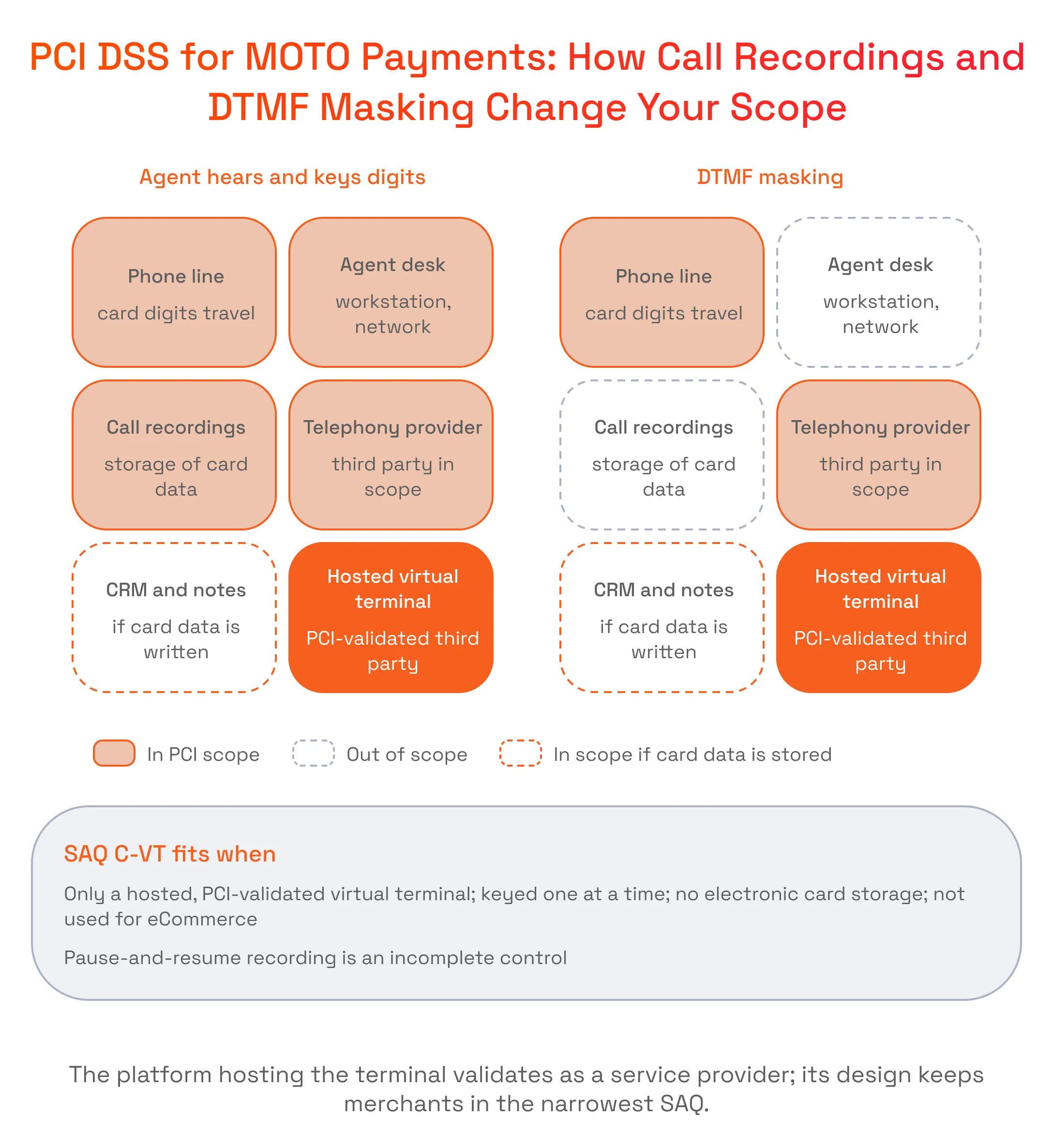
Eligibility rests on a short list of conditions that must all hold at once. The only card processing runs through a browser-based virtual terminal, provided and hosted by a PCI DSS-validated third party. Payments are keyed manually, one at a time, no card data is stored electronically, and the terminal is never used for eCommerce. The criteria come from the PCI Security Standards Council Document Library.
The isolation point is the one that catches platforms out. The device used for the virtual terminal must be isolated from other systems. Under v4.0.1, that can be done through network segmentation, but a terminal on the same PC as a mailbox and a CRM takes the merchant out of SAQ C-VT and into a longer questionnaire.
What Happens to Card Data | Effect on PCI Scope |
|---|---|
Agent hears digits and keys them into a hosted virtual terminal | Agent, workstation and network are in scope, and SAQ C-VT may apply where the workstation is isolated |
Calls are recorded with card numbers in them | Recording systems and storage come into scope, and sensitive authentication data such as CVV must never be stored after authorization |
Pause-and-resume recording | Reduces but does not reliably remove card data, and PCI SSC guidance treats it as an incomplete control |
DTMF masking | Card digits bypass the agent and the recordings, and contact-center scope shrinks sharply |
Card details written down, emailed or kept in a CRM | Storage is in scope, and SAQ C-VT no longer applies |
Third-party telephony or recording provider handles card data | That provider comes into scope too |
What Happens to Card Data
Agent hears digits and keys them into a hosted virtual terminal
Calls are recorded with card numbers in them
Pause-and-resume recording
DTMF masking
Card details written down, emailed or kept in a CRM
Third-party telephony or recording provider handles card data
Effect on PCI Scope
Agent, workstation and network are in scope, and SAQ C-VT may apply where the workstation is isolated
Recording systems and storage come into scope, and sensitive authentication data such as CVV must never be stored after authorization
Reduces but does not reliably remove card data, and PCI SSC guidance treats it as an incomplete control
Card digits bypass the agent and the recordings, and contact-center scope shrinks sharply
Storage is in scope, and SAQ C-VT no longer applies
That provider comes into scope too
Responsibility splits along the same line. A platform hosting the terminal is a service provider and validates through an ROC and an AOC, while each merchant validates its own environment with the right SAQ. Keeping merchants eligible for SAQ C-VT is a design job: masked PANs in every report, no card data in notes or exports, and DTMF or payment-link capture for call centers. Those choices keep payment data out of systems never built to protect it, which is where breaches tend to start. The PCI SSC’s guidance on protecting telephone-based payment card data covers the recording side.
SPD Technology built an embedded lending platform for a US SMB lender from scratch over 18 months, to PCI DSS, GDPR and KYC/KYB requirements, with sensitive data handling designed into the architecture. The platform has funded more than 4,000 businesses and facilitated over $350 million in financing.
Working through PCI scope across a whole platform? Our full PCI DSS compliance checklist covers the cardholder data environment end to end.
Can MOTO Payments Be Recurring or Installment Payments?
MOTO payments can run as recurring or installment charges through stored credentials. A merchant takes the first payment by phone or mail, stores the card as a tokenized credential with consent, and runs later charges as merchant-initiated transactions linked to the first one. Subscriptions, service plans and installment arrangements sold over the phone all work this way, so repeat purchases no longer depend on an agent re-keying card details every cycle.
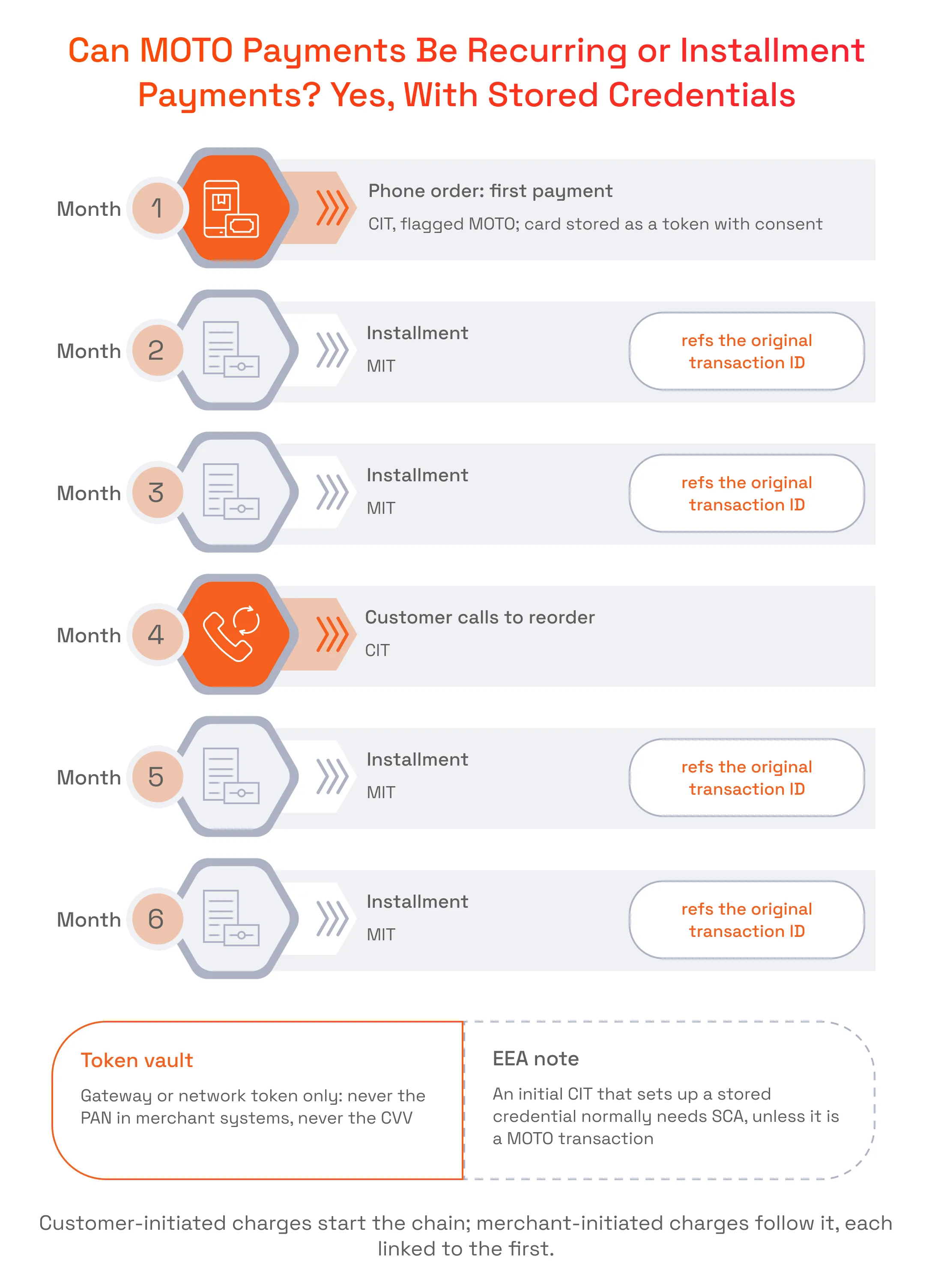
The first transaction is flagged as establishing the credential and carries consent terms for amount and frequency, recorded alongside it. Later charges then split into two. A customer who calls again to reorder starts a customer-initiated transaction, while a scheduled subscription or installment run is merchant-initiated and references the original transaction ID.
What gets stored is a gateway or network token, a reference the merchant can charge without holding the card number. The PAN never sits in merchant systems, and the CVV is never stored. Acquirers that support them expose MOTO indicator variants for recurring and installment charges, which keeps the channel visible for the life of the arrangement.
In the EEA, an initial customer-initiated transaction that sets up a stored credential normally needs strong customer authentication unless it is a MOTO transaction, per network and gateway documentation.
- Consent capture, with amount and frequency recorded against the credential
- Token vault holding gateway or network tokens
- Original transaction ID stored with every stored-credential agreement
- Retry logic and account-updater handling for reissued or expired cards
- Cancellation flow that the merchant and the cardholder can both trigger
Do MOTO Payments Need 3-D Secure?
Pure MOTO payments sit outside 3-D Secure and, in the EEA, outside PSD2 strong customer authentication, because the customer does not initiate them electronically. PSD2 recital 95 and the EBA Q&As on mail and telephone orders are the source of that exemption.
The EBA and ECB 2025 Report on Payment Fraud found fraud rates for card payments authenticated with strong customer authentication consistently and substantially below those without it. Missing authentication changes the risk profile, not only the liability rule.
Edge cases are where this catches people out. The EBA has said card payments keyed by the payee are not automatically MOTO, which pulls in hotel bookings. Whether IVR counts as a telephone order was put to the EBA as Single Rulebook Q&A 2018_4058. Until your acquirer confirms how it treats IVR, do not flag internet-based IVR or voice-assistant payments as MOTO.
No authentication also means no liability shift, so fraud chargebacks stay with the merchant. That is why a MOTO flag cannot be used to keep an online payment out of SCA, and acquirers watch for that misuse. Outside the EEA, 3DS stays optional for eCommerce in many markets, and MOTO sits outside it wherever the networks define the channel this way.
What Do Payment Platforms Need to Offer MOTO to Their Merchants?
To offer MOTO safely, a platform needs a hosted virtual terminal with correct MOTO flagging, card-not-present fraud controls, tokenized stored credentials, settlement and dispute reporting, audit logs and a PCI design that keeps merchants in the narrowest SAQ. None of those pieces is exotic. The work is in making them agree with the acquirer’s rules.
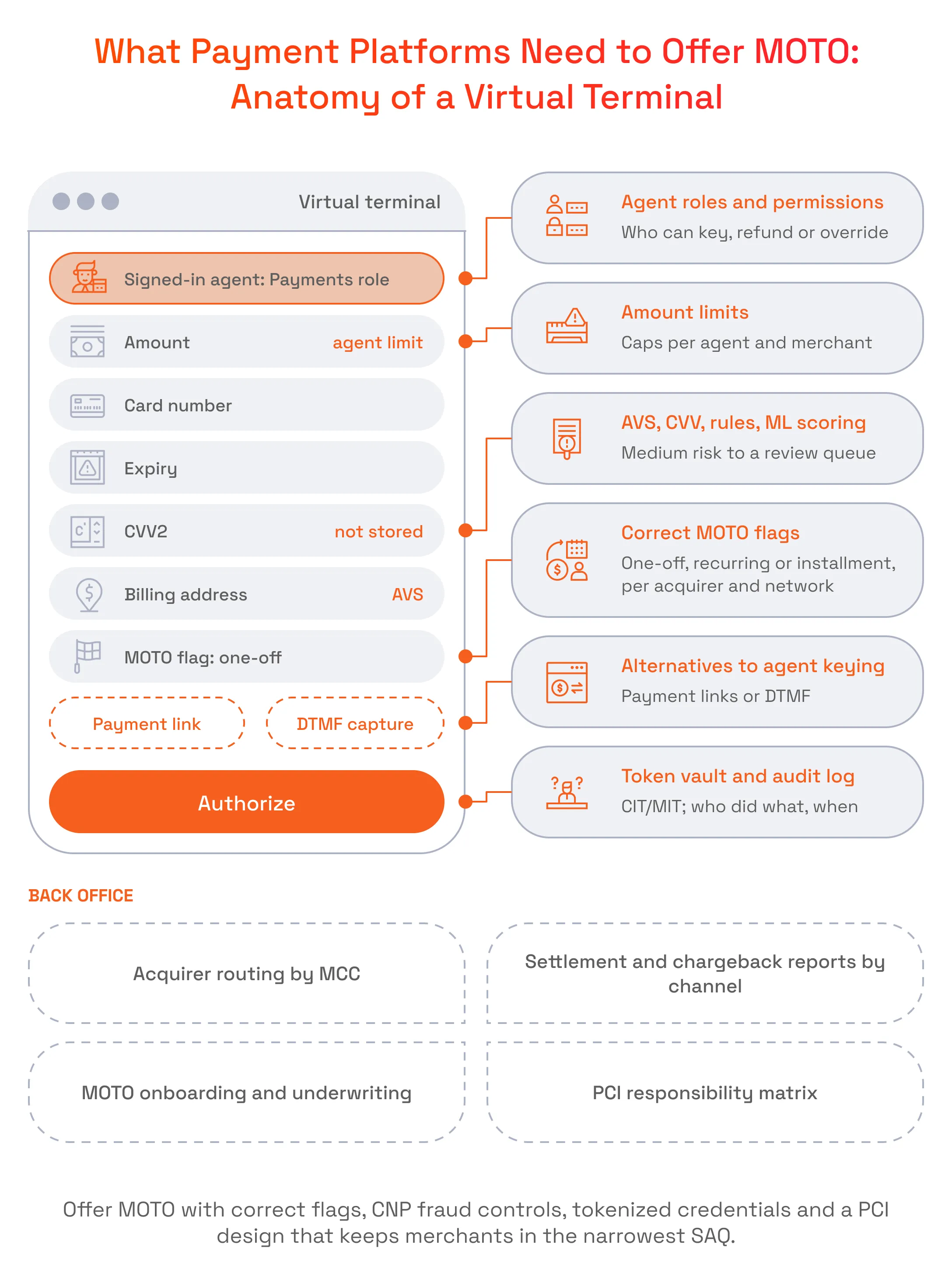
A terminal can look complete in a demo and still miss what only surfaces at volume, such as agent-level permissions or a token vault that survives a card reissue. Those gaps cost little during the build and a lot afterward.
- Virtual terminal software: hosted, browser-based, with agent roles, permissions and amount limits
- Correct MOTO, recurring and installment flags per acquirer and network
- Acquirer and processor routing, including which acquirers allow MOTO for which merchant categories
- AVS and CVV handling, a rules engine, ML scoring and a review queue
- Token vault and stored-credential framework covering CIT/MIT and original transaction IDs
- Payment links or DTMF capture as alternatives to agent keying
- Settlement, fee and chargeback reporting that separates MOTO from other channels
- Audit logs showing who keyed, refunded or overrode what, and when
- Merchant onboarding and underwriting rules for MOTO, covering eligibility, limits and reserves
- PCI responsibility matrix placing the platform as a service provider and merchants on SAQ C-VT
Most platforms already cover half of this in their eCommerce stack, including the rules engine, the token vault and settlement reporting. MOTO adds the flagging layer, agent-level controls and a PCI story that holds up when a merchant’s auditor asks where the card number goes.
Routing comes first in practice. Which acquirers allow MOTO for which merchant categories shapes everything downstream, and merchant payment gateway development is where that gets settled. Eligibility rules move upstream into merchant onboarding, where limits, reserves and MOTO permissions are set before a MOTO merchant account goes live. A merchant account underwritten for card-present volume rarely covers MOTO without a fresh review, so the two get scoped together.
More than 30 hours of manual work a day disappeared from Poynt’s operations after SPD Technology automated POS terminal registration and activation, together with SSO integration with a third-party partner portal, within a partnership with the US payments platform that has run for more than five years. Audit logs of who keyed, refunded or overrode a payment sit in the same layer, and a dispute six months later is usually what makes somebody read them.
Settlement reporting that separates MOTO from other channels turns the channel into a line item. SPD Technology built a merchant settlement platform with automated report generation and commission calculation for Blackhawk Network, which had produced those reports by hand. It now serves more than 37,000 users. The responsibility split underneath is familiar ground for PayFac platform development, where one platform sits between the acquirer and hundreds of sub-merchants.
Phase | Scope | Indicative Duration |
|---|---|---|
1. Discovery | Acquirer requirements, MOTO eligibility by MCC, PCI scope, fraud baseline | 2–4 weeks |
2. Core terminal | Virtual terminal UI, agent roles, MOTO flagging, authorization and capture, acquirer certification | 6–10 weeks |
3. Risk and credentials | AVS/CVV rules, velocity, review queue, token vault, CIT/MIT | 4–8 weeks |
4. Reporting and compliance | Settlement and dispute reports, audit logs, PCI evidence | 3–6 weeks |
5. Rollout | Pilot merchants, monitoring, fraud model tuning | 2–4 weeks |
Phase
1. Discovery
2. Core terminal
3. Risk and credentials
4. Reporting and compliance
5. Rollout
Scope
Acquirer requirements, MOTO eligibility by MCC, PCI scope, fraud baseline
Virtual terminal UI, agent roles, MOTO flagging, authorization and capture, acquirer certification
AVS/CVV rules, velocity, review queue, token vault, CIT/MIT
Settlement and dispute reports, audit logs, PCI evidence
Pilot merchants, monitoring, fraud model tuning
Indicative Duration
2–4 weeks
6–10 weeks
4–8 weeks
3–6 weeks
2–4 weeks
Cost moves with scope: the number of acquirers and networks, the depth of fraud tooling, the reach of stored credentials, the PCI validation level and merchant volume. A platform that treats MOTO virtual terminal development as a channel build ends up with a terminal its merchants can trust.
Want the wider picture? See how terminals and virtual terminals fit into the merchant lifecycle in our dedicated guide
How SPD Technology Builds Payment Platforms End to End
SPD Technology builds payment platforms end to end, covering processing, settlement, merchant onboarding, terminal management and fraud tooling. Since 2006, 650+ talents and 460+ delivered projects sit behind that work, with one team owning both architecture and execution.
Poynt, a US payments and open-commerce platform, needed one omnicommerce payment system where processing had been stitched together from separate pieces. SPD Technology delivered full-cycle payment processing, settlement and a third-party integration API on the PayFac model in five months. The partnership has run for more than five years, and SPD Technology was retained after the company was acquired.
Automated OFAC, EIN and SSN checks replaced a manual compliance review in the aggregated merchant portal built for Blackhawk Network, alongside self-service registration and Salesforce lead automation. Onboarding dropped from seven days to under 24 hours, and more than 8,000 US businesses joined the platform in two years.
SPD Technology is an Adyen service partner and an AWS Select Tier Services Partner, and any change touching payments or personal data passes a dedicated security-review gate. That work sits inside a wider fintech software development practice covering PCI DSS, PSD2, AML/KYC and production payment orchestration.
Conclusion
MOTO is a card-not-present channel with its own flags, fees, liability position, PCI scope and authentication rules. A platform that builds those differences into its virtual terminal gives merchants a way to take phone and mail orders without inheriting avoidable fraud and compliance risk. Those decisions get made once, at design time, and merchants live with them for years.
A terminal that handles MOTO payments without correct flagging, agent-level limits and a clean PCI responsibility split can still ship and still take money. The cost arrives later, in declines nobody can explain and a compliance scope that grew while nobody was watching. Which parts to build first is a scoping conversation, and it is cheaper before the terminal ships.
Key Takeaways
- Because MOTO payments are card-not-present and unauthenticated, they carry higher processing fees and leave fraud chargeback liability with the merchant.
- Incorrect MOTO flagging distorts issuer risk decisions, interchange and dispute handling, so flags must match the acquirer’s and the network’s specifications.
- Merchants can use SAQ C-VT only when they key payments one at a time from an isolated computing device into a PCI-validated hosted virtual terminal and store no card data electronically; under v4.0.1, the isolation can be achieved through network segmentation.
- DTMF masking keeps card digits away from agents and recordings, which shrinks contact-center PCI scope more reliably than pause-and-resume.
- Recurring MOTO payments run on tokenized stored credentials with later charges sent as merchant-initiated transactions, because re-keying card numbers recreates the original risk every cycle.
- Pure MOTO payments sit outside 3-D Secure and PSD2 SCA, so platforms need CNP fraud controls such as AVS, CVV, velocity rules, ML scoring and review queues.
- A platform that builds flagging, fraud tooling, credential handling and a PCI responsibility split into its virtual terminal can offer MOTO without pushing risk onto merchants or onto itself.
In short: a MOTO channel is safe to offer once the platform owns the flag, the fraud controls, the stored credential and the PCI boundary.
FAQ
What is the difference between MOTO and eCommerce card payments?
Both are card-not-present transactions. They differ in who enters the card details and whether the cardholder is authenticated. In eCommerce, the customer enters the details on a checkout page that may use 3-D Secure, which can shift fraud liability to the issuer. In MOTO, an agent keys the details from a phone call or a letter, with no authentication, and the merchant keeps the liability.
Are MOTO payments safe for merchants?
MOTO payments are safe for merchants when controls that substitute for authentication are in place. Address verification, security code checks, velocity checks, order-level rules, agent-level permissions and a review queue do the work that 3-D Secure does elsewhere. Without them, the merchant carries the liability for fraudulent transactions with nothing else to rely on.
Which PCI DSS SAQ applies to MOTO payments?
SAQ C-VT is for merchants that manually key individual transactions into a PCI-validated virtual terminal provided and hosted by a third party, and store no card data electronically. The device used to reach that terminal must be isolated from other locations and systems, for example through network segmentation. Call recordings with card numbers, card data kept in a CRM or any other electronic storage move the merchant to SAQ D.
Can MOTO payments be used for subscriptions or installments?
Yes, through stored credentials. The first payment by phone or mail is marked as establishing the credential, with the amount and frequency recorded, and the card is stored as a token. Later payments run as merchant-initiated transactions that reference the first transaction ID, so the issuer treats them as one agreement. Re-keying the card number each time would recreate the original risk.
Do MOTO transactions require 3-D Secure?
No. Pure mail and telephone orders sit outside 3-D Secure and, in the EEA, outside PSD2 strong customer authentication, because the cardholder does not initiate them electronically. The trade-off is that there is no liability shift, so fraud chargebacks stay with the merchant. Acquirers also watch for online payments flagged as MOTO to avoid authentication, which is misuse.
How do you accept MOTO transactions?
To accept MOTO payments, a merchant needs a MOTO merchant account from a processor that permits the channel for its merchant category, a virtual terminal and a process for taking card details. The agent keys the details, or the customer enters them on the keypad through DTMF capture. The terminal flags the payment as MOTO before authorization, and MOTO transactions then clear and settle on the normal card rails.
What is DTMF masking in phone payments?
DTMF masking lets the customer enter card digits on the phone keypad during the call, with the tones masked so neither the agent nor the recording captures them. The card details go directly to the payment processor without passing through the contact center, which sharply reduces the contact center’s PCI scope.
How can merchants reduce MOTO fraud?
Merchants replace the missing authentication with additional checks. Address verification and CVV, velocity controls per card and per agent, and order-level rules stop most automated attacks, while callback verification to a known number catches social engineering the other checks miss. Suspicious activity in a MOTO merchant account often starts with an agent override, not only a stolen card, so permissions and amount caps belong in the same control set.
How much does it cost and how long does it take to build a MOTO virtual terminal?
A build typically runs 17 to 32 weeks (about 4 to 8 months) across five milestones: discovery, core terminal, risk and credentials, reporting and compliance, and rollout. Most of the time goes into the core terminal and risk and credentials milestones, which together take 10 to 18 weeks and include acquirer certification.
For comparison, SPD Technology estimates a custom payment gateway MVP covering one country and currency runs $160,000 to $250,000, and a production-grade gateway runs $500,000 to $2 million. A MOTO virtual terminal is a narrower build that rides on gateway and settlement infrastructure already in place, so it sits below the gateway MVP figure. Acquirer count, fraud tooling depth, PCI validation level and merchant volume move it within that band.