

Choosing whether to build vs buy a payment platform involves three distinct options: building entirely in-house, buying a SaaS subscription, or co-building owned infrastructure with an experienced engineering partner. An in-house build typically demands 9 to 18 months of development alongside continuous security overhead. Most of the real engineering investment sits in the underlying abstraction layer, PCI DSS compliance, automated ledger reconciliation, and dispute resolution workflows rather than the initial payment gateway connection.
A working sandbox integration with one PSP feels like the hard part of the decision is already done. It isn’t — a sandbox integration and a production payment platform are different projects, and the distance between them is exactly where teams underestimate scope.
Most teams start this evaluation assuming there are only two options: build everything internally, or rent a vendor’s SaaS engine. That framing obscures the underlying technical realities and forces engineering leaders into unnecessary compromises. According to Accenture’s research, financial institutions and software platforms investing in a strong owned payments core can unlock a $55 billion efficiency and revenue opportunity. Navigating this decision requires evaluating the true scope of custom payment infrastructure, analyzing long-term operational costs, and reviewing alternative deployment models. You can explore the ways fintech companies build payment platforms to see how industry leaders structure these core systems.
What “Building” a Payment Platform Actually Involves
Engineering teams evaluating a custom build often focus initial estimates on basic API integrations, yet single-PSP connections represent only the surface area of production systems. A functional platform requires persistent state tracking, multi-region compliance, and deep settlement orchestration across diverse financial networks.
Component | What It Involves |
|---|---|
Multi-PSP abstraction / integration layer | Normalizing different APIs, webhook formats, and authentication models across PSPs so the core platform doesn’t need PSP-specific logic |
Tokenization and card data handling | Managing token lifecycle across providers, since tokens generally aren’t portable between PSPs, while minimizing PCI scope |
PCI DSS compliance infrastructure | Encryption, network segmentation, access controls, audits — Level 1 status kicks in at a materially lower transaction threshold for service providers than for merchants |
Reconciliation and settlement | Matching transactions to settlements across multiple PSPs with different formats, timelines, and fee structures |
Dispute and chargeback handling | Provider-specific evidence requirements, response deadlines, and notification mechanisms, unified into one workflow |
Multi-currency and regulatory compliance | Currency conversion, cross-border fees, and region-specific requirements (e.g., SCA in Europe) as the platform expands |
Component
Multi-PSP abstraction / integration layer
Tokenization and card data handling
PCI DSS compliance infrastructure
Reconciliation and settlement
Dispute and chargeback handling
Multi-currency and regulatory compliance
What It Involves
Normalizing different APIs, webhook formats, and authentication models across PSPs so the core platform doesn’t need PSP-specific logic
Managing token lifecycle across providers, since tokens generally aren’t portable between PSPs, while minimizing PCI scope
Encryption, network segmentation, access controls, audits — Level 1 status kicks in at a materially lower transaction threshold for service providers than for merchants
Matching transactions to settlements across multiple PSPs with different formats, timelines, and fee structures
Provider-specific evidence requirements, response deadlines, and notification mechanisms, unified into one workflow
Currency conversion, cross-border fees, and region-specific requirements (e.g., SCA in Europe) as the platform expands
A single-PSP integration is genuinely simple, allowing a senior engineer to prototype the happy path within a single sprint. Production payment infrastructure demands building every layer detailed in the matrix above, which represents where the true engineering investment goes. Architectures utilizing a payment orchestration platform development strategy isolate these multi-PSP integrations behind unified APIs.
Implementing payment security architecture further contains sensitive cardholder data boundaries. According to McKinsey’s 2025 Global Payments Report, routing logic, fraud detection, and liquidity management are moving directly into software agents and APIs, replacing the legacy batch systems that carried this logic before.
These requirements force engineering teams to design flexible payment orchestration layers early in the technical roadmap.
What It Actually Costs and How Long It Takes to Build a Payment Platform
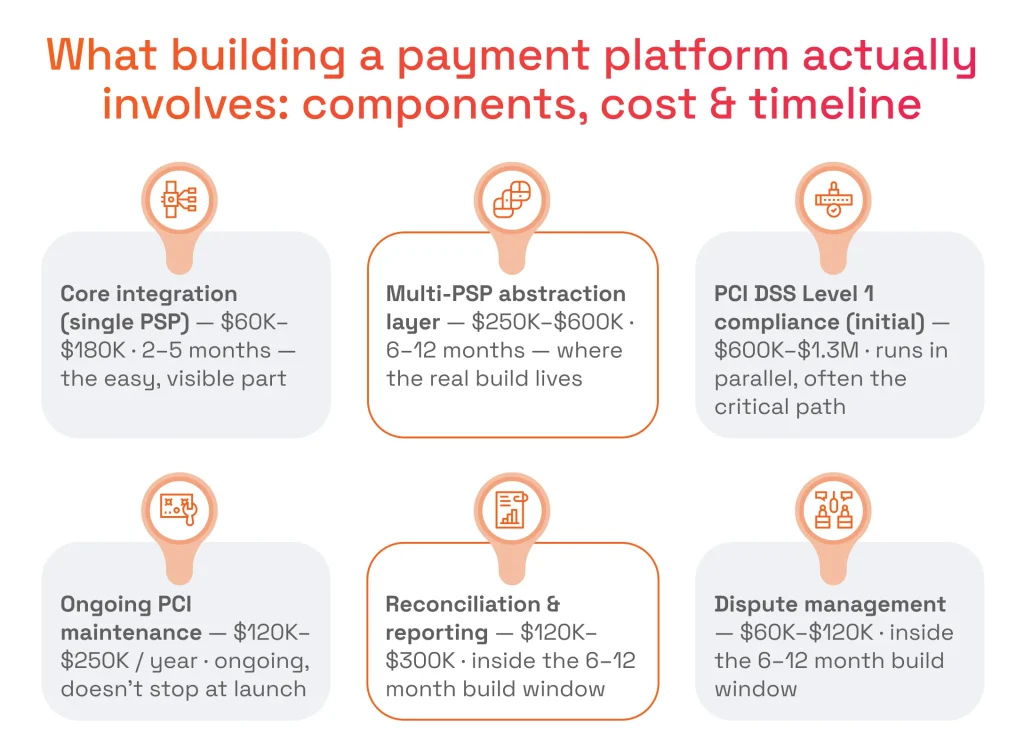
Determining accurate total cost of ownership requires looking beyond initial engineering salaries to account for ongoing maintenance, audit fees, and specialized vendor services. Capital expenditure during year one consists primarily of specialized architecture design, compliance hardening, and infrastructure automation.
The figures below are illustrative USD estimates based on prevailing market rates and typical build phases. They should be treated as approximate and verified against current benchmarks before finalizing budget allocations.
Component | Typical Cost Range (Year 1) | Typical Timeline |
|---|---|---|
Core integration (single PSP) | $60K–$180K | 2–5 months |
Multi-PSP abstraction layer | $250K–$600K | 6–12 months |
PCI DSS Level 1 compliance (initial) | $600K–$1.3M | Runs in parallel, often the critical path |
Ongoing PCI maintenance | $120K–$250K / year | Ongoing |
Reconciliation & reporting | $120K–$300K | Included in the 6–12 month build window |
Dispute management | $60K–$120K | Included in the 6–12 month build window |
Component
Core integration (single PSP)
Multi-PSP abstraction layer
PCI DSS Level 1 compliance (initial)
Ongoing PCI maintenance
Reconciliation & reporting
Dispute management
Typical Cost Range (Year 1)
$60K–$180K
$250K–$600K
$600K–$1.3M
$120K–$250K / year
$120K–$300K
$60K–$120K
Typical Timeline
2–5 months
6–12 months
Runs in parallel, often the critical path
Ongoing
Included in the 6–12 month build window
Included in the 6–12 month build window
These figures cover direct software development and compliance expenses, excluding the strategic opportunity cost incurred by diverting core engineering capacity. Capital investments in payment operations automation mitigate long-term operational friction, yet base system maintenance remains a permanent operational line item.
Three Paths, Not Two: Build, Buy, or Build a Payment Platform With a Partner
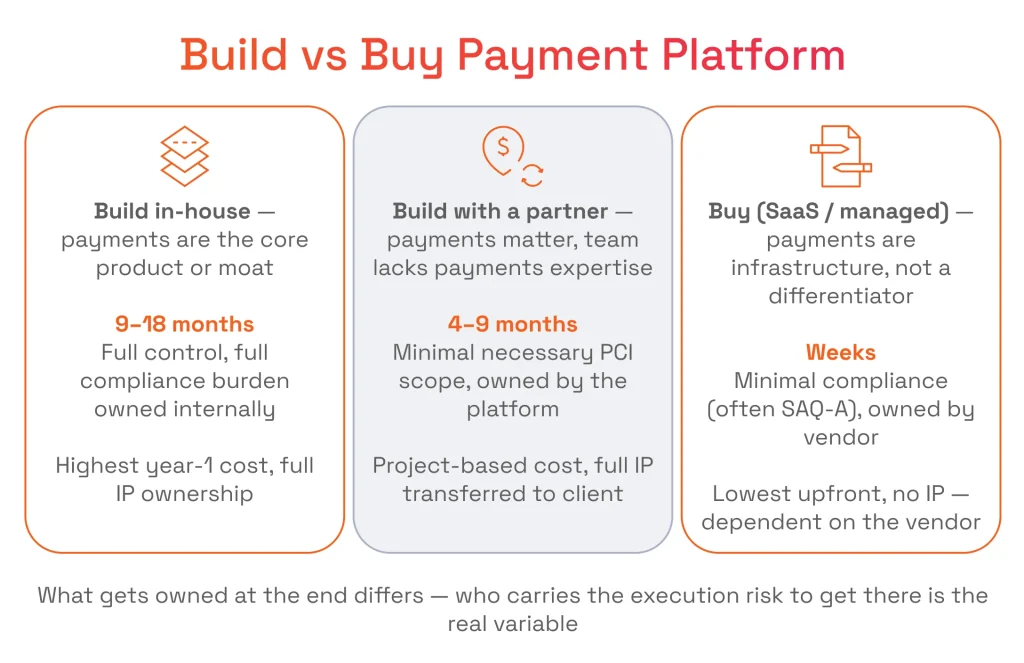
Engineering leaders usually frame this choice as a rigid binary — build everything internally, or rent a vendor’s SaaS engine. There’s a third option in between: co-building custom, fully owned payment infrastructure with a specialized engineering partner. No subscription overhead, no rigid API constraints from someone else’s platform, and no months spent teaching an internal team PCI boundaries and settlement matching from a standing start. What the client ends up owning — the IP, the architecture, the source code — doesn’t change. What changes is who carries the execution risk of getting there, and engineers who ship payment gateways for a living tend to carry it better than a team doing this for the first time. Fintech development outsourcing built around that model gets production systems live without a business absorbing the learning curve itself.

Oleksandr Boiko
Delivery Director at SPD Technology
“Co-building custom payment platforms with an engineering partner is fundamentally different from both software rental and unguided internal development. You are not licensing someone else’s black-box infrastructure or forcing your engineering leads to discover subtle edge cases in card network tokenization and ledger idempotency through trial and error. You are capturing existing production knowledge to construct a proprietary platform that your internal team fully owns and operates from day one.”
When Building a Payment Platform In-House Makes Sense
Building custom infrastructure internally is optimal when payment processing forms the core revenue engine or primary competitive differentiator of the business. Companies requiring proprietary risk-scoring models, deeply custom transaction routing, or micro-level authorization controls benefit directly from complete internal ownership. Achieving custom control often leads software platforms toward PayFac platform development to capture transaction margins directly. Internal builds are justified when an organization maintains the capital, specialized security talent, and long-term commitment required to operate a payments core indefinitely.
When Buying a Payment Platform Makes Sense
Buying a SaaS or managed payment gateway fits best when payment processing is a supporting utility, not something the business differentiates on — here, shipping speed matters more than owning the stack. That calculus shows up most clearly when engineering time is scarce: handing compliance, gateway integration, and tokenization to a vendor keeps the team focused on the product features that actually move the business forward. Margins in this space are already thin and getting thinner — Deloitte’s research found merchant-acquiring margins have dropped roughly 30% over five years, with 2024 marking the slowest payments-revenue growth the industry has seen in a decade. Against that backdrop, flat vendor fees are simply the more economical bet than financing a custom build whose payoff depends on margins that keep compressing.
When Building a Payment Platform With a Partner Makes Sense
Partnering to build payment infrastructure makes sense when full strategic ownership, custom data control, and fee optimization are required, but internal teams lack specialized payment engineering experience. This path is ideal for platforms seeking to eliminate perpetual SaaS rev-share commitments without subjecting their internal teams to steep learning curves around PCI DSS isolation, complex ledger design, or multi-processor settlement automation. The business retains complete IP ownership while accelerating time to market.
Decision Framework: Build vs. Partner-Build vs. Buy for a Payment Platform
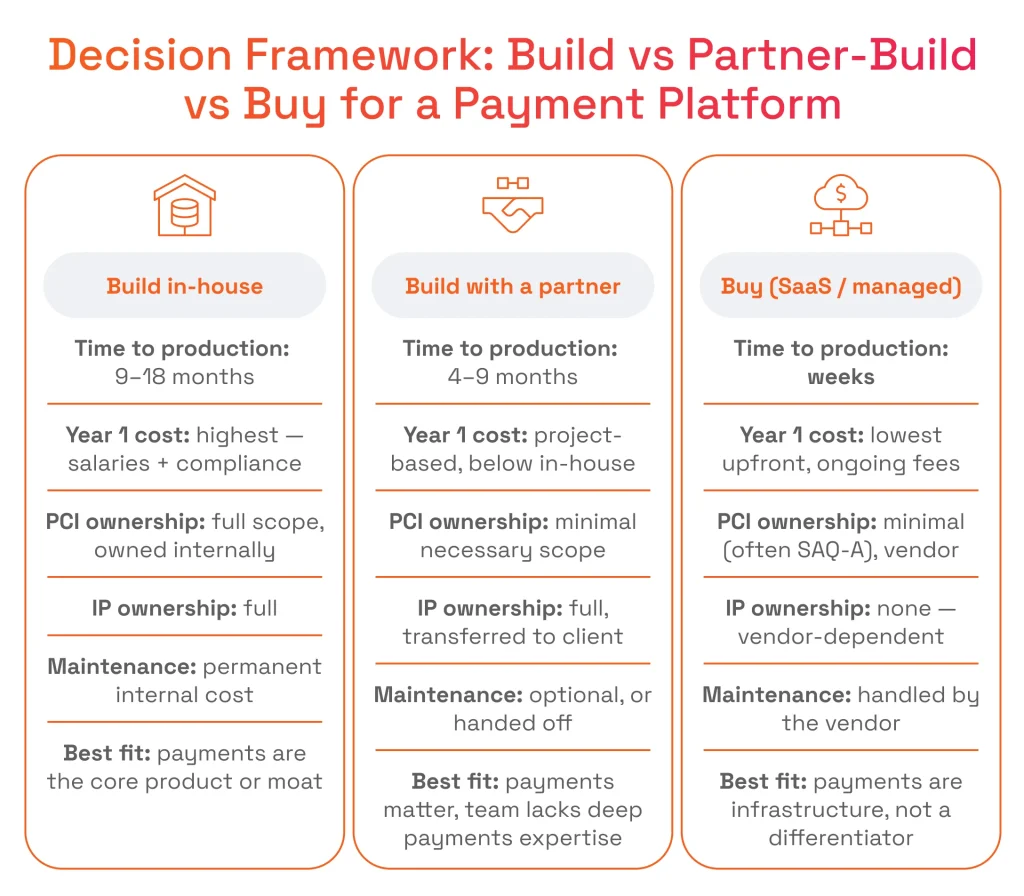
Evaluating these paths requires comparing structural trade-offs across development timelines, long-term costs, compliance burdens, and IP retention. The table below lines up all three paths against the factors that actually decide which one fits a given team.
Factor | Build In-House | Build With a Partner | Buy (SaaS / Managed) |
|---|---|---|---|
Time to production | 9–18 months | 4–9 months | Weeks |
Year 1 cost structure | Highest — fixed engineering salaries plus compliance | Project-based, typically below the cost of hiring an equivalent in-house team | Lowest upfront, ongoing per-transaction or subscription fees |
PCI compliance ownership | Full scope, owned and maintained internally | Architected for minimal necessary scope, owned by the platform | Minimal (often SAQ-A), owned by the vendor |
Long-term IP ownership | Full ownership | Full ownership, transferred to the client | None — dependent on the vendor’s platform |
Ongoing maintenance burden | Permanent internal engineering cost | Optional ongoing support, or handed off to the internal team | Handled by the vendor |
Best fit | Payments are the core product or moat | Payments matter strategically, team lacks deep payments expertise | Payments are infrastructure, not a differentiator |
Factor
Time to production
Year 1 cost structure
PCI compliance ownership
Long-term IP ownership
Ongoing maintenance burden
Best fit
Build In-House
9–18 months
Highest — fixed engineering salaries plus compliance
Full scope, owned and maintained internally
Full ownership
Permanent internal engineering cost
Payments are the core product or moat
Build With a Partner
4–9 months
Project-based, typically below the cost of hiring an equivalent in-house team
Architected for minimal necessary scope, owned by the platform
Full ownership, transferred to the client
Optional ongoing support, or handed off to the internal team
Payments matter strategically, team lacks deep payments expertise
Buy (SaaS / Managed)
Weeks
Lowest upfront, ongoing per-transaction or subscription fees
Minimal (often SAQ-A), owned by the vendor
None — dependent on the vendor’s platform
Handled by the vendor
Payments are infrastructure, not a differentiator
While buying offers the fastest route to launch, building with a partner provides the shortest path to an owned, production-ready system without absorbing the severe timelines and overhead of a solo in-house build.
Team and Skills Required If You Build a Payment Platform
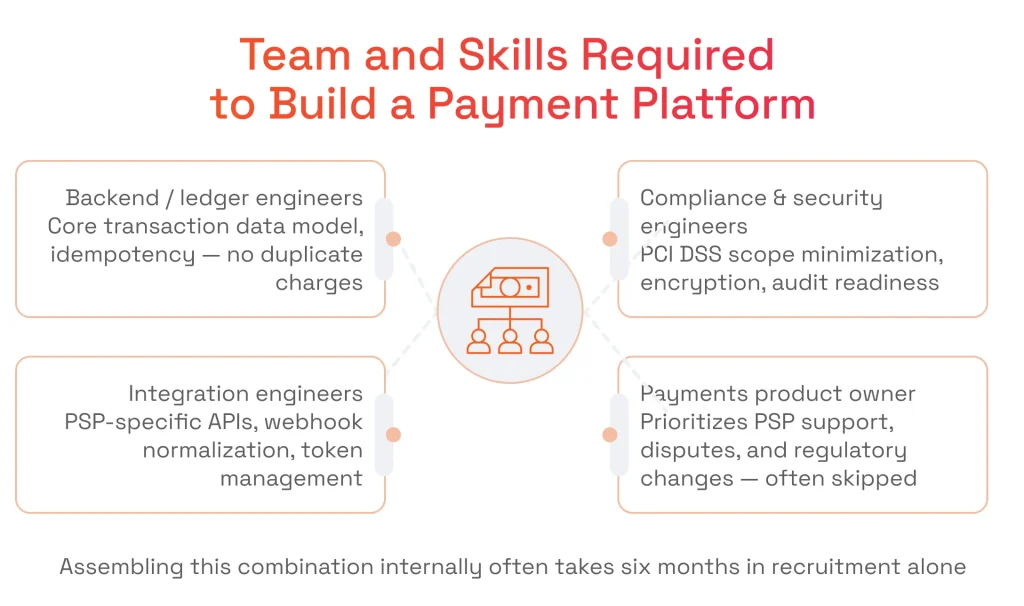
Constructing production-ready financial infrastructure demands specialized engineering domain expertise that differs significantly from standard full-stack web development. The roles below cover the disciplines a production build needs beyond generalist engineering capacity.
Role | Responsibility |
|---|---|
Backend / ledger engineers | Core transaction data model, multi-PSP abstraction layer, idempotency handling |
Integration engineers | PSP-specific API integration, webhook normalization, token management across providers |
Compliance and security engineers | PCI DSS scope minimization, encryption, network segmentation, audit readiness |
Payments product owner | Prioritization across PSP support, dispute workflows, and regulatory requirements as the platform evolves |
Role
Backend / ledger engineers
Integration engineers
Compliance and security engineers
Payments product owner
Responsibility
Core transaction data model, multi-PSP abstraction layer, idempotency handling
PSP-specific API integration, webhook normalization, token management across providers
PCI DSS scope minimization, encryption, network segmentation, audit readiness
Prioritization across PSP support, dispute workflows, and regulatory requirements as the platform evolves
Assembling this specific combination of specialized roles internally often takes six months or more in recruitment alone, which directly inflates the initial launch timeline and headcount risk of a solo build.
Common Pitfalls in the Payment Platform Build vs Buy Decision
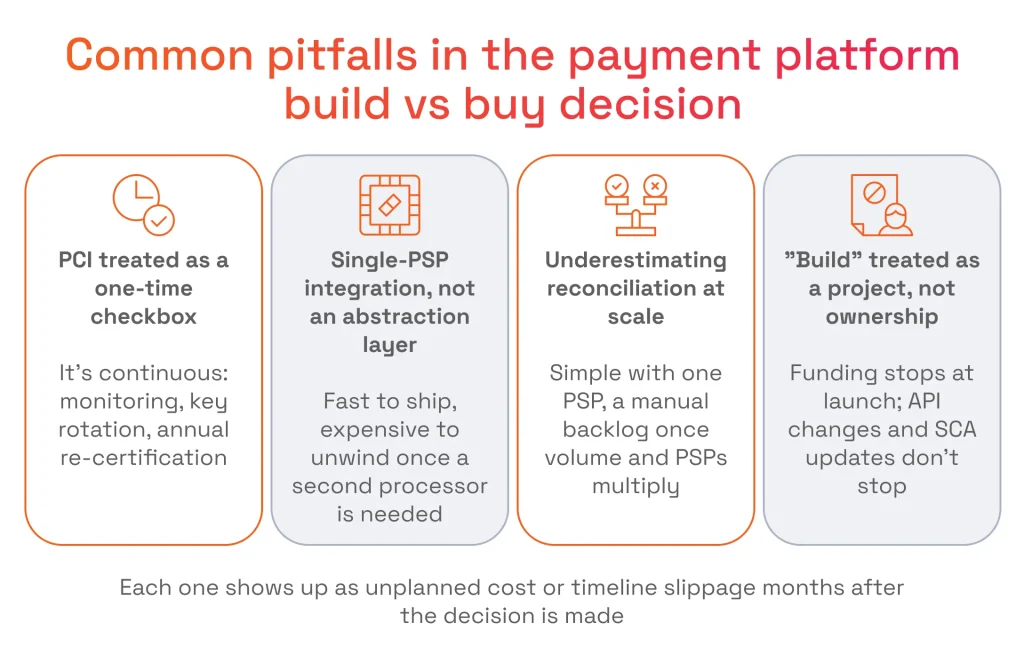
Teams evaluating build vs buy tend to make the same handful of scoping mistakes, and each one shows up as unplanned cost or timeline slippage months after the decision gets made. The four pitfalls below cover where that underestimation happens most often.
Underestimating PCI Compliance as a One-Time Checkbox
Engineering teams frequently treat PCI DSS compliance as a static audit to be cleared at launch, when in practice it’s a continuous operational burden. True compliance requires persistent log monitoring, automated key rotation, strict network isolation, and annual re-certification audits. Designing system boundaries incorrectly can bring entire backend databases into audit scope, multiplying compliance expenditures exponentially. Designing for tight tokenization boundaries keeps core application servers fully isolated from cardholder data environments.
Shipping an all-in-one omnicommerce payment processing system in 5 months for Poynt demonstrates that a production build is achievable well inside the 6–12 month range this article cites, even with rigorous security compliance built in from day one. That build covered full-cycle processing, settlement workflows, and third-party integration APIs inside a partnership spanning over 5 years. Securing early architectural validation through an established payment security architecture prevents inadvertent scope expansion during expansion.
Building a Single-PSP Integration Instead of an Abstraction Layer
Connecting directly to a single payment processor’s API allows engineering teams to ship an initial payment flow quickly during early development. That tight coupling creates severe technical debt when the business inevitably expands into new regions or requires secondary fallback processors. Refactoring a point-to-point processor connection into a flexible multi-PSP system requires rewriting core transaction logic, ledger routines, and checkout interfaces. Designing an abstraction layer from day one allows developers to add new gateways via configuration adjustments rather than complete code rewrites.
Underestimating Reconciliation as the Build Scales
Automating transaction reconciliation appears simple when processing test transactions through a single payment service provider. Operational friction escalates rapidly once the system handles thousands of daily transactions across multiple processors, processing schedules, fee structures, and payout windows. Mismatches between core application ledgers and processor settlement files generate manual investigation backlogs that consume extensive finance and engineering resources. Implementing merchant risk monitoring at scale along with automated, multi-currency ledger reconciliation prevents these operational and scaling bottlenecks.
Automated report generation and commission calculations built for Blackhawk Network’s Merchant Settlement Platform handle settlement workflows across 37,000+ users. That system architecture was refined through a partnership originating with NimbleCommerce in 2008 and extending over 7 years.
Treating “Build” as a Project With an End Date, Not Ongoing Ownership
Project plans often allocate funding exclusively up to launch day, ignoring the ongoing maintenance tax required to operate payment infrastructure. Payment gateways regularly update API versions, card networks modify mandatory security parameters, and regulatory jurisdictions update compliance requirements like SCA. Without dedicated maintenance budgets and clear domain ownership, critical security patches and integration maintenance compete directly against new product feature development. Partner-build frameworks explicitly scope knowledge transfer and long-term support so the client’s team can take over maintenance with confidence.
Our Expertise in Payment Platform Development
SPD Technology provides custom software development, backed by over 650 engineers and 460 delivered projects across a 20-year history. Architecture, execution, and security all sit with one team here — there’s no vendor hand-off partway through a build, and that’s the kind of domain expertise a standard dev shop working from a fixed feature list typically can’t match. Payment gateways, real-time orchestration engines, PCI-compliant platforms designed for direct client ownership — that’s the shape of what gets built. Accenture’s research backs up why this matters: owning flexible payments infrastructure creates significant long-term operational efficiencies for growing businesses.
Long-Term Ownership and Architecture Evolution
Decoupling a critical Reseller Portal from a legacy monolith for Poynt required a dedicated 8-person engineering team taking full technical ownership over a two-year engagement. This continuous architectural refinement demonstrates how long-term partner engagements support legacy modernization without interrupting live transaction flows.
Production-Grade, Idempotent Payment Processing
Sub-second reward attribution delivered for one of our clients utilizes direct Plaid connectivity and a custom card-linked offer engine built on an exactly-once processing architecture. Engineering this level of transactional idempotency guarantees system reliability and exact ledger consistency even during high-concurrency network spikes.

Whether your team requires end-to-end platform delivery, specialized engineers to solve complex ledger components, or post-launch technical support, our team tailors engagements directly to your roadmap.
Conclusion
Build vs buy for a payment platform was never going to resolve into a single right answer — the honest version of this decision balances time-to-market against long-term margins, engineering overhead, and how much control the business actually wants to keep. Off-the-shelf software gets you live fast, but that speed comes with a permanent fee tail and a platform you can’t fully shape to your own risk logic. Going fully in-house buys you the opposite trade: total control, at the cost of engineering time that could be going toward the core product, plus a compliance burden that doesn’t end at launch. The middle path is co-building — an experienced partner delivers a fully owned, tailored system, and your team skips both the fee tail and the years it would otherwise take to learn payments engineering from zero.
Key Takeaways
- The real cost of a payment platform isn’t the PSP integration — it’s the multi-PSP abstraction layer, PCI compliance, reconciliation, and dispute handling built around it.
- Single-PSP timelines run in months; multi-PSP builds run 6–12 months, with PCI Level 1 compliance often the critical path rather than the integration work itself.
- Buying trades control and long-term margin for speed, a trade-off sharpened by Deloitte’s finding that merchant-acquiring margins have dropped roughly 30% over five years.
- Building in-house makes sense when payments are a genuine competitive moat or when the platform needs sub-transaction-level control no vendor can offer.
- The partner-build path avoids both the in-house learning curve and indefinite vendor lock-in, transferring ownership of the resulting system to the client.
- Team composition — ledger engineers, integration engineers, compliance engineers, a payments product owner — determines in-house success more than budget size alone.
In short: build vs buy payment platform decisions come down to three real paths, and the right one depends on how strategically important payments are to the business, not just on cost or timeline in isolation.
FAQ
Should we build or buy our payment platform?
Whether to build or buy comes down to one question: is payment processing your competitive moat, or infrastructure your business needs but doesn’t compete on? A moat looks like custom transaction routing, proprietary risk scoring, or capturing processing margins yourself — and when that’s the driver, building custom infrastructure pays off long-term. Payments that are just an operational necessity point the other way, toward buying, since a SaaS solution frees up engineering time for the features that actually differentiate the product. The harder case is in between: payments matter enough strategically that you don’t want to hand them off entirely, but your team hasn’t built this kind of infrastructure before — that’s when co-building with an engineering partner gets you full ownership of the system without the cost of learning payment mechanics from zero.
How much does it cost to build a payment platform in-house?
Building a production-ready, multi-PSP payment platform in-house typically runs $600,000 to over $1,500,000 in first-year capital investment. That range covers engineering salaries, the multi-PSP abstraction layer, PCI DSS Level 1 compliance architecture, ledger reconciliation, and dispute management — the full list from earlier in this article, priced out. Compliance work doesn’t stop at launch, either: annual maintenance runs another $120,000 to $250,000, mostly for PCI re-certification, security patching, and keeping up with processor API changes. Treat all of these as a starting point rather than a quote — actual costs shift with team location, existing infrastructure, and how much of this scope a partner absorbs versus how much stays in-house.
How long does it take to build a payment platform?
A single-PSP integration is the fast part — 2 to 5 months if the scope stays narrow. Multi-PSP abstraction is where the real timeline lives: pairing that layer with automated reconciliation routines typically runs 6 to 12 months on its own. PCI DSS compliance work usually happens in parallel with all of it, and more often than not, it’s compliance — not the engineering — that ends up setting the launch date. Add it all together and a team building this in-house should expect 9 to 18 months before the platform is ready for real production volume.
What’s the difference between building in-house and building with a payment engineering partner?
Going in-house means your own team learns payments the hard way — designing core ledgers, working out tokenization boundaries, and getting through PCI DSS audits mostly by trial and error, since nobody’s done this before internally. A partner engagement moves that risk somewhere else: the people building the system have already shipped production payment architectures, so the mistakes get made once, elsewhere, before your codebase exists. What your team gets at the end is the same either way — full source code and IP ownership — but only one path gets you there without either an eighteen-month learning curve or a permanent vendor relationship you can’t leave.
What team and skills do you need to build a payment platform?
Building custom payment infrastructure takes a multi-disciplinary team — this isn’t a job for generalist full-stack engineers. Backend ledger engineers carry the core transaction data model and handle idempotency, since a duplicate charge is the kind of bug this system can’t tolerate. Integration engineers deal with the messier reality underneath that: every PSP normalizes its APIs, webhooks, and token vaults differently, and someone has to reconcile all of it into one internal interface. Compliance and security work is its own specialty too, mainly network segmentation designed to keep PCI DSS scope as narrow as it can be. One role that gets skipped in planning more often than it should is a dedicated payments product owner — without someone prioritizing processor updates, scheme rule changes, and dispute workflows as they come in, the other three roles end up fighting over what to build next.
Is PCI DSS compliance different depending on whether you build or buy?
Yes, compliance obligations shift depending on which path you take. A SaaS payment solution offloads most security overhead onto the vendor, and that’s often enough to qualify your business for the simpler SAQ-A reporting track instead of full certification. In-house builds don’t get that shortcut — your core backend environment comes into PCI scope, which means full Level 1 certification, regular penetration testing, and audit logging that doesn’t stop once the platform ships. The partner-build path sits in between: tokenization boundaries get designed specifically to keep sensitive data out of your own environment wherever possible, so the audit scope stays closer to what a SaaS buyer deals with than what an in-house build takes on.
Can you switch from a bought payment solution to a custom-built one later?
Migrating from a SaaS payment gateway to a custom platform is achievable. It isn’t quick, and it isn’t risk-free — data portability and operational continuity both take real planning before a migration starts. Token vault migration tends to be the hardest part, since cardholder tokens have to move between processors without ever exposing raw PAN data along the way. Beyond the tokens, a team also has to rebuild merchant-facing interfaces and reconnect reporting pipelines, and a new settlement reconciliation engine usually follows once those pieces are in place, because reconciliation logic built for a vendor’s platform rarely lines up with one built in-house. Doing the architectural evaluation before committing to a vendor is what keeps that whole sequence from turning into a rebuild nobody budgeted for.