

The custom vs. white-label payment platform choice trades speed and lower upfront cost against differentiation and lower long-term marginal cost.
A custom payment platform is built for one business, with full control over branding, backend logic, and infrastructure. A white-label payment platform is pre-built, often multi-tenant, rebranded, and launched quickly, with backend customization limited to vendor-supported configuration.
Launching payments on a licensed platform often feels like the low-risk path. Weeks to go live, a licensing fee against a build budget, and a vendor carrying the compliance posture. That reading holds until the business needs payments to do something specific.
The constraints that really matter are invisible in the course of evaluation. The vendor demonstrates the checkout flow, merchant dashboard, and branding capabilities – and each layer is accessible for customization by the tenants. The settlement logic, routing rules, and pricing policies live underneath in shared code and reveal themselves as constraints only when the business requests something the platform can’t do.
Now it’s time for the teams that haven’t planned on running payments at all. McKinsey’s 2026 analysis of integrated software vendors, the ISV adoption rate of US small- and medium-sized enterprises exceeded 90% by then, making the ISV channel transition from a specialized distribution layer into an integral component of the payments industry, thus making payments available together with the software, and the architecture choice along with it.
It must be stated clearly upfront: a white-label payment platform is a different model from integrating a PSP API. In this article, we will discuss both models, the feature set, the limitations revealed after deployment, the use cases of each model, the cost and time range, and the migration paths between them. The architecture decisions sitting underneath both models are the subject of how fintech companies build payment platforms, which covers the build side of the same question in depth.
What “Custom” and “White-Label” Actually Mean for a Payment Platform
A custom payment platform is built for one business and answers to one roadmap. That company owns branding decisions, business logic, infrastructure choices, and the cost of maintaining all of them. A white-label payment platform arrives pre-built and often multi-tenant, deployed under the client’s brand with UI theming and whatever configuration the vendor chooses to expose, often paired with reseller economics or an ISV-style revenue share.
Both instances may be referred to as a white-label payment gateway. Nevertheless, if an API is integrated into the process, the provider will still be present in the chain and in the merchant’s agreement. On the other hand, a true white-label system hides the provider behind everything.
NimbleCommerce went live as a global white-label eCommerce platform across the US, Canada, Mexico, Greece, the UK, and other European markets. It runs 27 third-party payment system integrations and a reporting and analytics module that applies AI to transaction data. SPD Technology was the sole tech vendor for the entire build, and the platform was later acquired. The constraints described below come from having built one of these systems from the tenant architecture up.
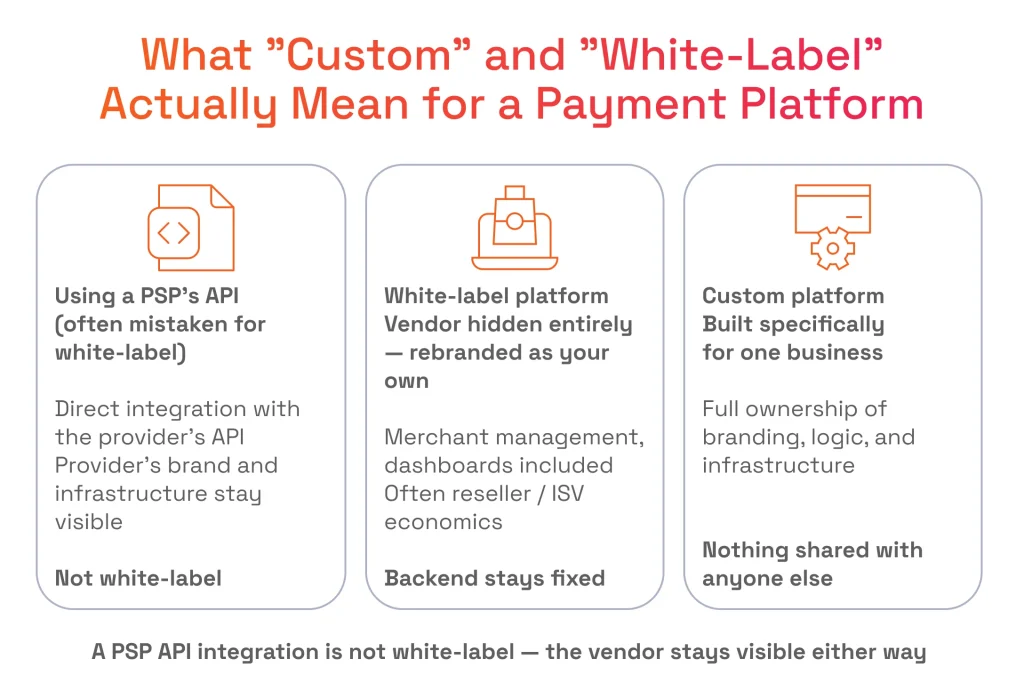
In both cases, merchants will have the same operational experience, so the merchant payment platform development process will always include onboarding, dashboards, and reporting regardless of the underlying architecture.
Feature Comparison: Custom vs. White-Label Payment Platforms
The two models differ in a few key ways, which form the core of our discussion. The table below shows how each model behaves in production environments.
Dimension | Custom Payment Platform | White-Label Payment Platform |
|---|---|---|
Branding and UI control | Full: brand, checkout flow, and merchant-facing UI change on your own schedule | Theming and UI customization; the underlying platform stays fixed |
Backend and business-logic customization | Full: routing, risk scoring, fee structures, ledger design | Limited to what the vendor’s configuration options support |
Time to launch | 6–12+ months | Weeks to a few months |
Infrastructure ownership | Fully owned and scoped to one business | Licensed from the vendor and shared across tenants |
Performance under load | Dedicated, scoped to your traffic | Shared infrastructure: subject to “noisy neighbor” effects from other tenants |
Compliance ownership | Full (or partner-assisted) | Largely handled by the vendor, but liability terms vary by contract |
Long-term cost curve | High upfront, lower marginal cost per transaction at scale | Lower upfront, ongoing revenue share that scales with volume indefinitely |
Dimension
Branding and UI control
Backend and business-logic customization
Time to launch
Infrastructure ownership
Performance under load
Compliance ownership
Long-term cost curve
Custom Payment Platform
Full: brand, checkout flow, and merchant-facing UI change on your own schedule
Full: routing, risk scoring, fee structures, ledger design
6–12+ months
Fully owned and scoped to one business
Dedicated, scoped to your traffic
Full (or partner-assisted)
High upfront, lower marginal cost per transaction at scale
White-Label Payment Platform
Theming and UI customization; the underlying platform stays fixed
Limited to what the vendor’s configuration options support
Weeks to a few months
Licensed from the vendor and shared across tenants
Shared infrastructure: subject to “noisy neighbor” effects from other tenants
Largely handled by the vendor, but liability terms vary by contract
Lower upfront, ongoing revenue share that scales with volume indefinitely
Limitations of White-Label Payment Platforms
White-label payment platform limitations rarely appear in a demo because a demo shows the layers tenants can change. They surface months after launch, when a differentiation request meets a backend used by every other tenant.
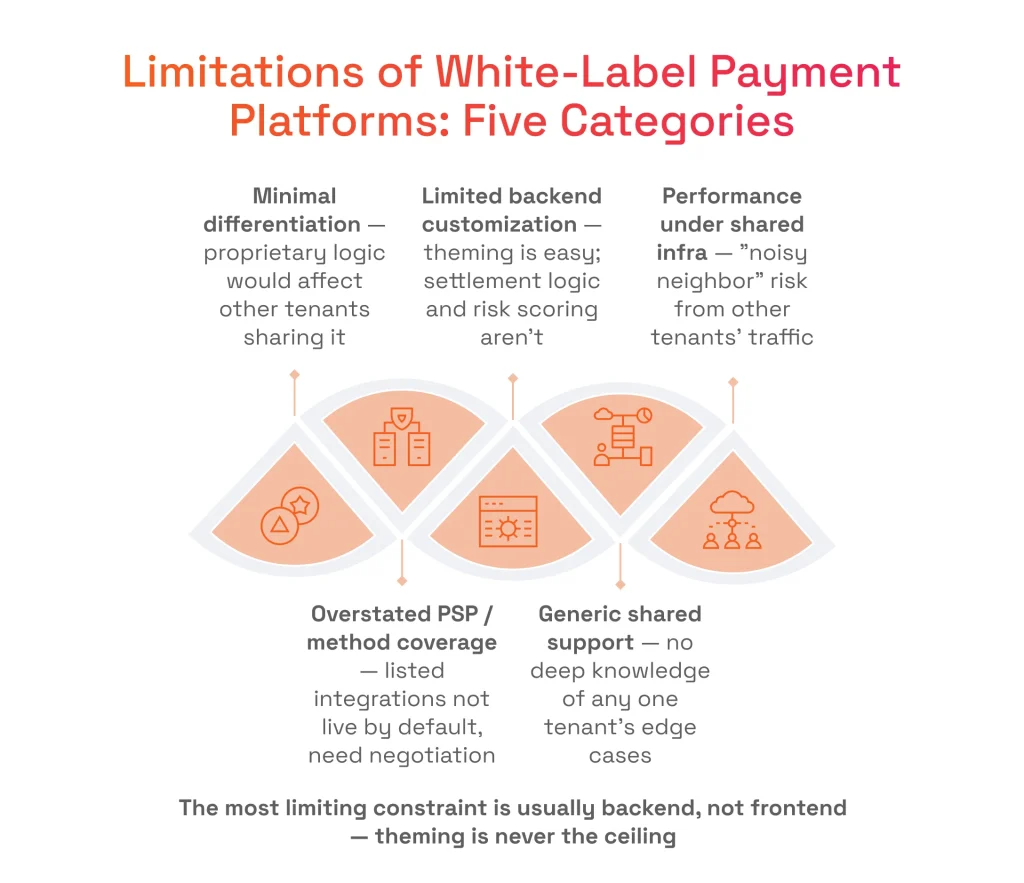
Five constraints account for most of that gap:
- How little room the platform leaves for differentiation
- How far backend logic can be changed
- How shared infrastructure behaves under load
- How much of the advertised provider coverage is actually live
- How a support desk spread across every tenant handles one business’s edge cases.
Compliance runs alongside all five: PCI DSS compliance ownership rests with the vendor, which lightens the client’s burden while simultaneously moving payment security architecture decisions outside the client’s control.
Minimal Differentiation and Feature Depth
While white-label platforms are designed for the common case across tenants, proprietary logic lives outside it. Routing rules biased towards a certain acquirer, special commission schemes for a particular marketplace, risk models that take into account a unique type of fraud — all these are quite often not even possible to implement even if there is an API available because of how the processing code works.
API access is often perceived as the escape valve, but it is not that easy. It is mostly about reading information and triggering certain actions, not influencing decisions inside the platform. A marketplace that wants to hold a seller’s split until a delivery event or price a fee band by merchant category is asking for a new decision point, and decision points live on the vendor’s roadmap.
What a business receives is the feature set that makes commercial sense for the vendor’s median customer. The ceiling arrives at the exact moment the business finds something in payments worth differentiating on.
Limited Backend and Business-Logic Customization
Frontend flexibility and backend flexibility are marketed as a single property, but they behave in no way alike. Theming, field labels, and receipt templates live in a layer the vendor built for tenants to edit themselves. Settlement logic, ledger structure, and risk scoring live in code that runs for every tenant, so a change request from one business becomes a roadmap decision that affects the vendor’s entire customer base.
The practical consequence is a queue. A settlement rule an internal team would change in a sprint becomes a feature request weighed against every other tenant’s request, on a delivery date the client does not set and often cannot see.
37,000+ users run through a merchant settlement platform SPD Technology built for Blackhawk Network, with report generation and commission calculation automated across a partnership now spanning more than seven years. The commission and settlement rules that the platform executes are specific to that business, which is precisely the class of logic a shared multi-tenant backend cannot accommodate.

Oleksandr Boiko
Delivery Director at SPD Technology
“Teams evaluate white-label platforms based on the checkout screen because it’s the part they can see and change. The decisions that bind them come later: how a transaction is split between parties, when funds actually settle, and which risk signal blocks a payout.Those rules live in a backend shared by all tenants, so changing one for your business means changing it for all of them, and no vendor prices that as a configuration option.”
The same asymmetry shapes payment operations automation, where reconciliation and payout rules only earn their keep when they align with a business’s actual workflow.
Performance and Scalability Constraints of Multi-Tenant Infrastructure
Multi-tenant infrastructure means your transaction traffic and someone else’s compete for the same capacity. A promotional spike at another tenant can degrade authorization latency for your merchants, and your own seasonal peak can do the same to theirs. This noisy-neighbor dynamic is difficult to diagnose from the tenant side, since the metrics that would explain it are owned by the vendor.
Two key contract questions determine the issue’s significance. Firstly, do availability and latency guarantees apply to the tenant level or to the platform alone? Secondly, what happens when a particular tenant breaches their share of the guarantee? Will they throttle that particular tenant, or distribute the cost among all others? Both issues are easy to answer during procurement, and vendors rarely volunteer either.
Scaling past the platform’s original design assumptions usually means buying dedicated capacity or a higher tier, priced at a level that erodes the savings that justified the white-label payment platform in the first place. Businesses discover the ceiling during their best week.
Overstated Payment Method and Provider Coverage
Marketing literature lists multiple PSP integrations and payment methods, and many of them sit idle. Sometimes integration requires a separate commercial arrangement with the PSP, sometimes it incurs an extra transaction fee, and sometimes the vendor provides engineering support on its own schedule.
This issue never manifests until a company decides to expand into a new market with an exclusive payment method. By then, the time is usually committed. However, testing this problem takes only one email: ask what PSP integrations the vendor enables for current tenants, and treat the rest of the list as the roadmap.
Shared Support and Slow Edge-Case Resolution
Support teams at white-label vendors serve every tenant on the platform, and that structure limits how deeply any of them can know a single business. Tickets describing an edge case in a client’s own commission logic or reconciliation flow go to people who have never seen that logic before.
Common issues resolve quickly; uncommon ones queue behind an internal escalation path the client cannot see or influence. The cost of that lands on the client’s own team, which ends up reproducing the issue, documenting it, and defending its priority to someone who supports hundreds of other merchants.
Businesses running unusual flows feel this most acutely, which is also where merchant risk monitoring at scale tends to expose how much operational nuance a shared support model cannot accommodate.
When Each Option Makes Sense
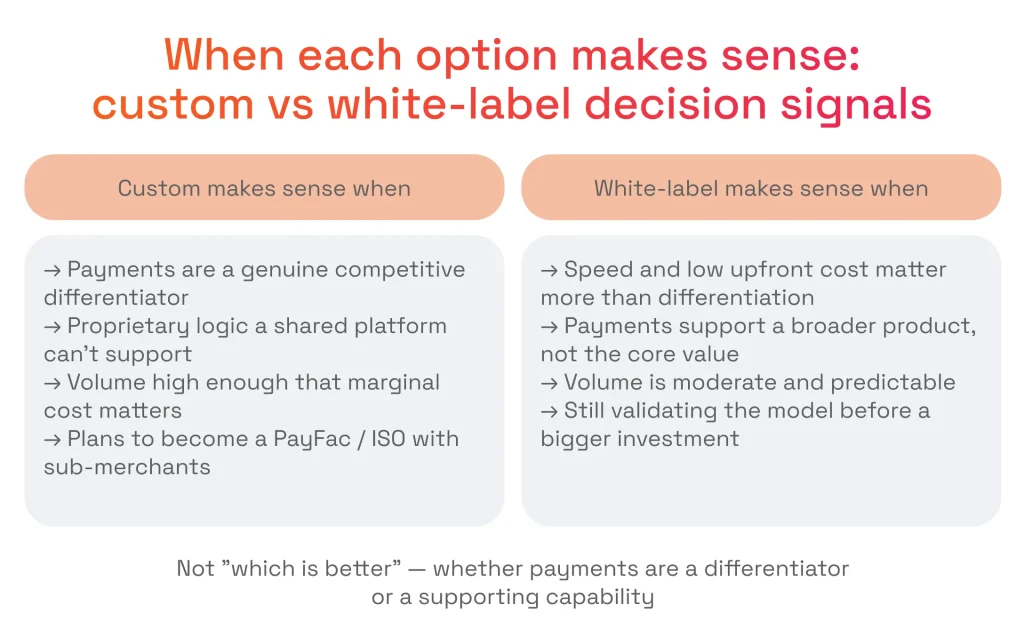
The decision turns on one question: whether payments are something the company wants to differentiate itself by or are just a means to another end. The scale behind this decision is easy to overlook.
The 2025 McKinsey Global Payments Report describes payments as the most valuable part of financial services, generating $2.5 trillion in revenue from $2.0 quadrillion in value flows across 3.6 trillion transactions. It also finds payments moving into platforms never traditionally associated with finance, which is how the question ends up on roadmaps written for something else entirely.
When Custom Payment Platform Development Makes Sense
Four signals point toward building, each strong enough on its own to justify the work.
- Payments are part of what the business sells. The experience and the economics both need to be yours, since any competitor can license the platform you licensed.
- The product requires proprietary logic: cost-oriented routing across acquirers, fee structures, and split payment structures, which a shared platform can’t execute.
- The volume is very large or growing rapidly, turning marginal cost per transaction into a management metric tracked monthly.
- Sub-merchant management is on the roadmap. Operating as a payment facilitator or ISO puts PayFac platform development directly in scope.
Routing across multiple providers with failover belongs to payment orchestration platform development, and that requirement rarely arrives on its own.
A global gift-card distribution company needed to onboard US businesses at a rate its manual process could not sustain. We built the aggregated merchant portal, which onboarded 8,000+ US businesses in two years and cut onboarding time from seven days to under 24 hours, with OFAC, EIN, and SSN checks automated and Salesforce lead automation built in. That onboarding logic is the kind of asset a business owns only when it owns the platform.
When a White-Label Payment Platform Makes Sense
For many businesses facing this decision, licensing wins on the merits, not on the budget.
- Payments support the product, and nobody buys the product because of how the payments work.
- Speed to market outranks differentiation for the next several quarters.
- Volume is moderate and predictable, which keeps revenue share affordable.
- The model is still unproven, and a validated business is worth more than an owned platform.
Companies still figuring out whether their investments will pay off would be better served spending time demonstrating success than putting up walls in two-quarter increments. This failure comes from treating a licensed platform as a set piece of architecture rather than an active staging ground with an end point.
Payment Platforms Comparison: Cost and Timeline
The first invoice is the least interesting number in this comparison. BCG’s 2025 Global Payments Report projects global payments revenue growth moderating to about 4% annually through 2029 after averaging 8.8% since 2019, while payments-focused fintechs reached $176 billion in revenue and are growing at 23% a year.
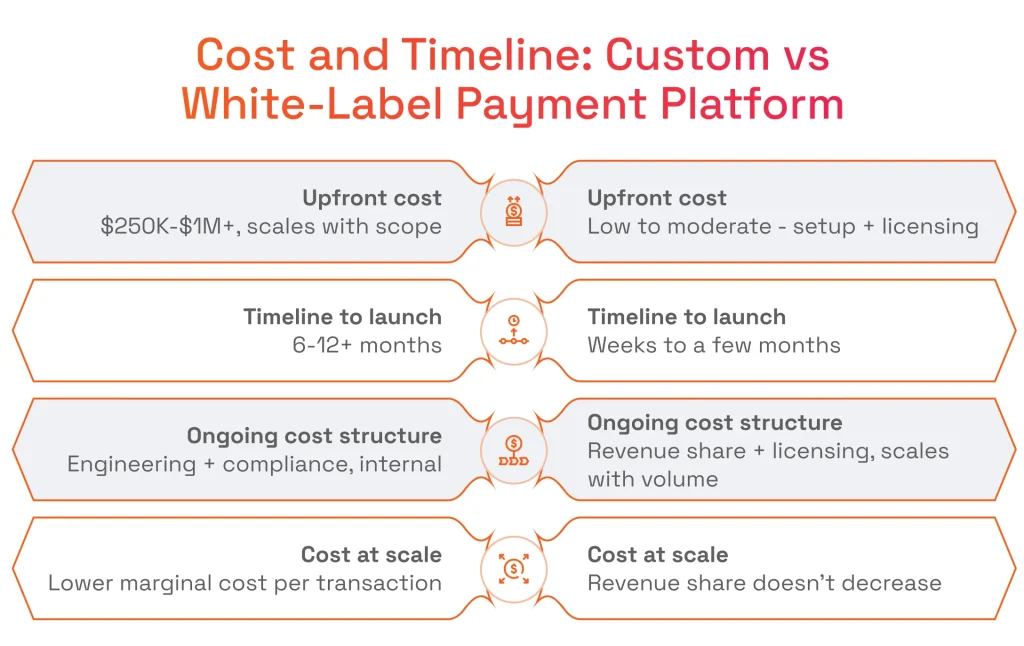
Transaction fees collected on every purchase grow exponentially, while revenue growth slows, and development costs peak pre-launch and level off post-launch. Teams working with the same numbers on the buy side will recognize the build vs. buy payment gateway framing.
The table above breaks down this disparity in cost, timing, and future trajectory. The ranges below are our delivery estimates, based on the scope we have built and shipped.
Factor | Custom Payment Platform | White-Label Payment Platform |
|---|---|---|
Upfront cost | $250K–$1M+, scaling with scope and compliance requirements | Low to moderate: setup and licensing fees, typically a fraction of a custom’s upfront cost |
Timeline to launch | 6–12+ months | Weeks to a few months |
Ongoing cost structure | Engineering and compliance maintenance, internally controlled | Per-transaction or revenue-share fees, plus licensing: cost scales with volume indefinitely |
Cost at scale | Lower marginal cost per transaction as volume grows | Revenue share doesn’t decrease; cost grows roughly in proportion to volume |
Factor
Upfront cost
Timeline to launch
Ongoing cost structure
Cost at scale
Custom Payment Platform
$250K–$1M+, scaling with scope and compliance requirements
6–12+ months
Engineering and compliance maintenance, internally controlled
Lower marginal cost per transaction as volume grows
White-Label Payment Platform
Low to moderate: setup and licensing fees, typically a fraction of a custom’s upfront cost
Weeks to a few months
Per-transaction or revenue-share fees, plus licensing: cost scales with volume indefinitely
Revenue share doesn’t decrease; cost grows roughly in proportion to volume
The trade-off is straightforward: early speed and capital against long-term margin. A white-label platform gets you to market in weeks for a fraction of the initial cost, but its revenue-share model taxes your growth indefinitely. A custom build demands a multi-month, six-figure investment upfront, but secures a fixed operational baseline where your marginal cost per transaction drops as your volume scales.
Starting White-Label and Migrating to Custom Later
Plenty of businesses launch on a white-label payment platform on purpose. Licensing lets a company validate the model, sign real merchants, and start earning while the question of whether payments warrant a full engineering investment remains open. The trigger to migrate from white-label to custom arrives when one of the limitations above becomes a blocked revenue line, or when volume increases enough that cumulative revenue share exceeds what a build would have cost.
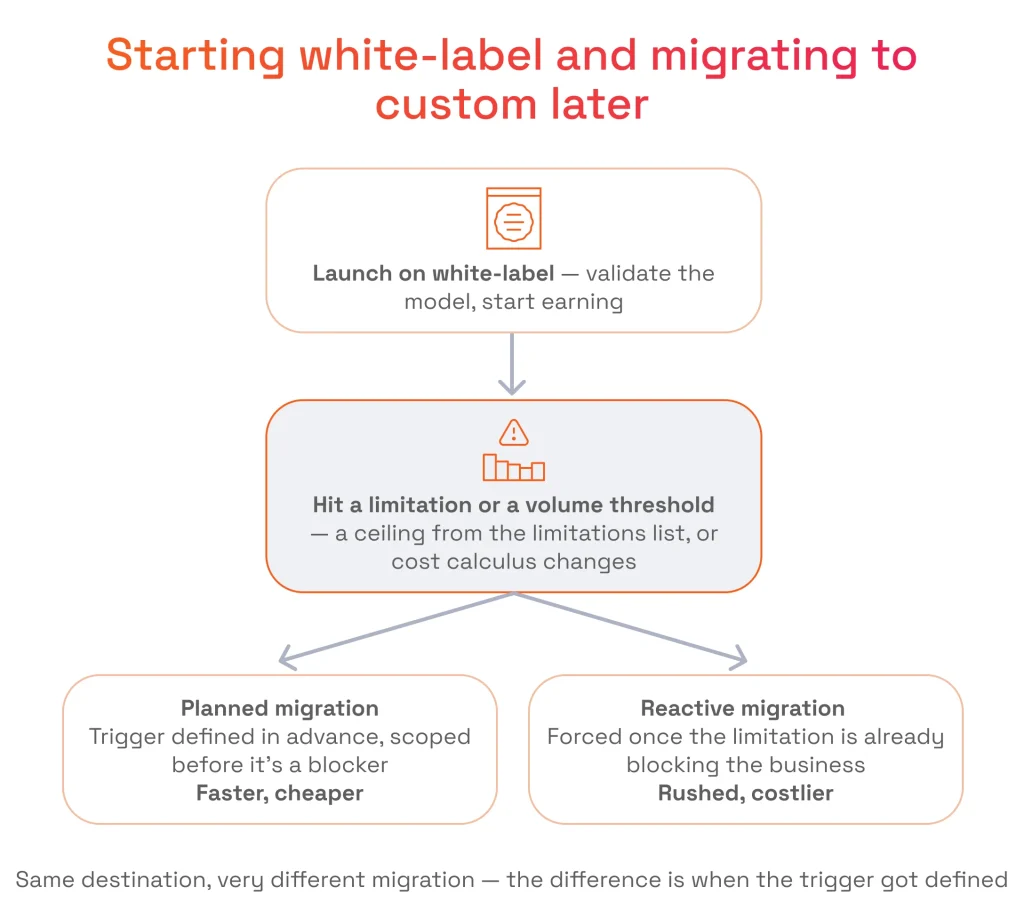
Companies that name the trigger in advance move faster and spend less than companies pushed to migrate under pressure. Defining it early changes three decisions made while still on the platform.
- Data portability. How merchant and customer records can be exported, in what format, and how often — settled in the original contract, where it costs nothing at signing and a great deal to retrofit.
- Configuration depth. How much business logic gets encoded in vendor-specific configuration, since every rule that exists only inside the platform deepens vendor lock-in?
- Scoping timing. When work on the custom build starts, it decides whether the migration runs to a plan or to a deadline set by circumstance.
Our engineers decoupled the reseller portal for Poynt from a monolithic system over a two-year engagement, with a dedicated eight-person team taking full ownership of the work. That decoupling reduced ongoing dependencies and lowered the support resources the platform required.
Teams planning a similar move often start by adding capacity to an existing group, which is where companies hire fintech developers with payments architecture experience.
Our Expertise in Custom Payment Platform Development
We build custom payment platforms for businesses that have outgrown an off-the-shelf system or never intended to use one. The work covers full-cycle payment processing, settlement infrastructure, high-volume merchant onboarding, and architectural migrations away from constrained legacy and licensed platforms.
Across 20 years and 460+ delivered projects, the payment engagements that reach us tend to share one trait: a differentiation or scale problem the previous architecture could not hold. Two of them sit on either side of this article’s decision: a payment platform built from scratch in five months, and a consolidation of eight systems a business had outgrown.
Full-Cycle Custom Payment Platform Build
In five months, we delivered an all-in-one omnicommerce payment system for Poynt covering full-cycle payment processing, settlement, and a third-party integration API. The system runs on a PayFac model that has reduced transaction costs, giving the business direct ownership of the economics that a licensed platform would otherwise retain.

Five months is short for a build of this shape, and it stayed short because scope stayed disciplined and one team held both architecture and execution. The partnership has now run past five years, and we were retained after the client was acquired.
Migrating Off a Constrained Architecture at Scale
Eight separate eCommerce platforms acquired by Blackhawk Network were consolidated into one system using 80+ service components and a BI reporting layer handling 40M+ daily transactions and 100+ report types. We migrated data worth $30B annually in load value with zero downtime during live transactions.

Such a massive consolidation is simply a more mature iteration of the same problem any company faces when leaving a licensed platform: reconciling multiple data models, preserving transaction history, and completing the data transfer despite ongoing transactions. The BI reporting layer is included because it is the purpose of the entire project.
Whether you are scoping a custom build from the start or planning a move off a platform that has hit its ceiling, our payment engineering team can scope the right path and own it end-to-end. Teams weighing how to staff that work will find the trade-offs in fintech development outsourcing worth reading first.
Key Takeaways
- Custom payment platforms deliver ownership and differentiation; white-label platforms deliver speed to launch and a lower upfront commitment, which makes the two models answers to different questions.
- A white-label payment platform differs from a PSP integration because a rebrandable, often multi-tenant system hides the vendor entirely and often follows reseller or ISV economics.
- Backend business logic locked into a shared platform architecture is the most limiting constraint in white-label deployments, while branding and UI layers remain fully customizable.
- Revenue-share pricing causes white-label costs to grow indefinitely with transaction volume, whereas a completed custom build results in a lower marginal cost per transaction as volume rises.
- Defining the migration trigger before launch leads to a faster, cheaper transition than a reactive migration forced by a business-blocking limitation.
- Payments that function as a competitive differentiator justify a custom build; payments that support a broader product are served well by a white-label platform.
In short: the custom vs. white-label payment platform decision comes down to whether the business intends to own payments as a product or consume them as a capability.
FAQ
What’s the difference between a custom and a white-label payment platform?
A custom payment platform is built for one business, with full control over branding, backend logic, and infrastructure. A white-label payment platform is pre-built, often multi-tenant, and rebranded by the client, with backend customization limited to the vendor’s configuration options.
You lose time and cost on one hand, but gain differentiation and control on the other. Custom software allows you to adjust settlement rules, routes, and fees as you see fit, while a licensed system puts the burden on the vendor and all its tenants.
Is white-label the same as using a payment service provider (PSP)?
No. A PSP integration means building against that provider’s API, with the PSP’s brand and infrastructure visible at several points in the flow, including checkout, statements, and merchant agreements. A white-label payment gateway hides the vendor entirely and presents merchant management, dashboards, and branding as the client’s own product, often with reseller economics that a plain API integration does not offer.
The practical difference shows up in the contract, where white-label arrangements usually layer licensing and revenue share on top of per-transaction fees.
When should a business choose a custom payment platform over a white-label solution?
Go with custom when payments can be a competitive differentiator for your company. If proprietary logic like custom routing rules, special fee structures, and split payment structures is an important part of the company’s payments strategy, the choice is clear again because no shared platform will execute logic relevant to all tenants. Large or growing transaction volumes also make marginal cost per transaction a significant factor.
Plans to operate as a payment facilitator with sub-merchant management effectively settle it because sub-merchant onboarding, underwriting, and payout rules become the core product surface.
How much does a white-label payment platform cost compared to a custom one?
The white-label option involves a very small upfront cost, consisting of setup and licensing costs rather than an entire engineering build, and includes ongoing revenue sharing or per-transaction costs. With custom, the initial cost will be high, ranging from $250K to $1M or more, depending on project size.
These figures are our delivery estimates based on the scope we have built. The biggest variable is compliance scope, since PCI DSS obligations and provider certifications add engineering time before a single transaction clears.
How long does it take to build a custom payment platform compared to launching on a white-label platform?
White-label launches take weeks to a few months, since the platform already exists and the work is configuration and branding. A custom platform typically runs for 6–12+ months, depending on scope, compliance requirements, and the number of provider integrations shipped in the first release.
A narrow scope reduces the range considerably: we built a turnkey omnicommerce payment solution for Poynt in five months, including processing, settlement, and a third-party integration API. The timeline depends less on the number of features and more on integration counts and the time required for integration certifications.
Can you switch from a white-label payment platform to a custom one later?
Indeed, many organizations account for this and adopt a staged approach: start with the white-label offering to prove the concept and generate income first, then move up once the platform begins to limit your revenue growth potential.
This way, you will save money through planning ahead of time, such as negotiating data portability terms in the contract itself, avoiding having to use platform-specific configurations for embedding your business logic, and scoping your custom development project.
What are the biggest limitations of white-label payment platforms?
The biggest limitation lies in the back end. The brand and UI theme can still be customized, whereas the business logic, including settlement policies, risk assessment, and fees, is fixed by the platform capabilities common to all tenants.
Here are three limitations inherent in the same architecture:
- performance limitations in multi-tenant architectures, which suffer reduced performance for your merchants because another tenant spikes traffic; and
- coverage of payment methods and providers advertised by marketing material but requiring separate negotiation or payments.
- a support model serving every tenant, which slows resolution of issues specific to one business.
Does a white-label payment platform limit ownership of PCI compliance?
Generally yes. Most white-label platforms handle PCI DSS compliance at the platform level, which reduces the client’s direct compliance burden and simultaneously means the client neither owns nor controls that compliance posture. Contract terms determine where liability lies when an incident occurs, and those terms vary widely among vendors.
Vendor compliance and vendor transfer of compliance risk are different things, and the merchant, acquirer, and regulator may still turn to the customer brand for answers first. Don’t assume coverage without reviewing the indemnification and breach notification sections.