

Finding skilled developers locally is becoming harder and more expensive. That reality has pushed many organizations toward offshore IT services. The global offshore software development market will grow from $178.32 billion in 2025 to $347.99 billion in 2030, with the United States driving much of the demand.
We at SPD Technology are a tenured player in this market, operating as a trusted outsourcing software development company for 20+ years. We deliver dedicated development teams, IT staff augmentation, and offshore development center (ODC) setup services.
Guided by our experience, we will provide you with a holistic overview of offshore software development services, highlighting everything you need to know to start a fruitful partnership with a reliable vendor.
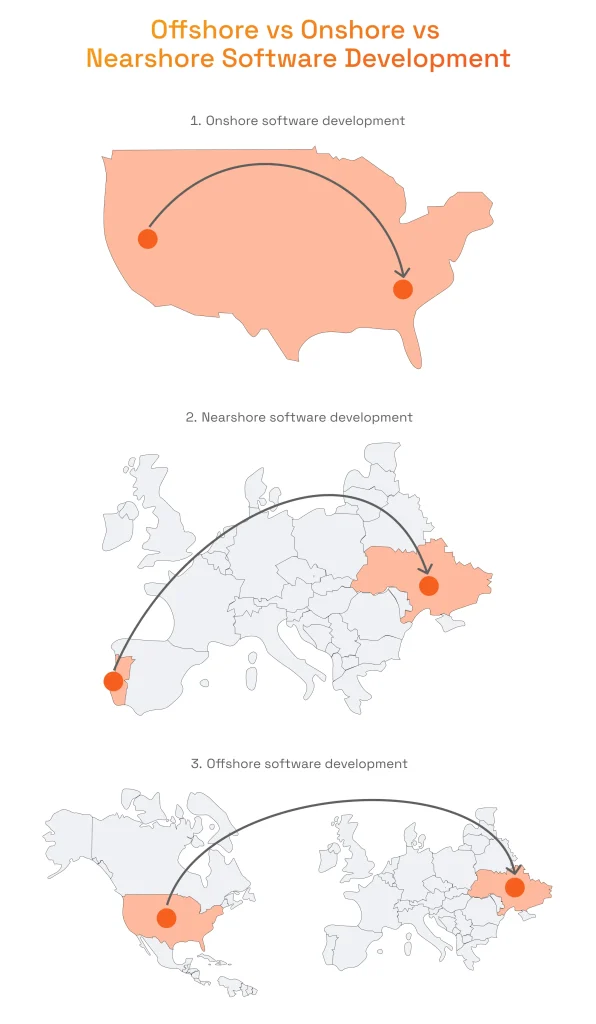
Offshore vs. Onshore vs. Nearshore Software Development
Offshore outsourcing is only one of the IT outsourcing models for cooperation available to companies looking to scale development capabilities.
Let’s clear out the three most common terms that sometimes are mixed up, and talk about the distinct characteristics of each.
Offshore Software Development
This type involves outsourcing software development tasks to a third-party service provider located in a different country and, in most cases, in a different time zone.
Pros
- The main reason to opt for offshoring is cost-effectiveness, as companies choose a country with lower labor costs, achieving significant savings while receiving the same quality of development services.
- Additionally, hiring an offshore software development team allows going beyond local talent, enabling access to a vast pool of skilled developers worldwide and finding the most specialized expertise and skill sets.
Cons
- The main challenges here are related to distance, as time zone differences and language barriers can lead to communication difficulties with some vendors.
- Cultural nuances of different countries may also affect understanding and collaboration. Finally, physical distance may lead to less direct control over the development process, which can be critical in some cases.
Onshore Software Development
This one involves hiring a third-party service provider located within the same country or region as the client.
Pros
- You may expect better communication and collaboration, due to the proximity of the two parties and minimized language and time zone differences.
Cons
- Onshore development can be significantly more expensive, especially in tier 1 countries where labor costs for software engineers are among the highest globally.
- In addition, the hourly rates for software developers will be the same for both the client and the vendor, and the limited talent pool will remain the same.
Nearshore Software Development
This type of software outsourcing is a middle-ground option where the outsourcing partner is located in a nearby country or within the same time zone.
Pros
- While not as significant as the offshore software engineering model, there can still be cost savings compared to onshore development.
- Closer time zones can facilitate overlapping work hours, and proximity allows for easier communication and collaboration.
Cons
Depending on the specific countries involved, there might still be some language and cultural challenges.
The choice among offshore, onshore, and nearshore development depends on factors such as project requirements, budget constraints, the level of customer involvement, and the need for direct control. It’s crucial for businesses to carefully evaluate these factors to determine the most suitable outsourcing model for their specific needs.
Some companies choose a hybrid model to balance delivery speed, cost-effectiveness, and operational control. The hybrid model helps you combine the best of onshore, nearshore, and offshore collaborations.
We at SPD Technology are strong believers that the benefits of offshore software development outweigh those of the other two approaches, and in the next section, we will provide a detailed explanation.
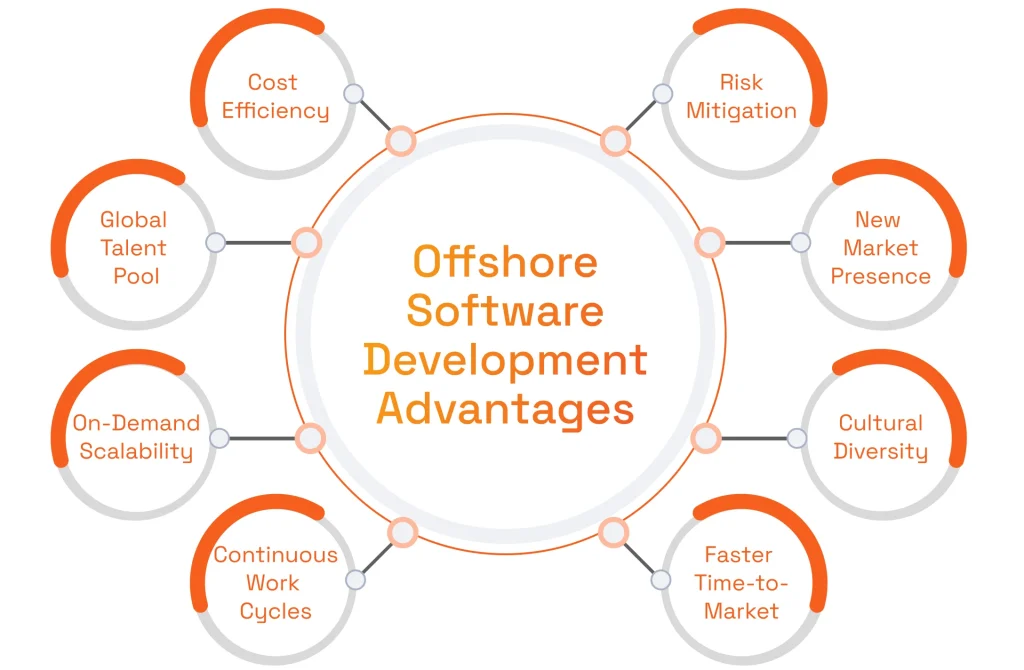
Advantages of Offshore Software Development
Let’s discuss why offshore software development services are more beneficial compared to other outsourcing options.
Cost Efficiency
Without a shadow of a doubt, the foremost reason to cooperate with an offshore software development company is to achieve significant budget savings. Offshore software development typically comes with lower hourly rates compared to local hiring, which directly impacts overall project budgets. According to Deloitte’s Global Outsourcing Survey, 57% of companies chose software development offshoring to reduce operational costs.
There are countries with an abundance of available professionals that could fulfill specific business and technical demands more cost-effectively than local talent. With offshoring, you can achieve cost-efficiency thanks to:
- A global talent pool that can be accessed at a more affordable cost.
- The absence of significant investments in infrastructure, office space, and equipment.
- Access to the latest, more effective technologies.
- Favorable tax structures of certain outsourcing regions.

Olexandr Boyko
Delivery Director at SPD Technology
“Most businesses are interested in offshore software programming as a cost-cutting opportunity. But in pursuit of higher revenues, make sure the price is not the primary factor in decision-making. Always remember that you will get what you pay for. You should look for a trusted offshore development partner with a proven track record of delivering results, and not the lowest price tag.”
Access to the Global Talent Pool
Offshore product development allows companies to engage with developers, designers, and other IT professionals who form a highly skilled offshore team with a wide range of expertise.
You will certainly have more options to connect with seemingly any technological experts you require, from artificial intelligence (AI) and machine learning (ML) specialists to experts proficient in any modern programming language. Many offshore software development companies now integrate AI tools into their workflows to automate repetitive coding tasks, testing routines, and documentation processes.
On-Demand Scalability
Another major reason for hiring external talent is to achieve additional scalability. Offshore software development companies can provide experts for specific tasks and workloads, allowing organizations to scale through outsourcing development when internal resources are limited.
The flexibility, scalability, and cost-effectiveness of an offshore software development team are unrivaled by other collaboration models.
Continuous Work Cycles
Offshore software development enables a true follow-the-sun workflow. When teams are distributed across regions such as Eastern Europe and North America, development continues around the clock without overloading any single team.

Risk Mitigation
By engaging in offshore IT development, companies can mitigate risks associated with a single location. If there are natural disasters, political instability, or other unforeseen events in one region, the development work can continue in other locations unaffected by the same risks.
New Market Presence
By offshoring software development, companies can establish a presence in new markets without a physical office. This expansion can help reach a broader customer base and tap into emerging markets, unlocking new business opportunities.
Cultural Diversity
Finally, cultural diversity within remote teams can lead to increased innovation and creativity. Having different perspectives and approaches to problem-solving can result in more robust custom software solutions and unique perspectives on complex challenges.
Faster Time-to-Market
The pace of development is a crucial factor in determining your organization’s competitiveness. Opting for offshore development services will enable your business to deliver products more promptly by increasing your production capacities.
This advantage is especially important for startups and can be achieved through an efficient hiring process, parallel development by cross-functional, distributed development teams, and an MVP to quickly gather user feedback and make informed decisions on future iterations of the product.
Need help with hiring software developers for a startup? Read our detailed guide for more information.
Offshore Software Development Models
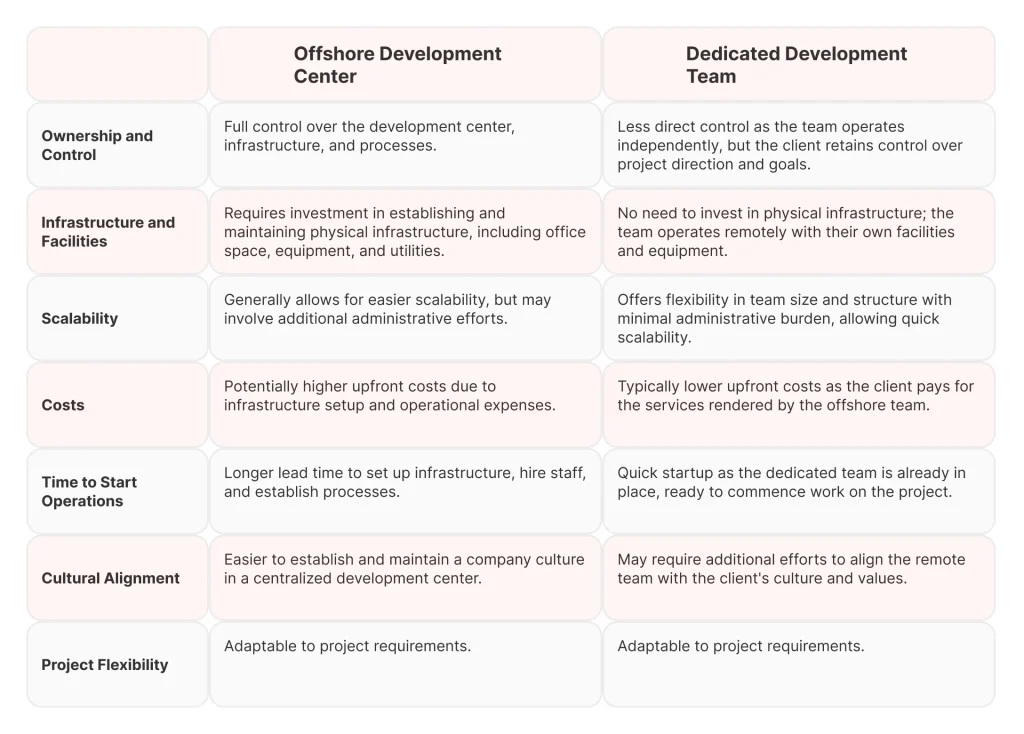
We already discussed engagement models in software development outsourcing that our company uses to deliver outstanding solutions to our clients. In this section, we would like to focus on the two most optimal options to hire offshore developers.
Setting Up an Offshore Software Development Center
In the offshore software development center model, a company sets up its development center in a foreign country by partnering with an outsourcing service provider. This center operates as an extension of the client’s organization and is dedicated to handling specific software development tasks and projects.
Key characteristics of this model include:
- The offshore development center is a dedicated facility established exclusively for the client.
- The model typically involves a long-term partnership between the client and the service provider.
- The client retains a high level of control over the development processes, strategies, and resource allocation.
- The model enables scalability, allowing the client to expand or reduce the team size as project requirements change.
Pros
- The client has direct control over the development center, ensuring alignment with organizational goals and policies.
- Close collaboration and integration with the client’s existing teams lead to seamless workflows.
- The offshore center becomes an integral part of the client’s operations, retaining institutional knowledge.
Cons
- Establishing an offshore center requires a significant initial investment in infrastructure and resources.
- The client is responsible for managing the offshore center, including administrative tasks.
When the ODC model makes sense
- You need to hire a large offshore development team.
- You plan for a big, possibly enterprise-level, project with ambitious scaling plans.
- You need to establish a market presence in a new region.
Do you want to find out how to set up an offshore development center? Read our article for more information.
Hiring a Remote Dedicated Development Team
In the dedicated team model, a client partners with an outsourcing service provider to set up a team of skilled professionals dedicated exclusively to the client’s projects. This team works the same way as ODC. You just hire a single or several teams, without opening an actual office. We already have an entire article on dedicated development team management, so if this offshore development services model suits your case, we invite you to read it.
Key characteristics of this model include:
- The dedicated offshore software development team typically comprises developers, designers, and other professionals selected specifically for the client’s project requirements.
- The client retains ownership and control over the projects, with a dedicated team working exclusively on them.
- The model provides flexibility to scale the team size up or down based on project needs.
- The dedicated team integrates seamlessly with the client’s existing processes and workflows.
Pros
- The client can adjust the team size to meet project requirements, making this model a scalable and flexible way to benefit from offshore software development services.
- The client pays only for the completed scope of work, making it a more cost-effective model compared to ODC.
- The client can focus on core business activities while the dedicated offshore development team handles the coding tasks.
Cons
- Communication challenges may arise when working across different time zones.
- The client relies entirely on the outsourcing provider for team management, which may be challenging if expectations are not met.
When a dedicated team model makes sense
- You need to hire a single team of up to 8–10 experts.
- You aim for a quick project kick-off.
- You need overall flexibility and human resource scalability.
Offshore Software Development: What Tasks Can Be Outsourced
IT outsourcing has become a common strategy for organizations looking to scale development capabilities and optimize resources. Companies outsource about 37% of their IT operations, while 13.6% of total IT budgets are allocated to outsourcing initiatives. Let’s specify the areas where offshore software development companies can help your organization.
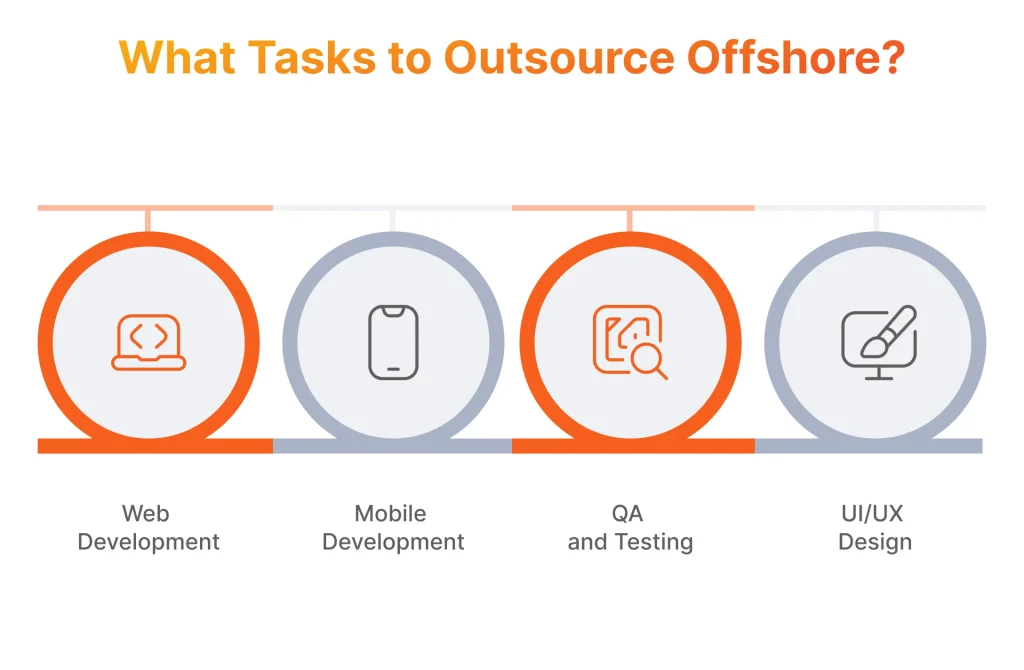
Web Development
Offshore software development companies can boost your online presence with a modern website or upgrade an existing one by offering professional web development services. In such a case, you will not be held back by a lack of local talent or the need to train your existing team to keep up with business demands.
For example, if you’re struggling to find web developers proficient in a legacy programming language, hiring an offshore software development team may be a good idea. Just like when we transformed a legacy notary service into a full-blown legal tech solution, helping our client quickly find rare PHP and Angular talent to complete the project on a strict deadline.
Mobile App Development
If you are a startup building a mobile application, time-to-market is the crucial factor that will make or break your product. Here, an offshore software development team can ensure the necessary speed to deliver your app on time, if you find skilled app developers, of course.
Usually, offshore software development companies already have assembled teams with extensive experience working together and strong communication. To ensure the best results, you’ll just have to pick an offshore software development company that will have the expertise, tech skills, and a proven track record of working with similar projects.
For one of our clients, we helped create a computer vision-powered API for a petcare mobile app, not only providing skilled mobile developers in the shortest possible time but also delivering complex AI-powered functionality.
Looking for help with mobile app development outsourcing? Find out our insights on this topic in a detailed guide.
UI/UX Design
Just like any other type of expert, a proficient UI/UX designer can save your organization a lot of time by delivering a solution that makes a complex interface simple to use in practice. An offshore software development company might have just the experts you need to create easy-to-use and intuitive interfaces for your website or app.
A great example of our UI/UX redesign is our legacy app improvement activities for an investment platform for a Western European client. Our experts implemented a visually striking, user-friendly interface design that aligns with contemporary design and usability standards, in addition to other offshore software development services SPD Technology delivered to the client.
QA and Testing
You may already have a bunch of outstanding programmers creating your product. However, to launch this product without bugs, you need an experienced team of testers. An offshore software development company may offer you both QA Manual and QA Automation experts who will be able to test your software remotely in the most efficient way.
QA experts from SPD Technology helped a leading provider of cancer treatments build medical device simulators remotely.
Our QAs on this project:
- Engaged in effectively testing software on real machines remotely.
- Developed the software Quality Assurance dashboard.
- Created automated tests that ensured 3x-4x time savings as compared with manual testing.
In addition to the services mentioned above, you can just as easily delegate to an offshore software development company tasks for product maintenance, future improvement, or the development of security solutions. It is also possible to outsource other services. For example, we conducted a software audit of one of the largest libraries in the MENA region and developed recommendations for software development and cost reduction across the client’s entire infrastructure.
Offshore Software Development Risks and Mitigation Strategies
There are certain challenges related to offshore development teams, as well as proven ways to deal with them. In this section, we will shed some light on the most common ones.
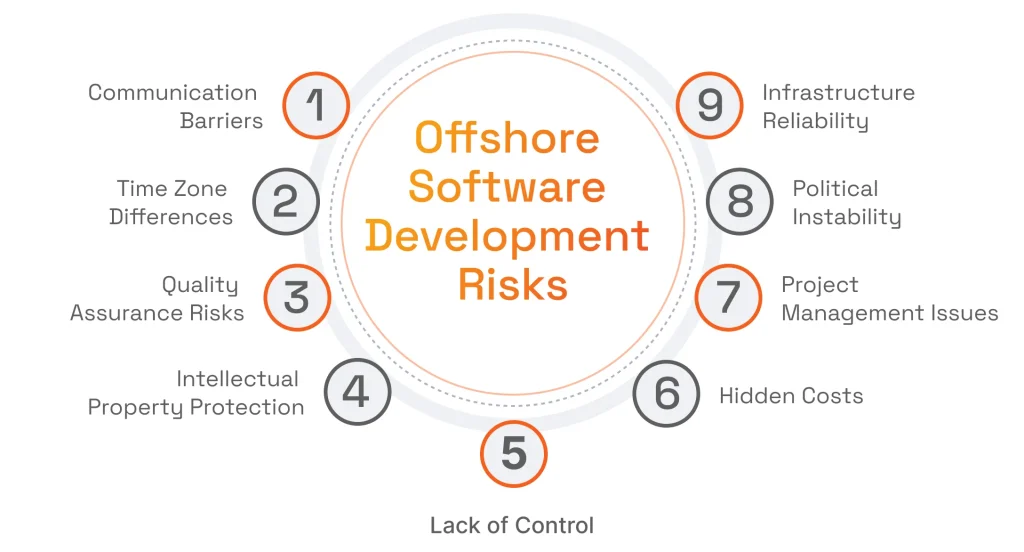
Communication Barriers
Unfortunately, offshore teams can sometimes include people who are not fluent in English. Thus, language differences and cultural gaps are inevitably almost always an issue, at least to a certain extent. To deal with it, having local representatives might help.
At SPD Technology, for instance, we have local representatives in the US and the UK to enable smoother communication. This approach helps us further improve our collaboration, in addition to our effective practices and our experts’ impressive English skills.
Mitigation Tips
- Collaborate with vendors that have a relatively high level of English, at least among project managers.
- Establish clear communication protocols and use collaboration tools.
- Encourage and schedule regular video conferences to build a personal connection.
Time Zone Differences
Hurdles associated with the different time zones are unavoidable, but devoted vendors find ways to be available 24/7, ensuring the Continuous Work Cycles approach that was described in one of the sections above. With the right management, some time zone differences can prove to be favorable in establishing a non-stop process: the offshore developers will be working, when your in-house team is asleep, compromising on video calls in convenient time slots.
Olexandr Boyko
Delivery Director at SPD Technology
“While often considered unfavorable or risky, a time zone difference can prove to be a beneficial factor. When communication opportunities are limited, the teams on both ends will be driven to communicate better, save each other’s time, and make the most of the communication between the teams. This apparent limitation can become a hidden driver for boosting the effectiveness of the communication process.”
Mitigation Tips
- Overlap working hours to facilitate productive real-time communication.
- Leverage asynchronous communication tools for documentation and updates.
Quality Assurance Risks
Offshore software developers may operate in diverse environments with different tools, methodologies, and coding standards. These variations can lead to inconsistencies in the way code is written, reviewed, and tested.
Additionally, offshore developers may follow different development processes, methodologies, or workflows than those used by the in-house team. This inconsistency can affect the integration and synchronization of code, testing, and deployment practices.
Mitigation Tips
- Implement robust testing processes supported by automated testing tools and conduct regular code reviews.
- Define and adhere to a comprehensive set of coding standards.
- Periodically review quality assurance processes to assess adherence to established standards.
Intellectual Property Protection
Protecting intellectual property (IP) rights and navigating legal complexities are crucial considerations when using custom offshore software development services, given the global nature of business collaborations. Unauthorized access to source code, algorithms, or proprietary information can lead to intellectual property theft, and ambiguity in defining ownership rights over the developed software can lead to disputes. Modern offshore software development teams need to prioritize strengthening cybersecurity protocols to protect sensitive data and comply with international security standards.
Mitigation Tips
- Implement robust confidentiality and non-disclosure agreements (NDAs) with an offshore software development company.
- Clearly define ownership and IP rights in contractual agreements.
- Utilize legal expertise to navigate international IP laws.
Lack of Control
You may have to pay more attention than expected to manage your newly hired experts. However, with an IT partner that focuses on improving your business, clearly understands its role, and does not simply deliver code, you may not encounter this problem at all.
Olexandr Boyko
Delivery Director at SPD Technology
“There are multiple ways to deal with this risk. Based on SPD Technology’s experience, we are offering multiple engagement models to provide on-site management and to handle offshore development solutions without extensive involvement on our clients’ part. With a high management involvement on our end, the risks of any incorrectly developed or missing functionality and those of under-delivering are kept at an absolute minimum.”
Mitigation Tips
- Share your business vision and goals with your outsourcing software development company so they can better understand your organization.
- Implement efficient project management tools for maximum transparency.
- Regularly review progress and conduct compliance audits.
In our dedicated article, our experts shared how to hire a dedicated development team hassle-free.
Hidden Costs
It’s important for businesses to conduct a comprehensive cost-benefit analysis and carefully consider potential hidden costs. These costs can be related to inaccurate estimation of the scope of work or to external factors such as fluctuations in currency exchange rates.
Mitigation Tips
- Conduct a comprehensive analysis of potential project development costs.
- Review the software service level agreement (SLA) carefully and make any necessary adjustments.
- Consider hiring a finance expert for consultations.
Project Management Challenges
Implementing effective project management for offshore software developers can be challenging due to geographical, cultural, and organizational differences. These challenges may affect communication, collaboration, and the project’s overall success.
Mitigation Tips
- Introduce a unified project management framework that is agreed upon by all teams.
- Adopt Agile methodologies to enhance collaboration, flexibility, and responsiveness to changes throughout the development process.
- Establish clear communication channels, leverage collaboration tools, schedule regular video meetings, and provide comprehensive project documentation.
- Unify project management for offshore software development using platforms such as Jira, Trello, or Asana to centralize task ownership and improve sprint visibility.
Political Instability
Political instability can lead to frequent changes in laws and regulations, affecting contractual agreements, data protection, and intellectual property rights, as well as increased government intervention, including nationalization, policy shifts, or changes in investment regulations.
Mitigation Tips
- Keep your finger on the pulse of global and local political developments.
- Consider diversifying operations across multiple stable locations.
- Establish contingency plans for potential government interventions.
Infrastructure Reliability
Issues such as power outages, hardware failures, or network disruptions can impact the development process. Downtime caused by infrastructure failures can delay project timelines, reduce productivity, and lead to data loss.
Olexandr Boyko
Delivery Director at SPD Technology
“In projects with significantly sensitive information, some additional security practices might be required. As has been the case with some of SPD Technology’s fintech clients, each developer in a dedicated offshore team was provided a secure laptop to completely rule out any possible data leaks.”
Mitigation Tips
- Work with an offshore software outsourcing company that has redundant systems and reliable infrastructure.
- Use redundant network connections, implement backup communication channels, and leverage collaboration tools that can work in low-bandwidth conditions.
- Choose a reputable provider with a track record of reliability.
- Regularly back up data and implement data recovery procedures if needed.
If you want to learn more about how to outsource app development and avoid major risks, feel free to read our article on this topic for more details.
How to Choose the Right Offshore Development Company
By following these steps, you can methodically evaluate and select the most suitable partner for your project. This structured approach enhances the likelihood of successful collaboration and the delivery of high-quality software solutions that meet your business objectives.
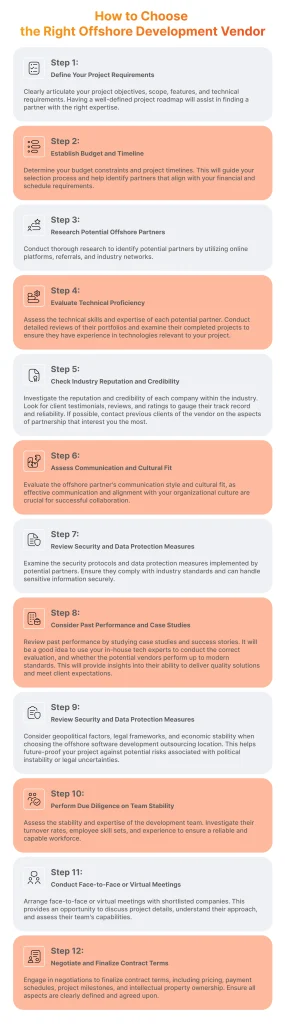
Step 1: Define Your Project Requirements
Clearly articulate your project objectives, scope, features, and technical requirements. Having a well-defined project roadmap will help find a partner with the right expertise.
Step 2: Establish Budget and Timeline
Determine your budget constraints and project timelines. This will guide your selection process and help identify partners that align with your financial and scheduling requirements.
Step 3: Research Potential Offshore Outsourcing Partners
Conduct thorough research to identify potential partners by utilizing online platforms, referrals, and industry networks.
Olexandr Boyko
Delivery Director at SPD Technology
“It will be a good idea to create a long list of potential vendors. While creating it, pay attention to the quality of their services, expertise, and security standards. Case studies, reviews, testimonials, and references will help you understand whether the experience of each offshore software company is legitimate.”
Step 4: Evaluate Technical Proficiency
Assess each potential partner’s technical skills and expertise. Conduct detailed reviews of their portfolios and examine their completed projects to ensure they have experience in technologies relevant to your project.
Step 5: Check Industry Reputation and Credibility
Investigate each company’s reputation and credibility within the industry. Look for client testimonials, reviews, and ratings to gauge their track record and reliability. If possible, contact the vendor’s previous clients about the aspects of the partnership that interest you most.
Step 6: Assess Communication and Cultural Fit
Evaluate the offshore partner’s communication style and cultural fit, as effective communication and alignment with your organizational culture are crucial for successful collaboration.
Step 7: Review Security and Data Protection Measures
When selecting an offshore partner, verify compliance with recognized security standards such as ISO 27001 and SOC 2. Ensure they comply with your industry standards and can handle sensitive information securely.
Step 8: Consider Past Performance and Case Studies
Review past performance by studying case studies of successful offshore software development projects. It would be a good idea to use your in-house tech experts to conduct the proper evaluation and determine whether the potential vendors meet modern standards. This will provide insights into their ability to deliver quality solutions and meet client expectations.
Step 9: Choose Location Strategically for Project Resilience
Consider geopolitical factors, legal frameworks, and economic stability when choosing the offshore software development outsourcing location. This helps future-proof your project against potential risks, including political instability and legal uncertainties.
Step 10: Perform Due Diligence on Team Stability
Assess the stability and expertise of the offshore developers. Investigate their turnover rates, employee skill sets, and experience to ensure a reliable and capable workforce.
Step 11: Conduct Face-to-Face or Virtual Meetings
Arrange face-to-face or virtual meetings with shortlisted product development companies. This provides an opportunity to discuss project details, understand their approach, and assess their team’s capabilities.
Before entering a long-term contract, many companies launch a small trial project to evaluate the offshore software development partner’s technical quality, communication style, and delivery discipline.
Step 12: Negotiate and Finalize Contract Terms
Engage in negotiations to finalize contract terms, including pricing, payment schedules, project milestones, and intellectual property ownership. Ensure all aspects are clearly defined and agreed upon.
Top Destinations to Hire Offshore Developers in 2024
The right choice of location can make or break the potential partnership, as offshore software development rates will be closely tied to the chosen location. Here is a quick overview of the most popular outsourcing destinations.
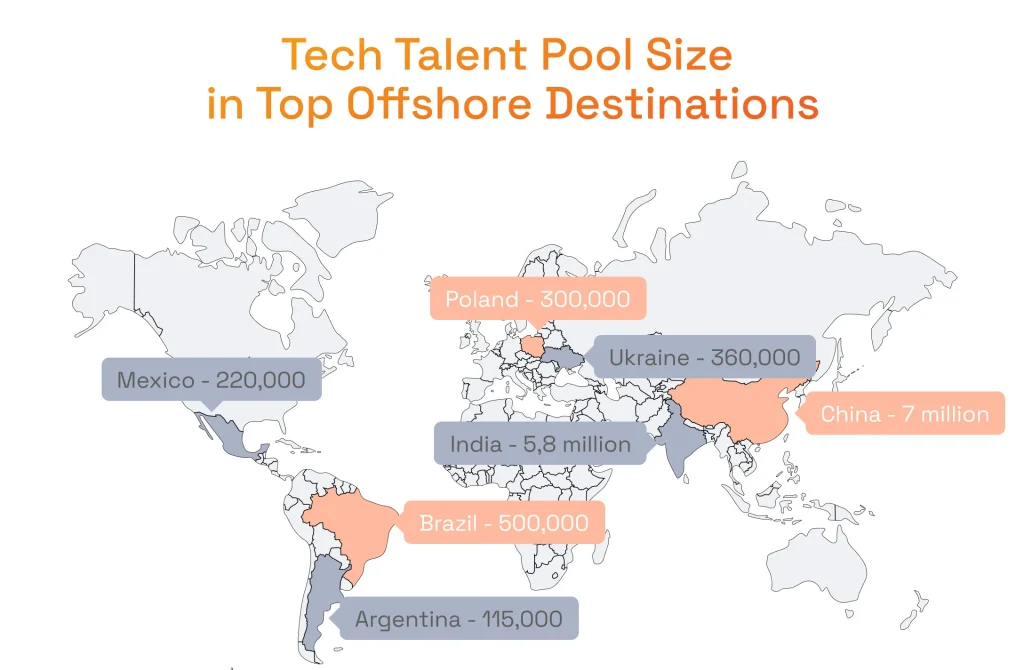
When you conduct your research, make sure to pay attention to:
- Cost of labor
- Skill and expertise
- Education system
- Language proficiency
- Cultural compatibility
LATAM
Given the minimal time difference, Latin America is usually the most preferred region for North American companies to approach and recruit experts. The LATAM IT services market is projected to reach $131.6 billion by 2033, with a CAGR of 6.7% between 2026 and 2033, and the most promising segments are expected to be Internet of Things (IoT) development and Big Data analytics.
This year, Latin America also stands out with the size of its tech talent pool. In 2023, there were approximately 680,000 software developers in Brazil. Mexico had around 220,000 software developers, while Argentina had approximately 115,000 specialists.
Asia
This region has one of the biggest talent pools for any offshore IT development. India alone has over 5.8 million available experts. While this country offers an attractive offshore software development cost, with this massive talent pool, you may struggle to find experts with narrow domain expertise. Additionally, cultural differences and language barriers may pose issues.
China is the other country in this region worth mentioning, with nearly 7 million experts available, with its outsourcing market revenue forecasted to reach $38.38 billion by 2030. With this vast talent pool, competitive costs, and technological advancements, businesses working with China should carefully navigate challenges related to language, culture, political situation, intellectual property, and cybersecurity.
Eastern Europe
While this region is not as massive as Asia, Eastern Europe has some of the most proficient experts. The majority of experts in the region come from Ukraine and Poland, most of them ready to work as offshore software developers. Being one of the leading software development outsourcing destinations globally, Eastern Europe stands out with the highest quality of development talent, strong technical background and practical experience, English proficiency, and shared business values with Western Europe and the USA.
how to Get Your Company Ready for Offshore Software Development
We already discussed where and how to find an outsourcing software development company that will be ready to help you, but is your organization ready for this type of cooperation? Let’s discuss what you can do for the smoothest workflow.
Define Offshoring Scope
The first thing you need to decide is what you need to outsource and to what extent. It is important to analyze your organization to know its strengths, weaknesses, and needs. Sometimes, you might not need an outsourcing company or offshore software outsourcing partner at all, and hiring just a few experts via a staff augmentation arrangement will be just enough.
As a business owner, you must have a clear understanding of whether adding particular experts to separate departments within your organization will be sufficient or whether delegating a considerable portion of your business responsibilities to an offshore development company is essential for the future growth of your organization.
So, the real question is, “How much responsibility are you willing to delegate to another offshore or outsourcing software development company?”
While creating a software product, you have to cover:
- Software development
- Testing
- Design
- Business analysis
- Marketing needs
So, you need to decide how far you are willing to go with trusting another company in some or all of these areas.
Olexandr Boyko
Delivery Director at SPD Technology
“From our experience, one of the most common and effective approaches is when companies outsource the entire software development process offshore, including product management and marketing. This approach allows you to control the product development process more efficiently than product ownership delegation. However, on the development side, you may need business analysts and project managers to ensure that everything goes according to plan and your project vision.
We also had projects in which our teams created the entire product, while the client handled marketing activities and overall direction in line with their high-level vision. This approach is also a viable option if you find a trusted and experienced software offshore provider.”
Appoint a Product Owner
It is necessary to have a product owner for any scenario of cooperation with an outsourcing company. Even with the best team of seasoned offshore developers who can quickly begin and deliver results, it will still be wise to control the direction of your product development. Some companies, especially startups, focus so much on development speed that they lose direction. You need someone to ensure your top-notch product is created to solve real-world problems and delivered in accordance with your initial vision.
It is obvious that one of the biggest challenges with any team of outside experts is that they struggle to understand your company’s real problems and thereby offer viable solutions. It is also clear that outsiders will not have the same understanding of your internal processes as your employees. The nuances of your business context are the most difficult to capture accurately in documentation because such knowledge is often unstructured. However, with the right partner and a properly set-up communication process, this challenge is completely solvable. In fact, when you outsource all product ownership, you have to find a way to share your business vision so the product is developed the way you want it.
You could share the context and provide your offshore development team with a deeper understanding of your organization. Great product ownership and communication are a major part of delivering this understanding to its fullest. A product owner on your side can bridge the gap between the external and internal teams by being fully aware of both the business and development aspects.
The responsibilities of a product owner include, but are not limited to:
- Defining and prioritizing the product backlog
- Understanding stakeholders’ needs
- Setting product vision and strategy
- Release planning
- User story creation
- Acceptance and validation of user stories
- Measurement of product success
- Budget management
Ensure Remote Cooperation Readiness
Your company must be able to welcome an expanded team of experts and provide them with all necessary resources and communication tools without disrupting your processes. It must be digitized to the fullest extent to enable effective online communication and collaboration.
If you still have any key processes that rely on in-person meetings, physical signatures, or any other processes that cannot be digitized, your company is not ready for a software outsourcing arrangement. You need to take care of your internal processes before adding any external teams.
Companies that succeed with offshore software development typically standardize communication through platforms like Jira, Slack, and Zoom to avoid fragmented updates and unclear responsibilities.
In addition to providing your teams with all the necessary tools, your management must clear any communication roadblocks and secure your virtual board meetings. Eliminating all bottlenecks that prevent your company from effective offshoring cooperation is a benefit in itself, even if you don’t cooperate with a distributed software development partner as yet. Digital transformation will improve your processes, saving your employees’ working time and, in turn, saving you money.
Manage Access and Permissions
Your system must be able to provide different levels of permissions to different user groups.
When outsourcing or offshoring your software development, you will face situations where users need limited permissions to solve certain problems. Every system is unique. Some systems may already provide such permissions through other existing software solutions, while others may have a single administrator role designed to grant only the “all or nothing” kind of access.
It is recommended that you implement a multi-role user hierarchy with varying permissions to enable productive collaboration with your external teams. In fact, flexible access and permissions functionality is a must-have for large enterprises, while for smaller organizations, it can be an option worth considering.
Identify Dependencies
In addition to considering flexible access and varying permissions for your external teams, it is also important to identify internal dependencies within your organization that may block their operations.
An example of dependency is when two tasks, one for an in-house team and one for an outsourced team, require the same resources, and there aren’t enough resources to do both at the same time, making one task dependent on the other.
Once you identify all dependencies, you can rule out the possibility that your departments’ activities will block your external team.
Prepare Security Measures
If you have never used external help before, some parts of your infrastructure, security-wise, may be best handled by your in-house team. Therefore, your security model must be reconsidered and adjusted to support outsourcing cooperation to keep your project safe.
In offshore IT outsourcing, data security must be treated as a top priority. Strict access protocols, encrypted communication channels, and controlled environments reduce the risk of unauthorized access to source code and sensitive business data. The most common practices for remote teams are:
- To always use a VPN.
- To work only with software that is recommended and pre-installed by your security department.
Get Your Team Ready
Although the practice of using offshore software development services is quite common, some concerns regarding job security may still arise among your in-house team members. So, when you have an in-house team but need to scale your project development by setting up a dedicated team or an ODC offshore, keep in mind that you also need to provide your internal team members with the context for hiring remote experts.
Addressing the interaction between in-house and remote teams is equally important. While your in-house team members may be protective of some technologies and approaches they are used to, your responsibility is to facilitate communication and provide the correct perspective. Ensuring both in-house and offshore teams feel valued fosters a collaborative environment, enhancing results and minimizing potential conflicts.
Need more practical tips? Our guide offers 6 pieces of advice to help CTOs with outsourcing product development.
Relevant Recommendations to Offshore Software Development in 2024
The Business Research Company predicts that by 2030, the global application development market will reach $1,890.3 billion, up from $1,000 billion in 2020. To truly benefit from this expansion and become a major player on the market, consider the following best practices for collaborating with an outsourcing software development company.
Invest Time and Effort in Clear Project Documentation
Clear and comprehensive project documentation has always been crucial in software development. It serves as a primary means of communication between the in-house and offshore teams, providing a detailed roadmap for the project’s execution. Make sure to outline project requirements, functionalities, and acceptance criteria. This document should serve as a relevant reference for all development teams.
Plan for Frequent Knowledge-Sharing Sessions
Regular knowledge-sharing sessions help bridge the gap between in-house and offshore teams. They foster collaboration, enhance communication, and ensure both teams are on the same page regarding project details and expectations. In addition to regular video meetings, you can also implement interactive workshop sessions to transfer knowledge more effectively.
Establish a Risk Management Plan
There will always be inherent risks, ranging from communication challenges to external factors like geopolitical instability. Establishing a risk management plan is crucial for identifying, assessing, and mitigating potential risks. To successfully create it, you need to:
- Identify potential risks related to communication, project scope, technology, and external factors.
- Evaluate the impact and likelihood of each identified risk to prioritize mitigation efforts.
- Develop strategies to mitigate or respond to identified risks. This may involve contingency planning, setting up alternative communication channels, or diversifying resources.
Prepare an Exit Strategy
Despite careful planning, there may be instances where terminating the partnership becomes necessary. An exit strategy helps ensure a smooth transition and protects the interests of both parties involved, so to build one, you need to:
- Clearly define terms related to contract termination in the legal agreements.
- Establish procedures for data retrieval and ownership, code repository management, and other project assets.
- Develop a transition plan outlining how responsibilities will be handed over.
- Ensure that knowledge transfer sessions will be conducted properly.
Establish Transparency in Communication
Finally, this is the most important recommendation there is. It is vital to talk openly about the challenges: technical, business, and product-related ones. Also, try to identify the appropriate solutions early on.
Daily stand-up meetings and structured progress updates keep offshore software development teams aligned with in-house stakeholders and reduce misunderstandings early.
Conclusion
Offshore software development has become an integral part of the global IT landscape, offering organizations the opportunity to leverage diverse talent pools, cost efficiencies, and specialized expertise. It offers tremendous opportunities for innovation and efficiency, provided that organizations approach it with a well-defined strategy, a commitment to overcoming challenges, and a proactive mindset toward collaboration and continuous improvement.
SPD Technology has been a trusted partner for companies around the globe for 20+ years. In 90% of our projects, we serve as an offshore software development service provider that not only delivers software but also becomes part of our clients’ corporate culture.
In one of our long-term projects, we have developed a solution for a financial industry giant from scratch. We designed the system’s microservice architecture and provided overall consulting, ongoing development, maintenance, and support. With this remarkable partnership lasting for over a decade, we have managed to organize the work of 200+ experts based in 4 countries, interacting with them 24/7.
We are strong believers that offshore software development services are not just a cost-cutting measure or a way to connect with a larger talent pool, but a strategic partnership that can become one of the main drivers of your business growth. You are welcome to get in touch with us and discover how our technical expertise can accelerate your business expansion offshore.
FAQ
What is onshore and offshore in software development outsourcing?
Onshore software development refers to the practice of conducting software development activities within the same country or geographical location as the client’s headquarters or primary business operations. It involves outsourcing software development tasks to a third-party service provider located in a different country or geographical region.
Offshore software development costs are typically lower compared to other options, and you will get broader access to a talent pool as well.
How to offshore software development?
Fully leveraging custom offshore software development services includes several key steps:
- Define objectives and requirements.
- Select the right development vendor as a partner.
- Establish clear communication channels.
- Clearly define roles, accesses, and responsibilities.
- Create detailed documentation, project specifications, coding standards, and design guidelines.
How to manage an offshore software development team?
Every case is unique and requires an individual approach to some extent; however, there are common managerial tips, and they include:
- Clearly defining project goals, expectations, and timelines.
- Ensuring that all team members are aware of their roles and responsibilities.
- Utilizing modern communication tools, conduct regular meetings, and ensure open and transparent communication.
- Implementing project management tools to track progress, manage tasks, and monitor milestones.
How to extend your offshore software development team?
To extend your offshore software development team, define the roles and skills you need and share the requirements with your offshore partner. They will provide suitable candidates, and after interviews and approval, the new specialists can quickly join your project.
How to implement Agile in offshore software development?
To effectively implement Agile practices, organizations should incorporate the following strategies:
- Clearly define Agile roles and responsibilities for development teams.
- Break projects into sprints to improve visibility across the development lifecycle and hold regular sprint planning meetings to define tasks and priorities.
- Emphasize clear and transparent communication within the Agile framework.
- Implement continuous integration and deployment practices to ensure that changes are integrated into the project continuously and delivered promptly.
- Conduct regular retrospectives to reflect on the development process, identify areas for improvement, and implement changes in subsequent iterations.