

Multi-gateway payment architecture is the system design that lets a business route transactions across two or more payment providers as one coordinated platform instead of a collection of gateway-specific code paths. It has four core layers: a gateway abstraction layer (a common interface that isolates provider-specific logic behind adapters), a routing and failover engine (rules and health checks that select a provider and reroute on failure), a token portability layer (a gateway-agnostic vault, since stored card tokens don’t transfer between providers), and a reconciliation and observability layer (unified transaction tracking and settlement matching across providers). Skipping any one of these layers is the most common reason multi-gateway implementations behave like two separate payment systems instead of one resilient platform.
Connecting a second payment provider usually starts as a straightforward integration task. Engineering adds a new SDK, writes a couple of gateway-specific execution paths inside checkout, and sets up another webhook receiver. Then the edge cases hit: stored card tokens fail across providers, webhook events arrive out of sequence, and month-end financial reporting requires comparing two wildly different settlement CSVs by hand.
This article provides a production reference design for engineering teams that need to build or refactor a multi-gateway payment architecture. It breaks down the four mandatory architecture layers—abstraction, routing and failover, token portability, and unified reconciliation—needed to operate multiple payment providers as a single, resilient engine.
Why Multi-Gateway Architecture Is an Engineering Problem, Not Just an Integration Task
When a development team integrates a second gateway directly into existing checkout logic, they unintentionally multiply their technical debt. Every subsequent change has to happen twice, once per provider interface — a new payment method, a webhook update, a card-brand compliance fix, each written and tested and shipped in two separate formats instead of one.
Without a shared abstraction layer, N payment gateways create N times the integration surface area but not N times the operational reliability. True failover cannot occur simply because a secondary provider account exists; it requires a real-time health-checking mechanism and an explicit decision engine capable of rerouting a transaction before or during execution. Choosing a payment gateway integration partner who understands these architectural boundaries is often what separates scalable infrastructure from duplicated code paths.
High availability in payments is an emergent property of the architecture, not an automatic benefit of having two merchant accounts. Gateway-specific if/else statements scattered through application code are the tell — that’s parallel payment paths, built one gateway at a time, standing in for an architecture that was never actually designed.
The Four-Layer Reference Architecture for Multi-Gateway Payments
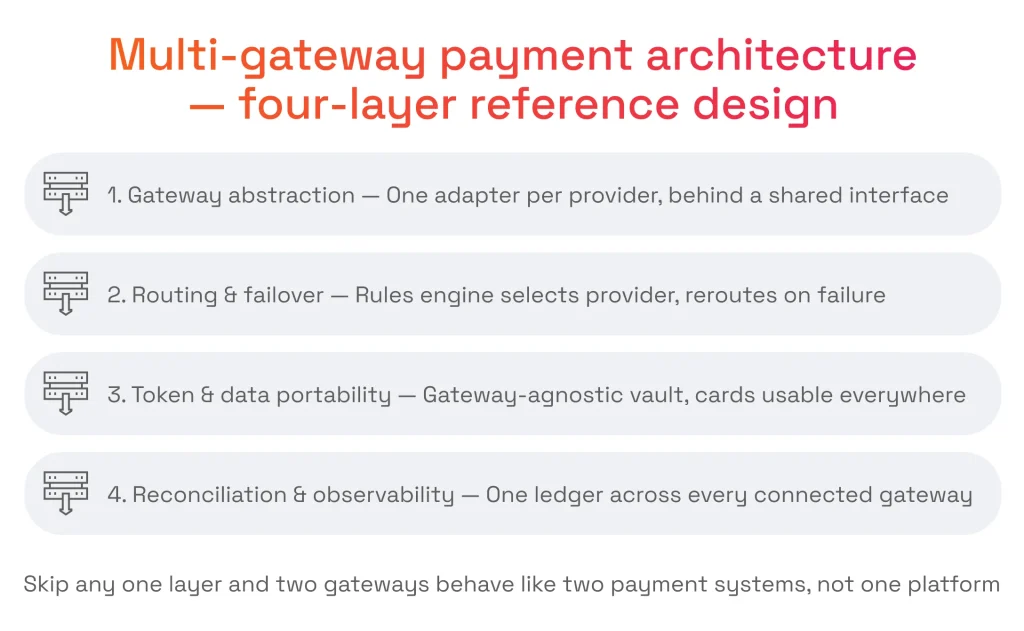
Building a resilient multi-gateway infrastructure requires decoupling payment decision-making from payment execution. Rather than allowing application logic to call provider endpoints directly, the platform routes requests through four specialized architecture layers.
Each layer solves a distinct engineering boundary, ensuring that upstream systems remain isolated from downstream provider quirks, API breaking changes, and settlement variations.
Layer | Responsibility | Key Design Decision |
|---|---|---|
1. Gateway abstraction | Isolates provider-specific logic behind a common interface | One adapter per gateway implementing a shared PaymentGateway interface; checkout and business logic never call a provider SDK directly |
2. Routing & failover | Selects a provider per transaction and reroutes on failure or decline | Rules engine driven by health checks, geography, cost, and decline-code classification — not a hardcoded if/else |
3. Token & data portability | Keeps stored cards and subscriptions usable across providers | Gateway-agnostic vault (or network tokens) so card data isn’t locked to one provider’s token format |
4. Reconciliation & observability | Unifies transaction tracking and settlement matching across providers | One normalized transaction ledger and settlement view, not N separate per-gateway reports compared by hand |
Layer
1. Gateway abstraction
2. Routing & failover
3. Token & data portability
4. Reconciliation & observability
Responsibility
Isolates provider-specific logic behind a common interface
Selects a provider per transaction and reroutes on failure or decline
Keeps stored cards and subscriptions usable across providers
Unifies transaction tracking and settlement matching across providers
Key Design Decision
One adapter per gateway implementing a shared PaymentGateway interface; checkout and business logic never call a provider SDK directly
Rules engine driven by health checks, geography, cost, and decline-code classification — not a hardcoded if/else
Gateway-agnostic vault (or network tokens) so card data isn’t locked to one provider’s token format
One normalized transaction ledger and settlement view, not N separate per-gateway reports compared by hand
Layer 1: Building the Gateway Abstraction Layer
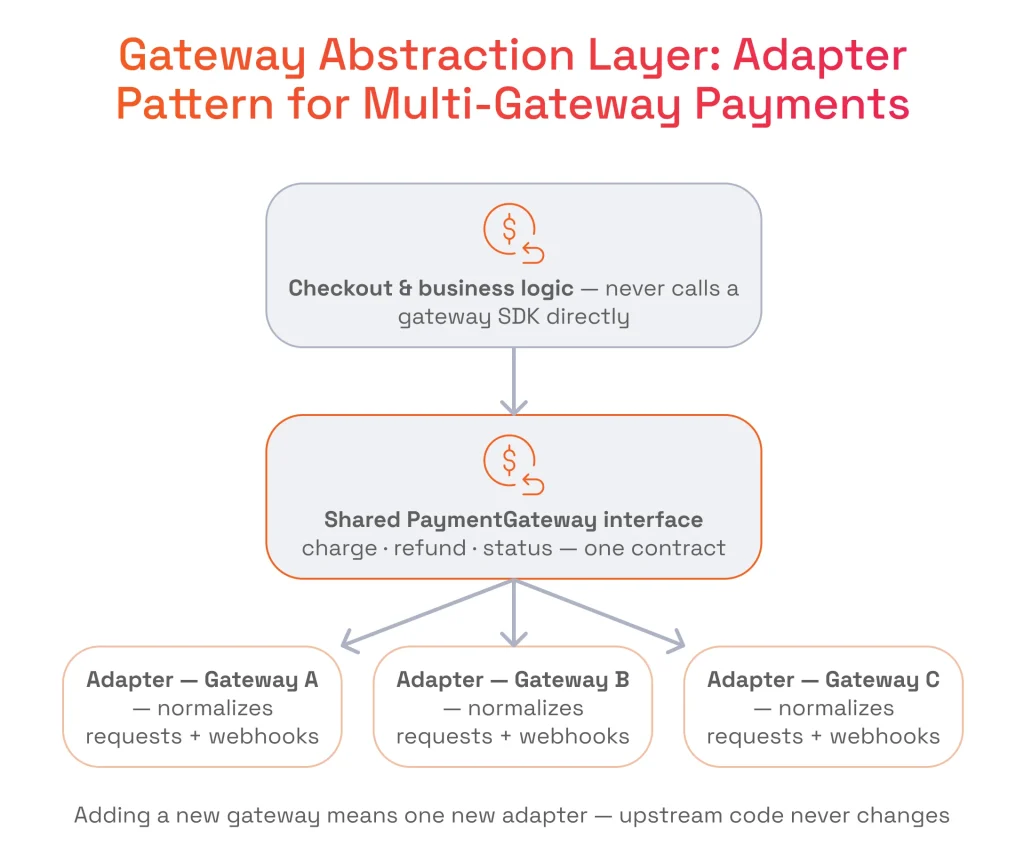
The Adapter Pattern: One Interface, Many Providers
The core contract begins with a uniform PaymentGateway interface that exposes standard domain operations such as Authorize, Capture, Charge, Refund, and GetStatus. Each connected gateway gets its own isolated adapter module that implements this interface, mapping internal operations to external API requests. Our guide on how to build a payment gateway outlines how to structure these component contracts for long-term maintainability.
Upstream execution modules depend strictly on the interface contract, making provider SDKs invisible to checkout services.
Normalizing Requests and Responses Across Providers
Every payment processor utilizes its own domain language, field naming conventions, and payload structures. Gateway A may require amount_cents and an order_id, while Gateway B expects total_amount in units of float alongside a transaction_reference. The abstraction layer normalizes incoming domain requests into standardized internal models before serialization, and maps heterogeneous provider responses into a unified internal status payload (SUCCESS, PENDING, DECLINED, ERROR).
Normalization prevents provider-specific data structures from leaking into application databases or downstream microservices.
Normalizing Webhooks Across Providers
Asynchronous event handling is where naive abstractions fall apart under load. Gateways dispatch webhooks with varying payloads, delivery guarantees, signature algorithms, and state transition orders. The abstraction layer must process incoming webhooks through dedicated endpoint receivers that validate signatures, normalize raw events into internal event types (payment.succeeded, charge.disputed), and push them onto an internal message bus for asynchronous execution.
Decoupling webhook ingestion from event processing ensures that late-arriving or duplicate provider webhooks do not disrupt downstream order fulfillment.
Layer 2: Routing and Failover Engine
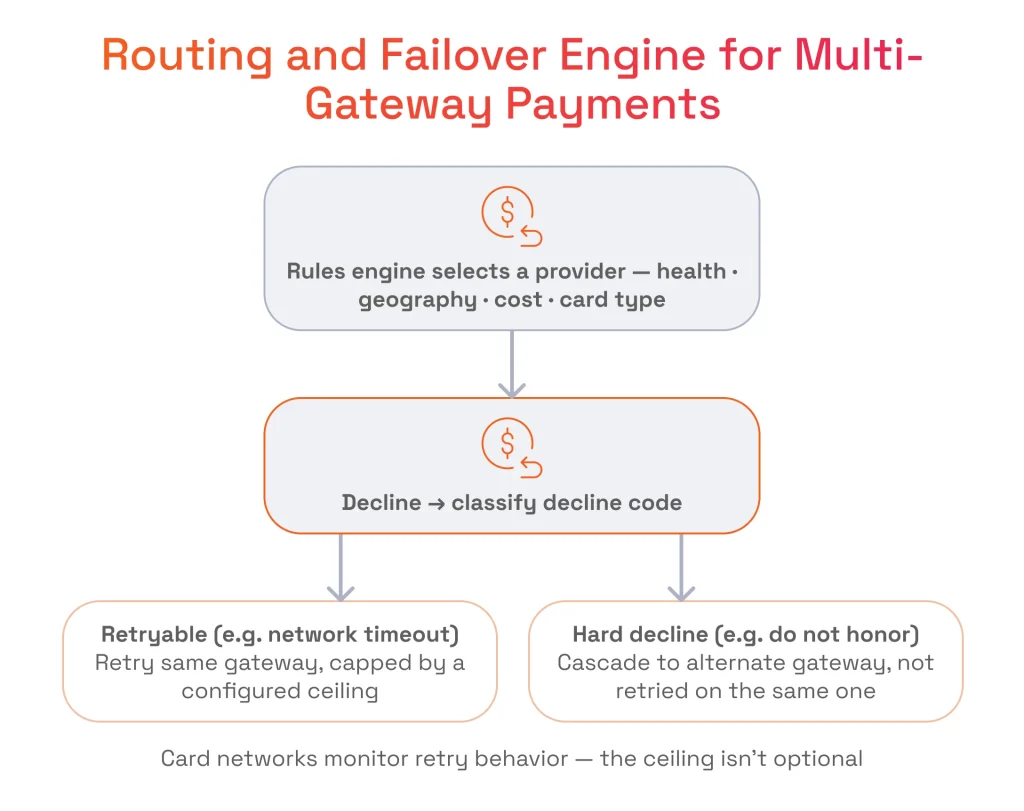
Once payment providers are abstracted behind a common interface, a centralized routing engine determines where each transaction should execute. The goal is optimizing for conversion rate, transaction cost, and system availability in real time.
Routing decisions must be calculated dynamically based on ambient system health, merchant business rules, and strict card network policies regarding retry behavior.
Rule-Based Routing: Health, Geography, Cost, and Card Type
Dynamic routing relies on a configurable rules engine that evaluates transaction context before picking an execution path. Rules evaluate factors such as regional interchange rates, customer country, card brand, transaction value, and real-time provider latency. Unplanned outages are an expensive failure mode to leave unrouted around — Uptime Institute’s 2025 outage analysis found 54% of respondents said their most recent outage cost more than $100,000, and one in five put the cost above $1 million.
Health-check monitors dynamically downgrade a gateway’s priority score when error rates or latency spikes exceed predefined thresholds.
Retry vs. Cascade: What Happens After a Decline
A failed payment requires immediate classification before any automated secondary attempt occurs. A transient network timeout or gateway 5xx error is a primary candidate for an immediate retry or provider cascade. Conversely, a hard decline from an issuing bank—such as insufficient_funds or stolen_card—will fail across all secondary gateways and should never trigger an automated cascade. Our work in payment orchestration platform development emphasizes building granular decline-code mapping tables to prevent unnecessary secondary processing attempts.
Cascading should only occur on soft failures or provider connectivity issues, preserving API quotas and authorization rates.
Why Retry Behavior Has Limits: Card Network Monitoring
Indiscriminate retries do not equal resilience; they trigger severe regulatory and financial penalties from card brands. Visa applies a per-transaction fee once a declined transaction has been reattempted more than 20 times within a 30-day window.
Engineering teams must implement strict retry ceilings, backing off exponential reattempts to remain within compliance thresholds.

Oleksandr Boiko
Delivery Director at SPD Technology
“Teams assume more retries means more approvals, but card networks read it the opposite way. A gateway that keeps reattempting past a hard decline isn’t demonstrating resilience — it’s producing exactly the signal networks use to flag a merchant for review. The routing engine’s job is knowing when to stop, not just when to reroute.”
Layer 3: Token and Data Portability Across Gateways
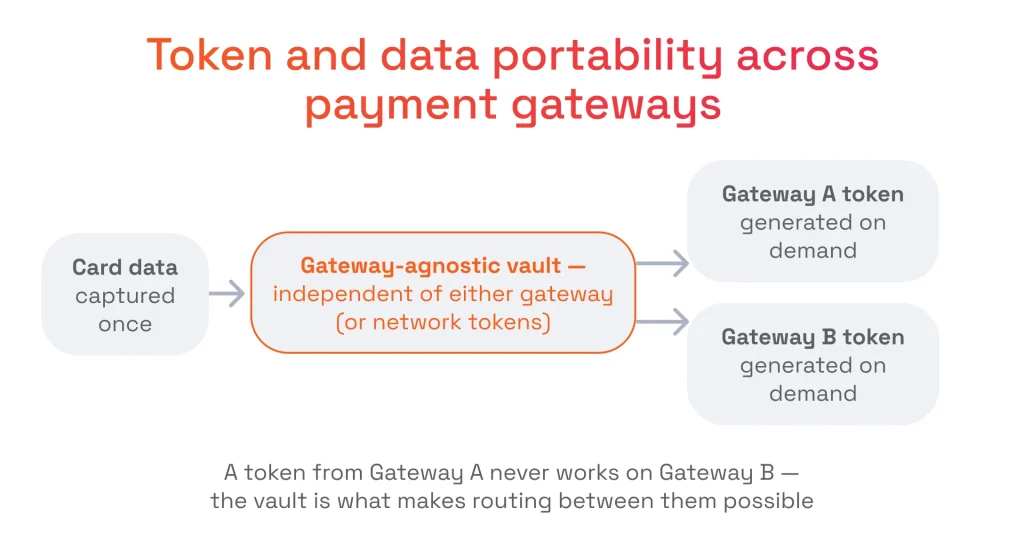
A multi-gateway architecture breaks if customer payment tokens are locked inside a single processor’s ecosystem. If Gateway A holds your customer’s vaulted credit card token, Gateway B cannot process a recurring subscription charge for that customer without prompting them for card details again.
Achieving token portability requires decoupling tokenization from payment processing using independent vaulting mechanisms or card-network standards.
Why a Card Token From One Gateway Doesn’t Work on Another
Gateway-issued tokens are proprietary primary account number (PAN) aliases generated inside a specific provider’s PCI-compliant vault. Gateway B cannot decrypt or resolve a token minted by Gateway A. Relying exclusively on processor-side tokenization locks your recurring revenue streams to that vendor and renders automated failover useless for subscription or one-click payments.
Gateway-Agnostic Vaulting
To achieve complete token mobility, engineering teams implement a gateway-agnostic vault—either built internally within an isolated PCI DSS Level 1 environment or integrated via an independent tokenization service. The agnostic vault ingests raw card data, stores it securely, and issues a neutral internal token. When a transaction routes to a specific gateway, the vault dynamically detokenizes the card payload or requests a proxy token for that specific target provider.
Reviewing payment gateway compliance and security is essential when designing these vault boundaries, and adhering to secure payment best practices keeps PCI scope strictly contained.Independent vaulting guarantees that stored payment credentials remain usable regardless of which gateway executes the charge.
Network Tokens as a Partial Solution
Network tokens represent an evolving alternative to traditional gateway tokens. Issued directly by card networks (Visa, Mastercard) rather than individual processors, network tokens remain valid across multiple acquiring channels and automatically update when card details change. Network tokens are seeing rapid adoption industry-wide — Visa alone has issued more than 12 billion tokens, a 44% increase in the last year.
While network tokens simplify portability, deploying them still requires an orchestration engine capable of provisioning and dispatching network token payloads to participating processors.
For the PCI-scope implications of where tokenization sits in the architecture, see our dedicated guide to payment security architecture.
Layer 4: Reconciliation and Observability Across Gateways
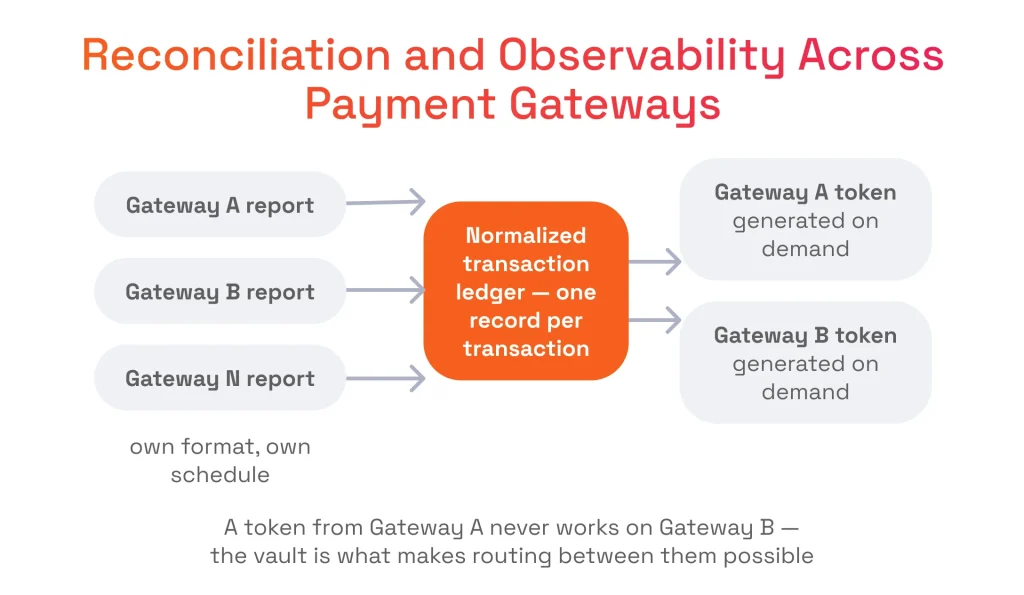
Processing payments through multiple gateways scatters settlement data across incompatible formats — each provider issues its own batch reports, fee structures, and dispute logs, on its own time zone and reporting cycle. Financial operations teams end up manually reconciling CSV exports against internal order records just to catch a missing payout or a processor fee nobody authorized, unless something unifies the ledger underneath all of it.
That unification takes the form of a normalized internal transaction ledger, where every payment event — authorization through chargeback — writes an immutable record mapping the internal order GUID directly to its provider-specific transaction ID.
That same ledger feeds Layer 2’s routing logic in real time: a statistical drift in authorization approvals, or a latency spike on one provider’s adapter, signals the routing engine to shift traffic before the degradation reaches revenue.
For the full reconciliation-engine build sequence — data normalization, algorithmic matching, exception handling — see our dedicated guide to payment operations automation.
Build Sequence and Engineering Effort for a Multi-Gateway Architecture
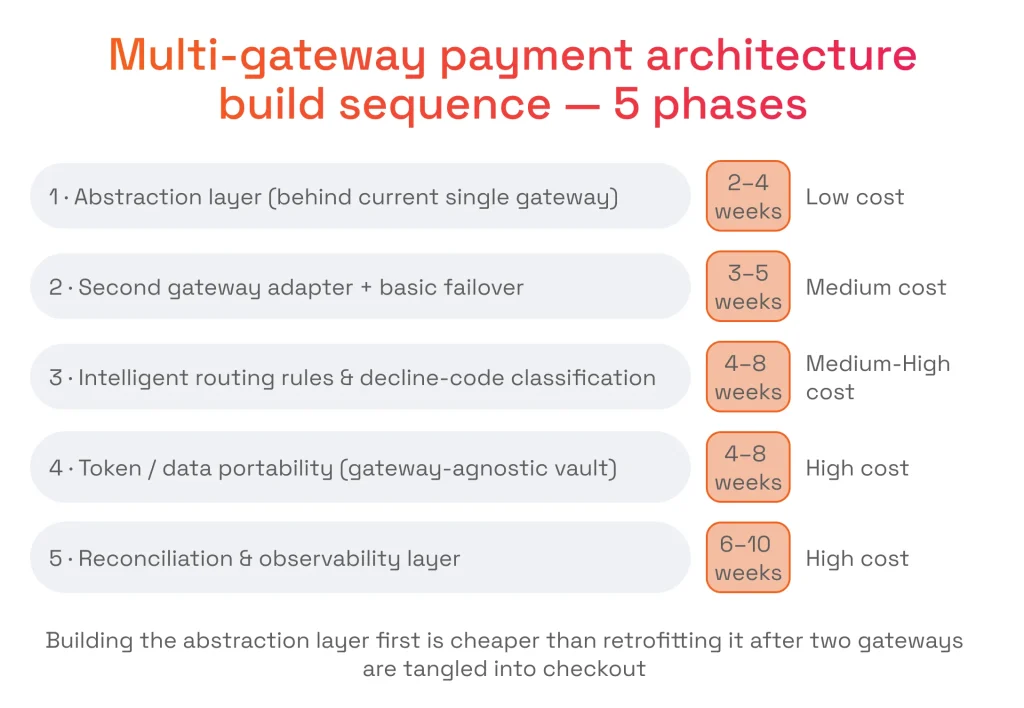
Attempting to build all five layers simultaneously can overwhelm engineering teams and delay time-to-market. A phased rollout allows organizations to extract architectural leverage early while incrementally implementing advanced features like automated routing and token portability.
The sequence starts with an internal abstraction layer behind the current single gateway, then adds a second gateway adapter with basic failover, followed by intelligent routing rules and decline-code classification once enough historical data exists to tune them, a gateway-agnostic token vault for portability, and finally a reconciliation and observability layer that scales alongside the number of connected gateways and entities.
Order | Phase | Timeline | Relative Engineering Cost |
|---|---|---|---|
1 | Abstraction layer (behind current single gateway) | 2–4 weeks | Low — highest leverage; far cheaper than retrofitting later |
2 | Second gateway adapter + basic failover | 3–5 weeks | Medium — depends on the second provider’s API and webhook model |
3 | Intelligent routing rules & decline-code classification | 4–8 weeks | Medium-High — requires historical decline data to tune rules meaningfully |
4 | Token / data portability (gateway-agnostic vault) | 4–6 weeks | High — touches checkout, subscriptions, and PCI scope directly |
5 | Reconciliation & observability layer | 6–10 weeks | High — scales with the number of connected gateways and entities |
Order
1
2
3
4
5
Phase
Abstraction layer (behind current single gateway)
Second gateway adapter + basic failover
Intelligent routing rules & decline-code classification
Token / data portability (gateway-agnostic vault)
Reconciliation & observability layer
Timeline
2–4 weeks
3–5 weeks
4–8 weeks
4–6 weeks
6–10 weeks
Relative Engineering Cost
Low — highest leverage; far cheaper than retrofitting later
Medium — depends on the second provider’s API and webhook model
Medium-High — requires historical decline data to tune rules meaningfully
High — touches checkout, subscriptions, and PCI scope directly
High — scales with the number of connected gateways and entities
Understanding the overall cost to build a payment gateway helps engineering leaders budget effectively across these implementation phases.
Architecture Readiness Checklist for Multi-Gateway Payments
Use this technical readiness checklist to evaluate whether your current implementation constitutes a fully realized multi-gateway payment architecture or simply a collection of disconnected integrations.
✓ | Decision | Architecture Implication |
|---|---|---|
☐ | Checkout and business logic call a shared payment interface, never a gateway SDK directly | A new gateway can be added as one adapter, without touching upstream code |
☐ | Webhooks from every gateway are normalized into one internal event model | Downstream systems (notifications, reconciliation) don’t need gateway-specific handling |
☐ | Routing decisions are made by a rules engine with live health checks, not a static primary/backup pair | Failover actually triggers on real degradation instead of only on a full outage |
☐ | Decline codes are classified before a retry or cascade decision is made | Retries target genuinely recoverable failures instead of hammering a hard decline |
☐ | Retry behavior has a configured ceiling per transaction | Routing logic stays within card-network monitoring thresholds and avoids merchant flags |
☐ | Card data is vaulted independently of either gateway (or network tokens are used) | Stored cards and subscriptions aren’t locked to one provider’s token format |
☐ | Every transaction maps to one internal record regardless of which gateway processed it | Reconciliation happens against one ledger instead of N separate settlement reports |
☐ | Per-gateway health and decline-rate monitoring feeds back into the routing engine’s rules | Routing quality improves over time instead of running on rules set once at launch |
✓
☐
☐
☐
☐
☐
☐
☐
☐
Decision
Checkout and business logic call a shared payment interface, never a gateway SDK directly
Webhooks from every gateway are normalized into one internal event model
Routing decisions are made by a rules engine with live health checks, not a static primary/backup pair
Decline codes are classified before a retry or cascade decision is made
Retry behavior has a configured ceiling per transaction
Card data is vaulted independently of either gateway (or network tokens are used)
Every transaction maps to one internal record regardless of which gateway processed it
Per-gateway health and decline-rate monitoring feeds back into the routing engine’s rules
Architecture Implication
A new gateway can be added as one adapter, without touching upstream code
Downstream systems (notifications, reconciliation) don’t need gateway-specific handling
Failover actually triggers on real degradation instead of only on a full outage
Retries target genuinely recoverable failures instead of hammering a hard decline
Routing logic stays within card-network monitoring thresholds and avoids merchant flags
Stored cards and subscriptions aren’t locked to one provider’s token format
Reconciliation happens against one ledger instead of N separate settlement reports
Routing quality improves over time instead of running on rules set once at launch
Teams that check every row in the abstraction column but few elsewhere usually have a working integration, not yet a resilient architecture. Routing and token portability are where most multi-gateway builds stall. Three or more unchecked rows outside the abstraction layer signals the next investment should be architectural, not another feature.
SPD Technology’s Expertise: Building Multi-Gateway Payment Architecture
Coordinating multiple third-party payment providers in one system takes domain experience most teams only build by doing it under real constraints — concurrent transaction volume that doesn’t tolerate slow routing decisions, compliance regimes that don’t bend for convenience, and consistency guarantees that have to hold even when a provider goes down mid-transaction.
SPD Technology has built that experience over 20 years and 460+ delivered projects, with 650+ engineers architecting custom payment platforms for global enterprises. The reference design above comes out of engagements where scalability and resilience weren’t optional — they were the operating constraint the system had to survive.
Multi-Provider Integration at Scale — NimbleCommerce
As the sole technology vendor for Silicon Valley eCommerce provider NimbleCommerce, SPD Technology architected and delivered a global white-label eCommerce platform. The system integrated 27 distinct third-party payment providers across the US, Canada, Mexico, Greece, the UK, and broader European markets — each provider abstracted behind a common interface and routed through shared checkout logic rather than maintained as a separate integration.
Long-Term Full-Cycle Payment Architecture — Poynt
For Poynt, the US payment company, SPD Technology engineered an all-in-one omnicommerce payment processing system in just 5 months. The architecture handled full-cycle payment processing, settlement pipelines, and third-party integration APIs. Over a 5+ year engineering partnership, SPD Technology maintained and evolved this core platform infrastructure to support growing transaction volumes and ongoing integration demands.
Event-Driven, Exactly-Once Transaction Processing — Cashback Platform
SPD Technology built a US fintech platform at the intersection of media and payments, an event-driven card-linked-offer processing engine. Running over Plaid integrations, the system enforced exactly-once processing on every reward event — no dropped or duplicate transactions — and got reward attribution down to sub-second, with payouts ready in 48 to 72 hours.
Transaction volume, regional footprint, and how many active subscriptions are in play all shape what the right build sequence looks like for a given system. SPD Technology’s payment engineering team starts by evaluating what’s already built — finding the structural gaps, then scoping bottlenecks against the infrastructure needed to close them for your specific operating requirements.
Key Takeaways
- A second gateway without a shared abstraction layer multiplies integration surface but adds no resilience — every change gets built twice instead of once.
- Failover only works when a routing engine makes a real-time reroute decision; a static primary/backup pair fails over only after a full outage, not on partial degradation.
- Retrying a hard decline wastes retry budget that should go to recoverable failures like network timeouts — decline codes must be classified before any retry decision.
- Card networks can penalize a merchant once a declined transaction is retried more than 20 times in 30 days, so routing engines need a configured retry ceiling, not unlimited retries.
- Stored card tokens are gateway-specific, so a subscription tied to one provider’s token requires a gateway-agnostic vault or network tokens to run through a different provider.
- Reconciliation across gateways stays a manual, per-provider task until every transaction maps to one internal ledger record — that mapping is what makes multi-gateway resilience real, not optional.
In short: multi-gateway resilience is an architecture property — abstraction, routing, tokens, and reconciliation working together — not a byproduct of holding two provider accounts.
Frequently Asked Questions
What is multi-gateway payment architecture?
Multi-gateway payment architecture is the software design pattern that allows a platform to route transactions across two or more payment service providers through a single, coordinated system layer. Instead of writing custom code paths for each processor throughout the application, a multi-gateway architecture unifies provider communication behind a common abstraction, using dynamic rules to handle routing, failover, token portability, and financial reconciliation.
What is the difference between a payment gateway abstraction layer and payment orchestration?
A payment gateway abstraction layer is a structural pattern within software code that wraps different payment provider APIs behind a uniform interface, preventing processor-specific code from leaking into core application logic. Payment orchestration is the broader system operationalizing that abstraction layer, adding runtime decision components such as dynamic routing logic, health checks, cascade policies, vault management, and automated reconciliation across providers.
Should a payment routing engine retry on the same gateway or switch to another?
Retry or cascade decisions come down to decline classification, not a fixed rule for every failure. A network timeout or temporary processor downtime is a soft error — retry it immediately, or cascade to another gateway if the first attempt fails again. A stolen card or invalid account number is a hard decline instead: every processor will reject it the same way, so retrying or cascading just burns attempts against a card network’s monitoring threshold for nothing.
Can payment tokens be transferred between different payment gateways?
No — payment tokens generated by a specific payment gateway cannot be directly charged through a different gateway, because each processor uses its own proprietary encryption keys to vault primary account numbers. Achieving token portability across providers usually means one of two paths: storing card details in a gateway-agnostic vault that re-tokenizes per provider, or adopting card-network tokens that stay valid across processors by design — a formal PCI-compliant migration between vaults is the fallback when neither is already in place.
How long does it take to build a multi-gateway payment architecture?
Building a basic abstraction layer and integrating a secondary gateway adapter typically takes 5 to 9 weeks of engineering effort. Adding dynamic rule-based routing, an independent token vault, and a unified reconciliation ledger on top of that generally runs another 14 to 24 weeks — the wide range comes down to transaction volume and how many providers the system ultimately needs to coordinate.
What’s the biggest mistake teams make when building multi-gateway payment systems?
The most common mistake is treating a multi-gateway expansion as a simple API integration task rather than an architectural design project. Teams scatter provider-specific if/else checks across application code and push token portability and reconciliation to “later” — later usually means fragile failover paths and subscription tokens locked to whichever gateway a customer first paid through, discovered only when month-end settlement turns into a manual reconciliation job nobody budgeted for.