

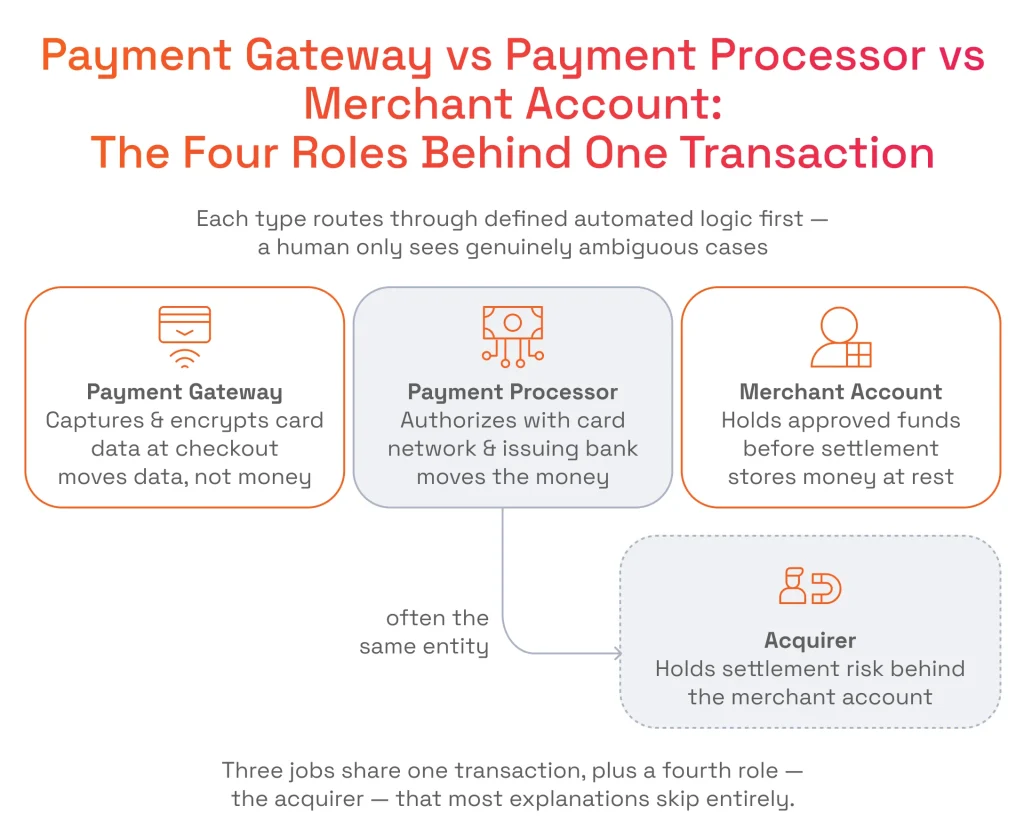
A payment gateway captures and encrypts card data at checkout and passes it along for a decision. A payment processor authorizes the transaction by checking with the card network and the customer’s bank, then moves the money. A merchant account, held with an acquiring bank, temporarily stores those approved funds before they settle into the business’s own account. Some providers bundle all three under one brand. The acquirer sits behind the merchant account, and many processors also act as acquirers, which is why gateway, processor, merchant account, and acquirer get treated as interchangeable in casual conversation about payment gateway vs payment processor vs merchant account setups.
Gateway, processor, merchant account, acquirer: the same four words appear in nearly every payment provider’s documentation, and each vendor seems to draw the lines in a different place. The payment gateway vs payment processor vs merchant account question comes from three distinct jobs sharing one transaction, plus a fourth role, the acquirer, that most explanations skip entirely.
It is important to have clarity on each role to understand what actually happens between a customer’s tap and a settled deposit, then work through where an acquirer fits and which setup makes sense at your transaction volume. McKinsey projects merchant acquiring revenue climbing from roughly $82 billion in 2022 to $107 billion by 2027, and that growth runs through infrastructure most engineering teams never examine closely until a settlement delay or a compliance question forces the issue.
What Is a Payment Gateway?
A payment gateway is the customer-facing checkpoint at checkout, whether that’s a merchant’s eCommerce platform or a physical point-of-sale terminal. It captures the card or wallet details a shopper enters, encrypts that data immediately, and transmits it to the payment processor for a decision. Once the processor responds, the gateway relays the approval or decline back to the checkout screen within about a second. That’s the core of what is a payment gateway vs payment processor: the gateway never touches the money itself, only the data describing it. Some businesses run more than one, and deciding between single vs. multiple payment gateways usually comes down to redundancy, multi-currency support, or negotiating power over processing rates.
What Is a Payment Processor?
A payment processor is the entity that actually authorizes a transaction. It communicates with the card network and the customer’s bank to confirm the account is valid, funds are available, and the transaction doesn’t look fraudulent. Once authorized, the processor facilitates moving money through the network toward the merchant’s side of the relationship. So, while a gateway only routes data, a processor makes the underlying banking system respond. This is why processor relationships come with heavier compliance overhead attached.
What Is a Merchant Account?
A merchant account is a specialized bank account, provided by an acquiring bank, that temporarily holds funds after a transaction is approved and before they settle into the business’s regular operating account. That role is easier to see next to a payment gateway: the merchant account vs. payment gateway distinction comes down to custody versus transmission, since the account holds money at rest while the gateway only ever moves data through. Holding that money is exactly why opening one requires underwriting, since the acquiring bank takes on risk for chargebacks and fraud before it ever reaches the merchant. That underwriting step is often the slowest part of standing up payment acceptance.

Oleksandr Boiko
Delivery Director at SPD Technology
“Some teams asking about payment gateways are actually running into merchant account or processor issues without realizing it. What looks like a simple two-week gateway swap quickly turns into a headache over underwriting and risk limits. Providers package these services together, but their technical and financial boundaries remain distinct”.
Payment Gateway vs. Payment Processor vs. Merchant Account: Key Differences
When the three components are placed side by side, they cease to overlap and begin to appear as they actually are: distinct systems each dealing with a different part of the same transaction. The four tables that follow resolve most of the confusion by comparing the components’ role, scope, cost, and regulatory status directly.
Role in the Transaction Process
If you consider the three roles one by one, the gap between a payment gateway and a merchant account becomes most obvious, since one deals exclusively with data and the other only handles money.
The table below breaks down how each component functions within a single checkout flow to keep transactions secure and moving efficiently.
Component | Role in the Transaction |
|---|---|
Payment gateway | Captures and encrypts payment data at checkout; transmits it to the processor and relays the approval or decline back to the merchant |
Payment processor | Authorizes the transaction by communicating with the card network and issuing bank; facilitates the movement of funds |
Merchant account | Holds approved transaction funds temporarily, provided by the acquiring bank, before they’re transferred to the business’s main bank account |
Component
Payment gateway
Payment processor
Merchant account
Role in the Transaction
Captures and encrypts payment data at checkout; transmits it to the processor and relays the approval or decline back to the merchant
Authorizes the transaction by communicating with the card network and issuing bank; facilitates the movement of funds
Holds approved transaction funds temporarily, provided by the acquiring bank, before they’re transferred to the business’s main bank account
Scope of Services and Integration
The scope and the amount of integration effort go hand in hand, and the position of a component within that hierarchy gives an approximate idea of how much engineering work it will require.
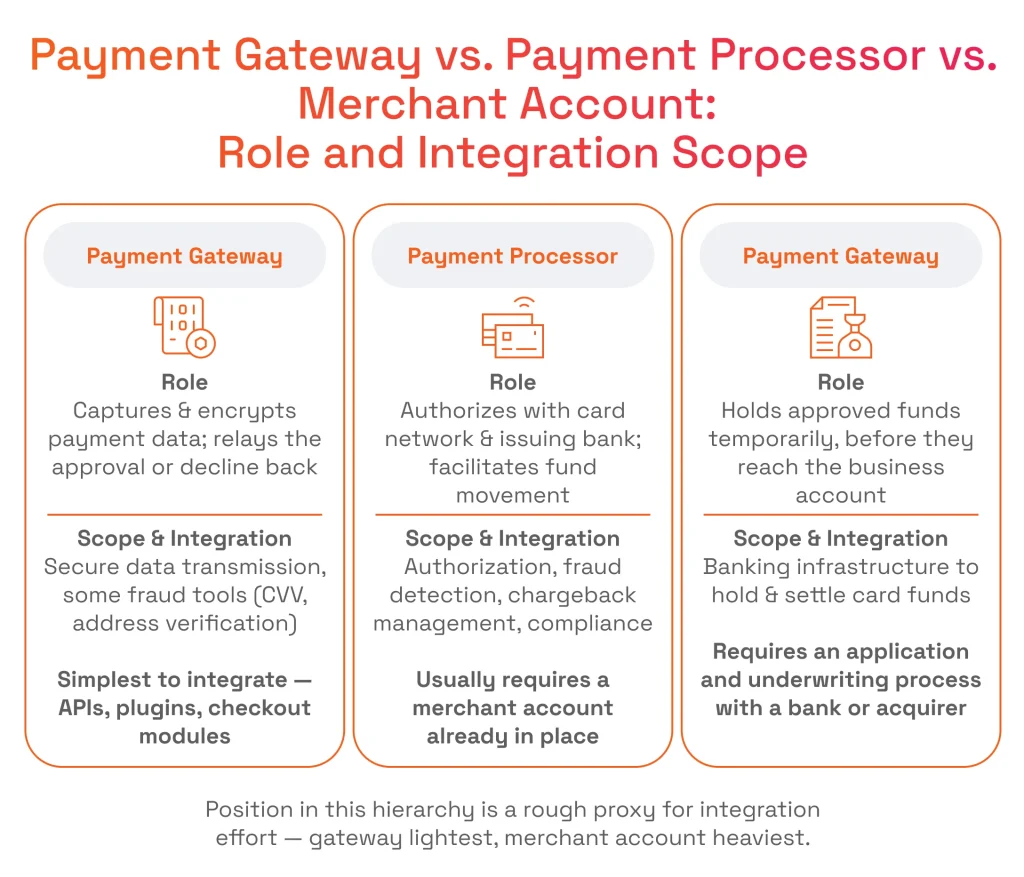
The following table details what each payment component provides and the technical complexity involved in setting it up.
Component | Scope of Services | Integration |
|---|---|---|
Payment gateway | Focused on secure data transmission; some offer fraud tools like CVV and address verification | Typically the simplest to integrate — APIs, plugins, and pre-built checkout modules |
Payment processor | Broader services: authorization, fraud detection, chargeback management, regulatory compliance | Usually requires a merchant account to be in place; more involved setup |
Merchant account | Provides the banking infrastructure to hold and settle card-based funds | Requires an application and underwriting process with a bank or acquirer |
Component
Payment gateway
Payment processor
Merchant account
Scope of Services
Focused on secure data transmission; some offer fraud tools like CVV and address verification
Broader services: authorization, fraud detection, chargeback management, regulatory compliance
Provides the banking infrastructure to hold and settle card-based funds
Integration
Typically the simplest to integrate — APIs, plugins, and pre-built checkout modules
Usually requires a merchant account to be in place; more involved setup
Requires an application and underwriting process with a bank or acquirer
Costs and Fees
The fee structure for a gateway, a processor, and an account determines whether the services are bundled or provided separately.
Component | Typical Fee Structure | What Drives Cost |
|---|---|---|
Payment gateway | Flat monthly platform fee and/or a small per-transaction fee | Transaction volume, feature set (fraud tools, multi-currency support) |
Payment processor | A percentage of transaction value (interchange plus markup) plus a per-transaction fee | Card type, interchange category, processing volume, negotiated rates |
Merchant account | Monthly account fee, statement fee, PCI compliance fee, chargeback fees | Risk profile, industry/MCC classification, monthly volume, provider |
Component
Payment gateway
Payment processor
Merchant account
Typical Fee Structure
Flat monthly platform fee and/or a small per-transaction fee
A percentage of transaction value (interchange plus markup) plus a per-transaction fee
Monthly account fee, statement fee, PCI compliance fee, chargeback fees
What Drives Cost
Transaction volume, feature set (fraud tools, multi-currency support)
Card type, interchange category, processing volume, negotiated rates
Risk profile, industry/MCC classification, monthly volume, provider
Regulatory and Licensing Status
The regulatory status is a major reason why onboarding timelines vary so much between different components.
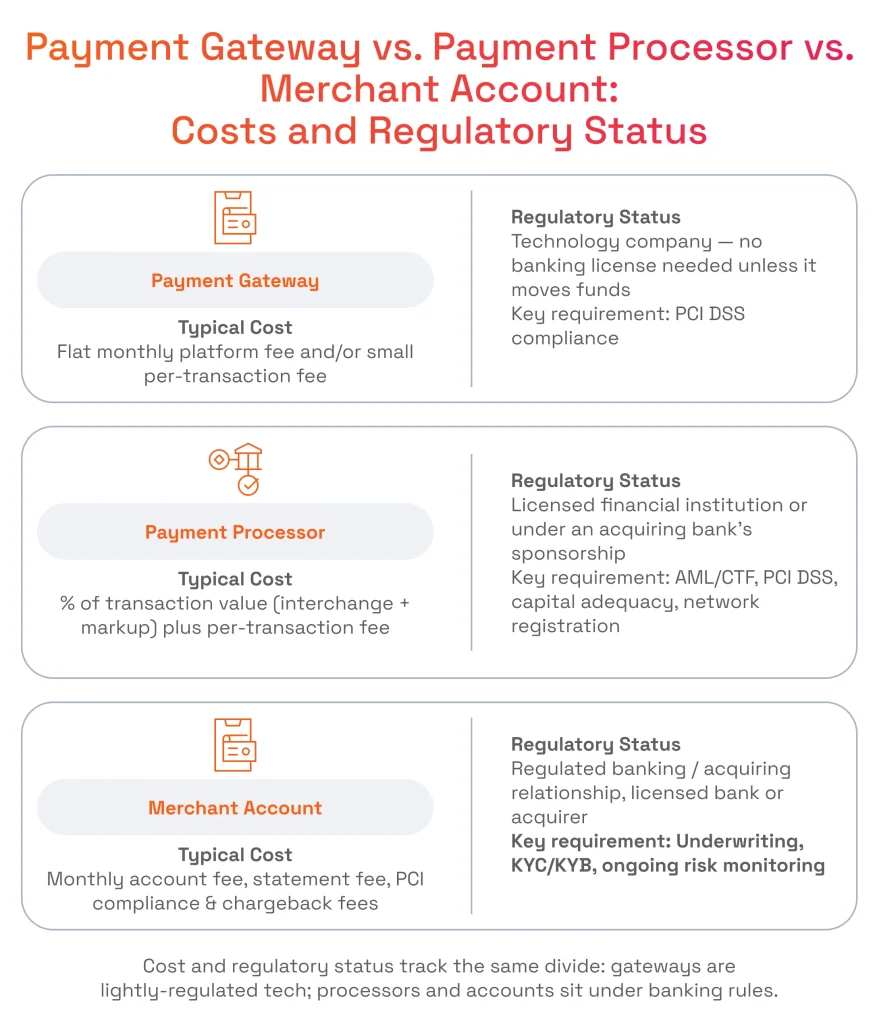
The overview below compares the legal designations and core compliance standards required across each layer of the payment stack.
Component | Regulatory / Licensing Status | Key Requirements |
|---|---|---|
Payment gateway | Typically a technology company; no banking or payments license required unless it also holds or moves funds | PCI DSS compliance; PSP or e-money institution licensing only if funds-handling functions are added |
Payment processor | Operates as a licensed financial institution or under an acquiring bank’s sponsorship | AML/CTF checks, PCI DSS, capital adequacy requirements, card network registration |
Merchant account | Exists within a regulated banking or acquiring relationship, provided by a licensed bank or acquirer | Merchant underwriting, KYC/KYB, ongoing risk monitoring by the acquirer |
Component
Payment gateway
Payment processor
Merchant account
Regulatory / Licensing Status
Typically a technology company; no banking or payments license required unless it also holds or moves funds
Operates as a licensed financial institution or under an acquiring bank’s sponsorship
Exists within a regulated banking or acquiring relationship, provided by a licensed bank or acquirer
Key Requirements
PCI DSS compliance; PSP or e-money institution licensing only if funds-handling functions are added
AML/CTF checks, PCI DSS, capital adequacy requirements, card network registration
Merchant underwriting, KYC/KYB, ongoing risk monitoring by the acquirer
How They Work Together: The Transaction Flow
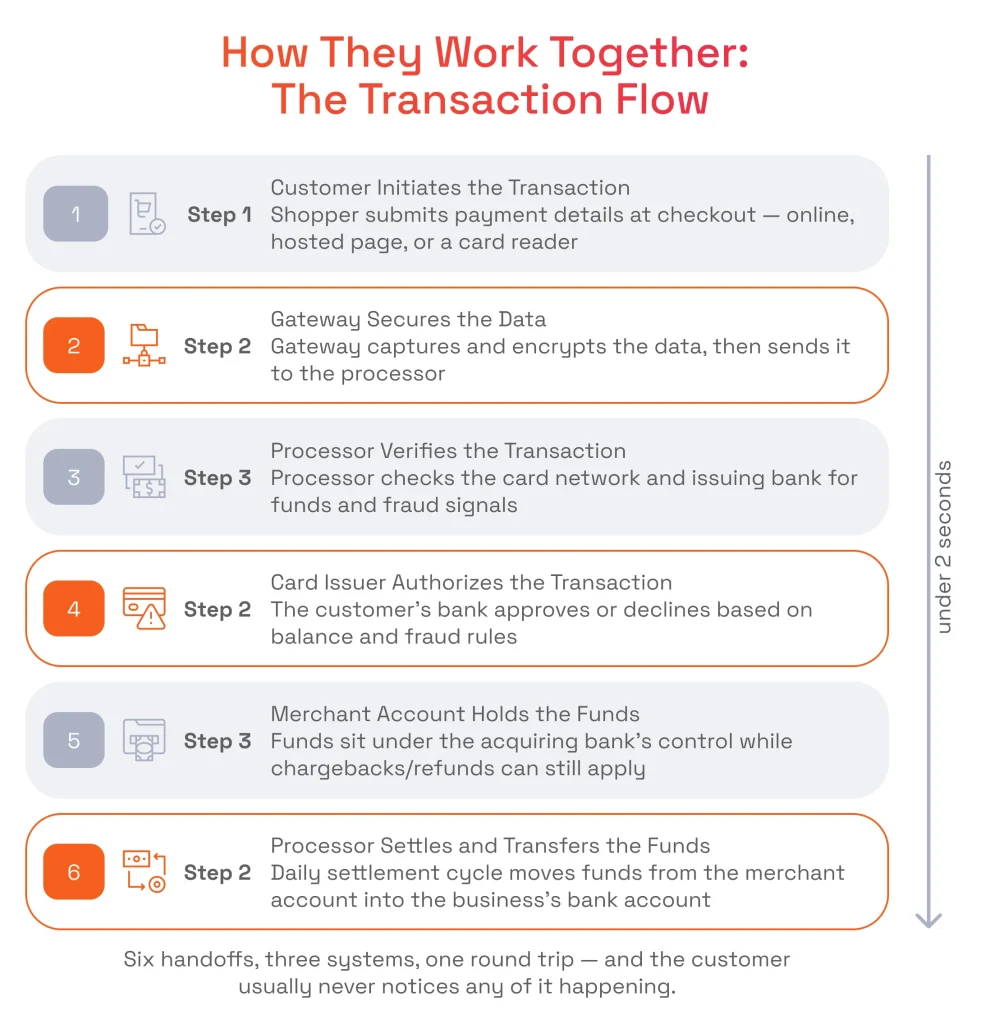
Understanding how fintech companies build payment platforms starts with the transaction itself: a single checkout process takes less than two seconds to move through all three systems and return an approval or decline, in six handoffs from entering the card number to that response. The sequence is as follows.
Step 1: Customer Initiates the Transaction
The transaction starts the moment a customer submits payment details at checkout, whether that’s a merchant’s eCommerce platform, a hosted payment page, or a card reader at a physical counter. Any business that wants to accept payments online needs both a payment gateway and a payment processor for accepting credit card payments, debit cards, and other digital payment methods, plus processing electronic payments securely from the start.
Nothing about the underlying systems matters yet. All that exists at this point is a shopper’s intent to complete an online payment and the information needed to attempt it, handled as part of secure transactions from the very first tap.
Step 2: Gateway Secures the Data
The payment gateway collects that sensitive payment information the instant a customer submits it, then the gateway encrypts it before transmission. From there, the gateway sends it onward to the payment processor over a secure channel, one of several payment gateway services that separate a serious provider from a plain form field.
Whether a business runs integrated payment gateways built directly into checkout or works with third-party payment gateways, the gateway acts the same way every time: it captures payment data, encrypts it, and moves it along. This step carries most of the PCI DSS scope. Solid payment gateways never store unencrypted card details, even briefly, during high-volume processing. Because encryption is only as strong as its surrounding infrastructure, a payment security architecture review is critical to test for vulnerabilities.
Step 3: Processor Verifies the Transaction
The payment processor verifies the transaction by communicating with the card network and the customer’s card issuing bank, checking for available funds and fraud signals in the same pass. Here, the processor acts as the checkpoint between gateway and bank, and the processor communicates directly with whichever financial institution issued the card.
Payment processors play this verifying role across every kind of card-based transaction processing, from a single sale to a full batch of credit card transactions running at volume. This step happens in milliseconds, but it’s where most declines actually originate.
Step 4: Card Issuer Authorizes the Transaction
The customer’s bank makes the final call, approving or declining based on the bank account status, available balance, and its own fraud rules, whether the sale involves a credit card, one of several debit cards on file, or a stored digital wallet credential.
The same logic applies to credit card payments and debit card payments alike, since both routes run through the same issuing bank and check the account before responding. That response travels back through the card network and processor until the payment gateway notifies the checkout page of whether the sale went through. The entire round trip usually finishes before the customer notices any delay.
Step 5: Merchant Account Holds the Funds
Once authorized, the funds move into the merchant account first, where they sit temporarily under the acquiring bank’s control while the transaction works through settlement, ahead of reaching the business’s main bank account.
This holding period is also where chargebacks and refunds get applied against the transaction before it’s finalized, which matters directly for a business managing its own cash flow. Every approved sale sits in this holding pattern for a short stretch before it’s released toward the business bank account that actually funds payroll and expenses.
Step 6: Processor Settles and Transfers the Funds
At the end of the settlement cycle, typically daily, the payment processor moves the accumulated funds from the merchant account into the business’s actual bank account, net of any transaction fees already deducted along the way.
For a business running online transactions across international payments and juggling multiple service providers, this is also where a credit card processor’s payment processing services earn their cost, since keeping regulatory compliance intact across borders takes ongoing attention well past the initial setup process. This is the point where an approved sale finally becomes usable cash.
Where Merchant Acquirers Fit In
The payment processor vs acquirer vs gateway question ultimately comes down to transaction volume and how much control over routing and fees a business requires. It’s also where the issue of choosing between a merchant account and a payment processor comes up, since providers that offer both services are covered by a single contract, and separating them carries its own cost.
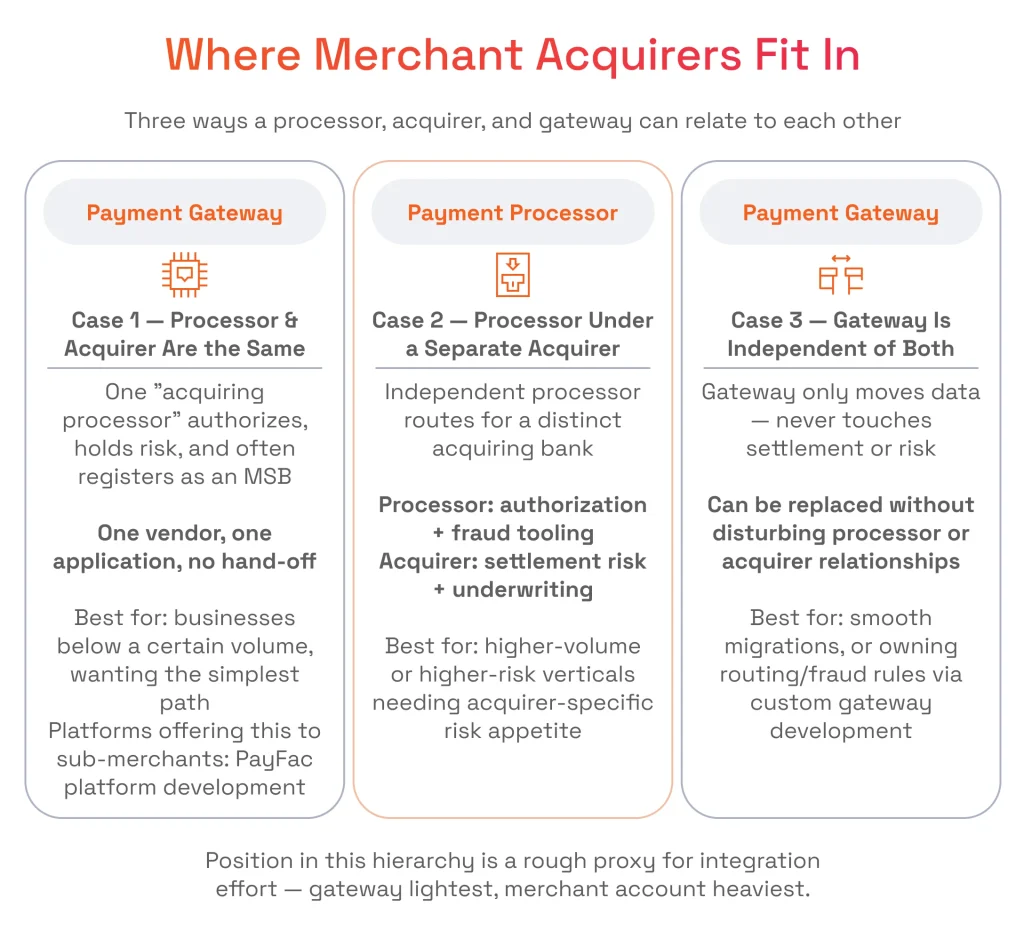
Case 1: Processor and Acquirer Are the Same Entity
Many providers act as both processor and acquirer under one contract, an arrangement usually called an acquiring processor. The same company authorizes the transaction, holds the settlement risk, and often ends up registered as a money services business, which is why merchants and even some engineers use processor and acquirer interchangeably in casual conversation.
A single payment service provider handling this combined role can run credit and debit cards, move funds toward a business’s own account, and confirm status against a customer’s bank account without ever handing off to a second vendor. For a business below a certain volume, this bundled model is usually the simplest path to accepting cards at all, since it folds all of that payment functionality, plus two underwriting relationships, into one application.
Platforms that want to offer this bundled experience to their own users, rather than just consume it as a merchant, are usually looking at PayFac platform development, since it lets them become the master merchant sitting between their sub-merchants and the underlying processor-acquirer relationship.
Case 2: Processor Operates Under a Separate Acquirer
Independent or specialized processors often route transactions for a distinct acquiring bank that isn’t part of the same company. As the connective layer, the payment processor routes transaction data between the card network and the issuing credit card company. Once it verifies the customer’s account, it sends the authorization back.
This split lets a processor stay narrowly focused on authorization, fraud tooling, and network connections, while the acquiring bank carries the settlement risk and underwriting relationship. It’s common in higher-volume or higher-risk verticals, where a business wants strong processor tooling paired with an acquirer that specializes in its particular risk profile.
Case 3: Gateway Is Independent of Both
The gateway sits apart from this relationship entirely, since it only ever moves data and never touches settlement or risk. Regardless of which payment gateway providers a business chooses, the payment gateway encrypts card details the moment a customer enters them on a merchant’s eCommerce platform, then the payment gateway sends that encrypted payload to whichever processor sits behind it.
All payment gateways function identically by focusing on one task: transmitting encrypted payment data. That independence lets businesses replace a gateway without disturbing processor or acquirer relationships, making migrations relatively smooth. Or, once a provider’s default checkout stops fitting, it makes merchant payment gateway development worth considering, since owning the layer hands back control over routing rules and fraud checks a template keeps locked down.
Oleksandr Boiko
Delivery Director at SPD Technology
“Bundling your processor and acquirer is fine when you’re small, but as volume grows, it traps you. Unbundling them gives you the freedom to route to different acquirers over a single processor integration. That’s where your real pricing leverage lies”.
Which Setup Is Right for Your Business?
Which combination makes commercial sense comes down to transaction volume and how much control over routing and fees a business needs.
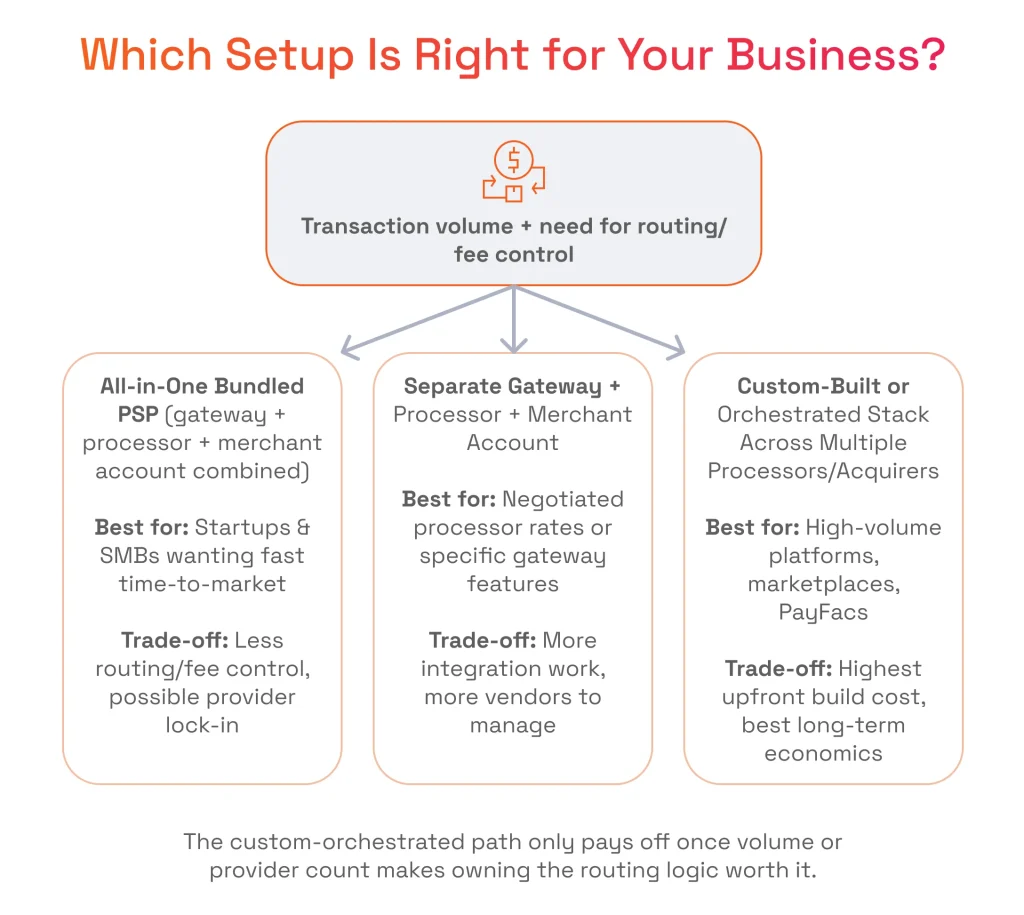
That’s also where the merchant account vs payment processor question resurfaces, since bundled providers cover both under one contract, and separating them carries its own cost.
Setup | Best For | Trade-off |
|---|---|---|
All-in-one bundled PSP (gateway + processor + merchant account combined) | Startups and SMBs prioritizing fast time-to-market and simple onboarding | Less control over routing and fees, and potential lock-in to one provider’s terms |
Separate gateway + processor + merchant account | Businesses wanting negotiated processor rates or specific gateway features not available in a bundle | More integration work and more vendor relationships to manage day to day |
Custom-built or orchestrated stack across multiple processors/acquirers | High-volume platforms, marketplaces, and PayFacs that need routing across several providers | Highest engineering investment upfront, but the most control and the best long-term economics at scale |
Setup
All-in-one bundled PSP (gateway + processor + merchant account combined)
Separate gateway + processor + merchant account
Custom-built or orchestrated stack across multiple processors/acquirers
Best For
Startups and SMBs prioritizing fast time-to-market and simple onboarding
Businesses wanting negotiated processor rates or specific gateway features not available in a bundle
High-volume platforms, marketplaces, and PayFacs that need routing across several providers
Trade-off
Less control over routing and fees, and potential lock-in to one provider’s terms
More integration work and more vendor relationships to manage day to day
Highest engineering investment upfront, but the most control and the best long-term economics at scale
The three paths break down fairly cleanly by scale, and how much of the build a business can staff in-house versus needing to hire fintech developers shifts the calculus at every tier. A bundled PSP gets a new or smaller business accepting cards fastest, at the cost of routing flexibility and negotiating room down the line. Splitting the gateway, processor, and merchant account into separate vendor relationships buys back some of that control, but each vendor is now something engineering has to integrate and maintain on its own. The custom-built or orchestrated option only really pays off once volume or provider count is high enough that owning the routing logic outweighs the upfront build cost.
Businesses leaning toward the custom-built or orchestrated route often start by evaluating payment orchestration platform development once volume or provider count makes a single bundled setup too rigid. This happens because payment orchestration platforms route transactions across several processors and acquirers from one integration layer instead of hardcoding logic against just one. That flexibility starts to matter the moment a business needs to fail over between providers automatically, split volume to negotiate better rates, or expand into a market where the incumbent processor doesn’t offer the best coverage.
This is also where the two get confused: payment gateway vs. payment orchestration, sounds like a wording distinction, but treating it that way is what leads teams to under-scope the build, since swapping a gateway only changes how data moves, while adding orchestration changes how routing and failover decisions get made across the whole stack.
Key Takeaways
- Three distinct jobs power one transaction: the gateway moves data, the processor authorizes and moves money, and the merchant account holds funds before they reach the business’s bank account.
- The acquirer sits behind the merchant account and often doubles as the processor. Below a certain volume, bundling is the simplest way to accept cards. Above it, separating the processor from the acquirer is usually what unlocks real pricing leverage.
- A single checkout passes through six handoffs, from the customer entering card details to the processor settling funds into the business’s bank account, in under two seconds.
- Cost and regulatory status track the same divide: gateways are lightly regulated tech companies with flat or per-transaction fees, while processors and merchant accounts operate under banking regulation, with fees and licensing tied to risk and transaction volume.
- The right setup depends on scale: a bundled PSP wins on speed, separating the three components buys back routing and fee control, and a custom or orchestrated stack only pays for itself once volume or provider count justifies owning the routing logic.
- Payment orchestration is a different layer than a payment gateway. Swapping a gateway only changes how data moves, while adding orchestration changes how routing and failover decisions get made across multiple providers.
In short: Gateway, processor, merchant account, and acquirer are four separable roles that providers bundle together for convenience, not necessity, and the right setup comes down to transaction volume and how much control over routing, fees, and risk the business actually needs.
FAQ
What is the difference between a payment gateway, a payment processor, and a merchant account?
Each handles a different stage of the same transaction.
- The payment gateway captures and encrypts payment data at checkout.
- The payment processor authorizes the transaction by checking with the card network and the customer’s bank, then facilitates moving the funds.
- The merchant account, held with an acquiring bank, temporarily stores those approved funds before they settle into the business’s own account.
What is the difference between a payment gateway and a payment processor?
A gateway is only capable of handling data. It takes what the customer inputs at checkout, encrypts it, and sends it on, before sending back either an approval or a rejection.
The processor is responsible for handling authorizations and the transfer of money. It verifies with both the card network and the issuing bank that the transaction is valid and ensures that the funds actually pass through the system.
What is the difference between a merchant account and a payment processor?
A payment processor is the system which authorizes transactions and causes the funds to be transferred through the network in real time.
In comparison, a merchant account is passive since it is a kind of bank account offered by an acquiring bank and temporarily holds funds that have been approved before they are settled.
Usually processors will only route transactions once a merchant account already exists, since some organisation has to hold the money while it is being authorised and until it is deposited into the business’s own bank account.
Where does a payment processor fit relative to an acquirer and a gateway?
The processor sits between the gateway, which only transmits encrypted data, and the acquirer, which holds the settlement risk behind the merchant account.
In many arrangements, the same company acts as both processor and acquirer. In others, an independent processor routes transactions for a separate acquiring bank. The gateway stays independent of both and can typically be replaced without renegotiating either relationship.
Do I need a separate payment gateway, processor, and merchant account, or can one provider handle all three?
One credit card processor or a bundled payment service provider can take on all three functions under a single contract, and for many small or newly established businesses that is the simpler and less expensive method of beginning to accept cards.
It makes sense to separate out the different components when the volume of transactions is high enough to allow for meaningful negotiation of the interchange rates, or when a business needs gateway features, routing flexibility, or acquirer relationships which a bundled provider does not provide.
Is a payment gateway regulated the same way as a payment processor?
A gateway is typically treated as a technology company and only needs PCI DSS compliance for handling card data, unless it also starts moving funds directly.
A processor usually operates as a licensed financial institution or under an acquiring bank’s sponsorship, and in the US may also need to register as a money services business with FinCEN.
How much do payment gateways, processors, and merchant accounts typically cost?
Exact rates vary enough by provider and industry that a direct quote from a provider is the only reliable number.
- Gateways generally charge a flat monthly platform fee, a small per-transaction fee, or both, scaling mostly with volume and feature set.
- Processors charge a percentage of transaction value on top of interchange, plus a per-transaction fee that varies by card type and negotiated rate.
- Merchant accounts carry their own monthly account fee, statement fee, PCI compliance fee, and chargeback fees, priced largely against the business’s risk profile and monthly volume.