

As the payments industry is booming, generating $2.5 trillion in revenue from $2.0 quadrillion in transaction value flows, supported by 3.6 trillion transactions worldwide, payments are still often treated as a simple backend utility. The truth is, payments are essential to revenue, as every attempted transaction represents a customer who has already decided to buy a product or service.
Modern secure payment environments are highly complex systems. The big players interact with multiple banks, currencies, geographies, and payment methods, creating additional gaps for errors and disruptions. Customers see these payment failures as random events; businesses experience unexpected drops in approval rates and conversion. But what really happens is structural problems in how payment flows are managed. Smart payment routing improves this by introducing a dynamic decision layer that determines the best path for each transaction in real time.
In this article, we’ll explore how intelligent payment routing systems work, why they have become essential for global digital businesses, and what new opportunities they unlock beyond simple payment processing.
Key Takeaways
- A single static payment system increases risk by causing unnecessary declines, missed approvals, and ultimately lost revenue.
- Even the slightest improvement in the transaction workflow can have a massive impact on revenue, especially for businesses with high payment volumes, without spending an additional dollar on marketing or customer acquisition.
- Smart payment routing optimizes transaction workflow by dynamically selecting the optimal processor for each transaction, increasing approval rates, reducing lost sales, and delivering cost savings through lower processing fees and optimized transaction costs.
- Intelligent payment routing also enhances global scalability and compliance by automatically routing transactions through processors that comply with regional rules and regulatory requirements.
What Is Transaction Smart Routing (From a System Perspective)
Transaction smart routing is much more than sending a payment request to the best possible provider, as it functions as a highly sophisticated decision engine built directly into an organization’s payment infrastructure. Smart routing analyzes multiple contextual and technical parameters in real time to determine the optimal path for each transaction. These attributes typically include:
- The payment method (card, digital wallet, bank transfer),
- The customer’s geographic location, the issuing bank region, and the card type (credit, debit, corporate, or prepaid),
- Transaction context, such as whether the payment is card-present (CP) or card-not-present (CNP),
- The merchant category code (MCC),
- Other risk or regulatory indicators that may affect authorization outcomes.
The logic of routing operates on a set of predefined rules combined with dynamic performance data. These rules may define preferred payment methods, processors for certain regions, or transaction types. While adhering to the rules, the system continuously monitors processor performance parameters, including availability, error frequency, latency, and authorization rates. By combining real-time analytics and predefined rules, the engine directs each transaction to the processor most likely to result in a successful authorization.
From an architectural standpoint, transaction smart routing also acts as an abstraction layer between the merchant’s application and multiple acquiring banks or payment processors. Merchants’ system doesn’t integrate with each provider separately; instead, it uses a routing layer that standardizes the payment request and manages processor selection internally. This design decision improves scalability, streamlines integrations, and, most importantly, allows businesses to change payment providers without modifying their core payment flows.
Supporting payment-processing compliance across regions is another critical function of smart routing systems worth mentioning. It is possible to embed different regulatory logics into routing rules and allow the system to automatically direct transactions to compliant processors based on jurisdiction, card network requirements, or local transaction data security standards.
If that’s the underlying mechanism, the next question becomes clear: what specific problems does smart routing payments actually solve for modern businesses and what’s the cost of not using it.
The Hidden Cost of Not Using Smart Routing
According to Signifyd, banks falsely decline about 15% of legitimate orders, meaning one in seven genuine transactions never reach completion. For merchants, this unfortunate statistic converts directly into lost profits, churned customers, and missed growth opportunities. By lacking an intelligent payment routing process and relying on basic systems, organizations cannot optimize approvals, transaction fees, or global coverage of payment operations in real time, ultimately losing money. Below are the most common ways this inefficiency shows up in real business operations.
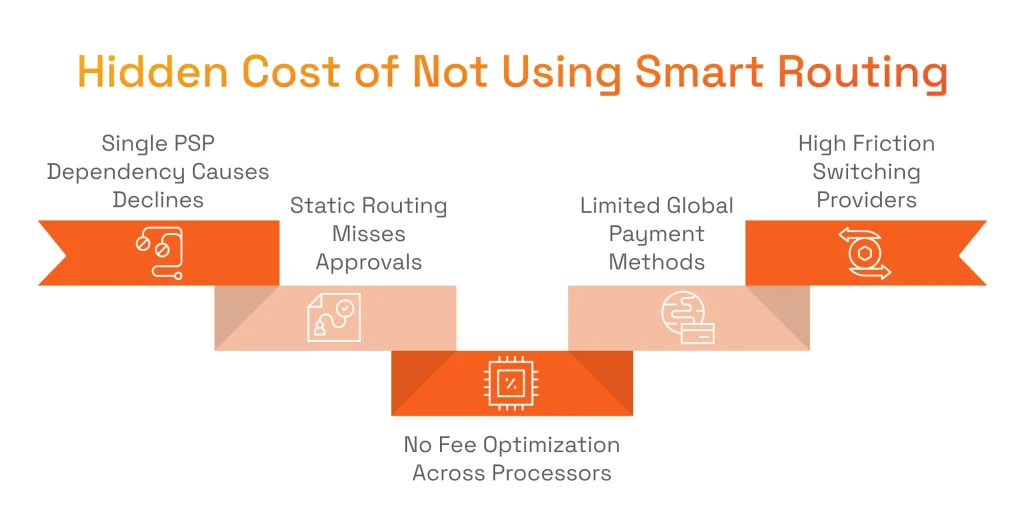
Single PSP Dependency Leads to Unnecessary Declines
On the surface, relying on a single, proven payment service provider (PSP) might seem a reasonable decision, but it brings substantial hidden costs. Any transaction can be declined due to temporary outages that this provider might have, possible regional restrictions, or processor-specific rules that you don’t have any control over. If the primary route fails, having automatic fallback options in your smart payment routing setup is necessary for recovering potentially lost revenue from failed transactions. By refusing to have a smart payment routing layer, businesses are always at risk of these declines, losing not only immediate sales but also, potentially, long-term customer trust and market reputation.
Static Routing Results in Missed Approval Opportunities
Hard-coded routing treats every transaction the same, regardless of card type, geography, or current network performance. This is a limitation that results in having missed approvals that a dynamic, data-driven system could have easily handled. Keep in mind that even the slightest percentage of declines can have a massive impact on customer satisfaction and your revenue.
Inability to Optimize Fees Across Processors
By refusing to implement smart routing, businesses miss the opportunity to earn from the differences in transaction processing fees across providers. For example, some providers may have higher authorization rates, while others offer lower fees in specific regions or by using specific cards. Ignoring these opportunities leaves money on the table in each transaction, eventually adding up to a significant chunk of lost revenue.
Limited Payment Method Support Globally
It is common for traditional PSPs to support only a specific set of payment methods in international markets. This factor can limit global growth for you, lower conversion rates among cross-border customers, and prevent your organization from flourishing in international markets.
High Operational Friction When Switching Providers
Adding or replacing payment providers without a smart routing layer is resource-intensive. Each integration requires time, technical effort, and risk management, creating operational friction that slows business agility.
Core Business Outcomes Enabled by Smart Routing
Solidgate reports that intelligent payment routing solutions can generate 10–15% higher transaction approval rates by optimizing processing paths, which could be a major driver of merchant retention going forward. Indeed, intelligent payment routing can significantly improve transaction success rates by directing payments through the most effective processors and by selecting the most cost-effective processors for each transaction.
At a time when every incremental increase in authorization can translate into millions in recovered sales, smart routing’s ability to optimize not just where transactions are processed but also how they are processed is rapidly shifting it from a backend detail to a strategic development lever for digital commerce.
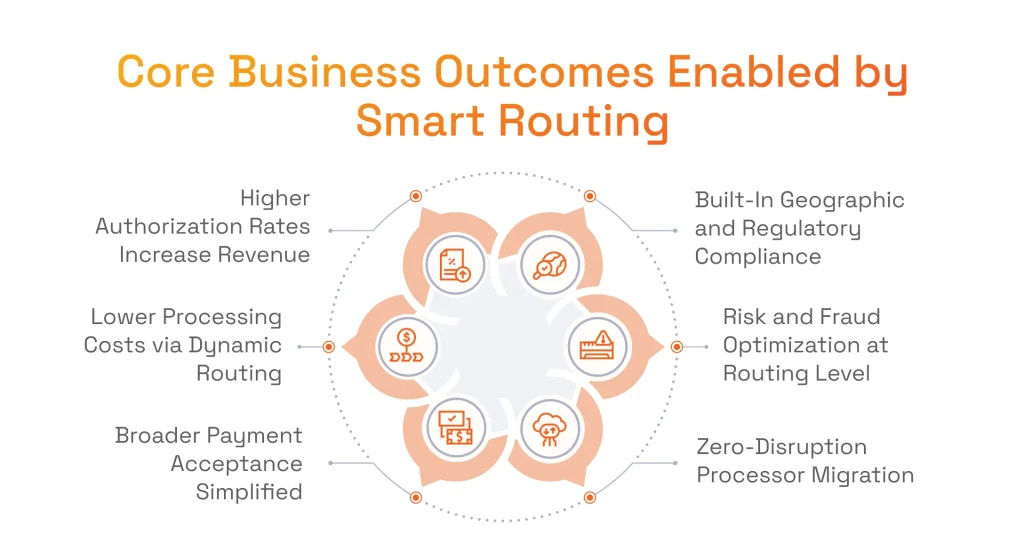
Higher Authorization Rates Are an Immediate Revenue Lift
It is a fact that the performance of different online payment processors may vary depending on region, card brand, and transaction type. Smart routing can help automatically pick the best processor for each transaction based on its performance. If we add retry logic across multiple processors, smart routing will most definitely reduce the number of failed transactions. The business outcome here is quite obvious: higher authorization rates immediately translate into a revenue boost, improved customer satisfaction, and reduced churn. Additionally, by integrating smart routing with fraud-detection software, organizations can further reduce declines, especially those caused by false positives.
Lower Processing Costs Thanks to Dynamic Optimization
Differences in region, transaction type, and card brand change processing fees. A modern routing engine can select the most cost-efficient processor for each case in real time. This unlocks advanced interchange optimizations, which include leveraging Level 2 and Level 3 data, and ensures businesses make the most of negotiated rates.
Through implementing methodical routing optimization, companies can significantly reduce per-transaction costs. When combined with custom fintech software development for multi-processor integration, smart routing may unlock unprecedented cost savings while maintaining flexibility and growth potential.
Broader Payment Acceptance Leads to Simplified Integration
A single PSP typically limits the global payment options available to an organization. Smart routing offers multiple fallback options across any providers you may require, allowing you to accept more methods without complex integrations. Businesses interact with a single layer, while routing takes over the complexities. This is a convenient way to deliver an effortless experience for international customers while improving conversion rates worldwide.
Built-In Geographic and Regulatory Compliance
Smart routing automatically accounts for area-specific rules, supports local settlement networks, and enforces compliance requirements. It enables businesses to efficiently process both local transactions and international payments by routing payments through the most optimal channels, whether domestic or cross-border.
In addition to reducing potential regulatory risks, intelligent routing accelerates global expansion by enabling entry into new markets without requiring any manual changes to payment flows. The system can easily enforce limits in accordance with local rules and automatically maintain compliance. This is perfect for enterprises that want to comply with international data protection laws while still providing a frictionless customer experience.
Risk and Fraud Optimization at the Routing Level
Integrating AI in fraud detection allows routing engines to assess transaction risk in real time. The system gains the power to intelligently handle PIN vs. non-PIN transactions, offline payments, and refund flows, lowering unnecessary declines while preventing fraudulent transactions. By combining fraud scoring with processor-specific rules, organizations can route high-risk transactions to the most appropriate provider, minimizing losses while increasing approval rates. This integration not only ensures revenue but also reinforces customer trust by reducing issues at checkout.
Zero-Disruption Processor Migration
Routing layers decouple business logic from payment providers, allowing merchants to add or remove PSPs without affecting the system or customer experience. A dependable payment routing solution permits seamless processor migration and true vendor independence, guaranteeing that businesses can switch providers or integrate new ones with minimal interruption.
This flexibility supports expansion at an impressive pace by enabling the onboarding of new payment partners and ensuring continuity despite potential outages. Ultimately, organizations gain vendor independence, reduce operational friction, and gain the ability to respond to market shifts and negotiate better terms with providers.
How Smart Routing Works in Practice — System Flow Breakdown
While smart routing may sound complex on the surface, its core logic can be understood as a real-time decision-making flow that ensures each transaction takes the optimal path. At a high level, every payment passes through a routing layer that serves as an intelligent intermediary between the merchant and multiple payment processors.
This is how smart payment routing works: by automatically directing each transaction through the optimal path using real-time data, the system can dynamically route payments for maximum efficiency and success.
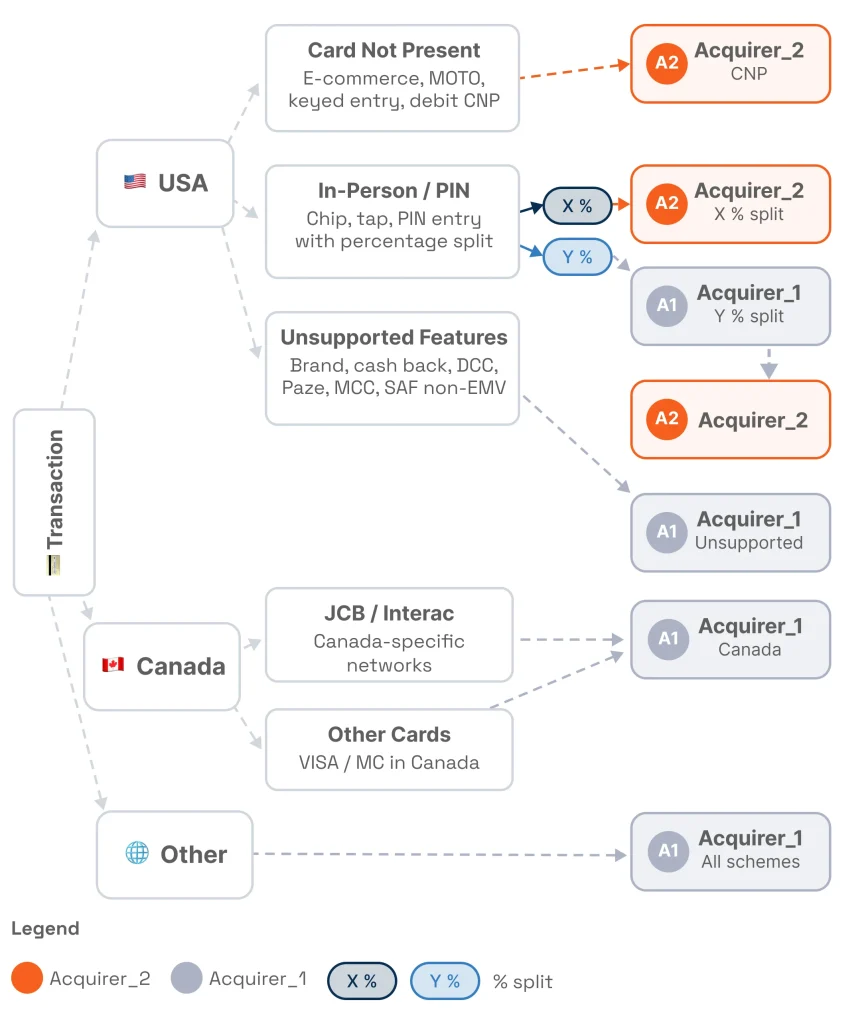
So, the transaction enters the routing layer, and the system begins evaluating the primary contextual factors. First, it considers geography, determining whether the transaction originates in the US, Canada, or another region. Next, it moves to detecting the payment type, which can be card-not-present (CNP), PIN-based, or another specialized way. Finally, it evaluates the card brand or payment method, which can affect both processor performance and compliance requirements.
After the assessment of these inputs is complete, the routing engine applies the decision logic to choose a primary processor. In our example, Adyen is used as the primary processor for CNP transactions due to its high authorization rates and global coverage.
Our experienced fintech team is here to help you with Adyen integration services, allowing your business to reach all potential customers.
If the primary processor fails to handle the transaction for various reasons, including unsupported methods, temporary outages, or real-time declines, the system activates fallback logic. In our scenario, Elavon is being automatically selected to process transactions that Adyen can’t handle. For the merchant, it appears to be a single flow with no messages about declined transactions or interruptions during checkout.

Volodymyr Soska
Senior Software Engineer at SPD Technology
“Beyond improving approval rates, this system also simplifies operations. From the merchant’s perspective, all transactions, regardless of the processor actually handling them, appear under a single interface for reporting, reconciliation, and customer support. This abstraction reduces technical overhead, enables faster provider changes, and ensures consistent compliance across regions.”
In practice, this flow allows businesses to optimize revenue, reduce costs, and mitigate operational risk, all without adding friction to the customer experience. The system intelligently routes each transaction relying on real-time data, pre-configured rules, and fallback contingencies, translating technical sophistication into concrete business outcomes.
Real-World Example: Building Payment Routing for a Global Platform
Here, at SPD Technology, we have proven experience in smart payment routing. This is one of our recent case studies, describing how we helped a global commerce platform with complex transaction flows.
Powering Poynt’s Growth with Scalable Payment Infrastructure
Business Challenge
Our client is Poynt, a B2B company with nearly 30 years of experience operating in the eCommerce and FinTech industry. The company operates across multiple geographies and supports different payment methods, including payment gateway integration. We have been working with this client for over 5 years, with the goal of scaling at a high level of reliability. The challenge was integrating Adyen’s event-driven payment system and the PayFac model into an existing settlement architecture that wasn’t designed to support these advanced workflows and hierarchical relationships.
SPD Technology’s Approach
We developed a custom payment orchestration layer that centralizes transaction routing strategies and processing logic. By enabling smart routing across multiple payment processors, our team ensured the system could dynamically select the most efficient payment path for each transaction, resulting in higher authorization rates, lower processing costs, and seamless operations across diverse payment providers.
Value Delivered
- Improved Approval Rates: By implementing a custom payment orchestration layer with smart routing across processors, we helped the client increase authorization success rates, reduce declined payments, and maximize revenue per payment.
- Scalable Architecture: The redesigned systems supported expansion and new service offerings, including the introduction of a second main payment processor. This allowed the client to expand operations globally, improve reliability, and deliver a better experience for merchants and end customers.
Overall, by helping Poynt with scalable payment infrastructure, we handled critical business needs while delivering clear results that support prolonged growth and service expansion.
Conclusion
In the modern environment, smart routing is much more than a “nice-to-have” feature. For many global businesses that rely on digital payments, it has already become a vital revenue optimization layer. Payment ecosystems will only become more complex, adding more requirements, card networks, and processors, so the importance of intelligent routing will continue to grow. Only the companies responsible for routing will be able to control authorization rates, optimize cost efficiency, and ultimately maximize operational performance.
Dynamic payment routing directly affects the bottom line by enabling companies to select the optimal processor for each transaction in response, leverage fallback logic, and integrate effortlessly with advanced payment orchestration layers. This approach also enhances merchant onboarding for eCommerce businesses, supporting faster, more secure onboarding. It is also important to note that combining routing logic with AI in fintech enables smarter fraud detection, predictive dynamic routing, and real-time performance optimization.
Here, at SPD Technology, we leverage decades of payment software development and custom orchestration solutions. We can help you build a payment infrastructure that increases revenue, minimizes friction, and sets your business up for lasting success.