Alternative payment methods for ecommerce include digital wallets, buy now pay later (BNPL) services, bank transfers, cryptocurrency, and local payment methods. They can lift conversion and open new regional markets, but for engineering teams and eCommerce decision-makers the harder problem is not which methods to add — it is how to support multiple payment rails without degrading the codebase into a disconnected cluster of custom API endpoints.
Conversion pressure and international expansion plans have likely already proved the commercial necessity of adding e commerce alternative payment methods to your checkout flow. The remaining engineering question is how to support several distinct rails without degrading your codebase into a disconnected cluster of custom API endpoints.
Our guide on e-payment systems for eCommerce already covers method definitions and regional market share, so this piece assumes that ground is covered and goes straight into how the implementation actually gets built. What follows walks through choosing methods by market, building a single integration layer instead of one connector per rail, verifying recurring billing and reconciliation before anything goes live, and getting testing, certification, and a phased rollout right — including the Shopify-specific wrinkles that trip up stores using App Store add-ons instead of native support.
Give it enough time, and every stack finds its own way into trouble: connectors built one at a time turn into code bloat, billing failures that nobody caught before launch turn into refund disputes, and a stack that outgrows however it was first put together turns unstable in whatever way it’s weakest.
Alternative Payment Methods and Regions at a Glance
Selecting the top alternative payment methods for your platform requires balancing consumer adoption against technical constraints. Regional payment preferences dictate conversion rates in cross-border commerce, yet every added method introduces distinct authorization workflows, settlement windows, and operational overhead that your system must process.
Alternative Payment Methods Types & Examples
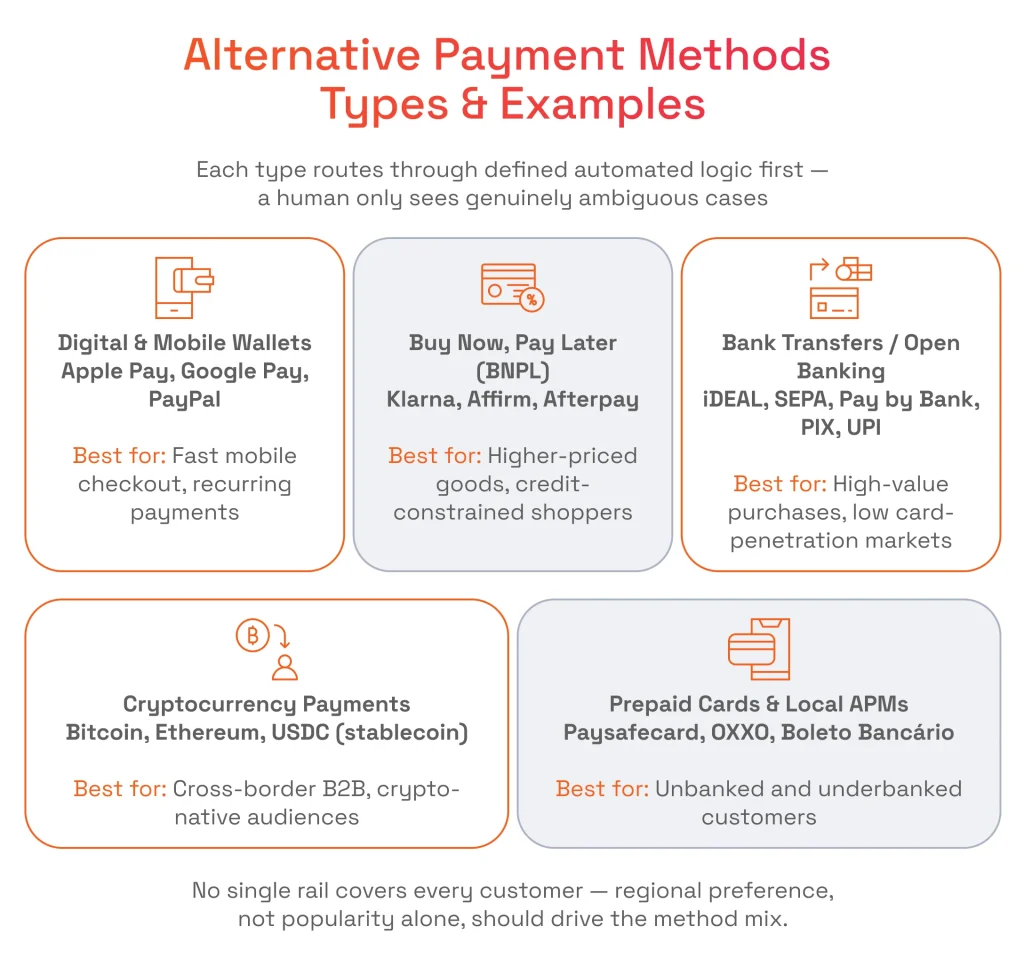
No single payment rail works the same way underneath, funds the same way, or takes the same effort to integrate — and no single rail covers every customer either, since payment preferences shift enough from region to region that betting on one method universally is its own kind of risk. Digital wallets already carry 56% of global e-commerce transaction value, and BNPL isn’t far behind: Worldpay’s 2026 Global Payments Report puts its US growth at 13% annually through 2030.
Method Type | Examples | Best For |
|---|---|---|
Digital and mobile wallets | Apple Pay, Google Pay, PayPal | Fast mobile checkout, recurring payments |
Buy now, pay later (BNPL) | Klarna, Affirm, Afterpay | Higher-priced goods, credit-constrained shoppers |
Bank transfers / open banking | iDEAL, SEPA, Pay by Bank, PIX, UPI | High-value purchases, low card-penetration markets |
Cryptocurrency payments | Bitcoin, Ethereum, USDC (stablecoin) | Cross-border B2B, crypto-native audiences |
Prepaid cards and local payment methods | Paysafecard, OXXO, Boleto Bancário | Unbanked and underbanked customers |
Method Type
Digital and mobile wallets
Buy now, pay later (BNPL)
Bank transfers / open banking
Cryptocurrency payments
Prepaid cards and local payment methods
Examples
Apple Pay, Google Pay, PayPal
Klarna, Affirm, Afterpay
iDEAL, SEPA, Pay by Bank, PIX, UPI
Bitcoin, Ethereum, USDC (stablecoin)
Paysafecard, OXXO, Boleto Bancário
Best For
Fast mobile checkout, recurring payments
Higher-priced goods, credit-constrained shoppers
High-value purchases, low card-penetration markets
Cross-border B2B, crypto-native audiences
Unbanked and underbanked customers
Evaluating these options through a crypto payment gateway development lens highlights how real-time blockchain settlement differs fundamentally from traditional asynchronous bank transfers, though many shoppers still fall back on more familiar specific payment methods like cards or wallets when a new rail feels unfamiliar.
Regional Preferences at a Glance
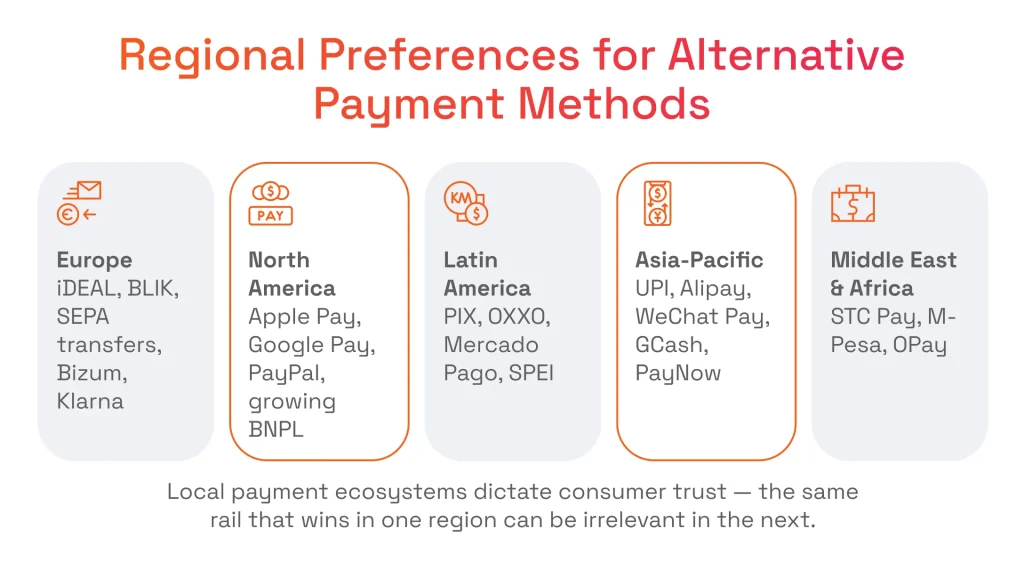
Local payment ecosystems dictate consumer trust, making payment localization essential for international merchant expansion.
Region | Dominant Local APMs |
|---|---|
Europe | iDEAL, BLIK, SEPA transfers, Bizum, Klarna |
North America | Apple Pay, Google Pay, PayPal, growing BNPL |
Latin America | PIX, OXXO, Mercado Pago, SPEI |
Asia-Pacific | UPI, Alipay, WeChat Pay, GCash, PayNow |
Middle East & Africa | STC Pay, M-Pesa, OPay |
Region
Europe
North America
Latin America
Asia-Pacific
Middle East & Africa
Dominant Local APMs
iDEAL, BLIK, SEPA transfers, Bizum, Klarna
Apple Pay, Google Pay, PayPal, growing BNPL
PIX, OXXO, Mercado Pago, SPEI
UPI, Alipay, WeChat Pay, GCash, PayNow
STC Pay, M-Pesa, OPay
Supporting e commerce alternative payment methods across these territories demands an infrastructure capable of handling localized checkout flows and distinct settlement mechanics.
Why Integration Architecture Matters More Than Which Methods You Pick
Standard industry advice focuses almost exclusively on selecting alternative payment methods based on consumer popularity metrics, often in contrast to traditional payment methods, but production failures usually originate in the underlying software architecture rather than the payment methods themselves. Account-to-account payments, including wallet-based rails, now account for roughly 30% of global point-of-sale volume, per McKinsey’s 2025 Global Payments Report — the shift already happening at checkout is exactly why the architecture question, not the method-selection question, is the one worth solving first. Building direct connections to every provider creates an unsustainable web of custom code.
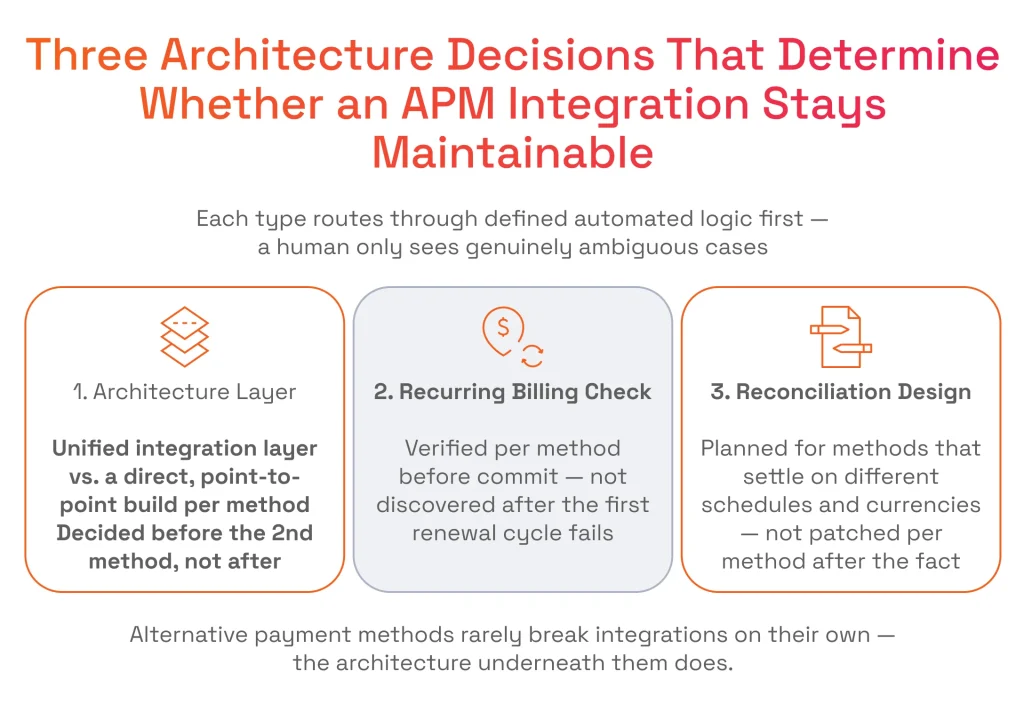
The three decisions that determine whether an APM integration stays maintainable:
- How it’s architected — a unified integration layer versus a direct, point-to-point build per method
- Whether recurring billing was verified per method before commit, not discovered after the first renewal cycle fails
- Whether reconciliation was planned for methods that settle on different schedules and currencies, not patched per method after the fact.
Investing early in custom payment orchestration platform development isolates your core transaction workflows from third-party API mutations and custom webhook schemas, even though businesses still need flexible ways to accept payments that match how customers want to pay and reflect real customer demand in each market.
Architecture Decisions Before You Integrate
Establishing an enterprise-grade payment stack requires resolving structural design questions before writing integration code for a second provider.
Unified Integration Layer vs. Per-Method Builds
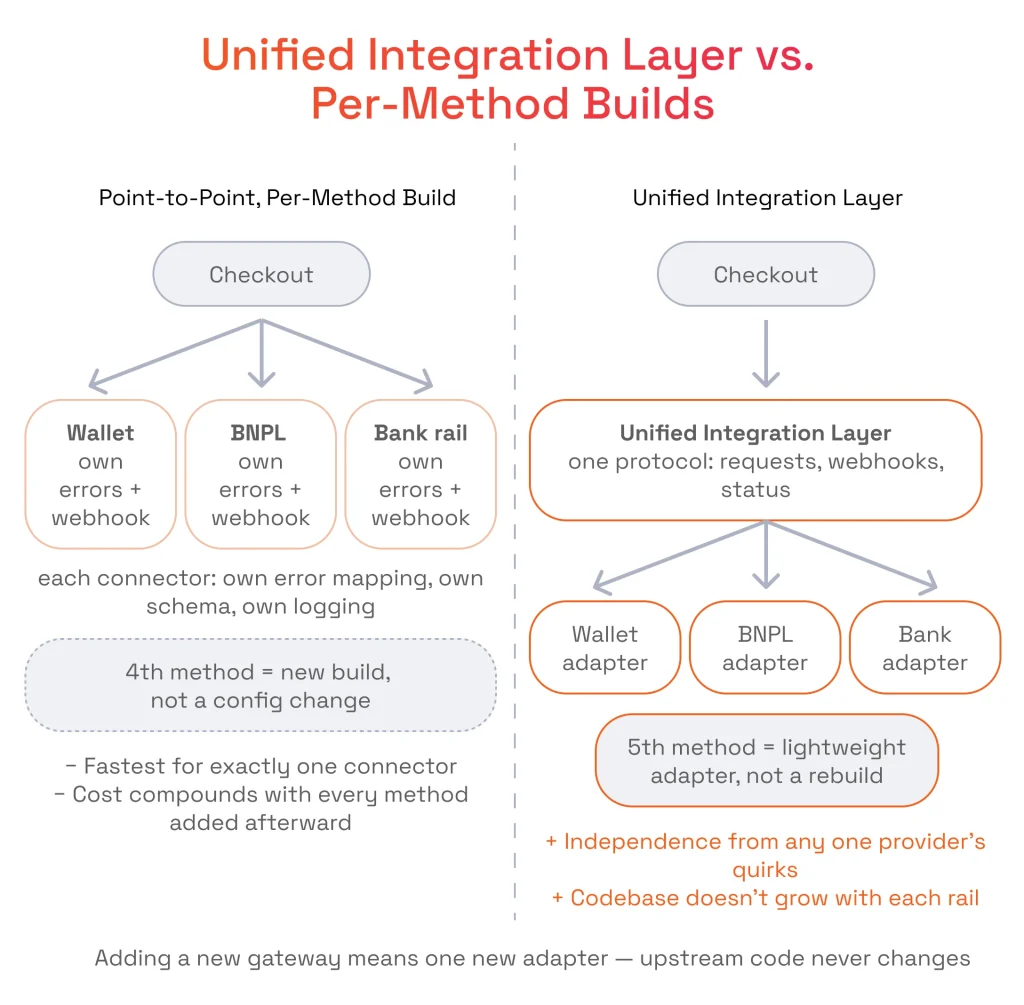
A single point-to-point integration looks like the fastest way to get a payment provider live, and for exactly one connector, it is. The cost shows up only once more payment forms start arriving behind it: each direct connection needs its own error handling, its own webhook listener, its own reporting pipeline, built and maintained apart from whatever came before it.
A unified integration layer absorbs all three of those jobs into a single internal protocol, translating incoming payloads, outgoing requests, and status notifications the same way regardless of which rail sent them. What that buys the checkout engine is independence from any one provider’s quirks — adding another of the alternative payment methods a store eventually wants becomes a configuration step layered onto infrastructure that already exists. Because that layer already exists, the codebase doesn’t need to grow every time the list of payment methods does.

Oleksandr Boiko
Delivery Director at SPD Technology
“Teams almost always evaluate alternative payment methods method by method — which wallet, which BNPL provider — and only see the real cost once the third integration needs its own webhook handler and its own reconciliation report. The architecture decision has to happen before the second method, not after it, or every addition afterward carries the weight of the ones that came before it.”
Recurring Billing Compatibility Verification
Say a store adds a BNPL provider assuming it’ll handle subscription renewals the same way a card does. It won’t, not automatically — plenty of BNPL services and push-based bank transfer schemes block automated recurring debits outright, or cap how long an authorization stays valid before it expires. Wallets and direct debit payments pulled straight from a customer’s bank account behave completely differently: native vaulting APIs let both hold onto a persistent mandate cleanly, with no re-authorization needed down the line. The gap between those two behaviors matters most exactly where it’s least visible on day one — checking each provider’s protocol against the actual billing schedule, retry logic, and dunning workflow has to happen before any code gets written, since a subscription functions like a recurring bill payment far more than a one-time charge does. Skip that check, and the first sign of trouble is a renewal cycle that quietly fails, followed by a customer who churns before anyone on the team even notices what broke.
Reconciliation Across Different Settlement Cadences
Card networks settle within a fairly predictable two-day window, and it’s tempting to design a reconciliation system around that number as if it were universal. It isn’t. Alternative payment rails run on their own clocks entirely — open banking and instant money transfers can clear before a card transaction even starts its cycle, while payments processed through local cash vouchers might take several days to report back, and by 2022 roughly 72% of the world already had real-time payment infrastructure, which means that spread of settlement speeds is now closer to the norm than the exception.
Multi-currency cross-border payments only widen the gap, since ledger balances have to reconcile across exchange rates on top of everything else already moving at different speeds. A reconciliation engine still wired around card-settlement timing breaks the moment an asynchronous payout feed hits it. Building the data schema to expect multiple settlement cadences from day one is what keeps accounting errors from creeping in as order volume climbs — which is exactly the job a custom payment operations automation pipeline is built to do.
Testing and Certification Requirements by Method Type
Sandbox environments vary dramatically in quality and scope across alternative payment providers, and certification timelines differ sharply by specific payment methods. Standard digital wallets often provide instant developer access and mock credentials for immediate automated testing. Local bank networks and BNPL vendors frequently enforce rigid compliance reviews, manual security audits, and formal integration testing before releasing production API keys — reviews that typically probe for enhanced security around stored credentials before signing off.
These mandatory certification pipelines can extend launch schedules by several weeks or months if unaccounted for in early project roadmaps. Factoring provider-specific compliance milestones directly into your initial release timeline keeps your deployment schedule on track.
How to Integrate Alternative Payment Methods for eCommerce
Deploying alternative payment methods into a live eCommerce system without a methodical sequence is how transaction processing stability quietly breaks somewhere nobody’s watching.
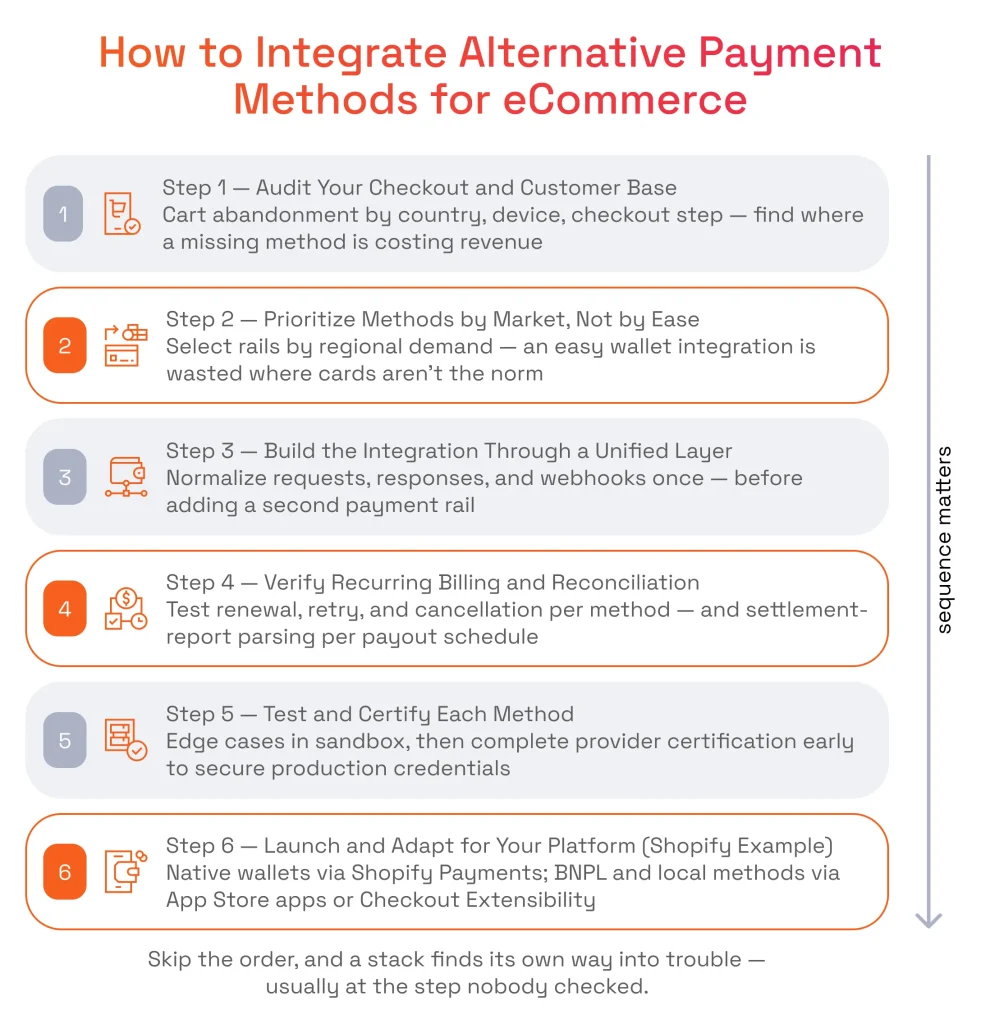
Step 1: Audit Your Current Checkout and Customer Base
Examine your checkout analytics to identify precise friction points in your current conversion funnel. Track cart abandonment rates by country, device type, specific checkout steps, and key customer segments to expose where a missing preferred payment method is driving measurable abandonment; checkout analysis often shows this clearly, and 56% of consumers abandon sites without their preferred payment method. Analyzing card decline codes reveals regional payment friction where localized payment options would capture lost revenue.
Step 2: Prioritize Methods by Market, Not by Integration Ease
Select payment rails based directly on the popular payment methods in each target market, and offer alternative payment methods according to local customer demand rather than technical simplicity. Adding an easily integrated wallet yields minimal commercial impact if your primary expansion market relies predominantly on local bank transfers or cash payment at delivery. In practice, region specific payment options often matter more than integration convenience when closing conversion gaps, so your payment strategy should stay market-specific instead of integration-led. Use regional transaction data to select payment rails that directly close conversion gaps in your target geographies.
Step 3: Build the Integration Through a Unified Layer
Construct a normalized abstraction layer between your order management system and external payment gateways before adding secondary methods to streamline the payment process through a unified layer. This internal API standardizes payment requests, response structures, and status webhooks across all current and future integrations, supporting a more convenient payment experience and a more consistent customer experience across methods. Utilizing well-engineered payment orchestration layers transforms future payment method additions into straightforward configuration updates rather than complete software builds.
Step 4: Verify Recurring Billing and Reconciliation Before Launch
A subscription renews fine in the sandbox. Then it hits a real customer’s card six weeks later and fails quietly, because nobody tested what happens when a cancellation lands mid-cycle instead of cleanly at the end of one. That’s the gap end-to-end testing has to catch before launch — running every method through renewal, retry, and cancellation, not just a single clean first payment that never gets touched again. The ledger side needs the same scrutiny: settlement reports don’t arrive on the same schedule from every provider, and accounting software built around one payout rhythm doesn’t automatically parse a different one correctly. Skip either check, and the first sign of trouble is usually a support ticket, not a test log.
Step 5: Test and Certify Each Method
Execute rigorous edge-case testing covering payment authorizations, partial refunds, timeouts, and network failure modes inside provider sandboxes. Complete all mandatory partner certification reviews early to secure production credentials well ahead of your target release date. Documenting custom error codes during this phase accelerates post-launch troubleshooting.
Step 6: Launch and Adapt for Your Platform (Shopify Example)
Executing a production release requires adapting your architecture to the specific constraints of your underlying commerce platform. Merchants evaluating Shopify alternative payment methods can use native Shopify Payments configurations for major digital wallets like Apple Pay, Google Pay, and Shop Pay, letting shoppers check out without manually entering card details. Stored payment details and securely saved card details also help speed mobile payments on Shopify-supported wallets, offering enhanced security without extra checkout steps.
Integrating BNPL networks or localized bank transfers on Shopify typically requires installing specialized apps from the Shopify App Store, or using Checkout Extensibility on Shopify Plus for custom API routing. Stacking numerous independent payment apps creates architectural instability, increased page weight, and maintenance headaches similar to fragmented custom software code bases. Reviewing established e-commerce development companies helps identify engineering partners capable of implementing unified checkout architectures.
Common Pitfalls When Integrating Alternative Payment Methods
Engineers regularly encounter predictable failure modes when integrating alternative payment methods into custom e-commerce applications.
Treating Each APM as a Separate Integration Project
Custom direct API integration feels like the fast path the first time a new provider gets connected, right up until the second one exposes what that speed actually costs. Each connector arrives with its own error mapping, its own database schema, its own logging implementation — three decisions made in isolation that never talk to each other. None of that shows up as a problem on day one. It shows up three providers later, when sprint capacity that used to go toward new features gets absorbed instead by updating whichever provider’s SDK just shipped a breaking change.
SPD Technology resolves this complexity by architecting a unified payment abstraction layer prior to adding a second payment rail. This structural normalization transforms each additional alternative payment method into a lightweight configuration module, keeping maintenance costs flat as your payment options scale.
Skipping Recurring-Billing Verification Before Launch
Say a team adds a new payment option and never checks whether it actually supports recurring charges. The first renewal cycle after launch is usually when they find out it doesn’t — quietly, in production, with real customers already mid-subscription. That’s not a hypothetical risk: the BNPL market alone was valued at $141.8 billion in 2021, and skipping this one check on a method that size is enough exposure to also start chipping away at customer retention.
SPD Technology’s work on a US card-linked cashback platform shows what the alternative looks like. Built at the intersection of media and payments, wired directly into Plaid, the system was engineered to deliver reward attribution in under a second while holding to exactly-once processing guarantees — no double-crediting, no dropped events, even under real transaction load. Payout readiness runs on its own slower clock underneath that, landing within 48 to 72 hours.
Getting both timelines right before launch is what verified-before-launch idempotency actually means in practice, and it’s the same discipline any multi-method recurring billing system needs. Merchant risk monitoring at scale is what keeps that discipline from decaying once fraudulent recurring charges start testing it in the wild.
Underestimating Reconciliation Complexity Across Methods
Imagine a team applies one reconciliation model across every payment method the platform accepts. Card payments settle on one cycle, instant bank transfers on another, local voucher schemes on a third entirely, and each deducts fees using its own formula — a single model built for one of those doesn’t bend to fit the rest, it just gets the numbers wrong quietly. Nobody notices right away. The discrepancies pile up in the background until a manual audit finally catches what automated reconciliation should have flagged months earlier.
Blackhawk Network handed its merchant settlement platform to SPD Technology’s direct engineering ownership seven years ago, and more than 37,000 active users now depend on what’s been running since. Commission calculations, multi-currency reporting, reconciliation across payment streams that have never once settled on the same clock — all of it still runs on the same infrastructure, no rebuild required in between. What seven years without a rebuild actually proves isn’t that the system is old. It’s that a reconciliation architecture built from day one to expect mismatched settlement cadences keeps its integrity as those cadences keep piling up.
Launching All Markets and Methods Simultaneously
Releasing multiple new payment methods across several geographical markets simultaneously obscures underlying system failures. When conversion rates drop or API timeouts spike during a blanket rollout, isolating whether the root cause stems from a buggy local payment gateway or a localized UI bug becomes exceptionally difficult.
SPD Technology mitigates deployment risk by executing phased rollouts sequenced carefully by market and method. Validating transaction pipelines against real customer traffic in isolated environments ensures system stability before expanding broader international support. Our core payment software development methodologies prioritize incremental deployment boundaries to safeguard revenue velocity.
Rollout Strategy: Sequencing APMs by Market
A phased deployment sequence isolates technical risk and provides operational clarity during complex payment integrations.
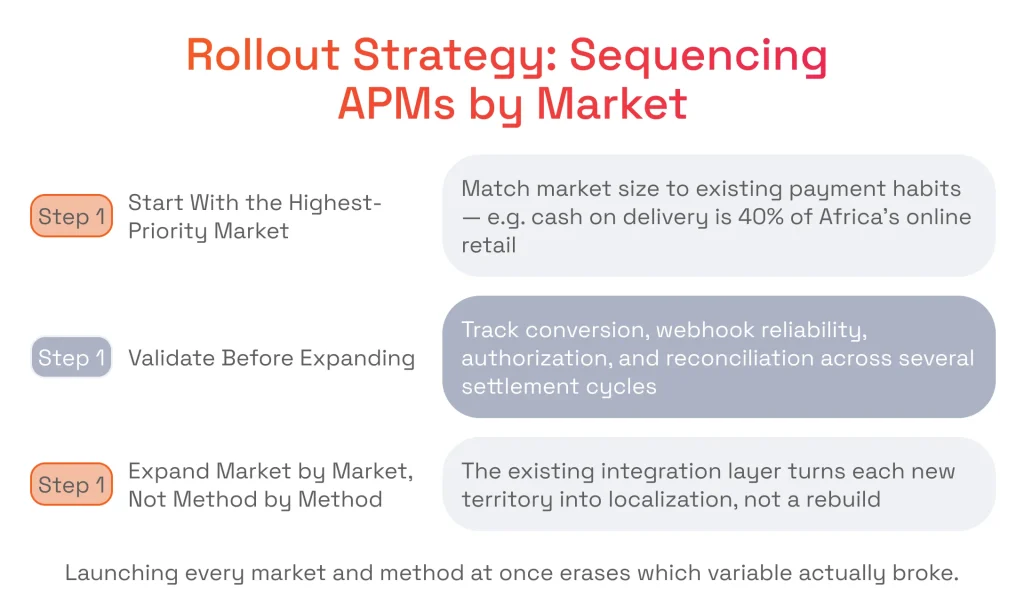
Step 1: Start With the Highest-Priority Market
The biggest addressable revenue opportunity doesn’t always mean much if the launch order ignores what a region already prefers to pay with. Matching the first market to both factors — size of opportunity and existing payment habits — is what makes the starting point worth anything at all.
Africa is the clearest case: cash on delivery still accounts for 40% of online retail there, meaning physical cash changing hands at the doorstep beats any digital rail by a wide margin, and no launch sequence that ignores that number is going to perform the way the revenue math suggested it would on paper. Starting with one market instead of several also makes the early data usable — baseline metrics mean something when there’s only one variable moving at a time.
Step 2: Validate Before Expanding
Monitor real-world conversion metrics, webhook reliability, authorization rates, and financial reconciliation accuracy for several settlement cycles. Confirm that your customer support team can manage dispute resolution flows smoothly before introducing more payment options.
Step 3: Expand Market by Market, Not Method by Method
The abstraction layer built during early development is what makes market two possible without redoing the technical work from market one. Expansion from there isn’t really a technical rollout — it’s a localization one: matching customer expectations, supporting whichever alternative payment methods a region actually expects to see, and accepting payments the way that market already prefers to pay. The integration layer standardizes the transaction data underneath all of that, which is what turns adding a new territory into a configuration task instead of a full software rebuild every single time.
Our Expertise in Alternative Payment Methods Integration for eCommerce
SPD Technology designs, builds, and maintains high-throughput financial infrastructure and custom payment layers for global enterprise platforms. Our engineering teams specialize in architecting idempotent transaction pipelines, building unified integration layers, and automating multi-source settlement reconciliation for complex e-commerce environments.
Idempotent, Event-Driven Payment Processing
Sub-second processing wasn’t a nice-to-have on this build — for a card-linked cashback platform running across media and payments, wired directly into Plaid’s financial APIs, it was the entire point of the exercise. SPD Technology developed an event-driven engine that holds to strict exactly-once processing guarantees, which matters more than it sounds like it should: a webhook fired twice by a flaky network connection, or a retry that lands after a timeout that wasn’t really a failure, is exactly how a customer gets credited for the same reward twice.
The system handles that instant attribution while a separate payout pipeline runs underneath it on its own clock, taking 48 to 72 hours to actually move the money. Two clocks running at once, one instant and one deliberately slower, is the same idempotency discipline any multi-provider subscription billing setup needs before real customer money moves through it.
Settlement Reconciliation at Scale — Merchant Settlement Platform (Blackhawk Network)
Seven years is a long time for any piece of financial infrastructure to keep running without a rewrite, and that’s roughly how long SPD Technology has maintained and evolved the merchant settlement infrastructure behind Blackhawk Network. More than 37,000 active users now depend on what that system does quietly in the background: commission calculations across multi-currency feeds, reconciliation against disparate payout schedules, and accounting reports that get generated without anyone triggering them by hand. None of that is the kind of engineering that shows up in a product demo. It’s the kind that gets noticed only the one time it stops working — which, seven years in, it hasn’t.
Full-Cycle Payment Integration Experience — Poynt
Delivering comprehensive payment processing capabilities under tight commercial deadlines demands deep domain expertise. SPD Technology engineered an all-in-one omnicommerce payment processing solution for Poynt in just five months, implementing full-cycle transaction handling, settlement pipelines, and developer-facing integration APIs. Following Poynt’s subsequent acquisition, the acquiring parent company retained SPD Technology’s specialized engineering team to maintain and extend the core platform — a relationship that continues past the five-year mark.
Whether your platform requires an enterprise payment abstraction layer built from scratch or dedicated engineering assistance verifying recurring-billing pathways, SPD Technology provides the technical domain expertise necessary to execute your payments roadmap cleanly.
Key Takeaways
- Alternative payment methods rarely cause integration problems on their own — the architecture underneath them does. A unified integration layer determines whether adding the fifth method is a configuration change or a new build.
- Recurring-billing support varies by method and has to be verified against the business’s actual billing model before committing — not discovered when the first renewal cycle fails.
- Reconciliation built for one method’s settlement cadence and currency breaks silently when a second method with a different cadence is added — design for multiple cadences from the start.
- Some methods offer a simple sandbox; others require formal provider approval with real lead time, and that difference has to get scoped into the plan early, before certification becomes the reason a launch date slips.
- Sequencing rollout by market, validating each addition before expanding, isolates problems far more effectively than launching every method and market simultaneously.
- Shopify stores have a distinct, narrower implementation path — native wallet support versus third-party apps for BNPL and local methods — that carries its own fragmentation risk if not architected deliberately.
In short: In short: what actually determines whether an APM integration stays maintainable is the layer underneath it — built once, checked for billing quirks method by method, and sequenced market by market before any of it reaches production.
FAQ
What are alternative payment methods (APMs)?
Alternative payment methods encompass any payment option distinct from traditional credit and debit cards or cash; in ecommerce, they are online payment methods customers use to complete transactions when making online purchases. Common examples include digital wallets (Apple Pay, Google Pay), buy now pay later services (Klarna, Affirm), direct bank transfers (iDEAL, SEPA, PIX), local voucher systems, and cryptocurrencies. These methods reduce checkout friction and cater to regional payment preferences across global markets. For a detailed breakdown of specific payment systems and regional adoption rates, our guide on e-payment systems for eCommerce offers comprehensive coverage.
How do you integrate multiple alternative payment methods without building a separate integration per method?
Fragmentation creeps in one connector at a time, and the fix is a single abstraction layer sitting between the core application and every external provider. That layer takes over the job each direct connector used to handle alone: normalizing incoming webhooks, standardizing API requests, and translating each provider’s response format into one internal protocol. Engineers then write a lightweight adapter for each new rail, translating that provider’s specific data into the schema the platform already expects, so no one writes a bespoke connector from scratch every time a rail gets added. The payoff shows up the next time a payment method gets added: it’s a configuration change, not a rewrite of the checkout.
What should you check before adding a new alternative payment method to your checkout?
Before initiating integration engineering, software teams must verify three primary technical parameters for any proposed payment rail:
- Recurring Billing Mechanics: Confirm whether the provider natively supports stored payment credentials, automated token vaulting, or persistent payment mandates matching your subscription model.
- Settlement Cadence: Map out the provider’s exact payout timelines and supported currencies to ensure compatibility with your internal financial ledger software.
- Provider Certification Lead Time: Determine whether the payment vendor mandates formal compliance reviews, manual security audits, or certified sandbox passes prior to granting production API keys.
How does reconciliation work when you accept multiple alternative payment methods?
Settlement doesn’t move at one speed, and a reconciliation pipeline built for card timelines chokes the moment it meets something faster or slower. Credit cards clear on a fairly predictable two-day cycle. Open banking rails can settle before that cycle even starts, while a paper voucher redeemed at a corner store might not report back for days. A dependable engine has to ingest raw payout data from every gateway, normalize the fee structures and currency conversions buried inside it, and match each disbursement back to the original order — automatically, without someone chasing a spreadsheet. Get that pipeline right once, and it keeps working as the list of payment methods behind checkout keeps growing.
Which alternative payment methods support recurring or subscription billing?
Digital wallets like Apple Pay and Google Pay handle recurring payments cleanly, since a stored token mandate survives long after the customer walks away from checkout — direct debit schemes such as SEPA work the same way, pulling from an account on a fixed schedule without asking the shopper to log back in. Push-based bank transfer systems sit at the other end: many refuse automated recurring charges outright, and BNPL providers often cap how long an authorization stays valid before it expires. Confirming which category a given mobile payment method falls into means reading the provider’s tokenization documentation directly, since assuming recurring support from a method’s popularity is exactly how a renewal cycle fails silently. Direct Debit’s reliability, paired with the right billing model, is part of what keeps BNPL flexible enough to support customer retention over time.
Which alternative payment methods should a Shopify store add first?
Native digital wallet support is the fastest win on Shopify — Apple Pay, Google Pay, and Shop Pay activate directly through Shopify Payments with minimal setup, and 213.7 million shoppers used PayPal monthly in the U.S. in 2024, which alone justifies putting major wallets first. Bank transfers and BNPL don’t come built in the same way; they typically mean installing a third-party app from the Shopify App Store, or building custom integration through Checkout Extensibility on Shopify Plus if the store needs more control. Every added app adds another line to the store’s payment options, and a digital wallet that took ten minutes to turn on can end up buried under five plugins that each slow the page down. Stack too many, and speed goes first.
How do you decide which markets or methods to launch first?
Checkout abandonment against market penetration is the actual data to compare before picking a launch order, not gut instinct about which country seems biggest. Weight that comparison by how customers there really make an online payment and complete online purchases, because the numbers on paper rarely match local habit. A country with high cart drop-off tied to missing payment preferences is telling you something directly: if mobile money already dominates local online transactions there, that rail belongs ahead of any card-first assumption, full stop. Bank account transfers carry the same weight in markets where cards get skipped entirely — plenty of shoppers just send money through something like cash app instead and never touch a card number at all. Validate whichever market goes first across a few billing cycles before expanding the same payment method into the next one, using the integration layer that’s already built rather than starting over.