

Payment gateway integration connects your website or app to a payment provider so customers can pay by card, digital wallet or bank transfer in your checkout. The main decision is the integration route: a hosted payment page, embedded fields or a direct API integration, or a fully custom gateway. That route sets your PCI DSS scope, and with it most of the cost and timeline. A hosted page keeps compliance work minimal, while a direct API puts your own servers in full scope. Whichever route you choose, the integration follows the same path from API credentials through sandbox testing and provider approval to go-live, and testing and approval usually take longer than the API work itself.
Given the evolving landscape of digital transactions, integrating a robust payment gateway into your website or app is no longer a convenience but a strategic imperative. For any online business, payment gateways are essential tools for securely and efficiently processing and authorizing digital customer payments. Still, when you need to integrate payment gateway, it requires strong technical expertise, deep understanding of data security practices and 360-degree awareness of compliance requirements. Supported by a solid technical input of our fintech software developers, we are going to cover all the important aspects of integrating a payment gateway into your business processes.
What Is Payment Gateway Integration?
Payment gateway integration is the process of connecting your website, mobile app or POS system to a payment gateway, so customers can pay with cards, digital wallets or bank transfers directly in your checkout. The gateway securely passes payment data between your platform, the customer’s bank and the acquiring bank, and returns an approval or decline in seconds.
An integrated gateway works inside your platform, unlike redirect-based systems that send customers to an external payment page, so the checkout stays on your site and keeps your branding. Payment gateway integration in websites allows businesses to securely handle customer payments and electronic transactions, ensuring seamless website integration for efficient online payment processing.
While integrating a third-party payment gateway is a popular option, businesses with unique requirements or industry-specific needs may consider the services of a custom payment gateway development company. This alternative provides full control over the payment flow, supports niche functionalities, and allows deeper customization tailored to specific business needs.
Build vs Integrate: Integrated Payment Gateway or Custom Development
In one of our recent articles, we discussed how to build a payment gateway tailored to your specific needs in a custom way. But what if an existing solution is good enough for your case, and you don’t need to spend an enormous amount of money on entirely custom-made software? Before making the final choice, let’s compare the pros and cons of building a custom gateway vs an integrated payment gateway.
In short, smaller businesses with standard requirements and a need for quick implementation may find existing payment gateways more suitable, while large enterprises with unique needs and the resources for custom development may opt for a custom payment gateway. Many e-commerce platforms, such as Shopify or WooCommerce, offer built-in support for payment gateway integration, streamlining the process for online stores.
Payment Gateway Integration Decision Matrix
Criteria | Integrated Gateway | Custom Payment Gateway |
|---|---|---|
Time to Market | Fast (days–weeks) | Slow (months) |
Initial Cost | Low | High |
Maintenance | Vendor-managed | Fully in-house |
Customization | Limited | Full control |
Compliance Burden | Handled by provider | Fully your responsibility |
Scalability | High (provider-dependent) | Fully customizable |
Best For | SMBs, startups, MVPs | Enterprises, fintech, marketplaces |
Criteria
Time to Market
Initial Cost
Maintenance
Customization
Compliance Burden
Scalability
Best For
Integrated Gateway
Fast (days–weeks)
Low
Vendor-managed
Limited
Handled by provider
High (provider-dependent)
SMBs, startups, MVPs
Custom Payment Gateway
Slow (months)
High
Fully in-house
Full control
Fully your responsibility
Fully customizable
Enterprises, fintech, marketplaces
Custom Payment Gateway Development
Pros:
- Tailored to Specific Needs: A custom solution can cover your unique requirements, including every payment option your business needs.
- Complete Control: You won’t have to rely on a third-party payment gateway provider, since you will be in charge of all software development and technical aspects, making changes and adding features to the system when necessary.
- Brand Consistency: You can design your gateway to seamlessly match the brand identity of the business, providing a consistent user experience throughout the entire payment process.
Cons:
- High Development Costs: A custom gateway costs significantly more than an integration, and the price grows with the functionality, compliance scope and number of integrations it needs. The costs include development time, testing, ongoing maintenance, and improvements. By the way, we discussed the payment gateway development cost and provided a detailed breakdown of each component of the final price.
- Security Challenges: Your development team needs to have deep domain knowledge, including but not limited to implementing KYC standards in Finance, and ensuring compliance. Failure to meet security standards could result in security vulnerabilities and major financial losses.
- Development Duration: Building a custom solution will take significantly more time compared to when you integrate a payment gateway. This can delay time-to-market and potentially impact revenue streams.
Existing or White Label Payment Gateway Integration
Pros:
- Quick Implementation: Integrating an existing payment gateway is generally faster compared to developing a custom solution. Most vendors offer well-documented payment gateway API integration and plugins that make the integration process straightforward.
- Security: Ensuring data security in Fintech is always a priority, and established payment gateways invest heavily in security measures, including encryption and fraud prevention. This significantly reduces the security and compliance work on your side.
- Cost-Effective: The cost for an integrated payment gateway will be significantly lower compared to building a solution from the ground up. The top vendors often provide a range of pricing plans, allowing businesses to choose a package that suits their needs and budget.
- Wide Range of Features: While extensive customization is not a forte of existing solutions, popular providers still offer an impressive variety of features including subscription management, reporting tools, and multiple payment options like PayPal payments, Stripe or Square.
Cons:
- Limited Customization: Existing providers still offer limited customization options that may not cater to unique needs and specific requirements.
- Transaction Fees: While costs, when you integrate payment gateway, will end up lower, compared to a custom solution, most existing payment gateways charge fees, which can add up over time and impact the overall cost for businesses, especially large enterprises with high transaction volumes. Still, transaction costs are easily calculable and accurately predictable depending on the transaction volume, so you will be able to choose a payment gateway provider that meets your business budget.
- Vendor lock-in: When you integrate payment gateway it may imply some kind of vendor lock-in – a situation when a business becomes dependent on the third-party solution. To avoid it, you have to carefully evaluate their long-term requirements, and choose online payment gateway providers that offer flexibility and scalability.
The Critical Importance of Seamless Payment Gateway Integration
Integrating a payment gateway seamlessly is critical for the organizations with the business models heavily dependent on online transactions. For them, is critical any friction in payment processing may result in lost sales and disappointed customers. eCommerce payment gateway integration services are essential, as integrating a payment gateway into your online store ensures the secure transfer of funds and a smooth customer experience. Payment gateways act as digital sentinels for financial transactions, safeguarding the transfer of funds between the customer’s issuing bank and the acquiring bank during online purchases. Any business using online transactions can benefit from effective payment processing. A reliable payment gateway supports business growth, scales with transaction volumes and strengthens payment security.
The Value-Adding Benefits of Online Payment Integration
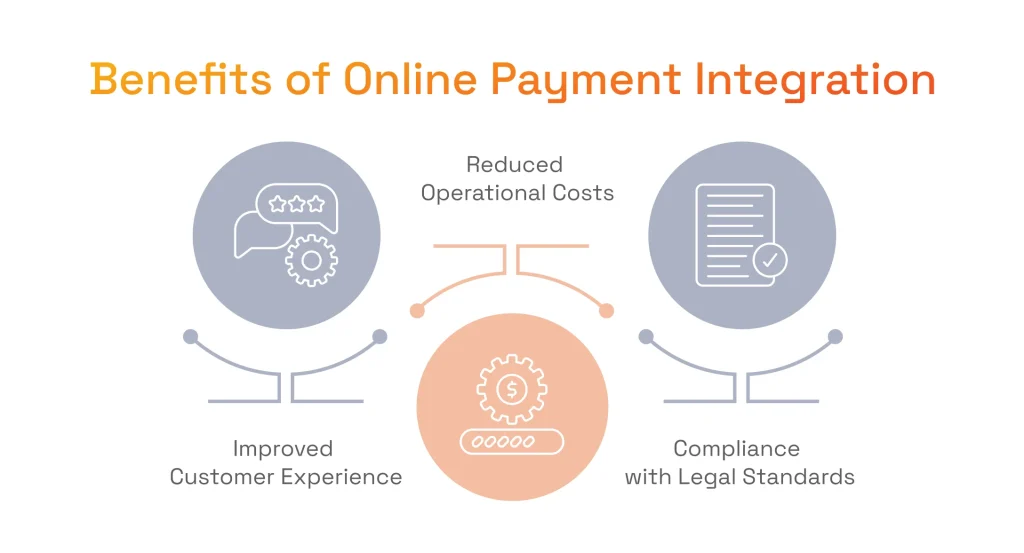
Payment gateways can become an additional driver for business growth, unlocking new opportunities in:
- Improved Customer Experience: a fine-tuned payment process will reduce any significant checkout friction thanks to features like one-click payments, saved payment details, and multiple payment method options.
- Reduced Operational Costs: direct integration into business platforms allows companies to automate transaction processing, reduce manual effort, and minimize costly errors.
- Compliance with Legal Standards: a properly set up gateway helps meet current regulatory requirements, which reduces legal risks and the risk of data breaches, and builds additional customer trust.
Factors to Consider Before You Integrate a Payment Gateway
The global real-time payments market is booming, and, according to Fortune Business Insights, is projected to grow from $47.06 billion in 2026 to $498.99 billion in 2034. So, as the market grows, more gateway options are likely to appear, and existing ones will keep improving.
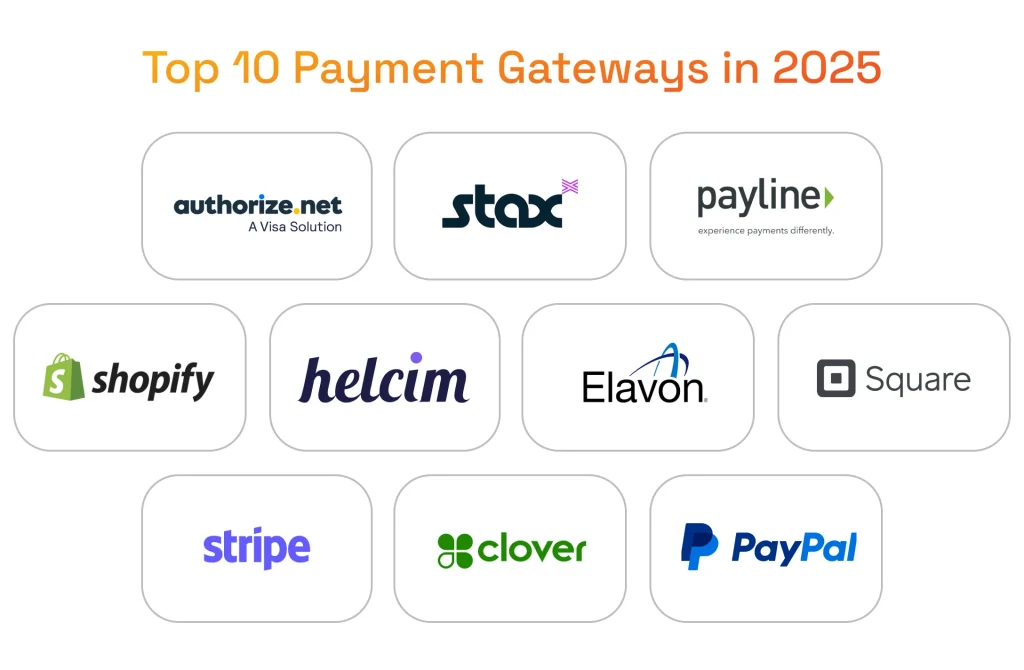
As of January 2025, Forbes considers the following to be the top 10 payment gateways:
- Authorize.net
- Stax
- Payline Data
- Shopify
- Helcim
- Elavon
- Square
- Stripe
- Clover
- PayPal
If you are considering online payment gateway integration, the above-mentioned providers are good options to start with. Selecting the right integration methods and carefully planning the integration implementation are crucial steps. This process involves project scoping and planning, integration design, implementation, testing, and ongoing maintenance. Before making the final choice, you should consider the following factors.
Payment Gateway Evaluation Checklist
Factor | What to Check | Why It Matters |
|---|---|---|
Transaction Volume | Pricing tiers, limits | Prevent cost overruns |
Supported Currencies | Multi-currency support | Enables global expansion |
Payment Methods | Cards, wallets, bank transfers | Improves conversion rates |
Compliance | PCI DSS, PSD2, GDPR; which integration route (hosted page, embedded fields or direct API) the provider supports, and the PCI DSS scope it leaves you with | Avoid legal & financial risks; the route decides your compliance workload and cost |
API Quality | Documentation, SDKs | Faster integration |
Fees | Transaction, setup, hidden fees | Total cost clarity |
Scalability | Load handling, uptime | Supports growth |
Sandbox | Test environment availability | Safer deployment |
UX Quality | Checkout experience | Reduces cart abandonment |
Factor
Transaction Volume
Supported Currencies
Payment Methods
Compliance
API Quality
Fees
Scalability
Sandbox
UX Quality
What to Check
Pricing tiers, limits
Multi-currency support
Cards, wallets, bank transfers
PCI DSS, PSD2, GDPR; which integration route (hosted page, embedded fields or direct API) the provider supports, and the PCI DSS scope it leaves you with
Documentation, SDKs
Transaction, setup, hidden fees
Load handling, uptime
Test environment availability
Checkout experience
Why It Matters
Prevent cost overruns
Enables global expansion
Improves conversion rates
Avoid legal & financial risks; the route decides your compliance workload and cost
Faster integration
Total cost clarity
Supports growth
Safer deployment
Reduces cart abandonment
Transaction Volume
Before you integrate payment gateway, you need to have estimations on the expected transaction volume to ensure that a payment gateway can handle the scale of your business. Many gateways have pricing based on transaction volume, which may end up in enormous expenses for big organizations with high amounts of operations.
Supported Currencies
If you have an international customer base, or you are looking to expand your business in the future, it makes sense to verify that payment gateways of your choice support the currencies you plan to transact in.
Available Payment Methods
Before deciding on a vendor, you need to do some research on the preferences of your customers and determine what payment methods are the most suitable. The most popular options include credit and debit cards, digital wallets, and bank transfers. Many payment gateways also support recurring payments, which are essential for subscription-based businesses, and offer flexible billing schedules.
Ensuring Compliance
Payment gateways are subject to various compliance standards to ensure the security, integrity, and confidentiality of payment transactions. Payment gateways must handle sensitive data securely by employing TLS encryption, tokenization, and fraud detection mechanisms such as address verification systems (AVS) and card verification value (CVV) checks.
Your integration route also decides how much of the compliance work falls on you. With a hosted payment page, card data never touches your servers, which keeps your PCI DSS scope minimal (SAQ A) and shifts most PCI compliance responsibility to the processor. Embedded fields hosted by the provider usually keep the same minimal scope, while a direct API integration puts your servers in full scope (SAQ D or a full Report on Compliance) and leaves more of that responsibility with you. Choose the route before you choose the provider, because it affects your security work, audit costs and timeline. Our guide to payment gateway compliance and security covers each route’s requirements in detail.
The payment gateways of your choice must adhere to compliance standards and update their systems and processes accordingly. Non-compliance can result in financial penalties, reputational damage, and legal consequences for your organization.
Here are some of the key compliance standards that are responsible for delivering compliant payment processing:
- PCI DSS (Payment Card Industry Data Security Standard)
- SSL/TLS Encryption
- EMV (Europay, Mastercard, and Visa)
- PSD2 (Payment Services Directive 2)
- GDPR (General Data Protection Regulation)
- ISO 27001
- SSAE 18 / SOC 2 (Service Organization Control)
- NACHA (National Automated Clearing House Association)
- AML (Anti-Money Laundering) and KYC (Know Your Customer)
Also, make sure that you are aware of all geographical regulations, adhering to any specific regulatory requirements in the regions where you operate. Ensure the vendor of your choice complies with these regulations to reduce the risk of penalties.
Ease of Payment Integration in Website
Thoroughly review the gateway’s API documentation to assess the ease of integration. Well-documented APIs can significantly speed up the integration process and save you some money. Additionally, it will be a good idea to check the availability of development support from the integrated payment gateway provider if issues or questions arise during integration.
Total Costs of Payment Gateway Integrations
We already mentioned transaction fees, however, there are other components of pricing, including setup fees and fees for specific features or services. You should also carefully look for possible hidden costs, including chargeback fees, currency conversion fees, or payments for premium support. Compare the most suitable options to make a fully informed decision.
eCommerce Payment Integration Scalability
Determine whether the gateway can handle increased transaction volumes and if it offers features suitable for growing businesses. The payment gateways should support horizontal scaling, allowing businesses to add more resources or instances to distribute the load and enhance performance as transaction volumes increase.
Sandbox Testing
Another important aspect to think about when you integrate payment gateway is whether the provider offers a sandbox or testing environment. This is required for payment gateway integration service providers to test transactions in a simulated environment before going live, reducing the risk of errors and data breaches.
Once sandbox testing is complete and everything works as expected, developers switch to live mode by updating your configuration with live API keys to start accepting real payments on your website.
Reputation and Reliability
Consider the reputation of the gateway provider in terms of reliability, security, and customer support. Look for reviews and testimonials from other businesses to know who you are dealing with.
User Experience
A smooth and intuitive checkout process is crucial for user satisfaction, so you should choose a payment gateway that provides a seamless and user-friendly checkout experience. It is essential to design a secure and easy-to-navigate checkout page that guides customers through each step, including obtaining payment confirmation and ensuring transaction completion.
Mobile payment gateway integration is also very important, as the mobile payment market size is expected to grow at a CAGR of 38.0% between 2025 and 2030, according to Grand View Research. So, make sure that the payment gateway of your choice is fully optimized for mobile devices.
Website Payment Integration Redundancy
It will be a good idea to consider implementing multiple gateways for redundancy. If one gateway experiences technical issues, having a backup can prevent disruptions in online payment processing and save costs caused by downtime.
Payment Gateway Integration Cost
Payment gateway integration cost depends less on the API calls themselves than on three decisions made before development starts: the integration route, the number of gateways and payment methods, and the compliance scope these choices create. Provider fees are a separate, ongoing cost, covered in the evaluation checklist above.
The Integration Route Sets the Compliance Scope
The way card data enters your system decides how much of your infrastructure falls under PCI DSS, and that is usually the biggest single cost driver:
Integration route | How card data flows | Typical PCI DSS validation | Effect on cost |
|---|---|---|---|
Hosted payment page (redirect) | The customer pays on the provider’s page; card data never touches your servers | SAQ A | Lowest. Mostly frontend work and configuration. |
Embedded fields or provider-hosted iFrame | Card fields are hosted by the provider inside your checkout page | SAQ A in most cases, if your site is protected against script-based attacks on the payment page | Low to moderate. More frontend work and payment page script controls. |
Direct API integration | Card data passes through your servers | SAQ D or a full Report on Compliance | Highest. It adds security engineering, tokenization, audits and ongoing compliance work. |
Integration route
Hosted payment page (redirect)
Embedded fields or provider-hosted iFrame
Direct API integration
How card data flows
The customer pays on the provider’s page; card data never touches your servers
Card fields are hosted by the provider inside your checkout page
Card data passes through your servers
Typical PCI DSS validation
SAQ A
SAQ A in most cases, if your site is protected against script-based attacks on the payment page
SAQ D or a full Report on Compliance
Effect on cost
Lowest. Mostly frontend work and configuration.
Low to moderate. More frontend work and payment page script controls.
Highest. It adds security engineering, tokenization, audits and ongoing compliance work.
The route affects the timeline in the same way. A hosted page can go live once configuration and testing are complete, while a direct API integration adds security implementation, compliance validation and audits before launch. As our engineer Volodymyr Soska notes in the steps below, the technical integration itself is often the shorter part of the project; provider approval and validation usually take longer.
For a full breakdown of each route’s compliance requirements, see our guide to payment gateway compliance and security.
Other Cost Drivers
- Number of gateways and payment methods. Each additional provider or method (cards, digital wallets, ACH, local payment methods) adds integration, testing and maintenance work. A multiple payment gateway integration with routing and failover between providers costs more than a single gateway but reduces downtime risk.
- Existing platform complexity. Legacy code, custom checkout flows and integrations with ERP, CRM or billing systems all increase the work.
- Features beyond basic payments. Recurring billing, split payments, multi-currency support and real-time reporting each add development and testing time.
- Authentication and regional requirements. Strong Customer Authentication with 3D Secure for European customers, and local payment rules in each market, add both development and testing scope.
- Testing and certification. Sandbox testing, user acceptance testing and the provider’s approval process often take longer than the technical integration itself.
- Ongoing maintenance. Providers update their APIs and security requirements, so integrations need monitoring and updates after launch.
When comparing quotes from a payment gateway integration company, ask for an estimate broken down by these drivers and by phase, with its assumptions listed. That shows where the cost actually comes from and makes vendors comparable.
How to Integrate a Payment Gateway Into a Website
When you need to integrate a payment gateway with the website, it is quite a time- and effort-consuming process, but when done correctly, there is nothing particularly hard about it. Here are the key steps to accomplish this goal.
-
Define Business Requirements
-
Choose Gateway Provider
-
Create an Account
-
Obtain API Credentials
-
Review API Documentation
-
Update Your Website or App
-
Implement API Calls
-
Implement Security Measures
-
Test in a Sandbox Environment
-
Conduct UA Testing
-
Implement Error Handling
-
Obtain the Certifications
-
Prepare for Go-Live
-
Monitor and Optimize
-
Ensure Ongoing Support
1–5 Steps: Prepare for the Integration
Before any code is written, complete the groundwork:
- Define business requirements: expected transaction volume, the currencies you need, your customers’ preferred payment methods, and a business bank account ready to receive payouts.
- Choose the gateway: compare providers on pricing and fees, payment methods, features and reputation, using the checklist above.
- Create a merchant account: agree to the provider’s terms and submit your business details, bank information and merchant credentials.
- Obtain API credentials: the provider issues an API key, a secret key and a merchant ID, which your platform uses to communicate securely with the gateway.
- Review the API documentation: with your developers, go through the available functionality, request and response formats, and any technical limits.
6. Develop or Update Your Website/Application
Finally, at this stage, some coding is required. To complete the integration, the existing code of your website may need to be updated, or the development of entirely new features may be required to accommodate payment processing. It will be a good idea to hire seasoned experts with industry experience for this task, as any errors on this task may cost you valuable time.
7. Implement Payment Gateway API Calls
With all software development aspects covered, you can use the obtained API credentials to make API calls for transactions and get access to features such as payment initiation, payment processing, order confirmation, and handling of payment responses. Your backend should be able to securely process payment requests and manage transactions between your website and the payment API.
8. Implement Gateway Integration Security Measures
Ensure that your integration follows best practices for security, as we mentioned in one of the previous sections of the article. Implementing TLS encryption and adhering to PCI DSS are mandatory to ensure the safety of the payment information in the modern Fintech industry.
9. Test a Payment Platform Integration in a Sandbox Environment
Most providers offer a sandbox or testing environment. Your development team can leverage this environment to perform thorough testing without processing real transactions. This process will help to verify that API calls, responses, and error handling work as expected.
Sandbox vs Production in Payment Gateway API Integration
A sandbox is the provider’s test environment: it accepts test card numbers, simulates approvals and declines, and moves no real money. Production is the live environment, where every transaction charges a real customer. Moving from one to the other changes more than the API keys:
- Credentials and endpoints. Production uses separate API keys, secret keys and often different endpoint URLs. Keep the two sets strictly separate, and never commit production keys to code repositories or expose them in frontend code.
- Webhooks. Webhook URLs and signing secrets must be registered again for production, or payment confirmations will be missed.
- Payment behavior. 3D Secure challenges, fraud rules, settlement times and rate limits can behave differently in production than in the sandbox.
- Data. Test data must never mix with live customer data, and production logs must never record full card numbers.
Before switching, run a small set of real low-value transactions, including a refund, to confirm the full flow works end to end.
10. Conduct User Acceptance Testing (UAT)
Conduct user acceptance testing with a select group of users to ensure that the payment processing is user-friendly and error-free. This will help to detect and report any issues that might occur.
11. Implement Error Handling
It is important to have robust error-handling mechanisms to manage situations such as payment failures, timeouts, or connectivity issues. Users should get clear error messages and know exactly what to do in case of any failures when a particular payment method doesn’t work as expected.
12. Obtain Necessary Certifications and Approvals
It is probably the most time-consuming part of the entire process, as you will need to get approval from the provider to use their services on your platform and finally start to accept payments.

Volodymyr Soska
Software Development Engineer at SPD Technology
“The actual technical integration may be completed within a month, however, getting the permission to use a certain gateway may take significantly longer, depending on the provider and its requirements.”
13. Prepare eCommerce Payment Gateway Integration for Go-Live
Now it is time to inform relevant stakeholders and your team members, plan the launch process carefully, and watch the system closely during the initial rollout.
14. Monitor and Optimize
As you will get your first transaction details data, and user feedback and see how the system performs, you will be able to fine-tune the integration based on real-world usage and address any issues promptly as they occur.
15. Provide Ongoing Support
Your provider can make changes or updates at any time, which may disrupt the integration and put your transactions on hold. To prevent that unfortunate scenario, you need to stay informed about new features or security measures on the vendor’s side and react rapidly to keep your integration at maximum efficiency level.
Digital Wallet & Payment API Integration in 2026
For SaaS and platform companies embedding payments into their products, digital wallets are now a standard checkout option rather than an extra. Customers expect to pay with Apple Pay, Google Pay or PayPal in a few taps, without typing card details.
Most businesses add wallets through their payment gateway rather than integrating each wallet directly. Gateways such as Stripe, Adyen and Braintree support Apple Pay and Google Pay through their own APIs and SDKs, so one integration covers several wallets. A direct integration is also possible, but it adds setup work for each wallet. Apple Pay, for example, requires merchant registration and domain verification before it can appear on a website.
Wallets also help with security and compliance. Apple Pay and Google Pay replace the card number with a device-specific token, so the real card details never reach your servers. The customer authenticates with a fingerprint, face recognition or a device PIN, which can meet Strong Customer Authentication requirements for European payments without an extra 3D Secure step.
The technical pattern is the same across platforms: the wallet SDK handles authentication and tokenization on the device or in the browser, then passes the token to your backend, which completes the payment through the gateway’s API. This keeps checkout inside your product instead of redirecting customers to external pages.
For platforms serving European customers, payment data handling must also comply with GDPR. That means storing as little personal data as possible, relying on tokenization and encryption for transactions, and controlling who can access payment information.
If you’re deciding between a gateway and a direct wallet integration, our guide to digital wallet integration walks through both routes in more depth.
Payment Integration Best Practices
To successfully add payment to websites or mobile apps, extensive knowledge of this process is required. Online payment gateways come in various forms, each with its own integration methods and benefits, making it important to choose the right solution for your business needs. In this section, we will share our practical insights on how to integrate payment gateways most efficiently, and you will be aware of the essential elements to pay attention to.
Setting Up a Fraud Prevention Mechanism
First and foremost, having a well-structured fraud prevention system that incorporates security features like 3D Secure authentication, tokenization, and Address Verification Systems (AVS) is mandatory. Additionally, the wise move will be to add fraud monitoring tools that analyze transaction patterns and flag potential threats in real-time. A proactive approach to fraud prevention helps protect the business and its customers from unauthorized transactions, data breaches, reputational damage, and financial losses.
Enabling Tokenization for Repeated Payments
Tokenization helps to replace sensitive credit card payment details with a token, a unique identifier that allows the business to store this information securely. So the need to store raw data is being eliminated, while fast and seamless checkouts are provided. This secure storage of payment details boosts the trust of customers and reduces checkout friction while supporting compliance with security regulations.
Designing for Multi-Device Compatibility
In 2026, eCommerce payment integration, as well as one for any other industry, entails consistent and responsive experience across desktops, mobile devices, and tablets. The optimization for various screen sizes, input methods, and network conditions adds to an uninterrupted checkout experience. There is a trend for a growing number of mobile transactions, that the companies should be ready for by providing a responsive payment experience across all platforms.
Using Webhooks for Real-Time Updates
With the help of webhooks, it is possible to provide instant notifications on transaction statuses automatically. This functionality helps both organizations and their customers to stay informed without the need for manual checks. Real-time updates help to improve transparency and boost customer satisfaction, and speed up the resolution of payment-related issues.
Providing Backup Payment Methods
This is a great idea for mobile apps and websites with payment gateways, as it ensures continuous payment processing despite possible technical failures, maintenance periods, or changes in regulatory requirements. Relying on a single payment gateway, in turn, is risky because possible service interruptions will harm business continuity and the bottom line.
Gathering User Feedback for Continuous Improvement
Getting feedback from the customers helps to get ideas for payment experience improvement. In particular, organizations can uncover complex checkout flows, unclear instructions, or desired but unsupported payment methods. Knowing exactly what the customers want, it becomes possible to optimize conversion rates and offer a more intuitive checkout experience.
Implementing Retry Logic for Failed Payments
There are different reasons for payment failures, including insufficient funds, connectivity disruptions, or alerts from fraud detection systems. By having smart retry logic in the payment system, it is possible to provide automated additional attempts that will reduce unnecessary declines. This reduces the frustration of customers whose payments fail due to temporary issues.
Enhancing Accessibility of the Payment Process
Last but not least, the organization must ensure that payment forms are navigable via screen readers, keyboard inputs, and assistive technologies. This can be achieved by adhering to the accessibility standards, such as WCAG (Web Content Accessibility Guidelines). It is a critical move to remove the possible blockers for users with disabilities and broaden the customer base.
Payment Integration Mistakes to Avoid
Knowing how to do payment gateway integration also means knowing where integrations usually go wrong. These are the most common mistakes:
- Storing or logging raw card data. Card numbers in databases, logs or error messages pull your whole system into PCI DSS scope. Use tokenization and keep card data with the provider.
- Exposing secret keys. Secret API keys in frontend code or public repositories let anyone make payment requests on your behalf.
- Trusting unverified webhooks. Without signature validation, attackers can send fake payment confirmations. Without idempotency checks, retries can charge a customer twice.
- Showing raw gateway errors. Customers need clear messages and a next step, not error codes. Timeouts and connection failures need their own handling.
- Testing only the happy path. Sandbox tests should cover declines, expired cards, 3D Secure challenges, refunds, partial payments and network failures, not just successful payments.
- Relying on a single gateway without a fallback. One provider outage can stop all sales. A backup gateway keeps payments running.
- Going live without monitoring. Without alerts on failed payments and declines, problems surface only through customer complaints.
The Challenges of Online Payment Gateway Integration
Payment integration in website or mobile app requires dealing with business and technical challenges. Let’s review the most common of them and discuss our approaches to resolve potential issues.
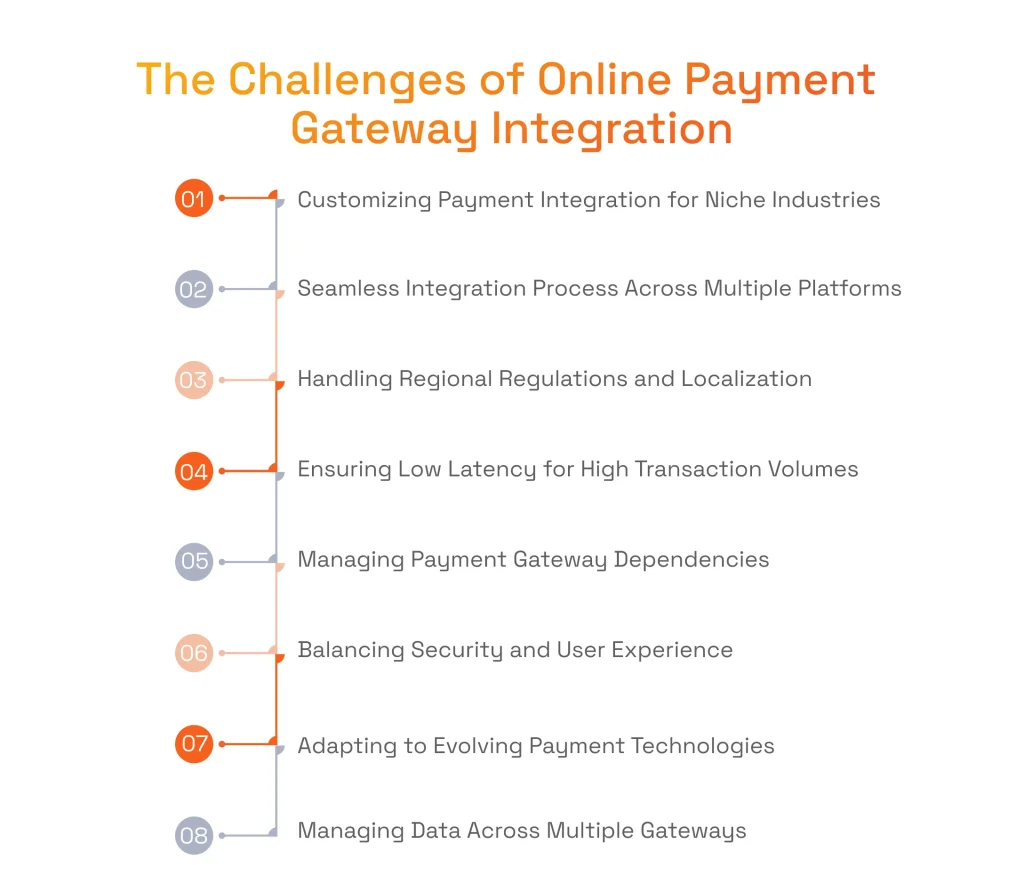
Customizing Payment Gateways Integration for Niche Industries
Organizations in different industries may require entirely different customization of payment flows or features beyond the capabilities of standard gateways. When you still decide to integrate payment gateways with basic functionality, your business may face transaction inefficiencies, compliance issues, and overall problems with customer service.
Having deep knowledge of requirements for payment gateway integration and experience with delivering tailored functionality, we develop integrations using APIs and diverse modular architectures. Our teams conduct research and build unique features aligned with the needs of a specific business in a particular industry.
Achieving Seamless Payment Gateway Integration Across Multiple Platforms
It is hard enough to integrate payment gateway in website, mobile app, and POS system, however, it is even harder to maintain consistent functionality across them. Any inconsistencies in payment experiences may lead to gaps in user experience and revenue loss.
Drawing on our multiplatform development experience, we develop responsive payment flows across multiple platforms. Our experts achieve this by designing smooth integration frameworks for reliable transactions.
Handling Regional Regulations and Localization
Local regulatory requirements remain a major blocker for global-scale integrations. Organizations are always at risk of missing some local regulations or skipping preferred payment methods in particular regions.
Our experts have proven experience in ensuring compliance with key regulatory frameworks and region-specific regulations. We leverage localized payment options to allow our clients to expand.
Ensuring Low Latency for High Transaction Volumes
Peak sales periods become a true testament to payment processor integration and the platform’s ability to take on high loads of traffic. Any issues with the latency may result in abandoned carts and lowered revenue.
To deal with this issue, in our projects, we deploy scalable cloud infrastructures, caching mechanisms, and optimized payment workflows. Our performance-optimized architectures are designed to keep latency low even during traffic spikes.
Managing Payment Gateway Dependencies
Another potential issue we should talk about is the downtimes of third-party APIs connected to payment processing. In some cases, even the slightest disruptions may result in massive reputational and financial losses.
We solve this by integrating multiple redundant gateways and implementing robust error-handling mechanisms to protect uptime. Our systems automatically switch to backup payment providers when required, so payments can continue during a provider outage.
Balancing Security and User Experience
Unfortunately, implementing strong security measures like 3D Secure authentication can add friction to the checkout process. With every security step, the possibility of cart abandonment grows.
Our experts are always working on implementing streamlined authentication flows that create a reasonable balance between convenience and security. We achieve this by properly implementing tokenization, biometric authentication, and risk-based authentication.
Adapting to Evolving Payment Technologies
While you integrate payment solutions, there are probably new payment methods that become popular, like new cryptocurrencies or digital wallets. Your customers are probably expecting to use them as soon as possible.
We always keep our finger on the pulse of the latest payment trends and technology and constantly integrate innovations into the payment systems of our clients. Our company has proven flexible integration frameworks that allow us to access innovation at speed.
Managing Data Across Multiple Gateways
Consolidating data from multiple sources is always time-consuming and error-prone. Not enough attention to data management can bring major consequences, from operational inefficiencies to compliance risks.
Having profound experience in data analytics and management, we develop centralized data aggregation and reporting systems that unify payment data across all gateways. By doing this, we deliver real-time visibility into transactions, simplifying reconciliation, tracking, and financial reporting.
Payment Gateway Integration Services from SPD Technology
Payment integration in a website or mobile app carries the risks covered in the previous section: compliance gaps, transaction failures, latency under load and dependence on third-party APIs. An experienced team reduces those risks by choosing the right integration route, building in security and PCI DSS compliance from the start, and testing every failure scenario before launch, so your team can stay focused on the product.
As a payment gateway integration company, SPD Technology provides payment gateway integration services for fintech, SaaS and eCommerce companies, with 20 years of software development experience and a team of 650+ engineers. Here’s what we bring to integration projects:
- Integration projects of different complexity: from single-gateway checkouts to platforms with dozens of payment providers and methods.
- Multi-platform integration: consistent payment experiences across web, mobile and cloud platforms.
- Scalable architecture: integrations designed to handle growing transaction volumes.
- Regional and global gateways: experience with major processors such as PayPal and Stripe, as well as regional gateways and their local regulations.
- Complex payment features: split payments, recurring billing and real-time reporting, beyond basic payment processing.
- Post-integration support: ongoing monitoring and maintenance after launch, as the client requires.
Proven Ways to Add Payment to Website: SPD Technology’s Successful Projects
During our 20 years of hands-on experience, we have dealt with projects of different sizes and complexities. Here are a few examples of how our involvement brings value to the clients.
Developing Custom Payment Processing Services for Poynt Open-Commerce Platform
Business Challenge
Our client is Poynt, a B2B company in the eCommerce and FinTech industry, founded in 2013. The product is a holistic set of services covering mission-critical functionality and is responsible for a full cycle of payment processing, settlement, and integration with 3rd party payment partners.
SPD Technology Approach
Our team of 10 experts, proficient in payment gateway integration services, conducted a major transformation of the settlement service to support PayFac transactions, drawing on our experience in customized billing software development. This involved redesigning transaction processing and settlement to meet PayFac model requirements. The team also reimagined the subscription system plans, introducing flexible billing models like subscription-based, usage-based, and tiered pricing.
React-based payment gateway UI, which our Front-End developer built, can now be embedded into any web page for seamless card data collection.
Other milestones for our team included enhancing payment processor integration for improved compatibility, developing a regression testing framework for automated testing, and implementing bidirectional data synchronization across internal systems to ensure real-time accuracy.
Value Delivered
- Delivering Business-Critical Functionality: we enabled the client to become a payment facilitator, offering payment process consolidation and providing customers with a highly performing, unified platform.
- Improved Customer Experience: our involvement helped the client significantly expand a set of features and improve service offerings.
The results of developing custom payment processing services for the Poynt open-commerce platform have been truly amazing. The global company eventually acquired our client, and we joined the new owners and continued to expand our expertise in gateway integration.
How We Helped LegalTech Company with Improving Payment Systems Integration
Business Challenge
Our client is a well-established online LegalTech company helping individuals and small-to-midsize businesses. The challenge was to establish and maintain a robust payment system and two additional payment methods within the client’s online platform.
SPD Technology Approach
Based on LegalTech and online payment integration expertise, we provided the client with the two Back-End engineers. These experts were integrated into the client’s payment team and focused on Stripe payment services integration as well as the addition of ACH and IBAN payment methods.
We completed the project using Jira and the SCRUM methodology. All design and communication activities were handled in Figma. We developed a monitoring and alerting system with Prometheus and Grafana, ensuring real-time performance and security insights.
Additionally, our developers built a bot traffic filtering system, analyzing user behavior and IP data through a rating mechanism. This allowed the system to assess the request’s legitimacy and take action accordingly.
Value Delivered
- Successful Payment Integration: we successfully facilitated secure and versatile payment options for customers by integrating with Stripe and introducing ACH and IBAN payment methods.
- Enhanced Traffic Security: our experts introduced a complex business logic that helped with filtering from bots and strengthened security on the platform.
By helping LegalTech Company with improving payment systems integration, we helped our client expand its payment options and improve the security of its platform.
Developing a Global White-Label eCommerce Platform for NimbleCommerce
Business Challenge
Our client was NimbleCommerce, a promising startup from Silicon Valley, founded in 2010, and had a goal to help merchants and brands manage their own pre-paid offer and gift card programs or resell through a network of retailer and publisher-branded sites. The challenge was to develop from the ground up a high-scale and extremely feature-rich B2C and B2B solution.
SPD Technology Approach
We began with a small team of two developers, rapidly expanding as project needs became clear, peaking at 30+ experts. Lead developers and Project Managers from our side also acted as software architects, collaborating closely with the client’s team to shape NimbleCommerce’s products.
SPD Technology’s dedicated teams operated as self-managed units, working directly with the client’s leadership, product managers, and account managers. Some team members even remained onsite to handle complex requirements and support major B2B client onboarding, including a major U.S. restaurant network.
We successfully delivered the core functionality, which included AI/ML fraud detection features, and launched the product without any major blockers or delays. As the solution became popular among users, we conducted 27 payment gateways integrations.
Value Delivered
- Innovative Solution from Scratch: our team created an innovative B2C and B2B software platform far beyond the client’s expectations, showcasing our proficiency in payment gateway integration.
- Massive Market Success: the platform attracted millions of B2C customers and thousands of B2B clients.
Our involvement helped the product grow until it was acquired by BlackHawk Network Inc. (BHN) in 2016. We continued to work on this platform under new ownership, expanding it with entirely new features, including data analytics functionality.
Key Takeaways
- Successful payment gateway integration depends on secure communication between the platform, the customer’s bank, the acquiring bank, and the card issuing company, ensuring that every transaction is verified and processed reliably.
- Businesses can simplify implementation by choosing hosted gateways, which handle payment processing on the provider’s infrastructure while still enabling secure checkout experiences within websites and mobile apps.
- Companies with complex payment requirements often rely on custom APIs to build tailored payment flows, integrate multiple providers, and support advanced features such as subscriptions or marketplace payments.
- A well-designed payment architecture combines integrated gateways, scalable APIs, and flexible payment options to ensure reliable transaction processing between merchants, financial institutions, and customers.
FAQ
How much does payment gateway integration cost?
A standard payment gateway integration with a well-documented provider such as Stripe, Braintree or PayPal typically costs $5,000 to $30,000, while a fully custom integration with multiple processors, recurring billing, multi-currency support and PCI DSS compliance can reach $50,000 to $200,000+. The integration route moves the price within those ranges because it decides your PCI DSS scope: a hosted payment page is the least expensive, embedded fields cost more, and a direct API integration costs the most, since card data passes through your own servers. Ongoing security monitoring and compliance maintenance add about 15–20% of the integration cost each year, and provider transaction and setup fees are a separate, recurring cost.
How long does it take to integrate a payment gateway into a website?
A standard integration with one well-documented provider usually takes two to four weeks of technical work, and provider approval can add anywhere from a few days to a few weeks on top. A hosted payment page is the fastest route because it mostly needs configuration and testing, while a direct API integration adds security implementation, PCI DSS validation and more extensive testing. The technical integration may be completed within a month, while getting permission to use a gateway can take significantly longer, depending on the provider and its requirements.
Should I use a hosted payment page or integrate through an API?
Use a hosted payment page if you want the fastest launch and the smallest compliance scope, and you’re comfortable with limited control over checkout design. Customers pay on the provider’s page, so card data never touches your servers. Embedded fields, where the provider hosts the card fields inside your own checkout page, keep compliance scope similarly small while giving you more control over the look of the checkout. Integrate directly through the API if you need full control over the payment flow, such as custom checkout logic, routing across multiple gateways or complex billing. That route also puts your servers in full PCI DSS scope, so it costs more and takes longer.
Do I need coding skills to integrate a payment gateway?
Not always. If your store runs on a platform such as Shopify or WooCommerce, you can usually connect a gateway through a built-in setting or plugin, and some providers also offer payment links and hosted checkout pages that need little or no code. Embedding payment fields into your own site requires some development work, and a direct API integration needs experienced developers. They write the backend code for payment requests, webhooks, error handling and security, and test it thoroughly before launch.
How does the integration method affect PCI DSS compliance?
The integration method decides how much of your system falls under PCI DSS:
- Hosted payment page. Card data never touches your servers, so you can usually validate with SAQ A, the shortest self-assessment.
- Provider-hosted embedded fields or iFrame. These usually qualify for SAQ A too, provided your site is protected against script-based attacks on the payment page. If your own page creates or posts the payment form, SAQ A-EP applies instead.
- Direct API integration. Card data passes through your servers, which puts them in full scope: SAQ D or a full Report on Compliance.
Our guide to payment gateway compliance and security covers each route’s requirements in detail.
What are the most common payment gateway integration errors and how are they fixed?
The most frequent integration error is incorrect API authentication configuration: mismatched API keys, expired tokens, or improperly scoped credentials that cause transaction failures at the point of payment. The fix is strict separation between sandbox and production credentials, plus automated credential rotation. Other common errors include webhook misconfiguration that causes payment confirmations to be missed or processed twice, TLS certificate issues that trigger security warnings at checkout, currency and locale formatting mismatches that cause declined cross-border transactions, and error handling that shows customers raw gateway error codes instead of clear next steps.
What security risks come with website payment gateway integration?
The primary risk is inadequate PCI DSS compliance. Websites that handle, transmit or store cardholder data without meeting PCI DSS requirements expose both customers and businesses to data breaches, fines and reputational damage. Other risks include:
- interception of payment data sent without strong encryption
- cross-site scripting and injection vulnerabilities in custom checkout forms
- weak tokenization that leaves card data exposed in application databases
- webhook endpoints that accept fake payment confirmations because signatures aren’t validated