

AI for retail works where data is clean and integrated. Personalization, demand forecasting, dynamic pricing, conversational assistants and AI agents all reach production on the same condition: the catalog, transaction and customer data behind them is unified and accessible through APIs. This guide is written for CTOs and technology leaders at retail platforms, ISVs and POS providers. It ranks each use case by the data readiness and integration effort it requires, and covers cost, implementation and the challenges behind them.
In one of our previous articles, we discussed how to build a marketplace, so now let’s turn our attention to AI for retail and what it takes to build it into eCommerce, POS and retail software platforms. Retail AI is rapidly transforming retail operations and retail websites, driving improvements in efficiency, personalization, and customer experience across the industry. For many organizations, this shift represents the beginning of a broader AI transformation journey, where retailers gradually move from experimentation to fully embedding AI across business operations in order to remain competitive in an increasingly data-driven marketplace.
The global AI in retail market size is projected to grow from USD 16.54 billion in 2026 to USD 105.88 billion by 2034, at a CAGR of 26.10%, according to Fortune Business Insights. There are a lot of factors that contribute to this impressive growth, and the opportunity to use AI for diverse retail business goals is one of them. That’s why this article ranks the main retail AI use cases by the data readiness and integration effort each one requires, rather than by how much attention they get, so you can see which one your platform can support today.
How AI for Retail Works: Core Technologies
Artificial Intelligence is making a significant impact in a number of industries, and online Retail is leading the trend of wide adoption. Some of the branches of AI are already considered a mainstay in Retail.
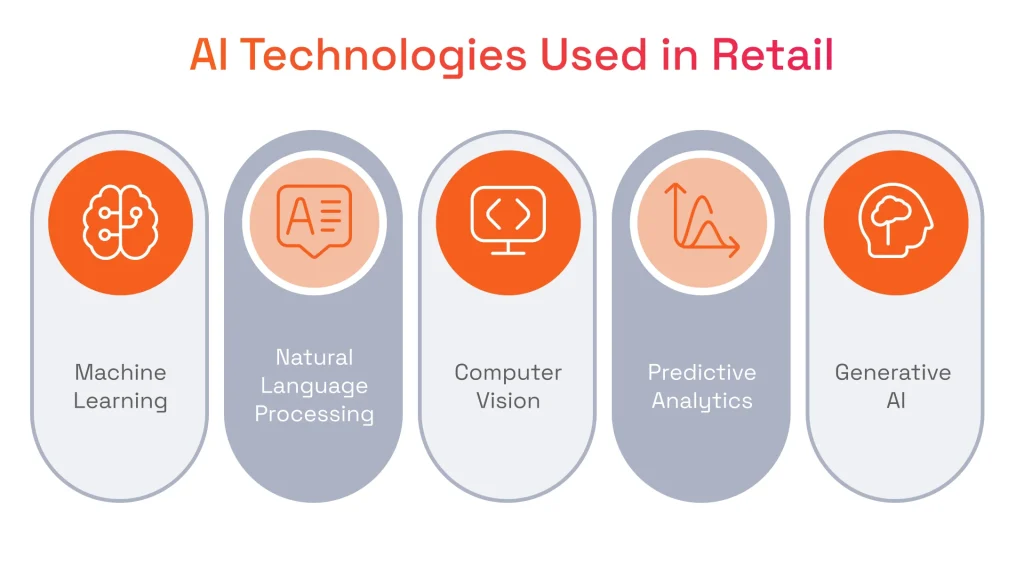
- Machine Learning: this is a subset of AI that focuses on developing algorithms and models that enable computers to learn from data and make predictions or decisions without being explicitly programmed.
- Natural Language Processing: this branch of AI deals with the interaction between computers and human languages, particularly to analyze and understand unstructured text data. AI can process natural language to interpret and generate human language, enabling chatbots to understand customer conversations and generative AI to create marketing content. We already provided a detailed guide on NLP for eCommerce business, so we welcome you to read it.
- Computer Vision: this technology enables computers to interpret and understand visual information from images or videos. In fact, computer vision tools already have over 95% accuracy.
- Predictive Analytics: this one involves using statistical techniques and Machine Learning algorithms to analyze historical sales data and make predictions about future events or trends, as well as demand forecasting by analyzing data from various sources such as demographics, weather, and income levels.
- Generative AI: allows generating new data, images, text, or other content that is similar to existing data but has novel characteristics. In generative AI for retail, this mostly means product content, catalog enrichment and conversational search. The areas of GenAI that leaders believe will have the most impactful effects are search and knowledge management, virtual assistants/chatbots, and content generation, according to a recent survey by Deloitte.
AI for Retail: Use Cases by Data Readiness and Integration Effort
The retail AI use cases that reach production share one trait: the data they depend on already exists in a usable shape. For teams building AI into retail platforms, the useful question is less “which use case is most promising” and more “which one our data and integration surface can support today.” The table below ranks the main use cases on those two factors.
Use case | Data it depends on | Data readiness bar | Integration effort |
|---|---|---|---|
Generative AI for content and catalog | Product catalog, attributes, brand guidelines | Low to medium | Low |
Conversational AI and chatbots | Catalog, inventory, order and returns APIs | Medium | Medium |
Personalization and recommendations | Behavioral events, catalog, customer identity | Medium to high | Medium |
Predictive analytics and demand forecasting | Sales history, inventory, promotions, external signals | High | Medium to high |
Dynamic pricing | Sales, inventory, competitor prices, margin rules | High | High |
AI agents (agentic AI) | All of the above, plus permissioned write access | High | High |
Use case
Generative AI for content and catalog
Conversational AI and chatbots
Personalization and recommendations
Predictive analytics and demand forecasting
Dynamic pricing
AI agents (agentic AI)
Data it depends on
Product catalog, attributes, brand guidelines
Catalog, inventory, order and returns APIs
Behavioral events, catalog, customer identity
Sales history, inventory, promotions, external signals
Sales, inventory, competitor prices, margin rules
All of the above, plus permissioned write access
Data readiness bar
Low to medium
Medium
Medium to high
High
High
High
Integration effort
Low
Medium
Medium
Medium to high
High
High
The order is not a ranking of value. A use case lower in the table can deliver more, but it asks more of the platform before the first model goes live.
Generative AI for Retail: Content, Catalog and Search
Most generative AI for retail examples in production sit in the catalog: product descriptions written at scale, attribute extraction from supplier feeds, image variants for different channels, and search that understands natural-language queries. For a platform serving many merchants, catalog enrichment is often the fastest feature to ship because it works on data the platform already holds.
Data needed: Structured product data, supplier feeds, brand tone rules per merchant.
Integration effort: Low. Output flows back into the catalog through existing content workflows.
The main build risk is generated text that contradicts structured data, such as a wrong material, size or compatibility claim. Validating generated output against catalog attributes before publishing is the control that makes this safe to automate.
Conversational AI for Retail: Assistants and Chatbots
Conversational AI for retail covers shopping assistants, order-status and returns bots, and in-store or POS-side assistants for staff. An AI chatbot for retail is only as useful as the systems it can query, so the work is mostly in grounding: connecting the model to live inventory, order history and policy content so its answers reflect reality.
Data needed: Catalog, real-time inventory, order and returns APIs, policy and FAQ content.
Integration effort: Medium. It requires read access across several systems and a clean handoff path to human agents.
For platforms that handle payments, keep card data out of chat transcripts entirely. Tokenized payment links or a handoff to the checkout flow keeps the assistant outside PCI DSS scope.
SPD Technology took this approach when building a high-load support chatbot for an online fashion store that sells clothing and accessories across France. The goal was to take repetitive questions about site navigation, purchasing methods and store policies off the human support team.
Personalization and Recommendation Engines
Personalization is the use case most retail buyers expect a platform to offer, and the one most often limited by data rather than models. Recommendations depend on a reliable stream of behavioral events tied to a resolved customer identity across web, app and in-store channels.
Data needed: Clickstream and purchase events, catalog, identity resolution across channels, consent flags.
Integration effort: Medium. Event tracking must be consistent across every channel that feeds the model.
Multi-tenant platforms face two specific problems: the cold start for new merchants with little history, and keeping one merchant’s customer data out of another merchant’s models. Both shape the architecture before any model is chosen, and both affect how reliably the platform can predict customer behavior from the data it holds.
AI Predictive Analytics for Retail: Demand Forecasting and Inventory
AI predictive analytics for retail turns sales history into forward-looking decisions: demand forecasts, replenishment suggestions, stockout alerts and churn or propensity scores. These models are well understood. Their accuracy depends on how much clean history the platform holds and whether promotions, returns and stockouts are recorded correctly.
Data needed: Sales history covering several seasonal cycles, inventory levels, promotion calendars, external signals such as holidays or weather.
Integration effort: Medium to high. Forecasts are only useful when they feed purchasing and inventory workflows.
POS and platform providers are well placed here because transaction data already passes through their systems. The gap is usually data hygiene: a stockout recorded as zero demand teaches the model the wrong lesson, which is why AI-based demand forecasting starts with cleaning the sales history before any model is trained.
Dynamic Pricing
Dynamic pricing adjusts prices based on demand, inventory, competitor prices and margin targets. Teams looking for the best AI solution for retail pricing usually find that the model is the smaller part of the work. The larger part is the rules around it: price floors and ceilings, minimum advertised price agreements, regional pricing law, and syncing every change to POS terminals and shelf labels without drift.
Data needed: Sales and inventory history, competitor price feeds, cost and margin data, merchant pricing rules.
Integration effort: High. Prices must propagate consistently to every channel at once.
Price changes customers notice and do not understand damage trust quickly, so pricing models need guardrails and audit trails from the first release.
Agentic AI for Retail: AI Agents That Act
Agentic AI for retail moves from recommending to acting. AI agents for retail can reorder stock when forecasts cross a threshold, process routine returns, assemble carts from a shopper’s request, or negotiate replenishment with suppliers. Unlike the use cases above, agents need write access to production systems, which changes the engineering problem.
Data needed: Everything the underlying tasks need, plus permission models defining what each agent may do.
Integration effort: High. It requires scoped write APIs, idempotent operations, audit logs and approval thresholds for high-value actions.
A second shift is arriving from outside: shoppers’ own AI agents placing orders on their behalf. eCommerce platforms will need machine-readable catalogs and a way to authenticate agent traffic, while POS and payment systems will need authorization flows designed for transactions a person did not click through. For payment and POS providers this is a build question now, not a trend.
How to Choose a First Use Case
Choosing among AI solutions for retail starts with the data audit, not the vendor shortlist. A platform with a clean catalog and weak event tracking should start with generative AI or conversational assistants. One with years of reliable transaction data is ready for forecasting. Pricing and agents come later, once the data and integration layers underneath them are proven.
The Main Advantages of AI for Retail Businesses
For platform teams, the advantages below are the outcomes merchants will expect AI features to deliver. While we’re only scratching the surface of the value AI can bring to businesses, 9 out of 10 retailers are now adopting or piloting AI, according to NVIDIA. Industry organizations, such as the National Retail Federation, also highlight AI as one of the key technologies shaping the future of retail operations and the customer experience.
Retailers implementing AI at scale enhance operational efficiency and customer experiences, enabling better decision-making and more personalized interactions. The decision-makers recognize the potential profits, as technology already delivers some major advantages. AI also helps retailers overcome operational and customer service challenges, including navigating the growing complexities of global trade and improving supply chain resilience.
Enhanced Customer Experience
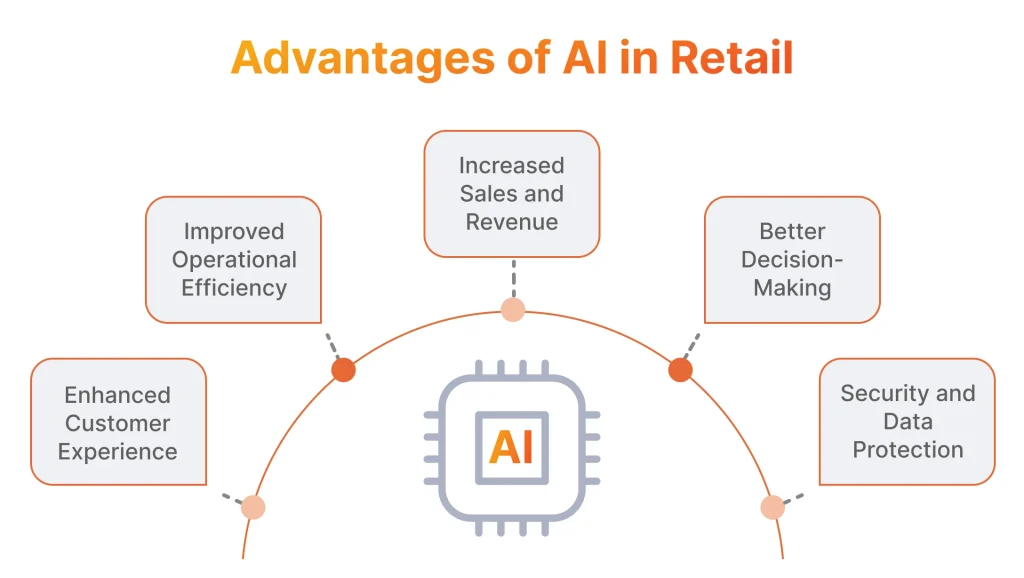
AI enables retailers to provide personalized offers and experiences to customers by automatically analyzing their preferences, past purchases, browsing behavior, and signals gathered from social media posts and other digital interactions. AI-powered chatbots and virtual assistants efficiently handle customer queries and provide instant support, ensuring customers receive immediate assistance throughout their shopping journey.
Balancing intelligent automation with human interaction is crucial to maintaining a personalized and effective service approach. By analyzing customer feedback and customer insights from various data sources, retailers can tailor services, improve product offerings, and enhance overall customer satisfaction.
Additionally, AI can help human agents by providing better answers to queries, improving customer service, and helping retailers navigate the complexities of global trade. These capabilities enable data driven personalization strategies and support highly effective personalized marketing, including automated recommendations and targeted promotions that increase customer engagement and conversion rates.
By offering personalized product recommendations, tailored promotions, and round-the-clock support through chatbots and virtual assistants, retailers can enhance customer satisfaction and loyalty.
Among marketing teams that leverage AI tools, 60% marketers agree that tools like chatbots are essential for converting high-intent visitors, according to HubSpot. We have an entire article focused on the benefits of using chatbots and virtual assistants, and we welcome you to read it to obtain more actionable insights.
Advanced Security and Data Protection
One of the biggest retail and eCommerce development challenges is data security. AI technologies can enhance and automate security measures, as well as protect retailers’ data and assets from cyber threats and fraud. By implementing advanced AI-driven fraud detection and data encryption techniques, retailers can safeguard sensitive information, prevent financial losses, and maintain compliance with data privacy regulations.
Are you looking for more information on eCommerce Fraud Detection?
In our recent article, we focused on this particular area, discussing the latest advancements.
Improved Operational Efficiency
AI helps retailers optimize their operations by automating tasks and processes, reducing manual effort, and minimizing errors. Businesses can benefit greatly from the usage of AI for automated inventory management, supply chain optimization, and logistics planning.
AI can also help retailers adapt faster to supply chain disruptions, optimize delivery routes, and introduce intelligent automation across warehouse and fulfillment operations. AI-powered supply chain analytics enables retailers to predict demand more accurately, optimize logistics, and enhance decision-making across different operational areas. These improvements not only increase efficiency but also help retailers control labor costs while scaling operations.
We know first-hand how Artificial Intelligence and Machine Learning can boost operational efficiency because we regularly deliver innovative solutions for our clients. In one of the recent cases, we leveraged Artificial Intelligence/Machine Learning for an expanded product range and enhanced eCommerce product listings for a U.S. retailer. We developed a powerful solution for an online retail store providing access to a diverse selection of over 1,000,000 products, and managed to achieve:
- Extended the product range of the client’s inventory, with an efficient scraping of 300,000 products in just 3 hours, enabling the client to significantly expand their product line and cater to a broader customer base.
- Achieved a remarkable increase in loading speed with a Google PageSpeed score improvement from 29 to 97 (web) and from 12 to 90 (mobile), enhancing user experience and search engine rankings.
Increased Sales and Revenue
AI-driven pricing algorithms and recommendation engines can help retailers increase sales by optimizing pricing strategies and identifying cross-selling and upselling opportunities. By dynamically adjusting prices based on market trends, customer demand forecasting, and competitor pricing, AI enables retailers to adapt and optimize retail prices in real time, boosting profitability and competitiveness. This allows retailers to grow revenue and capitalize on more sales opportunities.
Better Decision-Making
With the power of AI analytics tools, retailers can glean valuable insights and predictions based on large-scale data analysis, enabling their global networks to make informed decisions across merchandising, marketing, and operations. Real-time analytics dashboards and predictive analytics algorithms empower retailers to monitor performance, anticipate trends, and react quickly to ever-changing market conditions.
AI also enables retailers to experiment with new business models and track innovative revenue streams, supporting the shift toward AI-driven transformation in retail. As retailers increasingly rely on insights derived from third party data, customer behavior analytics, and market intelligence to guide business strategies, they benefit from a more informed decision-making process for executives.
Predicting customer behavior with AI unlocks new opportunities and possible revenue streams for retailers.
Find out how to do it right in our article!
Considerations for Implementing AI Solutions for Retail
Before investing in AI for retail, platform teams should conduct internal research and determine whether the following factors would not be a blocker to the implementation of an Artificial Intelligence or Machine Learning systems.
Integration with Existing Systems
Chances are your existing infrastructure was not designed with AI integration in mind, so here are a few suggestions to consider:
- Before getting started with AI implementation, conduct a thorough assessment of your existing systems, including POS systems, inventory management systems that monitor product availability, CRM systems, supply chain management systems, and eCommerce platforms. Identify integration points, data dependencies, and potential bottlenecks that may impact the implementation of AI solutions.
- If you opt for ready-made AI solutions for retail, ensure they are compatible with your existing systems and can integrate with them. Look for solutions that offer robust APIs, connectors, or plugins that facilitate integration and interoperability across different systems and data sources.
- Establish data integration pipelines and data governance practices to ensure the consistency, accuracy, and reliability of data used for AI modeling.
Cost and ROI Analysis
Conduct a comprehensive analysis of the Total Cost of Ownership (TCO) associated with implementing your solution. Consider factors such as:
- Upfront costs like software licensing fees or hardware infrastructure.
- Ongoing operational costs, for example, maintenance, support, and training.
- Potential hidden costs like data acquisition, integration, and compliance.
Evaluate the potential Return on Investment (ROI) of AI initiatives as well, by assessing the expected benefits and outcomes relative to the costs incurred. Set clear performance indicators and benchmarks to measure the success and effectiveness of AI implementations over time.
Training and Talent Acquisition
Assess your organization’s internal HR capabilities and identify any skills gaps or training needs related to AI implementation. Determine whether you have the necessary talent and expertise in-house, or if you need to acquire additional skills or resources to support AI initiatives, for example, you may need narrow expertise for Machine Learning models for Fraud Detection.
In case you need more talent, develop recruitment strategies to attract top experts and build diverse, multidisciplinary teams that can collaborate effectively on AI projects. SPD Technology can help you with this task, and build a dedicated team of AI engineers highly experienced with building advanced solutions for retail and eCommerce.
-
Conduct a thorough audit of existing POS, CRM, inventory, and eCommerce systems before selecting any AI solution
-
Establish unified data pipelines and governance practices to ensure consistency and accuracy across all data sources
-
Perform a Total Cost of Ownership analysis covering upfront, ongoing, and hidden costs before committing to implementation
-
Assess internal talent gaps and determine whether to build in-house capability or partner with a specialist AI vendor
-
Define clear KPIs and ROI benchmarks upfront so AI performance can be measured and validated post-launch

Challenges and Limitations of AI in Retail
There are still some aspects that need to be addressed, however, hopefully, they will all be solved soon to maximize the potential of AI technologies for Retail business.
Data Quality and Availability
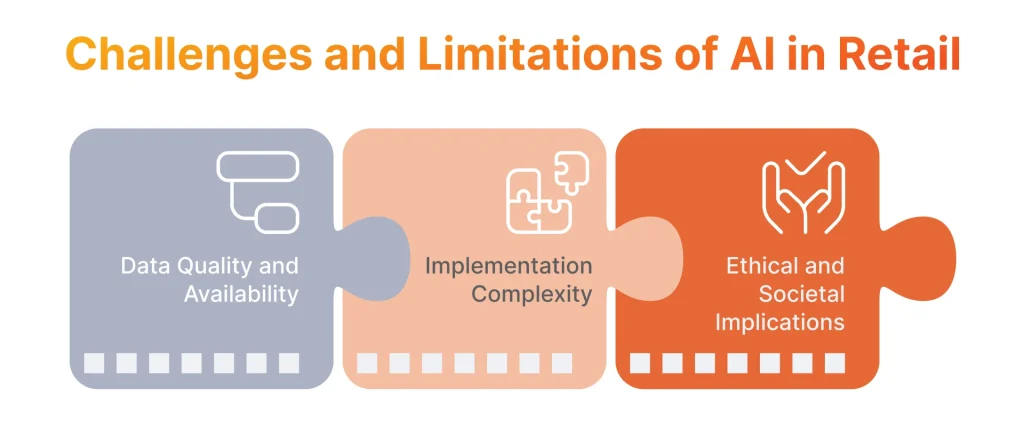
When we talk about the quality of available data, we refer to the accuracy, completeness, consistency, reliability, and relevance of data for a specific use case or application. Having high quality data is essential for the effective and accurate performance of AI tools.
The main issues with data for the organization may include:
- Fragmented Data Sources: retailers collect data from various sources such as Point-Of-Sale (POS) systems, eCommerce platforms, Customer Relationship Management (CRM) systems, social media, and brick-and-mortar stores. These data sources may be siloed or fragmented, making it difficult to integrate AI, analyze, and use data effectively.
- Legacy Systems: the business may have an outdated system that stores data in different formats and structures, hindering data integration and interoperability. Legacy systems will probably lack the capabilities to capture and process real-time data, limiting the availability of information for AI algorithms.
- Data Privacy Regulations: Retail industry as a whole is subject to stringent data privacy regulations such as GDPR and CCPA, which impose restrictions on the collection, storage, and processing of customer data. Compliance with these regulations requires retailers to implement robust data governance practices and ensure data privacy while still leveraging data for AI applications.
- Data Bias and Inaccuracy: retail data may contain biases or inaccuracies, resulting from factors such as sampling bias, data entry errors, or outdated information.

Serhii Leleko
ML & AI Engineer at SPD Technology
“Setting up a proper data collection process is critical for applying AI in your business. You should always start by clearly defining what business goals you want to achieve, and only after that start identifying the relevant data sources you might have. Make sure you don’t collect the data that you don’t actually need, to make the job easier for AI engineers, and don’t waste time on collecting and sorting irrelevant data.”
Implementation Complexity
Many retailers operate across multiple channels like eCommerce platforms, brick-and-mortar stores, and mobile apps, and have different functions including sales, marketing, and supply chain, for example. Each of those channels and functions has its systems, processes, and stakeholders. Depending on the structure of the business and its size, integrating AI solutions across diverse systems and processes can be challenging and require additional collaboration and coordination across different departments and teams.
Ethical and Societal Implications
The adoption of AI in Retail comes with several ethical and societal implications that need to be carefully considered.
Algorithmic Bias
Systematic errors or prejudices in AI algorithms result in unfair or discriminatory outcomes, often reflecting biases present in the training data or design choices made by developers. Some of the most common ones include bias in product recommendations, product placements, pricing disparities, or discriminatory hiring practices. Biased AI algorithms can lead to unequal treatment of customers or employees based on factors such as race, gender, age, or socioeconomic status.
Privacy Concerns
Since online retailers collect vast amounts of customer data, including personal information such as purchase history, preferences, and demographic details, AI applications that leverage this data may raise concerns about data privacy, surveillance, and data security. When AI solutions collect, analyze, or process personal data without adequate consent or safeguards, it may potentially infringe on individuals’ privacy rights. So, if customers perceive a lack of transparency or control over how their data is used, it may lead to trust issues and potential reputational damage for businesses.
Job Displacement
Since AI technologies automate tasks and processes traditionally performed by human workers, it may lead to a reduction in the demand for certain types of jobs or skills. For retail, specifically, AI-driven automation can lead to job displacement for roles that involve repetitive or routine tasks, such as cashiering, inventory management, or customer service. Before implementing AI solutions, businesses must consider the societal impacts of job displacement and develop business strategies to upskill affected employees to adapt to changing job requirements or transition to new roles.
AI for Retail: Future Trends and Opportunities
The future of AI for retail is looking to be very bright, as the new emerging trends are on the way to get center stage and become the talk of the industry.
Trend | AI Application | Business Impact |
|---|---|---|
Hyper-Personalization | Real-time behavioral analysis across browsing, purchase history, and social signals | Higher customer retention and conversion; Amazon’s personalized homepage drives discovery and repeat purchases |
Hyper-Automation | AI, NLP, MLOps, and robotics combined to automate warehouse sorting, packing, and decision-making | Reduced operational costs and human error across fulfillment and logistics |
Omnichannel Integration | Unified commerce platforms connecting eCommerce, mobile, in-store, and social channels | Seamless customer experience across all touchpoints, reducing friction and increasing basket size |
Social Commerce | AI-driven product discovery and purchasing directly within social media platforms | New revenue channel reaching high-intent buyers at the point of inspiration |
In-Store Analytics | Computer vision tracking customer movement patterns and optimizing store layouts | Improved assortment planning and product placement based on real-world shopper behavior |
AI-Driven Trend Forecasting | Analyzing social media, search trends, and historical sales to predict emerging consumer demand | Faster inventory positioning ahead of market shifts, reducing overstock and lost sales |
Trend
Hyper-Personalization
Hyper-Automation
Omnichannel Integration
Social Commerce
In-Store Analytics
AI-Driven Trend Forecasting
AI Application
Real-time behavioral analysis across browsing, purchase history, and social signals
AI, NLP, MLOps, and robotics combined to automate warehouse sorting, packing, and decision-making
Unified commerce platforms connecting eCommerce, mobile, in-store, and social channels
AI-driven product discovery and purchasing directly within social media platforms
Computer vision tracking customer movement patterns and optimizing store layouts
Analyzing social media, search trends, and historical sales to predict emerging consumer demand
Business Impact
Higher customer retention and conversion; Amazon’s personalized homepage drives discovery and repeat purchases
Reduced operational costs and human error across fulfillment and logistics
Seamless customer experience across all touchpoints, reducing friction and increasing basket size
New revenue channel reaching high-intent buyers at the point of inspiration
Improved assortment planning and product placement based on real-world shopper behavior
Faster inventory positioning ahead of market shifts, reducing overstock and lost sales
Hyper-Personalization and Hyper-Automation
Hyper-personalization uses advanced data analytics and agentic AI to tailor products, services, and marketing campaigns to the specific needs, preferences, and behaviors of customers. It goes beyond traditional personalization by leveraging real-time data and contextual information to deliver highly relevant and timely experiences to each customer.
Speaking within the context of this trend, the business impact of Big Data and AI is quite significant, enabling gathering and analyzing vast amounts of proprietary data to deliver highly personalized shopping experiences and ultimately leading to higher customer retention.
Retail giant Amazon is already heavily using this opportunity, creating a personalized homepage for each customer based on such factors as historical shopping habits, wish lists, and shopping carts. Anticipating the needs of its customers makes it easier to find what they’re looking for and discover new products.

Serhii Leleko
Serhii Leleko, ML & AI Engineer at SPD Technology
“In the future, we can expect even more sophisticated personalization techniques, where AI algorithms deeply consider contextual factors such as location, weather, and current trends. This level of hyper-personalization will help retailers anticipate customer needs and preferences more accurately, leading to entirely new levels of customer satisfaction and loyalty.”
Hyper-automation, on the other hand, involves the usage of AI, Natural Language Processing, MLOps, and robotic process automation to optimize a wide range of business processes across an organization. It aims to streamline workflows, improve efficiency, and reduce human intervention by automating repetitive tasks and decision-making processes.
Amazon uses hyper-automation in its warehouses as well. In particular, they use advanced robotics and AI to automate various tasks such as sorting, packing, and shipping, improving efficiency and leading to lowered operational costs, as well as successful loss prevention efforts.
Rise of Omnichannel Retailing
Seamless integration of various online and offline channels, including brick-and-mortar stores, eCommerce websites, mobile payment apps, and social media platforms to provide customers with a unified and consistent shopping experience will only evolve. Today, it is not enough just to build an eCommerce website and have a few physical stores across the country, but rather deliver a cohesive brand experience across all channels and touchpoints.
So, the current top omnichannel retailing trends include:
- Unified Commerce Platforms: integrating all channels and touchpoints, providing customers with a seamless shopping experience across online and offline channels.
- Click-and-Collect Services: offering curbside pickup, locker pickup, and in-store pickup options, providing online shoppers with convenience and flexibility in how they receive their orders.
- Social Commerce: turning social media platforms into shopping destinations, with retailers leveraging social commerce features to sell products directly to consumers.
AI is transforming brick-and-mortar stores through in store analytics, enabling retailers to analyze customer movement patterns, optimize store layouts, and improve assortment planning based on real-world shopper behavior.
Evolution of Customer Expectations
With this rapid technology rise, it’s safe to say that even more new trends will emerge, and more customers will expect that retailers will anticipate their needs, provide personalized customer experiences, offer convenience, and demonstrate transparency and authenticity in their interactions. Businesses need to keep a finger on the pulse of how Artificial Intelligence transforms customer service and be ready for drastic changes, when necessary.
This is a critical area for the industry and major companies are constantly working on improving customer interactions, as the customer experience management market size was valued at USD 15.55 billion in 2025 and is projected to reach USD 47.72 billion by 2033, growing at a CAGR of 15.2% from 2026 to 2033, according to a forecast by the Grand View Research.
AI-Driven Shopping Trends Forecasting
This involves the use of AI and advanced data analytics techniques to analyze large volumes of data from various sources, including social media, search trends, historical sales data, and external factors, to identify emerging trends and predict future consumer behavior. This can be a very valuable feature to add during eCommerce app development. By leveraging AI algorithms, retailers can gain valuable insights into changing market dynamics, customer preferences, and customer demand patterns, enabling them to make data-driven decisions and capitalize on emerging opportunities in the market.
AI-driven Shopping Trends Forecasting is a very similar concept to demand forecasting with ML in Retail, which we discussed in great detail in one of our previous articles. In both cases, AI-powered analytics are enabling retailers to forecast trends and predict customer behavior more accurately than ever before.
Key Takeaways
- Retailers leverage AI to enhance customer experience through personalized recommendations, chatbots, and round-the-clock support, among marketing teams using AI tools, 60% agree chatbots are essential for converting high-intent visitors.
- Operational efficiency and revenue growth are directly tied to AI-driven inventory management, supply chain optimization, and dynamic pricing.
- Successful AI implementation requires careful planning around system integration, data quality, ROI assessment, and talent acquisition. Retailers must audit existing infrastructure before committing to any AI initiative.
- The business impact of Big Data is central to retail’s AI transformation, enabling hyper-personalization by gathering and analyzing vast amounts of proprietary data to deliver highly relevant shopping experiences and drive customer retention.
- Future retail trends are converging on four pillars: hyper-personalization, hyper-automation, omnichannel integration, and AI-driven trend forecasting.
FAQ
How much does AI implementation in retail cost for a mid-size business?
Cost depends on three factors more than on company size: how complex the AI task is, how ready the data is, and where the model runs. A single-function proof of concept, such as a support chatbot or a demand forecast for one category, is a few weeks of focused effort. A production feature with integrations, monitoring and model retraining is a multi-month build. The biggest hidden cost is usually data engineering. When catalog, transaction and customer data sit in disconnected systems, unifying them can cost more than the model itself. Ongoing costs include inference, monitoring and periodic retraining as data shifts.
What data infrastructure must be in place before implementing AI in retail?
At minimum, the data the use case depends on must be unified, consistent and reachable through APIs. For most retail AI, that means a clean product catalog with structured attributes, transaction history long enough to cover several seasonal cycles, consistent event tracking across web, app and store channels, and customer identity resolved across those channels. Data governance and consent management for GDPR and CCPA need to be in place before personal data reaches a model. Real-time access to inventory and order systems matters most for conversational assistants and AI agents, which answer or act on live data.
Which AI retail use cases have the most reliable ROI?
The most reliable returns come from use cases where the data already exists and the outcome is easy to measure. Generative AI for catalog content and conversational AI for support usually qualify: they run on catalog and policy data the business already holds, and their results show up directly in content throughput, support workload and response times. Search and recommendation assistants can be measured on conversion. In one SPD project, an AWS Bedrock-powered AI search assistant raised search-to-purchase conversions by 12.5% for a gift card platform. Dynamic pricing and AI agents can deliver more, but their returns depend on mature data and integration layers, so they are less predictable as a first project.
What are the most common AI retail projects that fail to deliver measurable results?
Personalization engines and demand forecasting models are the most frequent underperformers. The technology usually works; the problem is that these models are deployed on top of fragmented, siloed data from disconnected POS, CRM and eCommerce systems that were never unified. Generic off-the-shelf solutions applied to domain-specific retail challenges without customization are the second leading cause of failure. They produce outputs that cannot account for the nuances of a retailer’s specific product mix, customer base or supply chain structure.
How long does it take to implement AI in a retail operation?
A proof of concept that validates one use case on existing data typically takes 4–8 weeks. An MVP with a production-ready model, system integrations and monitoring takes 3–6 months. A full AI system with multiple models, MLOps infrastructure, compliance controls and enterprise integrations takes 6–12 months or more. Data readiness is the most variable factor. When the data a model needs isn’t yet clean or labeled, preparation can add significant time before development starts.
What is the difference between generative AI and agentic AI in retail?
Generative AI creates content: product descriptions, marketing copy, image variants, or answers in a customer chat. It produces output that a person or system then uses. Agentic AI takes actions. An AI agent can reorder stock when a forecast crosses a threshold, process a return, or assemble and pay for a cart on a shopper’s behalf. The engineering difference is significant. Generative AI for retail mostly needs read access to catalog and content data. Agentic AI for retail needs write access to production systems, plus permission scopes, audit logs and approval thresholds for high-value actions.