

AI is triggering a fundamental shift in legal services, automating up to 44% of legal processes across the US and Europe according to Goldman Sachs. Machine learning, NLP, large language models, and generative AI are eliminating the most labor-intensive aspects of legal work — from document review and contract analysis to case outcome prediction and compliance monitoring. Law firms that embrace AI are reducing operational costs, improving client outcomes, and scaling operations without proportional increases in headcount, while those that delay risk falling behind rising client expectations and tech-forward competitors.
In 2024, the global AI market is valued at over USD 196 billion, according to Exploding Topics, and this market size is expected to grow by at least 120% year-over-year. Legal professionals and law firms are among the major adopters of Artificial Intelligence and Machine Learning, as client expectations evolve and competitive pressure increases.
Let’s discover why the process of delivering legal services is changing with custom AI solutions development, and find out how you can unlock the full potential of AI/ML innovation for your legal practice.
How the Latest AI Technologies Work for Law Firms
While improving businesses with Machine Learning and NLP has been in the spotlight for quite a while, there is a new trend emerging — Generative AI. These technologies disrupt the traditional way of conducting business for legal professionals, transforming essential processes. Artificial Intelligence is dramatically changing the core of legal work, in addition to a significant efficiency boost. With the power of AI, lawyers will be free from mundane tasks and will be able to focus more on working directly with clients, solve complex problems, and strategically plan their actions.
Machine Learning
This is a field of study in Artificial Intelligence that focuses on developing statistical algorithms allowing for the detection of patterns in massive datasets, and providing correct forecasts and predictions. The best part is that ML models can train based on experience and improve without being heavily programmed by humans to complete specific actions.
Machine Learning also adds to the business impact of Big Data and gradually becomes a major part of a lawyer’s work. When a law firm has a lot of legal research, information is not a problem that requires additional attention, but rather an advantage, because with AI assistance it can be easily extracted, classified, and used to win a specific case.

Serhii Leleko
ML & AI Engineer at SPD Technology
“In the past, it would have taken countless hours for legal experts to search existing cases, identify precedents, and calculate probabilities to predict the outcome of a sophisticated litigation case. In 2024, ML algorithms can conduct a rigorous analysis of enormous amounts of historical data, identify hidden patterns, and do a much more effective prediction job, compared to humans.”
With these algorithms and accurate predictions at their disposal, lawyers can benefit from having opportunities to come up with more precise strategies, adding to the overall effectiveness of a law firm in serving their clients.
So the most common applications of ML for law practice include:
- Predictive analytics for outcome prediction of cases and settlement forecasting based on historical data
- Automated risk assessment and regulatory monitoring of compliance risks and potential legal issues
- Advanced client management based on identifying trends and preferences.
Natural Language Processing
With Natural Language Processing (NLP), another integral part of AI, it is possible to interpret and generate human language from text to extract meaningful information.
Serhii Leleko
ML & AI Engineer at SPD Technology
“A great example of this new technology in legal practice is automating document review. Let’s think about a team of legal professionals tasked to search and analyze a massive number of contracts, extracting specific clauses and being aware of compliance issues. With Natural Language Processing, it is possible to not only scan this information in a fraction of time but at the same time to extract the necessary information and alert the legal team on potential risks. It is not just keyword research, but rather an intelligent analysis with a deep understanding of the context and intricacies of legal language, speeding up and improving the review process.”
Not limited to document and contract review, Natural Language Processing in legal practice can help with:
- Retrieving information and recognizing particular entities
- Extracting vast amounts of data and classifying texts.
If you need to successfully overcome the above mentioned challenges, adding an NLP-driven feature could become among the key requirements for a modern Document Management system (DMS) development.
We invite you to read our detailed article and find out how to develop a system that makes the complete automation of the document review process possible.
Large Language Models and ChatGPT
These technologies gained a lot of hype recently, and they can be a game-changer for the legal industry as well, by providing realistic generated tasks. For instance, when lawyers need to create a complex merger agreement, they can add the essential details to a language model and get a detailed draft in minutes, customized specifically for a particular case. The chances are that the results would still require some edits, however, the overall efficiency boost for this process is quite impressive.
This is not the sole potential use case, as Large Language Models can help with:
- Conducting preliminary assessments and offering advice according to added data
- Providing instant customer support and feedback by answering typical questions
- Generating holistic and quick summarization of legal articles, and case law as well as regulatory updates.
Using AI in the Legal Industry for Peak Efficiency
The modern-day legal practice is here, as Artificial Intelligence is already disrupting the traditional approaches of legal professionals to completing day-to-day operations. The mundane and repetitive tasks are looking to be a thing of the past, as Artificial Intelligence is powering up research functionalities and deriving data-based insights. Law firms now have new capabilities to elevate their services, improve the results for the clients, and secure leading market positions, surpassing the competitors.
Legal Function | AI Application | Business Impact |
|---|---|---|
Legal Research | NLP scanning of case law, statutes, and legal literature | Hours of manual research reduced to seconds; stronger precedent identification |
Contract Drafting | LLM-generated briefs and agreements based on key case inputs | Significant time savings on routine drafting; reduced oversight risk |
Litigation Preparation | ML analysis of past cases and successful strategies | Better court preparedness; data-driven strategy development |
Document Management | Automated categorization, indexing, tagging, and retrieval | 20TB data migration achieved; file retrieval reduced from 20 minutes to under 2 |
Dispute Resolution | AI pattern recognition across facts, precedents, and arguments | More effective strategies; reduced risk of overlooked critical points |
Case Outcome Prediction | Predictive analytics scoring based on historical judicial decisions | Realistic client expectations; data-driven risk management |
Legal Function
Legal Research
Contract Drafting
Litigation Preparation
Document Management
Dispute Resolution
Case Outcome Prediction
AI Application
NLP scanning of case law, statutes, and legal literature
LLM-generated briefs and agreements based on key case inputs
ML analysis of past cases and successful strategies
Automated categorization, indexing, tagging, and retrieval
AI pattern recognition across facts, precedents, and arguments
Predictive analytics scoring based on historical judicial decisions
Business Impact
Hours of manual research reduced to seconds; stronger precedent identification
Significant time savings on routine drafting; reduced oversight risk
Better court preparedness; data-driven strategy development
20TB data migration achieved; file retrieval reduced from 20 minutes to under 2
More effective strategies; reduced risk of overlooked critical points
Realistic client expectations; data-driven risk management
Let’s take a closer look and discuss exactly how it’s done and how your legal work can achieve maximum performance.
Identify the Best Case Law Instantly
Legal research is a key element of effective legal practice while being time-consuming and labor-intensive at the same time. With NLP-based innovation, it is now possible to dramatically improve this process. Modern tools can search through enormous amounts of data, including case law, legal documents, and statuses in mere moments, extracting the most suitable precedents and most appropriate legal arguments.
Keyword searches cannot stand a chance against intelligent software, as NLP solutions deeply understand the details of legal queries and can offer comprehensive results to lawyers. With these never-seen-before opportunities, legal professionals have access to more effective legal research and can make data-driven decisions in a shorter amount of time.
Compose Superior Legal Briefs More Efficiently
Another task that requires attention to detail and high precision is drafting legal briefs. Innovations in the field of Generative AI, GPT-4 in particular, can become a true game changer in this process. Lawyers just need to share the case details and set the preferable outcomes, and the technology is already capable of creating accurate and correctly structured briefs, nearly on the level of human intelligence.
The good news is that Generative AI ensures that all required legal provisions and arguments will be included in the brief, reducing, if not eliminating, the possibility of an oversight. The resulting time savings allow legal experts to change their focus to completing more strategic tasks while benefiting from accurate legal briefs crafted in the quickest time possible.
Enhance Litigation Preparedness
To fully prepare for the litigation process, it is essential to excel in a bunch of organizational activities and conduct a comprehensive document analysis. Implementing AI properly can automate key preparatory tasks for the litigation process, including:
- Past cases analysis
- Successful litigation strategy identification
- Potential changes prediction.
Artificial Intelligence brings the advantages of quick data analysis to the litigation process and enables lawyers to be more prepared for court proceedings, equipped with accurate information to maximize the chances of winning a case.
Automation and Smart Management of Documents
A well-built custom Document Management System benefits legal practices by introducing automation to one of the most important areas for lawyers. While working with documents, AI-powered solutions can help with:
- Enabling the complete or partial automation of organization and categorization, as well as retrieval of legal documents
- Based on their unique content and relevance, smart DMSs can scan, index, and tag documents
- Finding the specific relevant information among a large amount of documents
- Ensuring full compliance of documents with regulatory requirements.
Knowing first-hand what benefits a modern DMS can bring to legal business, we developed numerous custom solutions for our clients, driving their digital transformation processes. In one of the cases, we completely overhauled and expanded a multi-tenant data document storage and management solution for a U.S. technology provider. As a result of our involvement, we migrated 20 TB of data from the legacy app to the Cloud, reducing the file-downloading time from around 20 to less than 2 minutes.
In-Depth Examination of Legal Disputes
A fair analysis of legal disputes requires a deep investigation of several facts, precedents, and legal arguments. AI-powered DMSs are capable of identifying hidden patterns, drawing connections, and highlighting critical points, far better than human experts, resulting in better dispute-resolution outcomes.
Searching for more strategic tips on how to create a DMS for a Legal company?
We have an entire article dedicated to this topic with our unique insights based on practical experience.
Predictive Analytics for Case Outcomes
Let’s conclude with one of the most interesting use cases of AI in the Legal industry, holding a lot of potential benefits for organizations when done right. Artificial Intelligence can provide precise probability scores for case outcomes based on the principal factors, including specifics, history, and previous judicial decisions. With this functionality, lawyers can set realistic expectations and act based on informed decisions.
The Ultimate Benefits of AI for Legal Organizations
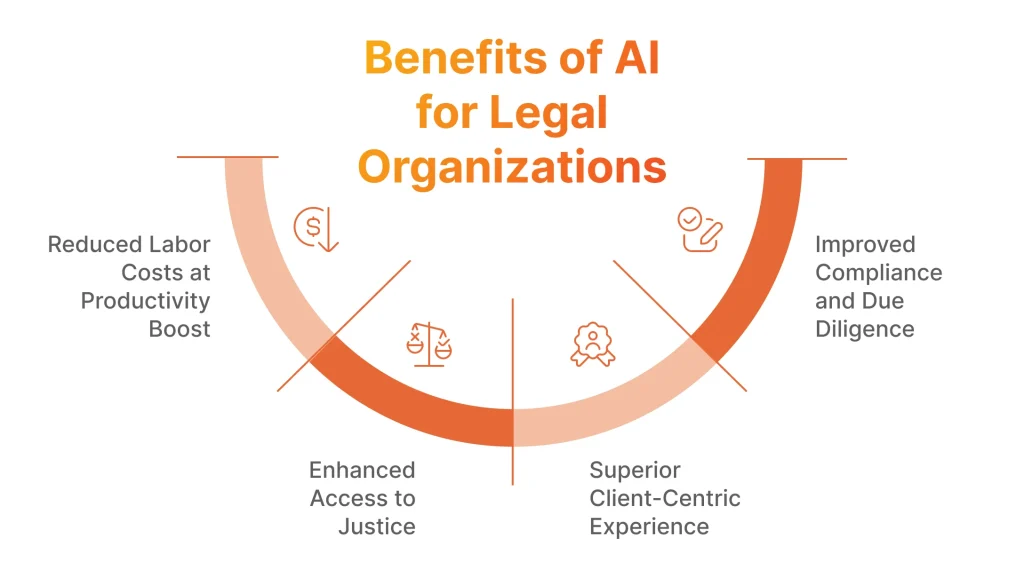
While it’s safe to say that the main benefits of implementing AI/ML for legal organizations include improved cost-efficiency, enhanced productivity, and increased profitability, there are more advantages to talk about. Companies that leverage AI also position themselves at the cutting edge of innovation in the highly competitive market, while also elevating customer experience.
Reduced Labor Costs at Productivity Boost
The bottom line is that the traditional approaches to some of the most common tasks including document review, legal research, and contract drafting are ineffective. Cutting-edge AI tools can help conduct legal research, for example, in minutes, compared to hours or even days required previously.
This improvement leads to significant cost savings for the organizations. The law firms get the opportunity to handle more workloads without the necessity of hiring new employees. This productivity boost has another bright side, as service prices for customers can be lowered, potentially resulting in an increased customer base.
Enhanced Access to Justice
With the price drop caused by less expensive internal processes, for example, implementing an AI/ML-powered chatbot with 24/7 availability, legal services will become more affordable and accessible to anyone who needs them. Small businesses and individuals, in particular, can find this access to legal representation extremely beneficial, and in some cases, life-changing.
We, at SPD Technology, in addition to constant innovation, are contributing to making justice more affordable. In one of our projects, we transformed a legacy notary service into a full-blown legal tech solution. The new notary service included an Admin Panel with different user roles, storage functionality, and 13+ integrated third-party services. Our involvement helped the client to extend its service geography to more than 20 states in America, as we made all state-specific requirements supported by the platform.
In another prominent case, we helped LegalTech Company with improving payment systems integration, allowing a 20 million customer base to use new payment methods.
Superior Client-Centric Experience
Just as Artificial Intelligence improves customer service in many top niches, the Legal industry is one of the biggest examples of this. Artificial Intelligence is offering a paradigm shift in highly personalized services, and by analyzing previous interactions and client preferences, AI can allow layers to deliver customized advice and services. For instance, AI can quicken the time for the drafting of legal contracts, providing advanced legal assistance to reduce wait times for customers.
Improved Compliance and Due Diligence
AI can help with these two most important aspects of legal practice as well, by automatically detecting any significant changes in laws or regulations for law firms. As for due diligence, specifically, AI can be far superior to your employees doing this task. Thanks to rigorous analysis of large amounts of information, AI-driven tools can be effective in identifying specific risks and issues and uncover hidden patterns in legal documents.
Find out additional insights on the benefits of legal technology, as we discuss the impact of AI tools on the Legal industry based on our practical experience.
SPD Technology’s Proficiency in AI for the Legal Industry
During nearly two decades of helping organizations of any size with digital innovation, we gained a ton of experience in building sophisticated legal software solutions powered by Machine Learning and Natural Language processing. We are constantly improving and innovating, regularly updating our skills and software knowledge based on feedback from our clients and rapid advancements in AI technology, ensuring our clients, legal professionals from all over the world, always have access to the best technology available.
Our tailored LegalTech solutions aimed to help individuals and organizations of any size, and include, but are not limited to:
- Legal Practice Management Software
- E-Discovery Software
- E-Filing Systems
- Legal Case Management Software
- Billing Software for law firms
- Legal Hold Software
To deal with legal challenges even more effectively, we offer advanced Document Management System Development Services, that already benefit our clients and include:
- Custom DMS Development
- Legacy DMS Modernization
- Cloud-Based DMS Development
- Third-Party Integrations
Speaking of our experience in application development for the Legal industry, our partnership with LegalShelf, a Mexico-city-based B2BLegaltech provider, truly stands out. We developed a modern Web-based software platform that allows their customers to comprehensively and securely manage and exchange legal documents, including the integration of advanced AI/ML models for fast, automated document processing.
The business impact for the client was truly remarkable, as by developing a complex modern platform for processing nearly 30,000 documents, we managed to increase the client’s customer base by 40%, significantly increasing the bottom line.

Key Takeaways
- Machine learning enables predictive analytics for case outcomes and settlement forecasting, capabilities that previously required hours of manual precedent research and are now delivered in seconds.
- NLP transforms document review from a labor-intensive bottleneck into an automated process, understanding legal language context and nuance far beyond simple keyword search.
- Large language models and generative AI accelerate contract drafting, legal brief composition, and preliminary client advice — reducing time spent on routine tasks while freeing lawyers for higher-value strategic work.
- AI improves access to justice by reducing the cost of legal services — making affordable representation available to individuals and small businesses previously priced out of professional legal counsel.
- Compliance monitoring and due diligence are among AI’s most reliable legal applications, with automated regulatory tracking and risk identification reducing human error in the highest-stakes areas of legal practice.
FAQ
What are the professional liability risks of using AI in legal work?
Lawyers remain professionally responsible for all AI-generated outputs under existing bar association rules and malpractice standards, meaning errors in AI-drafted contracts, incorrect case outcome predictions, or missed compliance flags carry the same liability exposure as human mistakes. The primary risk is over-reliance on AI outputs without adequate attorney review, particularly in jurisdictions where courts have already sanctioned lawyers for submitting AI-generated briefs containing fabricated case citations.
How much does implementing AI in a law firm or legal department cost?
A focused AI implementation covering a single legal function, such as NLP contract review, automated document management, or predictive case analytics, typically ranges from $60,000 to $250,000 depending on data volume, legacy system complexity, and jurisdictional compliance requirements. A full legaltech platform spanning e-discovery, compliance monitoring, document management, and client-facing advisory capabilities can reach $400,000 to $1,500,000+, with ongoing model maintenance, security audits, and regulatory updates adding 15–20% of build cost annually.
What legal AI tools have the fastest ROI and lowest implementation risk?
NLP-powered contract review and document management automation consistently deliver the fastest ROI in legal AI, reducing hours of manual document analysis to minutes while requiring relatively straightforward integration compared to predictive analytics or generative drafting tools. Legal research automation tools such as those built on NLP search across case law and statutes follow closely, offering immediate productivity gains for associates and paralegals with minimal disruption to existing workflows.
How accurate are AI contract review and legal research tools in practice?
Leading NLP-powered contract review tools achieve accuracy rates comparable to experienced junior associates on standard clause identification and compliance flagging tasks, but performance degrades on highly specialized, novel, or jurisdiction-specific legal language outside their training data. Legal research tools deliver strong results for established areas of law with large historical datasets, but require attorney validation for emerging legal questions, cross-jurisdictional edge cases, and any output that will be submitted to a court or regulatory body.
What are the ethical and compliance concerns of AI in legal services?
The core ethical concerns center on confidentiality, AI systems trained on or processing privileged client communications must meet the same attorney-client privilege protections as any other legal work product, requiring rigorous data governance and vendor due diligence before deployment. Additional concerns include algorithmic bias in predictive outcome models that could disadvantage certain demographic groups, transparency obligations when AI is used in client-facing advisory roles, and compliance with evolving bar association guidance on the disclosure of AI use in legal proceedings and documentation.