

Natural language processing (NLP) helps businesses understand and analyze large volumes of unstructured text data in business intelligence. It combines language processing, classification models, sentiment analysis, and information extraction to uncover patterns that traditional analytics often miss. NLP improves visibility into customer behavior, operational performance, and emerging business trends, when integrated into business intelligence workflows.
Your business is producing more data than ever, but most of it is invisible to your traditional analytics tools. Industry reports consistently show that most enterprise data is unstructured: locked away in emails, customer reviews, support tickets, and social media posts.
Ignoring this information means missing the real story of your business. It’s a challenge leaders recognize, with nearly 88% of Fortune 1000 executives surveyed stating that investments in data and analytics are a top organizational priority. This executive focus is driving significant growth in the NLP market.
Traditional BI systems were not built to handle the modern complexity. They often provide a rear-view analysis rather than real-time insights, limiting quick decision-making. This delay creates a critical gap between data and action.
Closing that gap requires a new approach. A professional, strategic implementation of natural language processing in business intelligence is no longer an optional upgrade. It is a competitive necessity for any organization serious about growth. Let’s discuss natural language processing in BI and how NLP improves business insights.
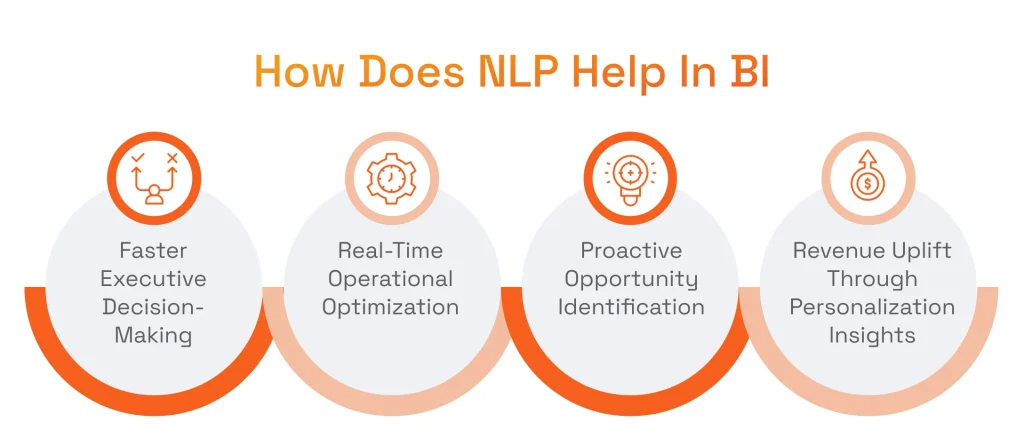
How Does NLP Help in BI
Integrating natural language processing into BI fundamentally changes how your company uses all its data, unifying the structured information in your databases with the vast amounts of unstructured text in emails, reports, and customer feedback. The goal is to make all information serve your business needs, shifting your BI framework from a tool that only understands rows and columns into a responsive asset that can interpret human language. NLP helps BI by bridging the gap between human language and machine-readable data.
While traditional BI systems primarily analyze structured data, NLP enables organizations to extract value from emails, reports, customer feedback, support tickets, and other text-based information. The table below summarizes how NLP transforms unstructured data into actionable business intelligence.
This unified approach translates raw information into tangible business advantages. By enabling a more direct and intuitive way to query both structured and unstructured data simultaneously, it delivers significant gains in operational speed, helps uncover opportunities hidden within customer comments and operational reports, and provides a sharper competitive edge for your entire organization.
Faster Executive Decision-Making
Gone are the days of executives waiting for data teams to decipher complex queries. With NLP in business intelligence, leaders can simply ask questions in plain English. “What were our top-selling products in the EU last quarter?” They get immediate and straightforward answers.
This direct line to data removes bottlenecks and enables faster and more confident data-driven decisions from the top down. It’s a massive shift from the rigid structure of traditional BI querying.
Real-Time Operational Optimization
Your business generates a constant stream of unstructured data through support tickets, social media mentions, and live chat. NLP tech in business intelligence acts as a digital nervous system, monitoring these channels in real time.
Sentiment analysis business intelligence can instantly detect a sudden surge in negative customer sentiment or identify a recurring bug mentioned in support conversations, allowing your teams to address operational fires before they spread. This ability to monitor and react in real time is a clear example of the Big Data impact on business when the right tools are in place to interpret it.
Proactive Opportunity Identification
What do your customers want next? The answers are often buried in thousands of product reviews, feedback forms, and survey responses. NLP sifts through this goldmine of unstructured text to spot emerging trends, popular feature requests, and gaps in the market.
NLP technologies in business intelligence help you find the next big opportunity by understanding what your customers are asking for, often before they say it directly.
Revenue Uplift Through Personalization
Effective personalization is built on a genuine understanding of your customer behavior. Custom AI solutions move beyond basic customer segments to analyze the intent and nuance in their language. By discerning what customers truly mean, you can deliver hyper-personalized marketing and product recommendations that connect on a deeper level.
While traditional BI systems primarily analyze structured data, NLP enables organizations to extract value from emails, reports, customer feedback, support tickets, and other text-based information. The table below summarizes how NLP transforms unstructured data into actionable business intelligence.
NLP Capability | Typical Data Sources | What the Model Identifies | Business Intelligence Outcome |
|---|---|---|---|
Sentiment analysis | Reviews, surveys, social media posts | Positive, negative, and neutral opinions | Improved understanding of customer satisfaction and brand perception |
Topic detection | Support tickets, feedback forms, forums | Recurring themes and discussion topics | Faster identification of emerging issues and opportunities |
Document classification | Contracts, reports, emails, invoices | Document categories and attributes | Improved organization and information retrieval |
Named entity recognition | Customer records, financial documents, contracts | People, organizations, products, locations, and key entities | More accurate reporting and analysis |
Text summarization | Reports, meeting notes, research documents | Key information and insights | Faster decision-making and knowledge sharing |
Conversational analytics | Chat transcripts, call center conversations | Customer concerns, intent, and behavioral patterns | Improved customer experience management |
Information extraction | Forms, invoices, legal documents | Structured data from unstructured content | Reduced manual processing effort |
Intent detection | Customer inquiries and support interactions | User goals and requests | Better service prioritization and workflow automation |
NLP Capability
Sentiment analysis
Topic detection
Document classification
Named entity recognition
Text summarization
Conversational analytics
Information extraction
Intent detection
Typical Data Sources
Reviews, surveys, social media posts
Support tickets, feedback forms, forums
Contracts, reports, emails, invoices
Customer records, financial documents, contracts
Reports, meeting notes, research documents
Chat transcripts, call center conversations
Forms, invoices, legal documents
Customer inquiries and support interactions
What the Model Identifies
Positive, negative, and neutral opinions
Recurring themes and discussion topics
Document categories and attributes
People, organizations, products, locations, and key entities
Key information and insights
Customer concerns, intent, and behavioral patterns
Structured data from unstructured content
User goals and requests
Business Intelligence Outcome
Improved understanding of customer satisfaction and brand perception
Faster identification of emerging issues and opportunities
Improved organization and information retrieval
More accurate reporting and analysis
Faster decision-making and knowledge sharing
Improved customer experience management
Reduced manual processing effort
Better service prioritization and workflow automation
How NLP Improves Business Insights in Practice
Theory is one thing. Practical application is another. So, how does NLP help in BI? When natural language processing is applied correctly to enterprise business intelligence, it fundamentally changes how your organization interacts with its data. It moves information out of siloed dashboards and into your entire team’s daily workflow. You turn historical data into a tool for immediate action and future strategy. The transition from reactive to proactive analysis is a key benefit of NLP for business operations.
Instead of waiting on a data analyst, a sales manager can ask Power BI, “Show me the top-performing regions for our new product line,” and get an instant visual report. This capability puts powerful analytics directly into the hands of the people who need it, creating a more agile, data-literate organization.
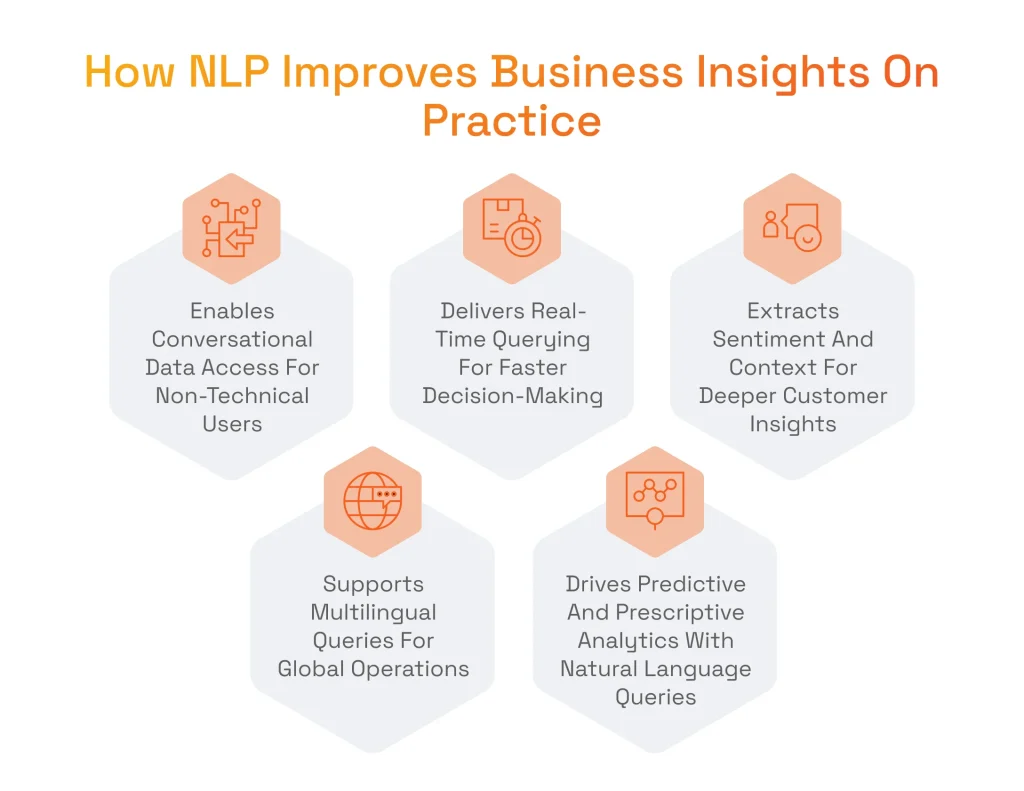
It’s a world away from the rigid structure of traditional BI data querying. This is where your teams can start winning back time and making sharper decisions. NLP enables conversational data access, letting staff query databases just by asking questions.
The speed of modern business requires immediate answers. With NLP, your teams get real-time querying capabilities that match this pace. A marketing leader can ask about a campaign’s performance over the last 24 hours and receive a synthesized report on the spot. The availability of real-time data strengthens the relationship between NLP and decision-making. This immediacy allows for quick pivots and adjustments, ensuring you’re always acting on the most current information.

Serhii Leleko
ML & AI Engineer at SPD Technology
“In today’s market, the speed of insight is a direct competitive advantage. NLP closes the gap between an event happening and the business understanding why it happened.”
The system also extracts deeper customer insights by going beyond simple keywords. Context-aware NLP algorithms can differentiate between sarcasm and authentic feedback, giving you a far more accurate read on customer satisfaction.
For global companies, scattered data is a constant challenge. NLP supports multilingual global operations, analyzing customer feedback and operational data from different languages to create a single, unified view. Suddenly, you have a clear picture of customer sentiment and performance across all markets. This analytical depth also drives predictive and prescriptive analytics.
Asking “What are the key drivers of customer churn?” can trigger models to not only identify at-risk customers but also suggest the most effective retention strategies. Your BI system stops just reporting the past and starts actively guiding your future. This entire process underscores the value of modern data analytics services.
NLP for Business Across Industries: Use Cases and Successful Projects
The true value of natural language processing in business intelligence becomes clear when you see it applied to specific real-world challenges. It’s a versatile tool that adapts to solve unique problems across different sectors.
From retail to legaltech, NLP adapts to diverse business problems. Our natural language processing services accelerate results across sectors with industry-specific models. We help our clients find efficiencies and uncover opportunities hidden within their text data.
Serhii Leleko
ML & AI Engineer at SPD Technology
“A model trained on legal contracts learns a different ‘language’ than one trained on social media sentiment. This domain-specific tuning is what transforms a general tool into a precision instrument for any industry.”
The following examples show how these principles work in practice.
eCommerce
In eCommerce business intelligence, success depends on understanding customers at a massive scale. NLP analyzes thousands of product reviews to get an accurate measure of customer sentiment, far beyond simple star ratings. It also powers the AI chatbots that provide instant, 24/7 customer support. As for the example, we developed an AI chatbot for the online fashion store, designed to handle huge traffic volumes, ensuring a smooth customer experience even during peak shopping seasons and freeing up human agents to focus on more complex issues. The application of NLP for business in customer-facing roles is critical for scaling support.
Manufacturing
Downtime on the factory floor can cripple productivity. The warning signs of equipment failure are often buried in unstructured maintenance logs and operator notes. NLP reads and understands this text, identifying recurring patterns that precede a breakdown. Maintenance shifts from a reactive fix to a predictive strategy, saving significant time and money.
Predictive maintenance powered by NLP is one of the most impactful business intelligence success stories in the industrial sector. Our portfolio also includes an ML solution for a packaging manufacturer that analyzed operational data to find these kinds of efficiencies, directly improving their bottom line.
Fintech
The financial industry runs on information. NLP automates the process of extracting critical data from news articles, financial reports, and market filings to assess risk and spot investment opportunities. It allows analysts to make faster and better-informed decisions based on financial business intelligence.
Automating complex data processing shows how NLP enhances business intelligence, especially in highly regulated industries. We helped a B2B intelligence firm by optimizing their data collection and processing with ML and OpenAI. The automated data collection and processing solution delivered more accurate insights to their clients in a fraction of the time it took manually.
Legaltech
Legal work is incredibly text-intensive. NLP is a perfect fit for automating the review of contracts, speeding up e-discovery, and assisting with legal research. These tools can analyze thousands of documents to find relevant information or flag unusual clauses in a contract, reducing hours of manual work. We have direct experience in this area, having developed a custom B2B Legaltech solution that increased the accuracy of document processing for our client, successfully streamlining complex legal workflows and boosting the client’s customer base by 40%.
NLP applications extend far beyond chatbots and customer support. Organizations use language processing technologies across departments to extract insights, automate workflows, and improve decision-making. The table below summarizes key NLP applications and their impact on business intelligence.
Industry | NLP Application | Data Analyzed | Business Intelligence Value | Business Outcome |
|---|---|---|---|---|
eCommerce | Sentiment analysis and AI-powered customer support | Product reviews, customer feedback, chatbot interactions, support inquiries | Provides deeper visibility into customer preferences, satisfaction, and recurring issues | Improved customer experience, more informed merchandising decisions, and scalable customer support |
Manufacturing | Predictive maintenance and operational intelligence | Maintenance logs, technician notes, equipment reports, operational records | Identifies patterns associated with equipment failures and operational inefficiencies | Reduced downtime, lower maintenance costs, and improved productivity |
Fintech | Financial document analysis and market intelligence | News articles, financial reports, market filings, and business documents | Accelerates risk assessment and identification of market opportunities | Faster decision-making and more accurate financial insights |
Legaltech | Contract analysis, legal research, and document review | Contracts, legal documents, case files, and compliance records | Extracts relevant information and identifies anomalies across large document collections | Reduced manual review effort, improved accuracy, and streamlined legal workflows |
Industry
eCommerce
Manufacturing
Fintech
Legaltech
NLP Application
Sentiment analysis and AI-powered customer support
Predictive maintenance and operational intelligence
Financial document analysis and market intelligence
Contract analysis, legal research, and document review
Data Analyzed
Product reviews, customer feedback, chatbot interactions, support inquiries
Maintenance logs, technician notes, equipment reports, operational records
News articles, financial reports, market filings, and business documents
Contracts, legal documents, case files, and compliance records
Business Intelligence Value
Provides deeper visibility into customer preferences, satisfaction, and recurring issues
Identifies patterns associated with equipment failures and operational inefficiencies
Accelerates risk assessment and identification of market opportunities
Extracts relevant information and identifies anomalies across large document collections
Business Outcome
Improved customer experience, more informed merchandising decisions, and scalable customer support
Reduced downtime, lower maintenance costs, and improved productivity
Faster decision-making and more accurate financial insights
Reduced manual review effort, improved accuracy, and streamlined legal workflows
The Future of NLP in Business Intelligence: What to Expect
The integration of natural language processing in BI is an accelerating field and not a static endpoint. The capabilities available today are just the beginning. As the underlying AI models become more sophisticated, the way businesses interact with their data will continue to shift in fundamental ways, moving from simple queries to genuine strategic partnerships with their BI systems. Such a forward-looking perspective is central to the growing field of AI for business intelligence, where the goal is to create a more symbiotic relationship between humans and data. The natural language processing future is tied to this deeper level of integration.
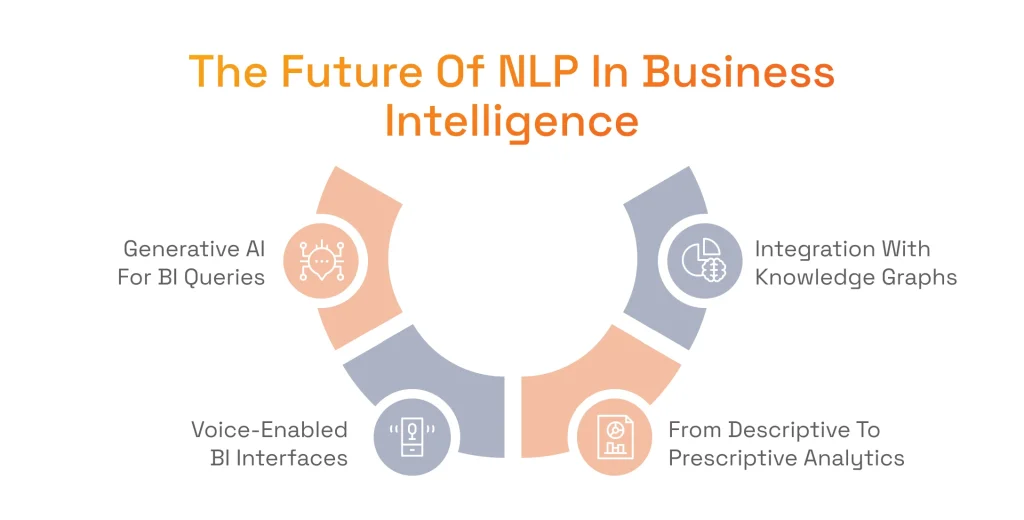
The rise of generative AI for BI queries is a clear next step. Soon, your tools will move beyond just answering questions. Instead, a single prompt will trigger the creation of a complete analytical report, complete with written narratives and key takeaways. This evolution will be complemented by voice-based BI tools, offering proper hands-free decision support. An executive will be able to get critical sales forecasts or supply chain updates simply by asking a smart device during their morning commute.
This progress also marks an expansion to fully prescriptive analytics. Many industry voices agree that the next significant milestone in BI is prescriptive analytics. Your BI system will evolve from telling you what happened and what might happen to actively recommending what you should do. It will suggest optimal business strategies based on its analysis.
It’s all made possible through integration with enterprise knowledge graphs, where NLP will connect disparate data sources across your organization. You get a more context-aware analytical fabric, which allows your BI tools to understand the complex relationships within your business and deliver far more intelligent insights.
Unlock NLP for Business Growth with SPD Technology
Putting natural language processing in business intelligence to work effectively is about more than just having the right technology. The real difference comes from a strategic partnership that connects the power of AI to your specific business goals. It’s how an NLP project becomes a true competitive asset.
Our data strategy consulting is designed to build this bridge between technology and tangible results. We specialize in delivering advanced business analytics using NLP, ensuring every solution integrates seamlessly with your operations and drives growth.
- Business-First Integration. We start with your business challenges, ensuring the solution aligns with your broader enterprise data strategy to improve data-driven decision-making where it counts.
- End-to-End Data Readiness. Effective insights rely on strong data quality management. We handle the entire pipeline, from preparation to governance, creating a reliable foundation for analysis.
- Domain-Tailored NLP Models. We don’t believe in one-size-fits-all AI. Our models are customized to understand the specific language and context of your industry, ensuring much higher accuracy and relevance. Our ML development services focus on creating these bespoke models to ensure much higher accuracy and relevance.
- Embedding into Existing BI Ecosystems. Our goal is to enhance the BI tools you already use, transforming them into powerful natural language BI platforms without causing unnecessary disruption.
- Multilingual and Multimodal Capabilities. We build systems that can analyze unstructured data from multiple sources and in various languages, giving you a clear, consolidated view of your global operations.
- MLOps-Driven Lifecycle Management. Our solutions are built for the long term. We implement MLOps practices to ensure your AI models are monitored, maintained, and continuously improved over time.
- Compliance and Responsible AI Built-In. We design every solution with security, privacy, and ethical AI principles from the ground up, so you can trust the results.
- Proven Track Record. Our experience in data-intensive industries means we understand the challenges and know how to deliver solutions that work in the real world.
Key Takeaways
- NLP transforms unstructured text into structured insights, enabling organizations to analyze information that traditional BI tools often cannot process effectively.
- Machine learning-powered NLP improves sentiment analysis, topic detection, and document classification, leading to more accurate business intelligence and decision-making.
- Organizations that integrate NLP into BI workflows gain greater visibility into customer feedback, operational issues, and emerging market trends.
- General-purpose language models provide rapid deployment, but domain-specific NLP models often deliver higher accuracy for industry-specific terminology and business processes.
- NLP projects depend heavily on data quality and labeling standards; poor training data reduces model performance and business value.
- The greatest value comes from integrating NLP outputs into existing analytics, reporting, and operational workflows rather than treating NLP as a standalone technology initiative.
In short: NLP extends business intelligence beyond structured reports and dashboards by making unstructured data searchable, measurable, and actionable. Organizations can uncover customer sentiment, operational bottlenecks, and emerging trends faster by turning emails, documents, support tickets, customer feedback, and other unstructured data sources into business intelligence assets.
FAQs
How much does building a custom NLP system cost compared to using an off-the-shelf solution?
Off-the-shelf NLP solutions typically have lower upfront costs because they provide pre-trained models, managed infrastructure, and subscription-based pricing. Depending on usage and feature requirements, costs can range from a few hundred dollars per month to tens of thousands annually. In contrast, custom NLP systems often require investments of $50,000–$300,000+ for development, model training, integration, testing, and deployment.
While custom solutions require greater initial investment, they can deliver higher accuracy, stronger data control, and better performance for industry-specific use cases such as legal document analysis, financial intelligence, healthcare records processing, or specialized customer support workflows.
What are the most common NLP implementation failures in enterprise environments?
Many NLP initiatives fail because organizations underestimate data preparation requirements or focus on technology before defining business objectives. Poor-quality training data, unclear success metrics, lack of stakeholder adoption, and insufficient integration with business processes frequently limit the value of projects.
Another common challenge is deploying NLP models without a strategy for continuous improvement. Language evolves over time, and models that are not monitored or retrained may experience declining performance.
How long does it take to train and deploy a domain-specific NLP model?
The timeline depends on data availability, labeling requirements, model complexity, and integration needs. Organizations with high-quality training data and clearly defined use cases can often train and deploy an initial domain-specific NLP model within 2–6 months. More advanced projects involving large datasets, custom architectures, or extensive validation may require 6–12 months or longer.
A significant portion of the timeline is often spent preparing and labeling data, validating model performance, and integrating the solution into existing business processes. Organizations that already maintain structured, high-quality datasets generally achieve faster deployment and better outcomes.
What data labeling requirements make NLP projects unexpectedly expensive?
Data labeling often becomes expensive when organizations must classify large volumes of domain-specific text, develop detailed annotation guidelines, or rely on subject-matter experts to review content. Industries such as healthcare, legal services, finance, and insurance frequently require specialized knowledge to label data accurately.
Costs also increase when annotation quality is inconsistent, business definitions change during the project, or multiple review cycles are required to achieve acceptable model performance.
What are the risks of using general-purpose LLMs for sensitive business NLP tasks?
General-purpose LLMs may produce inaccurate outputs, expose sensitive information, generate inconsistent responses, or struggle with industry-specific terminology. These risks become more significant when models are used for regulated processes, customer communications, compliance activities, or strategic decision-making.
Organizations should evaluate data privacy requirements, governance policies, explainability needs, and accuracy expectations before deploying LLMs in business-critical environments. In many cases, additional controls, fine-tuning, or custom NLP models are necessary to reduce risk.