An enterprise data strategy defines how a large organization collects, integrates, governs, secures, and analyzes its data to support business objectives at scale. Unlike strategies for smaller companies, it must address cross-system complexity, compliance across regions, growing data volumes, and alignment between data initiatives and enterprise-wide goals. With 86% of leaders unprepared to scale AI into operations, a well-structured data strategy is what separates organizations that extract compounding value from data from those stuck in fragmented pilots.
McKinsey reports that 86% of leaders feel unready to scale new technologies because their technical and organizational systems aren’t aligned. Data is the foundation that brings everything together. With the right data strategy, companies can move from scattered systems to a seamless flow of information to feed emerging technologies that accelerate business performance.
Approaches to handling data differ between small or medium-sized companies and large enterprises. Smaller businesses typically opt for flexibility and budget-friendly solutions, while large enterprises need robust, scalable systems to manage huge data volumes. In this article, we will dwell on the specifics of an effective data strategy that supports the organization’s objectives.
Overview of Enterprise Data Strategy: Definition and Key Components
An effective enterprise data strategy demands more than the strategy crafted for small and medium-size companies since large organizations handle complex datasets across numerous systems and platforms. To understand better the specifics of crafting the strategy for enterprise data, it is important to delve into the definition and key components of a data strategy.
What Is Data Strategy?
The data strategy states a high-level vision that provides an understanding of why data is valuable and what the organization aims to achieve with it. It focuses on matching the organization’s data initiatives to its business objectives and ensures that data endeavors assist an organization in turning raw data into practical decisions.
Still, no data strategy can exist without a data strategy framework. The framework shapes and sets the boundaries of the vision described in the data strategy. It also covers specific practices necessary to manage data effectively. Those data practices are:
- Data Governance
- Data Architecture
- Data Quality
- Data Integration
- Data Storage
- Data Security and Compliance.
When it comes to a practical implementation of an enterprise data strategy, the data strategy roadmap comes to the fore. The roadmap, in turn, works on a more practical level than strategy and outlines the phases, timelines, and milestones required for the strategy implementation. Its core components are:
- Vision and Goals
- Data Landscape Assessment
- Goal Prioritization
- Resource Allocation and Budgeting
- Timelines and Milestones
- Risk Management and Mitigation.
Why Does an Enterprise Need a Data Strategy?
An enterprise operates as a multi-component system that generates, processes, and stores vast volumes of data across multiple departments. Without a solid enterprise data strategy, the company can face challenges that can hinder not only the execution of data initiatives but also the whole path towards data-driven culture.
There are several reasons why having a data strategy is crucial for enterprises operating in a dynamic business environment. With so many data sources existing within a single company, an enterprise data strategy serves as a foundation for effective data integration into a Single Source of Truth (SSOT), ensuring consistency and reliability across the organization. This strategy includes methodologies for data analysis, reporting, and visualization, enabling data-informed decision making as a result.
A well-crafted enterprise data strategy also defines data architecture levels. When designed with scalability in mind, it addresses the need for scalability and helps growing businesses future-proof their data environments. Additionally, it establishes governance policies and compliance protocols to ensure the enterprise’s data processes meet regulatory requirements.
What to learn about key elements and importance of a data strategy roadmap?
Read our featured article!
What Tasks Does an Enterprise Data Strategy Address?
- Ensuring Seamless Data Integration: An enterprise data strategy ensures seamless data integration by establishing standardized integration processes, unifying disparate data sources, and highlighting practices for efficient data flow across the organization.
- Providing for Scalability: An enterprise data strategy outlines the tools (storage, analytics, etc.), architectures (hybrid, cloud, or microservices models), and processes needed to handle increasing data volumes and complexity without sacrificing performance or efficiency.
- Establishing Security: A strategy helps to incorporate encryption, access controls, and monitoring mechanisms into every layer of the data lifecycle to protect intellectual property and private data from breaches, unauthorized access, and other vulnerabilities.
- Enabling New Technologies Integration with Existing Systems: An enterprise data strategy suggests practices for integrating emerging technologies (AI, ML, and IoT) with legacy systems, while maintaining flexible scalable architecture and supporting current operations.
- Empowering Customer Data Analysis: An enterprise data strategy defines processes for collecting, managing, and analyzing customer data from various touchpoints (CRM, social media, etc.) and promotes the use of advanced analytics, AI, and ML models to derive practical insights from it.
- Supporting Informed Decision-Making: A data strategy states the importance of fostering data accessibility within an enterprise and sets the foundation for predictive and prescriptive analytics, enabling forward-looking decisions that anticipate trends, risks, and opportunities.
- Ensuring Data Projects and Business Priorities Alignment: An enterprise data strategy assists in evaluating which data projects deliver the most value for the organization, promoting resource allocation to projects that support core business goals.

Sergii Leleko
AI & ML Engineer at SPD Technology
“A concise data strategy is indispensable for any enterprise looking to thrive in today’s data-driven world. It provides the structure, guidance, and tools necessary to manage data effectively, align it with business objectives, and leverage it to drive long-term success.”
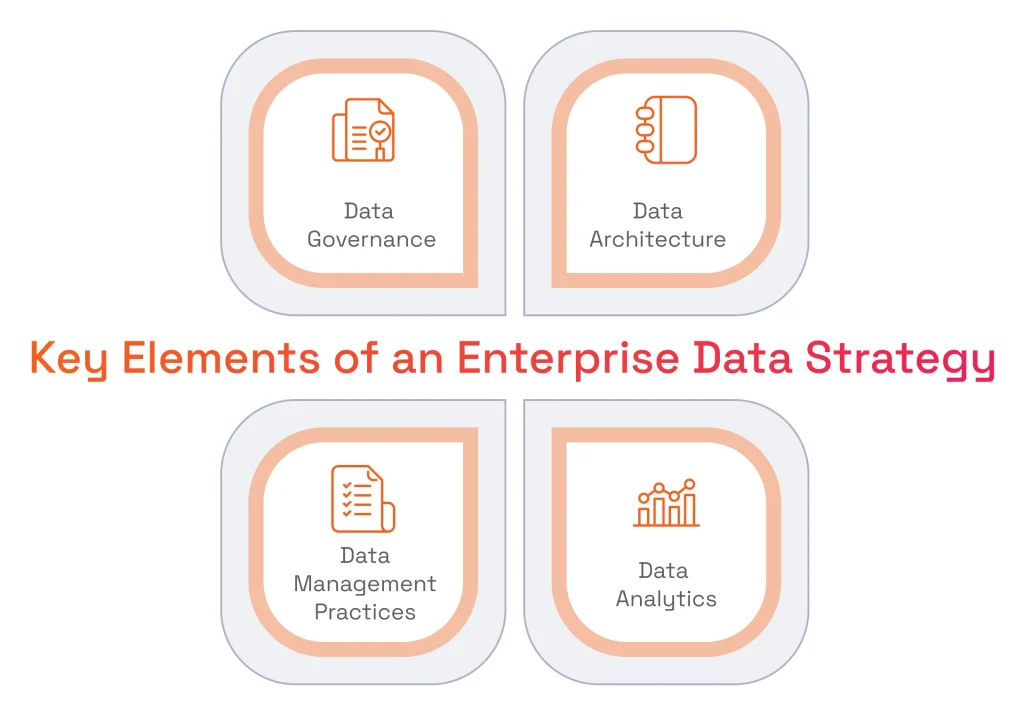
Key Elements of an Enterprise Data Strategy
So, the enterprise data strategy helps ensure integration, migration, security, scalability, and other aspects of the data mentioned above. But what components does it consist of? We offer an overview of the essential elements which are the primary focus of data strategy consulting services.
Data Governance
Data governance helps control how data is handled, accessed, and utilized inside a company. The important aspect of this strategy component is that it provides clear instructions for working with several key elements. Those are:
- Data ownership for identifying who owns and is responsible for data assets;
- Data stewardship for assigning managers to oversee the quality and use of data;
- Compliance for ensuring that data usage complies with regulations;
- Data quality standards for defining criteria for data accuracy, completeness, and consistency.
When an enterprise implements a data governance framework, it puts specific individuals or teams in charge of particular datasets, defining responsibilities at different levels, from data creation to data consumption. In other words, the company defines data owners, who are responsible for data quality, security, and usage policies, and data stewards, who are responsible for managing data day-to-day. This promotes accountability and transparency in working on data projects, while also reducing risks of data mismanagement.
Data Architecture
The tools and infrastructure utilized for data collection, storage, and management are defined by data architecture. Data architecture is about creating a coherent and efficient system for managing data so that it aligns with the company’s needs and can adapt to changing demands.
When designing data architecture as a part of a data strategy development, organizations can opt for centralized architectures to achieve unified data management and consistent governance, though they may face scalability and flexibility challenges. Conversely, large companies may choose decentralized architectures to achieve greater scalability, but this approach can make maintaining consistent data standards across the organization more difficult.
Data architecture consists of the following elements:
- Data lakes and warehouses for structured and unstructured data repositories, where data can be stored for analysis and retrieval;
- Cloud infrastructure for scalability, cost-effectiveness, and ease of access;
- Integration with legacy systems for preserving historical data when connecting older systems to the new architecture;
- APIs and real-time data pipelines for integrating real-time data flows to ensure instant analysis and decision-making.
All these elements work together to create a scalable and accessible architecture that enables seamless data storage, processing, and real-time insights. When elaborating on data architecture as a part of enterprise data strategy, enterprises are recommended to consider a modular architecture that can easily integrate new data sources and tools as they emerge. This allows for creating a system, efficient enough to process large volumes of data, and secure enough to protect sensitive information.
Data Management Practices
Robust data management procedures guarantee that the data within the company maintains or even maximizes its value and usage. They ensure that the organization can trust the data it collects, processes, and analyzes, which is crucial for making informed, strategic decisions to drive business success. Enterprise data management practices consist of four key processes.
- Data quality management for establishing processes such as data cleansing, validation, and deduplication.
- Data integration for combining data from multiple sources into a unified system.
- Data lifecycle management for governing data from its creation to its eventual archiving or deletion.
- Data security for ensuring that sensitive data is protected from unauthorized access and breaches.
Since enterprises deal with data from disparate sources (ERP, CRM, IoT, third-party APIs), enabling a seamless data flow among the systems can make data interoperable and standardized across the organization. This measure facilitates the use of data, while maintaining security standards. Additionally, without coherent data management, enterprises risk exposing data to authorized users. To safeguard data, it is crucial to implement role-based access controls or attribute-based access controls.
Data Analytics
Enterprise data analytics strategy focuses on the transformation of raw data into meaningful information. The end goal here is to extract business insights and unleash the potential to make informed decisions or even drive innovation with custom AI solutions. To understand past performance, diagnose issues, and forecast future trends, different types of analytics are used, such as:
- Descriptive analytics for summarizing past data to understand what has happened over a given period.
- Diagnostic analytics for delving deeper into the data to explain why something happened.
- Predictive analytics for forecasting future outcomes based on historical data and statistical models.
- Prescriptive analytics for recommending specific actions based on predictive insights.
Large businesses can leverage AI/ML development services to unlock the capabilities of advanced analytics and support such use cases as fraud detection, customer engagement, supply chain monitoring, and operational optimization depending on organizational needs. By creating and training AI/ML models, enterprises can automate the analysis of large datasets, automating the identification of hidden patterns that highlight fraud schemes, customer behaviors, processes disruptions, seasonal demand, and more.
The Specific Challenges and Solutions of Enterprise Data Strategy Development
Failing to build a solid data strategy turns emerging tech into a costly experiment and undermines everyday decisions. When data is scattered, low quality, or poorly governed, teams lose trust in analytics and nothing scales beyond isolated pilots. So what bottlenecks does an organization need to break through to be ready for emerging technologies? This table maps the seven most common enterprise data strategy challenges to their root causes and the specific solutions that address them.
Challenge | Root cause | Strategic solution |
|---|---|---|
Data system complexity | Mix of legacy systems, cloud platforms, and third-party apps creates fragmented, siloed data | Implement ETL/ELT platforms, data lakes, or warehouses; adopt data mesh architecture to enable team-level data ownership; use Apache Kafka, AWS Glue, or Azure Data Factory to eliminate silos |
Growing data volume | 221 zettabytes of data projected for 2026 outpaces legacy storage and processing capacity | Adopt scalable cloud platforms (Amazon Redshift, Google BigQuery, Snowflake); use modular architecture; plan AI/ML incorporation to automate processing and analysis |
Compliance governance | Almost 40% of global leaders cite rising compliance burden as their biggest challenge across multi-region operations | Establish robust data governance frameworks with Collibra or Informatica; implement automated compliance monitoring for GDPR, HIPAA, CCPA; use OneTrust or TrustArc for global compliance management |
Resistance to change | Only 14% of leaders say colleagues consistently champion AI adoption; one in six organizations has no C-suite AI owner | Conduct training and workshops; adopt phased implementation; create cross-functional teams; use Balanced Scorecard to connect data initiatives directly to measurable business objectives |
Data integration | Heterogeneous systems across departments and geographies create incompatible formats and interoperability gaps | Deploy middleware and APIs using MuleSoft or Apigee; implement data standardization protocols; use ETL tools to create unified data flows across disparate systems |
Budget constraints | 47% of CDOs cite budget and resource limitations as a key barrier; pressure to prove direct ROI on every initiative | Prioritize high-impact quick wins; use phased investment with incremental ROI demonstration; leverage cloud-based services and managed/outsourced expertise to reduce upfront costs |
Data security | Growing cyber threats and AI-enabled attacks drive worldwide security spending to $240 billion in 2026 | Implement encryption, multi-factor authentication, and intrusion detection at every data layer; use Microsoft Sentinel or AWS Security Hub for centralized security management; maintain a risk management roadmap with regular audits |
Challenge
Data system complexity
Growing data volume
Compliance governance
Resistance to change
Data integration
Budget constraints
Data security
Root cause
Mix of legacy systems, cloud platforms, and third-party apps creates fragmented, siloed data
221 zettabytes of data projected for 2026 outpaces legacy storage and processing capacity
Almost 40% of global leaders cite rising compliance burden as their biggest challenge across multi-region operations
Only 14% of leaders say colleagues consistently champion AI adoption; one in six organizations has no C-suite AI owner
Heterogeneous systems across departments and geographies create incompatible formats and interoperability gaps
47% of CDOs cite budget and resource limitations as a key barrier; pressure to prove direct ROI on every initiative
Growing cyber threats and AI-enabled attacks drive worldwide security spending to $240 billion in 2026
Strategic solution
Implement ETL/ELT platforms, data lakes, or warehouses; adopt data mesh architecture to enable team-level data ownership; use Apache Kafka, AWS Glue, or Azure Data Factory to eliminate silos
Adopt scalable cloud platforms (Amazon Redshift, Google BigQuery, Snowflake); use modular architecture; plan AI/ML incorporation to automate processing and analysis
Establish robust data governance frameworks with Collibra or Informatica; implement automated compliance monitoring for GDPR, HIPAA, CCPA; use OneTrust or TrustArc for global compliance management
Conduct training and workshops; adopt phased implementation; create cross-functional teams; use Balanced Scorecard to connect data initiatives directly to measurable business objectives
Deploy middleware and APIs using MuleSoft or Apigee; implement data standardization protocols; use ETL tools to create unified data flows across disparate systems
Prioritize high-impact quick wins; use phased investment with incremental ROI demonstration; leverage cloud-based services and managed/outsourced expertise to reduce upfront costs
Implement encryption, multi-factor authentication, and intrusion detection at every data layer; use Microsoft Sentinel or AWS Security Hub for centralized security management; maintain a risk management roadmap with regular audits
Now, let’s examine these challenges in detail.
Complexity of Data Systems
One of the most significant challenges that enterprises face today is the complexity of their data systems. Businesses have no choice but to operate with a mix of legacy systems, cloud platforms, and third-party applications. The problem with that way of work is that data is fragmented and prone to silos and integration issues.
To tackle this complexity, the enterprise data strategy must address the challenge of unifying all the systems and implementing a data integration platform. The prioritization of the use of tools like ETL (Extract, Transform, Load) platforms, data lakes, or data warehouses comes up as necessary for productive integration processes.
We know from experience that they provide the infrastructure needed to collect, transform, and consolidate data from several sources and help achieve 5x operational cost reduction. Also, it is important to state the benefits of Apache Kafka, AWS Glue, and Microsoft Azure Data Factory for the integration process and the elimination of silos.
Another solution to include in the strategy is the adoption of a data mesh approach. This will help companies break from centralized data management and allow individual teams to manage their own data as a product. Through our experience in delivering Fintech development services for this project, we learned that a streamlined data feed solution, capable of consolidating information from multiple external providers, can significantly accelerate data availability for end users. The solution we implemented proved to be flexible and ready to accommodate new data integrations.

Growing Scale and Volume of Data
As statistics shows, the 221 zettabytes of data is projected to be generated in 2026. While the business impact of Big Data continues to grow, its volume poses significant challenges for large businesses as it is hard to handle. Moreover, it forces companies to invest more in larger data storage and mature technologies for data processing and analysis.
However, considering scalable cloud solutions in the enterprise data strategy can help pave the way to the management of the increasing amount of data. One of our projects showed that migrating to the cloud helps withstand 1 million users daily. It is also essential to mention that cloud-based storage and computing services, such as Amazon Redshift, Google BigQuery, and Snowflake, propose a solution to automatically scale resources.
As the scale and volume of data continues to grow, enterprises have to be agile and proactive in adapting their data strategies. For this goal, an enterprise data strategy should foresee the usage of cloud-based data platforms along with opting for modular data architecture for scalability and flexibility. Planning AI/ML incorporation also makes sense to automate data processing and analysis.
Ensuring Compliance-First Data Governance
85% of compliance leaders report that requirements have become significantly more complex in the last three years. Often, the complexity multiplies depending on the region and industry in which a business operates. At the same time, ensuring regulatory compliance while effectively managing data is what helps avoid legal issues and penalties.
This is why establishing a robust data governance framework is a crucial part of the enterprise data strategy. A thought-through framework includes detailed policies, procedures, and defined roles to ensure data compliance and maintain high data quality. Including such technology as Collibra and Informatica can facilitate the search for the right tools in providing the necessary infrastructure to manage data governance.
On top of that, it is necessary to craft the strategy, mentioning intelligent automation tools that help track and ensure adherence to regulations such as GDPR, HIPAA, and CCPA. These tools reduce the risk of human error, ensuring that data handling practices align with industry standards.
Resistance to Change
With only 25% of the workforce currently embracing enterprise changes at the desired pace, it is clear that even the most advanced data initiatives can be derailed by skepticism. To address this resistance to change during the development of an enterprise data strategy, organizations can implement several key practices.
For instance, conducting training sessions and workshops can help educate employees about the benefits of data-driven decision-making. Adopting phased implementation of data initiatives also helps to navigate change as it promotes a more adaptable approach to embracing new data culture. Smaller, manageable changes allow employees to adapt gradually, reducing the feeling of being overwhelmed by significant shifts in processes. Finally, creating cross-functional teams helps solve departmental issues thanks to open communication that brings multiple viewpoints and expertise to the table.
Addressing Data Integration and Interoperability
The global data integration market is valued at $19.21 billion in 2026 and is projected to surge to over $51 billion by 2035. This growth indicates the critical importance of data integration for modern business operations, where connected data serves as the digital nervous system necessary to transition innovative initiatives from experimental pilots into scalable, production-ready products.
Enterprises can elaborate the strategy stating what middleware and APIs to use to address these issues. They enable communication between heterogeneous systems. To facilitate the work with APIs and integrate disparate applications and systems, businesses can utilize solutions such as MuleSoft and Apigee. These tools provide high-level API management and integration capabilities.
Furthermore, implementing data standardization techniques facilitates smooth interoperability. When it comes to data mismatches and misunderstandings, the use of standard terminology, protocols, and data formats during the project can help all the parties involved to stay on the same page.
Data Initiatives Budget Constraints
While data initiatives indeed require significant investment, especially for enterprises, there are still some ways to overcome budget constraints. This is more critical than ever, as 56% of Chief Data and Analytics Officers report feeling intense pressure to prove the direct business value and ROI of their initiatives in 2026.
To navigate this pressure, you have to set the right priorities in your data strategy. Focus on projects that can deliver quick wins or address critical pain points to justify budget allocations. The strategy we designed for one of our projects included the projection of $200,000 in monthly operational savings by replacing legacy systems with a consolidated platform.
Additionally, largest data initiatives can also be broken down into manageable parts. This allows for incremental investment and reduces the financial burden, enabling the organization to demonstrate value at each stage. You are also welcome to consider cloud-based services, since the main benefits of cloud computing infrastructure are flexibility and scalability, in terms of both computational resources and costs.
Using outsourcing and managed services is another smart way to handle financial restrictions. The requirement for substantial internal resources may be decreased by contracting with specialist companies to handle tasks related to data processing, analysis, and storage.
Ensuring Data Security and Risk Management
Gartner forecasts that worldwide spending on information security will reach $240 billion in 2026. This is because security is a must for any digital business since the number of cyber threats is increasing just like the complexity of data systems.
Encryption, multi-factor authentication, and intrusion detection systems provide essential layers of protection and should not be neglected in the enterprise data strategy. Additionally, with centralized security management provided by programs like Microsoft Sentinel and AWS Security Hub, businesses can keep an eye on and improve their whole system security posture.
Sergii Leleko
AI & ML Engineer at SPD Technology
“Companies must not forget about a risk management strategy. It is a step-by-step roadmap for protecting themselves from potential attacks and includes regular security audits, in-depth risk assessments, and incident response plans. Overlooking risk management in the data strategy means making the business vulnerable”.
Aligning Data Strategy with Business Objectives
One of the most critical challenges enterprises face is ensuring that their data strategy aligns with overall business objectives. To develop a business-aligned data strategy, it is necessary to involve key stakeholders from various departments to ensure that the data strategy reflects the goals of each. Together, you will have to define clear, specific, and measurable business objectives that the enterprise aims to achieve with a data project (e.g., increasing revenue by 15%, reducing operational costs by 10%). At this stage, you can follow the Balanced Scorecard strategic management framework to create a direct connection between data initiatives and business objectives, ensuring that every data project supports measurable outcomes.
Then, an enterprise data strategy should specify what data is necessary to support each business objective. For example, if a goal is to enhance customer satisfaction, identify data sources related to customer feedback, transaction history, and service performance. Last but not least, you have to develop key performance indicators (KPIs) that measure progress toward each business objective, ensuring that these KPIs are directly linked to data initiatives.
Ensuring Data Strategy Adaptability
A rigid data strategy can quickly become outdated when the technology evolves at the rapid pace, with innovations emerging every day. Therefore, flexibility and continuous improvement are indispensable to keep the data strategy working and, what’s important, bringing results.
Using an agile methodology is the answer here. With it, businesses can create the enterprise data and analytics strategy that is flexible and adaptable to change. Iterative development is supported by this approach, which in its turn encourages frequent feedback and modifications to keep the project in line with the needs of the company.
It’s also critical to invest in ongoing education and technological advancements. By keeping up with new developments in the fields of artificial intelligence, machine learning, and data automation, businesses can make sure they are ready to incorporate these technologies into their data ecosystems.
Governance of Data Across Global Operations
For enterprises operating on a global scale, managing data governance and compliance across multiple regions presents a significant challenge. With varying legal and regulatory requirements across countries and regions, businesses must ensure that their data management practices are compliant with local laws while maintaining the integrity and security of their global operations.
By implementing governance frameworks, enterprises can establish uniform policies and practices that ensure consistency across their global operations while accommodating specific local compliance requirements. OneTrust or TrustArc are ideal tools for managing global compliance, helping navigate the complexities of region-specific laws.
Plus, data localization strategies are essential for compliance in regions with strict data sovereignty laws. These strategies involve managing and storing data within a specific geographic location to meet legal requirements while ensuring secure cross-border data transfers.
Vendor Selection Criteria for Enterprise Data Strategy
Considering the complexity of data initiatives, especially for enterprises, specific expertise is required to develop strategies that account for every nuance of a company’s data. Partnering with enterprise data strategy development vendors is a wise choice that opens access to specialized data management tools, proven data architecture designs, and strategic data product consulting roadmaps tailored to break down data silos across business units.
Product companies building a robust data strategy must carefully evaluate vendors and data infrastructure partners. Key criteria include proven expertise in data architecture and data management tools that ensure data quality, support data operations for data scientists and data consumers, and establish data governance policies for compliance.
Essential Evaluation Checklist
The following criteria help to assess vendors during RFPs or demos. A vendor is worth considering when it:
- Ensures scalability: Handles growing volumes, supports APIs, ETL tools, integrates legacy systems.
- Performs smooth integration: Prevents data silos, enables seamless business processes.
- Takes care of data governance: Provides clear policies and adherence to compliance (GDPR, HIPAA), sets up role-based access.
- Hold the highest standards for security: Meets data priorities, protects sensitive data collected.
- Enables analytics capabilities: Delivers actionable insights via AI/ML, data literacy training for IT leaders, powers predictive analytics for data-driven growth.
- Provides a transparent vendor roadmap: Offers a strategic roadmap with timelines, post-implementation data management resources.
- Offers support: Ensures adaptability and maintains a successful data strategy.
- Guarantees ROI & cost structure: Provides proven TCO reduction and quick wins for business strategy alignment, justifies investment in data capabilities.
Data Platforms Integrate Operational Health Data with Business Metrics
Another key criterion is integrating operational health data with business metrics. This connection reveals how technical issues directly impact revenue, for example, when a latency spike drives cart abandonment. This enables proactive fixes before they hit the bottom line.
Unlike other criteria, this requires platforms with native, bidirectional fusion of ops telemetry and KPIs. Standard tools manage volume/visualization, while these provide correlation engines blending Prometheus/Grafana metrics with CRM/ERP data for anomaly detection that silos miss.
Vendor maturity in OpenTelemetry and semantic mapping elevates it from basic ETL to executive insights (e.g., 5% latency drop = $2M uplift). Prioritizing Snowflake (Snowpipe streaming) or Databricks (Delta Live Tables) breaks data silos, ensures data quality/governance, and delivers AI-driven dashboards linking ops to financial KPIs, which optimizes processes beyond legacy limits.
SPD Technology’s Experience in Enterprise Data Strategy Development and Implementation
With all the intricacies that business data strategies include, it is impossible to overestimate the advantages of strategic technology consulting. Moreover, our clients experienced those benefits themselves.
Speaking of the competent enterprise data strategy examples, it would be safe to mention our collaboration with HaulHub. As a part of this project, we developed an enterprise data strategy and developed a data analytics system. One of the aspects we addressed was the challenge of managing and analyzing a data set consisting of over 70 million records.
Also, the strategy needed to encompass the construction of a client-facing OLAP system, optimized for high performance and near real-time data availability. We stated that it is important to aggregate both current and historical ticketing data across various dimensions and time ranges. To achieve this, we elaborated a solution, where a Data Lake was used to centralize all collected data. After rigorously evaluating several technologies, including AWS Athena, Glue, Redshift, and ClickHouse, we opted for PostgreSQL. It provided the optimal balance of rapid response times and stringent non-functional requirements.
Moreover, we needed to take care of data integration from diverse sources. We suggested the orchestration using AWS Database Migration Service (DMS), complemented by custom-built ETL processes. This was critical in transforming raw data into structured, relational formats accessible within milliseconds.
After the strategy was presented to the client, they asked us to implement it. This resulted in a business intelligence application, providing users with powerful visual data analytics tools. Our solution processed millions of data points, achieving a response time of under 2 seconds. At the same time, database optimizations and the Data Lake implementation helped the client to achieve infrastructure cost savings, putting overall operational efficiency on a completely different, higher level.

Key Takeaways
- 86% of leaders say their organization is not prepared to adapt AI into day-to-day operations. A data strategy that aligns governance, architecture, and analytics with business objectives is the structural foundation that closes this gap rather than adding more AI tools on top of fragmented data.
- Enterprise data strategy is distinct from SMB data strategy. It must handle cross-system complexity, multi-region compliance, petabyte-scale volumes, and alignment across departments, making scalable cloud architecture and modular infrastructure design non-negotiable elements of any enterprise approach.
- Compliance complexity is accelerating, with almost 40% of global tax and finance leaders citing rising compliance burden as their biggest challenge, an enterprise data strategy must embed governance frameworks and automated compliance monitoring from day one rather than retrofitting them after deployment.
- Security spending will reach $240 billion globally in 2026, yet the biggest vulnerability remains ungoverned data: encryption, role-based access, and intrusion detection must be embedded at every layer of the data lifecycle, not treated as a separate workstream in the enterprise strategy.
- 47% of CDOs say competing organizational priorities hinder data value realization (only 14% of leaders consistently champion AI adoption), making stakeholder alignment, phased change management, and clear ROI projections as critical to enterprise data strategy success as technical architecture.
In short: An enterprise data strategy succeeds not when data is collected at scale, but when it is governed, integrated, secured, and aligned with business outcomes. Organizations that treat these as sequenced priorities compound value from data.
FAQ
How long does it take to develop and begin executing an enterprise data strategy?
Developing and initiating an enterprise data strategy typically takes three to nine months, depending on organizational size, data maturity, and stakeholder alignment. The process includes assessing current capabilities, defining business objectives, creating a roadmap, and establishing governance structures. Execution often begins in phases, with high-priority initiatives launched before the full strategy is implemented.
What are the most common reasons enterprise data strategies fail to get implemented?
Enterprise data strategies often fail due to weak executive sponsorship, unclear business objectives, insufficient funding, and resistance to organizational change. Other common factors include poor stakeholder engagement, lack of accountability, inadequate data governance, and unrealistic expectations. Without measurable outcomes and strong leadership support, strategies frequently remain planning documents rather than operational programs.
How much does building an enterprise data strategy cost including consulting and tooling?
The cost of developing an enterprise data strategy varies widely based on scope, organizational complexity, and technology requirements. Consulting engagements typically range from tens of thousands to several hundred thousand dollars, while supporting tools and platforms can add significant costs. Large enterprises often invest hundreds of thousands to several million dollars when strategy development includes implementation planning and technology modernization.
What organizational changes are required for an enterprise data strategy to succeed?
Successful data strategies often require clear data ownership, stronger executive sponsorship, cross-functional collaboration, and defined accountability structures. Organizations may establish data leadership roles, governance councils, and dedicated data teams. Cultural changes are equally important, encouraging data-driven decision-making, improved data literacy, and alignment between business and technology stakeholders.
What is the difference between a data strategy and a data management framework?
A data strategy defines the organization’s long-term vision, goals, priorities, and business outcomes related to data. A data management framework provides the operational structure, processes, standards, and controls needed to achieve those objectives. In simple terms, the strategy determines where the organization wants to go with data, while the framework defines how it gets there.