

Machine learning anomaly detection helps organizations identify unusual patterns, behaviors, and events before they escalate into operational, financial, or security incidents. Unlike rule-based monitoring systems, ML models continuously learn from historical and real-time data, enabling them to detect subtle anomalies across complex environments. From fraud prevention and cybersecurity to predictive maintenance and retail analytics, anomaly detection improves visibility, reduces risk, and helps businesses respond proactively to emerging threats and performance issues.
Cybersecurity threats and data reliability challenges are becoming increasingly common in modern digital infrastructures. The UK Cyber Security Breaches Survey 2025 reports that 43% of businesses experienced a cybersecurity breach or attack in the past year, underscoring the scale of operational risk facing organizations. Anomaly detection is a critical component of data analysis and data science, playing a vital role in identifying unusual patterns across domains such as finance, cybersecurity, and healthcare.
In this article, we will focus on anomaly detection with machine learning as a practical, high-impact capability that drives smarter operations and faster decisions. Data scientists rely on anomaly detection as part of broader data analysis efforts to monitor, interpret, and manage complex datasets, ensuring accuracy and actionable insights. Rather than overwhelming you with math or models, we’ll explore why anomaly detection matters, where it delivers the most value, and how to build an approach that actually fits your organization’s goals.
If you’re considering how to bring intelligent monitoring into your systems, this guide will give you a clear starting point, as well as a path forward with our expert insight.
What Is Anomaly Detection in Machine Learning — and Why It Matters to Your Business
Anomaly detection is the identification of rare data instances or incoming data points that deviate significantly from normal instances. Machine learning models used for anomaly detection can leverage labeled data, synthetic data, or data collected from multiple sources to identify subtle deviations.
In essence, anomaly detection is the identification of rare events or observations that deviate significantly from the majority of the data. While traditional monitoring systems rely on predefined rules, anomaly detection machine learning algorithms learn what is the “normal” first—referred to as normal data—and then flag even the slightest signs of potential trouble in real-time by detecting anomalous data and anomalous behavior. This exceptional capability has already proven itself in powerful applications for many industries.
Fraud detection using machine learning, for example, can already be considered a standard for the finance industry, helping to identify fraudulent transactions the moment they occur through outlier detection techniques. In IT operations, anomaly detection algorithms enable the detection of early indicators of system failure, before they escalate into major outages, by continuously monitoring system performance. Anomaly detection also plays a crucial role in identifying system failures and potential security breaches in complex networks of IoT devices, and is widely used in intrusion detection systems to monitor network traffic for signs of security violations or malicious activity.
As for ecommerce and SaaS platforms, the technology can help to detect sudden shifts in user activity and conversion rates, which can signal bugs or external attacks. Lastly, but not least, the manufacturing industry serves as a remarkable anomaly detection machine learning example where slight deviations in sensor data can indicate failures in costly equipment, and having a powerful modern solution is vital. Unfortunately, the actual cost of data anomalies exceeds the initial estimates. The damage from fraud can snowball into reputational damage and lost customer trust. Undiagnosed system issues, often revealed through outlier detection, can eventually lead to extended downtime, negatively impacting productivity and revenue. And if KPIs slip without being noticed, it may take weeks before a drop in performance is understood and corrected, during which time your competitors will take the lead.
What Makes a Pattern ‘Anomalous’? (And Why That’s Not Always Obvious)
So, an anomaly is something that deviates from the norm; however, with data, what qualifies as abnormal is not always obvious. Aside from extreme spikes and drops, many anomalies are far more subtle and only make sense when viewed within a specific context. This factor makes machine learning anomaly detection both a powerful and complex process, requiring models capable of recognizing patterns across multiple variables and contexts.
There are four main types of anomalies:
- Point anomalies are individual data points that stand out, for example, a single fraudulent transaction.
- Contextual anomalies depend on timing or environment. For instance, a drop in sales might be expected on a weekend but is suspicious midweek.
- Collective anomalies are groups of data points that appear normal individually but are unusual as a whole, like a pattern of user activity that signals a coordinated attack.
- Multivariate anomalies occur when analyzing multiple data sources together, where individual readings may seem normal but their relationship indicates a problem.
It is easy for traditional business intelligence tools to overlook this nuance, as they rely on static thresholds and historical averages, which are insufficient for modern, dynamic environments. There is no surprise here, as BI dashboards are built to report on past events, showing what happened, rather than what is wrong at the moment.
Anomaly detection using machine learning, on the other hand, continually learns from data and easily adapts to changing inputs. This approach takes into account seasonality, context, and relationships between variables, helping teams detect issues before they escalate.
Today, understanding what makes a specific pattern truly anomalous is essential. Spotting every slight deviation from the norm is important, while identifying the most impactful ones is critical. This requires more than a static dashboard, but rather a state-of-the-art intelligent system that can spot what humans and traditional tools often miss.
Find out how we leveraged machine learning algorithms for anomaly detection to help our client.
In this detailed credit card fraud detection case study, we demonstrate the capabilities of trending technology to deliver business results.
3 Approaches to Anomaly Detection Using Machine Learning
There are several types of anomaly detection systems, each with its distinct limitations and strengths. Let’s break them down and discuss why machine learning has become the go-to solution for detecting meaningful deviations in complex datasets.
- Rule-Based Systems: They rely on predefined thresholds and business logic set manually. As an example of a rule, any transaction over $5,000 should be considered suspicious. Rule-based systems are great for predictable and familiar problems, but they don’t scale in dynamic environments. With the growth of the dataset, static rules will most likely fail to keep up and will generate too many false positives or miss emerging threats entirely. To fix this, constant manual updates are required, which add operational overhead.
- Statistical Methods: These methods include techniques like Z-scores, moving averages, and hypothesis testing, which can detect anomalies in structured and relatively stable datasets. While they work reasonably well for detecting outliers in consistent datasets, when seasonality, trends, or multiple correlated variables come into play, statistical methods typically struggle. The model needs to be recalibrated every time data changes.
- Machine Learning Models: Compared to the previous two, machine learning anomaly detection offers a far more flexible and scalable approach. In the context of AI and IoT, some anomaly detection models, including Isolation Forests, Autoencoders, and LSTM networks, can learn normal behavior from historical data, adapt to changing patterns, and identify anomalies without explicit rules and manual input. The effectiveness of these models depends heavily on the quality and quantity of training data used to establish the predictive model. This is invaluable in high-dimensional, real-time data environments where models analyze patterns across a multi dimensional space, making human monitoring or manual rules impractical. Many anomaly detection algorithms identify anomalies by locating low density regions in the data where unusual observations are more likely to occur. Machine learning for anomaly detection is also very good at identifying subtle contextual or collective anomalies that other methods often overlook.
Approach | Best Use Cases | Key Limitations |
|---|---|---|
Rule-Based Systems | Simple monitoring, compliance checks, predictable environments | Requires manual maintenance and struggles with evolving patterns |
Statistical Methods | Stable datasets, KPI monitoring, trend analysis | Limited ability to handle complex relationships and changing conditions |
Machine Learning Models | Large-scale systems, fraud detection, cybersecurity, predictive maintenance | Requires quality data, model training, and ongoing monitoring |
Approach
Rule-Based Systems
Statistical Methods
Machine Learning Models
Best Use Cases
Simple monitoring, compliance checks, predictable environments
Stable datasets, KPI monitoring, trend analysis
Large-scale systems, fraud detection, cybersecurity, predictive maintenance
Key Limitations
Requires manual maintenance and struggles with evolving patterns
Limited ability to handle complex relationships and changing conditions
Requires quality data, model training, and ongoing monitoring
The choice of anomaly detection technique depends on the characteristics of the data, the desired level of interpretability, and the computational resources available. Traditional methods like statistical models may rely on robust covariance measures, while modern ML approaches use algorithms such as Local Outlier Factor or unsupervised machine learning techniques to perform anomaly detection effectively.

Serhii Leleko
AI & ML Engineer at SPD Technology
“The first two methods have their place. Rule-based systems can work for small-scale and legacy systems, while statistical models can be just enough for monitoring business KPIs. Modern, data-driven organizations, however, should pay attention to the advancements in machine learning for anomaly detection, as ML is perfect for handling large, evolving datasets with agility, precision, and depth.”
Common Use Cases Where Anomaly Detection Algorithms Deliver Most Business Value
According to Precedence Research, the global anomaly detection market is valued at $8.07 billion in 2026, and is expected to reach $28.00 billion by 2034. It is important to note that the machine learning and Artificial Intelligence segment is expected to expand at the highest CAGR of 18.92% during this period, as the number of real-world applications of anomaly detection in machine learning will increase dramatically.

Finance
Anomaly detection is a significant part of ML in finance, helping to provide exceptional fraud detection, compliance, and risk management. ML algorithms for anomaly detection such as the support vector machine (SVM), are widely used to flag suspicious transactions. Financial data sets are analyzed to detect anomalies based on normal data points. Models assign an anomaly score to flag unusual transactions early, preventing potential financial and regulatory issues. In particular, one-class SVM methods utilize support vectors to define the boundary between normal and anomalous transactions, making them effective for identifying unusual patterns in high-dimensional financial data. Additionally, the ML in fintech development services offers a big help in detecting internal and system errors that could lead to regulatory violations.
Healthcare
Proper implementation of machine learning in healthcare can save lives, as anomalies here influence vital decisions. Use cases include monitoring patient vitals, lab results, and device readings to detect early signs of deterioration or malfunction. Anomaly detection machine learning also allows for the identification of scheduling irregularities, billing errors, or unusual treatment patterns that may signal administrative or systemic issues.
Retail & eCommerce
The integration of machine learning in retail for anomaly detection boosts customer experience and secures revenue. ML models analyze input data from user interactions to detect unusual patterns and identify deviations in consumer behavior much faster compared to human experts. These anomalies are often identified by analyzing time series data, where time-series methods like moving averages and exponential smoothing are used to detect unexpected drops or spikes. There is also ML-powered predictive analytics for consumer behavior that allows for managing inventory most effectively, flagging changes in demand to adjust supply chains on time.
Manufacturing
Machine learning in the manufacturing industry is all about preventing costly downtime and breakdown of expensive equipment and machinery. By analyzing sensor data, algorithms can detect subtle shifts in temperature, vibration, or output quality that suggest a failure is near. Slight deviations in sensor readings are considered anomalies. Using predictive maintenance, models detect equipment failures early, minimizing downtime, reducing repair costs, and extending equipment life.
Delve deep into predictive maintenance with machine learning by reading our featured article.
It covers key aspects of this process, supported by practical insights from our experts.
What an Effective Anomaly Detection Process Looks Like
Whatever type of anomaly detection algorithm you will end up using, you must remember that there is no magic here, but rather a thought-out, systematic process. So, whether you’re tracking an industrial system’s performance or applying credit card fraud detection with ML, here is the process to follow.
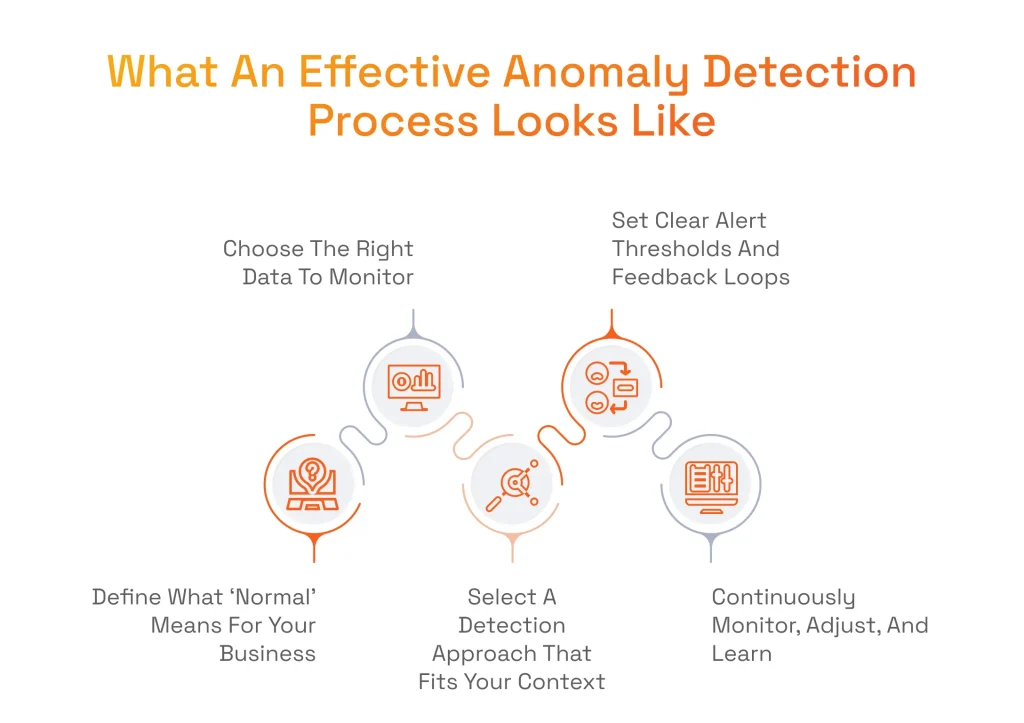
1. Define What ‘Normal’ Means for Your Business
It makes sense to start with defining a baseline, using labeled data or synthetic dataset to define what constitutes normal instances, improving the ability to perform anomaly detection on real-time incoming data. What does typical behavior look like for your users, transactions, systems, or machines? Set a reference point for detecting deviations. For instance, website traffic for your organization may dip on weekends, which is considered normal. However, a sudden drop on Monday likely indicates some problems. What constitutes normal behavior can vary significantly over time, so continuous learning and adaptation by your anomaly detection model is necessary.
2. Choose the Right Data to Monitor
Focus on data streams that have the most significant impact, particularly those tied to core organizational metrics such as revenue, system uptime, or customer experience. Ensure data collected from multiple sources is clean and structured, as high-quality data instances are critical for both unsupervised learning and supervised anomaly detection techniques.
Clean and high-quality data is essential for unsupervised anomaly detection and semi-supervised anomaly detection, or any ML solution in general. It is impossible to effectively operate based on incomplete or noisy data, as it increases false positives and reduces the effectiveness of ML models. Scaling data is also important to ensure features have comparable weights, which improves the performance of your anomaly detection model. A well-designed data collection strategy ensures that relevant signals are captured consistently across systems and environments.
3. Select a Detection Approach That Fits Your Context
As discussed previously, for predictable environments like fixed KPIs and controlled manufacturing lines, statistical anomaly detection models and rule-based methods will work just fine. For example, Z-score Analysis measures how many standard deviations a data point is from the mean, helping to identify points that deviate significantly from normal behavior. For large-scale environments, unsupervised learning methods and neural networks help detect anomalies in dynamic nature of data, supporting pattern recognition and identifying deviations across multiple variables.
4. Set Clear Alert Thresholds and Feedback Loops
Alerts must trigger meaningful, predefined actions. Oversight of dedicated development teams is crucial, especially in the early stages, to validate anomalies and fine-tune detection logic. Feedback loops help refine the system, so it learns from false positives and missed issues over time.
5. Continuously Monitor, Adjust, and Learn
Anomaly detection fraud detection, or any other use case, requires much more than a one-time setup. It is essential to constantly monitor data for drift and seasonal changes to be able to retrain models, adjusting to new behaviors. An effective anomaly detection process should evolve alongside your business and improve with each iteration.
Signs You Are Ready for Anomany Detection Algorithms Implementation
When monitoring systems struggle to keep up with data growth, organizations often realize their existing anomaly detection work relies too heavily on manual analysis and outdated tools. It may be time to rethink your monitoring approach. Effective data analysis and outlier detection are crucial for extracting actionable information from large datasets, helping organizations identify unusual patterns and make informed decisions. It is common for organizations to reach a point where traditional tools can no longer keep up, leading to missed threats, wasted effort, and growing operational risk.
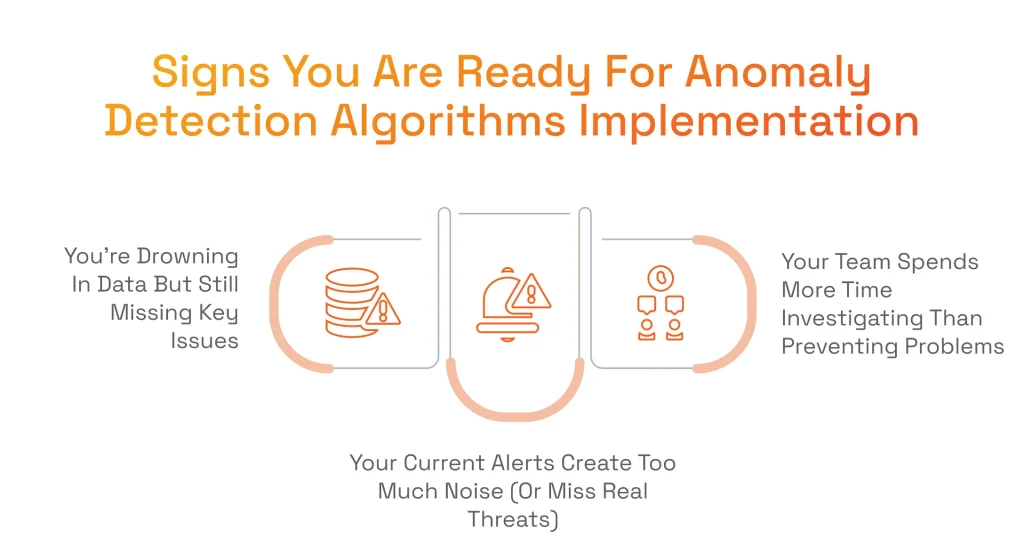
Another key sign is alert fatigue, when your existing systems flag too many false positives or fail to detect issues until it’s too late. As data volumes continue to grow, slow response times will eventually lead to critical blind spots.
When alerts become a noise, your technical team will spend more time reacting than proactively solving problems. Suppose your experts spend hours investigating what went wrong instead of preventing it in the first place. In that case, that’s another red flag signaling the need for a modern anomaly detection in a machine learning solution. Lacking innovative, adaptive tools makes it nearly impossible to spot subtle patterns or emerging risks in time.
Laying the Foundation for Spotting Anomalies Effectively
Did you realize you have a data problem, and recognized your business in the previous section? Here are the most important preparatory steps for an effective anomaly detection solution implementation.
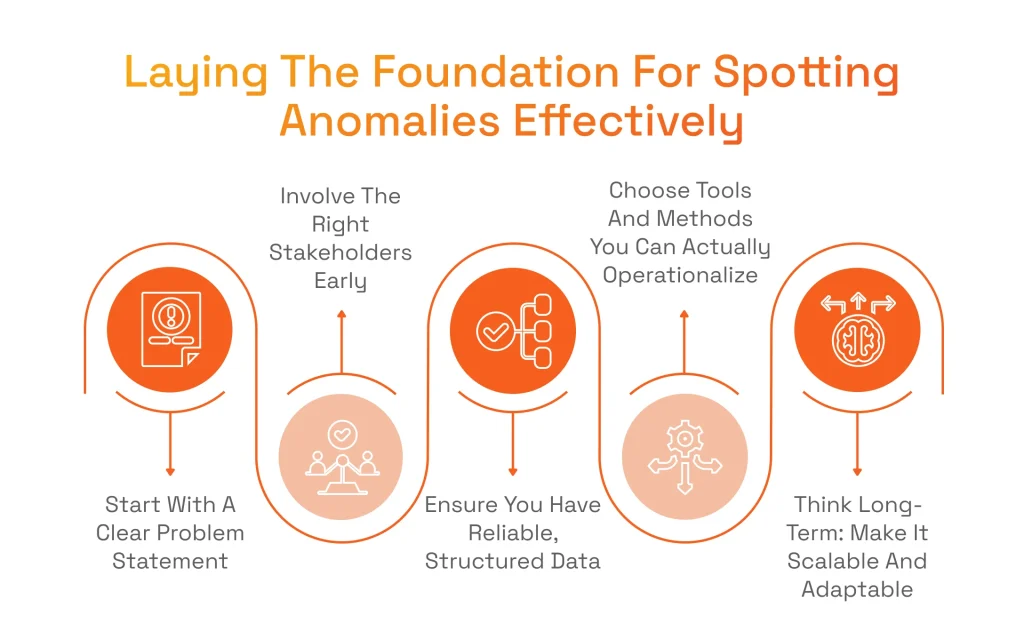
Start with a Clear Problem Statement
It all starts with clarity, not fancy algorithms. You already know some algorithms, or even popular tools, but take a step back and define what exactly you are trying to detect. Is it fraud? Latency spikes? Unexpected shifts in user behavior or failures in a data pipeline? A clear problem statement not only sharpens your early detection goals but also helps you measure success and choose the right approach, as some work better than others.
Involve the Right Stakeholders Early
Anomalies cross technical and operational boundaries, so your process should do it too. Combine domain experts from finance, operations, or product with your data analysts and engineers. This cross-functional collaboration reduces blind spots and ensures that what counts as “anomalous” is dealt with on the business level as well.
Ensure You Have Reliable, Structured Data
Data assessment is critical, as ML-powered anomaly detection is only as good as the data behind it. Make sure that your primary data sources are reliable and structured, as well as labeled. Investing in data hygiene early on saves time and improves accuracy down the line.
Choose Tools and Methods You Can Actually Operationalize
Start simple while selecting tools and methods, focusing on what your team can operationalize. Highly advanced and sophisticated tools are good, but they are useless when they are too complex for maintenance. Focus on the technology that delivers fast wins and easy adoption.
Think Long-Term: Make It Scalable and Adaptable
Finally, always have the future in mind. Your detection process should scale with your data and seamlessly adapt to changing patterns over time. This long-term mindset helps you avoid costly redesigns and ensures your system continues to add value as your business grows.
-
Clearly define the business problem and the types of anomalies you want to detect.
-
Involve business stakeholders, domain experts, data analysts, and engineering teams early in the process.
-
Assess and improve data quality to ensure reliable and structured inputs.
-
Select tools and technologies that your team can realistically maintain and operationalize.
-
Design for scalability so the system can adapt to growing data volumes and changing business conditions.
Serhii Leleko
AI & ML Engineer at SPD Technology
“The most important thing to remember is that effective anomaly detection solutions are not plug-and-play, but rather a capability you build for the long run. Find a professional team with proven experience that will be capable of laying the groundwork for your system to grow smarter and more accurate over time.”
Key Takeaways
- Anomaly detection in machine learning helps organizations identify patterns in high dimensional data, detect anomalies based on normal data points, and flag anomalous samples before they escalate into costly business problems.
- Custom AI solutions leverage artificial neural networks, convolutional neural networks, and other unsupervised anomaly detection algorithms to identify patterns, detect anomalous samples, and assign anomaly scores, ensuring organizations can detect anomalies early and respond to potential security threats before they escalate.
- Businesses across finance, healthcare, retail, and manufacturing use advanced anomaly detection methods and machine learning algorithms to improve security, operational reliability, and data-driven decision making.
- An effective anomaly detection strategy requires defining normal behavior, selecting high-quality data sources, choosing the right detection approach, and continuously refining models through feedback loops.
- Organizations typically adopt ML anomaly detection when traditional monitoring tools create alert fatigue, miss subtle issues, or struggle to keep up with growing data volumes and system complexity.
FAQ
What is the difference between rule-based anomaly detection and ML-based anomaly detection?
Rule-based systems rely on manually defined thresholds and business logic to identify anomalies. ML-based anomaly detection learns normal behavior from data and can adapt automatically to changing patterns, making it more effective in dynamic environments.
How much does building an ML anomaly detection system cost?
The cost typically ranges from $40,000 to $250,000+ depending on data complexity, infrastructure requirements, integration scope, and model sophistication. Enterprise-scale solutions with real-time monitoring and automated response capabilities generally require larger investments.
What are the most common causes of high false positive rates in anomaly detection systems?
Poor data quality, incomplete context, outdated detection rules, insufficient model training, and poorly calibrated alert thresholds are among the most common causes. Continuous monitoring and feedback loops help reduce false positives over time.
How much labeled data is required to train a supervised anomaly detection model?
Requirements vary by use case, but supervised models generally need hundreds to thousands of verified anomaly examples to perform reliably. Because anomalies are often rare, many organizations use unsupervised or semi-supervised approaches instead.
How long does it take to deploy a production-grade ML anomaly detection system?
Most implementations take between 3 and 8 months, including data preparation, model development, testing, integration, and monitoring setup. Timelines depend heavily on data readiness and deployment complexity.